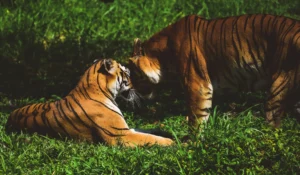
Discover the scientific truth behind tiger and leopard interactions in India. Learn how habitat overlap, prey competition, and human land use drive conflict.
When looking at big cat interactions in India, understanding the difference between natural predator behavior and human-wildlife friction is essential for making sense of conservation reports. The term “tiger vs leopard conflict” does not describe an ongoing warfare between two species; instead, it refers to a complex mix of ecological competition, shared territory, and the pressures caused by human encroachment.
For travelers, researchers, and communities living near forest edges, recognizing how these two apex predators share the landscape is the first step toward understanding modern Indian conservation. India serves as a unique global study ground because it supports significant populations of both tigers (Panthera tigris) and leopards (Panthera pardus) within highly fragmented, densely populated landscapes.
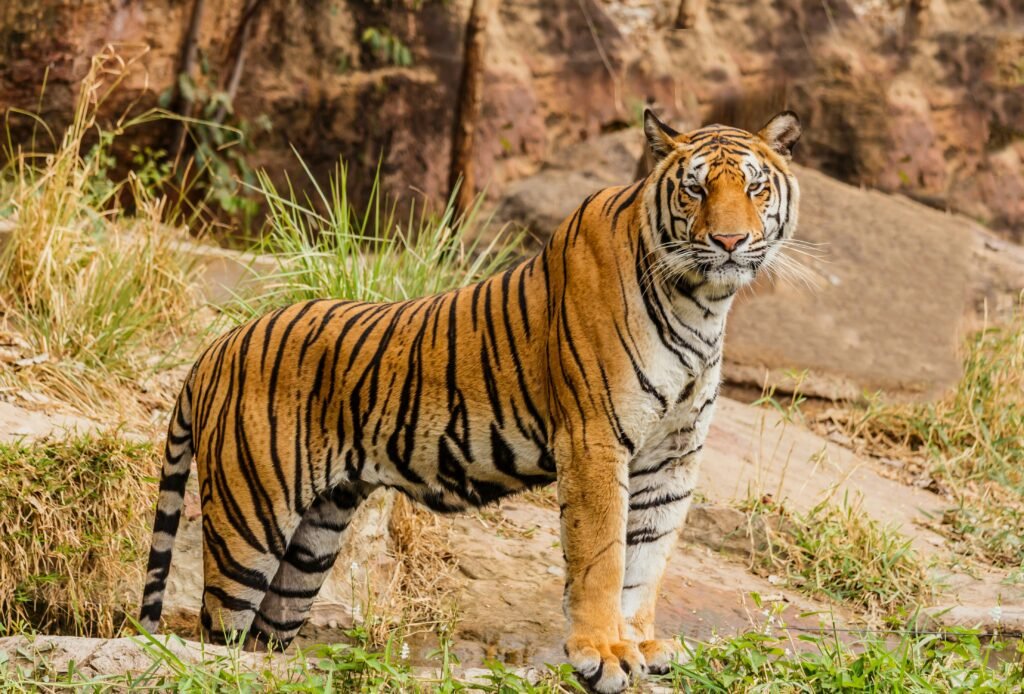
What Tiger vs Leopard Conflict Means in India
To understand big cat dynamics, you must first separate what happens deep within the forest from what happens on the edges of villages. Misunderstanding this distinction leads to poor travel planning, inaccurate reporting, and ineffective community awareness.
Direct Interspecies Encounters vs. Human-Wildlife Conflict
Direct interspecies conflict is a purely ecological event. It occurs when a tiger encounters a leopard within a shared habitat and asserts dominance, which can result in spatial displacement, resource competition, or direct mortality. Tigers are significantly larger and act as the absolute apex predators in these ecosystems; leopards function as co-predators that must continuously adapt to avoid direct confrontations.
Human-wildlife conflict, by contrast, occurs when either species moves beyond the core forest and interacts negatively with human communities. This type of conflict shows up as livestock predation, accidental encounters near agricultural fields, or entry into village settlements. While a tiger dominating a leopard inside a national park is a natural biological interaction, a leopard taking livestock from a village boundary is a socio-economic and land-use challenge.
| Conflict Layer | Primary Drivers | Typical Location | Common Outcome |
| Interspecies Competition | Prey overlap, territorial dominance, encounter rates. | Core protected areas, undisturbed forest tracts. | Spatial avoidance by leopards, occasional direct mortality. |
| Human-Wildlife Conflict | Habitat fragmentation, domestic livestock availability, human encroachment. | Forest edges, buffer zones, multi-use agricultural areas. | Economic loss for communities, retaliatory risks, big cat displacement. |
Why the Phrase is Often Misunderstood
The phrase “tiger vs leopard conflict” is frequently used by mainstream media to depict dramatic, gladiatorial battles between the two largest cats in India. This sensationalism creates the false impression that the two species cannot exist in the same landscape or that they are actively hunting each other down.
Field Note: Naturalists and researchers view this relationship through the lens of resource partitioning. Leopards survive alongside tigers not by fighting them, but by changing their daily schedules, utilizing different canopy layers, and targeting smaller prey sizes to minimize the risk of a direct encounter.
When conservation authorities like the National Tiger Conservation Authority (NTCA) discuss conflict, they are focused on localized management challenges near reserve boundaries where high predator densities meet human land use. The real issue is rarely about the two cats fighting each other; it is about how shrinking habitats force both species into closer proximity with human populations, changing their natural behaviors and driving up encounter risks for local villages.
Why These Big Cats Overlap
Tigers and leopards share millions of hectares of forested landscapes across India. While tigers are strictly protected within national parks and tiger reserves, leopards possess a biological flexibility that allows them to thrive both inside these heavily protected zones and in the multi-use forests that surround them.
Habitat Sharing and Prey Competition
In healthy ecosystems, tigers and leopards naturally co-exist by utilizing different resources and schedules. Tigers dominate the prime hunting grounds, relying on large prey bases. Leopards, acting as co-predators, shift their focus to smaller prey and adjust their activity patterns to minimize the risk of a direct encounter with a tiger. This ecological resource partitioning allows both species to survive in the same broader landscape.
Forest Edges and Fragmented Landscapes
Conflict dynamics change drastically at the forest boundary. The National Tiger Conservation Authority (NTCA) notes that human-wildlife conflict is often localized near the edges of tiger reserves and protected areas.
As tiger populations thrive in core zones, their high density can indirectly shift leopard movement outward. Habitat fragmentation forces both species to navigate broken landscapes and agricultural boundaries, increasing encounters with livestock and local communities.
Expert Tip: For safari-goers, understanding this displacement helps set realistic sighting expectations. In tiger-dense parks, leopards are rarely seen on the main central tourist tracks because they actively avoid tiger territories, preferring the rocky outcrops, dense canopies, or peripheral buffer zones.
Behavioral Adaptability: Why Leopards Persist Near Humans
Leopards are far more widely distributed across India than tigers. A significant portion of the leopard population lives outside protected areas, successfully navigating human-dominated landscapes. Their ability to hunt domestic livestock—combined with their stealthy habits and climbing ability—makes them highly adaptable. Tigers, conversely, require large, undisturbed core areas and substantial wild prey to survive, making them far less tolerant of human presence.
Table 2: Tiger vs. Leopard Coexistence Profile
| Trait | Tiger (Panthera tigris) | Leopard (Panthera pardus) |
| Status in Habitat | Apex predator. | Co-predator. |
| Landscape Preference | Core protected areas, undisturbed forests. | Multi-use forests, buffer zones, rocky terrains. |
| Human Tolerance | Low. Avoids highly developed areas. | High. Persists well in human-dominated areas. |
| Primary Conflict Driver | Forest-edge dispersal, shrinking corridors. | Livestock availability, settlement proximity. |
Where Overlap and Conflict Are Most Common
Big cat distribution in India is not uniform. Understanding regional variations helps conservationists design targeted mitigation strategies and helps visitors comprehend local ecological pressures.
Central India: The High-Density Strongholds
Central Indian states like Madhya Pradesh and Maharashtra form the heartland of big cat conservation. The 2022 leopard estimation report showed that Central India maintains stable or slightly rising leopard numbers. Because this landscape also supports some of India’s highest tiger densities, the overlap here is substantial. Conflict is frequently driven by seasonal movement and dispersal through the wildlife corridors that connect major reserves.
Shivalik Hills and Gangetic Plains: Landscapes Under Pressure
Unlike Central India, the Shivalik hills and Gangetic plains experienced a regional decline in leopard populations during the 2022 survey cycle. This landscape faces intense pressure from human encroachment and linear infrastructure. The loss of habitat connectivity heavily impacts both species, making the remaining forest patches highly competitive and increasing the friction between wildlife and expanding settlements.
Western Ghats and Southern Forest Mosaics
The complex forest mosaics of southern India present unique management challenges. In Tamil Nadu, a recent analysis identified specific conflict hotspots in the Nilgiris and Hasanur divisions. In these areas, livestock depredation is the most common form of conflict. The close proximity of tea estates, agricultural lands, and protected forests creates high-pressure zones where both tigers and leopards frequently cross paths with human activity and domestic animals.
What the Latest Population Data Shows
To understand the scale of big cat dynamics in India, it is essential to look at the official numbers. The most recent data provides a clear picture of conservation successes, but it also highlights why habitat pressure is an increasing concern for both policymakers and local communities.
Tiger Population Estimates and Status
According to the All India Tiger Estimation 2022 released by the Government of India, the country’s tiger population was estimated at 3,682, with a working range of 3,167 to 3,925 individuals. This represents a significant conservation achievement. However, as tiger populations stabilize or grow within the fixed boundaries of protected reserves, density increases. This success indirectly forces subordinate tigers and other predators outward into buffer zones and human-use landscapes to seek territory and prey, escalating the potential for edge conflict.
Leopard Population Estimates and Status
In February 2024, India released its fifth leopard population estimation report, covering the 2022 cycle. The estimated leopard population stands at 13,874, with a range of 12,616 to 15,132. The data indicates that leopard numbers are generally stable across the country, though regional shifts—such as slight increases in central India and declines in the Shivalik hills and Gangetic plains—demonstrate how localized habitat pressures impact survival.
Understanding the Limits of Wildlife Surveys
When reading wildlife statistics, context is critical. A common misconception is that the official leopard population figure represents every leopard in India.
Data Insight: The 2022 leopard estimate covers approximately 70% of actual leopard habitat. The survey was primarily conducted within sampled tiger-range areas. Critical leopard habitats like the high Himalayas and semi-arid non-tiger landscapes were not sampled in this report. Therefore, the actual number of leopards navigating India’s complex landscapes is higher than the surveyed baseline.
The Impact on Communities and Wildlife
When ecological overlap spills into human-dominated landscapes, it ceases to be a purely biological issue. Human-wildlife conflict is fundamentally a land-use and governance challenge that carries heavy consequences for both local communities and long-term conservation efforts.
Livestock Loss and Economic Strain
Livestock depredation is the most frequent and economically damaging form of conflict. As forests fragment and natural prey bases deplete, leopards and dispersing tigers frequently target cattle, goats, and sheep. For forest-edge communities, these losses represent severe economic shocks. Studies from conflict hotspots like the Nilgiris demonstrate that the availability of domestic livestock in buffer zones actively alters predator movement patterns, drawing them closer to settlements.
Human Injuries and Safety Risks
While direct attacks on humans are statistically rare compared to livestock losses, they remain a severe and emotionally charged reality. The risk of human injury varies drastically depending on the habitat context, local human behavior, and the specific circumstances of the encounter. Incidents often peak seasonally—such as during harvests when agricultural workers are in tall crops, or when local residents venture into degraded forest patches to collect fuelwood or non-timber forest products.
Retaliation and Conservation Risks
The most significant threat to big cat conservation arising from conflict is retaliatory action. When communities suffer repeated livestock losses or face threats to their safety without adequate compensation or rapid response, tolerance for wildlife collapses. This breakdown in coexistence often leads to retaliatory killing through poisoning carcasses or setting indiscriminate snares. Snaring is particularly devastating because it is non-selective; a snare set for a wild boar or a “problem” leopard will just as easily kill a tiger. Maintaining public tolerance is therefore just as crucial as protecting the forest habitat itself.
Responsible Tourism Tip: When traveling to tiger reserves, ensure your tourism footprint benefits local communities. Lodges that employ local guides and source food locally help build an economy where living alongside dangerous wildlife has tangible financial benefits, rather than just representing a risk to livestock and safety.
How India Manages Big Cat Conflicts
Managing the overlapping territories of tigers and leopards requires structured administrative action and field-level expertise. India’s approach focuses on minimizing human-wildlife friction while maintaining the ecological balance between these two major predators.
NTCA Standard Operating Procedures
The National Tiger Conservation Authority (NTCA) provides the primary operational guidelines for handling big cat conflict in India. The NTCA emphasizes that tiger and leopard conflict incidents are often highly localized to the edges of reserves and protected areas.
Rather than treating every big cat sighting as an emergency, the official standard operating procedures (SOPs) mandate a clear, step-by-step response. This includes setting up a localized perimeter, assessing the animal’s behavior, and determining whether it is transient, dispersing, or posing a direct threat to human safety before taking any active intervention measures.
Rescue, Monitoring, and Rapid Response
When an animal wanders deep into human settlements or agricultural fields, specialized Rapid Response Teams (RRTs) are deployed. Recent policy updates have directed significant attention toward upgrading rescue infrastructure and building dedicated conflict-management models. Because a large portion of the leopard population lives outside protected areas, encounter risks are naturally higher, making well-equipped rescue facilities a priority for forest departments.
Monitoring tools, such as camera trapping, play a vital role in these operations. Forest officials use camera traps to identify individual animals, track their movement patterns, and determine if a specific cat is repeatedly targeting livestock or if multiple individuals are using the same edge habitat.
Corridor Protection and Proactive Community Action
Long-term conflict reduction depends on preserving wildlife corridors that connect fragmented forests. When corridors are broken by linear infrastructure or settlements, dispersing animals are forced into human-dominated areas. Protecting these migratory pathways allows both tigers and leopards to move between protected areas without entering villages.
Alongside corridor protection, proactive community action is vital. Providing early-warning alerts to villagers and supporting the construction of secure livestock enclosures drastically reduces the chances of nighttime predation, keeping both livestock and big cats safe.
Table 3: Big Cat Mitigation Strategies and Conservation Outcomes
| Mitigation Measure | Direct Action | Intended Conservation Outcome |
| Secure Livestock Enclosures | Building predator-proof sheds for community livestock. | Reduces livestock depredation and prevents retaliatory killings. |
| Camera Trap Monitoring | Deploying cameras to identify individual animals. | Distinguishes problem animals from transient wildlife. |
| Corridor Protection | Restoring and securing forested paths between reserves. | Allows safe dispersal and reduces forest-edge encounters. |
| Rapid Response Teams | Deploying trained staff for rescue and crowd management. | Safely relocates distressed wildlife and manages public safety. |
Common Mistakes in Understanding Big Cat Conflicts
- Assuming “conflict” always means physical fighting: Many people mistake the term for direct battles between the two cats. In reality, much of the issue involves indirect resource competition or entirely separate human-wildlife incidents.
- Believing that more tigers automatically equals more conflict: While rising tiger densities can push co-predators outward, conflict remains highly localized and depends heavily on the quality of the landscape, prey availability, and human land-use patterns.
- Treating the official census as a complete count: The official leopard population figure is an estimate covering roughly 70% of their habitat. Believing it represents every leopard in India ignores the large populations living uncounted in the Himalayas and semi-arid regions.
- Viewing conflict as solely a wildlife problem: Approaching the issue without considering human encroachment, habitat fragmentation, and agricultural choices ignores the primary drivers of the problem.
FAQs about Tiger and Leopard Conflict
1. Do tigers and leopards live in the same forests in India?
Yes. Tigers and leopards share many of the same forest ecosystems across India, particularly within major national parks and tiger reserves in central and southern India.
2. Are tigers and leopards active competitors?
Yes. They are competitors because their prey preferences can overlap. Because tigers are the larger, absolute apex predators, leopards must adapt their behavior to avoid direct confrontations.
3. Do tigers kill leopards in the wild?
Yes. Direct encounters inside core forest areas can result in tigers killing leopards to eliminate resource competition or assert territorial dominance.
4. Do leopards actively avoid tigers?
Yes. Leopards practice spatial and temporal avoidance, meaning they shift their hunting hours, utilize tree canopies, and avoid core tiger territories to minimize contact.
5. Which big cat is more adaptable in human-dominated areas?
Leopards are significantly more adaptable. Their stealth, climbing abilities, and willingness to hunt smaller domestic prey allow them to survive in close proximity to human settlements where tigers rarely venture.
6. Why are leopards frequently found outside protected reserves?
Because tigers dominate the prey-rich core zones of protected reserves, leopards are often pushed to the edges or choose to occupy multi-use forests and buffer zones where they can find alternative prey.
7. Which Indian states report the highest levels of big cat conflict?
States with large forest networks and high predator densities, such as Madhya Pradesh, Maharashtra, and parts of Tamil Nadu, frequently report localized conflict incidents.
8. What does the NTCA recommend for managing tiger conflict?
The NTCA mandates strict adherence to its Standard Operating Procedures, which emphasize localized monitoring, identifying specific problem animals, and deploying rapid response teams rather than taking generalized action.
9. How does livestock loss relate to big cat conservation?
Livestock loss causes severe economic strain for forest-edge communities. If compensation is delayed, it can destroy local tolerance and lead to retaliatory measures like poisoning or snaring.
10. Can camera traps accurately identify individual leopards?
Yes. Just like a tiger’s stripes, a leopard’s rosette patterns are entirely unique to each individual, allowing researchers to track specific animals using camera trap data.
Conclusion
The dynamic between tigers and leopards in India is a striking example of ecological balance under pressure. Coexistence in these shared landscapes is entirely possible, provided that core habitats remain protected, wildlife corridors are preserved, and local communities receive immediate support when conflicts occur. By moving away from sensationalized narratives and relying on science-based management strategies, India can continue to safeguard both of its large cat species while ensuring the safety and livelihood of the people living alongside them.
Author Note & Update Log: Written by the WildlifeSafaris.in Editorial Team. Last Updated: August 2026.