
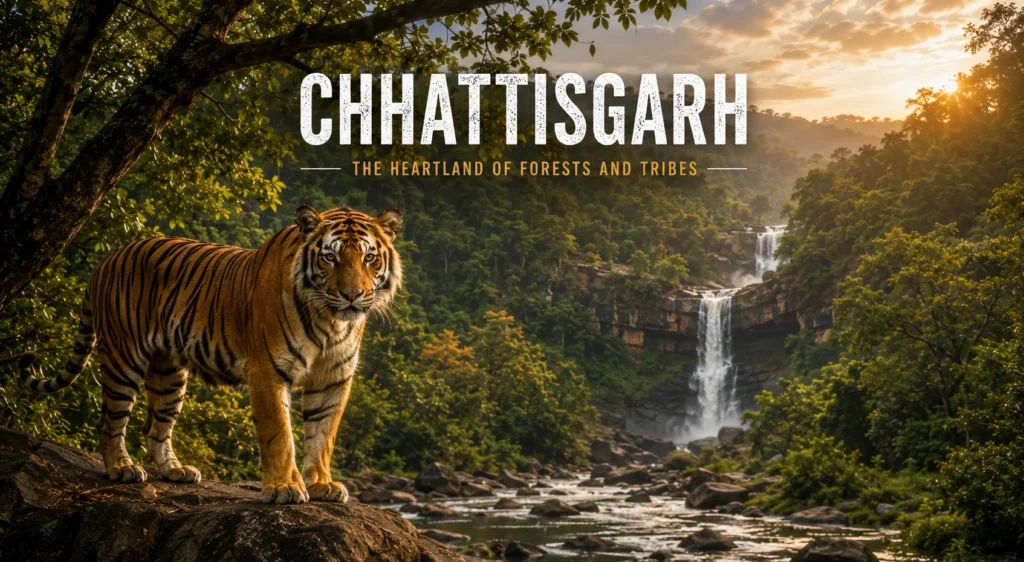
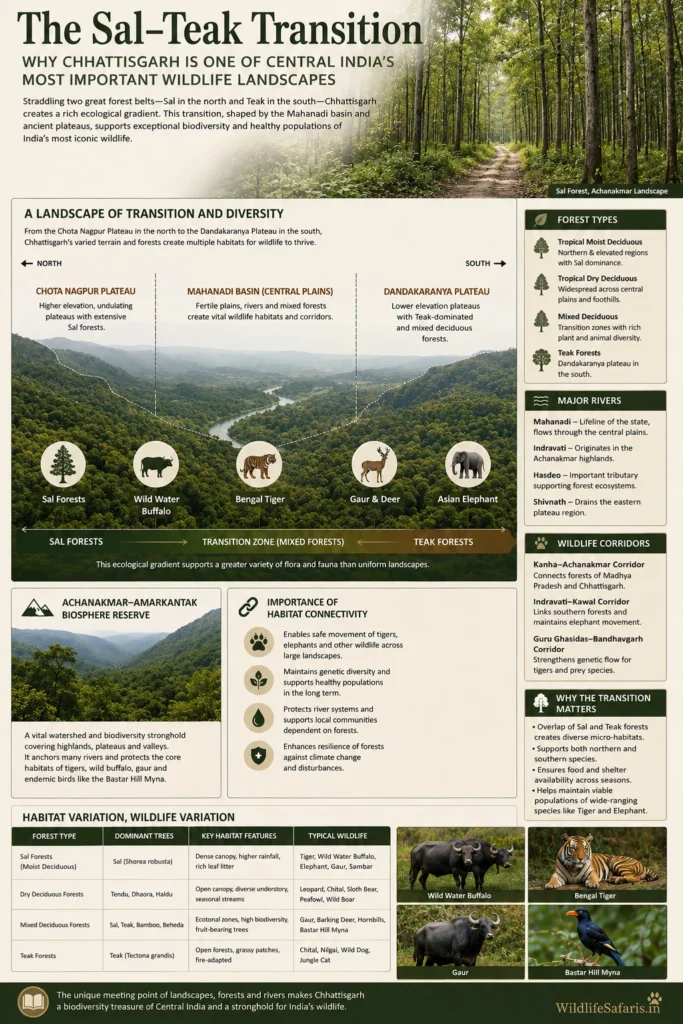
Chhattisgarh, situated in the heart of central India, is defined by its extensive forest cover and rich tribal heritage. The state’s topography is characterised by the fertile Mahanadi river basin in the central plains, bordered by the rugged Chota Nagpur Plateau in the north and the undulating Dandakaranya plateau in the south. Experiencing a tropical monsoon climate, Chhattisgarh sustains vast expanses of tropical moist and dry deciduous forests, which cover over forty-one per cent of its total geographic area. The state is uniquely positioned at the confluence of the sal (Shorea robusta) and teak (Tectona grandis) forest belts, creating diverse micro-habitats that support a robust and varied faunal assemblage.
The state’s wildlife profile is anchored by several flagship species, most notably the critically endangered wild water buffalo, the state animal, which finds its last remaining stronghold in central India within the Udanti Wildlife Sanctuary and Indravati National Park. The canopy of the dense southern forests reverberates with the calls of the Bastar hill myna, the state bird, renowned for its exceptional vocal mimicry. Chhattisgarh’s apex predators include the Bengal tiger and the Indian leopard, supported by healthy prey bases of gaur, sambar, and chital. The state’s protected area network is extensive, comprising three National Parks, three Tiger Reserves—including the newly consolidated Guru Ghasidas-Tamor Pingla Tiger Reserve—and multiple Wildlife Sanctuaries. The Achanakmar-Amarkantak Biosphere Reserve further highlights the region’s ecological importance, acting as a critical watershed and biodiversity repository.
Conservation in Chhattisgarh faces complex, region-specific challenges. Human-wildlife conflict, particularly involving elephant herds migrating from neighbouring states, requires intense management. Furthermore, wildlife monitoring in the southern Indravati landscape has been historically impeded by left-wing extremism, although recent conservation efforts are steadily reclaiming these vital habitats. Despite these challenges, Chhattisgarh offers exceptional, off-the-beaten-path wildlife tourism experiences, from exploring subterranean limestone caves in Kanger Valley to tracking tigers in the dense sal forests of Achanakmar, making it a critical frontier for central Indian conservation.
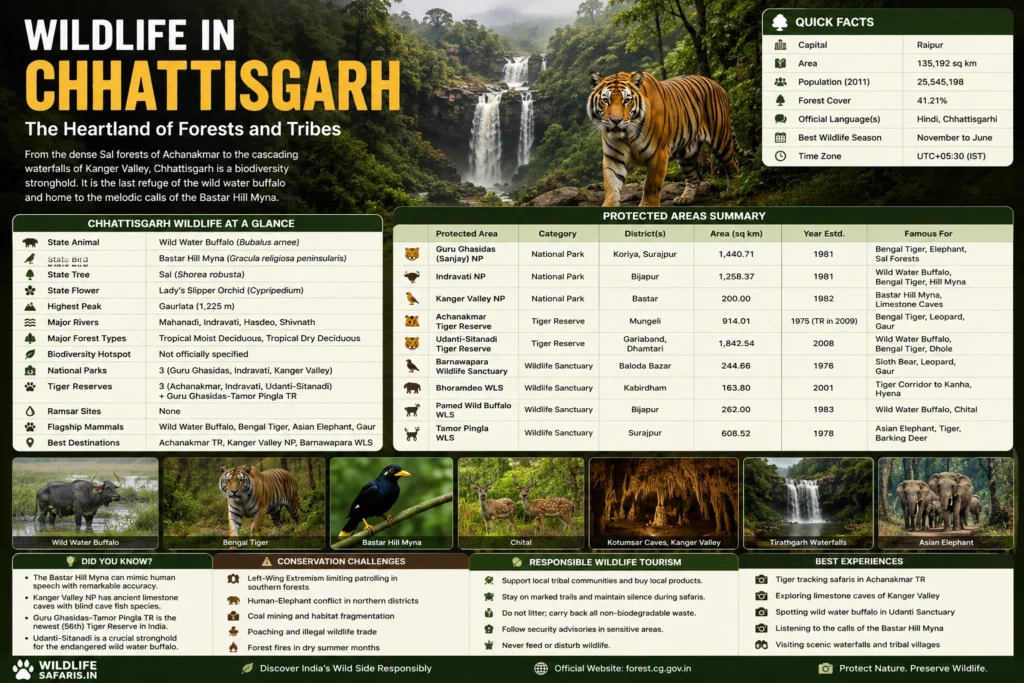
Quick Facts Table
| Category | Details |
| State / Union Territory | Chhattisgarh |
| Capital | Raipur |
| Area | 135,192 sq km |
| Population | 25,545,198 (2011 Census) |
| Forest Cover | 41.21% |
| Official Language(s) | Hindi, Chhattisgarhi |
| Time Zone | UTC+05:30 (IST) |
| Best Wildlife Season | November to June |
State Wildlife Master Table
| Attribute | Details |
| State / Union Territory | Chhattisgarh |
| Capital | Raipur |
| Geographic Region | Central India (Deccan Peninsula) |
| Total Area | 135,192 sq km |
| Forest Cover | 41.21% |
| State Animal | Wild Water Buffalo (Bubalus arnee) |
| State Bird | Bastar Hill Myna (Gracula religiosa peninsularis) |
| State Tree | Sal (Shorea robusta) |
| State Flower | Lady’s Slipper Orchid (Cypripedium) |
| Highest Peak | Gaurlata (1,225 m) |
| Major Rivers | Mahanadi, Indravati, Hasdeo, Shivnath |
| Major Forest Types | Tropical Moist Deciduous, Tropical Dry Deciduous |
| Biodiversity Hotspot | Not officially specified |
| UNESCO Natural Sites | None |
| Biosphere Reserves | Achanakmar-Amarkantak Biosphere Reserve |
| Tiger Reserves | Achanakmar, Indravati, Udanti-Sitanadi, Guru Ghasidas-Tamor Pingla |
| Elephant Reserves | Lemru, Badalkhol-Tamor Pingla |
| National Parks | Guru Ghasidas (Sanjay), Indravati, Kanger Valley |
| Wildlife Sanctuaries | 11 Sanctuaries (including Barnawapara, Bhoramdeo, Gomarda, Pamed, Semarsot) |
| Conservation Reserves | Not officially specified |
| Community Reserves | Not officially specified |
| Ramsar Sites | None |
| Important Bird Areas (IBAs) | Achanakmar, Barnawapara, Indravati, Kanger Valley |
| Major Wildlife Corridors | Kanha-Achanakmar, Indravati-Kawal, Guru Ghasidas-Bandhavgarh |
| Flagship Mammals | Wild Water Buffalo, Bengal Tiger, Asian Elephant, Gaur, Indian Leopard |
| Flagship Birds | Bastar Hill Myna, Malabar Pied Hornbill, Indian Pitta |
| Endemic Wildlife | Bastar Hill Myna (sub-species) |
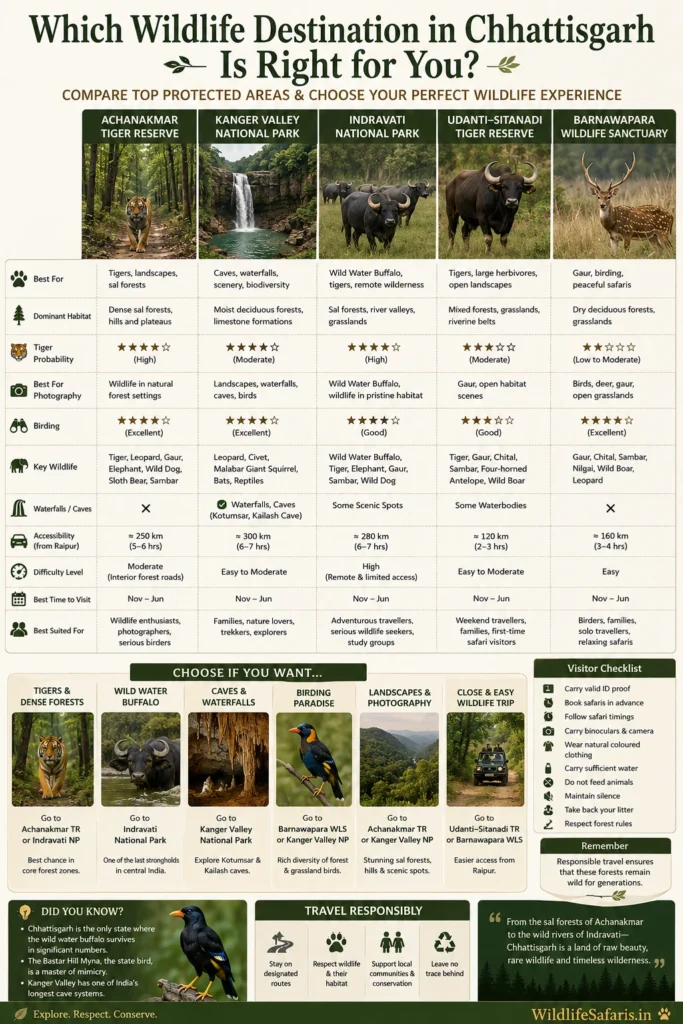
| Best Wildlife Destinations | Achanakmar TR, Kanger Valley NP, Barnawapara WLS |
| Best Time for Wildlife Tourism | November to June |
| Nearest International Airports | Swami Vivekananda Airport (Raipur – Domestic; nearest International is Nagpur) |
| Official Forest Department Website | forest.cg.gov.in |
Protected Areas Summary Table
| Protected Area | Category | District | Area (sq km) | Year Established | Famous For |
| Guru Ghasidas National Park | National Park | Koriya, Surajpur | 1,440.71 | 1981 | Bengal Tiger, Asian Elephant, Sal Forests |
| Indravati National Park | National Park | Bijapur | 1,258.37 | 1981 | Wild Water Buffalo, Bengal Tiger, Hill Myna |
| Kanger Valley National Park | National Park | Bastar | 200.00 | 1982 | Bastar Hill Myna, Limestone Caves, Flying Squirrel |
| Achanakmar Tiger Reserve | Tiger Reserve | Mungeli | 914.01 | 1975 (TR in 2009) | Bengal Tiger, Indian Leopard, Gaur |
| Udanti-Sitanadi Tiger Reserve | Tiger Reserve | Gariaband, Dhamtari | 1,842.54 | 2008 | Wild Water Buffalo, Bengal Tiger, Dhole |
| Barnawapara Wildlife Sanctuary | Wildlife Sanctuary | Baloda Bazar | 244.66 | 1976 | Sloth Bear, Indian Leopard, Gaur |
| Bhoramdeo Wildlife Sanctuary | Wildlife Sanctuary | Kabirdham | 163.80 | 2001 | Bengal Tiger Corridor to Kanha, Hyena |
| Pamed Wild Buffalo Wildlife Sanctuary | Wildlife Sanctuary | Bijapur | 262.00 | 1983 | Wild Water Buffalo, Chital |
| Tamor Pingla Wildlife Sanctuary | Wildlife Sanctuary | Surajpur | 608.52 | 1978 | Asian Elephant, Bengal Tiger, Barking Deer |
Wildlife Highlights
- Top Mammals: Wild Water Buffalo, Bengal Tiger, Indian Leopard, Gaur (Indian Bison), Asian Elephant, Sloth Bear, Dhole (Indian Wild Dog), Indian Giant Squirrel.
- Top Birds: Bastar Hill Myna, Malabar Pied Hornbill, Racket-tailed Drongo, Crested Serpent Eagle, Indian Pitta, Painted Spurfowl.
- Reptiles & Amphibians: Indian Rock Python, Mugger Crocodile, King Cobra, Common Krait, Monitor Lizard.
- Endemic Species: Bastar Hill Myna (regional sub-species endemic to the Dandakaranya plateau).
- Flagship Flora: Sal (Shorea robusta), Teak (Tectona grandis), Mahua (Madhuca longifolia), Tendu (Diospyros melanoxylon), Bamboo.
- Best Wildlife Experiences: Tiger tracking in Achanakmar, exploring the subterranean Kotumsar caves in Kanger Valley, spotting herds of Gaur in Barnawapara, and viewing the majestic Tirathgarh waterfalls amidst dense primary forests.
Conservation Challenges
- Left-Wing Extremism: The presence of armed insurgent groups in the southern Bastar and Bijapur regions has historically restricted forest department patrols, hindering conservation efforts and wildlife monitoring in Indravati Tiger Reserve.
- Coal Mining: Extensive open-cast coal mining, particularly in the biodiverse Hasdeo Arand forest tract, causes severe habitat fragmentation, disrupting ancient elephant migratory corridors.
- Human-Elephant Conflict: Increasing numbers of elephants migrating into northern Chhattisgarh (from Jharkhand and Odisha) are coming into conflict with local agrarian communities, leading to crop damage and retaliatory killings.
- Endangered State Animal: The pure-bred population of the Wild Water Buffalo is critically low in the state, facing threats from habitat degradation and genetic dilution through cross-breeding with domestic cattle.
- Poaching: Localised bushmeat hunting by tribal communities and targeted poaching of tigers and leopards for illicit wildlife trade networks.
- Forest Fires: Uncontrolled summer fires, sometimes deliberately set for the collection of Mahua flowers and Tendu leaves, damage undergrowth and destroy ground-nesting bird habitats.
Responsible Wildlife Tourism
- Support Local Tribal Economy: Engage with eco-tourism initiatives run by indigenous communities (such as the Baiga and Gond tribes), purchasing local handicrafts and non-timber forest products like wild honey.
- Respect Cave Ecosystems: When visiting the limestone caves of Kanger Valley, refrain from using flash photography, touching stalactite formations, or making loud noises, to protect the fragile subterranean fauna.
- Stay on Marked Tracks: Adhere strictly to the designated safari routes, especially in sensitive reserves like Udanti-Sitanadi and Achanakmar, to prevent soil compaction and vegetation damage.
- Adhere to Security Advisories: In the southern districts of Bastar and Bijapur, strictly follow the guidance and travel advisories issued by the state authorities and forest department.
- No Fire Incidents: Never discard cigarette butts or light campfires in or near forest peripheries, particularly during the dry summer months, to prevent devastating forest fires.
- Silence During Safaris: Maintain absolute silence on jeep safaris to increase the likelihood of sighting elusive predators and the acoustic-sensitive Bastar Hill Myna.
Did You Know?
- Kanger Valley National Park is home to a network of ancient subterranean limestone caves, such as Kotumsar and Dandak, which harbour highly adapted, blind, and albinistic cave fish species.
- Chhattisgarh recently established the Guru Ghasidas-Tamor Pingla Tiger Reserve, which became the 56th Tiger Reserve in India, connecting the tiger habitats of Madhya Pradesh and Jharkhand.
- The state bird, the Bastar Hill Myna, possesses an extraordinary vocal apparatus that allows it to mimic the human voice with startling accuracy, a trait that unfortunately made it a target for the illegal pet trade.
- The Hasdeo Arand forest, located in northern Chhattisgarh, is one of the largest contiguous tracts of unfragmented forest in central India and serves as a vital catchment for the Hasdeo river.
- Chhattisgarh’s state animal, the Wild Water Buffalo, is globally endangered; the Udanti-Sitanadi landscape holds one of the most critical genetically pure populations outside of Northeast India.
- Bhoramdeo Wildlife Sanctuary acts as a crucial wildlife corridor linking the tiger populations of Kanha Tiger Reserve in Madhya Pradesh with Achanakmar in Chhattisgarh.
Safari Planning : Topics Cluster
- How to book a wildlife safari in India?
- Park by Park Online Safari Booking Guide
- Tiger Safari India Planning Workbook
- Park by Park Safari Permits Guide
- National Parks Permit Guide – Park by Park Guide
- Tatkal Safari Booking Guide – Last Minute Safari Permits Booking
- Tiger Safari in India Cost
- Indian Wildlife Safari Budget Planner
- Jeep vs Canter Safari
- Best time for Tiger Sightings in India
- How far advanced should you book safari permits?
- Can foreigners book Indian Wildlife Safari online?
- Special Permits Guide for Foreigners and Domestic Visitors
- How to book a Safari Permit online in India? 2026 step by step guide
- Senior Citizens Friendly Safari Planning
- Multi Generation Family Safari Planning
- 50 things to know before your first safari in India