
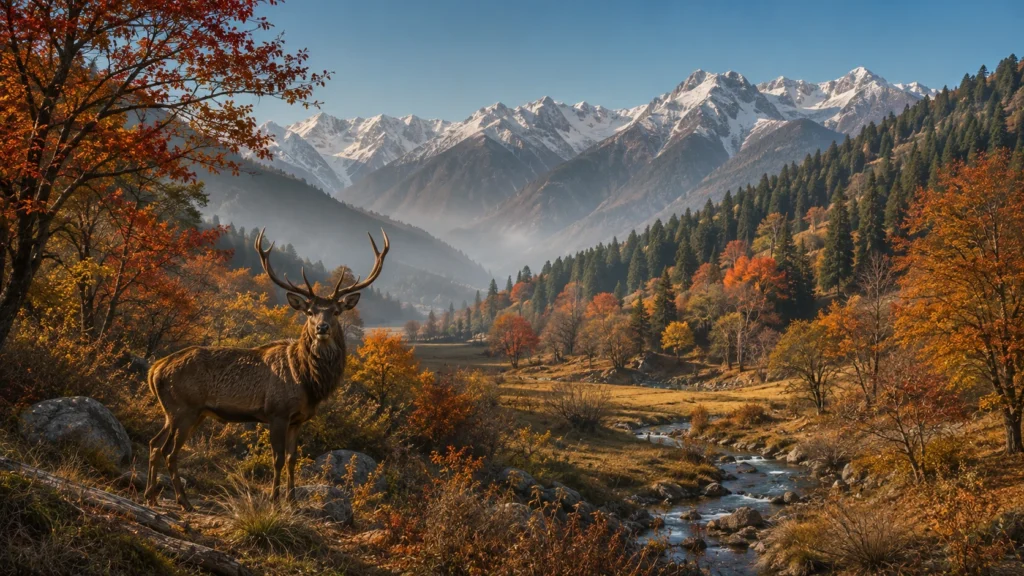
The Union Territory of Jammu and Kashmir, situated in the northernmost reaches of the Indian subcontinent, presents a dramatic ecological gradient shaped by the Pir Panjal range and the Greater Himalayas. The region’s physiography encompasses the fertile, bowl-shaped Kashmir Valley, surrounded by towering, snow-capped peaks and deep river gorges carved by the Jhelum, Chenab, and Ravi rivers. Experiencing a temperate to sub-mediterranean climate, the territory transitions from sub-tropical scrub in the Jammu region to expansive tracts of Himalayan moist temperate forests, dominated by deodar, fir, blue pine, and the iconic chinar. Higher elevations give way to sub-alpine birch forests and vast alpine meadows, locally known as margs, before culminating in perpetual snowlines. This diverse vegetative matrix covers nearly thirty-nine per cent of the territory’s administered geographic area, forming a critical ecological buffer in the western Himalayas.
Jammu and Kashmir is globally significant for harbouring the last viable population of the Kashmir stag, or hangul, a critically endangered subspecies of the red deer and the designated state animal. Dachigam National Park, located on the outskirts of Srinagar, serves as the primary stronghold for the hangul, alongside robust populations of the Himalayan black bear and the elusive Himalayan brown bear. Further west, near the Line of Control, Kazinag National Park protects one of the last remaining Indian habitats for the markhor, a magnificent wild goat. The region’s avifauna is equally distinguished, featuring the recently designated state bird, the Kalij pheasant, alongside high-altitude specialists such as the Himalayan monal and the western tragopan.
Beyond its terrestrial wealth, the Kashmir Valley contains a highly sensitive network of freshwater lakes and marshes. Ramsar-designated wetlands like Wular Lake, Hokera, and Shallbugh function as indispensable wintering grounds for hundreds of thousands of migratory waterfowl navigating the Central Asian Flyway. Conservation in the territory faces unique geopolitical and ecological challenges, including habitat fragmentation, heavy militarisation in border areas, and the impacts of climate change on snowfall patterns. Despite these complexities, Jammu and Kashmir offers profound opportunities for high-altitude wildlife tracking and ornithological research, remaining a fragile yet spectacular frontier of Himalayan biodiversity.
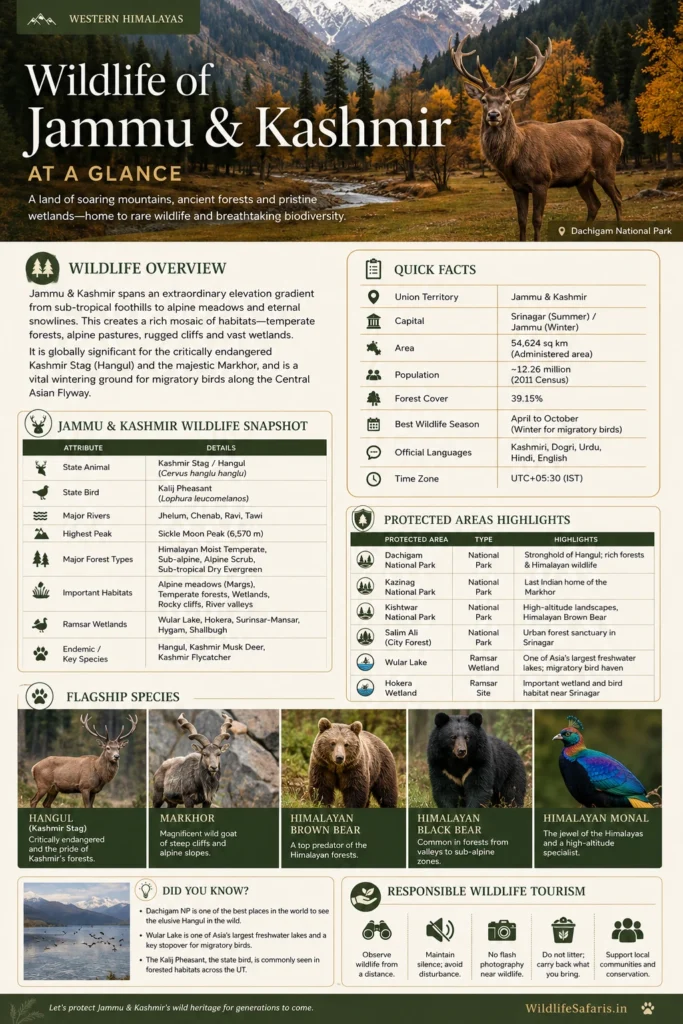
Quick Facts Table
| Category | Details |
| State / Union Territory | Jammu and Kashmir (Union Territory) |
| Capital | Srinagar (Summer) / Jammu (Winter) |
| Area | 54,624 sq km (Administered area per ISFR 2021) |
| Population | ~12.26 million (Estimated J&K UT portion, 2011 Census) |
| Forest Cover | 39.15% |
| Official Language(s) | Kashmiri, Dogri, Urdu, Hindi, English |
| Time Zone | UTC+05:30 (IST) |
| Best Wildlife Season | April to October (General) / Winter for migratory birds |
State Wildlife Master Table
| Attribute | Details |
| State / Union Territory | Jammu and Kashmir |
| Capital | Srinagar (Summer) / Jammu (Winter) |
| Geographic Region | Western Himalayas and Pir Panjal Range |
| Total Area | 54,624 sq km |
| Forest Cover | 39.15% |
| State Animal | Kashmir Stag / Hangul (Cervus hanglu hanglu) |
| State Bird | Kalij Pheasant (Lophura leucomelanos) |
| State Tree | Not officially specified post-bifurcation (Traditionally Chinar) |
| State Flower | Not officially specified post-bifurcation (Traditionally Lotus) |
| Highest Peak | Sickle Moon Peak (6,570 m) |
| Major Rivers | Jhelum, Chenab, Ravi, Tawi |
| Major Forest Types | Himalayan Moist Temperate, Sub-alpine, Alpine Scrub, Sub-tropical Dry Evergreen |
| Biodiversity Hotspot | Himalayas |
| UNESCO Natural Sites | None |
| Biosphere Reserves | None |
| Tiger Reserves | None |
| Elephant Reserves | None |
| National Parks | Dachigam, Kazinag, Kishtwar, Salim Ali (City Forest) |
| Wildlife Sanctuaries | 14 Sanctuaries (including Gulmarg, Hirpora, Overa-Aru, Ramnagar, Surinsar-Mansar) |
| Conservation Reserves | Gharana, Hokersar (also a Ramsar site), Shalbaugh |
| Community Reserves | Not officially specified |
| Ramsar Sites | Wular Lake, Hokera, Surinsar-Mansar, Hygam, Shallbugh |
| Important Bird Areas (IBAs) | Dachigam, Gulmarg, Haigam, Hokersar, Overa-Aru, Wular Lake |
| Major Wildlife Corridors | Dachigam-Overa-Aru Corridor, Pir Panjal Bear Corridors |
| Flagship Mammals | Hangul, Markhor, Himalayan Brown Bear, Asiatic Black Bear, Kashmir Musk Deer |
| Flagship Birds | Kalij Pheasant, Himalayan Monal, Western Tragopan, Greylag Goose |
| Endemic Wildlife | Kashmir Stag (Hangul), Kashmir Flycatcher |
| Best Wildlife Destinations | Dachigam NP, Kazinag NP, Hokera Wetland, Wular Lake |
| Best Time for Wildlife Tourism | April to October (Winter for birdwatching in wetlands) |
| Nearest International Airports | Sheikh ul-Alam International Airport (Srinagar) |
| Official Forest Department Website | jkforest.gov.in / jkwildlife.com |
Protected Areas Summary Table
| Protected Area | Category | District | Area (sq km) | Year Established | Famous For |
| Dachigam National Park | National Park | Srinagar | 141.00 | 1981 | Hangul, Asiatic Black Bear, Himalayan Brown Bear |
| Kazinag National Park | National Park | Baramulla | 160.00 | 1992 | Markhor, Musk Deer, Snow Leopard |
| Kishtwar National Park | National Park | Kishtwar | 400.00 | 1981 | Snow Leopard, Brown Bear, High-altitude Treks |
| Salim Ali (City Forest) National Park | National Park | Srinagar | 9.07 | 1986 | Hangul (historical), Avifauna, Urban Conservation |
| Gulmarg Wildlife Sanctuary | Wildlife Sanctuary | Baramulla | 180.00 | 1987 | Musk Deer, Brown Bear, Alpine Meadows |
| Hirpora Wildlife Sanctuary | Wildlife Sanctuary | Shopian | 341.25 | 1987 | Markhor, Pir Panjal Landscape, Musk Deer |
| Overa-Aru Wildlife Sanctuary | Wildlife Sanctuary | Anantnag | 511.00 | 1981 | Hangul, Western Tragopan, Glacial Streams |
| Ramnagar Wildlife Sanctuary | Wildlife Sanctuary | Jammu | 31.50 | 1981 | Barking Deer, Nilgai, Rhesus Macaque |
| Surinsar-Mansar Wildlife Sanctuary | Wildlife Sanctuary | Jammu, Udhampur | 97.82 | 1981 | Ramsar Wetland, Softshell Turtles, Avifauna |
Wildlife Highlights
- Top Mammals: Kashmir Stag (Hangul), Markhor (Pir Panjal wild goat), Himalayan Brown Bear, Asiatic Black Bear, Kashmir Musk Deer, Snow Leopard (in Kishtwar), Himalayan Marmot, Yellow-throated Marten.
- Top Birds: Kalij Pheasant, Himalayan Monal, Western Tragopan, Kashmir Flycatcher, Koklass Pheasant, Golden Eagle, Greylag Goose, Mallard, Northern Pintail.
- Reptiles & Amphibians: Himalayan Pit Viper, Kashmir Rock Agama, Indian Flapshell Turtle (in Jammu lakes).
- Flagship Flora: Chinar (Platanus orientalis), Deodar Cedar, Blue Pine (Pinus wallichiana), Himalayan Birch (Bhojpatra), Walnuts, Saffron (cultivated but ecologically linked).
- Best Wildlife Experiences: Tracking the Hangul in the lower Dachigam valley during autumn, observing massive flocks of migratory ducks at Hokera wetland in deep winter, and high-altitude trekking for Markhor in Kazinag or Hirpora.
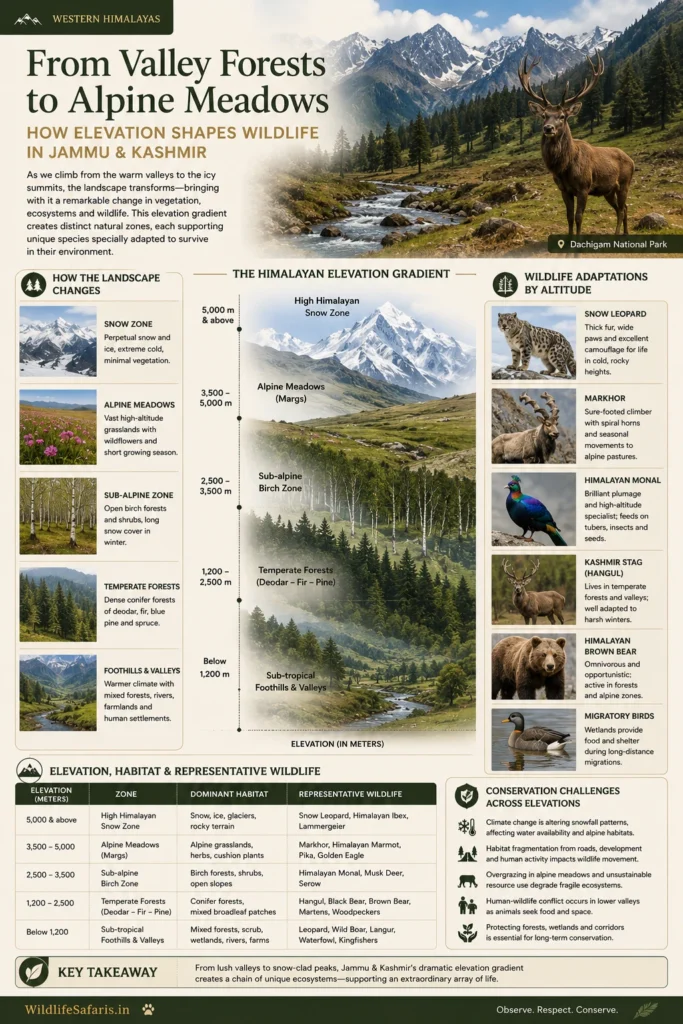
Conservation Challenges
- Geopolitical Conflict: The presence of extensive border fencing and heavy militarisation along the Line of Control (LoC) severely fragments ancient migratory corridors, particularly affecting the movement of the Markhor and Brown Bear.
- Critically Endangered Hangul: The Hangul population remains precariously small (hovering around 250-300 individuals). Habitat degradation, fragmentation of the Dachigam-Overa-Aru corridor, and predation of fawns by feral dogs pose existential threats to the subspecies.
- Human-Bear Conflict: Encroachment into forested foothills for horticulture (particularly apple and walnut orchards) has led to a severe escalation in human-wildlife conflict, resulting in frequent and often tragic encounters with Asiatic Black Bears.
- Wetland Degradation: The Kashmir Valley’s critical wetlands, including Wular and Hokera, suffer from heavy siltation, untreated sewage discharge, and illegal land reclamation, drastically reducing the wintering habitat for millions of migratory birds.
- Climate Change: Erratic snowfall and rapidly melting glaciers alter the hydrology of the alpine ecosystems, disrupting the seasonal migration patterns of herbivores and threatening the delicate alpine flora.
- Poaching and Smuggling: Although reduced, the illegal hunting of the Kashmir Musk Deer for its scent gland (musk pod) and poaching of bears for bile remain latent threats.
Responsible Wildlife Tourism
- Strict Security Compliance: Always carry valid identification and strictly adhere to the guidelines set by security forces and the forest department, as many wildlife habitats are in proximity to sensitive border areas.
- Protect the Hangul: When visiting Dachigam, stick strictly to the authorised trekking paths and gypsy routes. Keep absolute silence to avoid stressing the critically endangered deer, especially during the autumn rutting season.
- Respect the Wetlands: Do not dispose of any waste, particularly plastics, in or around Dal Lake, Wular Lake, or the Ramsar wetlands. Use non-motorised shikaras (traditional boats) for birdwatching to minimise noise and water pollution.
- Bear Safety: When trekking in regions like Gulmarg or Pahalgam, never travel alone at dawn or dusk, and properly dispose of all food waste to avoid attracting Asiatic Black Bears to campsites.
- No Floral Extraction: Refrain from plucking alpine flowers, medicinal herbs, or breaking branches of the iconic Chinar trees.
- Ethical Photography: Use telephoto lenses to photograph wildlife. Approaching animals like the Markhor or Brown Bear on foot is highly dangerous and stresses the animals.
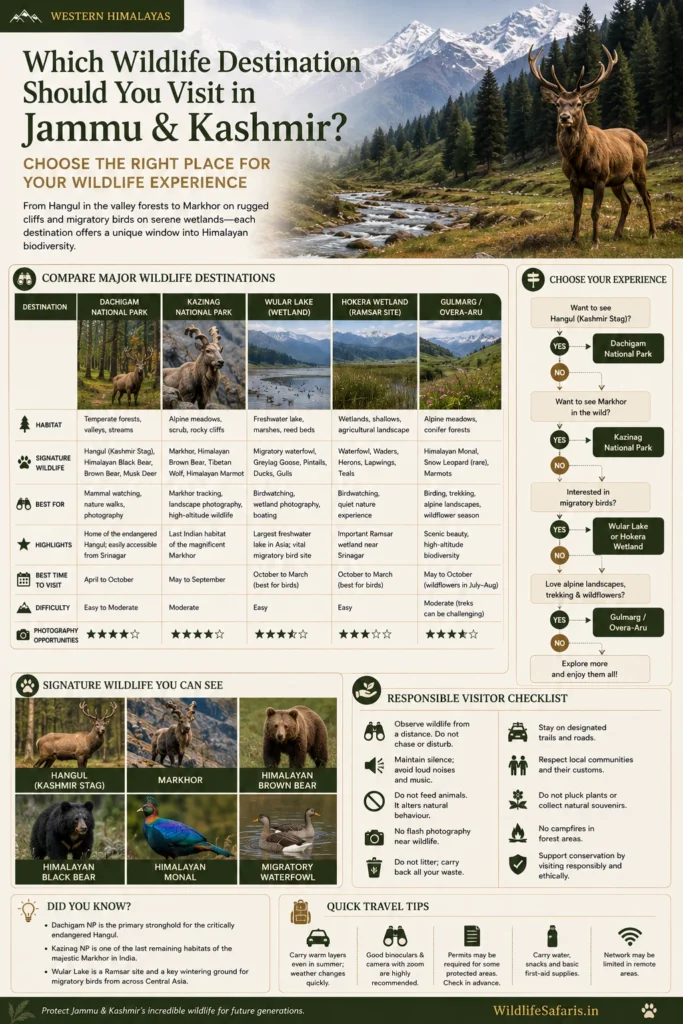
Did You Know?
- Dachigam literally translates to “Ten Villages,” reflecting the historical fact that ten villages were relocated in the early 20th century to create a protected catchment area for Srinagar’s water supply, which subsequently became the National Park.
- The Kashmir Stag (Hangul) is the only surviving subspecies of the Red Deer found in the Indian subcontinent.
- Following the bifurcation of the state in 2019, Jammu and Kashmir officially adopted the Kalij Pheasant as its new state bird in 2021, replacing the Black-necked Crane, which is now the state bird of Ladakh.
- Wular Lake, designated as a Wetland of International Importance under the Ramsar Convention, is one of the largest freshwater lakes in Asia and acts as a massive natural flood reservoir for the Jhelum River.
- Kazinag National Park was specifically established to conserve the Markhor, the world’s largest species of wild goat, which was severely threatened by conflict along the Line of Control.
- The Salim Ali National Park in Srinagar was named in honour of the renowned Indian ornithologist, Dr. Salim Ali, though it has faced significant urban pressures and was controversially converted into a golf course before conservation efforts were reignited.
Safari Planning : Topics Cluster
- How to book a wildlife safari in India?
- Park by Park Online Safari Booking Guide
- Tiger Safari India Planning Workbook
- Park by Park Safari Permits Guide
- National Parks Permit Guide – Park by Park Guide
- Tatkal Safari Booking Guide – Last Minute Safari Permits Booking
- Tiger Safari in India Cost
- Indian Wildlife Safari Budget Planner
- Jeep vs Canter Safari
- Best time for Tiger Sightings in India
- How far advanced should you book safari permits?
- Can foreigners book Indian Wildlife Safari online?
- Special Permits Guide for Foreigners and Domestic Visitors
- How to book a Safari Permit online in India? 2026 step by step guide
- Senior Citizens Friendly Safari Planning
- Multi Generation Family Safari Planning
- 50 things to know before your first safari in India
Himalayas : Topics Cluster
- Himalayan Wildlife Comprehensive Guide
- Wildlife in Ladakh
- Himalayan Pheasants
- Raptors of Himalayas
- Wildlife in Sikkim
- Wildlife in Arunachal Pradesh
- Wildlife in Uttarakhand
- Wildlife in Himachal Pradesh
- Wildlife in Jammu and Kashmir
- Himalayan Black Bear
- Snow Leopard
- Kibber Wildlife Sanctuary Guide
- Great Himalayan National Park
- Khangchendzonga National Park
- Eastern Himalayas