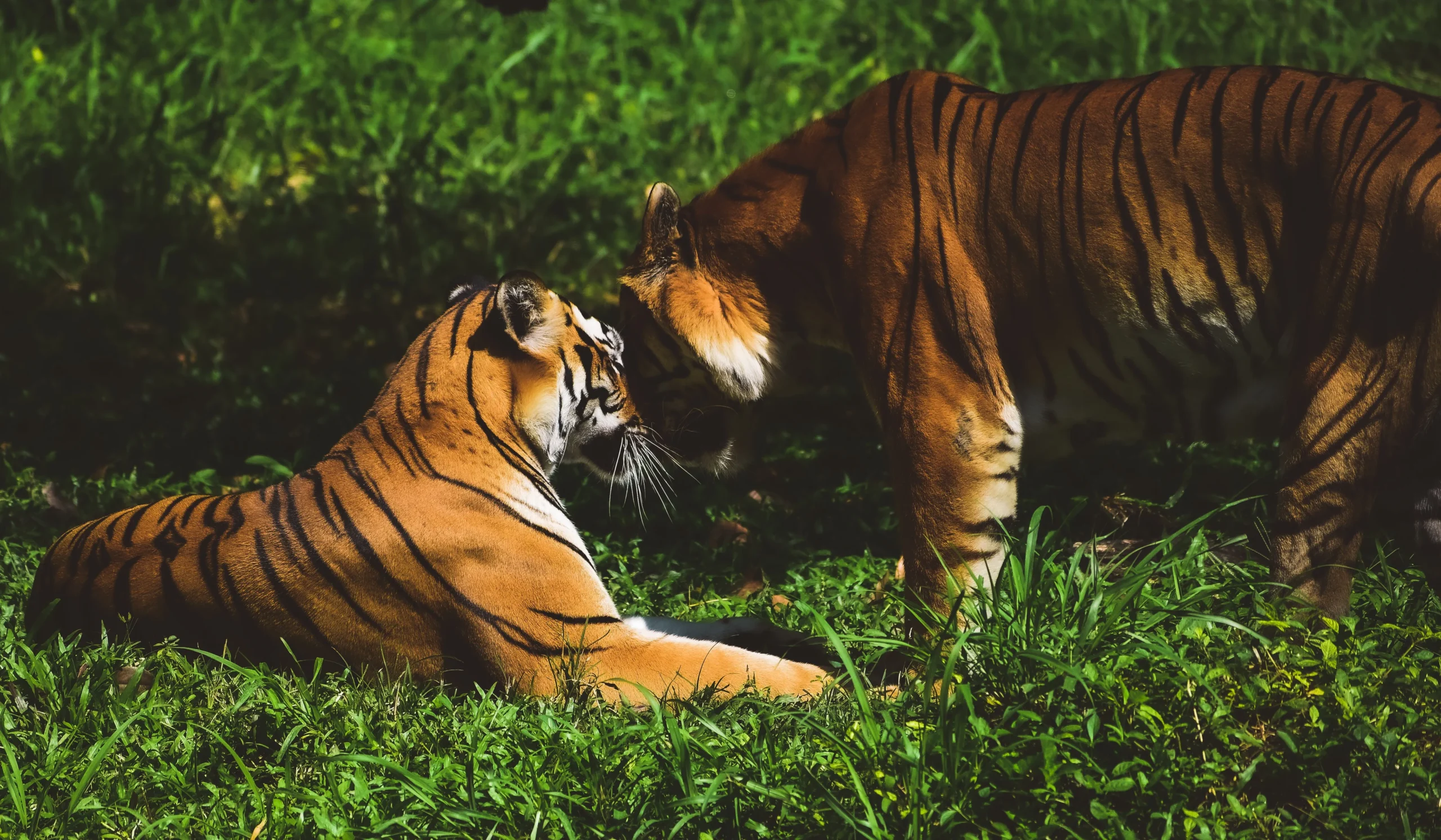
Discover how much a tiger eats per day and in one meal, what tigers hunt, how long they can survive without food, and how diet varies in the wild and captivity.
How Much Does a Tiger Eat?
A fully grown wild tiger typically eats about 10–25 pounds (4.5–11 kg) of prey per day on average, although it does not hunt or eat every day. After making a successful kill, a tiger can consume more than 80 pounds (36 kg) of meat in a single meal, then survive for several days before hunting again.
This difference between average daily intake and maximum meal size is the source of most confusion. Many articles mention the impressive 80-pound figure without explaining that it represents an occasional large feeding event rather than a tiger’s normal daily requirement.
Understanding this feeding pattern helps explain how tigers survive in the wild. Hunting large prey requires considerable energy and carries a risk of failure, so tigers have evolved to eat heavily when they succeed instead of making small daily kills.
How Much Does a Tiger Eat? (Direct Answer)
For most readers, the short answer is straightforward:
| Measure | Typical Amount |
| Average daily food intake | 10–25 lb (4.5–11 kg) |
| Maximum single meal | 80+ lb (36+ kg) |
| Hunting frequency | Irregular; not every day |
| Annual prey consumption | Around 50 deer-sized animals (estimate) |
These figures vary depending on:
- Tiger subspecies
- Body size
- Sex
- Hunting success
- Availability of prey
- Habitat conditions
Rather than following a fixed daily eating schedule, wild tigers live according to a feast-and-fast cycle, consuming large quantities after a successful hunt and then feeding from the carcass over the following days where possible.
Why Do Different Sources Give Different Numbers?
If you’ve searched this topic online, you’ve probably encountered figures ranging from 10 pounds to 80 pounds or more.
These numbers are not contradictory—they refer to different aspects of tiger feeding.
Average Daily Intake
Field studies commonly estimate that an adult wild tiger consumes the equivalent of 10–25 pounds of prey per day when averaged over time. This reflects the tiger’s long-term energy requirements rather than what it eats on any single day.
Maximum Meal Size
Following the successful capture of a large prey animal such as a deer or wild boar, a tiger may eat more than 80 pounds of meat in one sitting. Such meals are exceptional rather than routine and are possible because tigers often experience several unsuccessful hunting attempts before securing a large kill.
Why This Matters
Understanding the distinction between daily intake and meal size provides a more accurate picture of tiger ecology. It reflects how these solitary predators balance long periods without food against occasional opportunities to consume large quantities of meat, an adaptation that supports survival in landscapes where hunting success is never guaranteed.
What Do Tigers Eat?
Tigers are obligate carnivores, meaning they survive entirely on meat. In the wild, they primarily hunt medium- to large-sized mammals that provide enough energy to sustain their feast-and-fast lifestyle. Their exact diet varies with habitat, prey availability, and the region they inhabit. Rather than targeting a single species, tigers usually hunt whatever large prey is abundant within their territory.
Preferred Wild Prey
Across their range, tigers most commonly hunt:
- Deer (such as chital, sambar, and other regional species)
- Wild boar
- Wild buffalo and gaur where available
- Other medium- and large-sized mammals
In areas where natural prey becomes scarce, tigers may occasionally prey on livestock, increasing the likelihood of human–wildlife conflict. This is generally considered a response to limited prey availability rather than a preferred feeding strategy.
Common Tiger Prey by Habitat
| Habitat | Typical Prey |
| Tropical and deciduous forests | Deer, wild boar, gaur |
| Grasslands | Deer, wild boar, buffalo |
| Mangrove forests | Deer, wild pigs, other available mammals |
| Temperate forests | Deer, wild boar, large ungulates |
The specific prey species differ from one tiger landscape to another, but the hunting strategy remains largely the same: ambush a sizeable herbivore that can provide several days’ worth of food.
Why Large Prey Matters
A tiger invests considerable energy in stalking, approaching, and overpowering prey. Because hunts are physically demanding and not always successful, catching a large animal is more efficient than pursuing many smaller ones.
Large prey offers several advantages:
- Provides food for multiple feeding sessions.
- Reduces the need for frequent hunting.
- Helps conserve energy between hunts.
- Supports large territorial carnivores with high nutritional demands.
This explains why tigers often return to a carcass over successive days whenever it remains undisturbed.
How Much Does a Tiger Eat Per Day?
Although an adult tiger requires the equivalent of 10–25 pounds (4.5–11 kg) of prey per day on average, it rarely consumes that amount every single day. Instead, food intake fluctuates according to hunting success.
Feast-and-Fast Feeding Strategy
Unlike grazing animals that feed continuously, tigers follow an irregular pattern:
- Hunt a large prey animal.
- Eat a substantial portion immediately.
- Rest and digest.
- Return to feed again if the carcass remains available.
- Hunt again only when necessary.
This feeding rhythm allows tigers to survive despite periods without successful hunts.
How Long Can Tigers Go Without Food?
After consuming a large meal, a healthy tiger may go several days before needing to hunt again. This does not mean food is unnecessary during that period; rather, the previous meal provides enough energy until the next successful hunt.
The ability to alternate between heavy feeding and fasting is an important adaptation for a solitary predator living in environments where prey encounters are unpredictable.
Field Note: A tiger’s feeding schedule is determined by hunting success, not by the calendar. Days without eating are a normal part of life in the wild and should not be interpreted as evidence of starvation.
Why Does a Tiger’s Food Requirement Vary?
No single number applies to every tiger. Food requirements differ between individuals because several biological and environmental factors influence how much a tiger needs and how often it can feed.
Body Size
Larger tigers generally require more food than smaller individuals because maintaining a heavier body demands greater energy.
Sex
Adult males are usually larger than females and therefore tend to consume more food over time, although actual intake depends on hunting success and prey availability.
Hunting Success
A tiger that successfully catches a large prey animal may eat heavily, whereas another may experience several unsuccessful hunts before feeding again.
Prey Availability
Healthy prey populations allow tigers to hunt more efficiently. In landscapes where prey numbers decline, tigers may need to travel farther, expend more energy, or occasionally target livestock.
Habitat and Season
Dense forests, grasslands, mangroves, and temperate forests each support different prey communities. Seasonal changes can also influence prey movement and availability, indirectly affecting tiger feeding opportunities.
Expert Tip
When reading statistics about tiger diet, always check whether the figure refers to average daily intake, a single large meal, or annual prey consumption. These measurements describe different aspects of tiger feeding and should not be compared directly.
How Much Do Tigers Eat in Captivity?
Captive tigers also require a meat-based diet, but their feeding routine differs significantly from that of wild tigers. In zoos and wildlife rescue centres, meals are carefully planned by animal care teams to meet each tiger’s nutritional needs while accounting for lower activity levels and the absence of hunting.
Unlike wild tigers, captive individuals do not expend energy stalking prey, defending large territories, or making repeated hunting attempts. As a result, their food intake, feeding schedule, and diet composition are managed rather than determined by hunting success.
Zoo Feeding Practices
Although feeding programmes vary between institutions, most modern zoos aim to:
- Provide balanced nutrition through carefully selected meat.
- Adjust portions according to age, health, and body condition.
- Monitor weight regularly.
- Include vitamin and mineral supplements where required.
- Maintain animal welfare through enrichment activities.
Because every facility follows its own veterinary protocols, there is no single universal daily ration that applies to all captive tigers. For this reason, it is more accurate to compare feeding principles rather than quote one fixed amount.
Why Captive Diets Differ
Several factors distinguish captive feeding from wild feeding:
- No need to hunt for food.
- Lower daily energy expenditure.
- Regular feeding schedules.
- Veterinary supervision.
- Consistent food availability throughout the year.
These differences mean that a captive tiger’s diet should not be used to estimate how much a wild tiger naturally eats.
Tiger Diet at a Glance
Wild vs Captive Tigers
| Feature | Wild Tiger | Captive Tiger |
| Food source | Self-hunted prey | Meat provided by caretakers |
| Feeding schedule | Irregular | Planned and regular |
| Hunting required | Yes | No |
| Meal size | Highly variable | Portion-controlled |
| Activity level | High | Generally lower |
| Diet management | Depends on prey availability | Managed by veterinary and nutrition teams |
Meal Size vs Daily Intake
| Measurement | Typical Value |
| Average daily intake | 10–25 lb (4.5–11 kg) |
| Large single meal | 80+ lb (36+ kg) |
| Feeding pattern | Feast followed by fasting |
| Estimated annual prey | Around 50 deer-sized animals |
Pounds to Kilograms Conversion
| Pounds | Kilograms |
| 10 lb | 4.5 kg |
| 25 lb | 11.3 kg |
| 50 lb | 22.7 kg |
| 75 lb | 34 kg |
| 80 lb | 36.3 kg |
Factors That Influence Food Intake
| Factor | Effect on Food Consumption |
| Body size | Larger tigers generally require more food. |
| Sex | Adult males often consume more than females. |
| Hunting success | Successful hunts allow large meals followed by fasting. |
| Prey availability | Abundant prey reduces hunting effort and supports regular feeding. |
| Habitat | Different habitats provide different prey species. |
| Health and age | Growing cubs, breeding females, and unhealthy individuals may have different nutritional requirements. |
Common Myths About Tiger Diet
Myth 1: Tigers Eat 80 Pounds Every Day
Reality: The often-quoted figure of 80 pounds or more refers to an exceptionally large single meal after a successful hunt—not a tiger’s average daily intake. Over longer periods, field estimates suggest an average equivalent of 10–25 pounds per day.
Myth 2: Tigers Hunt Every Day
Reality: Tigers frequently go several days between successful hunts. They compensate by consuming large quantities of meat when prey is available, creating a natural feast-and-fast cycle.
Myth 3: All Tigers Eat the Same Amount
Reality: Food intake varies with body size, sex, prey availability, habitat, season, and hunting success. No single figure accurately represents every tiger across its entire range.
Myth 4: Tigers Eat Only Deer
Reality: Deer are important prey in many regions, but tigers also hunt wild boar, buffalo, gaur, and other medium- to large-sized mammals depending on local availability. Livestock may occasionally be taken where natural prey is scarce.
Responsible Tourism Tip
If you encounter a tiger feeding during a safari, maintain a respectful distance and follow your guide’s instructions. Feeding tigers are often focused on protecting their kill, and responsible viewing minimizes disturbance to both the animal and other wildlife.
Common Mistakes
Understanding how much a tiger eats becomes much easier when you avoid a few common misconceptions.
Mistake 1: Confusing Meal Size with Daily Food Intake
The most frequent error is assuming that because a tiger can eat more than 80 pounds (36 kg) in one sitting, it eats that amount every day.
In reality:
- 80+ pounds refers to an unusually large single meal.
- 10–25 pounds (4.5–11 kg) represents an average daily equivalent calculated over time.
These figures describe different aspects of tiger feeding and should not be used interchangeably.
Mistake 2: Assuming Tigers Hunt Every Day
Wild tigers do not follow a daily feeding schedule. Hunting is unpredictable, and many attempts may fail.
Instead, tigers:
- Make relatively infrequent successful kills.
- Consume large quantities after a successful hunt.
- Feed from the carcass over time when possible.
- Go several days before hunting again.
This feast-and-fast rhythm is a normal adaptation rather than a sign of food shortage.
Mistake 3: Comparing Zoo Tigers with Wild Tigers
Captive tigers receive planned diets under veterinary supervision, while wild tigers depend entirely on hunting success and natural prey availability.
Using zoo feeding schedules to estimate the diet of wild tigers can therefore be misleading.
Mistake 4: Believing All Tigers Eat the Same Amount
Food requirements vary according to:
- Body size
- Sex
- Age
- Habitat
- Prey density
- Health
- Hunting success
There is no single number that accurately represents every tiger across its range.
Frequently Asked Questions
How much does a tiger eat per day?
An adult wild tiger typically consumes the equivalent of 10–25 pounds (4.5–11 kg) of prey per day on average, although it does not eat every day.
How much can a tiger eat in one meal?
Following a successful hunt, a tiger may consume more than 80 pounds (36 kg) of meat in a single feeding session.
Do tigers eat every day?
No. Tigers often go several days between successful hunts and compensate by eating heavily after making a kill.
What animals do tigers usually hunt?
Their diet mainly consists of large mammals such as deer, wild boar, buffalo, and other regionally available prey species.
How long can a tiger survive without food?
After consuming a large meal, a healthy tiger may go several days before needing to hunt again. The exact duration depends on the size of the previous meal, environmental conditions, and the individual tiger.
Do Bengal tigers eat more than other tigers?
Food intake generally reflects body size, prey availability, and hunting success rather than subspecies alone. Larger individuals usually require more food, but there is no universal amount that applies to all Bengal tigers.
Do tigers eat the whole prey animal?
Tigers consume much of a carcass over one or more feeding sessions, although the exact parts eaten vary depending on prey size, carcass condition, disturbance, and competition from scavengers.
Why is prey availability important?
Healthy prey populations allow tigers to hunt efficiently. When wild prey declines, tigers may need to travel farther for food and, in some situations, may target livestock, increasing the risk of human–wildlife conflict.
Conclusion
A tiger’s feeding habits reflect the realities of life as a solitary apex predator. Rather than eating a fixed amount every day, wild tigers alternate between periods of heavy feeding and fasting, depending on when they successfully capture prey.
The most accurate summary is that an adult wild tiger averages 10–25 pounds (4.5–11 kg) of prey per day over time, yet it can consume more than 80 pounds (36 kg) in a single meal after a successful hunt. Recognizing the difference between these two figures is essential for understanding tiger biology and avoiding one of the most common misconceptions about their diet.
More broadly, a tiger’s ability to find sufficient food depends on healthy prey populations and well-protected habitats. Conserving these ecosystems not only supports tiger survival but also maintains the ecological balance of the forests, grasslands, and wetlands they inhabit.