
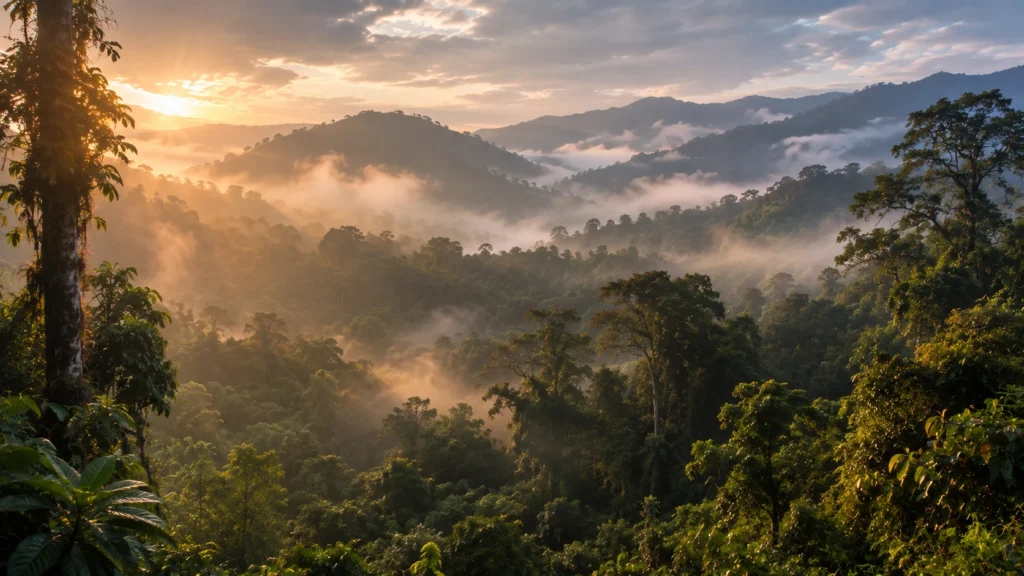
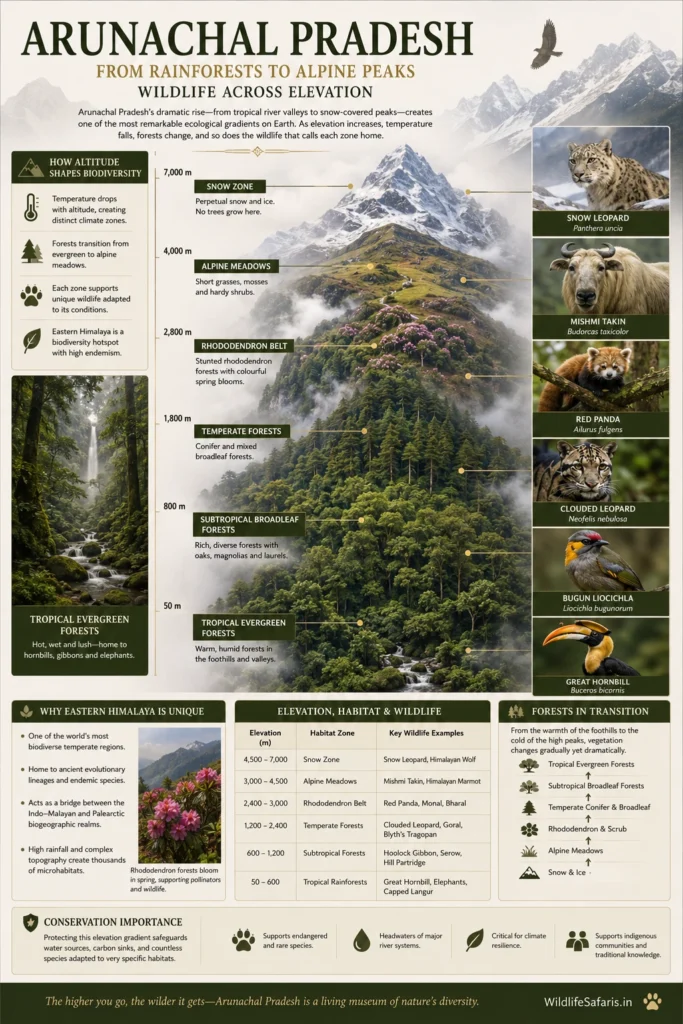
Arunachal Pradesh, located in the remote northeastern extremity of India, is an ecological marvel set within the Eastern Himalaya biodiversity hotspot. The state’s physiography is characterised by extreme altitudinal variations, ranging from riverine plains at fifty metres above sea level to perpetually snow-capped alpine peaks exceeding seven thousand metres. This dramatic topography, intersected by major river systems such as the Siang, Kameng, Lohit, and Subansiri, creates a complex mosaic of microclimates. Consequently, Arunachal Pradesh sustains a remarkable continuum of forest types, transitioning seamlessly from tropical evergreen and semi-evergreen forests in the foothills to subtropical broadleaved, temperate pine, and pristine alpine meadows in the higher elevations. This dense vegetative cover blankets nearly eighty per cent of the state, serving as a critical carbon sink and a sanctuary for ancient evolutionary lineages.
The terrestrial ecosystems of Arunachal Pradesh support a globally significant concentration of biodiversity and an exceptionally high degree of endemism. It is the only Indian state to harbour four major feline species within a single protected area—the Bengal tiger, Indian leopard, snow leopard, and clouded leopard—all documented within the expansive Namdapha National Park. The canopy reverberates with the calls of the endangered western hoolock gibbon, while the dense undergrowth conceals rare ungulates like the Mishmi takin and the red goral. The state’s avifauna is equally extraordinary, acting as a magnet for ornithologists seeking highly localised species such as the Bugun liocichla, Sclater’s monal, and the spectacular rufous-necked hornbill.
Conservation in this frontier state hinges on a vast network of Protected Areas, including two National Parks, several Wildlife Sanctuaries, and the sprawling Dihang-Dibang Biosphere Reserve. Despite its remote nature, wildlife tourism is steadily gaining prominence, driven by community-led conservation models such as the renowned hornbill protection initiatives in Pakke Tiger Reserve. Protecting these fragile Himalayan ecosystems from the pressures of infrastructural expansion and climate change remains a paramount priority for national conservation authorities.
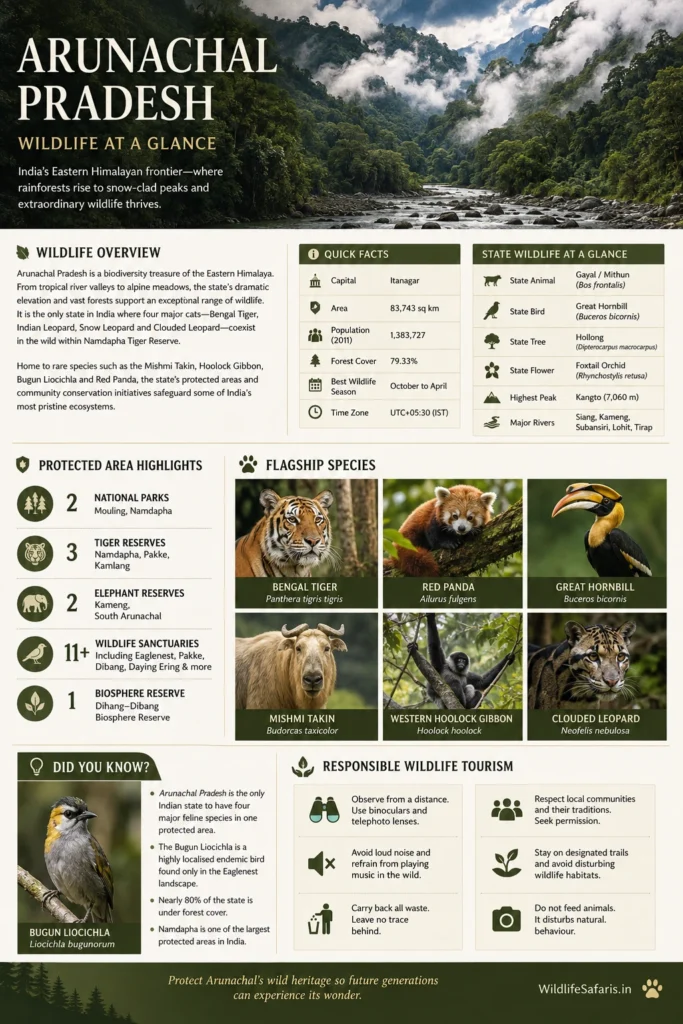
Quick Facts Table
| Category | Details |
| State / Union Territory | Arunachal Pradesh |
| Capital | Itanagar |
| Area | 83,743 sq km |
| Population | 1,383,727 (2011 Census) |
| Forest Cover | 79.33% |
| Official Language(s) | English |
| Time Zone | UTC+05:30 (IST) |
| Best Wildlife Season | October to April |
State Wildlife Master Table
| Attribute | Details |
| State / Union Territory | Arunachal Pradesh |
| Capital | Itanagar |
| Geographic Region | Eastern Himalayas |
| Total Area | 83,743 sq km |
| Forest Cover | 79.33% |
| State Animal | Gayal / Mithun (Bos frontalis) |
| State Bird | Great Hornbill (Buceros bicornis) |
| State Tree | Hollong (Dipterocarpus macrocarpus) |
| State Flower | Foxtail Orchid (Rhynchostylis retusa) |
| Highest Peak | Kangto (7,060 m) |
| Major Rivers | Siang, Kameng, Subansiri, Lohit, Tirap |
| Major Forest Types | Tropical Evergreen, Subtropical Broadleaved, Temperate, Alpine |
| Biodiversity Hotspot | Eastern Himalaya |
| UNESCO Natural Sites | None (Namdapha is on the tentative list) |
| Biosphere Reserves | Dihang-Dibang Biosphere Reserve |
| Tiger Reserves | Namdapha, Pakke, Kamlang |
| Elephant Reserves | Kameng, South Arunachal |
| National Parks | Mouling, Namdapha |
| Wildlife Sanctuaries | Daying Ering, Dibang, Eaglenest, Itanagar, Kamlang, Kane, Mehao, Pakke, Sessa Orchid, Talle Valley, Yardi-Rabe Supse |
| Conservation Reserves | Not officially specified |
| Community Reserves | Not officially specified |
| Ramsar Sites | None |
| Important Bird Areas (IBAs) | Eaglenest, Namdapha, Pakke, Dihang-Dibang, Talle Valley |
| Major Wildlife Corridors | Pakke-Nameri Corridor, Kaziranga-Karbi Anglong-Arunachal Corridors |
| Flagship Mammals | Snow Leopard, Bengal Tiger, Clouded Leopard, Red Panda, Hoolock Gibbon, Takin |
| Flagship Birds | Great Hornbill, Bugun Liocichla, White-bellied Heron, Blyth’s Tragopan |
| Endemic Wildlife | Bugun Liocichla, Mishmi Takin, Arunachal Macaque |
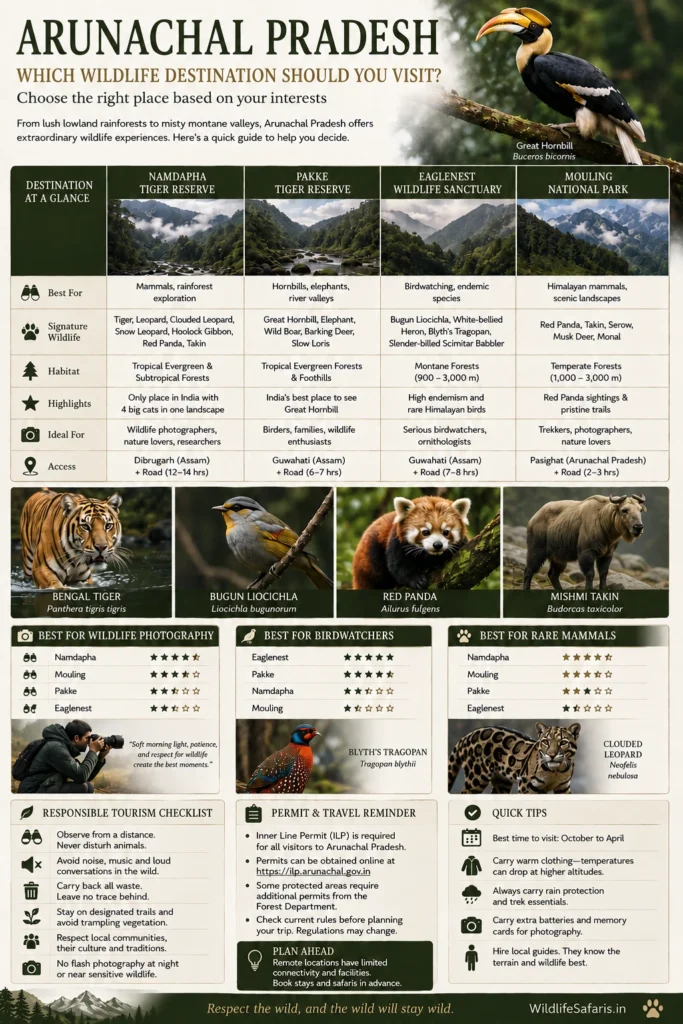
| Best Wildlife Destinations | Namdapha TR, Pakke TR, Eaglenest WLS |
| Best Time for Wildlife Tourism | October to April |
| Nearest International Airports | Lokpriya Gopinath Bordoloi International Airport (Guwahati, Assam) |
| Official Forest Department Website | arunachalforests.gov.in |
Protected Areas Summary Table
| Protected Area | Category | District | Area (sq km) | Year Established | Famous For |
| Mouling National Park | National Park | Upper Siang | 483.00 | 1986 | Red Panda, Takin, Serow, Subtropical Forests |
| Namdapha National Park | National Park | Changlang | 1,985.24 | 1983 | Four Big Cats, Hoolock Gibbon, Lowland Evergreen Forests |
| Kamlang Tiger Reserve | Tiger Reserve | Lohit | 783.00 | 1989 (TR in 2016) | Bengal Tiger, Clouded Leopard, Hoolock Gibbon |
| Pakke Tiger Reserve | Tiger Reserve | Pakke Kessang | 861.95 | 1977 (TR in 2002) | Great Hornbill, Bengal Tiger, Asian Elephant |
| Daying Ering Memorial Wildlife Sanctuary | Wildlife Sanctuary | East Siang | 190.00 | 1978 | Water Buffalo, Bengal Florican, Riverine Islands |
| Dibang Wildlife Sanctuary | Wildlife Sanctuary | Dibang Valley | 4,149.00 | 1991 | Mishmi Takin, Snow Leopard, Red Goral |
| Eaglenest Wildlife Sanctuary | Wildlife Sanctuary | West Kameng | 217.00 | 1989 | Bugun Liocichla, Ward’s Trogon, High-altitude Avifauna |
| Itanagar Wildlife Sanctuary | Wildlife Sanctuary | Papum Pare | 140.30 | 1978 | Asian Elephant, Sambar, Subtropical Ecology |
| Kane Wildlife Sanctuary | Wildlife Sanctuary | West Siang | 31.00 | 1991 | Rufous-necked Hornbill, Small Cats |
| Mehao Wildlife Sanctuary | Wildlife Sanctuary | Lower Dibang Valley | 281.50 | 1980 | Hoolock Gibbon, Tiger, Mishmi Takin |
| Sessa Orchid Wildlife Sanctuary | Wildlife Sanctuary | West Kameng | 100.00 | 1989 | Endemic Orchids, Red Panda |
| Talle Valley Wildlife Sanctuary | Wildlife Sanctuary | Lower Subansiri | 337.00 | 1995 | Clouded Leopard, Giant Squirrel, Pristine Subtropical Forests |
Wildlife Highlights
- Top Mammals: Snow Leopard, Bengal Tiger, Clouded Leopard, Common Leopard, Red Panda, Western Hoolock Gibbon, Mishmi Takin, Asian Elephant, Arunachal Macaque.
- Top Birds: Great Hornbill, Wreathed Hornbill, Rufous-necked Hornbill, Bugun Liocichla, White-bellied Heron, Blyth’s Tragopan, Sclater’s Monal.
- Reptiles & Amphibians: King Cobra, Reticulated Python, Monocled Cobra, Abor Hills Agama, Namdapha Flying Frog.
- Endemic Species: Bugun Liocichla (Bird), Arunachal Macaque (Mammal), Mishmi Takin (Mammal sub-species), Namdapha Flying Squirrel.
- Flagship Flora: Blue Vanda, Foxtail Orchid, Slipper Orchid, Rhododendrons (over 50 species in high altitudes), Hollong.
- Best Wildlife Experiences: Birdwatching in Eaglenest, Trekking and Camping in Namdapha, Hornbill spotting in Pakke, exploring the Sessa Orchid Sanctuary.
Conservation Challenges
- Deforestation and Shifting Cultivation: The traditional agricultural practice of slash-and-burn (Jhum cultivation) leads to significant habitat fragmentation and loss of primary forest cover.
- Infrastructure Development: The construction of extensive road networks and proposed large-scale hydroelectric projects in river valleys threaten vital aquatic and terrestrial ecosystems.
- Poaching: Illegal hunting for local consumption and the cross-border illicit trade in wildlife parts (such as tiger bones, pangolin scales, and bear bile) remain persistent threats.
- Human-Wildlife Conflict: Increasing instances of crop depredation by wild elephants in the foothills bordering Assam, leading to retaliatory measures.
- Climate Change: Rising average temperatures and altering precipitation patterns are shifting the tree line, threatening highly specialised alpine flora and fauna.
Responsible Wildlife Tourism
- Obtain Necessary Permits: Ensure all Inner Line Permits (ILP) for domestic tourists and Protected Area Permits (PAP) for foreign nationals are secured before entering the state.
- Respect Indigenous Communities: Acknowledge the deep spiritual connection indigenous tribes have with the forest; seek permission before photographing people or sacred groves.
- Support Community Ecotourism: Opt for homestays and community-managed eco-camps, such as those near Pakke and Eaglenest, to ensure tourism revenue directly supports local conservation.
- Strictly Avoid Off-Roading: Stick to designated trekking routes and safari tracks to prevent damaging fragile undergrowth and disturbing nesting ground birds.
- Zero Waste Policy: Carry all non-biodegradable waste, particularly plastics and batteries, back to urban centres for proper disposal.
- Minimise Noise: Maintain absolute silence while traversing dense forests to maximize the chances of observing canopy-dwelling species like gibbons and hornbills.
Did You Know?
- Namdapha National Park is globally unique for housing four species of large cats: the tiger, leopard, snow leopard, and clouded leopard.
- The Bugun Liocichla, a rare bird species discovered in 2006 in the Eaglenest Wildlife Sanctuary, was the first new bird species discovered in India in over half a century.
- Arunachal Pradesh is often referred to as the “Orchid State of India,” harbouring over 600 species of orchids, many of which are highly endangered and strictly endemic.
- The Pakke Tiger Reserve has received national accolades for its successful Hornbill Nest Adoption Programme, an initiative driven entirely by the local Nyishi community.
- The Mithun (Gayal), the state animal, is a semi-domesticated bovine that roams freely in the forests and holds immense socio-cultural and economic significance for indigenous tribes.
- The Dihang-Dibang Biosphere Reserve spans an incredible altitudinal range, starting from 500 metres and peaking at over 5,000 metres above sea level.
- The elusive Namdapha Flying Squirrel is known only from a single specimen collected in 1981 and is considered one of the most critically endangered mammals in the world.
Safari Planning : Topics Cluster
- How to book a wildlife safari in India?
- Park by Park Online Safari Booking Guide
- Tiger Safari India Planning Workbook
- Park by Park Safari Permits Guide
- National Parks Permit Guide – Park by Park Guide
- Tatkal Safari Booking Guide – Last Minute Safari Permits Booking
- Tiger Safari in India Cost
- Indian Wildlife Safari Budget Planner
- Jeep vs Canter Safari
- Best time for Tiger Sightings in India
- How far advanced should you book safari permits?
- Can foreigners book Indian Wildlife Safari online?
- Special Permits Guide for Foreigners and Domestic Visitors
- How to book a Safari Permit online in India? 2026 step by step guide
- Senior Citizens Friendly Safari Planning
- Multi Generation Family Safari Planning
- 50 things to know before your first safari in India