
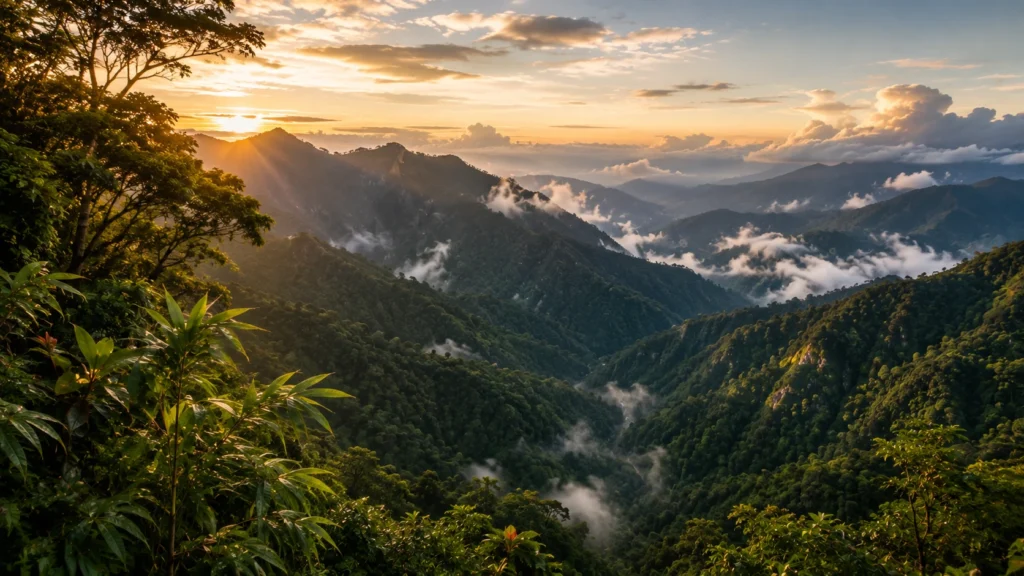
Mizoram, translating to the “Land of the Hill People,” is nestled in the southernmost extremity of northeast India, flanked by the international borders of Myanmar and Bangladesh. The state’s topography is characterised by a series of steep, parallel mountain ridges oriented north to south, intersected by deep river gorges such as those formed by the Tlawng and Kaladan rivers. Experiencing a mild sub-tropical climate, Mizoram boasts the highest percentage of forest cover of any Indian state, with an extraordinary eighty-four per cent of its geographical area blanketed in greenery. This dense vegetative cover is highly stratified, transitioning from tropical semi-evergreen and moist deciduous forests in the lower river valleys to sub-tropical broadleaved and pine forests at higher elevations.
Situated entirely within the Indo-Burma biodiversity hotspot, Mizoram functions as a crucial ecological bridge between the Indian subcontinent and Southeast Asia. The state’s wildlife is characterised by elusive canopy-dwellers and dense forest ungulates. The state animal, the Himalayan serow, navigates the precipitous slopes alongside the western hoolock gibbon, Malayan sun bear, and the binturong (bearcat). Dampa Tiger Reserve, the state’s largest protected area, is globally significant for harbouring one of the highest recorded densities of the clouded leopard in South Asia, thriving amidst the impenetrable bamboo brakes and primary forests.
The avifauna of Mizoram is exceptionally rich, headlined by the state bird, Mrs. Hume’s pheasant, alongside the great hornbill and Blyth’s tragopan. The region’s aquatic biodiversity is anchored by Palak Lake (Pala Wetland), a Ramsar-designated site in the south that provides a critical refuge for migratory waterfowl and unique Indo-Malayan amphibians. Conservation in the state faces formidable challenges, primarily stemming from the traditional practice of shifting cultivation (jhum) and the pressures of border infrastructure development. Nevertheless, Mizoram’s largely unexplored, deeply forested terrain offers an untamed frontier for scientific research and highly specialised wildlife exploration.
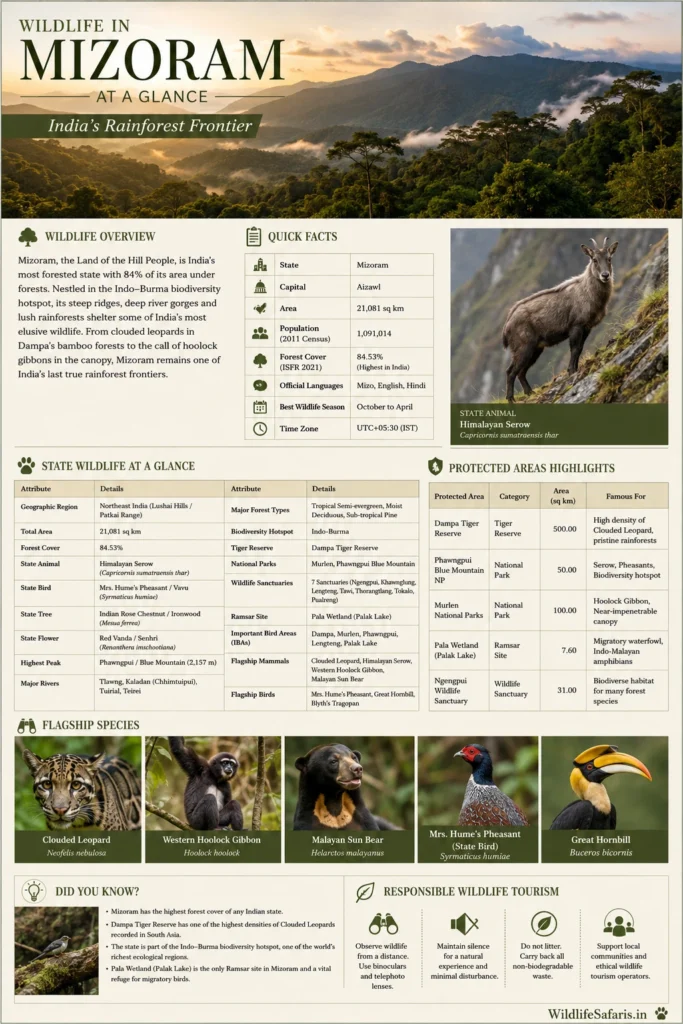
Quick Facts Table
| Category | Details |
| State / Union Territory | Mizoram |
| Capital | Aizawl |
| Area | 21,081 sq km |
| Population | 1,091,014 (2011 Census) |
| Forest Cover | 84.53% (Highest percentage in India per ISFR 2021) |
| Official Language(s) | Mizo, English, Hindi |
| Time Zone | UTC+05:30 (IST) |
| Best Wildlife Season | October to April |
State Wildlife Master Table
| Attribute | Details |
| State / Union Territory | Mizoram |
| Capital | Aizawl |
| Geographic Region | Northeast India (Lushai Hills / Patkai Range) |
| Total Area | 21,081 sq km |
| Forest Cover | 84.53% |
| State Animal | Himalayan Serow (Capricornis sumatraensis thar) |
| State Bird | Mrs. Hume’s Pheasant / Vavu (Syrmaticus humiae) |
| State Tree | Indian Rose Chestnut / Ironwood (Mesua ferrea) |
| State Flower | Red Vanda / Senhri (Renanthera imschootiana) |
| Highest Peak | Phawngpui / Blue Mountain (2,157 m) |
| Major Rivers | Tlawng, Kaladan (Chhimtuipui), Tuirial, Teirei |
| Major Forest Types | Tropical Semi-evergreen, Moist Deciduous, Sub-tropical Pine |
| Biodiversity Hotspot | Indo-Burma |
| UNESCO Natural Sites | None |
| Biosphere Reserves | None |
| Tiger Reserves | Dampa Tiger Reserve |
| Elephant Reserves | None |
| National Parks | Murlen, Phawngpui Blue Mountain |
| Wildlife Sanctuaries | 7 Sanctuaries (Ngengpui, Khawnglung, Lengteng, Tawi, Thorangtlang, Tokalo, Pualreng) |
| Conservation Reserves | Not officially specified |
| Community Reserves | Not officially specified |
| Ramsar Sites | Pala Wetland (Palak Lake) |
| Important Bird Areas (IBAs) | Dampa, Murlen, Phawngpui, Lengteng, Palak Lake |
| Major Wildlife Corridors | Indo-Myanmar Border Corridors, Dampa-Thorangtlang Corridor |
| Flagship Mammals | Clouded Leopard, Himalayan Serow, Western Hoolock Gibbon, Malayan Sun Bear |
| Flagship Birds | Mrs. Hume’s Pheasant, Great Hornbill, Blyth’s Tragopan |
| Endemic Wildlife | Not officially specified (Fauna generally shared with Indo-Burma region) |
| Best Wildlife Destinations | Dampa TR, Phawngpui NP, Murlen NP, Pala Wetland |
| Best Time for Wildlife Tourism | October to April |
| Nearest International Airports | Lengpui Airport (Aizawl – Domestic), Netaji Subhas Chandra Bose International Airport (Kolkata) |
| Official Forest Department Website | forest.mizoram.gov.in |
Protected Areas Summary Table
| Protected Area | Category | District | Area (sq km) | Year Established | Famous For |
| Murlen National Park | National Park | Champhai | 100.00 | 1991 | Hoolock Gibbon, Near-impenetrable canopy |
| Phawngpui Blue Mountain NP | National Park | Lawngtlai | 50.00 | 1992 | Mrs. Hume’s Pheasant, Serow, Clouded Leopard |
| Dampa Tiger Reserve | Tiger Reserve | Mamit | 500.00 | 1985 (WLS), 1994 (TR) | Highest Clouded Leopard density, Phayre’s Leaf Monkey |
| Khawnglung Wildlife Sanctuary | Wildlife Sanctuary | Lunglei | 35.00 | 2000 | Sambar, Barking Deer, Sub-tropical Forests |
| Lengteng Wildlife Sanctuary | Wildlife Sanctuary | Champhai | 60.00 | 1999 | Sub-montane Avifauna, Northern Pig-tailed Macaque |
| Ngengpui Wildlife Sanctuary | Wildlife Sanctuary | Lawngtlai | 110.00 | 1991 | Asian Elephant, Gaur, Virgin Rainforests |
| Pualreng Wildlife Sanctuary | Wildlife Sanctuary | Kolasib | 50.00 | 2004 | Hoolock Gibbon, Dense Bamboo Brakes |
| Tawi Wildlife Sanctuary | Wildlife Sanctuary | Serchhip | 35.75 | 1978 | First WLS in Mizoram, Rich Avifauna |
| Thorangtlang Wildlife Sanctuary | Wildlife Sanctuary | Lunglei | 50.00 | 2002 | Elephant Corridor (connecting to Bangladesh) |
| Tokalo Wildlife Sanctuary | Wildlife Sanctuary | Saiha | 250.00 | 2007 | Indo-Burmese cross-border wildlife |
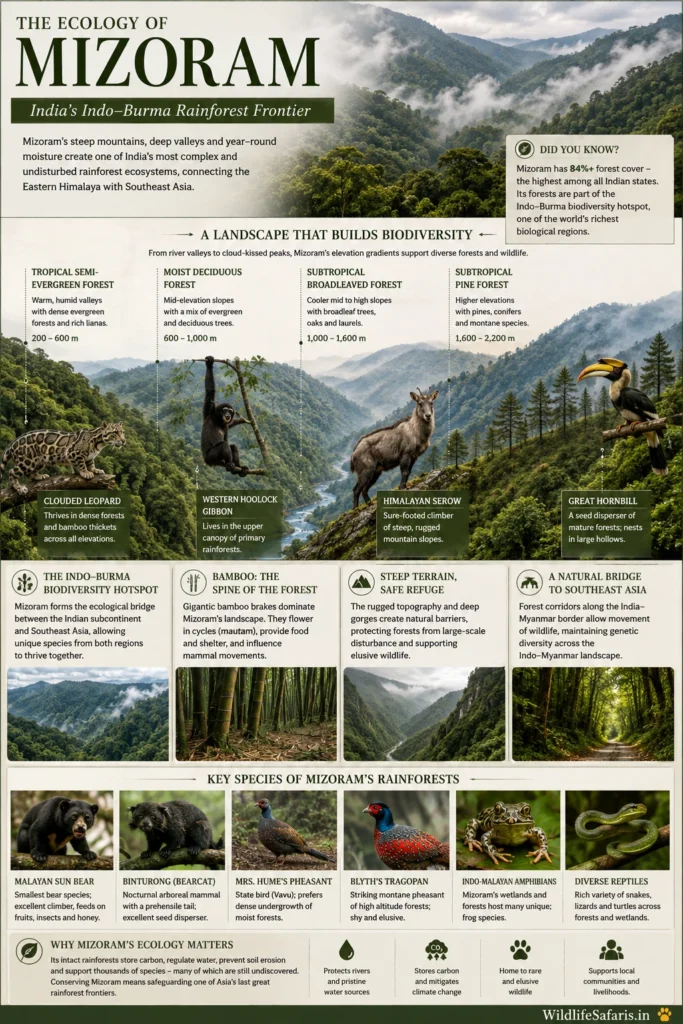
Wildlife Highlights
- Top Mammals: Clouded Leopard, Himalayan Serow, Western Hoolock Gibbon, Malayan Sun Bear, Phayre’s Leaf Monkey, Binturong, Asian Elephant, Northern Pig-tailed Macaque, Bengal Tiger (rare/transient).
- Top Birds: Mrs. Hume’s Pheasant, Blyth’s Tragopan, Great Hornbill, Wreathed Hornbill, Mountain Bamboo Partridge, Grey Sibia.
- Reptiles & Amphibians: Asian Leaf Turtle, Reticulated Python, King Cobra, Water Monitor Lizard.
- Flagship Flora: Indian Rose Chestnut (Ironwood), Red Vanda (rare endemic orchid), extensive Bamboo forests (Melocanna baccifera), Sub-tropical Pine.
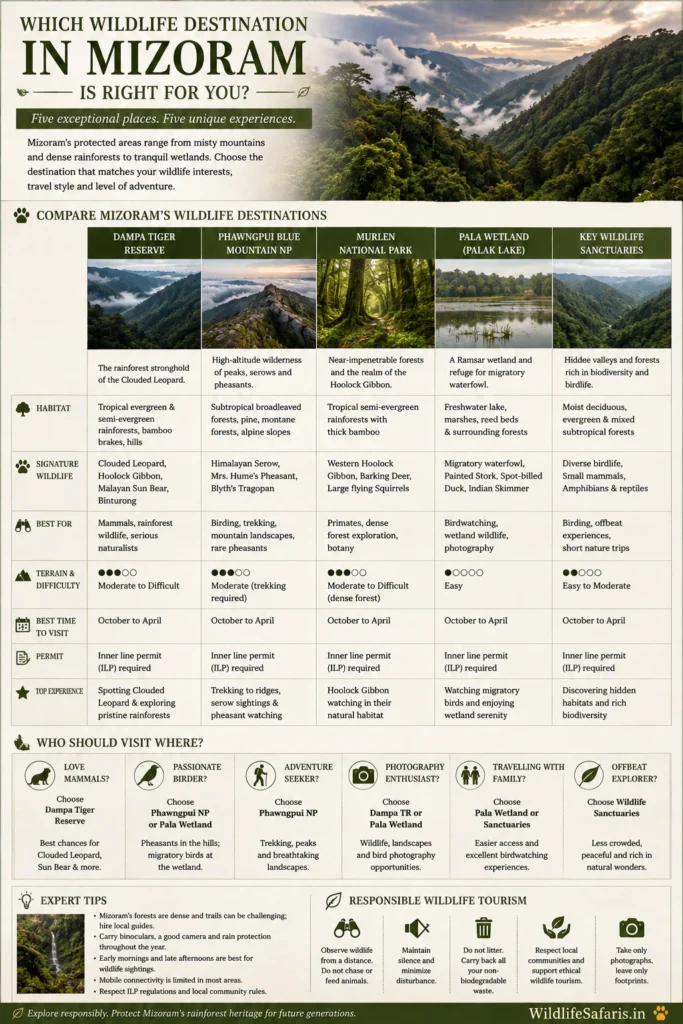
- Best Wildlife Experiences: High-altitude trekking in Phawngpui (Blue Mountain) National Park to spot rare pheasants, exploring the deep jungles of Dampa Tiger Reserve, and birdwatching around the Ramsar-designated Pala Wetland.
Conservation Challenges
- Shifting Cultivation (Jhum): The widespread traditional practice of slash-and-burn agriculture leads to severe forest fragmentation, soil erosion on steep slopes, and loss of contiguous canopy required by primates like the Hoolock Gibbon.
- Porous Borders: Proximity to the international borders of Myanmar and Bangladesh facilitates the illegal trans-boundary trafficking of wildlife products, including pangolin scales, timber, and rare orchids.
- Bamboo Flowering (Mautam): Mizoram experiences a cyclical ecological phenomenon every 48-50 years called Mautam, where bamboo forests flower synchronously and die off. This triggers a catastrophic explosion in the rat population, which subsequently destroys crops and disrupts the local forest ecology.
- Infrastructure Expansion: The construction of border roads and security infrastructure fragments critical habitats, particularly affecting the movement of elephants in the Ngengpui and Thorangtlang sanctuaries.
- Hunting: Subsistence hunting by remote tribal communities for bushmeat remains a persistent challenge, threatening populations of small carnivores, pheasants, and primates.
Responsible Wildlife Tourism
- Secure the Inner Line Permit (ILP): Domestic tourists must obtain an ILP before entering Mizoram, while foreign nationals must register with the state police upon arrival.
- Hire Local Mizo Guides: The terrain in Mizoram is exceptionally rugged and remote. Always hire experienced local guides when trekking in Phawngpui or Murlen to navigate safely and support the local economy.
- Respect Tribal Culture: The forests are deeply integrated into the cultural fabric of the Mizo people. Always seek permission before photographing local villages or entering community-managed forest patches.
- Zero Plastic at Ramsar Sites: Ensure no plastic waste is left behind when visiting Pala Wetland (Palak Lake) to protect the sensitive aquatic and migratory bird ecosystem.
- No Floral Extraction: Plucking orchids, particularly the endangered state flower (Red Vanda), or carrying away forest flora is strictly prohibited and highly damaging to the ecosystem.
- Prepare for Rugged Terrain: Wildlife sanctuaries in Mizoram lack the luxury safari infrastructure of central India. Expect demanding treks, basic forest rest houses, and unpredictable monsoon weather.
Did You Know?
- According to the India State of Forest Report (ISFR) 2021, Mizoram has the highest forest cover in India as a percentage of its total geographical area, standing at an incredible 84.53%.
- Dampa Tiger Reserve holds one of the highest known densities of Clouded Leopards in South and Southeast Asia, despite recording very few actual Bengal tigers in recent censuses.
- The Tropic of Cancer passes directly through Mizoram, heavily influencing its sub-tropical climate and dictating its unique longitudinal biodiversity.
- Murlen National Park features forests so dense that it is locally compared to the “Amazon of the East”; it is said that in some patches, sunlight cannot penetrate the canopy even at noon.
- Pala Wetland (Palak Lake) is steeped in local Mizo folklore and acts as a critical ecological refuge for rare Indo-Burmese migratory birds and amphibian species.
- Mizoram is one of the only places in India to witness the Mautam—a fascinating yet destructive ecological cycle linked to the mass flowering of bamboo that occurs roughly every half-century.
Safari Planning : Topics Cluster
- How to book a wildlife safari in India?
- Park by Park Online Safari Booking Guide
- Tiger Safari India Planning Workbook
- Park by Park Safari Permits Guide
- National Parks Permit Guide – Park by Park Guide
- Tatkal Safari Booking Guide – Last Minute Safari Permits Booking
- Tiger Safari in India Cost
- Indian Wildlife Safari Budget Planner
- Jeep vs Canter Safari
- Best time for Tiger Sightings in India
- How far advanced should you book safari permits?
- Can foreigners book Indian Wildlife Safari online?
- Special Permits Guide for Foreigners and Domestic Visitors
- How to book a Safari Permit online in India? 2026 step by step guide
- Senior Citizens Friendly Safari Planning
- Multi Generation Family Safari Planning
- 50 things to know before your first safari in India