Tripura, a compact and incredibly biodiverse state in Northeast India, is geographically unique as it is bounded by Bangladesh on three sides. The state’s topography is defined by a series of parallel north-south hill ranges alternating with narrow, fertile river valleys. Experiencing a tropical savannah and monsoon climate, Tripura retains a substantial forest cover of over seventy-three per cent. This vegetative matrix is predominantly composed of tropical evergreen, semi-evergreen, and moist deciduous forests, interspersed with extensive, ecologically vital bamboo brakes that heavily influence the region’s faunal distribution.
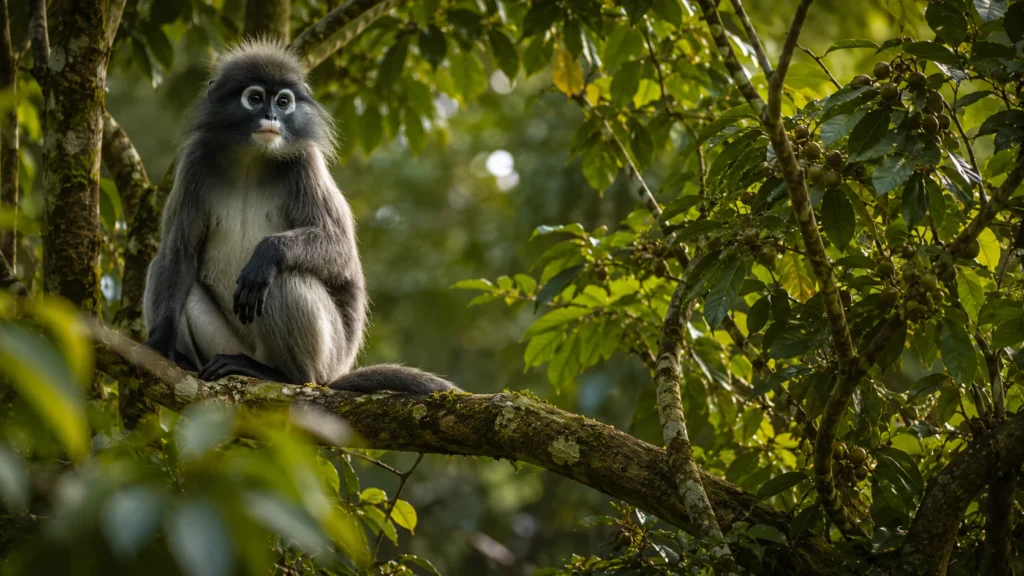
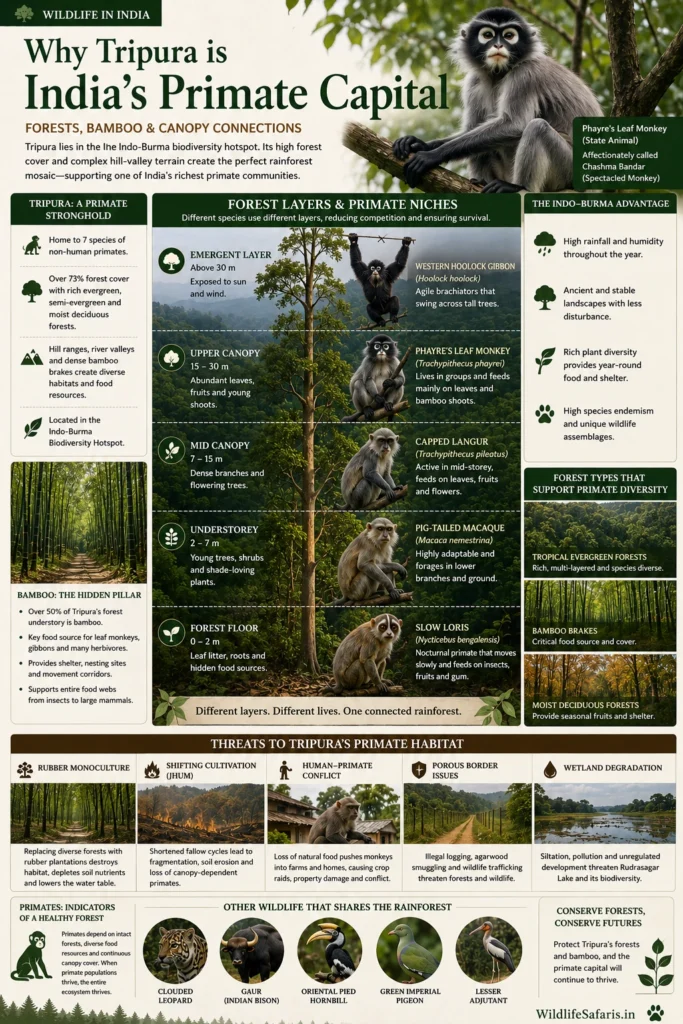
Tripura serves as a critical refuge for Indo-Malayan primate and feline genetics. The state is globally renowned for its population of the Phayre’s leaf monkey, the designated state animal. Locally referred to as Chashma Bandar due to the distinct white, spectacle-like rings around its eyes, this primate thrives in the dense canopy of the Sepahijala Wildlife Sanctuary. Embedded within this sanctuary is the Clouded Leopard National Park, India’s first dedicated national park for the conservation and captive breeding of the elusive clouded leopard. Further south, the Trishna Wildlife Sanctuary and its internal Rajbari (Bison) National Park provide a crucial, heavily forested stronghold for the gaur (Indian bison) and the western hoolock gibbon.
The state’s aquatic ecology is anchored by Rudrasagar Lake, a Ramsar-designated wetland that famously surrounds the Neermahal (Water Palace). This lake acts as an indispensable wintering ground for migratory waterfowl and supports the state bird, the green imperial pigeon. Wildlife conservation in Tripura must navigate complex socio-economic transformations, particularly the rapid, large-scale conversion of native forests into commercial rubber monocultures and the ecological impacts of traditional shifting cultivation (jhum). Despite these pressures, Tripura offers an intimate, deeply forested frontier for primate researchers and eco-tourists seeking the lesser-known wildlife jewels of the Northeast.
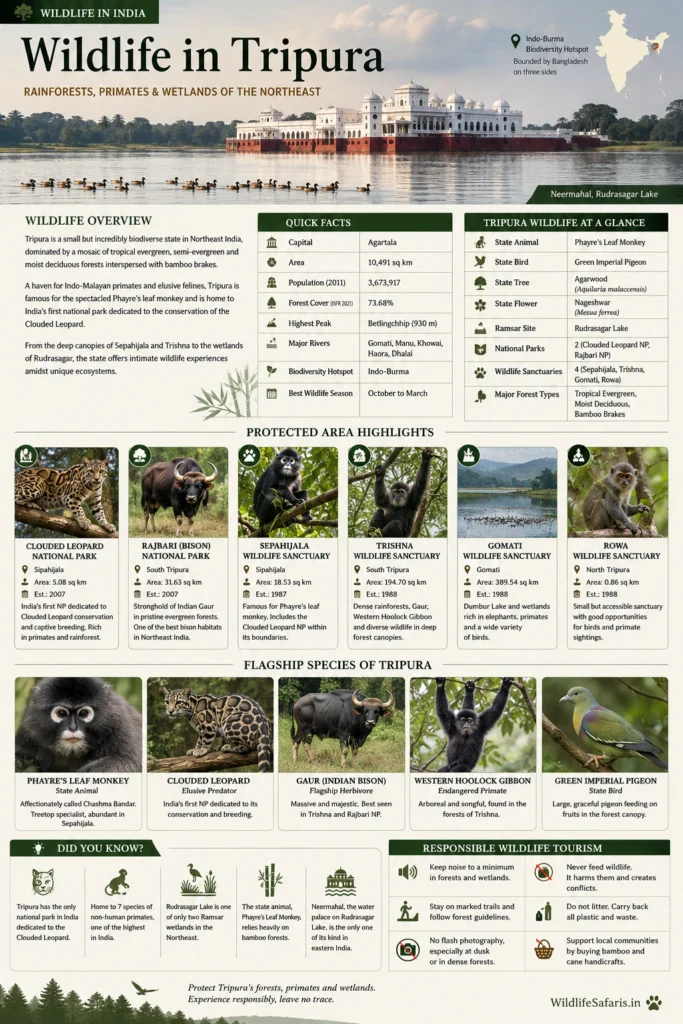
Quick Facts Table
| Category | Details |
| State / Union Territory | Tripura |
| Capital | Agartala |
| Area | 10,491 sq km |
| Population | 3,673,917 (2011 Census) |
| Forest Cover | 73.68% (ISFR 2021) |
| Official Language(s) | Bengali, Kokborok, English |
| Time Zone | UTC+05:30 (IST) |
| Best Wildlife Season | October to March |
State Wildlife Master Table
| Attribute | Details |
| State / Union Territory | Tripura |
| Capital | Agartala |
| Geographic Region | Northeast India |
| Total Area | 10,491 sq km |
| Forest Cover | 73.68% |
| State Animal | Phayre’s Leaf Monkey (Trachypithecus phayrei) |
| State Bird | Green Imperial Pigeon (Ducula aenea) |
| State Tree | Agarwood (Aquilaria malaccensis) |
| State Flower | Nageshwar / Indian Rose Chestnut (Mesua ferrea) |
| Highest Peak | Betlingchhip (930 m) |
| Major Rivers | Gomati, Manu, Khowai, Haora, Dhalai |
| Major Forest Types | Tropical Evergreen, Moist Deciduous, Bamboo Brakes |
| Biodiversity Hotspot | Indo-Burma |
| UNESCO Natural Sites | None |
| Biosphere Reserves | None |
| Tiger Reserves | None |
| Elephant Reserves | None (Small resident and transient populations exist) |
| National Parks | Clouded Leopard, Rajbari (Bison) |
| Wildlife Sanctuaries | 4 Sanctuaries (Sepahijala, Trishna, Gomati, Rowa) |
| Conservation Reserves | Not officially specified |
| Community Reserves | Not officially specified |
| Ramsar Sites | Rudrasagar Lake |
| Important Bird Areas (IBAs) | Sepahijala, Trishna, Gomati WLS |
| Major Wildlife Corridors | Indo-Bangladesh Transboundary Corridors |
| Flagship Mammals | Phayre’s Leaf Monkey, Clouded Leopard, Gaur (Bison), Hoolock Gibbon |
| Flagship Birds | Green Imperial Pigeon, Oriental Pied Hornbill, Lesser Adjutant |
| Endemic Wildlife | Not strictly endemic, but highly specific Indo-Malayan species |
| Best Wildlife Destinations | Sepahijala WLS, Trishna WLS, Rudrasagar Lake |
| Best Time for Wildlife Tourism | October to March |
| Nearest International Airports | Maharaja Bir Bikram Airport (Agartala – currently upgrading to international) |
| Official Forest Department Website | forest.tripura.gov.in |
Protected Areas Summary Table
| Protected Area | Category | District | Area (sq km) | Year Established | Famous For |
| Clouded Leopard National Park | National Park | Sipahijala | 5.08 | 2007 | Clouded Leopard Conservation, Primates |
| Rajbari (Bison) National Park | National Park | South Tripura | 31.63 | 2007 | Gaur (Indian Bison), Virgin Forests |
| Sepahijala Wildlife Sanctuary | Wildlife Sanctuary | Sipahijala | 18.53 | 1987 | Phayre’s Leaf Monkey, Clouded Leopard NP |
| Trishna Wildlife Sanctuary | Wildlife Sanctuary | South Tripura | 194.70 | 1988 | Gaur (Indian Bison), Hoolock Gibbon, Deep Canopies |
| Gomati Wildlife Sanctuary | Wildlife Sanctuary | Gomati | 389.54 | 1988 | Dumbur Lake, Elephants, Avifauna |
| Rowa Wildlife Sanctuary | Wildlife Sanctuary | North Tripura | 0.86 | 1988 | Avifauna, Primates, Easily accessible forest patch |
Wildlife Highlights
- Top Mammals: Phayre’s Leaf Monkey, Clouded Leopard, Gaur (Indian Bison), Western Hoolock Gibbon, Pig-tailed Macaque, Capped Langur, Slow Loris, Binturong, Asian Elephant.
- Top Birds: Green Imperial Pigeon, Oriental Pied Hornbill, Lesser Adjutant, Pheasant-tailed Jacana, Red Junglefowl, Great Hornbill.
- Reptiles & Amphibians: Monocled Cobra, Spectacled Cobra, Monitor Lizard, Burmese Python.
- Flagship Flora: Agarwood, Nageshwar (Indian Rose Chestnut), Sal, Garjan, and vast, commercially and ecologically vital Bamboo forests.
- Best Wildlife Experiences: Spotting the spectacle-eyed Phayre’s leaf monkey in the canopy of Sepahijala, tracking the massive Indian Gaur in Trishna, and observing migratory birds by boat around the Neermahal palace in Rudrasagar Lake.
Conservation Challenges
- Rubber Monoculture: The aggressive and highly lucrative expansion of commercial rubber plantations (Hevea brasiliensis) is the single largest threat to Tripura’s biodiversity. Replacing diverse primary forests with rubber monoculture severely depletes soil nutrients, lowers the water table, and creates ecological “dead zones” devoid of wildlife.
- Shifting Cultivation (Jhum): Traditional slash-and-burn agriculture by hill tribes, when practiced with heavily shortened fallow cycles due to population density, leads to severe forest fragmentation, soil erosion, and habitat loss for canopy-dependent primates.
- Porous International Borders: Sharing an 856 km border with Bangladesh, the state battles continuous challenges related to illegal cross-border logging, smuggling of valuable Agarwood, and transboundary wildlife trafficking.
- Human-Primate Conflict: As native fruit-bearing trees are replaced by timber or rubber plantations, troops of macaques and langurs are increasingly forced into human settlements and agricultural fields to forage, leading to intense retaliatory conflicts.
- Wetland Degradation: Rudrasagar Lake faces severe siltation, agricultural chemical runoff from surrounding paddy fields, and unregulated expansion of brick kilns along its catchment area, which threatens its status as a vital Ramsar site.
Responsible Wildlife Tourism
- Primate Viewing Etiquette: When observing the Phayre’s leaf monkey or Hoolock gibbon in Sepahijala or Trishna, remain quiet and avoid direct eye contact, which primates often interpret as a threat.
- Do Not Feed Wildlife: Never offer food to monkeys or birds in the sanctuaries. Artificial feeding alters their natural foraging habits, causes severe health issues, and increases human-wildlife conflict.
- Respect Wetland Ecosystems: While boating to Neermahal on Rudrasagar Lake, ensure you do not drop any plastic wrappers or bottles into the water. The lake is already battling severe pollution.
- Stay on Marked Trails: The deep forests of Trishna are incredibly dense and house wild elephants and gaur. Never venture off the marked paths or explore without an authorized forest guard.
- Support Local Handicrafts: Instead of seeking forest products, support the local economy by purchasing Tripura’s famous bamboo and cane handicrafts, which promotes sustainable use of non-timber forest resources.
- Ethical Photography: Clouded leopards and nocturnal primates are highly sensitive to bright lights. Absolutely no flash photography is permitted during dusk or in the denser, darker sections of the national parks.
Did You Know?
- Tripura is the only state in India to have a dedicated national park explicitly named after and focused on the conservation of the Clouded Leopard.
- The state animal, the Phayre’s Leaf Monkey, is heavily dependent on specific species of bamboo for its diet and is affectionately called Chashma Bandar (Spectacled Monkey) in Hindi/Bengali.
- Rudrasagar Lake is one of only two wetlands in Northeast India designated as a Ramsar site, making it a critical ecological stepping stone for birds on the Central Asian Flyway.
- Tripura is home to seven different species of non-human primates, making it one of the most primate-dense regions in India despite its small geographical size.
- The state tree, Agarwood (Aquilaria malaccensis), produces one of the most expensive and highly sought-after resins in the world (Oudh) when infected by a specific mold, making its wild conservation highly sensitive.
- Neermahal, situated in the middle of Rudrasagar Lake, is the only water palace in eastern India and was built as a summer resort by Maharaja Bir Bikram Kishore Manikya Bahadur.
Safari Planning : Topics Cluster
- How to book a wildlife safari in India?
- Park by Park Online Safari Booking Guide
- Tiger Safari India Planning Workbook
- Park by Park Safari Permits Guide
- National Parks Permit Guide – Park by Park Guide
- Tatkal Safari Booking Guide – Last Minute Safari Permits Booking
- Tiger Safari in India Cost
- Indian Wildlife Safari Budget Planner
- Jeep vs Canter Safari
- Best time for Tiger Sightings in India
- How far advanced should you book safari permits?
- Can foreigners book Indian Wildlife Safari online?
- Special Permits Guide for Foreigners and Domestic Visitors
- How to book a Safari Permit online in India? 2026 step by step guide
- Senior Citizens Friendly Safari Planning
- Multi Generation Family Safari Planning
- 50 things to know before your first safari in India