
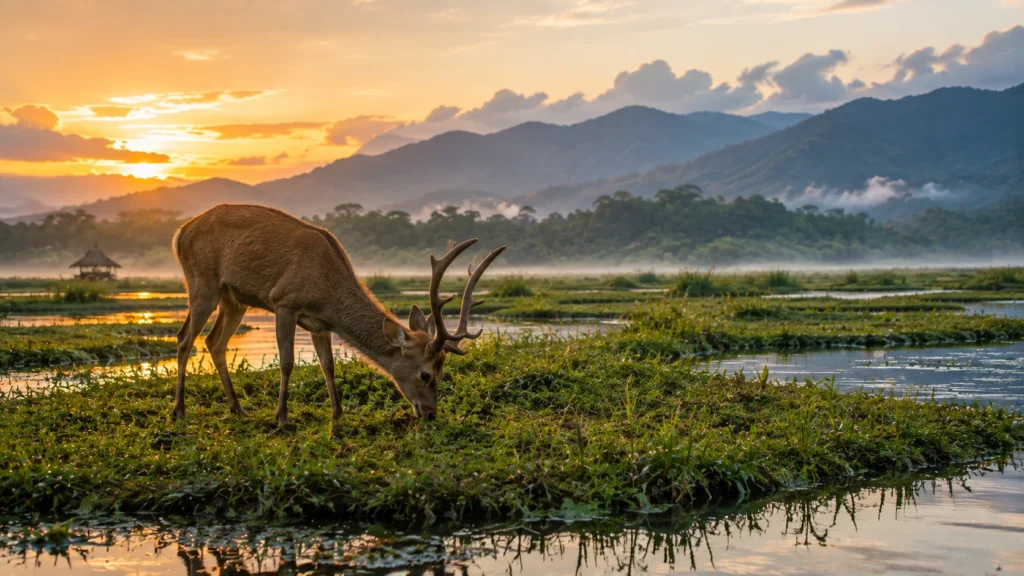
Manipur, affectionately known as the “Jewelled Land,” is nestled within the Indo-Burma biodiversity hotspot in Northeast India. The state’s topography is uniquely structured, comprising a central, oval-shaped valley surrounded by continuous, jagged ranges of the Patkai and Barail mountains. Experiencing a sub-tropical monsoon climate, Manipur retains an impressive forest cover of over seventy-four per cent of its total geographical area. The vegetation transitions from tropical moist deciduous and semi-evergreen forests in the lower river basins (like the Barak and Jiri) to dense, sub-alpine and temperate broadleaved forests in the higher elevations of Ukhrul and Senapati.
The undisputed crown jewel of Manipur’s wildlife is the sangai, or the brow-antlered deer, which is the designated state animal. This critically endangered ungulate is entirely endemic to the Keibul Lamjao National Park, globally celebrated as the only floating national park in the world. The park is situated on Loktak Lake, a Ramsar-designated wetland, and is composed of phumdis—massive, floating islands of decomposing vegetation upon which the sangai has uniquely adapted to walk. Beyond the central valley, the dense hill sanctuaries, such as Yangoupokpi-Lokchao and Jiri-Makru, protect highly elusive species including the western hoolock gibbon, clouded leopard, and Asian golden cat.
Manipur is also a treasure trove of rare avifauna and flora. The state bird, the magnificent Nongin (Mrs. Hume’s pheasant), navigates the high-altitude forests, while the Shirui Hills serve as the sole global habitat for the exquisite Shirui Lily, the state flower. Wildlife conservation in Manipur faces complex socio-ecological challenges. The delicate hydrology of Loktak Lake and its floating phumdis is under severe stress from hydroelectric projects (specifically the Ithai Barrage), while the surrounding hills battle the impacts of traditional jhum (slash-and-burn) cultivation and unregulated logging. Despite these hurdles, Manipur offers an unparalleled, deeply niche wildlife experience for wetland ecologists and primate enthusiasts.
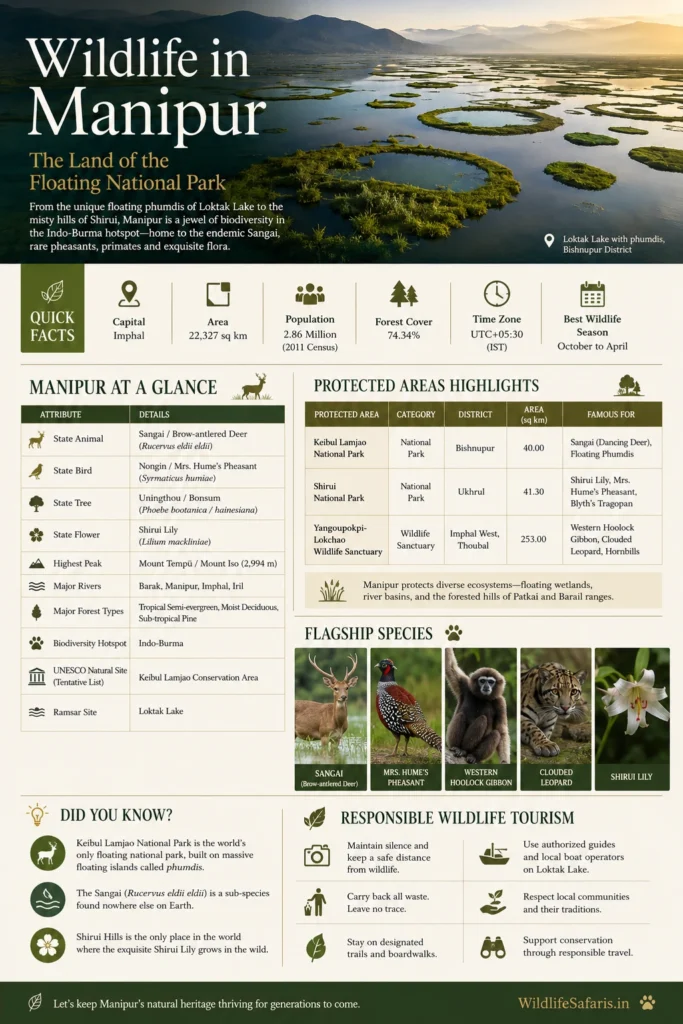
Quick Facts Table
| Category | Details |
| State / Union Territory | Manipur |
| Capital | Imphal |
| Area | 22,327 sq km |
| Population | 2,855,794 (2011 Census) |
| Forest Cover | 74.34% |
| Official Language(s) | Meiteilon (Manipuri) |
| Time Zone | UTC+05:30 (IST) |
| Best Wildlife Season | October to April |
State Wildlife Master Table
| Attribute | Details |
| State / Union Territory | Manipur |
| Capital | Imphal |
| Geographic Region | Northeast India (Patkai and Barail Ranges) |
| Total Area | 22,327 sq km |
| Forest Cover | 74.34% |
| State Animal | Sangai / Brow-antlered Deer (Rucervus eldii eldii) |
| State Bird | Nongin / Mrs. Hume’s Pheasant (Syrmaticus humiae) |
| State Tree | Uningthou / Bonsum (Phoebe bootanica / hainesiana) |
| State Flower | Shirui Lily (Lilium mackliniae) |
| Highest Peak | Mount Tempü / Mount Iso (2,994 m) |
| Major Rivers | Barak, Manipur, Imphal, Iril |
| Major Forest Types | Tropical Semi-evergreen, Moist Deciduous, Sub-tropical Pine |
| Biodiversity Hotspot | Indo-Burma |
| UNESCO Natural Sites | Keibul Lamjao Conservation Area (Tentative List) |
| Biosphere Reserves | None |
| Tiger Reserves | None |
| Elephant Reserves | None |
| National Parks | Keibul Lamjao, Shirui |
| Wildlife Sanctuaries | 6 Sanctuaries (Yangoupokpi-Lokchao, Jiri-Makru, Bunning, Kailam, Zeilad Lake, Khongjaingamba Ching) |
| Conservation Reserves | Not officially specified |
| Community Reserves | Not officially specified |
| Ramsar Sites | Loktak Lake |
| Important Bird Areas (IBAs) | Keibul Lamjao, Loktak Lake, Shirui Kashung, Yangoupokpi-Lokchao |
| Major Wildlife Corridors | Indo-Myanmar Border Corridors |
| Flagship Mammals | Sangai, Western Hoolock Gibbon, Clouded Leopard, Asian Golden Cat |
| Flagship Birds | Mrs. Hume’s Pheasant, Blyth’s Tragopan, Amur Falcon |
| Endemic Wildlife | Sangai (strictly endemic sub-species) |
| Best Wildlife Destinations | Keibul Lamjao NP, Loktak Lake, Shirui Hills, Yangoupokpi-Lokchao WLS |
| Best Time for Wildlife Tourism | October to April |
| Nearest International Airports | Bir Tikendrajit International Airport (Imphal) |
| Official Forest Department Website | manipurforest.gov.in |
Protected Areas Summary Table
| Protected Area | Category | District | Area (sq km) | Year Established | Famous For |
| Keibul Lamjao National Park | National Park | Bishnupur | 40.00 | 1977 | Sangai (Dancing Deer), Floating Phumdis |
| Shirui National Park | National Park | Ukhrul | 41.30 | 1982 | Shirui Lily, Mrs. Hume’s Pheasant, Blyth’s Tragopan |
| Bunning Wildlife Sanctuary | Wildlife Sanctuary | Tamenglong | 115.80 | 1997 | Hoolock Gibbon, Clouded Leopard, Orchids |
| Jiri-Makru Wildlife Sanctuary | Wildlife Sanctuary | Tamenglong | 198.00 | 1989 | Asian Elephant, Hoolock Gibbon, Dense Canopy |
| Kailam Wildlife Sanctuary | Wildlife Sanctuary | Churachandpur | 187.50 | 1997 | Hornbills, Serow, Clouded Leopard |
| Khongjaingamba Ching WLS | Wildlife Sanctuary | Bishnupur | 0.42 | 2016 | Micro-habitat conservation, Hog Deer |
| Yangoupokpi-Lokchao WLS | Wildlife Sanctuary | Chandel (Indo-Myanmar border) | 184.40 | 1989 | Hoolock Gibbon, Malayan Sun Bear, Cross-border fauna |
| Zeilad Lake Wildlife Sanctuary | Wildlife Sanctuary | Tamenglong | 21.00 | 1997 | High-altitude Lake, Migratory Birds, Pythons |
Wildlife Highlights
- Top Mammals: Sangai (Manipur Brow-antlered Deer), Western Hoolock Gibbon, Clouded Leopard, Malayan Sun Bear, Asian Golden Cat, Hog Deer, Serow, Barking Deer.
- Top Birds: Nongin (Mrs. Hume’s Pheasant), Blyth’s Tragopan, Amur Falcon (during migration), Bar-headed Goose, Wreathed Hornbill, Rufous-necked Hornbill.
- Reptiles & Amphibians: Burmese Python, Keeled Box Turtle, Monitor Lizard.
- Flagship Flora: Shirui Lily (endemic to Shirui Peak), Uningthou, diverse native orchids, Bamboo, and Zizania latifolia (a wild grass vital for the Sangai).
- Best Wildlife Experiences: Boat safaris through the floating phumdis of Keibul Lamjao to spot the Sangai, birdwatching around the expansive Loktak Lake, and trekking the Shirui Hills during the May-June lily bloom.
Conservation Challenges
- Hydrological Disruption: The construction of the Ithai Barrage in 1983 artificially maintains a high water level in Loktak Lake year-round. This prevents the floating phumdis from settling on the lake bed during the dry season to absorb nutrients, causing them to thin, break apart, and threatening the very foundation of the Sangai’s habitat.
- Shifting Cultivation (Jhum): The traditional practice of slash-and-burn agriculture by hill tribes severely fragments the dense forested corridors of Tamenglong and Ukhrul, leading to habitat loss for canopy-dwelling species like the Hoolock Gibbon.
- Pollution of Loktak Lake: Untreated agricultural runoff (pesticides/fertilisers) and urban sewage from rivers flowing into Loktak Lake severely degrade the water quality, impacting aquatic flora, fisheries, and migratory bird habitats.
- Poaching and Snaring: Due to proximity to the porous Indo-Myanmar border, there is a persistent threat of illegal wildlife trade and localised bushmeat hunting targeting pangolins, hornbills, and small carnivores.
- Extremely Localised Endemism: The Sangai population is entirely restricted to a single 40 sq km area of floating biomass. Any catastrophic event (disease outbreak or severe flood) could trigger the immediate extinction of the sub-species in the wild.

Responsible Wildlife Tourism
- Tread Lightly on Phumdis: When visiting Keibul Lamjao, remain at designated watchtowers or in authorised boats. Never attempt to walk on the phumdis; the biomass is deceptive, easily damaged, and you risk falling through.
- Respect Avian Stopovers: During the winter migration, do not use motorised boats near large flocks of waterfowl on Loktak Lake. Use traditional dug-out canoes to minimise noise.
- Protect the Shirui Lily: When trekking in the Shirui Hills (especially during the Shirui Lily Festival in May), stay strictly on the marked trails. Plucking the state flower is illegal and destroys its highly restricted natural habitat.
- Say No to Wildlife Products: Given the region’s proximity to international borders, tourists must remain vigilant against purchasing any illegal wildlife derivatives, including orchids, animal skins, or traditional medicines.
- Support Local Conservation: Engage with local Meitei and tribal community eco-guides. Tourism revenue is a crucial incentive for communities to abandon poaching and support conservation in fringe villages.
Did You Know?
- The Sangai deer is often affectionately called the “Dancing Deer” because of its delicate, bouncing gait as it balances its weight on the spongy, floating phumdis.
- Keibul Lamjao National Park is the only floating national park in the world, covering an area of 40 square kilometres entirely composed of biomass floating on Loktak Lake.
- The Shirui Lily (Lilium mackliniae) is an incredibly sensitive plant; it refuses to be transplanted and grows naturally only on the upper reaches of the Shirui Kashung peak in the Ukhrul district.
- In Meitei folklore, the Sangai is deeply revered and represents the binding soul between humans and nature.
- The Yangoupokpi-Lokchao Wildlife Sanctuary sits right on the international border with Myanmar and acts as a vital cross-border genetic corridor for Indo-Chinese fauna entering the Indian subcontinent.
- The phumdis in Loktak Lake are formed by an intricate mass of soil, vegetation, and organic matter at various stages of decomposition, and are thick enough to support the weight of humans and large deer.
Safari Planning : Topics Cluster
- How to book a wildlife safari in India?
- Park by Park Online Safari Booking Guide
- Tiger Safari India Planning Workbook
- Park by Park Safari Permits Guide
- National Parks Permit Guide – Park by Park Guide
- Tatkal Safari Booking Guide – Last Minute Safari Permits Booking
- Tiger Safari in India Cost
- Indian Wildlife Safari Budget Planner
- Jeep vs Canter Safari
- Best time for Tiger Sightings in India
- How far advanced should you book safari permits?
- Can foreigners book Indian Wildlife Safari online?
- Special Permits Guide for Foreigners and Domestic Visitors
- How to book a Safari Permit online in India? 2026 step by step guide
- Senior Citizens Friendly Safari Planning
- Multi Generation Family Safari Planning
- 50 things to know before your first safari in India