
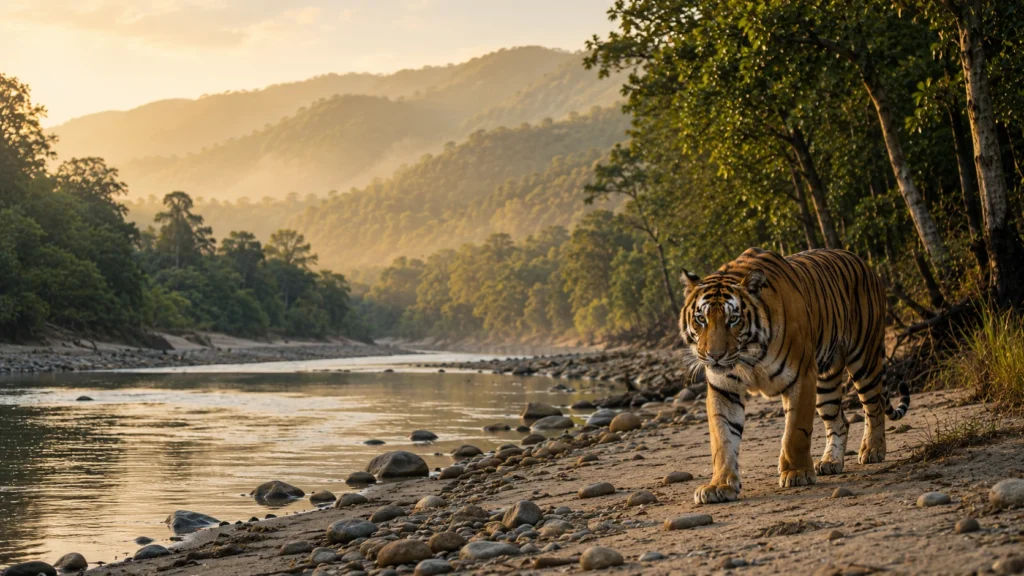
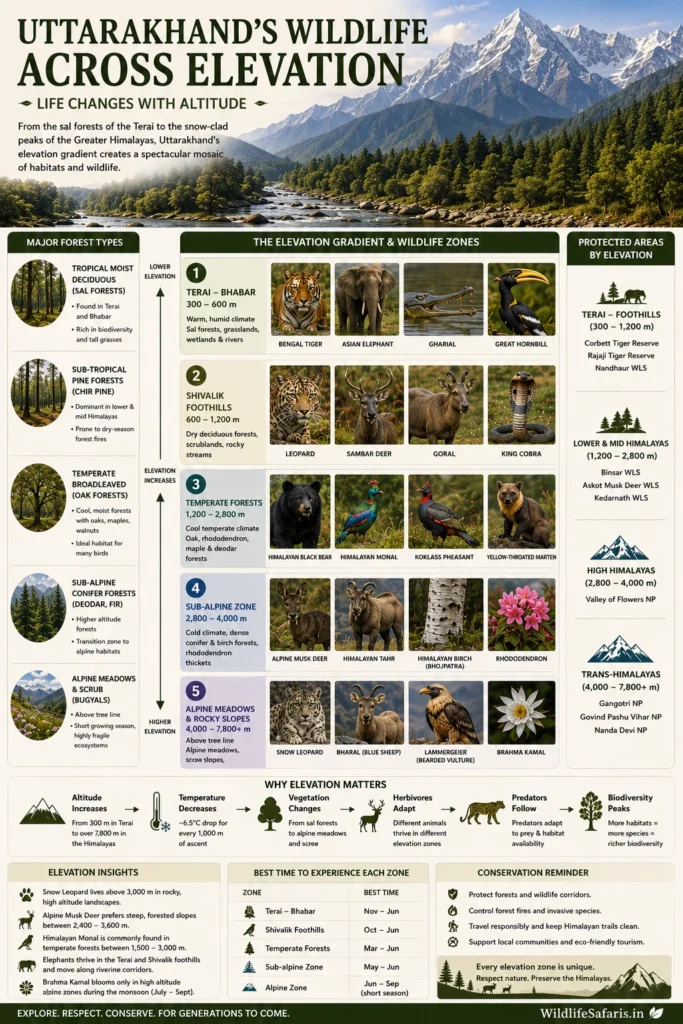
Uttarakhand, widely revered as the “Devbhoomi” (Land of the Gods), is an incredibly biodiverse state carved entirely out of the western Himalayas. Its dramatic topography descends from the towering, glacier-draped peaks of the Greater Himalayas in the north, through the dense pine-clad ridges of the Lesser Himalayas, down to the ecologically vibrant Terai-Bhabar marshlands and Shivalik foothills in the south. This immense altitudinal gradient—ranging from 300 metres to over 7,800 metres—supports a highly stratified ecosystem. With a robust forest cover exceeding forty-five per cent, the state’s vegetation transitions from dense, tropical moist deciduous sal forests in the plains to sub-tropical pine, temperate oak, and ultimately, fragile alpine meadows (bugyals) near the snowline.
The state is a global titan in megafauna conservation, primarily due to the legendary Jim Corbett National Park. Established in 1936 as India’s first national park and the birthplace of Project Tiger, the Corbett landscape, alongside the adjacent Rajaji Tiger Reserve, harbours one of the highest densities of Bengal tigers in the world and serves as the northwestern limit for the Asian elephant. Higher up, the pristine and treacherous alpine terrains of Gangotri and Govind Pashu Vihar protect highly elusive high-altitude fauna, including the snow leopard, the Himalayan brown bear, and the state animal, the critically endangered alpine musk deer.
Uttarakhand also claims two highly celebrated UNESCO World Heritage Sites: Nanda Devi and the Valley of Flowers National Parks. The latter is a high-altitude botanical wonderland that erupts into a spectacular carpet of endemic alpine blooms during the monsoon. The state’s avifauna is spectacular, deeply integrated into the landscape, featuring the iridescent Himalayan monal (the state bird) and massive raptors like the lammergeier. Managing wildlife in Uttarakhand involves a complex balancing act—mitigating severe human-leopard conflict in the mid-hills, controlling catastrophic dry-season forest fires, and addressing the massive ecological footprint of millions of domestic tourists.
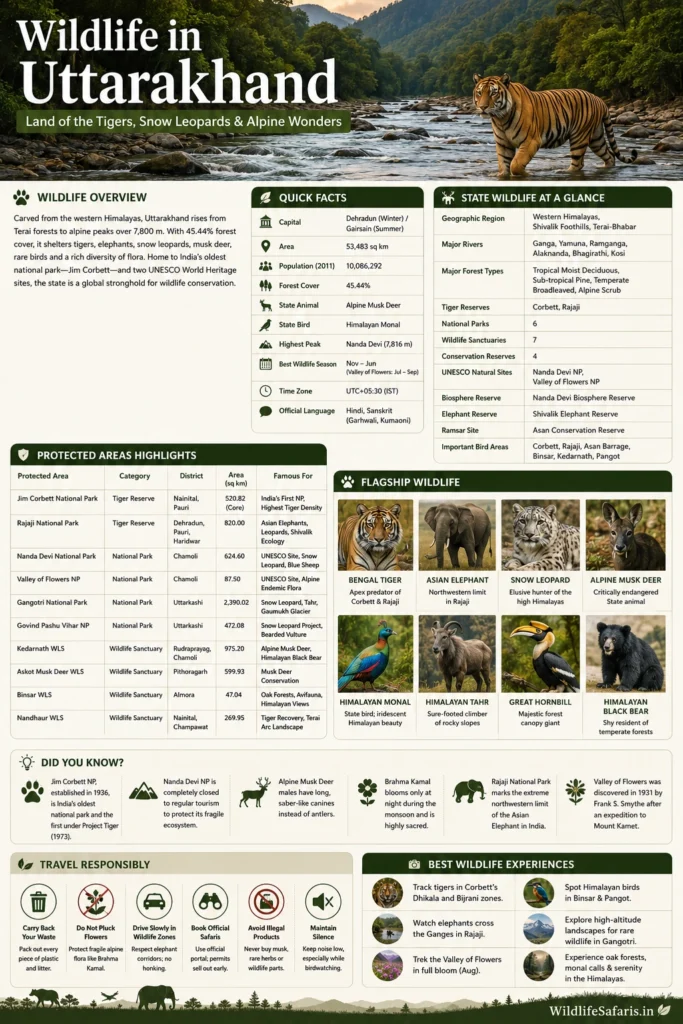
Quick Facts Table
| Category | Details |
| State / Union Territory | Uttarakhand |
| Capital | Dehradun (Winter) / Gairsain (Summer) |
| Area | 53,483 sq km |
| Population | 10,086,292 (2011 Census) |
| Forest Cover | 45.44% |
| Official Language(s) | Hindi, Sanskrit (Garhwali and Kumaoni widely spoken) |
| Time Zone | UTC+05:30 (IST) |
| Best Wildlife Season | November to June (Valley of Flowers: July to September) |
State Wildlife Master Table
| Attribute | Details |
| State / Union Territory | Uttarakhand |
| Capital | Dehradun, Gairsain |
| Geographic Region | Western Himalayas, Shivalik Foothills, Terai-Bhabar |
| Total Area | 53,483 sq km |
| Forest Cover | 45.44% |
| State Animal | Alpine Musk Deer (Moschus chrysogaster) |
| State Bird | Himalayan Monal (Lophophorus impejanus) |
| State Tree | Buransh / Rhododendron (Rhododendron arboreum) |
| State Flower | Brahma Kamal (Saussurea obvallata) |
| Highest Peak | Nanda Devi (7,816 m) |
| Major Rivers | Ganga, Yamuna, Ramganga, Kosi, Alaknanda, Bhagirathi |
| Major Forest Types | Tropical Moist Deciduous, Sub-tropical Pine, Temperate Broadleaved, Alpine Scrub |
| Biodiversity Hotspot | Himalayas |
| UNESCO Natural Sites | Nanda Devi and Valley of Flowers National Parks |
| Biosphere Reserves | Nanda Devi Biosphere Reserve |
| Tiger Reserves | Corbett, Rajaji |
| Elephant Reserves | Shivalik Elephant Reserve |
| National Parks | Corbett, Gangotri, Govind Pashu Vihar, Nanda Devi, Rajaji, Valley of Flowers |
| Wildlife Sanctuaries | 7 Sanctuaries (including Kedarnath, Askot, Binsar, Sonanadi, Nandhaur) |
| Conservation Reserves | 4 Reserves (Asan, Jhilmil Jheel, Pawalgarh, Naina Devi Himalayan Bird) |
| Community Reserves | Not officially specified |
| Ramsar Sites | Asan Conservation Reserve |
| Important Bird Areas (IBAs) | Corbett, Rajaji, Asan Barrage, Binsar, Kedarnath, Pangot |
| Major Wildlife Corridors | Rajaji-Corbett Corridor, Terai Arc Landscape |
| Flagship Mammals | Bengal Tiger, Asian Elephant, Snow Leopard, Alpine Musk Deer, Himalayan Tahr |
| Flagship Birds | Himalayan Monal, Koklass Pheasant, Great Hornbill, Lammergeier |
| Endemic Wildlife | Several alpine flora species including the Brahma Kamal |
| Best Wildlife Destinations | Corbett TR, Rajaji TR, Binsar WLS, Valley of Flowers |
| Best Time for Wildlife Tourism | November to June (High altitude parks close in winter) |
| Nearest International Airports | Jolly Grant Airport (Dehradun – currently domestic, upgrading), Indira Gandhi International Airport (New Delhi) |
| Official Forest Department Website | forest.uk.gov.in |
Protected Areas Summary Table
| Protected Area | Category | District | Area (sq km) | Year Established | Famous For |
| Jim Corbett National Park | Tiger Reserve | Nainital, Pauri Garhwal | 520.82 (Core) | 1936 | India’s First NP, Highest Tiger Density |
| Rajaji National Park | Tiger Reserve | Dehradun, Pauri, Haridwar | 820.00 | 1983 (NP), 2015 (TR) | Asian Elephants, Leopards, Shivalik Ecology |
| Nanda Devi National Park | National Park | Chamoli | 624.60 | 1982 | UNESCO Site, Snow Leopard, Blue Sheep |
| Valley of Flowers | National Park | Chamoli | 87.50 | 1982 | UNESCO Site, Alpine Endemic Flora, Monal |
| Gangotri National Park | National Park | Uttarkashi | 2,390.02 | 1989 | Snow Leopard, Gaumukh Glacier, Himalayan Tahr |
| Govind Pashu Vihar | National Park | Uttarkashi | 472.08 | 1955 (WLS), 1990 (NP) | Snow Leopard Project, Bearded Vulture |
| Kedarnath Wildlife Sanctuary | Wildlife Sanctuary | Rudraprayag, Chamoli | 975.20 | 1972 | Alpine Musk Deer, Himalayan Black Bear |
| Askot Musk Deer Sanctuary | Wildlife Sanctuary | Pithoragarh | 599.93 | 1986 | Musk Deer Conservation, Indo-Nepal Border |
| Binsar Wildlife Sanctuary | Wildlife Sanctuary | Almora | 47.04 | 1988 | Broadleaved Oak Forests, Avifauna, Himalayan Views |
| Nandhaur Wildlife Sanctuary | Wildlife Sanctuary | Nainital, Champawat | 269.95 | 2012 | Tiger Recovery, Terai Arc Landscape |
Wildlife Highlights
- Top Mammals: Bengal Tiger, Asian Elephant, Indian Leopard, Snow Leopard, Alpine Musk Deer, Himalayan Tahr, Blue Sheep (Bharal), Himalayan Brown Bear, Himalayan Black Bear, Yellow-throated Marten, Goral.
- Top Birds: Himalayan Monal, Koklass Pheasant, Lammergeier (Bearded Vulture), Great Hornbill, Plumbeous Water Redstart, Crested Kingfisher, Himalayan Griffon.
- Reptiles & Amphibians: King Cobra, Mugger Crocodile (Ramganga River), Gharial, Himalayan Pit Viper.
- Flagship Flora: Sal (Shorea robusta), Deodar Cedar, Chir Pine, Buransh (Rhododendron), Brahma Kamal, Himalayan Birch (Bhojpatra).
- Best Wildlife Experiences: Tracking tigers through the dense sal forests of Corbett’s Dhikala zone, photographing elephants crossing the Ganges in Rajaji, trekking through the blooming Valley of Flowers in August, and birdwatching in the quiet oak forests of Pangot and Binsar.
Conservation Challenges
- Human-Leopard Conflict: The mid-elevation hills of Garhwal and Kumaon face incredibly high rates of human-leopard conflict. Habitat degradation and a depleted natural prey base push leopards into villages to hunt livestock and feral dogs, occasionally resulting in tragic human casualties.
- Forest Fires: The highly resinous Chir Pine forests that dominate the lower and middle Himalayas are incredibly susceptible to devastating summer forest fires, severely damaging undergrowth and wiping out ground-nesting bird populations.
- Linear Infrastructure and Pilgrimage: The massive, ongoing expansion of the all-weather Char Dham highway project involves extensive hill cutting and deforestation, causing landslides, fragmenting habitats, and drastically increasing vehicular pollution in highly fragile alpine zones.
- Poaching: The high-altitude regions face a constant, latent threat from highly organized poaching syndicates targeting the Alpine Musk Deer for its scent gland (musk pod) and the Snow Leopard for its pelt.
- Habitat Fragmentation in Terai: Expanding agriculture, expanding resorts, and busy highways (like those near Haridwar and Ramnagar) sever the vital Rajaji-Corbett wildlife corridor, isolating tiger and elephant populations and reducing genetic diversity.
Responsible Wildlife Tourism
- Book Corbett Safaris Early: Corbett is arguably India’s most popular wildlife destination. Safari permits for premium zones (like Dhikala and Bijrani) sell out months in advance. Always book through the official state portal to avoid scams.
- Valley of Flowers Etiquette: When trekking in the Valley of Flowers or near Hemkund Sahib, absolutely never pluck the Brahma Kamal or any other high-altitude flowers. Stay strictly on the stone paths to avoid crushing delicate seedlings.
- Zero Littering on Treks: The Himalayas have a severe solid waste problem. If you trek into Gangotri, Nanda Devi, or Kedarnath, pack out every single piece of plastic, wrapper, and battery you bring in.
- Respect Elephant Corridors: When driving through the forested highways around Rajaji and Corbett (especially the Lansdowne and Ramnagar routes), drive slowly, never use high-beam headlights at night, and never honk if elephants are near the road.
- Avoid Illegal Wildlife Products: Be extremely vigilant against purchasing any products claiming to be musk (Kasturi) or rare Himalayan medicinal herbs without verified, legal sourcing.
- Silence in the Hills: When birdwatching in high-altitude sanctuaries like Binsar or Pangot, keep noise levels to a minimum to fully appreciate the complex calls of the region’s diverse avifauna.
Did You Know?
- Jim Corbett National Park, established in 1936 originally as Hailey National Park, is the oldest national park in India and the very first to come under the Project Tiger initiative in 1973.
- Nanda Devi National Park is completely closed to regular tourism to protect its incredibly fragile ecosystem. Access is granted only to a handful of rigorous scientific expeditions every few years.
- The Alpine Musk Deer possesses no antlers; instead, the males grow elongated, saber-like upper canine teeth which they use during mating battles.
- The state flower, the Brahma Kamal, only blooms at night during the monsoon season and is highly revered in Hindu mythology as the flower upon which Lord Brahma sits.
- Rajaji National Park represents the extreme northwestern limit of the Asian Elephant’s distribution range in India.
- The Valley of Flowers was unknown to the modern world until it was accidentally discovered in 1931 by British mountaineer Frank S. Smythe after a successful expedition to Mount Kamet.
Tiger Safari in India : Topics Cluster
- Tiger Safari Planning Workbook
- Tiger Safari Booking Guide
- Best time for tiger sightings in India
- How to increase chances of tiger sighting?
- Tiger Safari Naturalist Guide
- Tiger Safari India Cost
- How to book a Tiger Safari in India?
- Best Wildlife Tour Operators in India
- Best Destination Cities for Tiger Safaris in India
- Tiger Safari under ₹25000
- Top 10 Budget Tiger Safaris 2026
- Tiger Photography Tips
- Best Tiger Reserves
- Top 10 Tiger Reserves by sighting chances
Jim Corbett National Park : Topics Cluster
- Complete Safari Guide (2026)
- Safari Booking Guide: Complete Step-by-step Guide (2026)
- Best Zones in Corbett National Park
- Best time to Visit
- Safari Cost breakdown
- Safari Costs Explained 2026
- Dhikala vs Bijrani vs Jhirna Zones
- Corbett with Family
- Corbett vs Ranthambore
- Delhi to Corbett Travel Guide
- Weekend Trip to Corbett from Delhi 2N/3D
- Best Hotels and Resorts near Corbett
- Luxury Resort near Corbett
- Corbett Birdwatching Guide
- Corbett Photography Guide
- Wildlife in Uttarakhand
Luxury Safari in India : Topics Cluster