
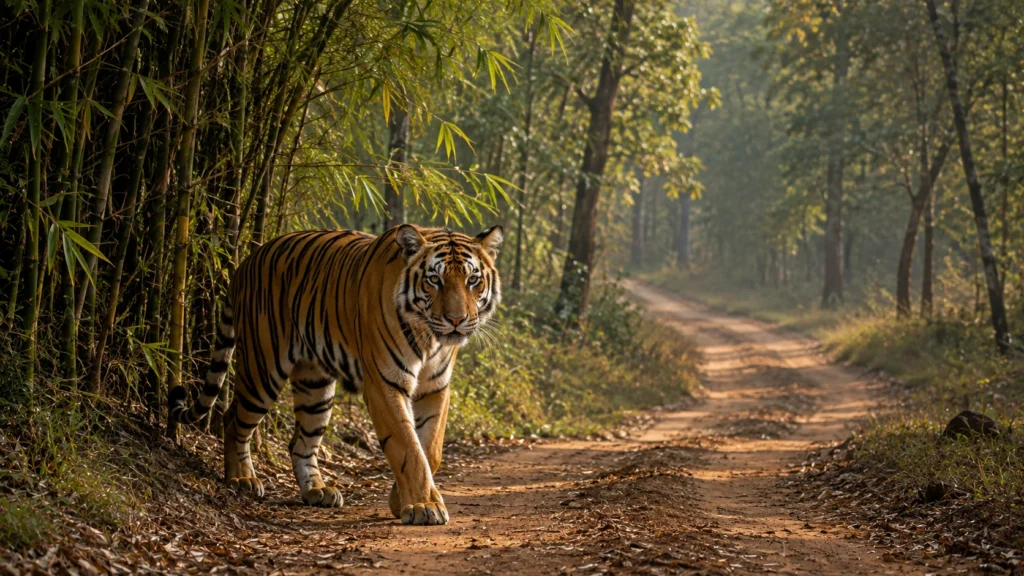
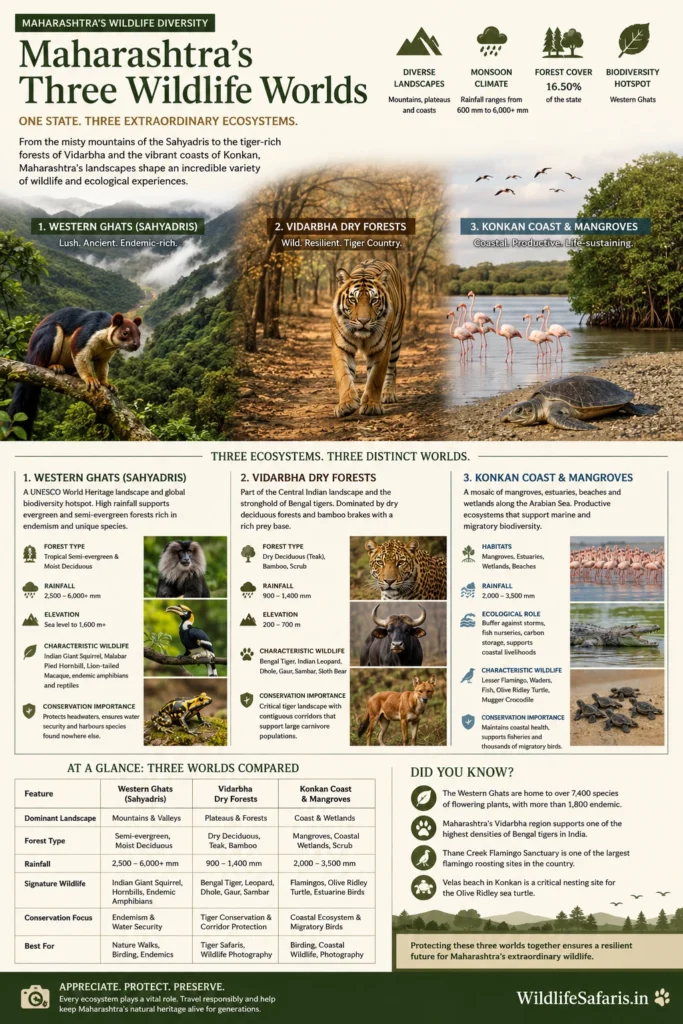
Maharashtra, India’s third-largest state, presents a vast and ecologically diverse landscape that stretches from the sun-drenched Konkan coast along the Arabian Sea to the dense, deciduous hinterlands of the Vidarbha region. The state is geographically dominated by the Sahyadri range (the northern Western Ghats)—a globally recognised biodiversity hotspot—and the expansive Deccan Plateau. Experiencing a tropical monsoon climate, Maharashtra sustains a forest cover of approximately sixteen per cent, ranging from coastal mangrove swamps and tropical semi-evergreen forests in the Ghats to the expansive dry and moist deciduous woodlands that blanket the eastern districts.
The eastern region of Vidarbha functions as the central node of Maharashtra’s wildlife conservation, globally renowned for its thriving Bengal tiger populations. A robust network of Tiger Reserves, prominently featuring Tadoba-Andhari, Pench, and Melghat, forms a critical contiguous landscape that supports high densities of apex predators, including the Indian leopard and dhole, alongside a massive prey base of gaur and sambar. In stark contrast, the Western Ghats harbour a high degree of endemism. The canopy of the Sahyadris reverberates with the calls of the state animal, the vividly coloured Indian giant squirrel (Shekru), while the undergrowth protects rare amphibians and reptiles unique to these mountains.
Maharashtra also features unparalleled urban wildlife integration, best exemplified by the Sanjay Gandhi National Park. Situated entirely within the metropolis of Mumbai, it sustains a remarkable density of wild leopards living adjacent to one of the world’s most populous cities. Furthermore, the state’s coastal ecosystems, including the Ramsar-designated Thane Creek, host immense flocks of flamingos, while beaches like Velas serve as critical nesting grounds for Olive Ridley sea turtles. Managing the intricate balance between rapid industrial expansion, linear infrastructure development, and the preservation of crucial wildlife corridors remains the focal point of the state’s conservation strategy.

Quick Facts Table
| Category | Details |
| State / Union Territory | Maharashtra |
| Capital | Mumbai (Summer) / Nagpur (Winter) |
| Area | 307,713 sq km |
| Population | 112,374,333 (2011 Census) |
| Forest Cover | 16.50% |
| Official Language(s) | Marathi |
| Time Zone | UTC+05:30 (IST) |
| Best Wildlife Season | October to June |
State Wildlife Master Table
| Attribute | Details |
| State / Union Territory | Maharashtra |
| Capital | Mumbai, Nagpur |
| Geographic Region | Western Ghats (Sahyadris), Deccan Plateau, Konkan Coast |
| Total Area | 307,713 sq km |
| Forest Cover | 16.50% |
| State Animal | Indian Giant Squirrel / Shekru (Ratufa indica) |
| State Bird | Yellow-footed Green Pigeon / Hariyal (Treron phoenicopterus) |
| State Tree | Mango (Mangifera indica) |
| State Flower | Pride of India / Jarul (Lagerstroemia speciosa) |
| Highest Peak | Kalsubai (1,646 m) |
| Major Rivers | Godavari, Krishna, Bhima, Tapi, Wardha, Wainganga |
| Major Forest Types | Tropical Semi-evergreen, Moist Deciduous, Dry Deciduous, Mangrove |
| Biodiversity Hotspot | Western Ghats |
| UNESCO Natural Sites | Western Ghats (Serial Nomination – multiple clusters including Kaas Plateau, Koyna, Chandoli, Radhanagari) |
| Biosphere Reserves | None |
| Tiger Reserves | Tadoba-Andhari, Melghat, Pench, Sahyadri, Nawegaon-Nagzira, Bor |
| Elephant Reserves | None |
| National Parks | Tadoba, Sanjay Gandhi (Borivali), Gugamal, Pench (Jawaharlal Nehru), Nawegaon, Chandoli |
| Wildlife Sanctuaries | 50 Sanctuaries (including Radhanagari, Great Indian Bustard, Karnala, Bhimashankar) |
| Conservation Reserves | 20+ Reserves (including Tillari, Kolamarka, Muktai Bhawani) |
| Community Reserves | Not officially specified |
| Ramsar Sites | Nandur Madhmeshwar, Lonar Lake, Thane Creek Flamingo |
| Important Bird Areas (IBAs) | 30 IBAs including Jayakwadi, Mahuldhul Ghat, Tadoba, Thane Creek |
| Major Wildlife Corridors | Kanha-Pench Corridor, Tadoba-Nagzira, Sahyadri-Konkan |
| Flagship Mammals | Bengal Tiger, Indian Leopard, Indian Giant Squirrel, Dhole, Gaur |
| Flagship Birds | Great Indian Bustard, Lesser Flamingo, Yellow-footed Green Pigeon |
| Endemic Wildlife | Indian Giant Squirrel, Amboli Toad, various shieldtail snakes |
| Best Wildlife Destinations | Tadoba-Andhari TR, Pench TR, SGNP, Thane Creek |
| Best Time for Wildlife Tourism | October to June (March to May for tiger sightings) |
| Nearest International Airports | Chhatrapati Shivaji Maharaj International Airport (Mumbai), Dr. Babasaheb Ambedkar International Airport (Nagpur), Pune International Airport |
| Official Forest Department Website | mahaforest.gov.in |
Protected Areas Summary Table
| Protected Area | Category | District | Area (sq km) | Year Established | Famous For |
| Chandoli National Park (Sahyadri TR) | National Park | Sangli, Satara, Kolhapur | 317.67 | 2004 | Western Ghats Flora, Leopard, Gaur |
| Gugamal National Park (Melghat TR) | National Park | Amravati | 361.28 | 1975 | Bengal Tiger, Sloth Bear, Forest Owlet |
| Nawegaon National Park | National Park | Gondia | 133.88 | 1975 | Avifauna, Bengal Tiger, Leopard |
| Pench (Jawaharlal Nehru) National Park | National Park | Nagpur | 257.26 | 1975 | Bengal Tiger, Dhole, Teak Forests |
| Sanjay Gandhi National Park | National Park | Mumbai Suburban, Thane | 86.96 | 1983 | Highest Urban Leopard Density, Kanheri Caves |
| Tadoba National Park | National Park | Chandrapur | 116.55 | 1955 | Exceptional Tiger Sightings, Mugger Crocodiles |
| Bhimashankar Wildlife Sanctuary | Wildlife Sanctuary | Pune, Thane | 130.78 | 1984 | Indian Giant Squirrel (Shekru), Sacred Groves |
| Bor Tiger Reserve | Tiger Reserve | Wardha | 138.12 | 2014 (TR status) | Smallest TR in India, Tiger Corridor |
| Great Indian Bustard Sanctuary | Wildlife Sanctuary | Solapur, Ahmednagar | 1,222.61 | 1979 | Great Indian Bustard, Indian Wolf, Blackbuck |
| Karnala Bird Sanctuary | Wildlife Sanctuary | Raigad | 12.11 | 1968 | Avifauna, Karnala Fort, Western Ghats base |
| Radhanagari Wildlife Sanctuary | Wildlife Sanctuary | Kolhapur | 351.16 | 1958 | Gaur (Indian Bison), Evergreen Forests |
| Thane Creek Flamingo Sanctuary | Wildlife Sanctuary | Mumbai Suburban, Thane | 16.90 | 2015 | Lesser and Greater Flamingos, Mangroves |
Wildlife Highlights
- Top Mammals: Bengal Tiger, Indian Leopard, Indian Giant Squirrel, Dhole (Indian Wild Dog), Gaur, Sloth Bear, Honey Badger (Ratel), Indian Wolf, Blackbuck.
- Top Birds: Great Indian Bustard (Critically Endangered), Lesser Flamingo, Forest Owlet, Yellow-footed Green Pigeon, Malabar Pied Hornbill, Indian Vulture.
- Reptiles & Amphibians: Mugger Crocodile, King Cobra, Bamboo Pit Viper, Olive Ridley Sea Turtle, Amboli Toad, Bombay Night Frog.
- Flagship Flora: Teak (Tectona grandis), Bamboo (Dendrocalamus strictus), Ain / Crocodile Bark (Terminalia elliptica), Mango, Karvi (Strobilanthes callosa).
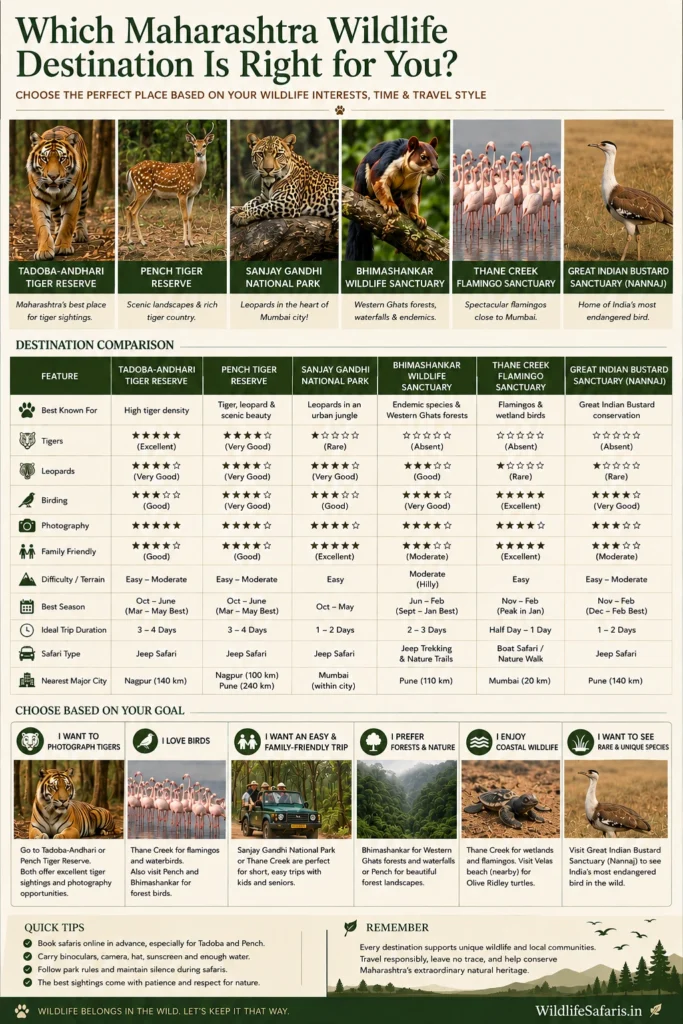
- Best Wildlife Experiences: Tiger safaris in Tadoba and Pench, photographing Flamingos on a boat safari in Thane Creek, leopard spotting nature walks in SGNP, and tracking the Indian Giant Squirrel in Bhimashankar.
Conservation Challenges
- Linear Infrastructure vs. Corridors: The rapid expansion of highways (such as the NH-44) and railway lines through the Vidarbha landscape severely fragments critical tiger corridors connecting Tadoba, Pench, and Kanha. This necessitates the construction of expensive wildlife mitigation structures like underpasses.
- Urban-Leopard Conflict: In Mumbai (SGNP) and Junnar, human encroachment into forest boundaries and the presence of feral dogs attract leopards into dense human settlements, requiring continuous monitoring and community conflict-mitigation programmes.
- Coal Mining: Extensive open-cast coal mining in the Chandrapur district degrades peripheral forest areas around Tadoba-Andhari Tiger Reserve, exacerbating human-wildlife conflict by pushing animals into agricultural fields.
- Grassland Conversion: The historic conversion of semi-arid grasslands into agricultural land in Solapur has led to the catastrophic decline of the Great Indian Bustard, which now hovers on the brink of regional extinction.
- Deforestation in the Western Ghats: Illegal logging, unregulated eco-tourism, and agricultural expansion threaten the highly sensitive, endemic ecosystems of the Sahyadri range.
- Forest Fires: The dry deciduous forests of Vidarbha are highly susceptible to natural and anthropogenic fires during the harsh summer months (March to May), destroying undergrowth and ground nests.
Responsible Wildlife Tourism
- Follow Urban Safari Rules: When visiting Sanjay Gandhi National Park, respect the unique urban-wild proximity. Stay on designated paths, do not litter, and never hike into restricted core areas without official permission.
- Plan Ahead for Tiger Reserves: Tadoba and Pench are highly popular and regulate entry through strict quotas. Book safari permits well in advance via the official portal to ensure access.
- Silence on the Water: While observing flamingos in Thane Creek or visiting coastal turtle nesting sites like Velas, maintain absolute silence to avoid stressing the migratory flocks and nesting females.
- No Flash Photography: Disable camera flashes during safaris, especially when encountering leopards in dense foliage or nocturnal species during evening nature trails.
- Support Local Communities: Utilise eco-tourism homestays and community-led wildlife guiding services, particularly around the Sahyadri Tiger Reserve and Bhimashankar, to promote conservation-linked livelihoods.
- Respect Floral Endemism: When visiting the Kaas Plateau (a UNESCO site) during the monsoon bloom, never step off the designated boardwalks to photograph flowers, as the shallow soil and flora are incredibly fragile.
Did You Know?
- Sanjay Gandhi National Park in Mumbai is one of the only national parks in the world situated entirely within municipal limits, supporting a staggering density of over 40 wild leopards.
- Tadoba National Park, established in 1955, is Maharashtra’s oldest and largest national park, famously known as the “Jewel of Vidarbha.”
- Lonar Lake in the Buldhana district is a Ramsar site and a notified National Geo-heritage Monument, created by a Pleistocene epoch meteor impact. It is one of the only known hyper-velocity impact craters in basaltic rock anywhere on Earth.
- The state animal, the Indian Giant Squirrel (Shekru), builds up to half a dozen large, globular nests (dreys) in the forest canopy, using only one to deceive predators like eagles and leopards.
- Maharashtra shares the Pench Tiger Reserve with Madhya Pradesh, and both states administer their respective sections of this contiguous forest, which inspired The Jungle Book.
- The Kaas Plateau in the Western Ghats is a UNESCO World Heritage site known as the “Valley of Flowers of Maharashtra,” erupting in a carpet of endemic blooms every monsoon.
Safari Planning : Topics Cluster
- How to book a wildlife safari in India?
- Park by Park Online Safari Booking Guide
- Tiger Safari India Planning Workbook
- Park by Park Safari Permits Guide
- National Parks Permit Guide – Park by Park Guide
- Tatkal Safari Booking Guide – Last Minute Safari Permits Booking
- Tiger Safari in India Cost
- Indian Wildlife Safari Budget Planner
- Jeep vs Canter Safari
- Best time for Tiger Sightings in India
- How far advanced should you book safari permits?
- Can foreigners book Indian Wildlife Safari online?
- Special Permits Guide for Foreigners and Domestic Visitors
- How to book a Safari Permit online in India? 2026 step by step guide
- Senior Citizens Friendly Safari Planning
- Multi Generation Family Safari Planning
- 50 things to know before your first safari in India
Tiger Safari in India : Topics Cluster
- Tiger Safari Planning Workbook
- Tiger Safari Booking Guide
- Best time for tiger sightings in India
- How to increase chances of tiger sighting?
- Tiger Safari Naturalist Guide
- Tiger Safari India Cost
- How to book a Tiger Safari in India?
- Best Wildlife Tour Operators in India
- Best Destination Cities for Tiger Safaris in India
- Tiger Safari under ₹25000
- Top 10 Budget Tiger Safaris 2026
- Tiger Photography Tips
- Best Tiger Reserves
- Top 10 Tiger Reserves by sighting chances
Tadoba National Park : Topics Cluster
- Complete Guide to Tadoba National Park
- Tadoba Quick Guide
- Tadoba Safari Cost Breakdown
- Best Zones in Tadoba National Park
- Best Resorts near Tadoba Tiger Reserve
- Best Tiger Safaris around Nagpur
- Nagpur to Tadoba Travel Guide
- Mumbai to Tadoba Travel Guide
- Pune to Tadoba Travel Guide
- Wildlife in Maharashtra
- Maharashtra Wildlife Tourism