
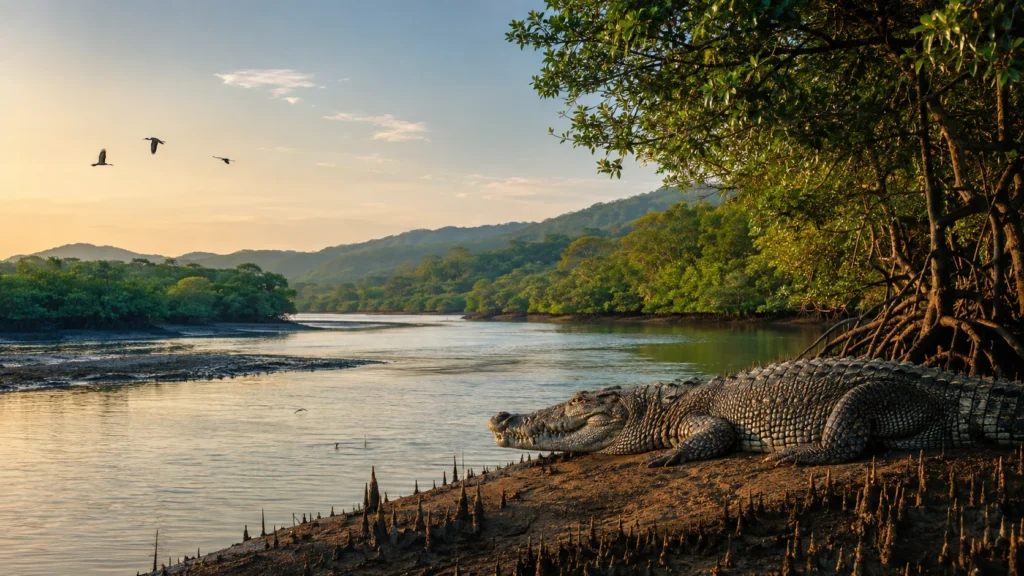
Odisha, situated along the eastern coast of India bordering the Bay of Bengal, is an ecologically magnificent state characterised by its vast river deltas, the Eastern Ghats, and the rolling Chota Nagpur Plateau. Experiencing a tropical monsoon climate, the state sustains a robust forest cover extending over thirty-three per cent of its geographical area. The vegetation transitions dramatically from the dense, salt-tolerant mangroves of the Mahanadi-Brahmani estuary to expansive tracts of tropical moist and dry deciduous forests dominated by robust sal trees in the hinterland. This diverse mosaic of ecosystems positions Odisha as a critical conservation stronghold on the eastern seaboard of the Indian subcontinent.
The wildlife of Odisha is globally significant for both its terrestrial and marine ecosystems. The dense forests of the Similipal Biosphere Reserve harbour a unique genetic anomaly—the world’s only known wild population of melanistic Bengal tigers, thriving alongside the Asian elephant and the state animal, the sambar deer. Coastal Odisha is equally spectacular. The Bhitarkanika National Park protects India’s second-largest mangrove ecosystem and acts as the prime breeding ground for massive saltwater crocodiles. Furthermore, the sandy beaches of Gahirmatha and Rushikulya witness one of nature’s greatest spectacles: the arribada, or mass nesting, of hundreds of thousands of vulnerable Olive Ridley sea turtles.
Odisha’s aquatic biodiversity is crowned by Chilika Lake, Asia’s largest brackish water lagoon and India’s first Ramsar site. This colossal wetland sustains a highly isolated population of the endangered Irrawaddy dolphin and serves as an unparalleled wintering ground for millions of migratory waterfowl navigating the Central Asian Flyway. Conservation in Odisha actively navigates the pressures of intense coastal cyclonic activity, expanding mining operations in the forested interior, and mitigating acute human-elephant conflict, striving to protect some of India’s most ecologically sensitive and distinctive natural heritage sites.
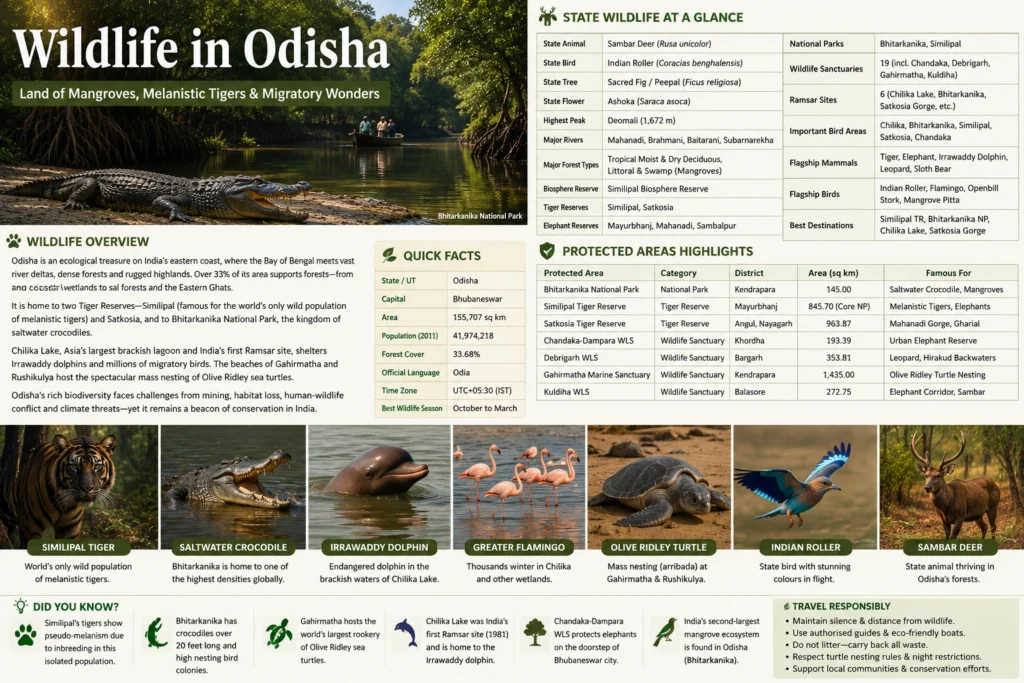
Quick Facts Table
| Category | Details |
| State / Union Territory | Odisha |
| Capital | Bhubaneswar |
| Area | 155,707 sq km |
| Population | 41,974,218 (2011 Census) |
| Forest Cover | 33.68% |
| Official Language(s) | Odia |
| Time Zone | UTC+05:30 (IST) |
| Best Wildlife Season | October to March |
State Wildlife Master Table
| Attribute | Details |
| State / Union Territory | Odisha |
| Capital | Bhubaneswar |
| Geographic Region | Eastern Coastal Plains and Eastern Ghats |
| Total Area | 155,707 sq km |
| Forest Cover | 33.68% |
| State Animal | Sambar Deer (Rusa unicolor) |
| State Bird | Indian Roller (Coracias benghalensis) |
| State Tree | Sacred Fig / Peepal (Ficus religiosa) |
| State Flower | Ashoka (Saraca asoca) |
| Highest Peak | Deomali (1,672 m) |
| Major Rivers | Mahanadi, Brahmani, Baitarani, Subarnarekha, Rushikulya |
| Major Forest Types | Tropical Moist Deciduous, Tropical Dry Deciduous, Littoral and Swamp (Mangroves) |
| Biodiversity Hotspot | Not officially specified |
| UNESCO Natural Sites | None (Bhitarkanika Conservation Area on tentative list) |
| Biosphere Reserves | Similipal Biosphere Reserve |
| Tiger Reserves | Similipal, Satkosia |
| Elephant Reserves | Mayurbhanj, Mahanadi, Sambalpur |
| National Parks | Bhitarkanika, Similipal |
| Wildlife Sanctuaries | 19 Sanctuaries (including Chandaka-Dampara, Debrigarh, Gahirmatha, Kuldiha, Karlapat, Sunabeda) |
| Conservation Reserves | Similipal-Hadgarh-Kuldiha, Brutanga |
| Community Reserves | Not officially specified |
| Ramsar Sites | Chilika Lake, Bhitarkanika Mangroves, Satkosia Gorge, Tampara Lake, Hirakud Reservoir, Ansupa Lake |
| Important Bird Areas (IBAs) | Chilika, Bhitarkanika, Similipal, Satkosia, Chandaka |
| Major Wildlife Corridors | Similipal-Kuldiha-Hadgarh Elephant Corridor, Satkosia-Baisipalli Corridor |
| Flagship Mammals | Asian Elephant, Bengal Tiger (Melanistic), Irrawaddy Dolphin, Indian Leopard |
| Flagship Birds | Indian Roller, Greater Flamingo, Asian Openbill, Mangrove Pitta |
| Endemic Wildlife | Melanistic Bengal Tiger (Pseudo-melanism unique to Similipal) |
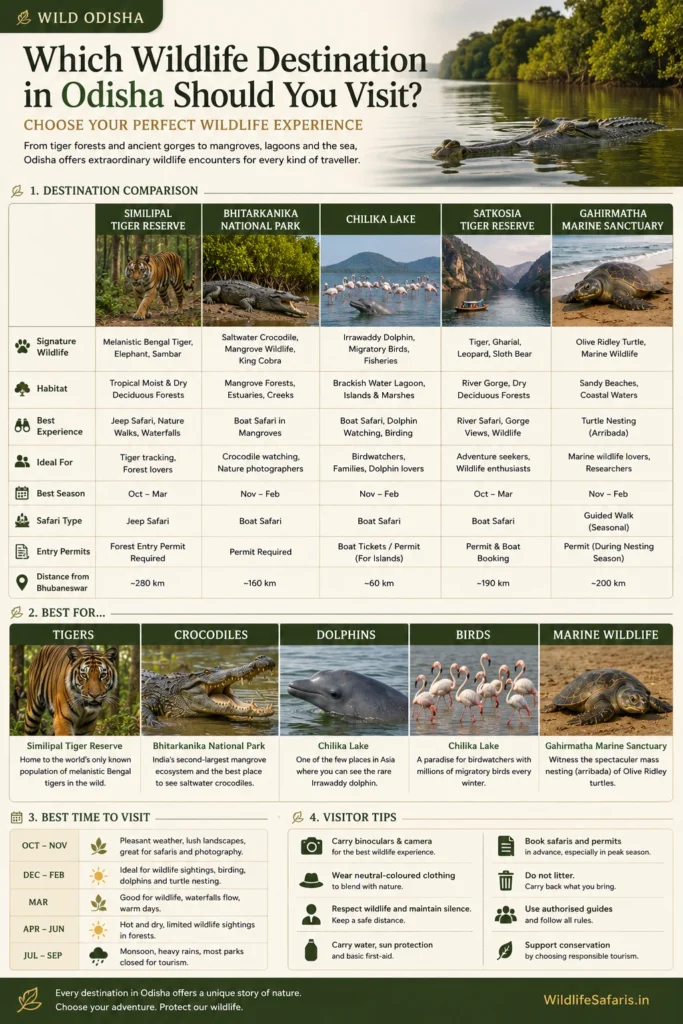
| Best Wildlife Destinations | Similipal TR, Bhitarkanika NP, Chilika Lake, Satkosia Gorge |
| Best Time for Wildlife Tourism | October to March (Monsoon restricts forest entry) |
| Nearest International Airports | Biju Patnaik International Airport (Bhubaneswar) |
| Official Forest Department Website | wildlife.odisha.gov.in / forest.odisha.gov.in |
Protected Areas Summary Table
Note: Odisha possesses 19 Wildlife Sanctuaries; the table highlights all National Parks, Tiger Reserves, and the most ecologically prominent Sanctuaries.
| Protected Area | Category | District | Area (sq km) | Year Established | Famous For |
| Bhitarkanika National Park | National Park | Kendrapara | 145.00 | 1998 | Saltwater Crocodile, Mangroves, Kingfishers |
| Similipal National Park / Tiger Reserve | Tiger Reserve | Mayurbhanj | 845.70 (Core NP) | 1980 (NP), 1973 (TR) | Melanistic Tigers, Asian Elephants, Waterfalls |
| Satkosia Tiger Reserve | Tiger Reserve | Angul, Nayagarh | 963.87 | 2007 (TR status) | Mahanadi Gorge, Gharial, Tiger Recovery |
| Baisipalli Wildlife Sanctuary | Wildlife Sanctuary | Nayagarh | 168.35 | 1981 | Satkosia Landscape, Asian Elephant, Leopard |
| Chandaka-Dampara WLS | Wildlife Sanctuary | Khordha | 193.39 | 1982 | Urban Elephant Reserve, Leopard |
| Debrigarh Wildlife Sanctuary | Wildlife Sanctuary | Bargarh | 353.81 | 1985 | Dry Deciduous Flora, Leopard, Hirakud Dam backwaters |
| Gahirmatha Marine Sanctuary | Wildlife Sanctuary | Kendrapara | 1,435.00 | 1997 | World’s Largest Olive Ridley Turtle Nesting Beach |
| Karlapat Wildlife Sanctuary | Wildlife Sanctuary | Kalahandi | 147.66 | 1992 | Phurlijharan Waterfall, Asian Elephant, Leopard |
| Kuldiha Wildlife Sanctuary | Wildlife Sanctuary | Balasore | 272.75 | 1984 | Elephant Corridor linking to Similipal, Sambar |
| Sunabeda Wildlife Sanctuary | Wildlife Sanctuary | Nuapada | 600.00 | 1988 | Grass-covered Plateau, Swamp Deer (historical), Leopard |
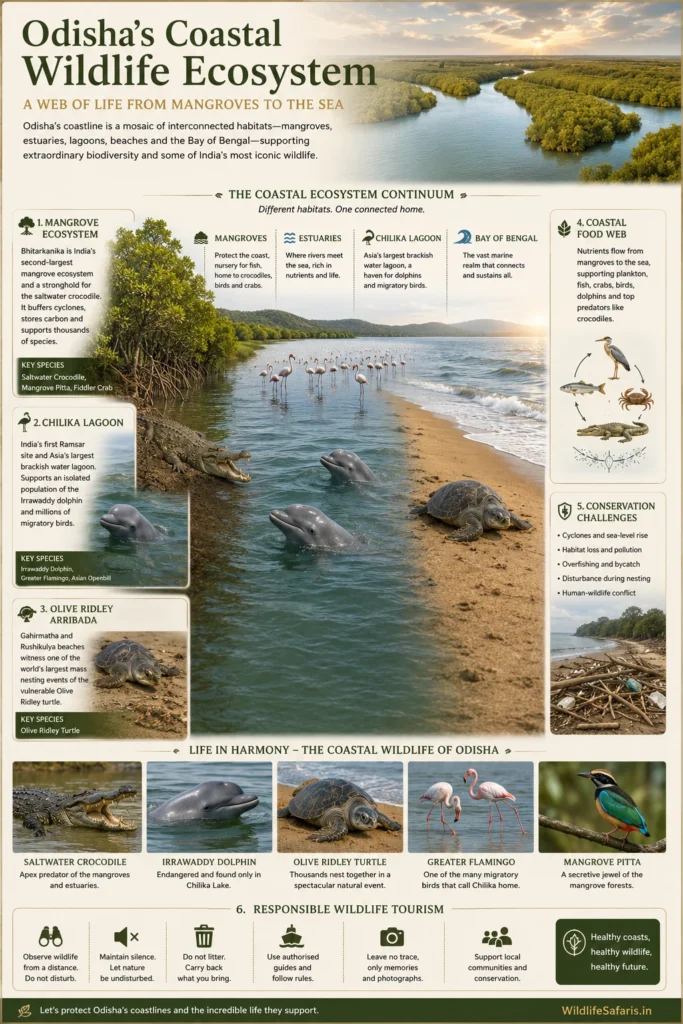
Wildlife Highlights
- Top Mammals: Asian Elephant, Bengal Tiger, Indian Leopard, Sambar Deer, Irrawaddy Dolphin (in Chilika), Gaur (Indian Bison), Sloth Bear, Indian Pangolin, Fishing Cat.
- Top Birds: Indian Roller, Greater Flamingo, Asian Openbill Stork, Mangrove Pitta, Black-capped Kingfisher, White-bellied Sea Eagle, Indian Skimmer.
- Reptiles & Amphibians: Saltwater Crocodile (Estuarine Crocodile), Olive Ridley Sea Turtle, Gharial (in Mahanadi/Satkosia), Mugger Crocodile, King Cobra.
- Flagship Flora: Sal (Shorea robusta), Teak, Sundari (Heritiera fomes – Mangrove), Bani (Avicennia officinalis), Hental (Phoenix pelludica).
- Best Wildlife Experiences: Boat safaris through the dense mangrove creeks of Bhitarkanika for crocodile spotting, dawn boat rides on Chilika Lake for Irrawaddy dolphins and flamingos, and deep forest jeep safaris in Similipal.
Conservation Challenges
- Human-Elephant Conflict: Severe habitat fragmentation caused by mining, railway expansion, and agricultural encroachment forces elephant herds out of historic corridors (like Chandaka and Keonjhar) into dense human settlements, leading to devastating crop and life losses.
- Mining Impact: Odisha is highly mineral-rich; extensive iron ore and bauxite mining in the Eastern Ghats and Chota Nagpur plateau causes severe deforestation, soil erosion, and disruption of critical watersheds.
- Coastal Vulnerability: Frequent, high-intensity cyclonic storms batter the Odisha coast, causing immense damage to the fragile mangrove forests of Bhitarkanika, which otherwise act as a crucial bio-shield.
- Turtle Bycatch: Unregulated mechanised trawling in the coastal waters off Gahirmatha and Rushikulya during the nesting season causes significant mortality among Olive Ridley turtles due to entanglement in fishing nets.
- Inbreeding in Tigers: The Similipal tiger population is highly isolated geographically. This lack of genetic exchange has resulted in pseudo-melanism (thick, merged black stripes), a direct indicator of severe inbreeding depression.
- Wetland Siltation: Chilika Lake faces continuous threats from rapid siltation, choking of its sea mouth, and unregulated aquaculture, which threatens the delicate salinity balance required by the Irrawaddy dolphins.
Responsible Wildlife Tourism
- Regulated Boat Safaris: When seeking Irrawaddy dolphins in Chilika Lake, ensure boat operators switch off their engines upon spotting a pod and maintain a respectful distance to avoid acoustic stress and propeller strikes.
- Protect Turtle Nesting Beaches: During the arribada season at Gahirmatha or Rushikulya, strictly adhere to the forest department’s night-time protocols: no flashlights, no camera flashes, and absolutely no walking near the nesting pits.
- Silence in Mangroves: Maintain quiet during boat safaris in Bhitarkanika. Loud noises startle the dense colonies of nesting herons, egrets, and openbill storks, causing them to abandon nests.
- Respect Elephant Corridors: When driving on highways passing through elephant reserves like Chandaka or Kuldiha, obey speed limits explicitly, especially at night, and never use high-beam lights or horns if an elephant is on the road.
- Zero Plastic on Coastlines: Ensure strict adherence to a plastic-free policy around all coastal sanctuaries and Ramsar wetlands to prevent marine pollution.
- Secure Proper Permits: Forest entry in Odisha, particularly for Similipal, is strictly regulated with daily vehicle caps. Procure permits in advance and always engage a local eco-guide.
Did You Know?
- Similipal Tiger Reserve is globally unique for harbouring the world’s only known wild population of pseudo-melanistic tigers, where a genetic mutation causes their black stripes to widen and merge.
- Bhitarkanika National Park is recognised as having one of the highest densities of Saltwater Crocodiles in the world, including several individuals recorded exceeding 20 feet in length.
- Gahirmatha Marine Sanctuary is the world’s largest known rookery (nesting beach) for the Olive Ridley sea turtle.
- Chilika Lake is the largest wintering ground for migratory birds on the Indian subcontinent and was the first Indian wetland to be designated a Ramsar site in 1981.
- Chandaka-Dampara Wildlife Sanctuary, located immediately adjacent to the capital city of Bhubaneswar, was created specifically to serve as a safe haven for elephants in a rapidly urbanising landscape.
- The rare and elusive Irrawaddy Dolphin, primarily found in Southeast Asian estuaries, has a highly isolated but stable population within the brackish waters of Chilika Lake.
Safari Planning : Topics Cluster
- How to book a wildlife safari in India?
- Park by Park Online Safari Booking Guide
- Tiger Safari India Planning Workbook
- Park by Park Safari Permits Guide
- National Parks Permit Guide – Park by Park Guide
- Tatkal Safari Booking Guide – Last Minute Safari Permits Booking
- Tiger Safari in India Cost
- Indian Wildlife Safari Budget Planner
- Jeep vs Canter Safari
- Best time for Tiger Sightings in India
- How far advanced should you book safari permits?
- Can foreigners book Indian Wildlife Safari online?
- Special Permits Guide for Foreigners and Domestic Visitors
- How to book a Safari Permit online in India? 2026 step by step guide
- Senior Citizens Friendly Safari Planning
- Multi Generation Family Safari Planning
- 50 things to know before your first safari in India