
Learn how Indian prey species use alarm calls to signal danger, how to interpret these sounds on safari, and how AI uses them to protect local communities.
Introduction & The Science of Forest Signals
A guide signals the driver to cut the gypsy engine. From a dense patch of scrub, a sharp, metallic bark rings out through the dry air—a sambar deer is on edge. Within moments, the surrounding forest quietens. High above, a troop of langurs scans the ground, while a small herd of spotted deer bunches together, staring fixedly into the undergrowth.
This vocalization is an alarm call, a critical tool for survival that often marks the boundary between a successful hunt and a missed opportunity for a predator. For safari travellers, learning to recognize these sounds turns a passive drive into an active exercise in wildlife tracking. In modern conservation, these same vocalizations are being used to power automated systems designed to protect both human communities and big cats.
Understanding these sounds requires looking closely at the field of acoustic ecology, examining how prey animals communicate danger, how different species share information, and how these vocalizations are analyzed in the field.
What are alarm calls and why they matter

Jungle Babbler : Alarm call specialist in India
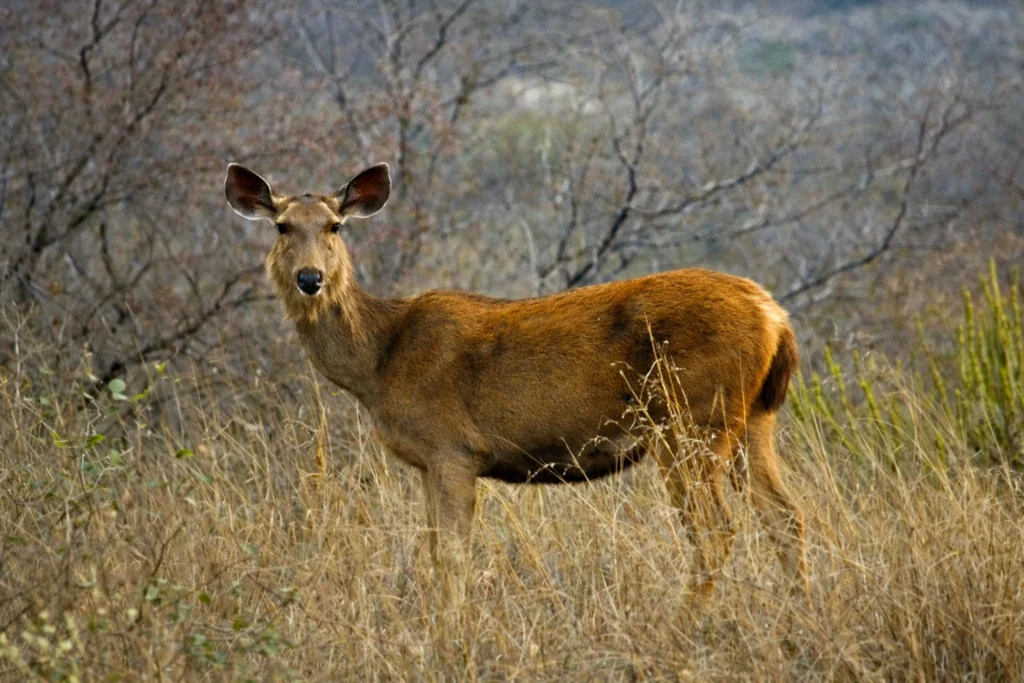
Sambar Deer : Alarm call specialist in India
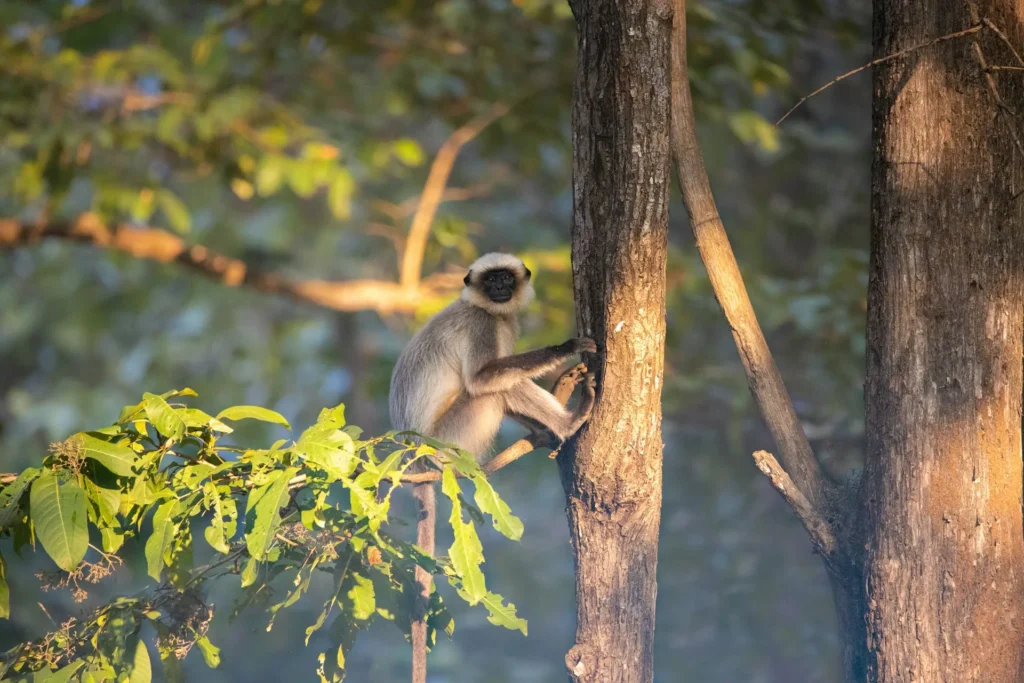
Gray / Hanuman Langur : Alarm call Specialist in India
Alarm calls are short, high-pitched or tonal vocalizations produced by prey species to alert others to the presence of a predator. Unlike territorial calls, which announce ownership, or mating calls, which attract partners, alarm calls serve an immediate protective purpose. They function as a shared language across the forest, allowing different species to benefit from each other’s vigilance.
[ Predatory Threat Spotted ]
│
▼
[ Vocal Alarm Issued by Sentinel ] ──► [ Cross-Species Interspecific Eavesdropping ]
│
├─────────────────────────┼─────────────────────────┐
▼ ▼ ▼
[ Warning Alerts ] [ Recruitment Action ] [ Mobbing Response ]
Primary functions: Warning, recruitment, and mobbing
Prey animals utilize vocal warning systems in three distinct ways depending on the nature of the threat:
- Warning Conspecifics and Heterospecifics: The primary purpose of an alarm call is to alert members of the sender’s own species (conspecifics) to seek cover. However, through a process called interspecific eavesdropping, other species (heterospecifics) regularly intercept these signals to avoid danger themselves.
- Recruitment: Certain calls serve to gather group members together, coordinate a collective retreat, or defensive formation, ensuring vulnerable individuals are protected.
- Mobbing Behavior: In some scenarios, particularly among birds and small mammals, alarm calls act as a call to action. Multiple individuals gather to vocalize loudly at a predator, effectively ruining its element of surprise and forcing it to move away.
Naturalists classify these communications into two structural categories: referential signals and graded signals. Referential signaling occurs when an animal produces distinct calls for specific types of danger—such as a different sound for an airborne eagle versus a ground-dwelling leopard. Graded signaling, by contrast, alters the intensity, frequency, or repetition rate of a single call type to reflect the immediate level of urgency or proximity of the threat.
Acoustic features of danger signals
The physical structure of an alarm call is shaped by evolution to balance two conflicting needs: notifying the community while minimizing risk to the caller.
Most mammalian and avian alarm calls feature short durations and abrupt start times. High-frequency, tonal structures make the sound distinct from the background noise of wind and rustling leaves, allowing the signal to carry clearly through dense forest canopies or over open grasslands.
Conversely, some large mammals produce deep, low-frequency rumbles or bellows when facing danger. These low-frequency sounds travel over longer distances through dense terrain and are less easily localized by predators, keeping the caller safer while alerting the herd.
Field Note
When listening to alarm calls in the field, look for repetition and pace. A single, isolated alarm call often indicates a false alarm or a distant, non-threatening movement. Rapid, continuous, and high-frequency calls usually indicate a predator that is nearby, active, and visible to the prey animal.
Senders of the Forest: Species Profiles
Indian wildlife species that produce alarm calls
Knowing which animal is sounding the alarm helps determine the specific type of predator nearby and the probability of an actual sighting. On a safari, not all calls carry the same weight. Some species are highly nervous and vocalize at minor disturbances, while others are reliable sentinels that only call when a major predator is visually confirmed.
To interpret the forest accurately, a naturalist must understand the specific acoustic profiles and typical threat targets of India’s key prey species.
Deer: Sambar, chital, and barking deer
Deer are the most common ground-level sentinels in Indian forests. Their calls vary significantly in pitch, acoustic structure, and reliability.
- Sambar (Rusa unicolor): Sambar produce a deep, resonant, and metallic honk or bark. Because they prefer dense cover and are generally less easily spooked than other deer, their alarm call is highly reliable. A sambar sounding an alarm usually indicates a direct visual sighting or a very strong scent of a tiger, leopard, or a pack of dholes (wild dogs).
- Chital / Spotted deer (Axis axis): Chital produce a sharp, high-pitched yelp or bark. They inhabit open meadows and forest edges, making them highly visible. Chital are inherently nervous and will call at the sight of tigers and leopards, but they frequently also vocalize at jackals, sudden human movement, or even snapping branches. They are excellent general indicators of movement but offer lower reliability for big cats specifically.
- Barking deer / Muntjac (Muntiacus spp.): True to their name, barking deer emit a hoarse, guttural sound closely resembling a domestic dog’s bark. They repeat this call frequently when stressed. Acoustic studies of muntjac calls highlight their distinct frequency structure, which carries well through their preferred dense, hilly terrains. They are reliable indicators of stealthy ground predators like leopards.
Primates: Langurs and macaques
Primates hold a distinct advantage as sentinels because they occupy the forest canopy, offering them a wide, unobstructed vantage point.
- Common Langur (Semnopithecus spp.): Langurs emit a harsh, coughing, guttural “khok-khok” sound. Safari guides and naturalists consider langurs to be among the most trustworthy sentinels in the jungle. When a langur calls while staring intently at the ground, a large predator—almost always a tiger or leopard—is highly probable.
- Bonnet macaque (Macaca radiata): Macaques utilize high-pitched screeches and rapid chattering. While they do alert to big cats, their threat matrix is much broader. They will frequently sound alarms for birds of prey (raptors), large snakes, and smaller felines, making their calls less predator-specific than those of langurs.
Birds and small mammals: Drongos, crows, babblers, and squirrels
Ground predators must also navigate the vigilance of birds and small mammals, which often engage in aggressive mobbing behaviors.
- Three-striped palm squirrel (Funambulus palmarum): These small mammals produce a sharp, repetitive, high-pitched whistle or trill. They are excellent indicators of stealthy threats operating at close range, such as leopards, small cats, or snakes moving through the undergrowth or lower tree branches.
- Birds (Drongos, Crows, Babblers): Flocks of crows and babblers engage in loud, agitated scolding when they locate a resting leopard or owl, effectively ruining the predator’s camouflage. Drongos (Dicrurus spp.) are particularly notable for their complex vocalizations, which include sophisticated interspecific eavesdropping and the mimicry of other species’ warning sounds.
Species Alarm-Call Quick Reference
The following table compares the typical acoustic profiles and reliability levels of common Indian forest sentinels.
| Species | Audio Profile & Pitch | Principal Threat Target | Sentinel Reliability Level | Primary Habitats |
| Sambar | Resonant, deep metallic honk | Tiger, Leopard, Dhole | High | Dense scrub, woodland |
| Chital | High-pitched yelp or bark | Tiger, Leopard, Dhole, Jackal | Moderate (easily spooked) | Open meadows, forest edges |
| Barking Deer | Guttural, dog-like bark | Leopard, Tiger, Dhole | High | Dense forest, hilly terrain |
| Common Langur | Guttural, repetitive cough | Tiger, Leopard | Very High | Canopy, mixed woodland |
| Bonnet Macaque | High-pitched screech | Leopard, Raptor, Snake | Moderate | Deciduous forest edges |
| Palm Squirrel | Rapid, high-pitched trill | Leopard, Snake, Small cat | High (for close-range threats) | Woodlands, camp areas |
| Drongo | Harsh scolding, mimicry | Birds of prey, small cats | Moderate (often mimics) | Mixed forests |
Field Interpretation & Safari Protocol
How to interpret alarm calls in the field
Hearing an alarm call is only the first step in tracking wildlife; interpreting it correctly is what separates an experienced naturalist from a casual visitor. In the dense scrub of Central Indian dry forests or the thick undergrowth of reserves like Bandipur and Kabini, visibility is often severely limited. Guides rely on acoustic cues to understand predator movements long before a tiger or leopard steps into the open.
Interpreting these calls requires understanding context. A single, isolated chital yelp might simply mean the animal was startled by a snapping branch. However, a continuous, rapid succession of calls from multiple species—often referred to as a “graded signal”—indicates a high level of urgency and a predator that is actively moving through the territory.
Visual cues that validate acoustic alerts
To confirm whether an alarm call is a genuine predator sighting or a false alarm, naturalists immediately look for paired visual behaviors. Animals rarely vocalize without accompanying physical reactions. When you hear an alert, scan the prey animals for the following behaviors:
- The Freeze: The most immediate reaction to a threat is complete stillness. Sambar and chital will stop feeding instantly, locking their bodies in place to avoid drawing attention to themselves.
- Directional Staring: Prey species will point their ears and stare fixedly in the direction of the threat. If you observe a langur in the canopy and a sambar on the ground staring intensely at the same patch of bamboo, they have successfully triangulated the predator’s location.
- Herd Tightening: Chital and barking deer will cluster tightly together, moving young fawns to the center of the group. This defensive formation makes it harder for a predator to single out an individual.
- Males Scanning: Dominant males will often step slightly forward or move to higher ground to scan the tree line, actively assessing the distance and trajectory of the threat.
Expert Tip
Watch the tail. While vocalizing, many deer species will raise their tails straight up, exposing a white patch of fur. This visual alarm signal is just as important as the vocal one, helping to warn other herd members who might be out of earshot but within a visual line of sight.
Safari protocols for travellers and drivers
When the forest erupts in warning calls, the environment becomes highly sensitive. The way tourists and safari drivers behave in these moments directly impacts both the wildlife and the likelihood of a successful sighting. The primary goal is to minimize human interference so the natural predator-prey dynamic can unfold.
Any sudden noise, movement, or aggressive maneuvering of the safari vehicle can easily cause the prey to scatter, which in turn causes the predator to abandon its path and retreat deep into the cover.
Safari Field Response Checklist
The following table outlines the required protocols for safari vehicles when an alarm call is heard nearby.
| Direct Action | Rationale | Mistake to Avoid |
| Stop the vehicle and turn off the engine | Eliminates mechanical noise, allowing you to hear the frequency and direction of the calls clearly. | Keeping the diesel engine idling, which drowns out subtle acoustic cues. |
| Maintain absolute silence | Predators rely on stealth. Human voices cause them to change direction and avoid the road entirely. | Whispering loudly or moving around inside the vehicle to get a better camera angle. |
| Observe the prey’s line of sight | Herbivores stare directly at the threat. Following their gaze tells you exactly where to look. | Scanning randomly instead of watching the behavior of the sentinels. |
| Hold your position | Predators often use the dirt tracks to cross between forest blocks. Staying still lets them approach. | Urging the driver to race ahead or reverse aggressively to chase the sound. |
| Avoid shining lights (if at dusk/night) | Artificial light blinds wildlife, disorients prey, and disrupts hunting behaviors. | Using flash photography or spotlights, which is strictly prohibited in most reserves. |
Acoustic Ecology & Research Methodology
Scientific methods in alarm call analysis
While a safari guide interprets a forest’s warning signals through years of field experience, acoustic ecologists study these same sounds to understand the evolutionary mechanics of animal communication. By treating the jungle as an acoustic laboratory, researchers investigate how different species encode urgency, identify predators, and share life-saving information across species boundaries.
This research is not merely academic; establishing a precise baseline of wildlife vocalizations is the foundational step required to develop modern conservation technology and automated alert systems.
Audio recording tools and acoustic metrics
Field researchers cannot rely on standard microphones to study wildlife acoustics. They require highly sensitive, directional microphones paired with recording equipment capable of very high sampling rates. This specialized gear ensures that the full acoustic spectrum of a call is captured, including subtle harmonics and high-frequency data that the human ear cannot detect.
Once a call is successfully recorded in the wild, the audio file is processed into a spectrogram. A spectrogram is a visual graph of sound that displays time on the horizontal axis, frequency (or pitch) on the vertical axis, and acoustic energy (or loudness) through color intensity or shading.
By analyzing these visual representations, scientists measure several key metrics to decode the signal:
- Dominant frequency: The specific pitch that carries the most acoustic energy, which determines how far the sound will travel through dense foliage.
- Call duration: The precise length of a single vocalization, measured in milliseconds.
- Nonlinear phenomena: Acoustic irregularities—similar to a human voice cracking under extreme fear—that mathematically indicate the caller’s stress level and the immediate urgency of the threat.
Field Note
For research purposes, capturing clean audio in Indian reserves is notoriously difficult due to background noise like wind, cicadas, and safari vehicle engines. Researchers often have to isolate the specific frequency band of a deer’s bark from a dense wall of ambient jungle sound.
Key findings from Indian acoustic studies
Peer-reviewed analyses of Indian wildlife have provided crucial insights into how prey species adapt their warnings to their environments. Notable acoustic structure studies focusing on the Indian sambar (Rusa unicolor) and the Indian muntjac, or barking deer (Muntiacus spp.), highlight how evolution shapes these sounds.
Research demonstrates that the acoustic structure of sambar and muntjac alarm calls differs significantly, with each species utilizing distinct frequencies and durations optimized for their specific habitats. The barking deer’s hoarse, repetitive calls are structurally adapted to cut through the dense, hilly terrains they favor, while the sambar’s resonant honk is engineered to carry across mixed woodlands.
Furthermore, acoustic analysis proves that these vocalizations often function as graded signals. Rather than producing a static noise, the caller alters the pace and acoustic intensity of the alarm based on the predator’s proximity. Because these acoustic structures are highly consistent, heterospecifics (other species listening in) can accurately judge the severity of the danger. This reliable consistency is exactly what allows human researchers to program artificial intelligence to “listen” to the forest.
Applied Conservation & Early-Warning Tech
Using alarm calls for community safety and conservation
The same vocalizations that have guided safari naturalists for decades are now being harnessed to save lives outside the protected core zones of India’s forests. As human populations expand and wildlife corridors narrow, human-wildlife conflict has become a critical challenge. Conservationists are now integrating traditional tracking knowledge with modern technology to create early-warning systems that protect both villagers and predators.
Community-driven tracking and elephant alerts
In Central and Eastern India, migrating elephant herds frequently cross into agricultural land, leading to tragic encounters. Unlike big cats, elephants announce their presence with deep rumbles, snapping branches, and the alarm calls of the birds and small mammals they disturb.
Since 2023, several states have deployed community-driven elephant warning mobile applications. These systems rely on a network of local trackers who monitor forest perimeters for physical signs and acoustic warnings. When a tracker hears the telltale signs of a herd, they log the location into the app, which instantly sends SMS alerts and triggers automated sirens in nearby villages. Public reporting indicates these community tracker apps have led to marked reductions in human casualties where implemented.
Automated AI tiger alert networks
For stealthy predators like tigers, human tracking is often not fast enough. In 2026, an experimental AI-driven tiger alert system was successfully deployed in the buffer zones of the Pench Tiger Reserve and the Nagpur territorial forests.
This system does not rely solely on visual camera traps, which are only effective if a tiger walks directly in front of the lens. Instead, it utilizes a network of acoustic sensors programmed to “listen” for the specific distress vocalizations of sambar and chital.
When the AI model detects a confirmed alarm call, the architecture follows a rapid protocol:
- The audio sensor captures the sound and filters out ambient noise.
- The AI algorithm matches the acoustic signature against a database of verified deer alarm calls.
- If a match is found, the system instantly triggers a loud siren in the nearest village and sends alerts to the mobile phones of local forest officials.
Because tigers rarely move into open spaces near human settlements during daylight, this audio-based detection provides a proactive, reliable perimeter defense that visual cameras cannot match.
Manual Tracking vs. Automated AI Audio Alert Systems
| Operational Metric | Manual Tracker Reliance | AI Sound Sensor Networks |
| Response Time | Moderate (depends on human reporting speed) | Instantaneous (automated processing) |
| Primary Triggers | Visual tracks, dung, large-scale forest disturbance | Species-specific alarm calls (sambar, chital) |
| False Positives | Low (human verification) | Moderate (requires continuous algorithmic tuning) |
| Deployment Examples | Elephant alert apps in Chhattisgarh and surrounding regions | Pench Tiger Reserve buffer zones (2026 deployment) |
Common mistakes when interpreting forest sounds
Even experienced wildlife tourists can misinterpret the jungle. Avoid these common traps:
- Assuming every call means a tiger: Alarm calls indicate a perceived threat, which could be a leopard, wild dogs, a python, or even a human on foot. Context is everything.
- Trusting every species equally: A chital’s yelp is helpful, but they are notoriously skittish. A langur or sambar call carries much more weight when determining if a big cat is actually present.
- Ignoring graded signals: A single, isolated bark is often a false alarm. It is the continuous, rapid repetition of calls from multiple animals that indicates an active, moving predator.
Frequently asked questions
1. What exactly is a wildlife alarm call? An alarm call is a short, high-pitched, or tonal vocalization produced by a prey species to warn others of an approaching predatory threat.
2. Which animals in India give the most reliable tiger warnings? Common langurs and sambar deer are considered the most trustworthy sentinels. Their calls usually indicate a direct visual sighting or strong scent of a tiger or leopard.
3. How do deer alarm calls differ between chital, sambar, and barking deer? Chital produce a high-pitched yelp, sambar emit a deep, resonant, metallic honk, and barking deer produce a guttural sound closely resembling a dog’s bark.
4. Can primates like langurs distinguish between a tiger and a leopard? While their calls are highly reliable for big cats, langurs generally use the same harsh, coughing alarm for both tigers and leopards.
5. Do birds give alarm calls for ground predators in India? Yes. Flocks of crows and babblers will loudly scold resting leopards, and drongos frequently mimic the warning calls of other species to signal danger.
6. Are wildlife alarm calls learned behaviors or innate instincts? The acoustic structure of the call is largely innate, but the specific context of when to use it—and how to interpret the calls of other species—is often refined through learning and experience.
7. What should a safari tourist do immediately upon hearing an alarm call? Tourists should ask the driver to stop the vehicle and turn off the engine, maintain absolute silence, and watch the prey animals to see where they are staring.
8. How does an AI tiger alert system listen to the forest? The system uses strategically placed audio sensors to capture forest sounds, filtering them through an AI model trained to identify the specific acoustic signatures of deer alarm calls.
9. Can alarm calls help reduce human-wildlife conflict in agricultural areas? Yes. By linking these natural acoustic warnings to mobile apps and automated sirens, communities receive early warnings of approaching elephants or tigers, allowing them to take shelter.
10. Where can naturalists access reliable sound archives of Indian wildlife? Nature audio enthusiasts and researchers can often find high-quality field recordings through specialized wildlife sound libraries, acoustic ecology publications, and platforms like Nature inFocus.
Conclusion and actionable resources
The forest is never truly silent; it is a complex, networked landscape where survival depends on listening. For the safari traveller, learning the language of chital, sambar, and langurs transforms a simple drive into an immersive lesson in animal behavior. For researchers and conservationists, these same sounds are the key to building smarter, safer boundaries between human communities and the wild.
The next time you find yourself in an Indian tiger reserve, close your eyes, turn off the engine, and listen. The jungle will tell you exactly what is moving through it.
Author Note & Update Log: Written by the WildlifeSafaris.in Editorial Team. Last Updated: August 2026.
FIELD CHECKLIST: 10 Alarm Calls Every Safari-Goer Should Know
Welcome to the jungle’s early-warning system.
Use this quick-reference guide during your safaris in India’s tiger reserves to understand what the forest is telling you. Remember: context is everything. Always look for accompanying visual cues like freezing, staring, or herd tightening.
🦌 The Ground Sentinels (Deer & Antelope)
1. Sambar Deer
- What it sounds like: A deep, resonant, metallic honk or bark.
- What it means: High probability of a Tiger, Leopard, or Wild Dog (Dhole). Sambar prefer dense cover and are not easily spooked; their alarms are highly reliable.
2. Chital (Spotted Deer)
- What it sounds like: A sharp, high-pitched yelp or bark.
- What it means: A predator is nearby, but chital are very skittish. They may also be reacting to a jackal, a snapping branch, or human movement. Look for continuous, repeated calling.
3. Barking Deer (Muntjac)
- What it sounds like: A hoarse, guttural, repetitive sound closely resembling a domestic dog.
- What it means: Often indicates a stealthy, ground-level predator like a leopard moving through dense, hilly terrain.
4. Nilgai (Blue Bull)
- What it sounds like: A short, deep, guttural grunt or roar.
- What it means: A significant threat. Because of their immense size, adult Nilgai are generally only threatened by tigers.
🐒 The Canopy Sentinels (Primates)
5. Common Langur
- What it sounds like: A harsh, two-syllable, guttural cough (khok-khok).
- What it means: The gold standard of safari sentinels. If a langur is calling while staring intently at the ground, a tiger or leopard is almost certainly present.
6. Bonnet Macaque
- What it sounds like: Rapid chattering and high-pitched screeches.
- What it means: A potential threat, but macaques cast a wide net. They will sound alarms for big cats, but also for birds of prey, large snakes, and smaller felines.
🪶 The Small Mammals & Avian Sentinels
7. Three-Striped Palm Squirrel
- What it sounds like: A rapid, high-pitched, repetitive trill or whistle.
- What it means: Excellent indicator of close-range, stealthy threats like leopards, small cats, or snakes moving through the undergrowth.
8. Greater Racket-Tailed Drongo
- What it sounds like: Complex scolding; frequently mimics the alarm calls of other species.
- What it means: A highly intelligent bird warning of smaller predators, raptors, or small cats.
9. Jungle Babblers (The “Seven Sisters”)
- What it sounds like: Extremely loud, agitated, continuous squeaking and chattering from a flock.
- What it means: Often signals a “mobbing” behavior. They have likely spotted a resting leopard, owl, or snake and are attempting to drive it away by ruining its camouflage.
10. Peafowl (Peacock)
- What it sounds like: A loud, piercing, trumpet-like honk (may-awe), especially when flying up to roost.
- What it means: Often used to warn of a tiger or leopard on the move, though they will also call loudly when startled or during loud thunder.
🛑 The Golden Rules of Safari Acoustics
- Kill the Engine: If you hear an alarm call, kindly ask your driver to stop and turn off the vehicle. Mechanical noise drowns out the forest.
- Hold Your Position: Predators use the same dirt tracks vehicles do. If you wait silently, the animal may walk right out in front of you.
- Follow the Eyes: Prey animals stare directly at the threat. Follow their gaze to find the predator.
- Listen for the “Graded Signal”: One bark is a false alarm. A continuous chorus of calls means the predator is actively hunting and visible.