
Punjab, situated in the northwestern plains of the Indian subcontinent, is overwhelmingly characterised by its intensive agricultural landscape and extensive river systems. The state’s physiography is dominated by the fertile alluvial plains drained by the Sutlej, Beas, and Ravi rivers, flanked by the undulating Shivalik foothills in the northeastern districts of Pathankot, Hoshiarpur, and Rupnagar. Consequent to its profound agrarian focus, Punjab possesses one of the lowest forest covers in India, recorded at under four per cent of its total geographical area. The natural vegetation is primarily restricted to tropical dry deciduous forests in the Shivaliks, thorny scrub in the southwest, and vital riparian ecosystems along the major river courses.
Despite the absence of any designated National Parks, Punjab sustains highly specialised and globally significant biodiversity, heavily anchored by its freshwater ecosystems. The state is renowned for its six Ramsar-designated wetlands. The confluence of the Beas and Sutlej rivers forms Harike Lake, the largest wetland in northern India, which acts as an irreplaceable wintering ground for tens of thousands of migratory waterfowl traversing the Central Asian Flyway. The Beas River Conservation Reserve holds extraordinary ecological importance as the only habitat in India for the endangered Indus River dolphin. Furthermore, successful conservation programmes have recently reintroduced the critically endangered gharial to the Beas river system after a regional absence of over three decades.
Terrestrial wildlife conservation in Punjab relies significantly on historic Birs (erstwhile royal hunting reserves converted to sanctuaries) and robust community-led initiatives. The Abohar Wildlife Sanctuary stands as a unique conservation model where the local Bishnoi community fiercely protects the state animal, the blackbuck, across private agricultural lands. While terrestrial safaris are limited, Punjab offers exceptional ornithological and riverine wildlife experiences, demonstrating remarkable ecological resilience within a highly modified agrarian landscape.
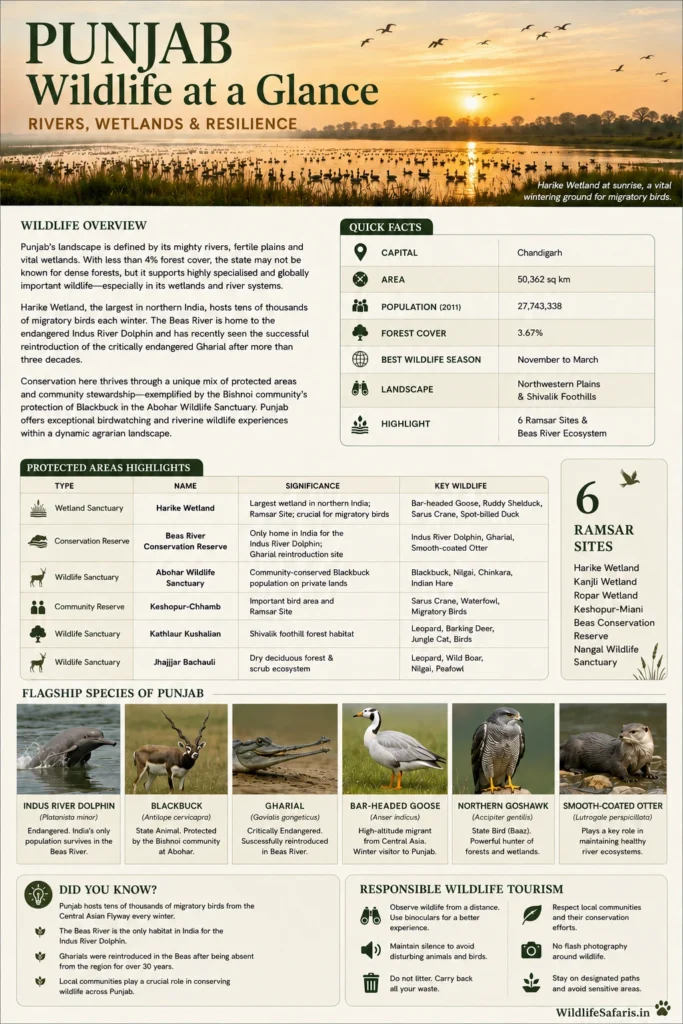
Quick Facts Table
| Category | Details |
|---|---|
| State / Union Territory | Punjab |
| Capital | Chandigarh |
| Area | 50,362 sq km |
| Population | 27,743,338 (2011 Census) |
| Forest Cover | 3.67% |
| Official Language(s) | Punjabi |
| Time Zone | UTC+05:30 (IST) |
| Best Wildlife Season | November to March |
State Wildlife Master Table
| Attribute | Details |
|---|---|
| State / Union Territory | Punjab |
| Capital | Chandigarh |
| Geographic Region | Northwestern Plains and Shivalik Foothills |
| Total Area | 50,362 sq km |
| Forest Cover | 3.67% |
| State Animal | Blackbuck (Antilope cervicapra) |
| State Bird | Northern Goshawk / Baaz (Accipiter gentilis) |
| State Tree | Shisham / Indian Rosewood (Dalbergia sissoo) |
| State Flower | Gladiolus (Gladiolus grandiflorus) |
| Highest Peak | Unnamed peak in Dhar Kalan, Shivalik Hills (~1,000 m) |
| Major Rivers | Sutlej, Beas, Ravi, Ghaggar |
| Major Forest Types | Tropical Dry Deciduous, Tropical Thorn, Riparian Scrub |
| Biodiversity Hotspot | Not officially specified |
| UNESCO Natural Sites | None |
| Biosphere Reserves | None |
| Tiger Reserves | None |
| Elephant Reserves | None |
| National Parks | None |
| Wildlife Sanctuaries | 13 Sanctuaries (including Abohar, Harike Lake, Jhajjar Bachauli, Bir Moti Bagh, Kathlaur Kushalian) |
| Conservation Reserves | Beas River, Ranjit Sagar Dam, Ropar Wetland, Rakh Sarai Amanat Khan |
| Community Reserves | Keshopur-Chhamb, Lalwan, Siswan, Phagwara |
| Ramsar Sites | Harike Wetland, Kanjli Wetland, Ropar Wetland, Keshopur-Miani, Beas Conservation Reserve, Nangal Wildlife Sanctuary |
| Important Bird Areas (IBAs) | Harike Lake, Keshopur-Miani, Ropar, Kanjli |
| Major Wildlife Corridors | Shivalik Foothill Corridor (connecting to Himachal Pradesh and J&K) |
| Flagship Mammals | Indus River Dolphin, Blackbuck, Indian Leopard, Smooth-coated Otter |
| Flagship Birds | Northern Goshawk, Bar-headed Goose, Sarus Crane, Rufous-vented Prinia |
| Endemic Wildlife | Not officially specified (Indus River Dolphin is a regional sub-species) |
| Best Wildlife Destinations | Harike Wetland, Beas River Conservation Reserve, Abohar WLS |
| Best Time for Wildlife Tourism | November to March |
| Nearest International Airports | Sri Guru Ram Dass Jee International Airport (Amritsar), Shaheed Bhagat Singh International Airport (Chandigarh) |
| Official Forest Department Website | pbforests.gov.in |
Protected Areas Summary Table
Note: Punjab does not have any designated National Parks. The table below highlights the most ecologically significant Wildlife Sanctuaries and Conservation Reserves.
| Protected Area | Category | District | Area (sq km) | Year Established | Famous For |
|---|---|---|---|---|---|
| Abohar Wildlife Sanctuary | Wildlife Sanctuary | Fazilka | 186.50 | 1988 | Blackbuck, Nilgai, Bishnoi Community Conservation |
| Harike Lake Wildlife Sanctuary | Wildlife Sanctuary | Tarn Taran, Ferozepur | 86.00 | 1982 | Ramsar Site, Migratory Waterfowl, Indus River Dolphin |
| Bir Moti Bagh Wildlife Sanctuary | Wildlife Sanctuary | Patiala | 6.54 | 1952 | Chital, Peafowl, Historic Hunting Reserve |
| Jhajjar Bachauli Wildlife Sanctuary | Wildlife Sanctuary | Rupnagar | 1.16 | 1998 | Sambar, Barking Deer, Indian Leopard |
| Kathlaur Kushalian Wildlife Sanctuary | Wildlife Sanctuary | Pathankot | 7.58 | 2007 | Chital, Pangolin, Shivalik Foothill Ecology |
| Nangal Wildlife Sanctuary | Wildlife Sanctuary | Rupnagar | 2.90 | 2009 | Ramsar Site, Smooth-coated Otter, Indian Pangolin |
| Beas River Conservation Reserve | Conservation Reserve | Multiple (Riverine stretch) | 185.00 (River stretch) | 2017 | Indus River Dolphin, Gharial Reintroduction |
| Keshopur-Chhamb Community Reserve | Community Reserve | Gurdaspur | 3.40 | 2007 | Ramsar Site, Sarus Crane, Common Teal |
Wildlife Highlights
- Top Mammals: Indus River Dolphin, Blackbuck, Indian Leopard, Smooth-coated Otter, Nilgai, Sambar, Indian Pangolin, Golden Jackal, Jungle Cat.
- Top Birds: Northern Goshawk (Baaz), Bar-headed Goose, Greylag Goose, Sarus Crane, Painted Stork, Ferruginous Pochard, Indian Skimmer.
- Reptiles & Amphibians: Gharial (Reintroduced), Indian Softshell Turtle, Brown Roofed Turtle, Indian Python, Monitor Lizard.
- Flagship Flora: Shisham (Indian Rosewood), Kikar (Acacia nilotica), Khair (Senegalia catechu), extensive riverine reeds and Phragmites.
- Best Wildlife Experiences: Birdwatching and boating at the Harike Wetland during peak winter, spotting the rare Indus River Dolphin in the Beas river, and observing Blackbucks grazing freely in the agricultural fields of Abohar.
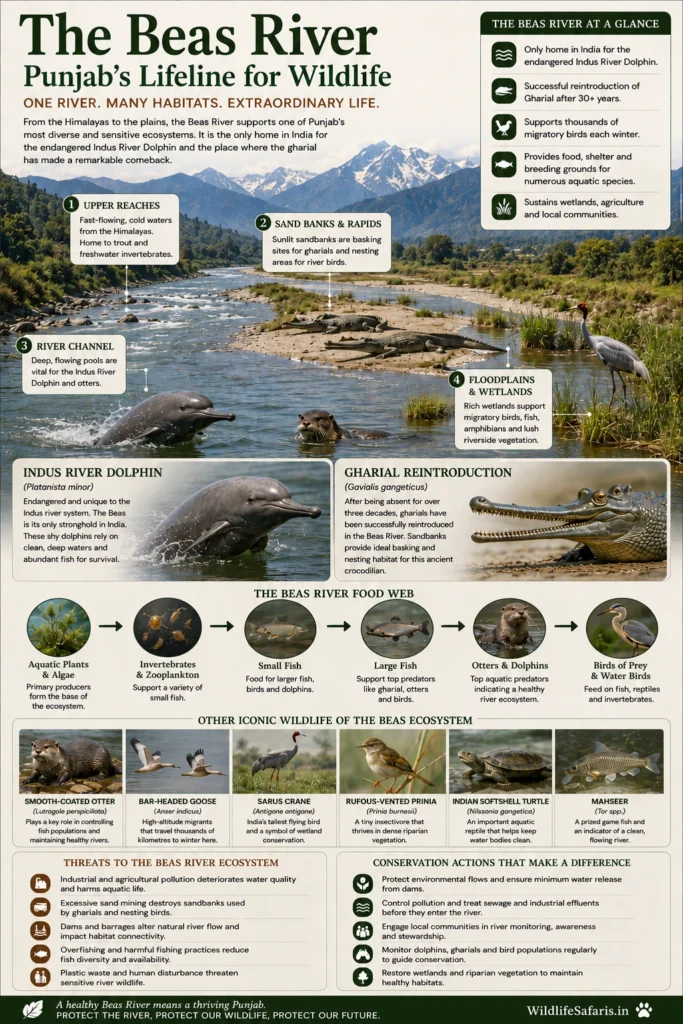
Conservation Challenges
- Agricultural Runoff: The intense use of chemical fertilisers and pesticides in Punjab’s agricultural sector leads to severe heavy metal and chemical pollution in river systems, heavily impacting aquatic species like the Indus River Dolphin and smooth-coated otter.
- Groundwater Depletion and Altered Hydrology: Over-extraction of groundwater and the extensive damming of rivers (such as the Ranjit Sagar and Pong dams) alter the natural flow and seasonal flooding required to maintain healthy riparian and wetland ecosystems.
- Habitat Fragmentation: Rapid urbanisation and the expansion of the road network restrict the movement of terrestrial mammals in the Shivalik foothills, occasionally leading to leopards straying into human settlements.
- Invasive Species: The widespread proliferation of water hyacinth in Harike and Kanjli wetlands drastically reduces open water surface area, suffocating aquatic life and limiting foraging grounds for migratory birds.
- Isolated Dolphin Population: The Indus River Dolphin population in the Beas river is incredibly small (estimated between 30 to 40 individuals) and geographically isolated by barrages, making it highly vulnerable to genetic depression and sudden hydrological changes.
Responsible Wildlife Tourism
- Respect Community Conservation: When visiting the Abohar Wildlife Sanctuary, remember that the sanctuary spans privately owned agricultural land. Respect the Bishnoi community’s customs, stay on public tracks, and do not damage crops.
- Maintain Wetland Etiquette: Use non-motorised boats where possible at Harike and Keshopur-Miani to minimise noise pollution. Keep a respectful distance from large flocks of wintering geese and ducks.
- Zero Pollution in Rivers: When observing the Beas River Conservation Reserve, ensure absolutely zero disposal of plastics or waste into the water to protect the critically endangered dolphins and gharials.
- Do Not Feed Wildlife: Avoid feeding nilgai or monkeys in the Bir sanctuaries (like Bir Moti Bagh) to prevent human habituation and dietary health issues for the animals.
- Use Authorised Guides: Engage local guides for birdwatching and dolphin spotting; their knowledge of the river currents and seasonal bird movements ensures a safe and ecologically sensitive experience.
Did You Know?
- Punjab is the only state in India where the Indus River Dolphin (Platanista minor) is found, restricted entirely to a small stretch of the Beas River.
- The Abohar Wildlife Sanctuary is unique in India as it does not consist of forest land; it comprises 13 agricultural villages where the local Bishnoi community voluntarily protects the blackbuck and nilgai.
- Harike Wetland, often referred to as “Hari-ke-Pattan,” is the largest artificial wetland in northern India, formed by the construction of a barrage across the confluence of the Beas and Sutlej rivers in 1953.
- In a landmark conservation success, the Punjab Forest Department successfully reintroduced the Gharial into the Beas river in 2017, repopulating the species in the state after it had gone locally extinct in the 1980s.
- Despite having less than 4% forest cover, Punjab boasts an impressive six Ramsar sites (Wetlands of International Importance), highlighting the outsized ecological value of its riverine landscapes.
- The state bird, the Northern Goshawk (Baaz), holds profound historical and religious significance in Sikhism, closely associated with the tenth Sikh Guru, Guru Gobind Singh Ji.
Safari Planning : Topics Cluster
- How to book a wildlife safari in India?
- Park by Park Online Safari Booking Guide
- Tiger Safari India Planning Workbook
- Park by Park Safari Permits Guide
- National Parks Permit Guide – Park by Park Guide
- Tatkal Safari Booking Guide – Last Minute Safari Permits Booking
- Tiger Safari in India Cost
- Indian Wildlife Safari Budget Planner
- Jeep vs Canter Safari
- Best time for Tiger Sightings in India
- How far advanced should you book safari permits?
- Can foreigners book Indian Wildlife Safari online?
- Special Permits Guide for Foreigners and Domestic Visitors
- How to book a Safari Permit online in India? 2026 step by step guide
- Senior Citizens Friendly Safari Planning
- Multi Generation Family Safari Planning
- 50 things to know before your first safari in India