Decode wild tiger behaviour. Learn how these apex predators hunt, defend territory, communicate, and adapt to human pressure in this expert safari guide.
Introduction, Overview & The Solitary Myth
Sitting in an open safari vehicle in the early hours of the morning, listening to the alarm calls of langurs and spotted deer, is one of the most anticipated moments of a wildlife journey. Suddenly, a track reveals a fresh, dinner-plate-sized pugmark. For a safari traveller, seeing a tiger is a matter of luck; understanding what that tiger is doing, however, is a matter of knowledge.
To truly appreciate a tiger sighting, you must understand their behaviour. Every movement—from the way a tiger scrapes its claws against a tree trunk to the direction it travels along a forest road—is part of a highly evolved system designed for survival.
Understanding Tiger Behaviour: A System for Survival
Wild tiger behaviour is not a collection of random instincts. Instead, it is a highly flexible survival system shaped directly by the tiger’s environment, the density of its prey, and the presence of human activity. As endangered apex predators, wild tigers must balance their energy expenditure carefully. Hunting is difficult, maintaining a territory is exhausting, and raising offspring is risky.
Plaintext
[ Prey Density & Cover ]
│
▼
[ Spatial & Temporal Adaptation ]
/ \
▼ ▼
[ Hunting Strategy ] [ Social / Territorial ]
(Ambush, Crepuscular/Nocturnal) (Scent-marking, Avoidance)
Why Behaviour Varies by Habitat and Prey
Tigers are remarkably adaptable. While they are biologically the same species (Panthera tigris), a Bengal tiger in the dry deciduous forests of Central India behaves differently from an Amur tiger in the snowy coniferous forests of the Russian Far East or a Sumatran tiger in dense tropical rainforests.
This variation comes down to three factors: cover, water, and prey. In grasslands and reserves with high prey density, tigers can afford to maintain smaller home ranges. In landscapes where prey is scarce or widely scattered, tigers must travel vast distances to survive, altering how they patrol their territories and interact with other tigers. Recent scientific studies from 2024 and 2025 confirm that tiger distribution and daily activity are strictly tied to where prey is available and how much human pressure exists on the forest edge.
The Truth About Solitary Living
Many popular wildlife documentaries describe the tiger as a completely isolated, lonely predator. This is a simplification. While tigers are solitary in that they forage, hunt, and travel alone, they actually live within a complex, loosely connected social network.
Field Note: A solitary lifestyle is a deliberate evolutionary choice, not a social failure. Unlike lions, which rely on pride cooperation to bring down large prey in open savannahs, a tiger relies on stealth and dense vegetation to ambush its quarry.
Plaintext
[ Lion Pride (Social) ] ◄─── Open Grassland ───► Group hunting / Shared kills
[ Tiger (Solitary) ] ◄─── Dense Cover ──────► Individual stealth / Solo kills
Why Tigers Avoid Group Living
The primary driver of a tiger’s solitary lifestyle is its hunting strategy. Because they are ambush predators, they rely entirely on the element of surprise. A group of tigers moving through dry leaves or tall grasslands would make too much noise, alerting deer and wild boar long before the cats could get within striking distance.
Furthermore, a single tiger can kill and consume prey without needing to share the carcass. A single large deer, like a sambar, provides enough meat to sustain a solitary tiger for several days. Sharing a kill with other adults is rarely energy-efficient in dense forest ecosystems.
Overlapping Ranges and Social Tolerance
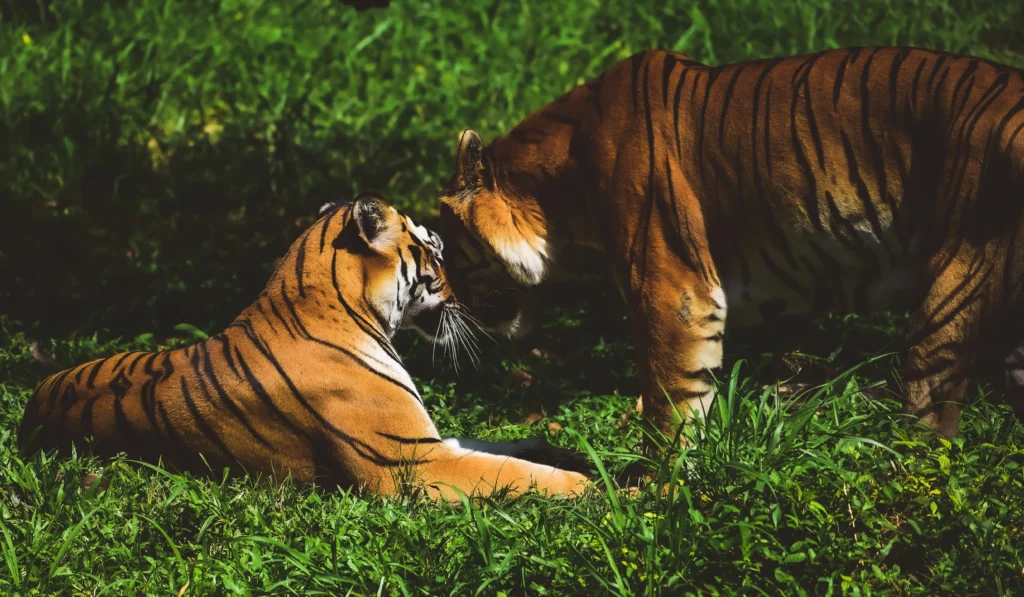
Tigers are not completely isolated from one another. Their social system is built on a framework of mutual avoidance and subtle communication, designed to keep them apart without the need for physical fighting.
Male territories are typically larger and will overlap with the smaller home ranges of multiple females. While males will actively defend their borders against other competing males, they are often surprisingly tolerant of the females and even the cubs living within their boundaries. In areas with very high prey density, naturalists have occasionally observed tigers sharing a carcass or resting in close proximity. This shows that their social structure is flexible, allowing for tolerance when resources are abundant.
| Feature | Tiger Behaviour | Lion Behaviour |
| Social Structure | Solitary (except mothers with cubs) | Highly social (prides of related females and males) |
| Hunting Style | Solo ambush predator | Cooperative group hunting |
| Habitat Preference | Dense forest, tall grasslands, heavy cover | Open woodland, plains, savannah |
| Territorial Defence | Indirect communication (scents, scrapes) | Direct physical presence and roaring patrols |
| Food Sharing | Solitary feeding; rare tolerance at large kills | Shared kills, structured by pride hierarchy |
Naturalist’s Tip: When you are on a safari, pay close attention to the trees along the forest roads. You might spot deep, vertical claw scrapes about five to six feet up a trunk. This is not a random act of scratching; it is a clear territorial marker left by a tiger to warn others that the space is occupied.
Territoriality & Communication: How Tigers Share Space
Because tigers are solitary hunters, they require exclusive access to hunting grounds. A territory is not simply a patch of forest; it is an actively patrolled area that guarantees access to three essential resources: prey, water, and dense cover. Understanding how these big cats divide and defend the jungle explains much of the behaviour you will witness on a safari.
How Tigers Establish and Defend Territory
Tigers dedicate a massive amount of time and energy to walking their territory boundaries. For an apex predator, fighting over land is always a last resort. An injury sustained in a territorial dispute can prevent a tiger from hunting, which quickly leads to starvation. Therefore, their entire territorial system is designed to establish boundaries clearly and avoid physical confrontation.
Home Range Sizes: Males vs. Females
The size and function of a home range differ significantly between the sexes. A tigress establishes a territory just large enough to provide a constant supply of meat to raise her cubs. Her primary concern is food security and finding safe cover for her offspring.
A dominant male, however, is driven by reproductive success. His territory is typically much larger and overlaps with the smaller ranges of several females. While he will fiercely defend his borders against rival males, he allows the females within his range to live and hunt freely.
Resource Gradients and Prey Abundance
A tiger’s territory size is not a fixed number; it expands or shrinks based on prey density and habitat quality. Recent ecological studies highlight that tiger occurrence is strongly linked to what researchers call “resource gradients”—specifically, the availability of prey and intact forest patches.
In highly productive habitats with dense populations of deer and wild boar, territories are naturally smaller because the tiger does not need to travel far to find food. A 2024 study noted a fascinating adaptation: tigers can even maintain high densities in multi-use landscapes shared with humans, provided there is enough prey and sufficient patches of undisturbed refuge.
The Language of Tigers
To maintain this complex spatial network without constantly fighting, tigers have developed a sophisticated, multi-layered communication system.
Scent Marking and Physical Scrapes
While tigers rely primarily on their acute sight and hearing to hunt, they rely heavily on scent to manage their social lives. A tiger patrols its boundaries leaving scent marks—usually a pungent mixture of urine and anal gland secretions—sprayed backward onto trees and bushes.
They also leave deep physical scrapes on tree trunks using their front claws, or scrape the dirt with their hind legs. These marks act as a jungle bulletin board. They tell other tigers exactly who occupies the space, how recently they passed by, and whether a resident female is ready to mate.
Field Note: When driving through a tiger reserve, your guide will frequently stop to smell specific trees at junctions in the road. Fresh tiger scent spray smells strongly of buttered popcorn or basmati rice. It is one of the most reliable indicators that a tiger has moved through the area recently.
Vocalisations: From Roars to Chuffs
Tigers produce a wide range of vocal signals depending on the distance of their intended audience. Full-throated roars are designed to carry across vast distances, advertising a tiger’s presence to rivals or calling out for a mate.
At close range, however, tigers use entirely different sounds. The most famous is the “chuff” (or prusten)—a soft, pulsing sound made by blowing air through the nostrils. It is a friendly, non-aggressive greeting frequently exchanged between a mother and her cubs, or between a courting male and female.
Facial Expressions and Body Language
When tigers do meet face-to-face, visual signals dictate the interaction. Body language helps to quickly establish dominance or submission without physical violence. A tiger defending a kill or feeling threatened will flatten its ears against its head, bare its teeth, and emit low growls. Conversely, relaxed facial muscles, forward-facing ears, and a slowly flicking tail tip indicate a neutral or tolerant disposition.
Table 2: Tiger Communication Channels
| Channel | Method | Primary Purpose |
| Scent | Urine spraying & gland secretions | Marking territory boundaries and communicating reproductive status. |
| Visual / Tactile | Claw scrapes on trees & ground | Providing a visual warning to rivals that a territory is actively patrolled. |
| Vocal (Long-range) | Roaring & deep moaning | Announcing presence across large distances or seeking a mate. |
| Vocal (Short-range) | Chuffing (Prusten) | Non-aggressive, friendly greeting used mostly between mothers, cubs, and mating pairs. |
| Body Language | Ear positioning & facial tension | Establishing dominance, submission, or threat levels during face-to-face encounters. |
The Hunt: Ambush Strategy & Daily Activity Rhythms
Spotting a sleeping tiger under the shade of a bamboo thicket is a wonderful experience, but understanding the energy dynamics of how that tiger hunts provides a deeper respect for its survival. Tigers are apex predators, yet hunting in the dense forest is an incredibly energy-intensive process that frequently ends in failure.
How Tigers Hunt and Feed
Unlike wild dogs or wolves that course and exhaust their prey over long distances, tigers are built for explosive, short-range power. Every aspect of their hunting strategy is designed to minimise the distance between themselves and their target before the prey is even aware of the danger.
The Anatomy of an Ambush
To locate prey, tigers rely primarily on their acute sight and hearing, rather than their sense of smell. They target a variety of animals depending on their habitat, with common prey including sambar deer, wild boar, gaur, and occasionally monkeys or crocodiles.
The sequence of a hunt is heavily dependent on stealth. A tiger will use tall grass, dry riverbeds, or dense vegetation to conceal its approach, stalking quietly until it is within striking distance.
Stalking, Pouncing, and Kill Methods
Once the tiger is close enough, it launches a short, rapid rush or a powerful pounce. Because their stamina for running is very low, this explosive charge must be highly calculated. A successful hunt usually involves the tiger using its immense body weight to bring the prey to the ground, followed by a precise bite to the neck or throat to secure the kill.
Feeding Behaviour and Diet Capacity
After making a kill, a tiger will usually drag the heavy carcass into thick undergrowth to hide it from scavengers like hyenas, jackals, and vultures. Tigers possess a massive digestive capacity; a single adult tiger can consume more than 80 pounds of meat at one time. A large kill, such as a full-grown deer, provides enough sustenance to feed a solitary tiger for several days, giving it the necessary energy to resume patrolling its territory.
Activity Patterns: Day, Night, and the Human Effect
To conserve energy and maximise hunting success, a tiger’s daily routine is dictated by temperature, prey movement, and the presence of human beings.
Crepuscular Activity: Dawn and Dusk Rhythms
A very common misconception is that tigers are strictly nocturnal animals. In natural, undisturbed habitats, tigers are actually crepuscular. This means their primary peaks of activity align with dusk and dawn.
These twilight hours offer the perfect hunting conditions: the fading or emerging light aids their ambush strategy, while the cooler temperatures prevent them from overheating during physical exertion. When actively hunting or patrolling boundaries, a tiger can travel anywhere from 16 to 32 kilometres in a single night. During the heat of the midday sun, they almost always seek shade near waterholes to rest and conserve energy.
Photography Tip: Because tigers are most active in low light at dawn and dusk, ensure your camera settings are optimised for these conditions. Use a fast lens and be prepared to increase your ISO to capture sharp movement during the twilight hours.
How Human Disturbance Shifts Tigers to Nocturnality
Tiger behaviour is remarkably adaptable, particularly in how they respond to human presence. Recent ecological research, including a 2024 study published in Nature, demonstrates that species adapt their activity rhythms under human pressure.
In highly disturbed habitats or multi-use landscapes shared with humans, tigers deliberately shift their behaviour to become more nocturnal. By delaying their movement and hunting activities until the deep night, they actively avoid interacting with human traffic and livestock activities during the day.
Table 3: Activity Shifts: Undisturbed vs. Disturbed Habitats
| Habitat Condition | Primary Activity Period | Movement Strategy | Behavioural Driver |
| Undisturbed Core Reserves | Crepuscular (Dawn & Dusk) | Patrols and hunts freely using natural forest cover. | Optimising hunting light and temperature. |
| Disturbed / Multi-Use Landscapes | Highly Nocturnal | Travels via hidden gullies; delays movement until deep night. | Actively avoiding human presence and daytime disturbance. |
Tiger Families, Conservation, Common Mistakes & FAQs
While a male tiger’s life revolves around securing hunting grounds and mating opportunities, a female’s life is defined by raising the next generation. Understanding the family dynamics of wild tigers offers a much clearer picture of how these populations survive and grow.
Tiger Family Dynamics and Cub Development
The most significant exception to a tiger’s solitary lifestyle is the bond between a mother and her cubs. This is the longest-lasting social connection in a tiger’s life and is crucial for the survival of the species.
Maternal Care and the Early Months
Tigresses raise their litters entirely on their own. While the resident dominant male provides indirect protection by keeping rival, potentially dangerous males out of the territory, he does not help provision the cubs with food.
The early months of a cub’s life are exceptionally vulnerable. According to the WWF, approximately half of all wild tiger cubs do not survive past their second year. During the first few months, a mother must leave her cubs in dense cover while she hunts, making them susceptible to predators and environmental hazards.
How Cubs Learn to Hunt and Survive
Learning to hunt is not completely instinctive; it requires intense practice and observation. Cubs begin by watching their mother stalk and kill. As they grow, she will bring small, injured prey back to the family resting site so the cubs can practice pouncing and subduing live animals safely. This learning phase is highly energy-intensive for the mother, as she must secure enough meat to feed herself and her rapidly growing offspring.
Dispersal and Independence
As cubs approach two years of age, their bond with their mother begins to loosen. They reach physical independence and must leave to establish their own territories. Young males typically disperse much farther away to avoid conflict with their father, while young females often try to establish home ranges adjacent to, or slightly overlapping with, their mother’s territory.
Table 4: Cub Development and Milestones Timeline
| Age | Key Behavioural Milestone |
| 0 – 6 Months | Highly vulnerable; rely completely on mother’s milk and meat she brings to the den. |
| 6 – 18 Months | Begin actively following the mother to kills and practicing ambush techniques. |
| 2 Years | Achieve independence and disperse to find their own territories. |
| 3 – 5 Years | Reach full sexual maturity and begin breeding (varies slightly between males and females). |
What Tiger Behaviour Tells Us About Conservation
Observing tiger behaviour in the wild is not just exciting for safari travellers; it provides essential data for researchers working to protect them. Behaviour is a direct indicator of habitat health.
Behavioural Indicators of Habitat Health
If tigers in a specific reserve are observed hunting during the day, maintaining relatively small territories, and successfully raising cubs to adulthood, it tells conservationists that the ecosystem is healthy. It means prey density is high, water is sufficient, and the forest cover is adequate. Conversely, if tigers are forced to travel vast distances or shift entirely to nocturnal movement, it signals that the habitat is degraded, prey is scarce, or human disturbance is too high.
Human-Wildlife Conflict and Refuges
Understanding that tigers need dense cover and prey helps mitigate human-wildlife conflict. A 2024 ecological study highlighted that tigers can survive in multi-use landscapes shared with humans, but only if they have sufficient patches of undisturbed refuge to retreat to during the day. Protecting these specific refuge patches and the wildlife corridors connecting them is vital for the long-term survival of the estimated 5,574 wild tigers remaining globally.
Common Misconceptions About Tiger Behaviour
| Myth | The Reality |
| Tigers are highly successful hunters. | Hunting is difficult and energy-intensive. Most ambush attempts fail, which is why tigers must carefully select their opportunities. |
| Tigers use their sense of smell to track prey. | Scent is primarily used for communication and territorial marking, not for hunting. Tigers rely almost entirely on their sharp eyesight and hearing to stalk prey. |
| Tigers are always nocturnal. | In natural, undisturbed habitats, they are crepuscular (most active at dawn and dusk). They become primarily nocturnal only when trying to avoid human disturbance. |
| Male tigers kill all cubs they encounter. | While males will kill the cubs of rival males to trigger a female into oestrus, they are generally tolerant of the cubs fathered within their own territory. |
Frequently Asked Questions
Are tigers completely solitary animals? No. While they hunt and travel alone, they operate within a complex social network of overlapping territories. They communicate constantly through scent and sound, and mothers maintain strong bonds with their cubs for up to two years.
Do tigers hunt at night or during the day? Naturally, tigers are crepuscular, peaking in activity during the cooler, low-light hours of dawn and dusk. However, in areas with high human activity, they adapt by shifting their hunting and travel to the middle of the night.
How do tigers mark and defend their territory? Tigers prefer to avoid physical fights. Instead, they mark their presence by spraying pungent scent marks on bushes and leaving deep claw scrapes on trees.
What does a tiger “chuff” mean? A chuff, or prusten, is a soft, pulsing sound made by exhaling through the nose. It is a non-aggressive, friendly greeting used mostly between mothers and cubs or courting pairs.
Do tigers ever hunt in groups? Almost never. Tigers are solitary ambush predators. Group hunting would create too much noise and ruin the element of surprise needed in dense forest habitats. A few rare instances of cooperative behaviour have been documented, but it is not their standard strategy.
How does human activity change wild tiger behaviour? Human presence forces tigers to alter their daily routines. They will use hidden gullies or dry riverbeds to move unseen and will delay their activity until late at night to actively avoid daytime human and livestock traffic.
Conclusion: Interpreting the Forest
A wildlife safari is not just about spotting a tiger; it is about reading the environment. Every alarm call, every scraped tree, and every fresh pugmark tells a story of survival. Tigers are not just solitary wanderers. They are highly adaptable predators operating a complex system of territory, communication, and ambush strategy.
By understanding why tigers behave the way they do, your time in the forest transforms from a simple sightseeing drive into a fascinating observation of one of the natural world’s most sophisticated apex predators.
Tiger Safari in India : Topics Cluster
- Tiger Safari Planning Workbook
- Tiger Safari Booking Guide
- Best time for tiger sightings in India
- How to increase chances of tiger sighting?
- Tiger Safari Naturalist Guide
- Tiger Safari India Cost
- How to book a Tiger Safari in India?
- Best Wildlife Tour Operators in India
- Best Destination Cities for Tiger Safaris in India
- Tiger Safari under ₹25000
- Top 10 Budget Tiger Safaris 2026
- Tiger Photography Tips
- Best Tiger Reserves
- Top 10 Tiger Reserves by sighting chances