
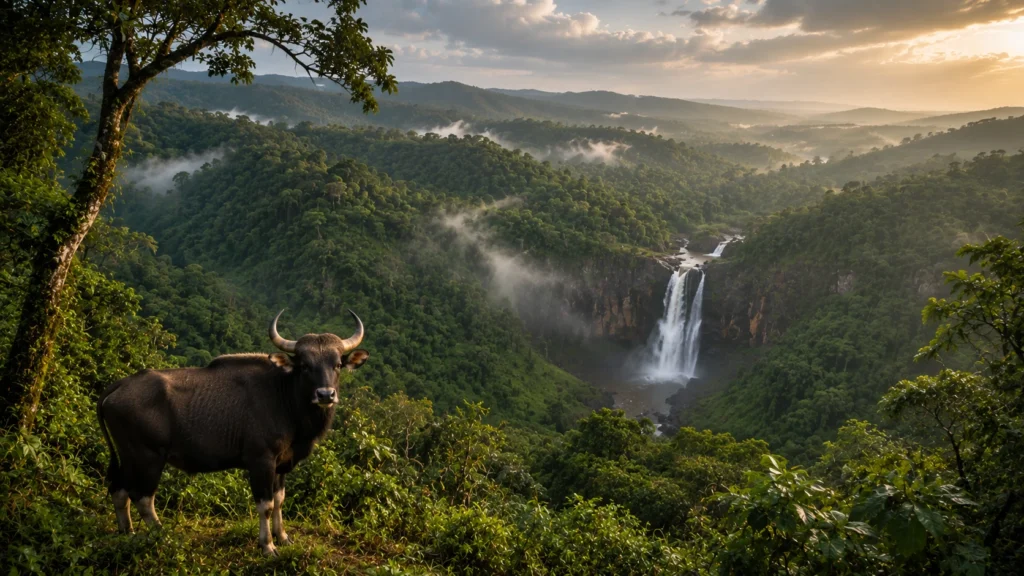
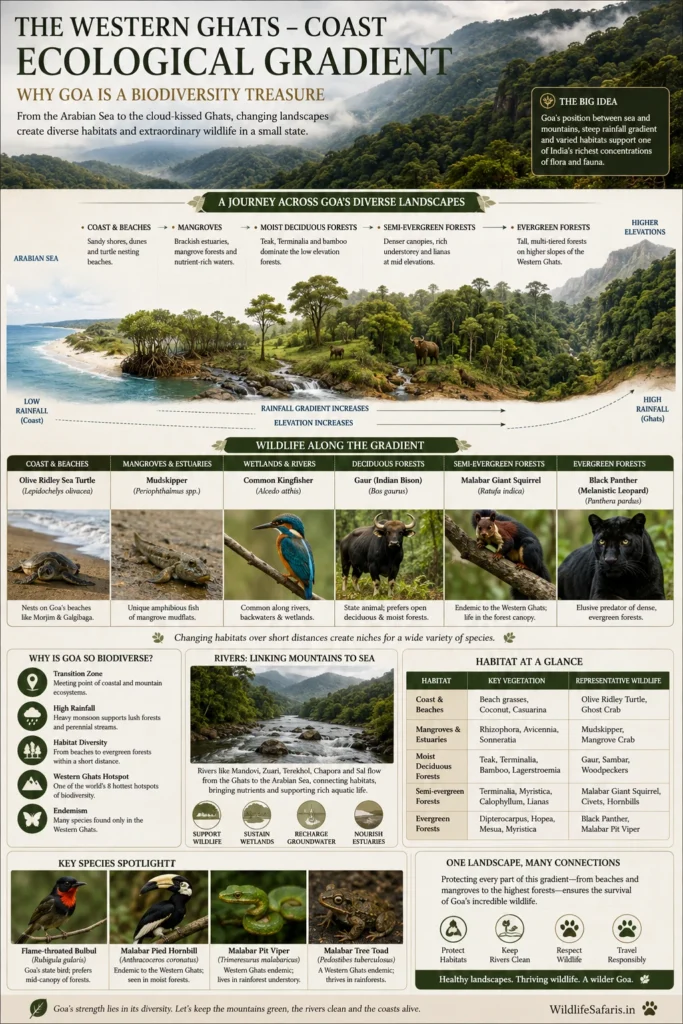
Goa, India’s smallest state by area, belies its diminutive size with an extraordinary wealth of biodiversity. Geographically wedged between the azure waters of the Arabian Sea and the rugged, forested slopes of the Western Ghats, the state represents a vibrant ecological transition zone. Experiencing a humid tropical monsoon climate, Goa receives immense rainfall that nurtures a lush, multi-tiered canopy. Nearly sixty per cent of the state’s geographical area is classified as forest cover, an impressive figure anchored by the contiguous protected network of the Eastern Goan hills. The vegetation transitions dramatically from coastal estuarine mangroves and littoral scrub to tropical moist deciduous, semi-evergreen, and pristine evergreen forests at higher elevations along the Ghats.
As an integral part of the Western Ghats biodiversity hotspot, Goa’s wildlife is incredibly rich and features a high degree of endemism. The state animal, the gaur (Indian bison), roams the dense deciduous tracts alongside the Indian leopard, sloth bear, and the Malabar giant squirrel. The dense evergreen canopies of Mhadei and Netravali Wildlife Sanctuaries occasionally yield sightings of the elusive black panther (a melanistic variant of the Indian leopard) and are recognised as critical, albeit currently unnotified, tiger habitats. Goa is also an internationally renowned ornithological destination; its forests harbour regional endemics like the state bird, the flame-throated bulbul, the Malabar pied hornbill, and the cryptic Sri Lanka frogmouth.
Beyond its terrestrial wealth, Goa’s coastline and estuarine networks are vital ecological assets. The state’s first Ramsar site, Nanda Lake, along with the Dr. Salim Ali Bird Sanctuary, provides critical refuge for migratory waterfowl. Furthermore, the pristine beaches of Morjim and Galgibaga serve as crucial nesting grounds for the globally vulnerable Olive Ridley sea turtles. While facing severe conservation challenges from intensive mining and linear infrastructure expansion, Goa’s wildlife sanctuaries offer some of the most accessible and rewarding nature trails in the Western Ghats, presenting an ecological narrative far removed from its conventional image as merely a beach destination.
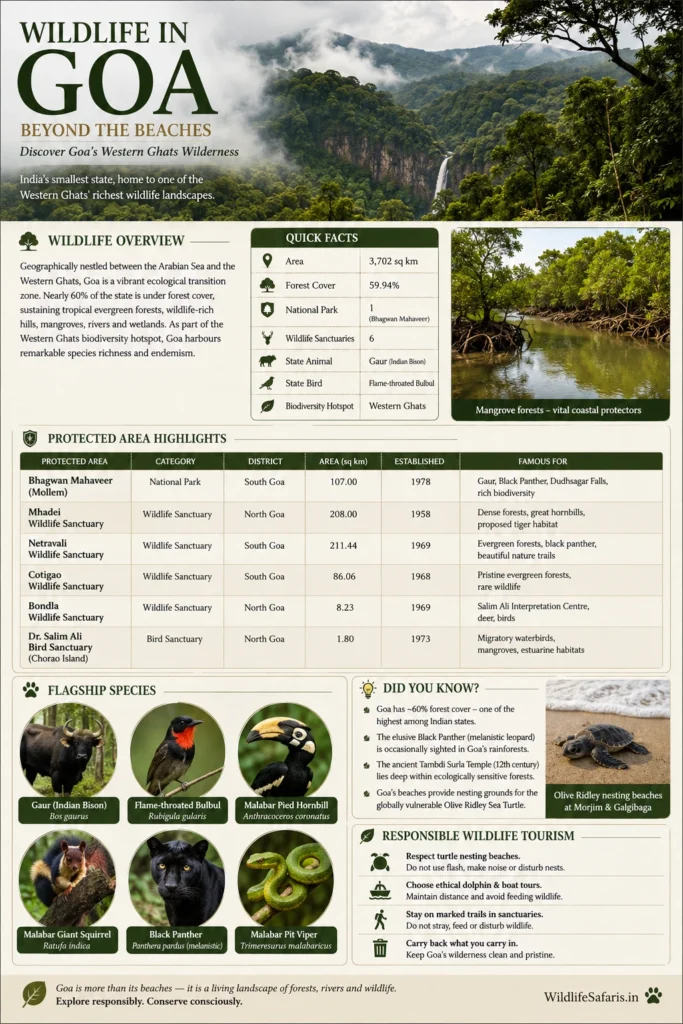
Quick Facts Table
| Category | Details |
| State / Union Territory | Goa |
| Capital | Panaji |
| Area | 3,702 sq km |
| Population | 1,458,545 (2011 Census) |
| Forest Cover | 59.94% |
| Official Language(s) | Konkani |
| Time Zone | UTC+05:30 (IST) |
| Best Wildlife Season | October to March |
State Wildlife Master Table
| Attribute | Details |
| State / Union Territory | Goa |
| Capital | Panaji |
| Geographic Region | Konkan Coast and Western Ghats |
| Total Area | 3,702 sq km |
| Forest Cover | 59.94% |
| State Animal | Gaur / Indian Bison (Bos gaurus) |
| State Bird | Flame-throated Bulbul (Rubigula gularis) |
| State Tree | Matti / Crocodile Bark Tree (Terminalia elliptica) |
| State Flower | Red Jasmine (Plumeria rubra – widely accepted) |
| Highest Peak | Sonsogor (1,026 m) |
| Major Rivers | Mandovi, Zuari, Terekhol, Chapora, Sal |
| Major Forest Types | Tropical Evergreen, Semi-evergreen, Moist Deciduous, Mangrove |
| Biodiversity Hotspot | Western Ghats |
| UNESCO Natural Sites | Western Ghats (Serial Nomination – Goa segment) |
| Biosphere Reserves | None |
| Tiger Reserves | None officially notified (Mhadei proposed) |
| Elephant Reserves | None |
| National Parks | Bhagwan Mahaveer (Mollem) |
| Wildlife Sanctuaries | Bhagwan Mahaveer, Bondla, Cotigao, Mhadei, Netravali, Dr. Salim Ali (Chorao Island) |
| Conservation Reserves | Not officially specified |
| Community Reserves | Not officially specified |
| Ramsar Sites | Nanda Lake |
| Important Bird Areas (IBAs) | Bhagwan Mahaveer WLS, Cotigao WLS, Mhadei WLS, Netravali WLS, Carambolim Lake |
| Major Wildlife Corridors | Sahyadri-Radhanagari-Goa Corridor, Kali-Bhagwan Mahaveer Corridor |
| Flagship Mammals | Gaur, Indian Leopard (including melanistic), Sloth Bear, Indian Pangolin |
| Flagship Birds | Flame-throated Bulbul, Malabar Pied Hornbill, Oriental Dwarf Kingfisher |
| Endemic Wildlife | Malabar Pit Viper, Malabar Tree Toad (Western Ghats endemics) |
| Best Wildlife Destinations | Bhagwan Mahaveer WLS, Netravali WLS, Dr. Salim Ali Bird Sanctuary |
| Best Time for Wildlife Tourism | October to March (Monsoon for amphibians/reptiles) |
| Nearest International Airports | Manohar International Airport (Mopa), Dabolim Airport |
| Official Forest Department Website | forest.goa.gov.in |
Protected Areas Summary Table
| Protected Area | Category | District | Area (sq km) | Year Established | Famous For |
| Bhagwan Mahaveer (Mollem) National Park | National Park | South Goa | 107.00 | 1978 | Gaur, Black Panther, Dudhsagar Waterfalls |
| Bhagwan Mahaveer Wildlife Sanctuary | Wildlife Sanctuary | South Goa | 133.00 | 1967 | King Cobra, Malabar Giant Squirrel, Western Ghats Flora |
| Bondla Wildlife Sanctuary | Wildlife Sanctuary | North Goa | 8.00 | 1969 | Zoological Park, Sambar Deer, Rescue Centre |
| Cotigao Wildlife Sanctuary | Wildlife Sanctuary | South Goa | 86.00 | 1968 | Multi-tiered Canopy, Slender Loris, Flying Squirrel |
| Dr. Salim Ali Bird Sanctuary | Wildlife Sanctuary | North Goa | 1.80 | 1988 | Mangrove Estuary, Kingfishers, Mudskippers |
| Mhadei Wildlife Sanctuary | Wildlife Sanctuary | North Goa | 208.48 | 1999 | Bengal Tiger Presence, Herpetofauna, Virdi Falls |
| Netravali Wildlife Sanctuary | Wildlife Sanctuary | South Goa | 211.05 | 1999 | Black Panther, Sloth Bear, Evergreen Forests |
Wildlife Highlights
- Top Mammals: Gaur, Indian Leopard (frequent Black Panther sightings), Sloth Bear, Dhole (Indian Wild Dog), Malabar Giant Squirrel, Indian Pangolin, Slender Loris.
- Top Birds: Flame-throated Bulbul, Malabar Pied Hornbill, Sri Lanka Frogmouth, Oriental Dwarf Kingfisher, Ruby-cheeked Sunbird, Malabar Trogon.
- Reptiles & Amphibians: King Cobra, Malabar Pit Viper, Bamboo Pit Viper, Indian Rock Python, Mugger Crocodile, Malabar Gliding Frog, Malabar Tree Toad.
- Marine Life: Indo-Pacific Humpback Dolphin, Finless Porpoise, Olive Ridley Sea Turtle (nesting sites at Morjim, Galgibaga, and Agonda).
- Flagship Flora: Matti (Crocodile Bark Tree), Teak, Rosewood, Bamboo, extensive Mangroves (Rhizophora and Avicennia).
- Best Wildlife Experiences: Trekking to Dudhsagar Falls through Mollem, Birdwatching boat rides in the Chorao Island mangroves, Herping (reptile/amphibian spotting) during the monsoon in Amboli/Mhadei, and Dolphin spotting off the coast of Sinquerim.
Conservation Challenges
- Mining Impact: Historically, unregulated open-cast iron ore mining has caused severe habitat destruction, soil erosion, and the siltation of vital rivers and streams within and adjacent to protected areas.
- Linear Infrastructure Projects: Proposed highway expansions, power transmission lines, and the double-tracking of the South Western Railway passing through Bhagwan Mahaveer Wildlife Sanctuary pose an immense threat to the unbroken canopy and wildlife corridors.
- Delayed Tiger Reserve Status: Despite documented presence and breeding of Bengal tigers, the delay in officially notifying the Mhadei-Netravali landscape as a Tiger Reserve hampers access to federal conservation funding and stringent protective measures.
- Tourism Pressure: Unregulated coastal tourism, light pollution, and beach commercialisation severely disrupt the nesting habitats of the vulnerable Olive Ridley sea turtles.
- Forest Fires: During the dry summer months (March-May), man-made forest fires—often ignited for clearing undergrowth for cashew plantations—threaten the fringes of the sanctuaries.
- Poaching: Localised poaching for bushmeat (wild boar, sambar, and porcupine) and occasional retaliatory killings of leopards and tigers due to livestock depredation.
Responsible Wildlife Tourism
- Support Turtle Conservation: When visiting nesting beaches like Galgibaga or Morjim, maintain absolute distance from nesting sites, do not use flashlights at night, and keep noise to a minimum.
- Ethical Dolphin Tours: Ensure boat operators maintain a minimum distance of 50 metres from dolphin pods, approach parallel to their direction of travel, and never chase or encircle them.
- Trek Responsibly: While hiking to Dudhsagar Falls or Tambdi Surla, stick strictly to the marked trails to avoid trampling endemic undergrowth and disturbing ground-nesting birds.
- Respect Herpetofauna: Goa is a global hotspot for reptiles and amphibians. During monsoon nature walks, look but do not handle or disturb snakes and frogs; always use trained local naturalists.
- Zero Littering: Carry all plastic waste out of the wildlife sanctuaries. The dense foliage can easily conceal waste, which is hazardous to foraging animals.
- Minimise Speed: Adhere to strict speed limits when driving through the forested Ghat roads (like the Chorla or Anmod Ghats) to prevent roadkills of snakes, amphibians, and small mammals.
Did You Know?
- Goa’s Bhagwan Mahaveer Wildlife Sanctuary houses the 12th-century Tambdi Surla temple, an exquisite basalt structure dedicated to Lord Shiva that survived historical invasions due to its remote location deep within the forest.
- The state bird, the Flame-throated Bulbul, is strictly endemic to the Western Ghats and is entirely absent from the rest of the Indian subcontinent.
- The Cotigao Wildlife Sanctuary features a 30-metre-tall treetop observation deck, offering visitors a rare glimpse into the complex ecosystem of the uppermost forest canopy.
- Despite its reputation as a coastal state, over half of Goa’s total land area is blanketed by forests, forming a crucial wildlife corridor connecting the forests of Maharashtra to Karnataka.
- Chorao Island, home to the Dr. Salim Ali Bird Sanctuary, features a network of mangrove swamps that act as a vital nursery for estuarine fish and mudskippers.
- Goa is one of the best places in India to spot the rare and elusive Black Panther, particularly within the dense, shaded forests of the Netravali and Mhadei sanctuaries.
Safari Planning : Topics Cluster
- How to book a wildlife safari in India?
- Park by Park Online Safari Booking Guide
- Tiger Safari India Planning Workbook
- Park by Park Safari Permits Guide
- National Parks Permit Guide – Park by Park Guide
- Tatkal Safari Booking Guide – Last Minute Safari Permits Booking
- Tiger Safari in India Cost
- Indian Wildlife Safari Budget Planner
- Jeep vs Canter Safari
- Best time for Tiger Sightings in India
- How far advanced should you book safari permits?
- Can foreigners book Indian Wildlife Safari online?
- Special Permits Guide for Foreigners and Domestic Visitors
- How to book a Safari Permit online in India? 2026 step by step guide
- Senior Citizens Friendly Safari Planning
- Multi Generation Family Safari Planning
- 50 things to know before your first safari in India