Learn how to identify the blackbuck, understand its native grassland habitats, track current population trends, and choose the best safaris to see them.
Blackbuck (Antilope cervicapra)— India’s Grassland Antelope
Introduction
The blackbuck (Antilope cervicapra) is the open-plains specialist of the Indian subcontinent. As the only true representative of the genus Antilope, this medium-sized antelope plays an essential role in maintaining the health of short-grass ecosystems. Observing a herd moving across an open plain provides a direct look into the evolutionary history of India’s grassland fauna.
For wildlife travellers and photographers, tracking blackbucks requires an understanding of their open habitat, herd structures, and distinct seasonal variations. This guide provides an authoritative overview of their biology, ecological challenges, and the practical logistical details needed to see them in their native environment.
What is the Blackbuck?
Taxonomy and Naming
The blackbuck is scientifically classified as Antilope cervicapra. It belongs to the family Bovidae and is recognized as the sole living species within its genus. Locally known across India by names such as Kala Hiran or Krishna Jiga, the animal holds historical significance in regional folklore and classical literature.
Unlike deer, which shed their antlers annually, blackbucks possess true horns that grow continuously throughout their lives. Understanding this biological distinction helps visitors appreciate the maturity and age structure of the herds they observe on safari.
Physical Description and Sexual Dimorphism
Identifying blackbucks in the field is straightforward due to the pronounced physical differences between adult males, females, and juveniles. This variations in color and horn structure represents one of the most striking examples of sexual dimorphism among Asian ungules.
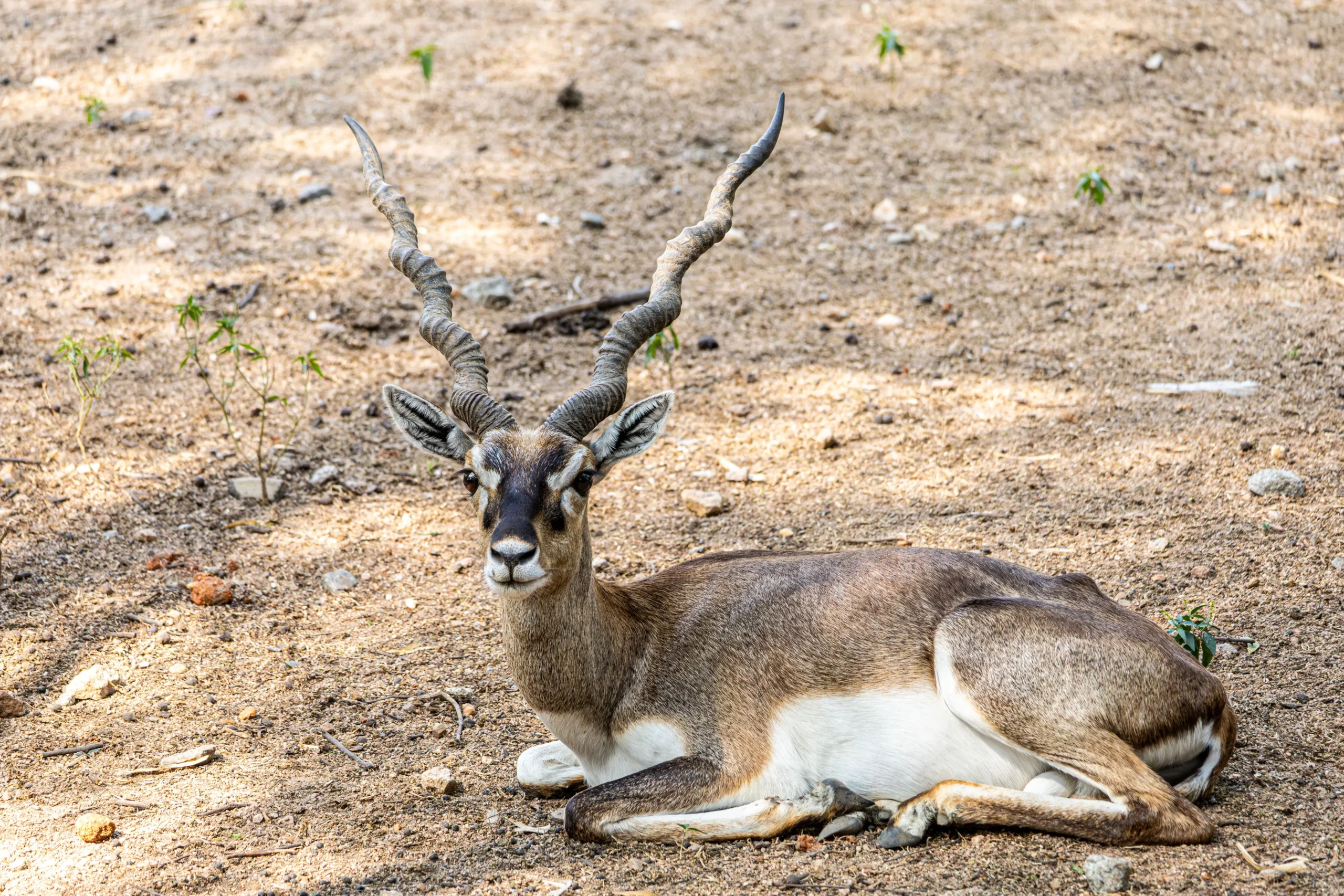
Adult males features a stark contrast between their upper bodies and underparts. Their backs, necks, and outer legs turn a deep, dark brown or velvet black as they mature, contrasted against bright white fur around their eyes, chin, chest, belly, and inner legs.
Females and young calves look completely different. They lack the dark coloration entirely, displaying a pale yellowish-fawn or light brown coat that blends efficiently into dry grassland cover.
The most prominent feature of the adult male is its long, ringed, V-shaped horns. These grow in a tight, corkscrew-like spiral from the crown of the skull. Females are typically hornless, though small, unspiralled horns can occasionally develop in certain individuals or local populations.
Plaintext
\ / (Long, spiralled horns present only on mature males)
\ /
(o o) (Distinct white eye rings contrast with dark face)
\=/
The following table outlines the specific physical measurements and structural variations across the species:
| Measurement | Adult Male | Adult Female / Juvenile |
| Coat Color | Deep dark brown to velvet black upperparts; sharp white underparts. | Pale yellowish-fawn to tan upperparts; white underparts. |
| Horn Status | Consistently present; long, ringed, and spiralled in a V-shape. | Generally hornless; rare instances of short, smooth horns. |
| Horn Length | 45 to 75 cm (18 to 30 inches). | N/A (Typically absent). |
| Shoulder Height | 74 to 84 cm (29 to 33 inches). | Slightly shorter than adult males. |
| Average Weight | 34 to 45 kg (75 to 100 pounds). | 31 to 39 kg (68 to 86 pounds). |
Field Note
When observing a herd from a distance, look closely at the variation in male coat shades. The intensity of a male’s black coat is not static; it darkens significantly during the peak breeding season and is heavily influenced by dominance status and testosterone levels. Out of the rutting season, sub-dominant or younger males may fade back to a darker shade of brown, making them look intermediate between females and territorial males.
Behaviour and Life History
Social Structure and Group Dynamics
Blackbucks are highly social ungulates, but their herd composition is fluid and strongly dictated by sex and age. When observing these animals on safari, you will typically encounter three distinct social groupings: female herds (often accompanied by young calves), bachelor groups consisting of non-dominant or sub-adult males, and solitary territorial males.
In modern protected reserves, herd sizes typically range from 5 to 50 individuals. However, before agricultural expansion fragmented their habitats, historical records documented massive aggregations of blackbucks numbering in the thousands.
Reproduction, Rutting, and Lifecycle
While blackbucks can breed year-round, safari-goers will observe distinct peaks in rutting behavior during February to March and August to September. During these periods, mature males become intensely territorial. They establish specific mating territories, mark them actively, and engage in aggressive posturing or physical clashes with rival males to control access to passing female herds.
Following a successful mating season, females have a gestation period of approximately five to six months. They almost always give birth to a single calf, which remains hidden in tall grass for the first few weeks of life to avoid detection by predators.
Photography Tip: The Rutting Season
If your primary goal is wildlife photography, timing your safari for the February–March or August–September breeding peaks provides the best behavioral action. The dominant males’ coats will be at their darkest, offering a striking contrast against the drying grasslands, and you are far more likely to capture territorial displays and sparring.
Foraging Ecology and Predator Avoidance
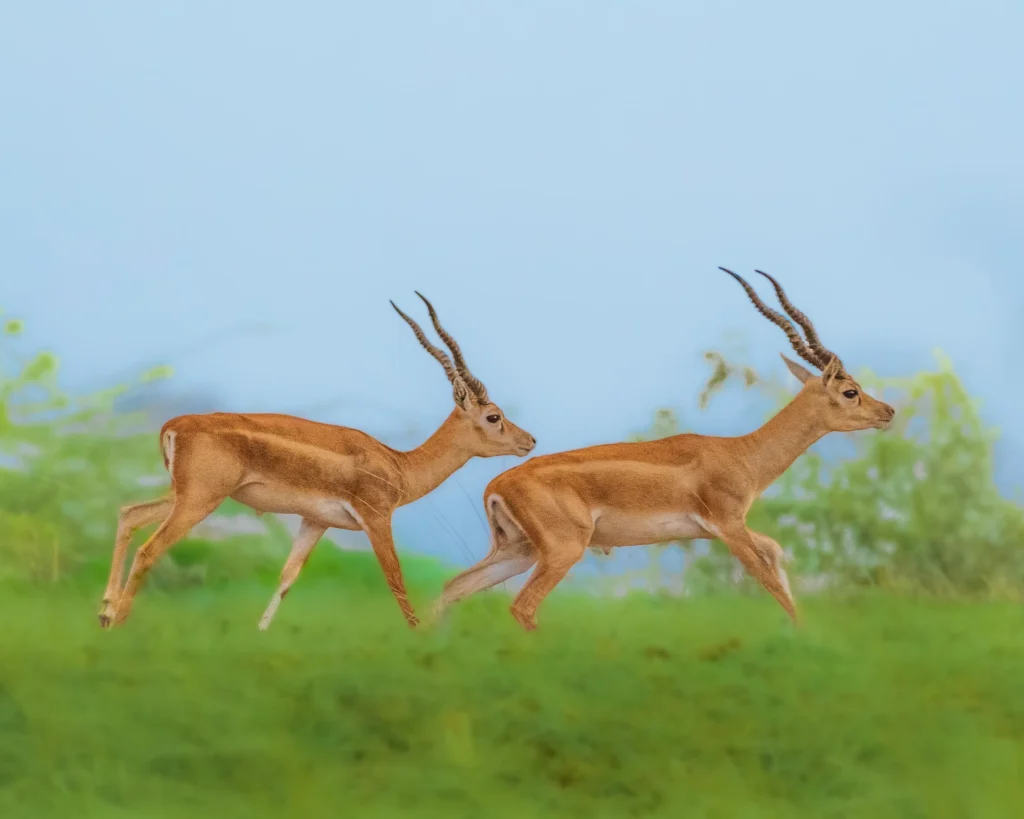
The blackbuck is a specialized grazer adapted specifically to open environments. They heavily prefer short-grass plains and lightly wooded areas, actively avoiding dense forests where visibility is poor. In open spaces, their primary defense mechanism—exceptional speed—can be fully utilized.
When threatened, a blackbuck bounds into a sprint, capable of reaching speeds up to 80 km/h to outpace pursuers. Historically, this immense speed evolved in response to predation by the Asiatic cheetah. Today, their main natural predators in the Indian subcontinent include wolves, jackals, and leopards.
Range, Distribution, and Population Trends
Native Range in India and Nepal
The blackbuck is strictly native to the Indian subcontinent. While they once roamed vast expanses of the region’s plains, their current natural distribution is highly fragmented. Today, healthy native populations are largely confined to managed national parks, sanctuaries, and community reserves across India, alongside specific conservation areas in Nepal, such as Khairapur. The species has been declared regionally extinct in Pakistan and Bangladesh.
Introduced Populations Outside Asia
Beyond their native range, introduced populations of blackbuck have successfully established themselves in Argentina and the United States, with significant numbers found on private ranches in Texas. While these populations are stable and locally abundant, conservationists stress a crucial ecological reality: introduced populations do not replace the need to protect the species’ native habitats and genetic diversity within Asia.
Historical Decline and Modern Population Recovery
To understand current blackbuck conservation, it is necessary to view their population timeline. The mid-20th century saw a catastrophic collapse in blackbuck numbers, driven by unregulated hunting and the rapid conversion of grassland habitats into agricultural land.
Concerted conservation interventions, legal protections, and the establishment of dedicated sanctuaries over the last few decades have stabilized populations in key areas. Global estimates now place their numbers in the tens of thousands. However, conservation is not uniform across their range.
Historical Population Timeline:
- Mid-20th Century: Catastrophic decline due to hunting and widespread habitat loss.
- Late 20th Century: Establishment of core protected zones halts the freefall of regional populations.
- Present Day (2022–2026 Data): Recent state-level surveys and regional studies—such as a 2025 peer-reviewed review of distribution and threats in Rajasthan—indicate that while populations inside protected sanctuaries are recovering, isolated groups outside these zones face severe threats from habitat fragmentation.
Editorial Research Note
The population timelines, conservation metrics, and behavioral data referenced in this guide are strictly grounded in authoritative ecological research and foundational documents, including the reference file Act as a senior SEO strategist, wildlife researche (53).docx.
Threats and Conservation Actions
Legal Protection and IUCN Status
The survival of the blackbuck relies heavily on strict legal frameworks. Internationally, the species is currently classified as Near Threatened on the IUCN Red List (visitors and researchers should always verify the most recent IUCN assessment, as local statuses fluctuate). Within India, blackbucks are protected by law under the stringent schedules of the Wildlife Protection Act, which strictly prohibits hunting and trade. This legal shield has been the primary factor in stabilizing core populations since their steep historical decline.
Habitat Fragmentation and Degradation
Despite legal protection against hunting, the blackbuck faces a severe, ongoing threat: the loss of its native habitat. Because blackbucks are open-plains specialists, their preferred short-grass ecosystems are frequently targeted for agricultural expansion and infrastructure development. This converts vast, continuous grasslands into fragmented patches. Consequently, many blackbuck herds find themselves isolated, reducing genetic diversity and restricting their natural seasonal movements.
Mitigating Human-Wildlife Conflict
As grasslands shrink and agriculture expands, blackbucks are increasingly forced into proximity with human settlements. This overlap inevitably leads to human-wildlife conflict, primarily in the form of crop raiding. When herds forage in agricultural fields, farmers suffer economic losses. Effective conservation now requires comprehensive mitigation strategies, including the strategic use of fencing, prompt agricultural compensation schemes for affected farmers, and the establishment of community reserves that directly benefit local residents.
Grassland Restoration and Translocation Programs
Blackbucks are not just residents of the grassland; they are active engineers of it. Their grazing patterns are linked to fire regimes, carbon storage, and overall grassland health. Recognizing this, modern conservation efforts often focus on ecosystem restoration rather than just species protection.
When isolated populations become unviable, wildlife departments utilize translocation programs. Notable success stories can be seen in Nepal, particularly the conservation actions and translocations at the Khairapur Blackbuck Conservation Area and Shukla Phanta National Park. These site-specific management plans provide a practical blueprint for re-establishing the species in its historical range.
Best Places to See Blackbuck in the Wild
For first-time visitors and dedicated wildlife photographers alike, planning a blackbuck safari requires choosing the right destination. Because blackbucks avoid dense forests, they are rarely seen in India’s famous tiger reserves. Instead, you must travel to specialized grassland sanctuaries.
Core Sanctuaries and National Parks
Velavadar (Blackbuck National Park) in Gujarat is widely considered the premier destination for observing these antelopes due to its high population density and excellent open-plains visibility. Further south, Ranebennur Blackbuck Sanctuary in Karnataka protects a vital regional population. In northern India, the desert grasslands of Kutch and various community-managed tracts in Rajasthan offer excellent viewing opportunities, often against stark, arid landscapes. For those traveling to Nepal, Khairapur is the definitive location.
Sanctuary Comparison Guide
The table below outlines the primary destinations for blackbuck safaris. Note: Population figures fluctuate annually based on regional census reports; always consult the respective state wildlife department for the latest data prior to travel.
| Sanctuary / Location | State / Country | Landscape Type | Visitor Access & Permit Notes |
| Velavadar (Blackbuck NP) | Gujarat, India | Coastal grassland and salt pans | Excellent safari infrastructure; official forest department permits required. |
| Ranebennur Sanctuary | Karnataka, India | Scrub and eucalyptus plantations | Open to visitors; local permits required at the gate. |
| Rajasthan Grasslands | Rajasthan, India | Arid scrub and open desert | Often community-managed or open areas; local guides highly recommended. |
| Khairapur Conservation Area | Nepal | Managed short-grass plains | Dedicated conservation zone; regulated entry via DNPWC guidelines. |
| Shukla Phanta | Nepal | Terai grasslands and wetlands | National park entry fees apply; notable site for translocation observation. |
Safari Logistics and Practical Visitor Tips
Because blackbucks inhabit exposed, open plains, daytime temperatures in these reserves can be extreme. Plan your safari drives for the early morning or late afternoon when the light is best for photography and the animals are most active.
Responsible Tourism Tip
A blackbuck’s primary defense is speed, and they will run if they feel trapped. Never ask your safari driver to drive off-track or approach a herd too quickly in an attempt to make them sprint for a photograph. This causes unnecessary stress, wastes the animal’s critical energy reserves, and violates park regulations. Maintain a respectful distance and let the herd habituate to your vehicle’s presence.
How You Can Help
Wildlife conservation extends beyond the boundaries of national parks. For the blackbuck to thrive, their fragmented grassland ecosystems require active management and public support.
NGOs and Community Projects
Travellers and wildlife enthusiasts can directly support blackbuck recovery by donating to or volunteering with NGOs focused on Indian grassland ecology. Seek out organizations that work on habitat restoration, community reserve management, and compensating farmers for crop raiding. Supporting eco-tourism initiatives around community reserves also provides a direct financial incentive for local residents to tolerate and protect nearby herds.
Citizen Science and Sighting Documentation
You can contribute to ongoing population monitoring without formal scientific training. When visiting lesser-known reserves or driving through open agricultural areas in Rajasthan or Gujarat, log your blackbuck sightings on citizen science platforms like iNaturalist. Recording accurate photo metadata, including location, herd size, and the ratio of males to females, helps researchers track population distributions and identify critical wildlife corridors outside protected zones.
Common Mistakes and Misconceptions
When researching or viewing blackbucks, visitors often encounter outdated information. Below are common misconceptions to avoid:
- Assuming they are common and widespread: While you might see large herds in Velavadar, the species is not globally secure. Their historical range has contracted severely, leading to regional extinctions in countries like Pakistan and Bangladesh.
- Believing introduced populations guarantee survival: It is true that large introduced populations thrive on private ranches in Texas (USA) and Argentina. However, these populations are ecologically and genetically distinct from native herds and do not fulfill the blackbuck’s role in the Asian grassland ecosystem.
- Thinking only males have horns: While the long, spiralled horns are the defining characteristic of a mature male, hornlessness is not a strict rule for females. Depending on the local population genetics, females can occasionally grow small, smooth horns.
Frequently Asked Questions (FAQs)
What is the scientific name of the blackbuck? The scientific name is Antilope cervicapra.
What is the blackbuck’s conservation status? Internationally, they are listed as Near Threatened on the IUCN Red List. In India, they receive the highest level of legal protection under the schedules of the Wildlife Protection Act. (Note: Always verify the current IUCN status prior to travel or research publication).
What do blackbucks eat? They are predominantly grazers, feeding on short grasses, though they will occasionally browse on the leaves of low shrubs depending on seasonal availability.
How fast can a blackbuck run? To escape predators in open terrain, blackbucks can reach sprint speeds of up to 80 km/h.
What is the gestation period and litter size? Gestation lasts approximately 5 to 6 months, typically resulting in a single calf.
What predators hunt blackbuck? Historically, they were hunted by the Asiatic cheetah. Today, their primary natural predators include wolves, jackals, and leopards.
Can blackbucks live near agricultural land? Yes, but this often leads to human-wildlife conflict. Because their natural grassland habitats have been heavily converted into farmland, blackbucks frequently raid crops for food, requiring strategic fencing and compensation schemes to protect local farming livelihoods.
Conclusion
The blackbuck (Antilope cervicapra) is more than just a photogenic subject for a safari; it is a vital indicator of grassland health across the Indian subcontinent. While severe historical declines threatened the species, dedicated sanctuaries and strict legal protections have successfully stabilized core populations. However, the ongoing challenges of habitat fragmentation and human-wildlife conflict require continuous, adaptive management.
By choosing to visit specialized grassland sanctuaries, hiring local guides, and supporting community-based conservation initiatives, wildlife travellers can directly contribute to the survival of India’s fastest antelope.
For further reading on population data and conservation status, consult the IUCN Red List, recent state wildlife census reports, and ecosystem profiles by the World Land Trust.
Author Note & Update Log: Written by the WildlifeSafaris.in Editorial Team. Last Updated: August 2026.