
Learn how to identify nilgai, where they live, what they eat, conservation status, safari locations, wildlife photography tips, and human-wildlife conflict.
Nilgai (Blue Bull): Complete Guide to Identification, Habitat, Behaviour, Conservation & Wildlife Safaris in India
Introduction
The nilgai (Boselaphus tragocamelus) is India’s largest antelope and one of the country’s most familiar large herbivores. Despite being widespread across northern and central India, it is often misunderstood. Some people know it as the “blue bull,” others associate it with crop damage, while wildlife travellers usually encounter it quietly browsing along forest edges, grasslands, scrublands, or open plains.
Unlike many Indian mammals that are largely restricted to protected forests, nilgai are highly adaptable. They use a variety of landscapes, including agricultural fields, woodland edges, scrub forests, and grasslands. This flexibility has helped the species remain widespread, but it has also increased contact with people, making nilgai central to discussions about conservation, farming, and wildlife management.
For wildlife enthusiasts, nilgai are rewarding animals to observe. Their cautious behaviour, strong sexual differences, and preference for open habitats make them one of the easiest large mammals to study during Indian safaris. Knowing how to identify them and understand their behaviour adds depth to any visit to India’s grasslands or dry deciduous forests.
What Is a Nilgai?
Nilgai (Boselaphus tragocamelus) belongs to the family Bovidae, making it a true antelope rather than a species of cattle. It is the only living member of its genus and is native to the Indian subcontinent, where it occurs across much of India and parts of Nepal, with historic records from Pakistan. Introduced populations also exist in Texas, USA, where the species is managed under a very different legal framework.
Adult males can weigh well over 200 kilograms in some cases, making nilgai considerably larger than blackbuck, chinkara, or four-horned antelope. Their long legs, sloping back, sturdy build, and horse-like gait often surprise first-time observers, especially when they break into a fast run across open country.
Scientific Classification
| Classification | Details |
| Common Name | Nilgai |
| Other Names | Blue Bull, Blue Cow |
| Scientific Name | Boselaphus tragocamelus |
| Family | Bovidae |
| Group | Antelope |
| Diet | Herbivore |
| IUCN Status | Least Concern |
Why Is It Called the Blue Bull?
The name Nilgai comes from the Hindi words neel (blue) and gai (cow). The name refers to the bluish-grey coat of mature males rather than any relationship with domestic cattle.
Although the common name “blue bull” is widely used in English, nilgai are not bulls. They are antelopes that evolved separately from cattle, even though both belong to the Bovidae family. This distinction is important because confusion over the name often leads people to assume the species is closely related to cows.
Quick Facts
| Feature | Information |
| Largest Asian antelope | Yes |
| Scientific Name | Boselaphus tragocamelus |
| Family | Bovidae |
| Diet | Grasses, leaves, herbs, shrubs and crops |
| Activity | Mainly diurnal, especially mornings and late afternoons |
| Male Horn Length | About 20–25 cm |
| Shoulder Height | Around 120–150 cm |
| Body Length | Around 180–200 cm |
| Top Speed | Up to about 48 km/h |
| Conservation Status | IUCN Least Concern |
How to Identify a Nilgai
Nilgai are among the easiest Indian antelopes to recognise once you know a few distinctive features. Unlike blackbuck or chinkara, males and females look noticeably different, making sex identification straightforward even from a distance.
Male Nilgai
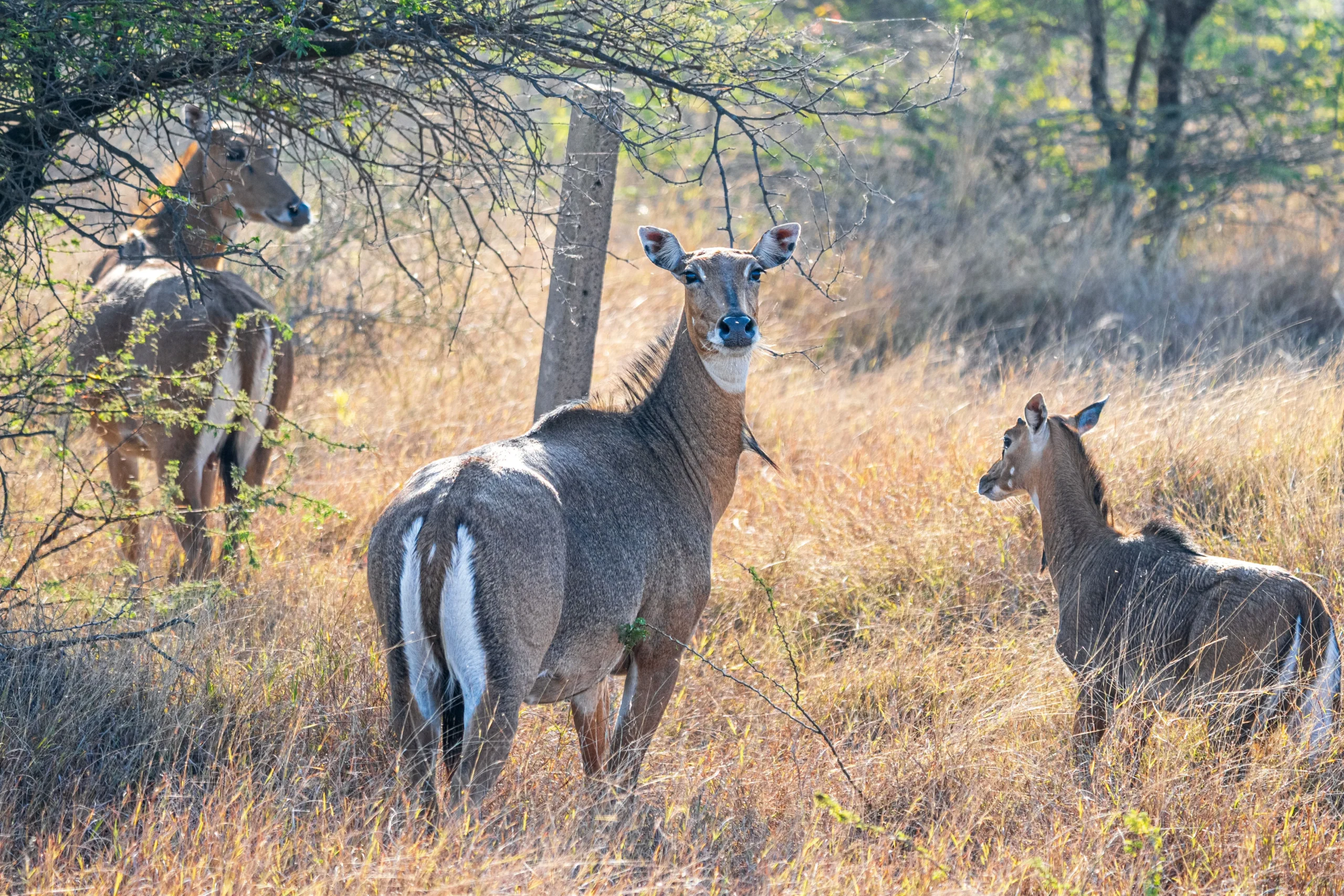
Adult males have a steel blue to bluish-grey coat that gives the species its common name. They have a robust body, thick neck, and short, straight black horns that project upward from the forehead. Mature males also show contrasting white markings on the face, throat, ears, lower legs, and tail, making them easy to recognise through binoculars.
Female Nilgai
Females are much lighter in colour, ranging from sandy brown to tawny. They do not have horns and are generally smaller and more slender than males. Their colouring provides effective camouflage in dry grasslands and scrub habitats where they spend much of their time feeding with calves or in female groups.
Young Animals
Calves resemble females in colour and lack horns. As young males mature, their coats gradually darken, eventually developing the characteristic blue-grey appearance of adults.
Field Identification Tips
When scanning open country during a safari, look for these features:
- Tall, long-legged body with a sloping back.
- Horse-like profile rather than the delicate build of gazelles.
- Adult males with short black horns and blue-grey coats.
- Females with no horns and light brown coats.
- White facial and leg markings visible even at moderate distances.
- A cautious stance, often pausing to observe before moving away.
Comparison: Male vs Female Nilgai
| Feature | Male | Female |
| Coat Colour | Blue-grey | Sandy brown |
| Horns | Present | Absent |
| Size | Larger | Smaller |
| Neck | Thick and muscular | Slender |
| Social Behaviour | Often solitary or bachelor groups | Female groups with calves |
Field Note: Nilgai are usually easier to observe early in the morning when they emerge into open grasslands and agricultural edges to feed before temperatures rise. Their height often makes them visible above tall grasses, even when other herbivores remain concealed.
Where Nilgai Live
Nilgai have one of the widest distributions among India’s large wild herbivores. They are native to the Indian subcontinent and occur across much of northern, western, and central India, extending into Nepal’s Terai, with historical records from parts of Pakistan. Outside their native range, introduced populations have become established in Texas, USA.
Unlike species that depend on dense forests, nilgai thrive in open landscapes where they can combine feeding areas with nearby cover. This adaptability allows them to survive both inside protected reserves and in human-dominated landscapes.
Distribution Across India
Nilgai are most frequently encountered in the plains of northern and central India. Healthy populations occur in several states, including Rajasthan, Gujarat, Madhya Pradesh, Uttar Pradesh, Haryana and Delhi, while they are absent from the dense rainforests of the Western Ghats and the high Himalayas.
Many populations live outside national parks and wildlife sanctuaries. Recent habitat studies indicate that a considerable proportion of suitable nilgai habitat lies beyond protected areas, increasing interactions with agriculture and villages.
Nepal and Pakistan
The species extends into the Terai grasslands of southern Nepal, where it occupies habitats similar to those found in northern India. Historical records also exist from eastern Pakistan, although its present distribution there is much more limited than in India.
Introduced Population in Texas
Nilgai were introduced to Texas during the early twentieth century for private ranches and hunting estates. They adapted well to the warm climate and now occur in several parts of South Texas.
Although biologically the same species, their management differs greatly from India. In Texas they are managed as an introduced game animal, whereas in India conservation and conflict management operate under wildlife legislation.
Preferred Habitats
Nilgai are habitat generalists. Rather than depending on one vegetation type, they use a mosaic of habitats that provide food, visibility and shelter.
Common habitats include:
- Dry deciduous woodland
- Thorn scrub
- Open grasslands
- Savannah-like plains
- Agricultural landscapes
- Woodland edges
- Semi-arid scrublands
They generally avoid extremely dense forests where visibility is poor. Open country allows them to detect predators from long distances while moving efficiently between feeding sites.
Habitat Comparison
| Habitat | Suitability | Chances of Seeing Nilgai |
| Open grasslands | Excellent | Very High |
| Scrub forests | Excellent | High |
| Dry deciduous forests | Very Good | High |
| Agricultural edges | Very Good | High (outside parks) |
| Dense evergreen forests | Poor | Low |
| Wetlands | Limited | Low |
Safari Tip: If your primary goal is to photograph nilgai, concentrate on open meadows, scrublands and park roads bordering grasslands during the first few hours after sunrise or the last two hours before sunset.
What Nilgai Eat
Nilgai are entirely herbivorous and have a flexible feeding strategy. They both graze on grasses and browse on leaves, shoots and shrubs, allowing them to exploit changing food resources throughout the year.
Their diet typically includes:
- Grasses
- Herbs
- Leaves
- Tender shoots
- Shrubs
- Woody vegetation
- Agricultural crops when available
This mixed feeding strategy helps nilgai survive seasonal changes, particularly in semi-arid regions where grasses may become scarce during dry months.
Why Do Nilgai Enter Croplands?
Crop fields often provide abundant, nutritious food that is easier to obtain than natural forage. When farmland borders scrub forests or grasslands, nilgai frequently move into cultivated areas, particularly where natural habitat has been fragmented.
Recent research identifies crop raiding as one of the main reasons for negative attitudes toward nilgai in many agricultural regions. The issue is especially significant because much of the species’ suitable habitat overlaps with cultivated landscapes outside protected areas.
Expert Tip: Seeing nilgai feeding close to farmland does not necessarily indicate that nearby forests lack food. Agricultural crops are often more nutritious and easier to access than many wild plants, making them attractive even when natural forage is available.
Behaviour and Ecology
Nilgai are alert, cautious animals that rely on keen eyesight and speed rather than concealment. They spend much of the day feeding, resting and moving between patches of vegetation while remaining watchful for danger.
Although generally calm, they can accelerate rapidly when disturbed and are capable of reaching speeds of around 48 km/h, making them one of India’s faster large herbivores.
Daily Activity Pattern
Nilgai are primarily diurnal. Activity usually peaks during:
- Early morning
- Late afternoon
- Early evening
During the hottest hours of the day they often rest beneath scattered trees or in scrub before resuming feeding later in the afternoon.
For safari visitors, this means that the best opportunities for observation usually coincide with regular morning and evening game drives.
Herd Structure
Nilgai social organisation is flexible.
You may encounter:
- Solitary adult bulls
- Small bachelor groups
- Female herds with calves
- Mixed groups, especially in productive habitats
Group size varies according to habitat quality, food availability and season. Large aggregations may occasionally form where feeding conditions are especially favourable, but smaller groups are more typical.
Vigilance and Communication
Nilgai depend heavily on visual awareness.
Individuals frequently:
- Pause while feeding to scan their surroundings.
- Raise their heads simultaneously when disturbed.
- Move cautiously before breaking into a run if the perceived threat continues.
This behaviour often alerts birdwatchers and photographers that another animal—or even a predator—may be nearby.
Speed and Escape Strategy
Unlike deer that rely on dense cover, nilgai usually escape by running across open ground. Their long legs, powerful shoulders and efficient stride allow them to cover large distances quickly while maintaining good visibility of potential threats.
Photography Tip: Because nilgai often stop briefly to assess danger before fleeing, avoid sudden movements after spotting one. Remaining still for a few moments may provide enough time for close behavioural photographs before the animal decides to move.
Breeding and Life Cycle
Nilgai can breed throughout the year, although breeding activity often peaks between December and March in many parts of their range. The exact timing may vary with local climate, food availability, and regional conditions.
Unlike highly seasonal ungulates that synchronize births within a short period, nilgai have a more flexible reproductive cycle. This allows populations to adapt to changing environmental conditions across their wide distribution.
Courtship and Mating
During the breeding season, adult males become more territorial and spend considerable time monitoring females. Rival males may engage in displays of strength, posturing, and occasional clashes before gaining access to receptive females.
Unlike deer, whose antlers are shed annually, nilgai have permanent horns. Mature males therefore rely on the same horns throughout their lives during dominance contests.
Gestation and Birth
Females have a gestation period of approximately 240–258 days before giving birth. Calving often coincides with periods when vegetation is abundant, increasing the survival chances of young animals.
Newborn calves spend much of their early life concealed within vegetation while their mothers forage nearby. This strategy reduces the risk of predation during the most vulnerable stage of life.
Growth and Maturity
Young nilgai grow rapidly during their first year.
As they mature:
- Young males gradually develop darker coats.
- Horns begin to emerge in males.
- Females retain their sandy-brown coloration throughout adulthood.
- Adult males eventually develop the characteristic blue-grey appearance that gives the species its common name.
Predators and Survival Strategies
Although nilgai are large animals, they are still vulnerable to predators, particularly young calves and weaker individuals.
Natural predators may include:
- Bengal Tiger
- Indian Leopard
- Dhole (in parts of their range)
- Occasionally large crocodiles near water bodies
Healthy adult bulls are formidable animals because of their size, speed and powerful kicks. Consequently, predators often target calves, juveniles or females rather than full-grown males.
Survival Adaptations
Nilgai possess several adaptations that improve survival.
These include:
- Excellent eyesight for detecting danger across open landscapes.
- Long legs that allow rapid running over uneven ground.
- Strong hearing.
- A cautious temperament with frequent vigilance.
- Preference for habitats offering both visibility and nearby cover.
Their tendency to stop briefly, assess a threat, and then flee at high speed is a behaviour frequently observed by safari guides.
Field Note: Nilgai often detect approaching vehicles long before people notice them. Watching their body posture—raised head, forward-facing ears and fixed gaze—can reveal that they have already become aware of your presence.
Conservation Status
Nilgai remain one of Asia’s most widespread large antelopes and are currently classified as Least Concern on the IUCN Red List. Their broad distribution and adaptability have helped maintain stable populations across much of their native range.
However, this favourable conservation status does not mean the species faces no challenges. Habitat fragmentation, expanding agriculture and increasing interactions with people create complex management issues that differ from region to region.
IUCN Status
| Assessment | Status |
| IUCN Red List | Least Concern |
| Population Trend | Widespread across native range |
| Primary Concern | Increasing human-wildlife interactions rather than global decline |
Being listed as Least Concern reflects the species’ overall security across its range, not the absence of local conservation issues.
Legal Protection in India
Nilgai receive legal protection under India’s wildlife laws. At the same time, wildlife authorities and state governments sometimes face difficult decisions where severe crop losses occur.
This distinction is often misunderstood.
Legal protection does not mean management interventions are never considered. Instead, wildlife authorities must balance:
- Species conservation
- Protection of agricultural livelihoods
- Local ecological conditions
- Applicable legal provisions
The appropriate management approach may therefore differ between states and specific situations. Presenting nilgai simply as either a “protected species” or a “pest” overlooks this more nuanced reality.
Why Conservation Can Be Challenging
Many threatened mammals decline because they occupy only small protected areas. Nilgai present almost the opposite situation.
Research suggests that much of their suitable habitat occurs outside protected areas, where wildlife regularly shares landscapes with villages, farms and roads. As a result, conservation increasingly depends on managing coexistence rather than protecting isolated reserves.
Major conservation challenges include:
- Habitat fragmentation.
- Expansion of agriculture.
- Road development.
- Increasing human-wildlife encounters.
- Maintaining ecological connectivity between populations.
Human–Nilgai Conflict
The nilgai illustrates one of the most important conservation lessons in modern India: a species can be both ecologically successful and socially controversial at the same time.
Across many agricultural landscapes, nilgai frequently enter cultivated fields to feed on crops. Because they are large, travel in groups and can consume or trample significant amounts of produce, farmers often experience substantial economic losses.
Recent studies identify crop raiding as one of the primary drivers of negative public attitudes toward the species.
Why Crop Damage Occurs
Several factors contribute to conflict:
- Farms often border suitable nilgai habitat.
- Crops provide highly nutritious food.
- Habitat outside protected areas overlaps extensively with agriculture.
- Large body size allows nilgai to consume substantial vegetation quickly.
Importantly, these conflicts arise because wildlife and agriculture increasingly occupy the same landscapes—not because nilgai naturally prefer farmland over wild habitats.
Vehicle Collisions
Roads crossing wildlife habitats create another source of conflict.
Nilgai are large animals capable of crossing highways rapidly, particularly during dawn, dusk and nighttime. Collisions can be dangerous for both animals and motorists, especially where roads intersect open scrub or grassland habitats.
Why Public Opinion Differs Across India
Attitudes toward nilgai vary considerably.
In some regions they are respected because the name “blue bull” creates cultural associations with cattle.
Elsewhere, repeated crop losses lead to frustration among farming communities.
Understanding these regional differences is essential. The species cannot be viewed solely through the lens of conservation or agriculture; both perspectives reflect genuine realities experienced by different communities.
Conservation and Conflict at a Glance
| Topic | Current Situation |
| Global conservation status | Least Concern |
| Main conservation issue | Human-wildlife coexistence |
| Most common conflict | Crop raiding |
| Habitat trend | Large areas outside protected reserves |
| Public perception | Varies by region and livelihood |
Responsible Tourism Tip: If you encounter nilgai feeding near village fields during a wildlife trip, observe quietly from a distance. Avoid encouraging animals toward roads or croplands for photographs, and remember that the same species admired by tourists may represent a significant livelihood challenge for nearby farming communities.
Nilgai in Indian Culture
Nilgai occupy a unique position in India because they are viewed through both cultural and ecological perspectives. Their common Hindi name—Nilgai, meaning “blue cow”—has shaped how many communities perceive the species.
The name refers to the bluish-grey coat of adult males rather than any biological relationship with domestic cattle. Scientifically, nilgai are antelopes belonging to the family Bovidae, not wild cattle.
In several regions, the association with cattle has contributed to greater cultural tolerance. At the same time, areas experiencing repeated crop losses may view nilgai quite differently. These contrasting perceptions explain why discussions about the species often involve conservation, agriculture, culture and public policy simultaneously.
Why the Name Matters
The common names “Blue Bull” and “Blue Cow” can unintentionally create confusion.
A few important facts help clarify the terminology:
- Nilgai are antelopes, not cattle.
- Only mature males develop the characteristic blue-grey coat.
- Females remain light brown throughout life.
- The Hindi name reflects appearance rather than taxonomy.
Understanding this distinction helps avoid one of the most common misconceptions surrounding the species.
Best Places to See Nilgai in India
Nilgai are among the easiest large herbivores to observe in northern and western India because they frequently use open habitats where visibility is good. Unlike many elusive mammals, they often remain visible while feeding, making them rewarding animals for both first-time visitors and wildlife photographers.
The best sightings usually occur in:
- Open grasslands
- Dry scrub forests
- Woodland edges
- Meadows inside national parks
- Agricultural landscapes bordering protected areas
National Parks and Wildlife Sanctuaries
Several protected areas are well known for regular nilgai sightings, while others provide occasional opportunities depending on habitat.
Some notable destinations include:
| Destination | Why Nilgai Are Common |
| Ranthambore National Park | Open woodland and grassland habitats support regular sightings. |
| Keoladeo National Park | Frequently seen around grasslands and woodland patches. |
| Velavadar National Park | Extensive grasslands ideal for observing large herbivores. |
| Blackbuck National Park (Velavadar) | Nilgai often share habitat with blackbuck. |
| Asola-Bhatti Wildlife Sanctuary (Delhi) | Urban-edge population studied in recent habitat research. |
| Abohar Wildlife Sanctuary | Frequently discussed in studies examining human–nilgai interactions. |
Nilgai can also be encountered in numerous other reserves across Rajasthan, Madhya Pradesh, Haryana, Uttar Pradesh and Gujarat wherever suitable open habitats exist.
When Are Nilgai Most Active?
Your chances of seeing nilgai increase during:
- Early morning safari drives.
- Late afternoon game drives.
- Cooler winter months when animals spend longer feeding in the open.
During hot summer afternoons they often remain in shade, making sightings less frequent.
How to Improve Your Chances
Experienced safari guides often look for nilgai in transition zones rather than dense forests.
Look for:
- Grassland clearings.
- Dry riverbeds with nearby vegetation.
- Scrub-covered hillsides.
- Forest edges opening into meadows.
- Quiet agricultural fields bordering protected forests.
These habitats provide abundant food while allowing nilgai to detect predators at long distances.
Wildlife Photography Tips
Nilgai are excellent subjects for behavioural photography because they often remain visible longer than many deer species.
Best Lighting
- Early morning produces soft light that highlights the blue-grey coat of adult males.
- Evening light creates attractive side lighting across open grasslands.
Camera Settings
For moving animals:
- Shutter speed: 1/1000 second or faster.
- Continuous autofocus.
- Burst shooting mode.
For feeding or resting animals:
- Slower shutter speeds are possible in good light.
- Focus on the eyes whenever possible.
Behaviour Worth Photographing
Instead of aiming only for portraits, look for natural behaviours such as:
- Feeding.
- Alert scanning.
- Mothers with calves.
- Bachelor groups.
- Bulls standing against open grassland.
- Animals crossing dusty tracks.
Behavioural photographs usually tell a stronger wildlife story than close-up headshots alone.
Photography Tip: Because nilgai often pause before deciding whether to flee, avoid immediately stepping out of a safari vehicle or making sudden movements. Remaining still often results in more relaxed behaviour and better photographs.
Responsible Wildlife Watching
Nilgai frequently occur close to villages and farmland, making responsible viewing especially important.
Follow these simple guidelines:
- Stay on designated safari tracks.
- Never approach animals on foot.
- Do not encourage animals toward roads for photographs.
- Avoid loud noises.
- Maintain a respectful viewing distance.
- Allow nilgai to cross roads without pressure.
- Respect local communities whose livelihoods may be affected by crop damage.
Responsible wildlife tourism benefits both conservation and local people.
Common Mistakes Visitors Make
Many first-time wildlife travellers unknowingly make assumptions about nilgai that reduce both safety and learning opportunities.
Avoid these common mistakes:
Assuming Nilgai Are Wild Cattle
Despite the name “Blue Bull,” nilgai are antelopes.
Looking Only Inside Dense Forests
Open scrub, grasslands and woodland edges usually offer much better viewing opportunities.
Expecting Males and Females to Look Alike
Their appearance differs dramatically. Learning these differences makes field identification much easier.
Confusing Them With Other Indian Antelopes
Nilgai are much taller and heavier than blackbuck, chinkara or four-horned antelope.
Judging the Species Only Through One Perspective
Nilgai are both an important native herbivore and a source of conflict in some farming regions. Understanding both realities provides a more balanced view of their conservation.
Frequently Asked Questions
Are nilgai antelopes or cattle?
Nilgai are antelopes belonging to the family Bovidae. They are not wild cattle.
Why are they called blue bulls?
The name refers to the bluish-grey coat of adult males and the Hindi word gai (cow), not to their biological classification.
Where are nilgai found?
They occur widely across northern, western and central India, extend into Nepal’s Terai, have historical records from Pakistan, and have introduced populations in Texas.
What do nilgai eat?
They feed on grasses, herbs, leaves, shrubs and other vegetation, while also entering croplands where cultivated plants are available.
Are nilgai dangerous to people?
They generally avoid humans and are not considered aggressive. Like any large wild animal, they should always be observed from a safe distance.
Why do nilgai damage crops?
Agricultural fields provide abundant, nutritious food and often overlap with suitable nilgai habitat, leading to frequent crop-raiding in some regions.
Are nilgai endangered?
No. They are currently listed as Least Concern on the IUCN Red List, although local conservation and management challenges remain.
Which predators hunt nilgai?
Tigers, leopards and dholes may prey on nilgai, particularly calves and younger animals.
Where are tourists most likely to see nilgai?
Open grasslands, scrub forests and dry deciduous habitats in parks such as Ranthambore, Velavadar, Keoladeo and several other reserves across northern and western India provide good opportunities.
When is the best time to see nilgai?
Early morning and late afternoon are generally the most productive times because nilgai are most active during these cooler periods.
Conclusion
The nilgai is far more than India’s largest antelope. It is a species that illustrates how wildlife, agriculture and human society increasingly share the same landscapes. Its adaptability has allowed it to thrive across grasslands, scrub forests and agricultural mosaics, while also making it one of India’s most discussed large herbivores.
For wildlife travellers, nilgai offer excellent opportunities to observe natural behaviour in open habitats and to better understand India’s often-overlooked grassland ecosystems. For conservationists and policymakers, the species demonstrates that successful wildlife conservation is not only about protecting animals inside national parks but also about finding practical ways for people and wildlife to coexist beyond protected boundaries.
Whether you encounter a solitary blue-grey bull standing watch over an open plain or a group of females quietly feeding along a forest edge, taking time to understand the nilgai’s ecology, behaviour and conservation challenges adds a richer perspective to any Indian wildlife safari.
Last Updated : August 2026
On winter mornings in Ranthambore’s Zone 3, lone bulls often stand motionless on low ridges before descending to graze. Family groups usually begin feeding first, while mature males remain several hundred metres away.
Around Rajbagh, Malik Talao and the open meadows of Ranthambore, nilgai are among the first large herbivores encountered on morning drives. Their alarm behaviour often alerts guides to the possible presence of a tiger nearby.
- how they compete with livestock
- seed dispersal
- browsing impact
- interaction with blackbuck
- interaction with chital
- habitat engineering
- dominant males
- scent marking
- body posture
- alert stance
- ear movement
- calf hiding strategy
- browsing technique
Field Note
Nilgai usually notice a walking human much earlier than a slow-moving safari vehicle. In heavily visited reserves they often tolerate vehicles but become wary if passengers stand up or make sudden movements.
- Velavadar — expansive grasslands where nilgai often share habitat with blackbuck.
- Ranthambore — open valleys and lakeside meadows provide reliable sightings.
- Keoladeo — woodland patches and grasslands support resident populations.