
Discover India’s grassland ecosystems, their wildlife, major landscapes, conservation challenges, and the best places to experience these unique habitats.
Introduction, What Grasslands Are & Why They Matter
Introduction
When people think of India’s natural landscapes, forests, mountains and wetlands usually come to mind. Grasslands receive far less attention, despite supporting some of the country’s most specialised wildlife and traditional pastoral communities. This misunderstanding has led many native grasslands to be labelled as “wastelands” or treated as degraded forests, even though they are ancient ecosystems with their own ecological identity.
From the open plains of Rajasthan to the vast Banni Grasslands of Gujarat and the high-altitude meadows of the Himalayas, grasslands occur across diverse climatic regions. They provide habitat for species such as the Critically Endangered Great Indian Bustard, Blackbuck, Indian Wolf, Lesser Florican and numerous grassland birds, reptiles and insects that depend on open landscapes rather than dense tree cover.
Beyond wildlife, grasslands play an important role in supporting pastoral livelihoods, storing carbon below ground, reducing soil erosion and maintaining ecological balance. Yet only a small proportion of India’s grassland habitats receive formal protection, making them one of the country’s most vulnerable ecosystems.
This guide explains what India’s grassland ecosystems are, where they occur, why they are ecologically important, the wildlife they support, the challenges they face, and how responsible conservation and tourism can help secure their future.
What Are Grassland Ecosystems?
Grasslands are ecosystems dominated primarily by grasses and herbaceous plants, with relatively few trees or shrubs. Their open character is not a sign of degradation but a natural outcome of climate, soils, grazing, fire and other ecological processes that have shaped these landscapes over thousands of years.
Unlike forests, which are characterised by continuous tree cover, grasslands remain open because their ecological conditions favour grasses over dense woodland. Many Indian grasslands also exist as mosaics with scrub vegetation, creating habitats that support species adapted specifically to open terrain.
Why Grasslands Are Often Misunderstood
One of the biggest challenges facing Indian grasslands is the widespread misconception that they are “empty” or “unused” land. Historically, many have been classified as wastelands or considered suitable for afforestation and agricultural conversion. However, ecological research increasingly recognises that these open habitats are complete ecosystems in their own right, with specialised plant and animal communities that cannot simply relocate to forests.
Why Grasslands Matter
Although they receive less public attention than forests, grasslands deliver several essential ecological services:
- Provide habitat for many threatened and endemic wildlife species.
- Support traditional grazing and pastoral livelihoods.
- Help conserve soil and regulate water movement.
- Store significant amounts of carbon below ground.
- Maintain biodiversity across landscapes that extend beyond protected areas.
Field Note: A healthy grassland is not defined by the absence of trees. It is defined by the presence of native grasses, herbs, seasonal wildflowers and the wildlife that has evolved to depend on open habitats.
Types of Grassland Ecosystems in India and Their Distribution
India’s grasslands are not a single uniform habitat. They range from the arid plains of western India to the rolling meadows of the Himalayas, with each type shaped by climate, rainfall, soils, altitude and natural disturbance. Understanding these differences helps explain why different grassland regions support distinct wildlife communities and require different conservation approaches.
Types of Grasslands in India
Semi-arid Grasslands
Semi-arid grasslands are among India’s best-known open ecosystems. They occur primarily in western and central India, where rainfall is relatively low and long dry seasons favour grasses, herbs and scattered shrubs rather than dense forests.
These landscapes support several iconic species, including:
Large parts of Rajasthan and Gujarat contain extensive semi-arid grasslands, although many have been converted for agriculture, infrastructure or plantations over time.
Dry Sub-humid Grasslands
These grasslands receive more rainfall than semi-arid regions but still remain largely open because of ecological conditions such as seasonal drought, grazing and soil characteristics.
They often occur as mosaics where grasses mix with scattered shrubs and small trees. Such habitats support a wide variety of birds, mammals, reptiles and pollinating insects while also providing grazing land for livestock.
Moist Grasslands
Moist grasslands develop in areas with higher rainfall and seasonal flooding. They are particularly valuable for herbivores and many wet grassland bird species.
Although less extensive than dry grasslands, these ecosystems contribute significantly to regional biodiversity and often occur alongside wetlands or river floodplains. Their productivity also supports numerous insects, amphibians and small mammals that form the base of the food web.
Montane Grasslands
Montane grasslands occur at higher elevations, particularly in the Himalayan region and parts of the Western Ghats.
These high-altitude meadows experience cooler temperatures and shorter growing seasons than lowland grasslands. They support specialised plant communities and wildlife adapted to mountain environments while providing seasonal grazing grounds for both wild herbivores and traditional pastoral communities.
Where Are India’s Grasslands Found?
Grasslands occur across much of the country rather than being confined to one region. Important grassland landscapes include:
- Rajasthan
- Gujarat
- Maharashtra
- Madhya Pradesh
- Karnataka
- Andhra Pradesh
- Uttar Pradesh’s Upper Gangetic Plains
- Himalayan regions with alpine and montane meadows
Some of these areas lie inside national parks and wildlife sanctuaries, while many others exist on community lands, village commons and pastoral landscapes outside protected areas. This means conserving India’s grasslands requires cooperation beyond the protected area network.
Major Grassland Landscapes
Several landscapes stand out because of their ecological importance:
- Banni Grasslands (Gujarat): One of India’s largest grassland ecosystems, covering roughly 2,500 sq km and supporting pastoral communities, migratory birds and diverse wildlife.
- Desert National Park (Rajasthan): A globally important refuge for the Great Indian Bustard and other species adapted to arid grasslands.
- Velavadar National Park (Gujarat): Known for Blackbuck, grassland birds and predators such as wolves and jackals.
- Upper Gangetic Plains: Once extensive grassland habitats that have experienced substantial decline because of agricultural expansion and land-use change.
Comparison: Major Grassland Types in India
| Grassland Type | Typical Conditions | Representative Regions | Notable Wildlife |
| Semi-arid | Low rainfall, long dry season | Rajasthan, Gujarat | Great Indian Bustard, Blackbuck, Indian Wolf |
| Dry Sub-humid | Moderate rainfall, open plains | Central India | Grassland birds, Blackbuck, Wolves |
| Moist | Higher rainfall, seasonal flooding | River plains and lowlands | Swamp Deer, waterbirds, grassland birds |
| Montane | High altitude, cool climate | Himalayas, Western Ghats | Alpine fauna, specialised birds and grazing mammals |
Expert Tip: Grasslands are dynamic ecosystems. Seasonal rainfall can dramatically change their appearance—from dry golden plains before the monsoon to lush green landscapes afterwards. Wildlife activity and bird diversity often change with these seasonal cycles, making the timing of a visit an important consideration.
Wildlife of Indian Grasslands and Major Grassland Landscapes
The true value of India’s grasslands becomes apparent when you look at the wildlife they support. Many species found in these open habitats cannot survive in forests because they depend on unobstructed landscapes for feeding, breeding or detecting predators. As grasslands shrink or become fragmented, these specialist species are often among the first to decline.
Wildlife Found in Indian Grasslands
Although grasslands may appear simple compared to forests, they support a remarkable diversity of mammals, birds, reptiles, insects and plants. Many of India’s most threatened species are grassland specialists, making these ecosystems a conservation priority.
Great Indian Bustard (Ardeotis nigriceps)
The Great Indian Bustard is India’s flagship grassland bird and one of the world’s most threatened avian species. It requires large, uninterrupted grasslands with minimal human disturbance for breeding and feeding.
Historically, the species occurred across much of western and central India, but its range has contracted dramatically. Today, its strongest remaining population survives in and around Rajasthan’s Desert National Park, with much smaller populations elsewhere. The species is classified as Critically Endangered and receives the highest level of legal protection under Indian wildlife law. Conservation efforts include habitat protection, conservation breeding and measures to reduce mortality from infrastructure such as power lines.
Blackbuck
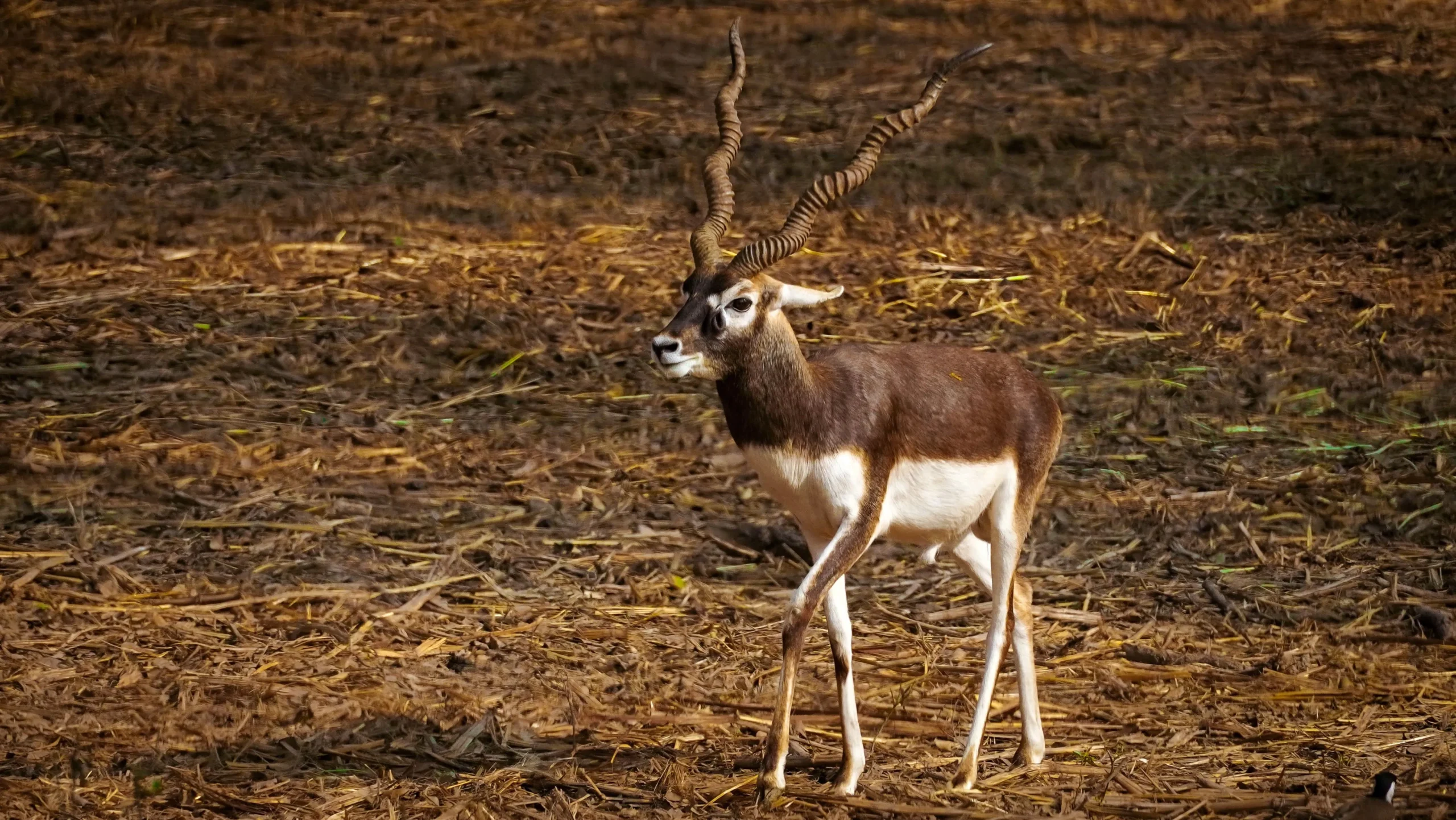
The Blackbuck is one of India’s most recognisable antelopes and is closely associated with open plains and grasslands. Its speed, keen eyesight and preference for unobstructed landscapes make grasslands its ideal habitat.
Healthy Blackbuck populations indicate well-managed open ecosystems. They also play an important ecological role as grazers, influencing vegetation dynamics while serving as prey for large carnivores in some landscapes. Velavadar National Park in Gujarat is among the country’s best-known places to observe Blackbucks in their natural habitat.
Indian Wolf
Unlike tigers and leopards, Indian Wolves have evolved to hunt across open country. Grasslands provide the visibility and space they need to pursue prey.
Habitat fragmentation and conversion have reduced suitable landscapes for wolves, bringing them into closer contact with human settlements. Conserving large connected grassland landscapes benefits both predators and their prey.
Lesser Florican
The Lesser Florican is another grassland-dependent bird whose spectacular breeding displays occur during the monsoon. Because it relies on seasonal grassland habitats, changes in land use and agricultural practices have contributed to population declines.
Its presence often reflects the ecological health of native grasslands.
Swamp Deer and Other Grassland Wildlife
Moist grasslands support species adapted to wetter environments, including Swamp Deer in suitable floodplain habitats. Indian grasslands also sustain:
- Desert Fox
- Jackal
- Numerous larks, coursers and pipits
- Raptors that hunt over open country
- Reptiles adapted to dry landscapes
- Pollinating insects and native grasses that form the foundation of the ecosystem
Many of these lesser-known species receive far less conservation attention than flagship mammals or birds but are equally important for maintaining ecological balance.
Major Grassland Landscapes in India
Rather than existing as one continuous habitat, India’s grasslands occur as distinct landscapes, each with its own ecological character and conservation challenges.
Banni Grasslands, Gujarat
Covering roughly 2,500 square kilometres, the Banni Grasslands are among India’s largest grassland ecosystems.
Located in the Kutch region of Gujarat, Banni supports native wildlife alongside traditional pastoral communities that have depended on these grasslands for generations. The landscape is internationally recognised for its bird diversity and is also affected by invasive species such as Prosopis juliflora, making restoration a major conservation priority. Recent discussions have also focused on habitat management and prey-base enhancement in the region.
Field Note: Banni demonstrates that conservation is not only about wildlife. Sustainable management must also consider the livelihoods and traditional knowledge of pastoral communities who have shaped these landscapes over centuries.
Desert National Park, Rajasthan
Desert National Park protects one of India’s most important remaining strongholds for the Great Indian Bustard.
Its mosaic of grasslands, scrub and desert habitats supports a range of species adapted to arid environments. Conservation actions here focus on safeguarding breeding habitats and reducing threats from infrastructure development.
Velavadar National Park, Gujarat
Velavadar National Park is widely recognised for its thriving Blackbuck population and extensive open grassland habitat.
The park also supports Indian Wolves, jackals and a rich diversity of grassland birds, making it one of the best protected examples of a native grassland ecosystem in India.
Upper Gangetic Plains
Once home to extensive grassland ecosystems, the Upper Gangetic Plains have experienced substantial habitat loss over recent decades because of agricultural expansion and land-use change.
This landscape illustrates how grassland decline can occur even outside the country’s better-known semi-arid regions.
Comparison: Major Grassland Destinations
| Destination | State | Habitat | Signature Wildlife |
| Banni Grasslands | Gujarat | Semi-arid grassland | Grassland birds, pastoral landscapes |
| Desert National Park | Rajasthan | Desert grassland and scrub | Great Indian Bustard |
| Velavadar National Park | Gujarat | Native grassland | Blackbuck, Indian Wolf |
| Upper Gangetic Plains | Northern India | Floodplain grasslands | Swamp Deer and grassland birds |
Photography Tip: Grassland wildlife is often most active during the cooler hours after sunrise and before sunset. Long lenses and patience are usually more valuable than approaching closely, especially around sensitive species such as bustards and breeding birds.
Threats, Conservation, Responsible Travel, Common Mistakes, FAQs & Conclusion
India’s grasslands have declined significantly over the past century because of changes in land use, policy priorities and infrastructure development. Unlike forests, which generally receive greater legal recognition, many grasslands exist outside protected areas and are therefore more vulnerable to conversion and fragmentation. Conserving these landscapes requires recognising them as valuable ecosystems rather than land awaiting another use.
Threats Facing Indian Grasslands
Habitat Conversion
The greatest threat to grasslands is the conversion of open habitats into agriculture, plantations, industrial areas and urban development.
Large, continuous grasslands are often broken into smaller fragments, making it difficult for wide-ranging species such as the Great Indian Bustard and Indian Wolf to survive. Research from the Upper Gangetic Plains, for example, has documented substantial grassland loss over recent decades due to agricultural expansion.
Invasive Species
Non-native plants can dramatically alter native grassland ecosystems. One of the most significant examples is Prosopis juliflora, which has spread across parts of western India, including the Banni Grasslands.
As invasive shrubs expand, they replace native grasses, reduce open habitat and change the structure of ecosystems that many grassland species depend upon. Restoration programmes increasingly focus on removing invasive plants and encouraging the recovery of native vegetation.
Infrastructure Development
Roads, transmission lines, renewable energy projects and other infrastructure can fragment habitats and create new risks for wildlife.
For species such as the Great Indian Bustard, collisions with overhead power lines have become a major conservation concern. Habitat planning therefore needs to balance development with measures that reduce impacts on sensitive wildlife.
Policy and Management Challenges
Grasslands have often been overlooked in conservation policy because they were historically classified as “wastelands” or viewed as degraded forests. This misunderstanding has sometimes resulted in inappropriate afforestation or land-use changes that replace native open habitats with tree plantations.
Recent conservation research argues for recognising grasslands as distinct ecosystems that require management approaches different from forests.
Climate Change
Changing rainfall patterns, prolonged droughts and shifting temperatures may affect grassland productivity, plant composition and wildlife distribution. While climate change is an important concern, researchers note that habitat loss and fragmentation remain the more immediate pressures in many regions.
Grassland Conservation in India
Conservation today extends beyond creating protected areas. It increasingly focuses on restoring degraded habitats, supporting local communities and improving landscape-level planning.
Habitat Restoration
Restoration efforts typically include:
- Re-establishing native grasses.
- Removing invasive plant species.
- Improving habitat connectivity.
- Managing grazing where necessary.
- Monitoring wildlife populations.
These measures aim to restore ecological processes rather than simply increasing vegetation cover.
Community-led Conservation
Many grasslands function as commons used by pastoral communities. Sustainable grazing practices developed over generations have helped maintain these ecosystems.
Successful conservation therefore depends not only on wildlife management but also on working with local communities whose livelihoods are closely linked to healthy grasslands.
Protected Areas and Flagship Species
Protected landscapes such as Desert National Park and Velavadar National Park remain essential for conserving grassland wildlife. They provide secure habitat for species including the Great Indian Bustard and Blackbuck while also supporting research, monitoring and public awareness.
Recent Conservation Developments
Recent initiatives highlighted in the research brief include:
- Grassland restoration using native vegetation in Guindy National Park.
- Continued conservation breeding and habitat protection for the Great Indian Bustard.
- Habitat management discussions in the Banni landscape.
- Growing recognition of the need for a dedicated national framework for grassland conservation.
Visiting India’s Grasslands Responsibly
Grassland tourism can support conservation when visitors follow responsible practices.
Practical Checklist
✔ Stay on designated tracks.
✔ Keep a safe distance from wildlife.
✔ Avoid disturbing breeding birds or nesting areas.
✔ Follow instructions from forest staff and local guides.
✔ Do not feed wildlife.
✔ Carry back all litter.
✔ Respect pastoral communities and livestock.
✔ Observe wildlife quietly rather than trying to attract attention.
Responsible Tourism Tip: Open landscapes may appear empty at first glance, but many grassland animals rely on camouflage. Walking off designated routes or approaching wildlife too closely can disturb species that are difficult to detect.
Common Mistakes
Avoid these common misconceptions when learning about or visiting Indian grasslands:
- Assuming grasslands are degraded forests.
- Believing more trees always improve biodiversity.
- Focusing only on large mammals while overlooking birds, reptiles and insects.
- Visiting sensitive breeding areas without understanding seasonal restrictions.
- Ignoring the importance of pastoral communities in maintaining grassland landscapes.
- Assuming all grasslands across India are ecologically similar.
Frequently Asked Questions
Are grasslands natural ecosystems in India?
Yes. Many Indian grasslands are ancient ecosystems shaped by climate, soils, grazing and other natural ecological processes rather than degraded forests.
Which states have important grasslands?
Major grassland landscapes occur in Rajasthan, Gujarat, Maharashtra, Madhya Pradesh, Karnataka, Andhra Pradesh and parts of the Upper Gangetic Plains and the Himalayas.
Which animals are closely associated with Indian grasslands?
The Great Indian Bustard, Blackbuck, Indian Wolf, Lesser Florican and Swamp Deer are among the best-known grassland species.
Why are Indian grasslands disappearing?
The main causes include agricultural expansion, habitat fragmentation, invasive species, infrastructure development and long-standing policy misconceptions about grasslands.
Are grasslands important for climate change mitigation?
Yes. Grasslands store significant amounts of carbon below ground while also supporting soil health and ecosystem resilience.
Which is India’s best-known grassland?
There is no single answer. Banni Grasslands, Desert National Park and Velavadar National Park are among the country’s most significant grassland landscapes, each representing different ecological conditions and wildlife communities.
Conclusion
India’s grasslands are far more than stretches of open land. They are ancient ecosystems that sustain specialised wildlife, support pastoral livelihoods and provide valuable ecological services that extend well beyond their boundaries. Yet they remain among the country’s least understood and least protected natural habitats.
Recognising grasslands as ecosystems in their own right is an essential first step towards their conservation. Protecting flagship species such as the Great Indian Bustard and Blackbuck also means safeguarding the open landscapes they depend upon. Equally important is supporting restoration efforts, reducing habitat fragmentation and working with communities that have long managed these landscapes sustainably.
For wildlife travellers, India’s grasslands offer an opportunity to experience a different side of the country’s natural heritage. Whether watching Blackbucks across the plains of Velavadar, searching for the elusive Great Indian Bustard in Rajasthan or exploring the vast Banni Grasslands, visitors gain an appreciation for ecosystems whose importance is often overlooked but whose future is vital to India’s biodiversity.
.