
An expert field guide to the Indian desert fox (Vulpes vulpes pusilla). Learn how to identify this Schedule I predator, map its habitat, and track it ethically.
Introduction
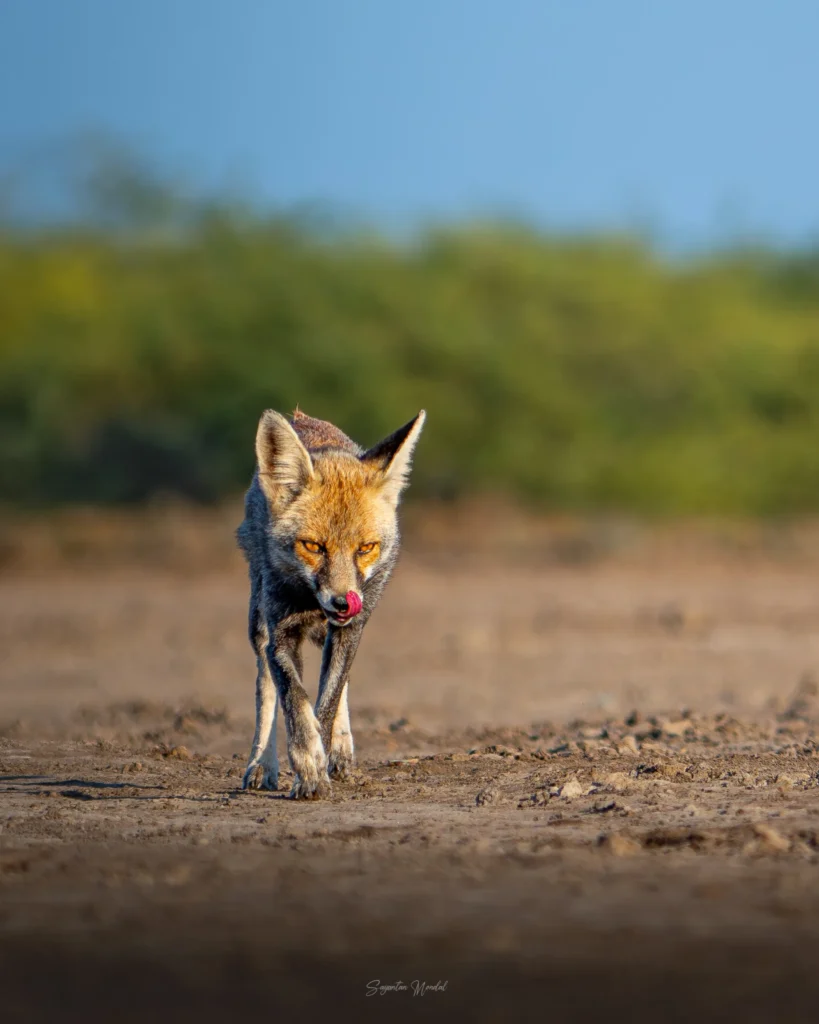
If you want to spot one of the most specialized carnivores of India’s arid zones, you must look to the open sand dunes and saline flats of the northwest. The Indian desert fox, historically known as the white-footed fox, is a highly adapted predator that plays a critical role in maintaining the balance of desert food webs.
Understanding the field characteristics and specific habitat needs of this small canid is essential for any traveller or researcher planning a journey into India’s drylands. While often overshadowed by larger apex species, this mammal offers an insightful look into how wildlife adapts to extreme heat and limited water availability.
What is the Indian Desert Fox?
Taxonomy and Subspecies Breakdown
The Indian desert fox is scientifically classified as Vulpes vulpes pusilla. It is not a distinct evolutionary species, but rather a distinct, localized geographical subspecies of the widespread red fox (Vulpes vulpes).
Misidentifications are frequent among first-time safari visitors. A common error is confusing the Indian desert fox with the African fennec fox due to its large ears, or assuming it is identical to the standard European red fox. Vulpes vulpes pusilla is specifically adapted to the hot, semi-arid environments extending across northwestern India, Pakistan, Iran, and Iraq.
Physical Features and High-Field Identification
Spotting a desert fox requires looking for a compact canid with a distinctly pale, yellowish-beige to sand-coloured coat that provides camouflage against parched earth. The fur is less dense and significantly lighter than that of its high-altitude relative, the Himalayan red fox.
Key field marks include:
- The Tail Tip: The tail is bushy and consistently terminates in a stark white tip, which remains one of the most reliable visual indicators during rapid field observations.
- The Feet: The lower parts of the limbs are pale, giving rise to its historical common name, the white-footed fox.
- The Ears: The ears are disproportionately large relative to its head size, serving a dual purpose: tracking the movements of subterranean prey and dissipating body heat during peak temperatures.
Field Identification: Desert Fox vs. Indian Fox
Distinguishing the desert fox from the co-occurring Indian fox (Vulpes bengalensis) is a foundational skill for accurate wildlife reporting and citizen science documentation. The two species overlap in several semi-arid zones, but they occupy different ecological niches and display clear physical variations.
The most critical diagnostic feature is the tip of the tail. The desert fox always features a white tail tip, whereas the Indian fox possesses a prominent, black tail tip. Additionally, the Indian fox is generally smaller, more gracile, and carries a greyish-brown coat compared to the sandy-ochre tones of the desert fox.
Table 1: Morphological Differences of Indian Canids
| Feature | Indian Desert Fox (Vulpes vulpes pusilla) | Indian Fox (Vulpes bengalensis) |
| Coat Colour | Sandy-ochre, pale yellowish-beige | Silver-grey to sandy-brown |
| Tail Tip | Distinctly white | Distinctly black |
| Ear Size | Relatively large and wide | Moderate, elongated |
| Primary Habitat | Sand dunes, saline flats, open scrub | Open grasslands, scrub forests, agricultural edges |
Field Note
When tracking in low-light conditions at dawn or dusk, body structure is a key indicator. The desert fox presents a slightly longer muzzle and a more robust, long-legged silhouette than the smaller, more compact Indian fox. If the tail tip is obscured by vegetation, observe the ears: the desert fox’s ears are noticeably wider at the base.
Distribution: Where Does the Desert Fox Live in India?
To find the desert fox, you need to target the highly open, arid, and semi-arid landscapes of northwestern India, specifically focusing on protected ecosystems that preserve native grasslands and sand dunes. This subspecies is highly specialized; it thrives in sand dunes, saline scrub grasslands, and open semi-arid scrub-savannah. Crucially, the desert fox actively avoids dense woody encroachment and thick vegetation, meaning you will rarely find them in heavily forested or overgrown areas.
The Thar Desert and Desert National Park (Rajasthan)
If you want the highest probability of a clear sighting, Desert National Park—spanning the Jaisalmer and Barmer regions—is the most reliable destination. The vast, undulating sand dunes and sparse patch grasslands provide the exact open visibility these canids require to hunt and survey for danger.
When exploring this region, focus your tracking efforts around the open dune perimeters near Jaisalmer and the semi-arid tracts extending toward Pokhran. The lack of dense tree cover here makes it easier to spot the silhouette of the fox against the sand during their active hours.
The Banni Grasslands and the Rann of Kutch (Gujarat)
For travellers visiting Gujarat, the Banni grasslands and the broader Kachchh (Kutch) district offer a completely different tracking environment. This region consists of vast, low-lying saline flats and seasonal clay savannahs.
In Kutch, the foxes depend entirely on the remaining open, flat expanses. Because they rely on clear sightlines to avoid larger predators and track prey, their presence in Banni is highly concentrated in areas that have not yet been overtaken by dense, invasive woody plants.
The Bikaner and Semi-Arid Scrub Belts
The semi-arid tracts surrounding the Bikaner district form the easternmost limit of their typical range in Rajasthan. The landscape here transitions from true desert dunes to dry, open scrub-savannah.
Spotting a fox in Bikaner requires scanning the margins of traditional pastoral lands and open fields. The foxes utilize these transitional zones because they support high populations of small desert rodents, though tracking here requires more patience due to the patchy nature of the habitat.
Table 2: Prime Desert Fox Tracking Destinations
| Destination | Primary Landscape | Core Sighting Areas |
| Desert National Park | Active sand dunes and sparse scrub | Jaisalmer and Pokhran tracts |
| Banni Grasslands | Saline clay flats and low scrub-savannah | Central Kutch (Kachchh) district |
| Bikaner Perimeters | Semi-arid scrub and pastoral margins | Rural Bikaner district belts |
Decision Guide: Choosing Your Tracking Destination
- Choose Desert National Park if your primary goal is high-visibility photography against classic sand dunes, or if you want to observe denning behaviour in true desert terrain.
- Choose the Banni Grasslands if you are interested in seeing how the species adapts to saline flat environments and want to understand the active habitat restoration efforts occurring in Gujarat.
Ecology: Foraging Habits and Denning Behaviour
Surviving in India’s arid zones requires high behavioural flexibility. The desert fox manages the extreme daytime heat by remaining primarily nocturnal and crepuscular, meaning they are most active during the twilight hours of dawn and dusk.
Diet Composition and Seasonal Foraging Shifts
Unlike strict carnivores, the Indian desert fox is an opportunistic forager whose diet changes significantly based on the specific site and seasonal availability. Their presence provides a vital ecological service, particularly through the control of rodent populations across the semi-arid scrublands.
Their typical diet includes:
- Small Mammals: Gerbils and other desert rodents form a substantial portion of their protein intake.
- Reptiles: The spiny-tailed lizard is a primary prey species in regions like the Thar desert.
- Invertebrates and Flora: Insects and seasonal fruits supplement their diet when larger prey is scarce.
Because their diet composition shifts so drastically between seasons, locating foxes often requires understanding what local prey is currently active in the landscape.
Den Structures and Reproductive Cycles
The den is the centre of the desert fox’s world. It provides necessary shelter from the lethal midday sun and a secure environment for pup rearing. Field studies note that their burrows are often dug directly into the sides of sand dunes or constructed near the stabilizing roots of reed clumps.
During the breeding season, these dens become critical hubs of activity. Desert foxes utilize communal dens to raise their pups. Observing an active den site offers insight into their social structure, as adults consistently return from twilight foraging to provision the young.
Expert Tip: Reading the Landscape
When attempting to locate a desert fox, look for secondary signs around potential den sites, such as distinct tracks in the loose sand or scattered scat. Because dens are vital for pup survival, they are highly sensitive microhabitats. If you locate an active den, always maintain a significant distance to avoid altering their natural rearing behaviour.
Threats and the Changing Desert Ecosystem
The survival of the Indian desert fox depends entirely on the preservation of open, unobstructed arid landscapes. As human activities, land-use changes, and biological invasions alter the Thar Desert and the Rann of Kutch, this specialized carnivore faces a shifting ecological landscape.
The Encroachment of Prosopis juliflora
The most visible threat to desert fox habitat is the rapid spread of Prosopis juliflora, an invasive woody tree species. Originally introduced to stabilize dunes and provide fuelwood, this tree forms dense, impenetrable thickets across native drylands.
Because the desert fox relies on clear sightlines to detect predators and pursue prey, it actively avoids areas with dense canopy cover. Field research confirms that fox occupancy declines significantly as Prosopis cover increases. In areas like the Banni grasslands, management interventions involving the mechanical removal of these trees have successfully restored the open terrain, leading to an increase in native species richness and returning foxes to their historical foraging grounds.
Feral Dogs and Intra-Guild Competition
Free-roaming domestic dogs present a severe threat to desert carnivore communities. As human settlements expand around the margins of protected areas, dog populations grow, creating pressure on native wildlife.
Dogs threaten desert foxes through three primary mechanisms:
- Direct Predation: Packs of feral dogs frequently attack and kill adult foxes and excavate active dens.
- Disease Transmission: Dogs act as vectors for lethal pathogens, including the mites responsible for sarcoptic mange, which causes severe population declines in arid zones.
- Prey Competition: Dogs compete directly for the small rodents and reptiles that form the core of the fox’s diet.
Furthermore, habitat alteration alters the balance of intra-guild competition. More adaptable generalist predators, like the golden jackal (Canis aureus), displace the desert fox from degraded landscapes where native grasses have been replaced by woody scrub.
Legal Safeguards and Conservation Reality
In terms of official policy, the Indian desert fox is granted the highest level of legal protection under Schedule I of the Wildlife (Protection) Act, 1972. This classification makes poaching or capturing the animal a severe criminal offense.
However, implementing effective conservation plans is difficult due to significant data gaps. There is currently no robust nationwide population estimate for Vulpes vulpes pusilla. Available data remains strictly site-specific, drawn from localized camera-trap and occupancy studies in Banni, Bikaner, and Desert National Park. Without baseline national data, tracking subtle population declines or measuring the long-term success of habitat restoration remains a major challenge for researchers.
Table 3: Primary Threat Matrices and Ecosystem Mitigation
| Threat Vector | Ecosystem Impact | Management Options |
| Invasive Woody Trees (Prosopis) | Loss of open hunting grounds; decreased fox occupancy. | Phased mechanical removal and native grassland restoration. |
| Free-Roaming Dogs | Direct predation, prey competition, and transmission of sarcoptic mange. | Dog vaccination initiatives and population control near park boundaries. |
| Data Deficits | Absence of national population estimates hinders tracking declines. | Expanded occupancy modelling, camera trapping, and citizen science reporting. |
Responsible Tourism Tip
When booking safaris or hiring guides in the Thar or Kutch regions, support operators who work directly with local communities engaged in habitat restoration. Phased, community-led clearing of invasive trees provides local livelihoods while ensuring that the open flats required by the desert fox are preserved for the future.
Safari Planning: How to See and Photograph the Desert Fox
Logistics, Permits, and Peak Viewing Windows
Planning a safari to see the Indian desert fox requires targeting specific activity windows and seasons. Because these foxes are predominantly nocturnal and crepuscular, your highest probability of a sighting occurs during the first two hours after sunrise and the final hour before sunset. During these times, foxes actively forage or sit near their den entrances before the midday heat forces them underground.
The most reliable months for wildlife tracking span from October to March. During this dry winter window, daytime temperatures are manageable, and visibility across the dunes and clay flats is optimal.
- Desert National Park (Rajasthan): Visitors must secure entry permits from the forest department office in Jaisalmer before entering the core wildlife zones. Hiring a registered local guide is mandatory and highly recommended, as they understand the microhabitats where active burrows are located.
- Banni Grasslands (Gujarat): Accessing the Banni region typically requires base camps in Bhuj or Hodka. While formal park permits are less rigid than in closed national parks, navigating the vast, flat terrain requires local tracking expertise to locate foxes across the expansive salt flats.
Ethical Field Tracking and Photographic Protocol
Photographing a small, alert carnivore requires discipline to avoid altering its natural behaviour. Desert foxes are highly sensitive to sudden movements and vehicle noise, especially when raising pups.
- Maintain Distance at Dens: Never approach closer than 50 metres to an active den site. Vehicles should cut their engines immediately upon spotting a fox to reduce stress on the animal.
- Prohibit Baiting: Using food or calls to attract foxes for a closer photograph is strictly forbidden and violates ethical wildlife watching standards. Baiting disrupts natural foraging habits and alters the foxes’ cautious behavior toward humans, increasing their vulnerability to poachers and feral dogs.
- Use the Right Equipment: A telephoto lens of at least 400mm or 500mm is necessary to secure detailed structural images without encroaching on the animal’s comfort zone.
Common Mistakes to Avoid
- Searching During Midday: Many travellers expect to see foxes during standard afternoon safari hours. Because the desert fox retreats to its burrow to escape extreme temperatures, midday tracking yields low success rates. Focus entirely on the dawn and dusk windows.
- Crowding Active Burrows: Approaching too close to a communal den during the pup-rearing season can cause the parents to abandon the site entirely, exposing the vulnerable pups to feral dog predation.
- Assuming All Foxes in the Thar Are the Same Species: Safari visitors often misidentify the Indian fox (Vulpes bengalensis) as the desert fox. Always check the tail tip before confirming an identification: a white tip indicates a desert fox, while a black tip indicates an Indian fox.
- Overlooking the Impact of Invasive Plants: A common misconception is that dense tree cover helps desert wildlife. In reality, overgrown stands of Prosopis juliflora degrade the open habitats these foxes rely on, making it harder for them to hunt and avoid larger predators.
Frequently Asked Questions (FAQs)
1. Is the Indian desert fox the same as the African fennec fox?
No. The Indian desert fox (Vulpes vulpes pusilla) is a localized subspecies of the red fox. While it has large ears to dissipate heat, it is genetically distinct from the African fennec fox, which is a completely separate species.
2. What is the current legal protection status of the desert fox in India?
The Indian desert fox is listed under Schedule I of the Wildlife (Protection) Act, 1972. This provides it with the highest level of legal protection under Indian law, making poaching, hunting, or habitat destruction a severe criminal offense.
3. How can you distinguish a desert fox from an Indian fox in low light?
Look directly at the tail tip. The desert fox always features a prominent white tip, whereas the Indian fox has a distinct black tip. Structurally, the desert fox also has a longer muzzle and larger, wider ears.
4. Why is the invasive Prosopis juliflora tree bad for desert foxes?
The desert fox is an open-habitat specialist that relies on clear sightlines to track rodents and avoid larger predators. Prosopis juliflora forms dense, woody thickets that block these sightlines, causing foxes to abandon these areas.
5. What time of day offers the highest probability of a desert fox sighting?
The twilight hours of dawn and dusk offer the best opportunity. The foxes are highly crepuscular and nocturnal to avoid daytime heat, making them active just as the sun rises or sets.
6. Do free-roaming domestic dogs pose a direct survival threat to these foxes?
Yes. Feral and free-roaming dogs compete with foxes for prey, attack adults, excavate dens, and transmit deadly diseases such as sarcoptic mange.
7. Where is the best specific zone to photograph desert foxes at their dens?
The protected dune areas inside Desert National Park near Jaisalmer offer the highest success rates for den photography, provided visitors maintain a responsible distance.
8. How can citizen scientists contribute to desert fox distribution mapping?
Travellers and researchers can upload clear, geotagged photographs of their sightings to the India Biodiversity Portal or Mammals of India platform. These records help bridge the existing data gaps regarding the national distribution of the species.
Conclusion
The Indian desert fox is a resilient and vital component of India’s northwestern drylands. From its physical adaptations for heat dissipation to its dynamic foraging habits, this predator is uniquely equipped to survive in extreme environments.
However, its long-term survival relies heavily on protecting open landscapes from invasive plants and managing pressures from expanding human settlements. By prioritizing ethical tracking, avoiding common identification mistakes, and supporting habitat restoration efforts, travellers can actively contribute to the conservation of this specialized canid.
Author Note & Update Log: Written by the WildlifeSafaris.in Editorial Team. Last Updated: October 2026.