
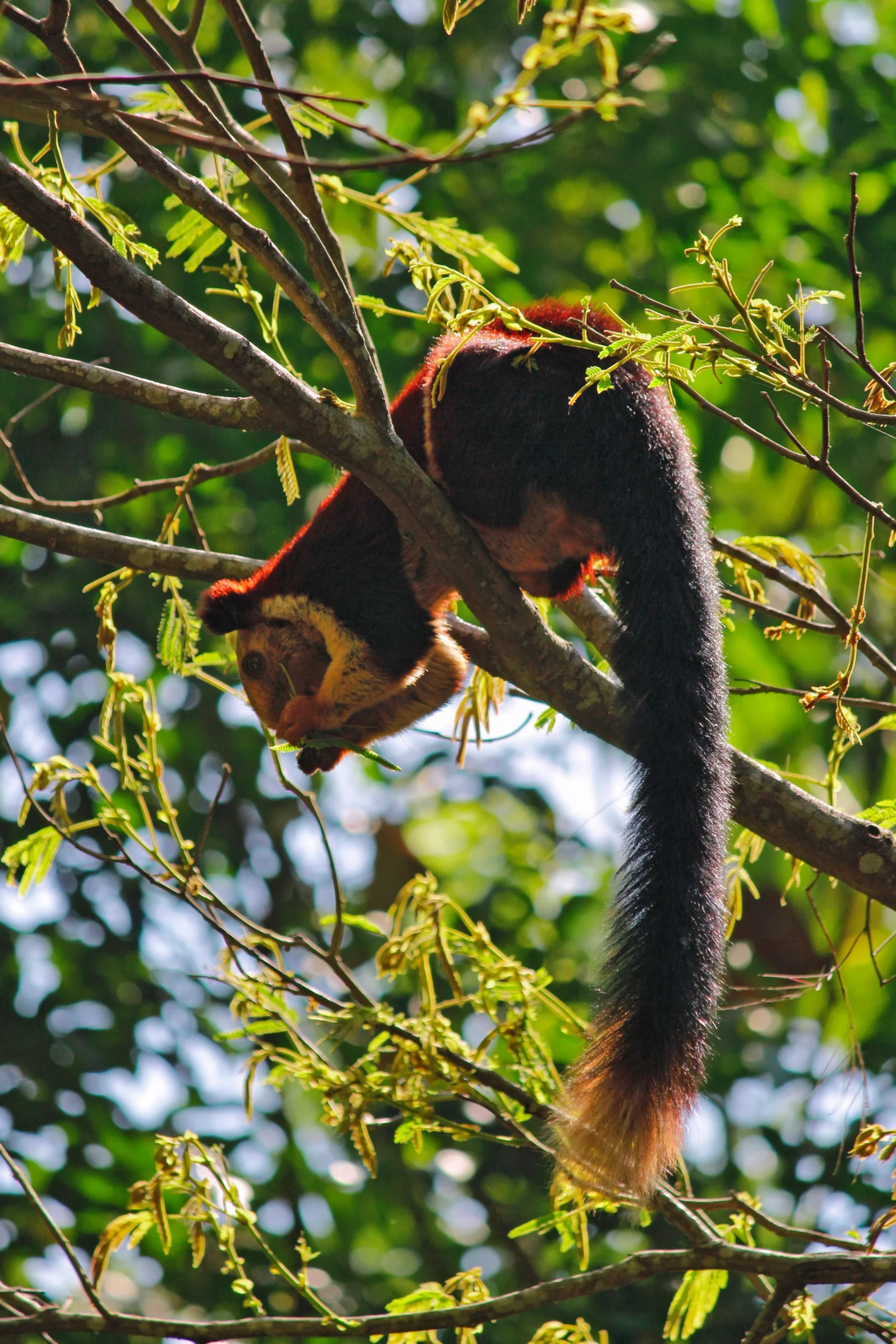
Learn where and when to photograph the Malabar giant squirrel, the best camera settings, field techniques, ethical practices, and top Western Ghats locations.
Malabar Giant Squirrel Photography Guide: Photographing India’s Colourful Canopy Acrobat

Photographing the Malabar giant squirrel is very different from photographing large mammals such as tigers, elephants or deer. Instead of searching forest roads, you’ll spend much of your time scanning the canopy, listening for movement, and waiting patiently for a clear view through branches.
Its combination of large size, deep maroon, cream and black fur, and agile movement makes it one of India’s most rewarding mammals to photograph. At the same time, it is also one of the most demanding. The squirrel spends almost all of its life in trees, often high above the ground where changing light, dense foliage and constantly shifting positions test both photographer and equipment.
Success depends less on luck than on understanding the animal’s behaviour. Knowing when it is most active, recognising feeding sounds, anticipating movement between trees and positioning yourself carefully can make a far greater difference than simply carrying a longer lens.
This guide brings together practical field techniques, photography advice, destination recommendations and ethical wildlife practices to help you photograph the Malabar giant squirrel responsibly while appreciating the forests it depends on.
Why the Malabar Giant Squirrel Is a Special Photography Subject
Unlike many mammals that spend time on the ground, the Malabar giant squirrel is almost entirely arboreal. Most encounters occur high in mature forest canopies, often with only brief openings through leaves.
Several characteristics make it particularly appealing to wildlife photographers:
- One of the world’s largest tree squirrels.
- Distinctive multi-coloured fur that stands out against green foliage.
- Active daytime behaviour, allowing photography in natural light.
- Agile leaps between branches that create dramatic action opportunities.
- Feeding, grooming and calling behaviours that reward patient observation.
These same characteristics also create challenges. Forest canopies produce uneven lighting, bright skies behind dark subjects and obstructed views. Even when a squirrel is visible, branches often hide parts of the body, making composition difficult.
Experienced wildlife photographers often find that a technically perfect image requires several encounters rather than a single sighting. Waiting for the squirrel to pause on an exposed branch or emerge into better light usually produces stronger photographs than continuously shooting through dense foliage.
Quick Facts About the Malabar Giant Squirrel
| Feature | Details |
| Scientific name | Ratufa indica |
| Other common names | Indian Giant Squirrel, Shekru (Maharashtra) |
| Family | Sciuridae |
| Activity | Diurnal |
| Lifestyle | Primarily arboreal |
| Distribution | Forests of the Western Ghats and other forested regions of peninsular India |
| Conservation status | IUCN: Least Concern, although habitat loss and fragmentation remain important concerns in parts of its range |
| Photography difficulty | Moderate to difficult due to canopy habitat and variable light |
Field Note
Many first-time photographers spend too much time looking at ground level. Instead, pause regularly and scan the upper canopy with binoculars or your naked eye. A patch of maroon fur, a flicking tail, falling fruit fragments or gentle rustling among branches often reveals the squirrel before it becomes clearly visible. Learning to read the canopy is one of the most valuable field skills you can develop.
Best Photography Locations, Best Time & Finding the Species
Where to Photograph the Malabar Giant Squirrel
The best place to photograph the Malabar giant squirrel is not necessarily the park with the highest visitor numbers. Instead, look for forests with mature trees, a connected canopy and relatively low disturbance. Since these squirrels spend nearly all their lives in the treetops, healthy forest structure is often a better predictor of successful sightings than the name of the destination itself.
The species occurs across much of the Western Ghats and parts of peninsular India, with several protected areas offering good opportunities for wildlife photographers.
Maharashtra
Bhimashankar Wildlife Sanctuary
Bhimashankar is widely associated with the Shekru, the local name for the Indian giant squirrel and the state animal of Maharashtra. Dense evergreen and semi-evergreen forests provide suitable habitat, making it one of the best-known destinations for photographing the species.
Photographers should be prepared for:
- Dense canopy that can make autofocus challenging.
- Soft morning light filtering through forest cover.
- Opportunities to photograph squirrels feeding or moving between mature trees.
- Sloping terrain that occasionally allows eye-level compositions.
Koyna Wildlife Sanctuary
Koyna’s extensive forests provide suitable habitat for giant squirrels, especially in less disturbed sections of the sanctuary. The large forest landscape rewards patient observers willing to spend time scanning the canopy rather than moving quickly along trails.
Radhanagri Wildlife Sanctuary
Known primarily for gaur, Radhanagri also supports mature forest where giant squirrels may be encountered. Wildlife photographers often combine mammal photography with bird photography during visits to the sanctuary.
Phansad Wildlife Sanctuary
Although smaller than many Western Ghats reserves, Phansad protects patches of suitable forest and can provide opportunities for photographing arboreal mammals. Success depends heavily on spending time in appropriate habitat rather than covering long distances.
Karnataka
Nagarhole National Park
Nagarhole is better known for tigers, leopards and elephants, but photographers occasionally encounter Malabar giant squirrels in wooded sections of the park.
Unlike dedicated forest walks, sightings during vehicle safaris may be brief. Having a telephoto lens ready and reacting quickly can make the difference between a record shot and a missed opportunity.
Kabini
Kabini’s woodland habitats sometimes produce sightings, particularly where mature trees line safari routes. While most visitors focus on large mammals, keeping an eye on the canopy can reward observant photographers with unexpected encounters.
Someshwara Wildlife Sanctuary
This Western Ghats sanctuary protects evergreen forests that provide suitable habitat for arboreal mammals. Forest trails offer opportunities to spend longer observing canopy activity than is usually possible during vehicle safaris.
Kerala
Wayanad Wildlife Sanctuary
Wayanad combines extensive forest cover with good wildlife diversity. Giant squirrels occur in suitable woodland, where patient scanning of fruiting trees often produces sightings.
Many photographers visit primarily for elephants or birds but discover that spending time around mature trees during the early morning can produce rewarding squirrel photographs.
Silent Valley Landscape
The rainforest landscapes around Silent Valley support suitable habitat for giant squirrels. Dense evergreen forest creates atmospheric images but also presents some of the most demanding lighting conditions photographers are likely to encounter.
Comparison of Popular Photography Destinations
| Destination | State | Habitat | Best For | Notes |
| Bhimashankar Wildlife Sanctuary | Maharashtra | Evergreen forest | Dedicated squirrel photography | Closely associated with the Shekru |
| Nagarhole National Park | Karnataka | Mixed woodland | Combining mammal photography | Squirrels are a bonus during safari drives |
| Wayanad Wildlife Sanctuary | Kerala | Moist deciduous and evergreen forest | Wildlife diversity | Good option for photographers seeking multiple species |
| Koyna Wildlife Sanctuary | Maharashtra | Mature forest | Patient forest photography | Rewards slow exploration |
| Someshwara Wildlife Sanctuary | Karnataka | Evergreen forest | Arboreal wildlife | Dense canopy requires patience |
When Is the Best Time to Photograph the Malabar Giant Squirrel?
Understanding the squirrel’s daily activity is often more important than choosing the perfect camera.
Early Morning Is Usually the Most Productive
Early morning generally offers the best combination of animal activity and favourable light.
Benefits include:
- Greater squirrel activity after sunrise.
- Softer light with less contrast.
- Cooler temperatures.
- Better opportunities to observe feeding behaviour.
- More pleasant conditions for extended walks.
For photographers, this period often produces cleaner images with lower ISO values than later in the day.
Midday Can Be Difficult
Midday presents several challenges:
- Harsh overhead sunlight.
- Bright patches of sky behind dark subjects.
- High contrast between leaves and shadows.
- More distracting highlights in the canopy.
Although sightings remain possible, obtaining well-exposed photographs becomes significantly harder.
Seasonal Considerations
The research brief does not identify a single universally best season across the species’ range. Instead, local weather, forest conditions and accessibility influence photography opportunities.
Rather than planning around a specific month alone, consider:
- Accessibility of forest trails.
- Expected weather conditions.
- Visibility within the canopy.
- Availability of experienced local guides familiar with recent squirrel activity.
Photography Tip
If your itinerary allows only one dedicated photography session each day, choose the first few hours after sunrise. You’ll usually benefit from better light, increased animal activity and more comfortable working conditions before the forest becomes brighter and warmer.
How to Find Malabar Giant Squirrels in the Wild
Finding the squirrel is often the hardest part of photographing it. Despite its impressive size, it blends surprisingly well into the forest canopy when stationary.
Successful photographers spend more time observing than walking.
Start by Looking Up
A common beginner’s mistake is scanning only the forest floor.
Instead:
- Search the upper canopy.
- Watch exposed branches.
- Look along connected tree crowns.
- Check fruiting trees.
- Pause regularly instead of constantly moving.
Listen Before You Look
The squirrel often reveals its presence before it becomes visible.
Useful clues include:
- Rustling leaves high in the canopy.
- Movement between branches.
- Feeding sounds.
- Vocal calls.
Once you’ve identified the general direction, continue watching patiently rather than rushing closer, as sudden movement may cause the animal to retreat deeper into the foliage.
Watch for Behaviour Patterns
Rather than photographing the first glimpse you get, spend a few minutes observing.
The squirrel may:
- Pause while feeding.
- Climb onto an exposed branch.
- Groom itself.
- Move into better light.
- Prepare for a leap between trees.
Waiting for these natural behaviours often results in more engaging photographs than taking hurried record shots through dense leaves.
Expert Tip
Instead of following the squirrel continuously with your camera, identify an open branch or natural gap in the canopy where it is likely to appear. Pre-compose your frame and wait. This approach often produces cleaner compositions and gives your autofocus system a much better chance of locking onto the subject when it emerges.
Camera Gear, Camera Settings, Composition & Behaviour Photography
Recommended Camera Gear for Malabar Giant Squirrel Photography
You don’t need the most expensive equipment to photograph a Malabar giant squirrel, but you do need gear that can cope with long shooting distances, uneven forest light and subjects that rarely stay still for long.
A combination of a responsive camera body and a good telephoto lens is usually more valuable than carrying a large amount of equipment into the forest.
Choosing the Right Lens
Because the squirrels spend most of their time high in the canopy, telephoto lenses are generally the most practical choice.
| Lens | Best Use | Advantages | Limitations |
| 200–300 mm | Large mammals plus occasional squirrel sightings | Lightweight and versatile | May require cropping for distant subjects |
| 300–400 mm | Dedicated squirrel photography | Good balance between reach and handling | Can still be short for high canopy subjects |
| 500–600 mm | Distant canopy photography | Excellent subject isolation | Larger, heavier and harder to handhold for long periods |
Rather than carrying the longest available lens, choose one you can comfortably handle during several hours of walking. Camera shake caused by fatigue can reduce image quality more than using a slightly shorter focal length.
Camera Body Features That Help
Modern cameras with strong autofocus performance provide a clear advantage when photographing arboreal mammals.
Useful features include:
- Fast continuous autofocus.
- Good high-ISO performance.
- High-speed continuous shooting.
- Reliable subject tracking.
- Weather sealing for humid forest conditions.
These features improve your chances of capturing sharp images when the squirrel suddenly moves between branches.
Helpful Accessories
Consider carrying:
- Extra batteries for long field days.
- Spare memory cards.
- Lens hood to reduce flare.
- Rain protection during the monsoon.
- Lightweight binoculars for locating animals before raising the camera.
A tripod can be useful in some situations, but it may become cumbersome on forest trails where the subject changes position frequently. Many wildlife photographers prefer shooting handheld or using lighter support systems.
Recommended Camera Settings
Forest photography requires balancing shutter speed, aperture and ISO while dealing with constantly changing light.
There is no single “correct” setting, but the following starting points work well in many situations.
| Situation | Shutter Speed | Aperture | ISO | Focus Mode |
| Resting squirrel | Fast enough to minimise movement | Wide enough to gather light | Adjust as needed | Continuous autofocus |
| Feeding behaviour | Slightly faster | Moderate aperture | Auto ISO if available | Continuous autofocus |
| Leaping between trees | High shutter speed | Wider aperture | Higher ISO often required | Continuous autofocus with burst shooting |
| Bright canopy | Faster exposure to protect highlights | Adjust for depth of field | Lower ISO where possible | Continuous autofocus |
The exact values will vary depending on your camera and lighting, but maintaining a sufficiently fast shutter speed is usually more important than keeping ISO extremely low. A slightly noisy image is often preferable to one blurred by subject movement.
Handling Difficult Forest Light
One of the biggest challenges is photographing a dark subject against a bright sky.
Common problems include:
- Overexposed backgrounds.
- Underexposed fur.
- Loss of detail in shadows.
- Distracting patches of sunlight.
Instead of photographing every sighting immediately, wait for the squirrel to move into softer, more even light whenever possible. A few seconds of patience can dramatically improve image quality.
Photography Tip
Review your histogram periodically rather than relying only on the camera screen. Bright canopy light can make images appear darker than they actually are, while deep forest shade can have the opposite effect.
Composition and Fieldcraft
Technical settings alone rarely produce memorable wildlife photographs. Strong composition depends on anticipating behaviour and positioning yourself carefully before the squirrel reaches an open perch.
Look for Eye-Level Opportunities
Photographs taken from directly below often show only the underside of the animal against a bright sky.
A better approach is to use natural terrain.
If the forest includes slopes or elevated trails, position yourself so that the squirrel is closer to eye level. This creates more intimate portraits and reduces distracting backgrounds.
Simplify the Background
Dense forests naturally create busy compositions.
Whenever possible:
- Wait for the squirrel to move onto an exposed branch.
- Avoid overlapping branches behind the subject.
- Use longer focal lengths to isolate the animal.
- Allow natural foliage to frame the squirrel instead of hiding it.
Sometimes moving only a few metres along the trail is enough to transform a cluttered image into a much cleaner composition.
Tell a Story, Not Just Record a Sighting
A sharp portrait is satisfying, but behaviour often creates stronger wildlife photographs.
Consider waiting for moments such as:
- Feeding.
- Grooming.
- Stretching.
- Looking across the canopy.
- Preparing to leap.
These images communicate something about the animal’s life rather than simply documenting its presence.
Use Natural Forest Elements
Instead of cropping tightly every time, include parts of the surrounding habitat when they add context.
Branches, vines and leaves can help show:
- The squirrel’s arboreal lifestyle.
- The height at which it lives.
- Relationships between the animal and its environment.
Environmental portraits often become more meaningful because they tell viewers where the animal lives, not just what it looks like.
Behaviour Worth Waiting For
The most memorable photographs usually capture behaviour rather than static poses.
| Behaviour | Photography Opportunity | Difficulty |
| Feeding | Natural, relaxed portraits | Moderate |
| Grooming | Detailed behavioural images | Moderate |
| Calling | Characterful expressions | Moderate to difficult |
| Resting | Clean portraits with good eye contact | Easier |
| Leaping | Dynamic action photographs | Difficult |
Feeding
When feeding, squirrels often remain in one area for several minutes. This gives photographers time to refine composition, adjust exposure and wait for better body positions.
Calling
Calling behaviour can create expressive images, particularly when the animal pauses on an exposed branch. Listening carefully also helps locate squirrels hidden within dense foliage.
Leaping
Few wildlife photographs are as dramatic as a giant squirrel suspended between trees.
These moments are difficult to predict, but patient observation helps. Rather than following every movement through the viewfinder, watch the animal’s body language. A crouched posture and focused gaze often indicate that it is preparing to jump. Burst shooting and fast autofocus improve the chances of capturing the action.
Resting
Resting squirrels often provide the best portrait opportunities. With less movement, you can pay closer attention to composition, eye contact and background while refining your exposure.
Field Note
Many experienced wildlife photographers return from a successful day with relatively few images but a high percentage of usable photographs. Patience usually produces better results than taking hundreds of hurried frames through dense foliage. Waiting for the right perch, cleaner light or more interesting behaviour often makes the difference between a simple record shot and an image worthy of publication.
Ethical Photography, Common Mistakes, FAQs & Conclusion
Ethical Wildlife Photography
A successful photograph should never come at the expense of the animal’s welfare. The Malabar giant squirrel is naturally wary and spends most of its life in the forest canopy. Respecting its behaviour and habitat not only protects the species but also increases the likelihood of observing natural behaviour.
Keep a Respectful Distance
If a squirrel repeatedly changes direction, freezes, or retreats deeper into the canopy because of your presence, you are probably too close.
Instead:
- Let the animal decide its distance from you.
- Avoid standing directly beneath an occupied tree for extended periods.
- Use your telephoto lens instead of trying to approach.
- Stay on established trails whenever possible.
Never Use Bait
Baiting wildlife with food to obtain photographs changes natural behaviour and may expose animals to unnecessary risks.
Responsible wildlife photography does not involve:
- Offering food.
- Playing recorded calls to attract animals.
- Throwing objects to encourage movement.
- Deliberately startling wildlife to create action shots.
Natural behaviour always produces more authentic photographs.
Respect Nesting and Feeding Animals
If you discover a nesting site or observe prolonged feeding behaviour:
- Maintain extra distance.
- Avoid blocking access routes.
- Keep conversations quiet.
- Allow the animal to continue its routine without interruption.
Repeated disturbance around nests can place unnecessary stress on wildlife.
Remember That Habitat Matters
Photographing the Malabar giant squirrel is ultimately about photographing healthy forests.
The species depends on mature trees and connected canopies. Conservation reports continue to highlight that habitat loss and forest fragmentation remain important long-term concerns, even though the species is currently listed as Least Concern globally. Supporting protected areas and responsible ecotourism helps maintain these habitats for future generations.
Responsible Tourism Tip
Leave the forest exactly as you found it. Carry out all litter, avoid damaging vegetation to create a clearer view, and follow the instructions of forest staff and local guides. Good field ethics benefit both wildlife and future visitors.
Common Mistakes Wildlife Photographers Make
Even experienced photographers find the Malabar giant squirrel challenging. Avoiding these common mistakes will improve both your images and your field experience.
Looking Only at Ground Level
The squirrel spends almost all of its time in the canopy. Train yourself to pause regularly and scan the treetops instead of searching only along the trail.
Walking Too Quickly
Many sightings are missed because photographers focus on covering distance rather than observing carefully. Slow, deliberate movement allows you to notice subtle canopy activity.
Photographing Immediately
Your first view is rarely the best one. Waiting a few moments often allows the squirrel to move onto a clearer branch or into better light.
Ignoring the Background
Branches crossing the face or body can distract from an otherwise strong photograph. Whenever possible, adjust your position or wait for a cleaner composition.
Using a Shutter Speed That Is Too Slow
Even when resting, squirrels make frequent small movements. Motion blur is a common reason otherwise good images are discarded.
Chasing the Animal
Following a moving squirrel through dense forest often causes unnecessary disturbance and rarely improves photographs. Instead, anticipate where it may appear next and wait patiently.
Frequently Asked Questions
Is the Malabar giant squirrel the same as the Indian giant squirrel?
Yes. Ratufa indica is commonly known as both the Malabar giant squirrel and the Indian giant squirrel. In Maharashtra, it is also called the Shekru.
Where are the best places to photograph it?
Well-known locations include Bhimashankar Wildlife Sanctuary, Koyna Wildlife Sanctuary, Radhanagri Wildlife Sanctuary, Nagarhole National Park, Wayanad Wildlife Sanctuary and Someshwara Wildlife Sanctuary. Success depends on habitat quality and patience rather than any guarantee of sightings.
What is the best time of day?
Early morning is generally the most productive period because squirrels are often more active and the light is softer for photography.
Which lens should I use?
A telephoto lens in the 300–600 mm range is often practical for canopy wildlife, although shorter telephoto lenses can also produce good results when animals are closer.
Is a tripod necessary?
Not always. Many photographers prefer handheld shooting because squirrels move frequently and forest trails often require mobility. A tripod may be useful for longer waits in one location.
Why is the species difficult to photograph?
Its arboreal lifestyle, dense forest habitat, constantly changing light and tendency to remain high in the canopy make photography technically demanding.
What behaviour should I photograph?
Feeding, grooming, calling and leaping between branches often create the most engaging images because they tell a story about the animal’s natural behaviour.
Is the Malabar giant squirrel endangered?
The species is currently classified as Least Concern on the IUCN Red List. However, habitat loss and forest fragmentation remain important conservation issues across parts of its range.
Can beginners photograph this species?
Yes, but success comes from patience rather than expensive equipment. Learning to observe the canopy, understand behaviour and work with forest light is often more valuable than owning the longest telephoto lens.
Is baiting acceptable for wildlife photography?
No. Ethical wildlife photography avoids baiting, disturbing nests or altering natural behaviour simply to obtain photographs.
Conclusion
The Malabar giant squirrel is one of India’s most distinctive mammals and one of the most rewarding subjects for wildlife photographers willing to slow down and observe carefully. Its colourful coat, impressive agility and life high in the forest canopy offer photographic opportunities that are very different from traditional safari wildlife.
Success depends less on expensive equipment than on understanding the species. Learning to read the canopy, listening for movement, working with changing forest light and waiting patiently for natural behaviour will consistently produce stronger images than simply taking more photographs.
Equally important is photographing the species responsibly. Healthy forests with mature, connected canopies are essential for the Malabar giant squirrel’s long-term survival. By practising ethical wildlife photography and supporting responsible nature tourism, photographers contribute not only to better images but also to the conservation of the remarkable forests that make these encounters possible.
On quiet mornings, photographers often hear dry leaves rustling high above before they see the squirrel itself. A flick of its long tail or fragments of fruit falling from the canopy are often the first clues that one is feeding overhead.
- territorial behaviour
- nest-building
- feeding preferences
- seed dispersal role
- why long canopy leaps matter
- Western Ghats Wildlife Photography Guide
- Best Wildlife Photography Camera Settings
- Ethical Wildlife Photography Guide
- Nagarhole National Park Guide
- Bhimashankar Wildlife Sanctuary Guide
- Endemic Mammals of India
Photographing a Malabar giant squirrel is less about chasing a rare animal and more about learning to read a living forest. The photographers who return with the strongest images are usually those who spend more time watching than shooting. Patience, careful observation and respect for the animal’s space are ultimately the most valuable pieces of equipment you can carry.
- Indian giant squirrel photography
- Shekru photography
- Western Ghats wildlife photography
- Canopy wildlife photography
- Arboreal mammal photography
- Forest wildlife photography tips