
Discover the diverse eagle species of India. Learn how to identify true eagles, fish eagles, and serpent eagles, their key habitats, and where to find them.
Planning a birdwatching trip to India requires a clear understanding of its predatory birds. If you want to identify eagles successfully in the field, you must first look beyond the common name “eagle” and understand how these birds divide into specific groups based on their anatomy and hunting habitats.
India’s geographical diversity creates distinct ecological zones. Each zone supports specific raptors adapted to distinct landscapes, ranging from the high-altitude peaks of the Himalayas to the interior grasslands and extensive coastal systems. Identifying these birds requires observing subtle differences in flight silhouettes, wing shapes, and habitat preferences rather than relying entirely on size or feather color.
How Many Eagle Species Are Found in India?
Casual reference websites and travel brochures frequently publish conflicting numbers regarding India’s total eagle species. This variation occurs because many lists fail to separate “true eagles” from other large birds of prey that share the eagle name colloquially.
To build an accurate checklist for your safari, you must differentiate between birds that live in India year-round and those that arrive only during the winter months. India’s raptor population includes resident breeders, regional within-India migrants, and long-distance migratory visitors that travel across the Himalayas from Central and East Asia.
Field Note: Knowing whether a bird is a resident or a winter migrant is one of the fastest ways to narrow down your identification options. If you sight a large, dark eagle in South India during July, you can immediately rule out winter-only migrants like the Steppe Eagle.
Understanding the Types of Eagles in India
Field identification becomes significantly easier when you categorize an unknown raptor into one of four major ecological groups. These groups tell you where the bird is most likely to hunt, what it eats, and what structural field marks to look for.
True Eagles
True eagles belong primarily to genera like Aquila and Clanga. These birds are characterized by their fully feathered legs, where the feathers extend all the way down to the base of the toes. They are mostly large, heavily built predators that utilize open country, grasslands, and montane regions. This group includes species such as the Steppe Eagle and the Indian Spotted Eagle.
Fish and Sea Eagles
Fish and sea eagles, belonging to the genus Haliaeetus, are specialized apex predators tied directly to aquatic environments. Unlike true eagles, their lower legs are bare of feathers, which prevents waterlogging when they snatch prey from the water surface. They feature heavily curved talons with specialized rough pads on the soles of their feet to grip slippery fish. They occupy major river systems, massive inland wetlands, lakes, and coastal shorelines.
Hawk-Eagles and Serpent Eagles
Hawk-eagles and serpent eagles are forest-dwelling raptors adapted for navigating dense tree canopies. They generally possess shorter, more rounded wings and longer tails compared to true eagles, giving them high maneuverability through branches.
- Serpent Eagles: These birds specialize in hunting reptiles. They have short, robust toes with thick scales that protect them from snake bites.
- Hawk-Eagles: These predators have long, powerful legs and claws designed to seize forest birds and small mammals.
Raptor Group Comparison
The table below outlines the structural differences and primary hunting habitats for the major raptor groups found across India.
| Raptor Group | Leg Feathering | Wing Profile | Primary Prey | Preferred Breeding Habitat |
| True Eagles (e.g., Aquila, Clanga) | Fully feathered down to the toes | Long, broad, deeply slotted fingertips | Mammals, birds, carrion | Grasslands, open plains, mountains |
| Fish & Sea Eagles (e.g., Haliaeetus) | Bare lower legs | Very broad, board-like wings | Fish, waterfowl, water snakes | Large lakes, rivers, coastal zones |
| Hawk-Eagles | Feathered legs | Short, rounded wings; long tail | Birds, small mammals | Dense woodlands, forest edges |
| Serpent Eagles | Bare, heavily scaled lower legs | Broad, rounded wings | Snakes, lizards, amphibians | Forests, well-wooded plantations |
Most Important Eagle Species in India
When planning a birding itinerary, it is practical to focus first on the species that define India’s open habitats and grasslands. These true eagles (primarily belonging to the genera Aquila and Clanga) present some of the most rewarding sightings, though they also pose significant identification challenges.
Separating dark raptors—especially juveniles and sub-adults—requires careful observation of habitat context, seasonal timing, and wing structure.
Core Indian Eagle Species Matrix
The following table outlines three of the most highly sought-after eagle species in India, comparing their movements, conservation status, and primary habitats based on recent conservation frameworks.
| Species | Scientific Name | Conservation Status | Movement | Main Habitat | Key India Regions |
| Indian Spotted Eagle | Clanga hastata | Vulnerable, Schedule I | Resident & within-India migrant | Open habitat | Karnataka, Tamil Nadu, Uttar Pradesh |
| Steppe Eagle | Aquila nipalensis | Migratory / Declining concern | Winter visitor / Migrant | Open country | North and central wintering areas |
| Pallas’s Fish-Eagle | Haliaeetus leucoryphus | Endangered | Partially migratory | Wetlands, rivers, lakes | Northern India (breeding/wintering range) |
Indian Spotted Eagle (Clanga hastata)
The Indian Spotted Eagle is a critical species for conservationists and birdwatchers. It is categorized as Vulnerable globally and receives the highest level of legal protection in India under Schedule I of the Wildlife (Protection) Act.
Unlike many large eagles that migrate across international borders, the Indian Spotted Eagle is a resident and within-India migrant. It occupies an estimated distribution range of 309,810 square kilometers. The State of India’s Birds factsheet highlights concerning population data for this species, recording a long-term decline of 24.26% and an annual decline trend of 2.61%.
- Habitat & Distribution: It relies heavily on open habitats, agricultural margins, and dry plains. You have the highest probability of observing this species in the states of Karnataka, Tamil Nadu, and Uttar Pradesh.
- Field Note: Proper identification requires distinguishing it from other dark Clanga and Aquila eagles found in peninsular India. Look for its relatively broad wings, short tail, and the distinctive “spotted” plumage on juveniles, which fades as the bird matures into a uniform brown adult.
Steppe Eagle (Aquila nipalensis)
The Steppe Eagle is a classic example of why the term “common” can be misleading in birdwatching. While you may see large numbers of these eagles in certain areas, they do not breed in India. They are winter migrants that travel from their northern breeding grounds to winter across open country in North and Central India.
The State of India’s Birds framework actively monitors the Steppe Eagle as a species of conservation concern due to documented population declines across its range.
- Habitat & Distribution: They are highly specialized for open country, grasslands, and large refuse dumps near urban margins where they scavenge.
- Expert Tip: Because Steppe Eagles migrate, size and plumage alone are insufficient for identification during winter months when they mix with resident eagles. Focus on the noticeable gape line (the fleshy area at the base of the beak) which extends prominently past the eye in this species.
Golden Eagle (Aquila chrysaetos)
The Golden Eagle occupies an entirely different ecological niche compared to the spotted or steppe eagles. This massive, powerful predator is an altitude specialist.
- Habitat & Distribution: In India, the Golden Eagle is strictly a resident of the high-altitude montane regions of the Himalayas.
- Identification: Look for a very large, dark brown eagle holding its wings in a slight “V” shape (dihedral) while soaring over high mountain ridges. Adult birds display a distinct golden wash on the nape of their neck.
Other Notable Open-Country and True Eagles
Several other true eagles share the open plains and forested margins of India, often complicating field identification:
- Eastern Imperial Eagle: A large, powerful winter migrant to northern and northwestern India, preferring arid and semi-arid plains.

- Tawny Eagle: A resident species that heavily utilizes dry, open country and scrublands. It is often confused with the migrant Steppe Eagle, though the Tawny is generally smaller and less bulky.
- Greater and Lesser Spotted Eagles: Migratory relatives of the Indian Spotted Eagle. The Greater Spotted Eagle typically prefers wetland margins, while the Lesser Spotted Eagle is a rare visitor to the subcontinent.
- Booted Eagle and Bonelli’s Eagle: Medium-sized, highly agile eagles. The Booted Eagle is a common winter migrant known for occurring in two distinct color phases (pale and dark morphs). Bonelli’s Eagle is a resident, aggressive hunter often found in hilly, rocky terrain and dry scrub.
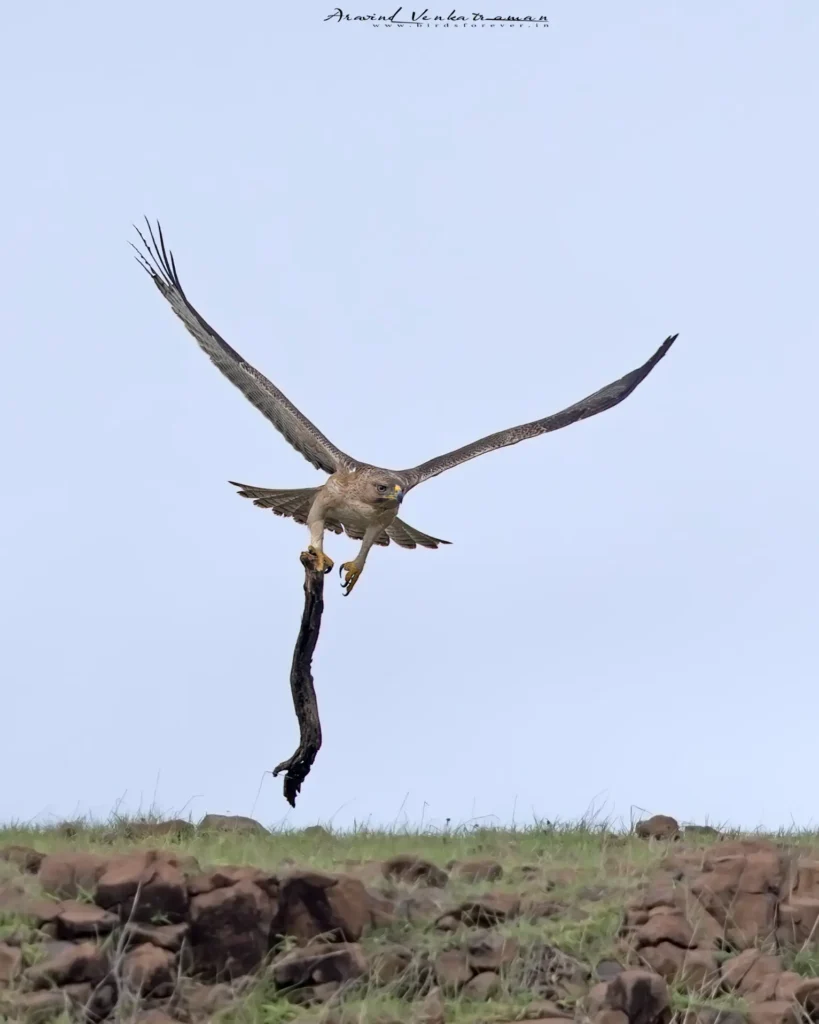
Specialized Raptors: Wetland, Coastal, and Forest Eagles
While the true eagles dominate India’s dry plains and high altitudes, a completely different cast of raptors rules the country’s waterways and dense jungles. These specialized birds—fish eagles, sea eagles, hawk-eagles, and serpent eagles—require different birdwatching strategies. Because they are tightly bound to specific ecological niches, identifying their habitat is often the first step in identifying the bird itself.
Pallas’s Fish-Eagle (Haliaeetus leucoryphus)
The Pallas’s Fish-Eagle is a priority species for any birder visiting India’s major river systems. It is widely treated as Endangered in conservation references and faces significant ongoing threats. Recent bird reference pages continue to emphasize population decline and severe habitat pressure for this species.
- Habitat & Distribution: This eagle is inextricably linked to large bodies of water, including wetlands, rivers, lakes, and marshes. It is partially migratory, associated with breeding in northern India and wintering across Central and East Asia.
- Field Note: Not every eagle seen near water is a fish eagle. However, if you are scanning inland freshwater systems in northern India, Pallas’s Fish-Eagle is a primary target. Watch for a large, heavy-chested bird with a distinctive pale head and a dark tail featuring a broad white band.
White-bellied Sea Eagle
While Pallas’s Fish-Eagle dominates inland freshwater, the White-bellied Sea Eagle rules the saltwater margins.
- Habitat & Distribution: This species relies on coastal habitats rather than inland plains. They are prominent along India’s mainland coastlines and are especially notable in the Andaman and Nicobar Islands.
- Expert Tip: Pay attention to your geography. If you are birding along coastal estuaries, beaches, or offshore islands, the large raptor soaring above the water is far more likely to be a sea eagle than an inland fish eagle.
Black Eagle
Moving away from the water and into the dense canopy, the Black Eagle is a specialized forest hunter.
- Habitat & Distribution: This species is adapted for life in heavily wooded, hilly, and mountainous terrains. You will look for them in regions like the Himalayas, Western Ghats, and Eastern Ghats.
- Identification: The Black Eagle presents a misidentification risk because it is a large, dark raptor. However, size alone is not enough for identification; wing shape and habitat matter. You will rarely see a Black Eagle sitting on the ground in an open plain. Instead, look for its distinctive silhouette—long, broad wings with a unique “pinched in” base—as it flies slowly and low over the forest canopy hunting for bird nests.
Hawk-Eagles and Serpent Eagles
It is a very common misconception that all large raptors are “true eagles”. Some of the most frequently sighted raptors on an Indian wildlife safari are actually hawk-eagles or serpent eagles. Two of the most widespread are the Changeable Hawk-Eagle and the Crested Serpent Eagle.
- Habitat & Distribution: Unlike the open-country Aquila eagles, hawk-eagles and serpent eagles are forest birds. They thrive in woodlands, jungle edges, and well-wooded plantations.
- Identification: To distinguish a serpent eagle from a true eagle, you must look closely at the legs and flight profile. A true eagle has feathers extending down to its toes, whereas a serpent eagle like the Crested Serpent Eagle has bare legs to protect against snake bites. In flight, serpent eagles display broad, rounded wings, which differ sharply from the deeply slotted fingertips of true eagles.
Best Habitats for Eagle Watching
To maximize your chances of sighting specific eagle species, you must plan your safari around their preferred habitats. India’s diverse geography means that different regions support entirely different raptor communities.
Geographic Habitats and Top Raptor-Watching Regions in India
| Habitat Type | Key Regions | Target Species |
| Montane / Himalayas | Himalayas, high-altitude ridges | Golden Eagle, Black Eagle |
| Open Grasslands & Plains | Northern & Central India plains | Steppe Eagle, Tawny Eagle, Eastern Imperial Eagle |
| Wetlands & Rivers | Northern India river systems, marshes | Pallas’s Fish-Eagle, Greater Spotted Eagle |
| Coasts & Islands | Mainland coastlines, Andaman & Nicobar Islands | White-bellied Sea Eagle |
| Dense Forests | Western Ghats, Eastern Ghats, Northeast India | Black Eagle, Hawk-Eagles, Serpent Eagles |
Choosing the right location dictates which eagles you will encounter. Open habitats like grasslands, dry plains, and agricultural margins in states such as Karnataka, Tamil Nadu, and Uttar Pradesh are best for spotting the Vulnerable Indian Spotted Eagle. Conversely, if you want to observe the Black Eagle, you must visit heavily wooded and hilly terrains like the Western or Eastern Ghats.
Field Identification: How to Identify Indian Eagles
Accurate raptor identification is one of the most challenging aspects of birdwatching. A bird’s size alone is never enough for a positive identification.
Resolving Dark Raptor Confusion
Separating dark Aquila and Clanga eagles in peninsular India is notoriously difficult. Juvenile plumages add another layer of complexity, as young birds often look drastically different from mature adults.
Photography Tip: When photographing a soaring eagle for identification purposes, try to expose for the underside of the wings. Capturing the wing shape, tail pattern, and head profile is far more useful for ID than capturing the bird’s overall size.
When attempting to identify a raptor in the field, use this practical checklist:
- Assess the Habitat: Are you looking at open country, dense forest, or a large water body? This immediately narrows down the possibilities.
- Observe Flight Behavior: Does the bird soar with wings held flat, in a “V” shape (dihedral), or does it maneuver tightly through the canopy?
- Check the Silhouette: Note the wing shape (broad and board-like vs. rounded) and whether the “fingertips” (primary feathers) are deeply slotted.
- Consider the Season: If you are visiting in summer, you can eliminate winter migrants like the Steppe Eagle.
Conservation Status and Threats
Many of India’s eagles are facing severe environmental pressures. The Indian Spotted Eagle has recorded a long-term population trend of -24.26%, with an annual decline of 2.61%, emphasizing the urgent need for conservation.
The primary threats to eagles in India include habitat loss and degradation. Open-habitat specialists lose their hunting grounds to agricultural expansion and urbanization, while wetland-dependent species like Pallas’s Fish-Eagle suffer from the degradation of rivers and lakes.
Common Misconceptions
Travelers and beginner birders often fall into a few predictable traps when trying to classify Indian raptors.
- Misconception 1: All large raptors are true eagles. Many large birds of prey are actually hawk-eagles or serpent eagles, which belong to different taxonomic groups.
- Misconception 2: “Common” means widespread breeding. The Steppe Eagle is frequently sighted in high numbers, but it does not breed in India; it is strictly a winter visitor.
- Misconception 3: Any eagle near water is a fish eagle. While Pallas’s Fish-Eagle lives near inland water bodies, coastal areas are dominated by sea eagles, and other raptors frequently visit water margins to drink or bathe.
- Misconception 4: Species lists are universal. Species counts on casual websites vary widely. Always rely on clearly defined taxonomy to understand exactly how many distinct species occur in the region.
Frequently Asked Questions
1. How many eagle species are found in India? India hosts multiple ecological groups of eagles, including true eagles, fish eagles, sea eagles, hawk-eagles, serpent eagles, and montane eagles. Exact species counts vary depending on taxonomic classification.
2. Which is the largest eagle in India? The Golden Eagle is among the largest, found in the high altitudes of the Himalayas.
3. Which eagle is most common in India? The Steppe Eagle is commonly monitored in wintering areas, while the Changeable Hawk-Eagle and Crested Serpent Eagle are widespread forest residents.
4. Which eagle is rarest in India? Pallas’s Fish-Eagle is Endangered and under severe pressure from habitat loss. The Lesser Spotted Eagle is also considered a rare visitor.
5. Which eagles are found in the Himalayas? The Golden Eagle is a resident specialist of the high-altitude Himalayan regions.
6. Which eagles are found in coastal India? The White-bellied Sea Eagle is the primary coastal species, found along the mainland and in the Andaman and Nicobar Islands.
7. Which eagles live in wetlands and large rivers? Pallas’s Fish-Eagle relies on rivers, lakes, and marshes. The Greater Spotted Eagle also utilizes wetland margins.
8. Which Indian eagles are migratory? The Steppe Eagle, Eastern Imperial Eagle, and Booted Eagle are winter visitors/migrants.
9. Which Indian eagles are resident? The Indian Spotted Eagle, Tawny Eagle, Golden Eagle, and Bonelli’s Eagle are resident species.
10. Is the Indian Spotted Eagle endangered? It is listed as Vulnerable globally and is fully protected under Schedule I of India’s Wildlife (Protection) Act.
11. Is the Steppe Eagle common in India? Yes, it is a prominent winter visitor and migrant across northern and central India, though it is monitored as a species of concern due to global declines.
12. Is Pallas’s Fish-Eagle found in India? Yes, it is partially migratory, associated with breeding in northern India and wintering across Central and East Asia.
13. How do I identify a Black Eagle? Look for a large, dark bird flying slowly over the forest canopy, displaying a unique “pinched in” base to its long, broad wings.
14. How do I identify a White-bellied Sea Eagle? Check your location; they are found specifically along coastal habitats and islands.
15. What is the difference between an eagle and a hawk-eagle? True eagles often occupy open country and have deeply slotted wings. Hawk-eagles have shorter, rounded wings and longer tails adapted for high maneuverability in dense woodlands.
16. What is the difference between a fish eagle and a serpent eagle? Fish eagles have bare lower legs and specialized pads for catching fish in water. Serpent eagles hunt reptiles in forests and have thick leg scales to protect against snake bites.
17. Which eagles are protected under Indian law? The Indian Spotted Eagle receives Schedule I protection under the Wildlife (Protection) Act.
18. Which Indian states are best for eagle watching? Karnataka, Tamil Nadu, and Uttar Pradesh are key states for the Indian Spotted Eagle. The Western Ghats and Himalayas are excellent for forest and montane species.
19. What threats do eagles in India face? Habitat loss and degradation, particularly the destruction of wetlands and open habitats, are the primary threats.
20. Are all large raptors in India true eagles? No. The term “eagle” is often applied colloquially to birds that are actually hawk-eagles or serpent eagles.
Sources and Methodology
This guide relies on authoritative conservation data to distinguish between India-wide presence and breeding presence, ensuring accurate planning for birdwatchers. Taxonomic classifications, habitat dependencies, and population trends are sourced from the State of India’s Birds framework, recognized species factsheets, and international conservation frameworks such as the IUCN and CMS.
Author Note & Update Log: Written by the WildlifeSafaris.in Editorial Team. Last Updated: August 2026.