Discover the hog deer (Axis porcinus), an endangered grassland deer of South and Southeast Asia. Learn its habitat, behaviour, distribution, conservation status, and where to see it in India.
Introduction
The hog deer is one of Asia’s least-known deer species despite being one of its most threatened. Unlike the familiar chital that grazes in open woodlands or the imposing sambar that inhabits forests, the hog deer is a specialist of floodplains, tall grasslands, marshes, and riverine landscapes. Across much of South and Southeast Asia, these habitats have been drained, converted to agriculture, fragmented by development, or degraded by changing river systems, leaving many hog deer populations small and isolated.
For wildlife travellers, the species offers a very different viewing experience from most Indian deer. Hog deer seldom stand prominently in open meadows. Instead, they spend much of their time moving through dense grasses, reedbeds, and wetland vegetation, relying on camouflage and cover rather than speed alone. Sightings are often brief but rewarding, particularly in protected floodplain landscapes such as Kaziranga National Park or the floating meadows of Keibul Lamjao National Park.
The species is also of growing interest to conservation scientists. Recent genetic research has shown that populations in northeastern India, particularly those in Manipur, are distinct from many other hog deer populations across the Indian subcontinent. These findings have increased the conservation importance of already fragmented populations and highlighted the need to protect remaining grassland habitats rather than viewing all hog deer populations as interchangeable.
This guide brings together current scientific knowledge and practical wildlife travel advice to explain how to identify hog deer, where they survive today, why they are endangered, and where visitors have the best chances of observing them responsibly in the wild.
What Is a Hog Deer?
The hog deer (Axis porcinus) is a medium-sized member of the deer family (Cervidae) native to South and Southeast Asia. It is closely associated with lowland floodplains, tall alluvial grasslands, marshes, and river valleys, habitats that support a unique community of wildlife including species such as the swamp deer, Eld’s deer, Bengal florican, pygmy hog, and hispid hare. Rather than being a forest specialist, the hog deer depends on a mosaic of grasslands interspersed with wetlands and patches of woodland that provide both food and cover.
Today, the species survives in fragmented populations across countries including India, Nepal, Bangladesh, Myanmar, Thailand, Cambodia, Laos, and Vietnam, although its distribution has contracted significantly compared with its historical range. Many former populations have disappeared entirely, while others persist only inside protected areas where suitable grassland habitat remains.
Unlike more adaptable deer that occupy a wide variety of habitats, hog deer are closely tied to the ecological health of floodplain grasslands. As these landscapes shrink or become disconnected, local populations become increasingly isolated, making them more vulnerable to habitat degradation, hunting, and genetic decline. This close relationship with grassland ecosystems makes the species an important indicator of the health of some of Asia’s most threatened habitats.
Scientific Classification
| Classification | Details |
| Common Name | Hog Deer |
| Scientific Name | Axis porcinus |
| Family | Cervidae |
| Subfamily | Cervinae |
| Conservation Status | Endangered (IUCN Red List) |
| Native Range | South and Southeast Asia |
| Primary Habitat | Floodplain grasslands, marshes, wetlands and riverine lowlands |
Why Is It Called a Hog Deer?
The name “hog deer” comes from its distinctive way of moving through dense vegetation. While many deer escape danger by bounding high over obstacles, hog deer usually lower their heads and run with a forward-leaning posture, weaving beneath tall grasses and shrubs in a manner that resembles a wild pig. This behaviour allows them to move quickly through thick cover without exposing themselves above the vegetation.
Their compact body, relatively short legs, and low-slung profile further reinforce this resemblance. These adaptations are particularly useful in floodplain grasslands where vegetation can be well above shoulder height for much of the year.
Why This Species Matters
Although tigers, rhinos, and elephants often dominate conservation discussions, protecting hog deer helps conserve entire floodplain ecosystems that support many specialised plants and animals.
Healthy grasslands maintained for hog deer also benefit species such as pygmy hogs, hispid hares, Bengal floricans, and numerous wetland birds. In northeastern India, conserving floating meadows and marshy grasslands for hog deer also contributes to the protection of one of the world’s most unusual freshwater ecosystems around Loktak Lake.
Recent research has added another reason for protecting the species. Studies indicate that the hog deer population in Manipur represents a genetically distinct lineage linked to Southeast Asian populations. Conserving these animals therefore protects not only local biodiversity but also an important component of the species’ overall evolutionary history.
Field Note: Hog deer are often overlooked because visitors focus on larger mammals. However, spotting one moving quietly through tall grass is often a sign that you’re exploring one of India’s healthiest remaining floodplain grassland ecosystems.
How to Identify a Hog Deer
Correctly identifying a hog deer can be surprisingly challenging, especially in landscapes where chital, swamp deer, or young sambar may also occur. Fortunately, a combination of body shape, posture, behaviour, and habitat usually provides reliable clues, even when sightings are brief.
The next section explores the hog deer’s physical features, antlers, seasonal appearance, and the key field marks that distinguish it from India’s other deer species.
Distribution, Habitat, Ecology & Behaviour
How to Identify a Hog Deer
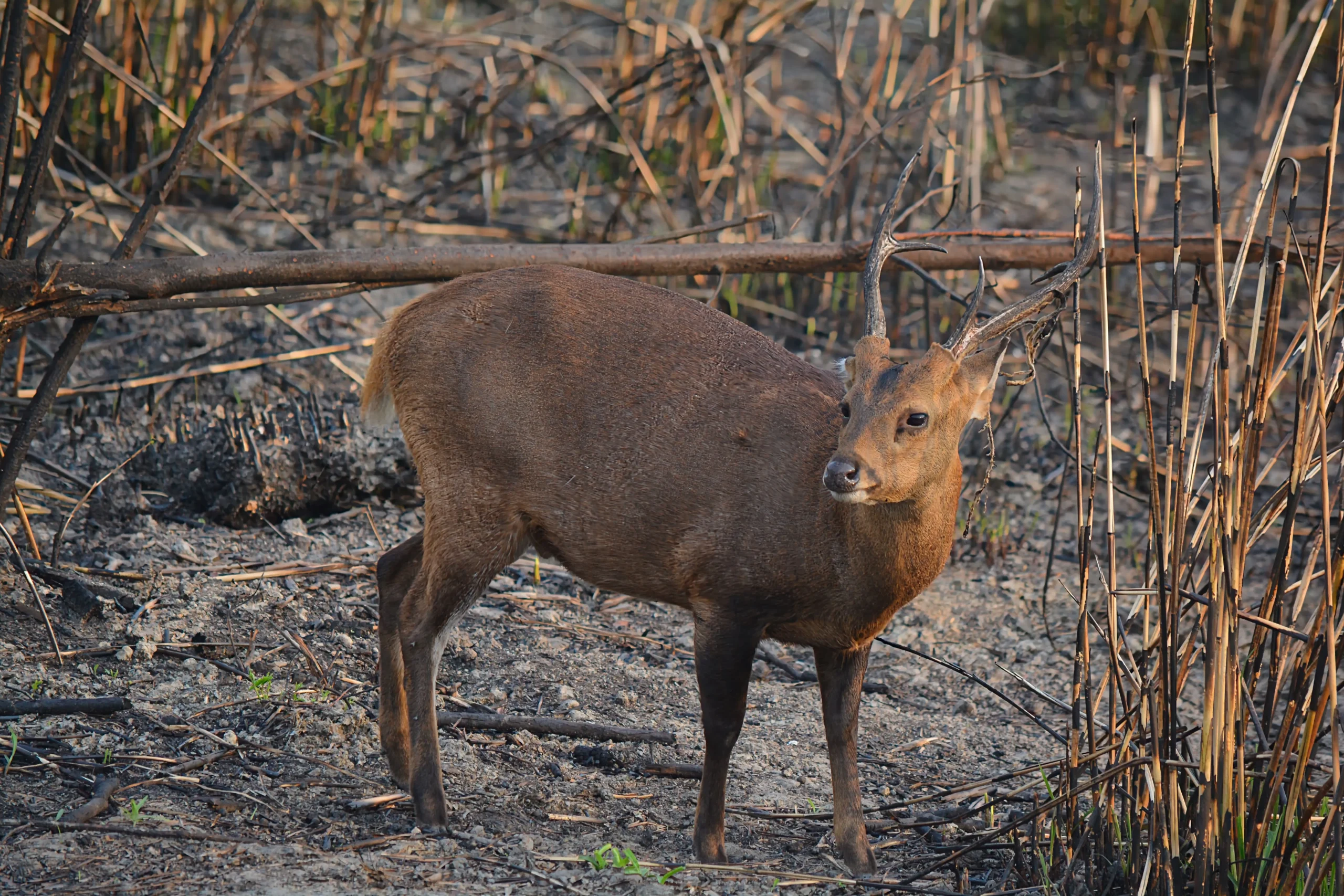
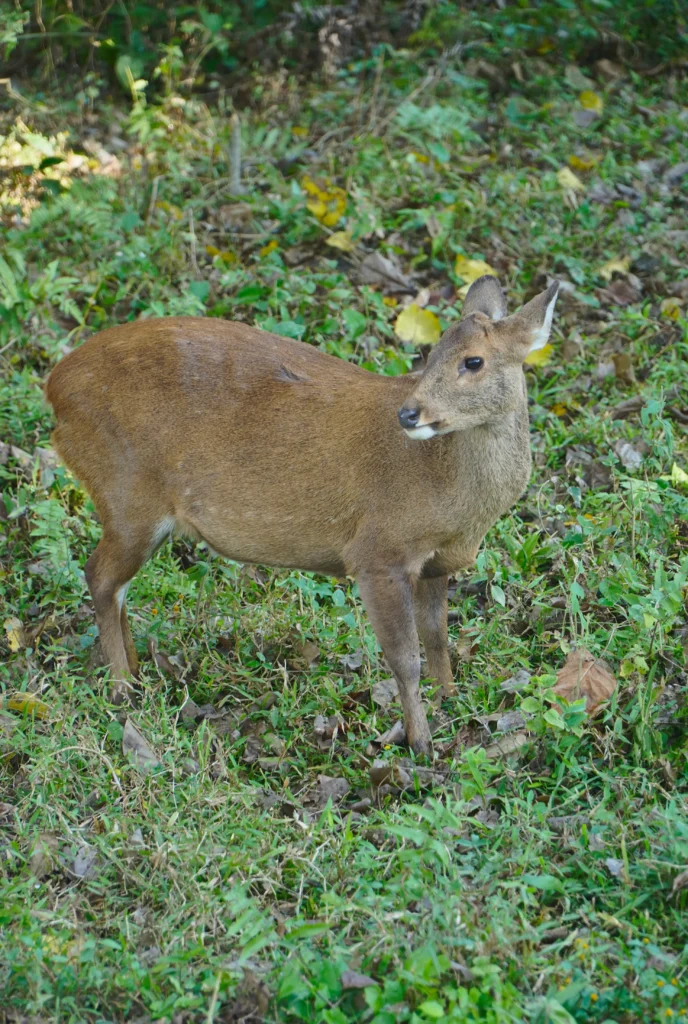
A hog deer is built very differently from the more familiar chital or swamp deer. It has a compact, muscular body carried on relatively short legs, giving it a low profile that is well suited to moving through dense grass rather than open woodland. Adults typically appear stockier than chital, with a broad chest, rounded body, and comparatively short neck. These proportions help distinguish the species even before finer details become visible.
Its coat is generally yellowish-brown to dark brown, with seasonal variation depending on age and the time of year. Young animals bear white spots that gradually fade with maturity, although faint spotting may remain visible in some adults, particularly during the summer coat. The underparts are lighter in colour, while the tail is relatively short and often shows a pale underside when raised.
Unlike the elegant appearance of a chital, a hog deer often looks heavier through the shoulders and lower to the ground. This sturdy build is an adaptation for life in thick floodplain vegetation, where agility through cover is more important than long-distance running across open country.
Antlers and Seasonal Changes
Only males carry antlers. The antlers are comparatively short and sturdy, usually with three tines, and lack the sweeping elegance seen in swamp deer or sambar. Mature stags develop thicker antlers with well-defined brow tines, while younger males carry smaller, simpler antlers.
Like many deer species, hog deer shed and regrow their antlers annually. The exact timing varies between populations and regions, so visitors should not rely on antler condition alone when ageing animals in the field.
Behaviour and Movement
Behaviour is often the easiest way to recognise a hog deer.
Instead of leaping over tall vegetation like many deer, it lowers its head and runs with a forward-leaning posture, weaving through grass in a manner reminiscent of a wild pig. This distinctive escape strategy inspired its common name and is particularly effective in tall floodplain grasses where remaining below the vegetation reduces visibility to predators.
Hog deer are generally solitary or seen in small groups. Large herds, common among chital in many Indian parks, are unusual. Individuals frequently pause within vegetation before moving again, making patience an important virtue for wildlife watchers.
Field Identification Tips
When observing deer in suitable habitat, look for these characteristics:
- A compact, stocky body with relatively short legs.
- A low head carriage while walking or running.
- Preference for tall grass, reeds, and marsh edges rather than open woodland.
- Small groups or solitary individuals.
- Short, sturdy antlers on adult males.
- A rapid, crouched escape through vegetation rather than high bounding leaps.
Photography Tip: Because hog deer often remain partly concealed by grass, autofocus systems may lock onto vegetation instead of the animal. Using a single focus point and waiting for brief openings between grass stems usually produces sharper images than continuous burst shooting through dense cover.
Hog Deer vs Chital vs Swamp Deer
Many first-time visitors confuse hog deer with young swamp deer or female chital, particularly when sightings are brief. Habitat, body proportions, and behaviour usually provide the most reliable clues.
| Feature | Hog Deer | Chital | Swamp Deer (Barasingha) |
| Body shape | Compact and low | Slender and graceful | Large and tall |
| Legs | Short | Long | Long |
| Running style | Head lowered, through vegetation | Bounding leaps | Powerful running in open grasslands |
| Preferred habitat | Floodplain grasslands, marshes | Woodland and open forest | Wet grasslands and swamps |
| Social behaviour | Solitary or small groups | Often large herds | Usually small to moderate herds |
| Antlers | Short, usually three-tined | Elegant three-tined antlers | Large, multi-tined antlers in mature males |
For wildlife travellers, location is also an important clue. A small deer slipping through dense elephant grass in Kaziranga is far more likely to be a hog deer than a chital, whereas chital dominate many central Indian tiger reserves.
Where Do Hog Deer Live?
Hog deer once occupied a much broader range across South and Southeast Asia than they do today. Their dependence on productive floodplain grasslands meant they flourished wherever large rivers created extensive mosaics of wetlands, reedbeds, and alluvial grasslands. As these landscapes were converted for agriculture, settlements, and infrastructure, many populations became isolated or disappeared altogether.
Today the species survives in scattered populations rather than as one continuous range, making conservation of each remaining stronghold increasingly important.
Historic Range
Historically, hog deer occurred across much of the floodplain systems of the Indian subcontinent and parts of mainland Southeast Asia. Their range extended through India, Nepal, Bangladesh, Myanmar, Thailand, Cambodia, Laos, Vietnam, and neighbouring regions where suitable lowland habitats existed.
Within India, they were associated with the great river systems of the Ganga and Brahmaputra as well as extensive wetlands and grasslands in the northeast.
Current Distribution
Although the overall geographic range remains extensive on paper, many populations are now highly fragmented. In several regions the species survives only within protected areas where natural grasslands have been retained. Outside these refuges, habitat conversion and fragmentation have led to sharp local declines.
This distinction between distribution and viable populations is important. A country may still record hog deer, yet only support a handful of isolated populations that require active conservation management.
Countries Where Hog Deer Still Occur
Confirmed populations occur across parts of:
- India
- Nepal
- Bangladesh
- Myanmar
- Thailand
- Cambodia
- Laos
- Vietnam
The conservation status and population size vary considerably between countries, with some supporting relatively stable protected populations while others retain only small, fragmented groups.
Distribution in India
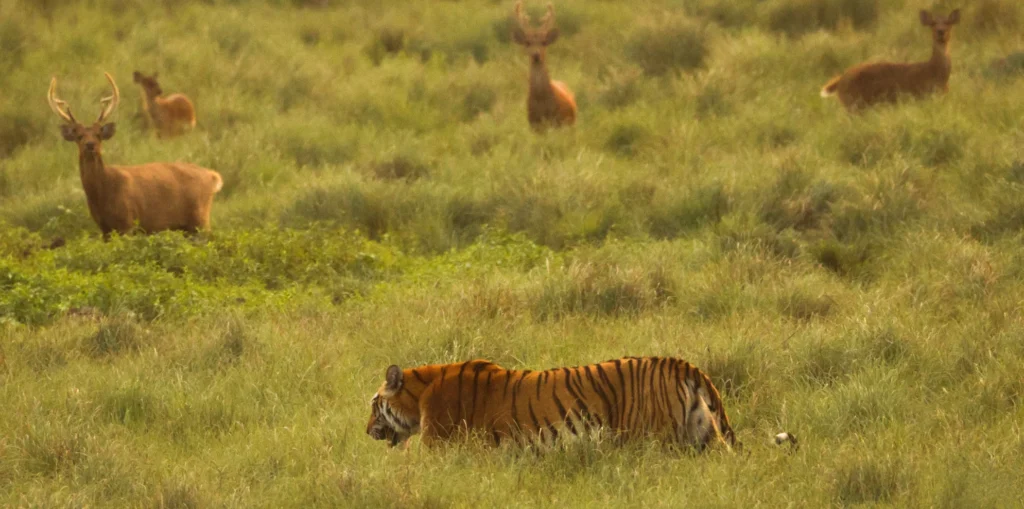
India remains one of the species’ most important range countries.
Significant populations occur primarily in the floodplain grasslands of the northeast, particularly within the Brahmaputra basin and parts of Manipur. Protected areas such as Kaziranga National Park and Keibul Lamjao National Park are especially important because they preserve habitat types that have disappeared from much of the surrounding landscape. Other populations occur in suitable grassland reserves across northeastern India, although their size and long-term viability vary between sites.
Historic Range vs Present-Day Distribution
| Historic Situation | Present Situation |
| Broad distribution across South and Southeast Asia | Fragmented populations across the former range |
| Extensive floodplain grasslands connected many populations | Remaining habitats are increasingly isolated |
| Large river valleys supported continuous habitat | Most strongholds are within protected areas |
| Natural grasslands covered vast landscapes | Habitat conversion has reduced available grasslands significantly |
Field Note: A protected area may contain suitable-looking grassland but still support very few hog deer. The species depends not only on vegetation but also on the quality, connectivity, and seasonal dynamics of floodplain habitats.
Habitat and Ecology
Understanding where hog deer live is the key to finding them in the wild. Unlike adaptable deer that occupy forests, scrublands, and agricultural edges, hog deer are closely tied to specific floodplain ecosystems whose seasonal flooding, vegetation structure, and hydrology shape every aspect of their lives.
The next section explores these habitats in detail, along with the species’ feeding ecology, daily activity patterns, breeding behaviour, and ecological role within Asia’s disappearing grassland landscapes.
Habitat, Ecology, Hog Deer in India, Genetics & Conservation
Habitat and Ecology
Hog deer are specialists of dynamic floodplain landscapes. Rather than inhabiting dense forests, they depend on a mosaic of tall grasslands, marshes, riverbanks, reedbeds, seasonally flooded meadows, and patches of woodland that provide both food and shelter. These habitats are naturally shaped by annual flooding, sediment deposition, and the growth of grasses, creating a constantly changing environment that the species has evolved to exploit.
This close dependence on floodplain ecosystems explains why hog deer have declined so sharply. When wetlands are drained, grasslands converted to farmland, or rivers altered by embankments and development, suitable habitat disappears even if surrounding vegetation appears green.
Preferred Habitats
Across their range, hog deer are most often associated with:
- Tall alluvial grasslands.
- River floodplains.
- Marshes and swamps.
- Reedbeds.
- Moist lowland grasslands.
- Wet meadows with scattered woodland.
- Grasslands bordering rivers and lakes.
These habitats provide abundant forage while allowing the deer to remain concealed from predators.
Unlike deer that rely on extensive forests, hog deer benefit from a patchwork of open feeding areas and dense cover. Seasonal flooding often stimulates fresh grass growth, producing nutritious grazing while maintaining the vegetation structure they require.
The Importance of Floodplain Grasslands
Floodplain grasslands rank among Asia’s most threatened ecosystems. Historically they stretched across major river systems, particularly those associated with the Brahmaputra and Ganga, supporting an extraordinary diversity of mammals, birds, reptiles, and wetland plants.
For hog deer, these grasslands provide far more than food.
Dense vegetation offers protection for fawns, cover from predators, and shelter during periods of disturbance. Adjacent wetlands provide moisture-rich feeding areas, while patches of woodland offer shade and refuge during hotter parts of the day. When any one component disappears, the entire habitat becomes less suitable.
Why Phumdis Matter in Manipur
One of the world’s most unusual hog deer habitats occurs in Keibul Lamjao National Park, where much of the landscape consists of phumdis—floating masses of vegetation, organic matter, and soil resting on Loktak Lake.
These floating meadows support grasses and shrubs that provide both food and cover for hog deer. Research has shown that habitat quality within the park is closely linked to characteristics such as phumdi thickness, vegetation cover, and the abundance of shorter grasses. Areas with favourable habitat conditions support higher levels of hog deer activity than degraded sections of the floating meadow system.
Because phumdis depend on natural hydrological processes, changes in water levels or wetland management can directly influence habitat quality.
Field Note: Keibul Lamjao is famous for the endangered Sangai (Eld’s deer), but it also supports one of India’s most scientifically important hog deer populations. Many visitors overlook this second conservation story.
Daily Activity Patterns
Hog deer generally spend much of the day concealed within dense vegetation, emerging to feed when conditions are favourable. Their cryptic behaviour is one reason they are less frequently observed than many other deer species, even in parks where they are reasonably common.
Individuals often remain motionless when disturbed, relying on camouflage rather than immediately fleeing. If approached more closely, they usually dash into thick cover with their characteristic head-down running posture.
For wildlife photographers and naturalists, patience often proves more productive than constant movement. Quiet observation of grassland edges may reveal animals feeding or moving between patches of cover.
Diet and Feeding Behaviour
Hog deer are herbivores that feed primarily on grasses and other low-growing vegetation characteristic of floodplain ecosystems. Their diet reflects seasonal changes in plant availability, with fresh grasses forming an important component whenever available. They also browse on herbs and other vegetation growing within wetlands and grasslands.
Because they depend heavily on productive grasslands, changes in vegetation caused by invasive plants, overgrazing, or altered flooding regimes can reduce food quality as well as shelter.
Breeding and Life Cycle
Although aspects of breeding vary across the species’ range, hog deer generally produce a single fawn. Dense grassland vegetation provides important concealment for young animals during their most vulnerable weeks.
This dependence on intact ground cover means that intensive burning, excessive grazing, or large-scale disturbance during the breeding season can reduce survival even when adult deer remain present.
Ecological Role
Hog deer are an integral part of floodplain ecosystems.
As grazers and browsers, they influence vegetation structure and contribute to nutrient cycling. They also form part of the prey base for large predators where these still occur, linking grassland productivity with higher levels of the food web.
Perhaps more importantly, their continued presence signals that a floodplain ecosystem retains many of the ecological characteristics needed by other specialised wildlife. Protecting habitat for hog deer therefore benefits an entire community of grassland-dependent species rather than a single mammal alone.
Hog Deer in India
India supports some of the most significant remaining populations of hog deer, particularly within the northeastern floodplains. While the species once occupied a broader distribution across suitable lowland habitats, today its strongest populations are concentrated in protected landscapes where extensive grasslands have survived.
For wildlife travellers, northeastern India offers by far the best opportunities to observe hog deer in their natural habitat.
Key States Supporting Hog Deer
Important populations occur in:
- Assam
- Manipur
- Parts of West Bengal
- Other suitable floodplain landscapes in northeastern India.
These populations vary considerably in size, habitat quality, and degree of isolation.
Kaziranga National Park
Kaziranga is widely recognised for its greater one-horned rhinoceroses, Asian elephants, wild water buffalo, and Bengal tigers, but its vast floodplain grasslands also provide excellent habitat for hog deer.
The combination of seasonally flooded grasslands, wetlands, and riverine vegetation closely matches the ecological conditions preferred by the species. Visitors on jeep safaris frequently encounter hog deer grazing near grassland edges or moving between patches of cover, particularly during the cooler hours of the day.
Keibul Lamjao National Park
Keibul Lamjao is globally unique because it protects the floating phumdis of Loktak Lake.
Although most visitors know the park as the last natural home of the endangered Sangai, it also supports a scientifically important hog deer population. Recent ecological and genetic studies conducted here have provided valuable insights into habitat use, population density, and the conservation significance of the Manipur population.
Other Important Protected Areas
Other protected floodplain landscapes across northeastern India continue to support hog deer where suitable grassland habitat survives, although population sizes and long-term viability differ between reserves. Continued monitoring remains important because isolated populations may decline even within protected areas if habitat quality deteriorates.
Decision Guide: Where Should Wildlife Travellers Look for Hog Deer?
| Destination | Why Visit |
| Kaziranga National Park | Best combination of accessibility, extensive floodplain grasslands, and good opportunities to see hog deer alongside rhinos, elephants, buffalo, and many other grassland species. |
| Keibul Lamjao National Park | Ideal for visitors interested in conservation, wetland ecology, and the unique floating meadow habitat supporting genetically important hog deer populations. |
| Other northeastern grassland reserves | Suitable for experienced wildlife travellers interested in specialised grassland ecosystems rather than seeking guaranteed sightings. |
Expert Tip: If your primary goal is to observe hog deer, spend time scanning the transition zone where tall grass meets open feeding areas. Animals often emerge briefly before retreating into cover, making careful observation more effective than constantly driving through grassland tracks.
Subspecies, Genetics and Why the Manipur Population Matters
For many years, hog deer across South and Southeast Asia were largely treated as belonging to a single widespread species with regional variation. Recent genetic research has revealed a more complex picture.
Scientists now recognise two principal lineages commonly described in the literature:
- Indian hog deer (Axis porcinus porcinus)
- Southeast Asian hog deer (Axis porcinus annamiticus)
Although these animals appear broadly similar in the field, genetic analyses indicate important evolutionary differences.
Why the Manipur Population Is Special
One of the most significant discoveries in recent years is that the hog deer population in Manipur shows a close genetic relationship with the Southeast Asian lineage rather than with many populations elsewhere in India. This finding makes the population particularly valuable from a conservation perspective because protecting it helps preserve unique genetic diversity within the species.
For conservationists, this means that losing the Manipur population would represent more than the loss of a local herd—it would mean losing an important component of the species’ evolutionary history.
Recent Research Findings
Population studies in Keibul Lamjao National Park have also highlighted the challenges faced by this isolated population.
Researchers documented:
- A relatively small occupied area within the park.
- Moderate genetic diversity despite fragmentation.
- Habitat use influenced by phumdi thickness, vegetation cover, and short grass availability.
- The continuing need for long-term monitoring and habitat management.
These findings demonstrate that protecting habitat quality is just as important as protecting the animals themselves.
Indian vs Southeast Asian Lineages
| Feature | Indian Lineage | Southeast Asian Lineage |
| Broad distribution | Indian subcontinent | Mainland Southeast Asia |
| Conservation importance | Protects remaining floodplain populations | Represents distinct evolutionary lineage |
| Scientific significance | Important for regional conservation | Includes the genetically significant Manipur population identified through recent research |
Conservation Status and Population Trends
The hog deer is currently classified as Endangered on the IUCN Red List, reflecting widespread population declines and increasing fragmentation across much of its historical range.
Unlike highly adaptable mammals capable of surviving in modified landscapes, hog deer remain closely tied to healthy floodplain grasslands. As these ecosystems have shrunk, many populations have become isolated from one another, reducing opportunities for natural dispersal and genetic exchange.
Small populations face multiple challenges simultaneously. They are more vulnerable to habitat degradation, local disasters, disease, and long-term genetic decline. This is why conservation programmes increasingly focus not only on protecting individual reserves but also on maintaining habitat quality and ecological connectivity wherever possible.
The next section examines the principal threats facing hog deer today and the conservation measures needed to secure the future of this endangered grassland specialist.
Threats, Conservation, Responsible Wildlife Watching, FAQs & Conclusion
Threats Facing Hog Deer
The decline of the hog deer has not been caused by a single factor. Instead, it reflects the cumulative impact of habitat loss, fragmentation, hunting, and changes to the floodplain ecosystems on which the species depends. Because hog deer occupy highly specialised habitats, even relatively small ecological changes can have significant consequences for local populations.
Habitat Loss and Fragmentation
The greatest long-term threat is the loss of floodplain grasslands.
Across South and Southeast Asia, wetlands have been drained, grasslands converted to agriculture, settlements have expanded into river valleys, and infrastructure has fragmented once-continuous habitats. These changes isolate populations within small habitat patches, reducing opportunities for dispersal and increasing the risk of local extinction.
Unlike generalist deer that can adapt to a wide range of landscapes, hog deer require a combination of suitable grasses, wetlands, and seasonal floodplain dynamics. Once these ecological conditions disappear, the habitat often becomes unsuitable even if vegetation remains.
Grassland Degradation
A grassland may appear healthy to a casual observer yet no longer provide suitable habitat for hog deer.
Changes in vegetation structure, excessive grazing by livestock, invasive plant species, poorly timed burning, and declining habitat quality can reduce both food availability and cover. Research from Keibul Lamjao National Park shows that habitat use is closely associated with vegetation characteristics such as grass cover and, in the case of floating meadows, phumdi thickness.
Maintaining habitat quality is therefore just as important as protecting the land itself.
Hunting and Poaching
Hunting continues to threaten some populations, particularly where law enforcement is limited or protected areas are small.
Even relatively low levels of hunting can have serious consequences for fragmented populations that already contain few breeding animals. Because many surviving populations are geographically isolated, recovering from losses can be difficult.
Hydrological Changes
Floodplain ecosystems depend on natural flooding cycles.
River regulation, embankments, altered water management, and changes to wetland hydrology can modify vegetation patterns, reduce habitat diversity, and affect the ecological processes that sustain productive grasslands. In floating meadow systems such as Loktak Lake, changes in water levels may also influence the condition of phumdis that support hog deer habitat.
Human Disturbance
Expanding human activities around wetlands and river valleys can increase disturbance through agriculture, livestock grazing, resource extraction, and infrastructure development.
While protected areas provide important refuges, many populations survive within landscapes where conservation must coexist with local communities and changing land use.
Why Small Populations Remain Vulnerable
Small, isolated populations face challenges beyond habitat loss alone.
Limited genetic exchange between populations can reduce long-term resilience, while local disasters, disease outbreaks, or extreme environmental events may affect a significant proportion of the remaining animals. This is one reason why conservation increasingly focuses on protecting connected landscapes rather than isolated reserves alone.
Threats and Conservation Responses
| Threat | Why It Matters | Conservation Response |
| Habitat loss | Reduces available grassland | Protect remaining floodplain habitats |
| Fragmentation | Isolates populations | Improve landscape connectivity |
| Grassland degradation | Lowers food and cover quality | Habitat restoration and grassland management |
| Hunting | Direct population decline | Stronger protection and enforcement |
| Hydrological alteration | Changes floodplain ecology | Maintain natural wetland processes |
| Small isolated populations | Increased long-term vulnerability | Scientific monitoring and genetic management |
Conservation Efforts and Future Priorities
The future of the hog deer depends less on intensive species-specific interventions and more on protecting the floodplain ecosystems that sustain it. Conserving healthy grasslands, wetlands, and river valleys benefits not only hog deer but also many other specialised animals that share these habitats.
Protected Areas
National parks and wildlife sanctuaries remain the cornerstone of hog deer conservation.
Protected landscapes such as Kaziranga National Park and Keibul Lamjao National Park safeguard some of the most important remaining habitats, allowing populations to persist despite increasing pressure elsewhere. However, protected status alone is not sufficient if habitat quality declines or ecological processes are disrupted.
Scientific Monitoring
Modern conservation increasingly relies on long-term monitoring rather than occasional surveys.
Researchers use methods such as distance sampling, habitat assessments, pellet surveys, and genetic analysis to understand population trends, habitat use, and changes in genetic diversity. These studies provide the evidence needed to guide conservation decisions and evaluate whether management actions are working.
Habitat Restoration
Where floodplain grasslands have been degraded, restoring natural vegetation and maintaining appropriate habitat structure can improve conditions for hog deer and many associated species.
In floating meadow ecosystems, protecting the ecological processes that maintain phumdis is equally important.
Landscape Connectivity
Many remaining populations exist as isolated fragments.
Maintaining or restoring ecological connectivity between suitable habitats can improve opportunities for dispersal and reduce the long-term risks associated with small, isolated populations.
Community Participation
Long-term conservation also depends on local communities.
Sustainable land management, responsible grazing practices, reduced hunting pressure, and support for protected areas all contribute to maintaining the floodplain landscapes on which hog deer depend.
Responsible Tourism Tip: Visiting protected areas that conserve floodplain grasslands helps support the management of habitats benefiting not only hog deer but also rhinos, wild buffalo, Bengal floricans, pygmy hogs, hispid hares, and numerous wetland birds. Responsible wildlife tourism creates additional incentives to conserve these increasingly rare ecosystems.
Responsible Wildlife Watching Tips
Observing hog deer requires patience and respect for their naturally cautious behaviour.
Following good wildlife-viewing practices improves both your experience and the animals’ welfare.
Practical Checklist
✔ Scan grassland edges rather than only open meadows.
✔ Use binoculars before approaching with a camera.
✔ Remain inside designated safari vehicles unless permitted otherwise.
✔ Keep noise to a minimum near wetlands and grasslands.
✔ Never attempt to flush animals from cover for a better photograph.
✔ Follow instructions from park guides and forest staff.
✔ Remember that brief sightings are often a sign that the animals remain naturally wary.
Photography Tip
A telephoto lens allows you to photograph hog deer without encouraging the animal to leave cover. Images showing natural behaviour within grassland habitat are usually more valuable than close portraits obtained by disturbing wildlife.
Field Note
One of the easiest ways to miss a hog deer is to focus only on open areas. Experienced guides often spend considerable time scanning subtle movement along the boundary between dense grass and open feeding patches, where animals may appear for only a few seconds.
Common Mistakes Visitors Make
- Assuming every small deer in northeastern India is a hog deer.
- Expecting hog deer to behave like chital and remain in open grasslands for long periods.
- Looking only in forests instead of floodplain grasslands and wetlands.
- Becoming impatient after a few minutes of scanning dense vegetation.
- Disturbing grassland wildlife by asking guides to leave designated safari tracks.
- Treating the species as common simply because it is occasionally seen in protected areas.
- Overlooking the importance of grassland conservation while focusing only on larger mammals such as rhinos and tigers.
Frequently Asked Questions
What is a hog deer?
The hog deer (Axis porcinus) is an endangered deer species native to South and Southeast Asia that is closely associated with floodplain grasslands, wetlands, and marshes.
Why is it called a hog deer?
Its name comes from its habit of running with its head lowered through dense vegetation, a movement that resembles a wild pig rather than the high bounding leaps typical of many deer.
Is the hog deer endangered?
Yes. The species is currently classified as Endangered on the IUCN Red List because of widespread habitat loss and fragmented populations.
Where are hog deer found?
They occur in scattered populations across South and Southeast Asia, including India, Nepal, Bangladesh, Myanmar, Thailand, Cambodia, Laos, and Vietnam.
Where can I see hog deer in India?
Kaziranga National Park and Keibul Lamjao National Park are among the most significant places to observe hog deer in their natural habitat.
What do hog deer eat?
They feed mainly on grasses and other vegetation growing in floodplain grasslands, marshes, and wetlands.
How are hog deer different from chital?
Hog deer are stockier, have shorter legs, prefer floodplain grasslands, and typically run with their heads lowered through dense vegetation rather than bounding across open ground.
Are hog deer active during the day?
They spend much of their time concealed in dense vegetation but may be seen feeding during cooler periods when disturbance is low.
Why is the Manipur population important?
Genetic research indicates that the Manipur population represents a distinct lineage linked to Southeast Asian hog deer, making it especially valuable for conservation.
What is the biggest threat to hog deer?
The greatest threat is the loss and fragmentation of floodplain grasslands, compounded by habitat degradation, hunting, and changes to wetland ecology.
Conclusion
The hog deer is a reminder that some of Asia’s most important wildlife survives not in dense forests but in floodplains, marshes, and tall grasslands that often receive far less conservation attention. Its compact build, distinctive head-down gait, and preference for dense cover reflect a lifetime of adaptation to these dynamic landscapes.
Although the species remains widely distributed on maps, the reality is far more fragile. Many populations are isolated within protected areas, and recent scientific research has highlighted the conservation significance of genetically distinct populations such as those in Manipur. Protecting these deer therefore means conserving not only a threatened species but also the ecological processes that sustain some of the region’s last remaining floodplain ecosystems.
For wildlife travellers, a hog deer sighting is rarely dramatic. It may be no more than a brief glimpse of a compact deer slipping through elephant grass before disappearing into cover. Yet those few seconds often reveal something much larger: a healthy grassland supporting one of Asia’s most specialised and increasingly rare mammals.
Whether you visit Kaziranga, Keibul Lamjao, or another protected floodplain reserve, watching responsibly and supporting the conservation of these habitats helps ensure that the hog deer—and the remarkable ecosystems it represents—continue to survive for generations to come.