
Discover India’s small carnivores, including civets, mongooses, otters and small cats. Learn identification, habitats, conservation and where to see them.
Indian Small Carnivores Guide: Species, Habitats, Conservation Status & Best Places to See Them
India’s wildlife is often associated with tigers, leopards, lions and elephants. Yet some of the country’s most important predators are far smaller—and far less familiar. Civets slipping through rainforest at night, mongooses searching for prey in open woodland, otters hunting in rivers, and elusive small cats moving silently through grasslands all play vital ecological roles but receive only a fraction of the attention given to larger mammals.
Collectively known as small carnivores, these mammals help regulate populations of rodents, reptiles, insects, fish and other prey. They also serve as indicators of healthy forests, wetlands and grasslands. Despite their importance, many remain poorly studied because they are nocturnal, secretive or occur at naturally low densities. Recent research has highlighted significant gaps in scientific knowledge, particularly for India’s small wild cats, making continued monitoring and conservation increasingly important.
For wildlife travellers, sightings of these animals are never guaranteed. Unlike tigers that attract dedicated safari tourism, small carnivores are usually encountered by chance, often during night drives where permitted, on camera traps, or by experienced naturalists who understand their habitats and behaviour. Their rarity is part of their appeal, but it also means that responsible wildlife viewing should always take precedence over the pursuit of a sighting.
Whether you are planning a safari, studying Indian mammals, or simply curious about these overlooked predators, this guide explains which species occur in India, where they live, how they differ from one another, and why conserving them matters.
What Are Indian Small Carnivores?
The term small carnivores is a practical ecological grouping rather than a formal scientific classification. Researchers generally use it for small- to medium-sized carnivorous mammals—often called mesocarnivores—that occupy ecological niches between the smallest insect-eating mammals and India’s large predators such as tigers, leopards and dholes.
Although the name suggests otherwise, these animals are not all closely related. Instead, they belong to several mammal families that share similar ecological roles as predators or omnivores.
The principal groups found in India include:
- Small cats (Felidae) such as the jungle cat, leopard cat, fishing cat and rusty-spotted cat.
- Civets and palm civets (Viverridae) including the common palm civet, small Indian civet, brown palm civet and the critically endangered Malabar civet.
- Mongooses (Herpestidae) such as the Indian grey mongoose, ruddy mongoose and stripe-necked mongoose.
- Otters and other mustelids (Mustelidae) including the smooth-coated otter and Asian small-clawed otter.
Why They Matter
Small carnivores occupy a wide range of habitats, from evergreen forests of the Western Ghats to Himalayan foothills, wetlands, river systems and even some human-modified landscapes. By controlling prey populations and acting as mid-level predators, they contribute to the ecological balance of these environments. Changes in their distribution or abundance can also provide early signs of habitat degradation and fragmentation.
Field Note: Many of India’s small carnivores are detected more often by camera traps than by direct observation. Studies from places such as Wayanad Wildlife Sanctuary have greatly improved our understanding of which species occur together and when they are active, demonstrating the value of modern wildlife monitoring techniques.
Indian Small Carnivore Species Guide
India supports around 37 species of small carnivores, spread across several mammal families that include cats, civets, mongooses, otters and other mustelids. Their diversity is particularly high in the Western Ghats, although important populations also occur in the Northeast, Himalayan foothills, central India and major river systems.
Unlike large carnivores, many of these species are secretive, primarily active at night and rarely seen even by experienced naturalists. Understanding their differences makes wildlife observations far more rewarding.
Indian Small Carnivore Families at a Glance
| Family | Representative species | General characteristics | Typical activity |
| Felidae | Jungle Cat, Leopard Cat, Rusty-spotted Cat, Fishing Cat | Solitary predators with retractable claws and excellent stalking ability | Mostly nocturnal or crepuscular |
| Viverridae | Common Palm Civet, Small Indian Civet, Brown Palm Civet, Malabar Civet | Long-bodied mammals with pointed faces and long tails, many adapted for climbing | Mostly nocturnal |
| Herpestidae | Indian Grey Mongoose, Ruddy Mongoose, Stripe-necked Mongoose | Agile ground hunters that feed on reptiles, rodents and insects | Mostly diurnal |
| Mustelidae | Asian Small-clawed Otter, Smooth-coated Otter and other mustelids | Semi-aquatic or terrestrial predators known for intelligence and adaptability | Variable depending on species |
Small Cats of India
India is home to nine native small felids, although several remain poorly studied. A 2024 review highlighted that scientific understanding of their ecology and population trends has progressed slowly over the past five decades, underlining the need for more research and long-term monitoring.
Jungle Cat (Felis chaus)
The jungle cat is probably India’s most widespread small wild cat. It occupies grasslands, scrub forests, agricultural landscapes and wetlands across much of the country.
Unlike many other small cats, it is often active during daylight as well as dawn and dusk, making it one of the easier species to observe in suitable habitats.
Its diet includes:
- Rodents
- Birds
- Reptiles
- Amphibians
- Small mammals
For safari visitors, productive locations include grassland habitats around several tiger reserves, where jungle cats occasionally hunt along roads and open meadows.
Leopard Cat (Prionailurus bengalensis)
The leopard cat is noticeably smaller than a leopard despite its spotted coat.
It occurs mainly in:
- Northeast India
- Himalayan foothills
- Parts of eastern India
- Forests of the Western Ghats
Dense forests and thick undergrowth make sightings uncommon. Most confirmed records come from camera-trap studies rather than direct observations.
Rusty-spotted Cat (Prionailurus rubiginosus)
Often regarded as one of the world’s smallest wild cats, the rusty-spotted cat occurs across parts of central, western and southern India.
Its tiny size allows it to hunt:
- Small rodents
- Lizards
- Frogs
- Birds
- Large insects
Despite its broad distribution, it is extremely elusive and is usually detected through camera trapping.
Photography Tip: If your safari destination is known for rusty-spotted cats, avoid expecting close views. Most sightings last only a few seconds before the animal disappears into vegetation.
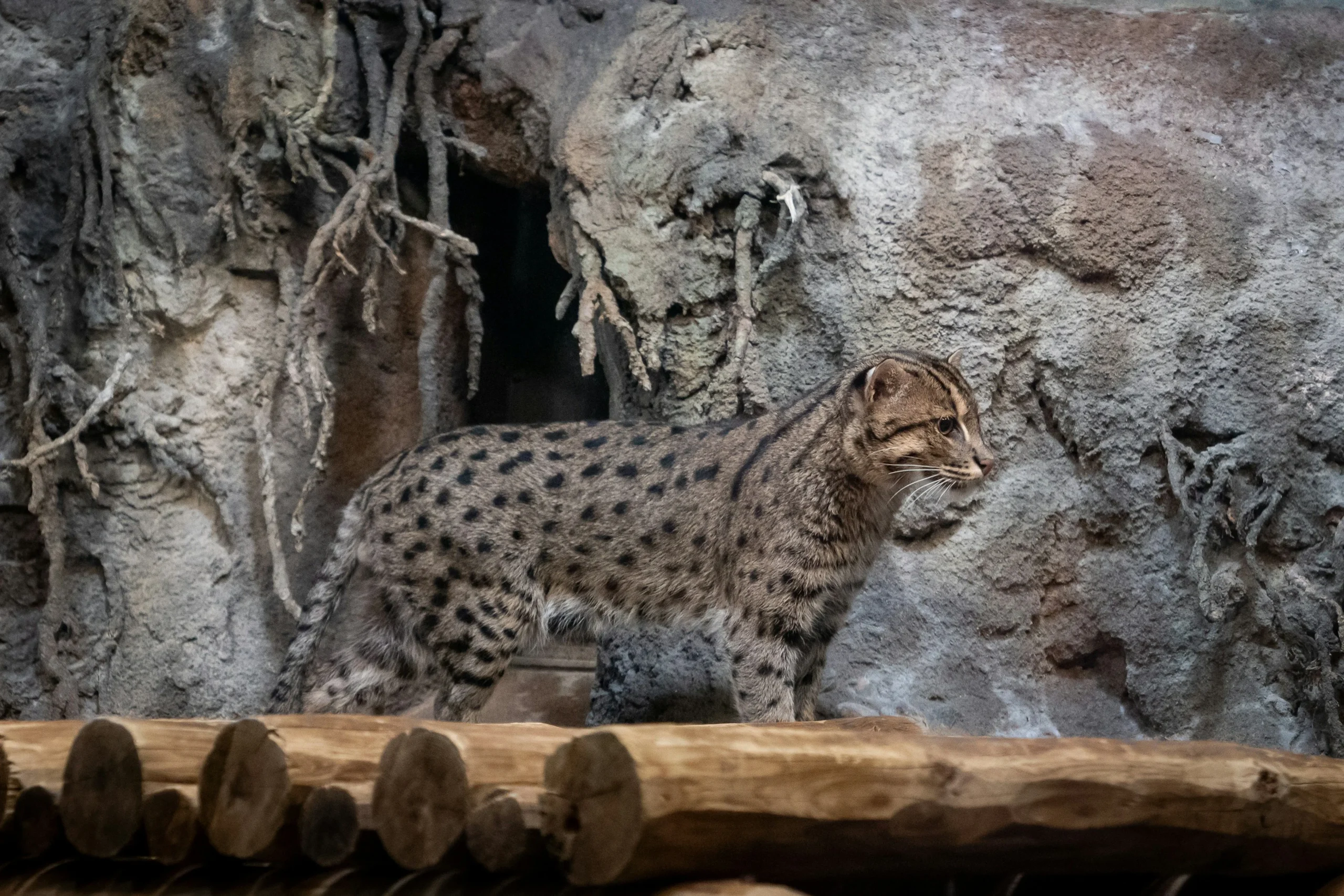
Fishing Cat (Prionailurus viverrinus)
Unlike most felids, the fishing cat is strongly associated with water.
It inhabits:
- Marshes
- Floodplains
- Mangroves
- Riverbanks
- Wetlands
Its partially webbed feet and powerful build make it an efficient hunter of fish, frogs and aquatic prey.
Healthy wetlands are essential for its survival, making wetland conservation just as important as forest conservation.
Other Native Small Felids
India’s remaining small cat species occur mainly in the Himalaya, high-altitude landscapes and parts of Northeast India. Although they receive less public attention than tigers or leopards, recent scientific reviews emphasise that many remain poorly understood because of limited field studies and low detection rates.
Civets and Palm Civets
Civets are frequently mistaken for cats because of their appearance and names, but they belong to the family Viverridae, making them a distinct evolutionary group.
Most Indian civets are:
- Nocturnal
- Solitary
- Excellent climbers
- Omnivorous
Camera-trap studies have consistently shown that viverrids are predominantly active at night.
Common Palm Civet (Paradoxurus hermaphroditus)
The common palm civet is one of India’s most adaptable small carnivores.
It occurs in:
- Evergreen forests
- Deciduous forests
- Plantations
- Rural landscapes
- Urban edges
Although capable hunters, common palm civets also consume fruits, berries and nectar, making them important seed dispersers in many forest ecosystems.
Because they adapt well to human presence, they are among the civets most frequently encountered around villages and forest lodges.
Small Indian Civet (Viverricula indica)
The small Indian civet has one of the widest distributions among Indian viverrids.
A camera-trap study in Wayanad Wildlife Sanctuary identified it as the most frequently recorded small carnivore among the documented species, highlighting its adaptability across different habitats.
It typically occupies:
- Dry deciduous forests
- Scrublands
- Agricultural edges
- Secondary forests
Its bold black body markings and ringed tail make it relatively easy to identify in camera-trap photographs.
Brown Palm Civet (Paradoxurus jerdoni)
The brown palm civet is one of the Western Ghats’ most distinctive endemic mammals.
Unlike the widespread common palm civet, it is largely restricted to tropical evergreen forests of the Western Ghats.
Its dependence on intact rainforest makes it especially vulnerable to habitat fragmentation, reinforcing the importance of conserving continuous forest landscapes.
Malabar Civet (Viverra civettina)
The Malabar civet is among India’s greatest conservation mysteries.
It is classified as Critically Endangered and is widely regarded as being possibly extinct in the wild, although occasional unverified reports continue to emerge. No confirmed wild population has been documented in recent years, and its true status remains uncertain.
Its story illustrates an important conservation lesson: species can decline rapidly when habitat loss combines with limited scientific knowledge and delayed conservation action.
Field Note: If you encounter travel content claiming reliable opportunities to see Malabar civets, treat such claims with caution. Current evidence does not support wildlife tourism focused on this species.
Mongooses
Mongooses belong to the family Herpestidae and differ markedly from civets in both behaviour and appearance.
Most species are:
- Active during the day
- Fast-moving ground hunters
- Opportunistic feeders
- Comfortable in relatively open habitats
Research from Wayanad Wildlife Sanctuary found herpestids to be primarily diurnal, contrasting with the mostly nocturnal habits of civets.
Indian Grey Mongoose (Herpestes edwardsii)
The Indian grey mongoose is perhaps the country’s best-known mongoose.
It occupies an impressive variety of habitats, including:
- Forest edges
- Farmland
- Grasslands
- Villages
- Semi-arid landscapes
Its diet includes rodents, reptiles, insects, birds and eggs, making it an important natural controller of agricultural pests.
Ruddy Mongoose (Herpestes smithii)
The ruddy mongoose favours dry forests and rocky terrain.
Compared with the Indian grey mongoose, it is less frequently encountered but is regularly photographed by camera traps in suitable habitats.
Stripe-necked Mongoose (Herpestes vitticollis)
Endemic to the Western Ghats and Sri Lanka, the stripe-necked mongoose is one of India’s largest mongoose species.
The Wayanad camera-trap study identified it as one of the area’s most frequently recorded mongooses, reflecting the importance of intact Western Ghats forests for this species.
Its striking neck stripe usually allows experienced naturalists to distinguish it from other Indian mongooses.
Otters
Although many people associate otters primarily with rivers, they are also an important component of India’s small carnivore community.
The principal Indian species include:
- Asian Small-clawed Otter
- Smooth-coated Otter
- Other regionally distributed otter taxa documented within India
Asian Small-clawed Otter (Aonyx cinereus)
The world’s smallest otter depends on healthy freshwater wetlands and streams.
It feeds on:
- Crabs
- Molluscs
- Fish
- Aquatic invertebrates
Its sensitive habitat requirements make it a useful indicator of wetland health.
Smooth-coated Otter (Lutrogale perspicillata)
The smooth-coated otter is larger and more social than the Asian small-clawed otter.
Family groups are sometimes observed along rivers and reservoirs, although sightings remain relatively uncommon and depend heavily on local conditions and disturbance levels.
Expert Tip: Don’t Expect Tiger-Style Sightings
Small carnivores reward patience rather than intensive searching.
Many species are:
- Naturally uncommon.
- Primarily nocturnal.
- Detected more often by camera traps than by direct observation.
- Easier to identify through signs, tracks and expert interpretation than through prolonged visual encounters.
For most visitors, simply knowing that these elusive mammals share the forest with larger wildlife adds another layer of appreciation to any safari.
Where Indian Small Carnivores Live, Behaviour and Ecology
One reason India’s small carnivores remain so little known is that they occupy an extraordinary variety of habitats. Some are rainforest specialists, others prefer wetlands or grasslands, while several adapt surprisingly well to plantations and agricultural landscapes. Understanding these habitat preferences not only improves wildlife appreciation but also explains why different regions of India support very different species.
Rather than searching for a single “best” destination, it is more useful to think in terms of regional diversity hotspots, each supporting its own characteristic assemblage of small carnivores.
Where Indian Small Carnivores Live
Western Ghats: India’s Greatest Small Carnivore Hotspot
For anyone interested in India’s lesser-known mammals, the Western Ghats deserve special attention.
Research cited in the brief indicates that this mountain chain supports exceptionally high diversity, with 13 documented small carnivore species, including six regional endemics in one Karnataka-focused study. Camera-trap surveys from Wayanad Wildlife Sanctuary have also documented nine species belonging to four major families—Felidae, Viverridae, Herpestidae and Mustelidae.
Several factors contribute to this richness:
- Extensive evergreen and semi-evergreen forests
- High rainfall and varied elevations
- Numerous river systems
- Long-term ecological stability
- Relatively large connected protected landscapes
Species closely associated with the Western Ghats include:
- Brown Palm Civet
- Stripe-necked Mongoose
- Common Palm Civet
- Small Indian Civet
- Leopard Cat
- Asian Small-clawed Otter
- Smooth-coated Otter
- Numerous other forest-dependent mammals
The region is also historically associated with the Malabar Civet, although its current status remains uncertain.
Protected Areas Worth Knowing
Several protected landscapes feature prominently in small carnivore research:
- Wayanad Wildlife Sanctuary
- Mudumalai Tiger Reserve
- Nilgiri Biosphere Reserve
- BRT Wildlife Sanctuary
- Eravikulam National Park
These reserves are best known for elephants and tigers, but they also provide important habitat for many elusive mesocarnivores.
Decision Guide: If your main goal is learning about India’s widest variety of small carnivores rather than maximising sightings, the Western Ghats offer the strongest combination of species richness and long-term scientific research.
Northeast India
Northeast India is another major centre of small carnivore diversity.
Its tropical and subtropical forests connect India with Southeast Asia, allowing several species to occur here that are absent from much of the rest of the country.
Important landscapes include:
- Arunachal Pradesh
- Assam
- Mizoram
- Nagaland
- Meghalaya
- Other forested hill states
Studies from protected areas in Arunachal Pradesh have documented diverse small carnivore communities, reinforcing the conservation importance of the region.
Many species remain difficult to study because:
- Dense forests reduce visibility.
- Rugged terrain limits survey effort.
- Several animals occur naturally at low densities.
- Many are almost entirely nocturnal.
Consequently, camera traps continue to reveal new information about species distributions and behaviour.
Central and Peninsular India
Although less diverse than the Western Ghats or Northeast, central India supports numerous adaptable species.
Typical habitats include:
- Dry deciduous forests
- Mixed woodlands
- Open scrub
- Grasslands
- Agricultural mosaics
Commonly encountered species include:
- Jungle Cat
- Indian Grey Mongoose
- Small Indian Civet
- Ruddy Mongoose
These landscapes illustrate that small carnivores are not restricted to dense forests. Many have learned to exploit habitat edges where natural vegetation meets cultivated land.
Himalayan Foothills
The Himalayan foothills provide cooler forests and highly varied elevations.
Species composition changes with altitude, and several Himalayan small cats and mustelids occur here instead of the better-known peninsular species.
Because much of the terrain is difficult to access, knowledge of these communities remains incomplete compared with India’s better-studied tiger landscapes.
Wetlands and River Systems
Not all small carnivores are forest animals.
India’s wetlands, rivers and floodplains are especially important for otters and fishing cats.
Healthy aquatic ecosystems provide:
- Fish
- Crabs
- Amphibians
- Molluscs
- Dense riverside vegetation for shelter
The condition of these wetlands directly influences the survival of several specialised carnivore species.
Habitat Preferences
Different families have evolved to exploit different environments.
| Habitat | Typical small carnivores |
| Evergreen rainforest | Brown Palm Civet, Stripe-necked Mongoose, Leopard Cat |
| Deciduous forest | Jungle Cat, Small Indian Civet, Indian Grey Mongoose |
| Grasslands | Jungle Cat, Indian Grey Mongoose |
| Wetlands and marshes | Fishing Cat, Smooth-coated Otter |
| Rivers and streams | Asian Small-clawed Otter, Smooth-coated Otter |
| Plantations and forest edges | Common Palm Civet, Small Indian Civet, Indian Grey Mongoose |
Many species use more than one habitat, particularly widespread generalists such as the common palm civet and Indian grey mongoose.
Behaviour and Ecology
Although grouped together as small carnivores, these mammals display remarkably different lifestyles.
Some spend much of their lives in trees, while others rarely climb. Some specialise in catching fish, whereas others focus on rodents, reptiles or insects.
These differences allow several species to coexist within the same forest by reducing competition.
Nocturnal and Diurnal Activity
Activity patterns are among the easiest ways to distinguish different families.
Camera-trap research from Wayanad Wildlife Sanctuary found clear behavioural differences:
- Viverrids (civets) were predominantly nocturnal.
- Herpestids (mongooses) were primarily diurnal.
- Small cats showed more variable activity depending on species and habitat.
Activity Pattern Comparison
| Mostly nocturnal | Mostly diurnal | Variable |
| Common Palm Civet | Indian Grey Mongoose | Jungle Cat |
| Brown Palm Civet | Stripe-necked Mongoose | Leopard Cat |
| Small Indian Civet | Ruddy Mongoose | Fishing Cat |
| Malabar Civet* | Rusty-spotted Cat |
*Current ecological observations remain extremely limited because of the species’ uncertain status.
For safari visitors, this has practical implications. Daytime jeep safaris are more likely to encounter mongooses than civets, while nocturnal species are usually recorded through camera traps or specialised night surveys where these are legally permitted.
Diet and Hunting Behaviour
Small carnivores occupy different feeding niches.
Their diet commonly includes:
- Rodents
- Birds
- Eggs
- Lizards
- Snakes
- Frogs
- Fish
- Crabs
- Insects
- Fruits
Many civets are omnivorous and consume substantial amounts of fruit, helping disperse seeds across forests. Mongooses are active hunters of reptiles and rodents, while fishing cats specialise in aquatic prey.
This dietary diversity reduces competition between species sharing the same landscape.
Why Small Carnivores Matter
Large predators often dominate conservation discussions, but healthy ecosystems also depend on mid-sized predators.
Small carnivores contribute by:
- Regulating rodent populations.
- Controlling reptiles and insect populations.
- Dispersing seeds through fruit consumption.
- Maintaining ecological balance within food webs.
- Acting as indicators of habitat quality.
Because many respond quickly to habitat degradation, changes in their presence can provide valuable information about the health of forests and wetlands.
Responsible Tourism Tip: Appreciating small carnivores means accepting that many visits will end without a sighting. Ethical wildlife travel values the protection of habitat over the expectation of guaranteed encounters.
Field Note: Why Camera Traps Changed Our Understanding
Many of today’s insights into Indian small carnivores come from camera-trap surveys rather than direct observations.
Studies from landscapes such as Wayanad have documented species that were previously overlooked, clarified activity patterns and improved understanding of how different carnivores share habitats. As camera-trap technology continues to improve, researchers are gradually filling long-standing gaps in knowledge, particularly for elusive small cats and rainforest specialists.
Conservation Status, Best Places to Observe Small Carnivores & Identification Guide
India’s small carnivores face many of the same pressures as larger mammals, but they often receive far less conservation attention. Their secretive behaviour, naturally low densities and limited long-term monitoring mean that population declines can go unnoticed for years.
Recent scientific reviews have highlighted that, particularly for India’s small wild cats, ecological and demographic information remains surprisingly limited despite decades of research. This lack of data makes it difficult to assess population trends accurately and to prioritise conservation action.
Conservation Status and Threats
Habitat Loss and Fragmentation
Habitat loss remains the single greatest long-term threat to many Indian small carnivores.
The impacts vary by species.
Forest specialists such as the Brown Palm Civet depend on extensive tracts of evergreen forest, while wetland-dependent species like the Fishing Cat and Asian Small-clawed Otter require healthy rivers, marshes and floodplains.
When forests become fragmented:
- Animals have fewer breeding opportunities.
- Populations become isolated.
- Road crossings become more frequent.
- Genetic exchange between populations declines.
- Local extinctions become more likely.
Even adaptable species that survive near human settlements may gradually disappear if natural habitat continues to shrink.
Hunting and Illegal Trade
Historically, hunting and wildlife trade affected several small carnivore species.
Some species were targeted for:
- Fur
- Meat
- Traditional practices
- Capture for illegal wildlife trade
Encouragingly, a recent review noted that records of trade involving India’s small wild felids have declined since 1997, suggesting that stronger legal protection and enforcement may have reduced pressure in some areas. However, illegal hunting and local exploitation remain concerns in parts of the country.
Data Deficiency: An Underappreciated Conservation Challenge
For several species, the greatest obstacle is not necessarily knowing they are declining—it is not knowing enough about them in the first place.
Researchers continue to face challenges such as:
- Low detection rates.
- Remote habitats.
- Mostly nocturnal behaviour.
- Limited long-term monitoring.
- Few population estimates.
As a result, many conservation decisions rely heavily on camera-trap studies, opportunistic records and habitat surveys rather than comprehensive population data. Improving this knowledge base is one of the highest priorities identified by recent research.
The Malabar Civet: A Conservation Warning
Few mammals illustrate the consequences of delayed conservation more clearly than the Malabar Civet.
Once believed to occur in the lowland forests of the Western Ghats, it is now classified as Critically Endangered and is widely regarded as possibly extinct in the wild. Despite occasional reports, no confirmed wild population has been documented in recent years, leaving its survival uncertain.
The species highlights several important lessons:
- Rare animals can disappear before they are adequately studied.
- Habitat protection is more effective than attempting recovery after severe declines.
- Scientific uncertainty should not delay conservation action.
Rather than representing a single-species issue, the Malabar civet has become a symbol of the need to conserve entire forest ecosystems before more poorly known mammals face similar declines.
Expert Tip: The absence of sightings should never be interpreted as evidence that a species is thriving. Many small carnivores are naturally difficult to detect, making systematic monitoring essential.
Best Places to Observe Small Carnivores in India
No protected area guarantees sightings of small carnivores. These animals are naturally elusive, and most visitors will see them only occasionally.
However, several landscapes have documented high diversity through scientific surveys.
Protected Areas with Documented Diversity
| Protected Area | Why it is important |
| Wayanad Wildlife Sanctuary | Camera-trap studies have documented nine small carnivore species from four families. |
| Mudumalai Tiger Reserve | Important Western Ghats landscape with published observations of sympatric small carnivores. |
| Nilgiri Biosphere Reserve | One of India’s best-studied regions for small carnivore distribution and ecology. |
| BRT Wildlife Sanctuary | Included in regional research on Western Ghats small carnivore communities. |
| Protected Areas in Arunachal Pradesh | Support diverse northeastern small carnivore assemblages. |
| Eravikulam National Park and adjoining Western Ghats forests | Important component of the region’s broader small carnivore landscape. |
These locations are valuable not because they promise sightings, but because they protect habitats known to support diverse small carnivore communities.
What Should Visitors Expect?
Unlike tiger safaris, searching specifically for small carnivores requires different expectations.
A realistic visit may involve:
- Learning about tracks and signs.
- Discussing camera-trap records with naturalists.
- Spotting a mongoose during the day.
- Seeing civets only if permitted night safaris are available.
- Appreciating suitable habitat even without an actual sighting.
For many wildlife enthusiasts, simply knowing these elusive mammals inhabit the forest adds another dimension to the safari experience.
Responsible Wildlife Watching
Because many small carnivores are active at night and easily disturbed, ethical wildlife viewing is particularly important.
Follow these principles:
- Never pressure guides to chase or corner an animal.
- Avoid excessive spotlighting where night drives are permitted.
- Keep noise to a minimum.
- Stay on designated safari routes.
- Never feed wildlife.
- Respect park regulations regarding night safaris and photography.
Responsible tourism helps ensure that wildlife behaviour remains natural and that research observations are not compromised.
Responsible Tourism Tip: If a guide says a species is unlikely to be seen, treat that as honest interpretation rather than disappointment. Real wildlife experiences are shaped by nature, not guarantees.
Identification Guide
For beginners, distinguishing India’s small carnivores can initially be confusing. Focusing on a few key characteristics makes identification much easier.
Civet vs Mongoose
| Civets | Mongooses |
| Mostly nocturnal | Mostly diurnal |
| Often climb trees | Mostly ground-dwelling |
| Long tails, spotted or striped bodies | Slender bodies with grizzled coats |
| Frequently eat fruit as well as animal prey | Primarily active hunters of reptiles, rodents and insects |
| Family: Viverridae | Family: Herpestidae |
Small Cats vs Civets
Although both can appear similar at first glance, several features separate them.
Small Cats
- Retractable claws
- Rounded head
- Cat-like movement
- Powerful stalking behaviour
- Predatory specialists
Civets
- Longer body
- Pointed muzzle
- Often longer tail
- More omnivorous diet
- Excellent climbers in many species
Remember that civets are not cats, despite their common names.
Otters
Otters are usually the easiest group to recognise.
Typical characteristics include:
- Streamlined body.
- Webbed feet.
- Thick water-resistant fur.
- Strong swimming ability.
- Frequent association with rivers, lakes and wetlands.
Unlike civets, mongooses and cats, they are rarely encountered far from aquatic habitats.
Practical Checklist for Wildlife Travellers
Before visiting a park known for small carnivores:
✓ Read about the species likely to occur there.
✓ Carry binoculars even though many observations are close.
✓ Listen carefully to your naturalist.
✓ Learn to recognise tracks and signs.
✓ Appreciate camera-trap photographs displayed at interpretation centres.
✓ Treat every sighting as a privilege rather than an expectation.
Small carnivores reward patience, observation and curiosity far more than luck alone.
Common Mistakes, Frequently Asked Questions & Conclusion
Before concluding, it’s worth remembering one theme that runs throughout this guide: small carnivores reward curiosity more than checklist tourism. They are among India’s least understood mammals, and many continue to surprise researchers through camera-trap discoveries and new ecological studies. Approaching them with realistic expectations not only leads to a better wildlife experience but also supports responsible conservation.
Common Mistakes Visitors Make
Expecting Frequent Sightings
Small carnivores are naturally elusive. Most are nocturnal, many occur at low densities, and some actively avoid roads and human activity.
A successful trip should be measured by understanding their habitats and ecology, not simply by whether you see one.
Assuming Every Small Predator Is a Cat
This is one of the most common misconceptions.
India’s small carnivore community includes several unrelated groups:
- Small cats
- Civets
- Mongooses
- Otters
- Other mustelids
Although some civets resemble cats superficially, they belong to a different mammalian family and have distinct evolutionary histories.
Underestimating Their Ecological Importance
Because they lack the public profile of tigers or leopards, small carnivores are sometimes viewed as secondary wildlife.
In reality, they help:
- Control rodents and other prey.
- Disperse seeds.
- Maintain balanced food webs.
- Indicate habitat quality.
Healthy forests depend on these mid-sized predators just as much as they depend on apex carnivores.
Chasing Rare Species
Searching aggressively for elusive mammals can disturb wildlife far more than it benefits visitors.
Responsible wildlife observation means:
- Accepting uncertainty.
- Respecting park regulations.
- Allowing animals to behave naturally.
- Avoiding disturbance for photographs.
Ethical behaviour contributes directly to long-term conservation.
Treating Camera-Trap Records as Guaranteed Sightings
Scientific studies often document species using months of continuous camera trapping.
That does not mean visitors can expect to see those animals during a two- or three-day safari.
Camera traps detect species that may remain invisible to people for years, highlighting how secretive many small carnivores really are.
Frequently Asked Questions
What are Indian small carnivores?
Indian small carnivores are small- to medium-sized predatory mammals that include small cats, civets, mongooses, otters and other mustelids. Researchers commonly group them together because they occupy similar ecological roles within ecosystems.
How many small carnivore species occur in India?
The research brief cites a Karnataka study reporting around 37 species of Indian small carnivores across cats, civets, mongooses, otters and related groups, with particularly high diversity in the Western Ghats.
Which region has the greatest diversity?
Current research identifies the Western Ghats as one of India’s most important centres of small carnivore diversity, supporting numerous documented species and several regional endemics.
Are civets cats?
No.
Despite their names and somewhat cat-like appearance, civets belong to the family Viverridae, whereas true cats belong to Felidae.
Are mongooses carnivores?
Yes.
Although many species occasionally consume fruit or other plant material, mongooses are primarily carnivorous predators that feed on rodents, reptiles, insects, birds and other small animals.
Are otters considered small carnivores?
Yes.
Otters belong to the family Mustelidae and are commonly included in discussions of India’s small carnivore community because of their size and ecological role.
Which Indian small carnivore is the rarest?
The Malabar Civet is widely regarded as one of India’s rarest mammals. It is classified as Critically Endangered and is considered by many researchers to be possibly extinct in the wild, although its status remains uncertain due to the absence of confirmed recent records.
Which species are active during the day?
Mongooses, particularly members of the family Herpestidae, are generally the most active during daylight hours. Camera-trap research from Wayanad found herpestids to be predominantly diurnal.
Which species are mostly nocturnal?
Most civets, including the common palm civet and small Indian civet, are primarily nocturnal. Many small cats are also most active after dark or during twilight.
Where are visitors most likely to learn about small carnivores?
Protected landscapes with documented research provide the best opportunities.
Examples include:
- Wayanad Wildlife Sanctuary
- Mudumalai Tiger Reserve
- Nilgiri Biosphere Reserve
- BRT Wildlife Sanctuary
- Protected areas in Arunachal Pradesh
Even in these locations, sightings should be viewed as opportunities rather than expectations.
Why are camera traps so important?
Many small carnivores are rarely observed directly.
Camera traps allow researchers to:
- Confirm species presence.
- Study activity patterns.
- Compare habitats.
- Monitor populations over time.
Much of what is currently known about Indian small carnivores comes from long-term camera-trap studies.
Conclusion
India’s small carnivores rarely attract the attention given to tigers, leopards or elephants, yet they form an essential part of the country’s wildlife heritage. From the rainforest-dwelling brown palm civet of the Western Ghats to the adaptable Indian grey mongoose and the wetland-specialist fishing cat, these mammals occupy an impressive range of habitats and perform ecological roles that help keep forests, grasslands and river systems functioning.
At the same time, they remain among India’s least understood mammals. Scientific reviews continue to highlight major knowledge gaps, particularly for several small wild cats, while the uncertain fate of the Malabar civet demonstrates how easily poorly known species can slip towards extinction before their ecology is fully understood.
For wildlife travellers, perhaps the greatest lesson is to shift the focus from guaranteed sightings to deeper understanding. Learning to recognise habitats, interpret animal signs, appreciate camera-trap research and support responsible tourism provides a far richer experience than simply adding another species to a checklist.
The next time you visit a forest in the Western Ghats, a wetland in eastern India or a river in the Himalayan foothills, remember that countless lives continue around you after sunset. Most will remain unseen—but they are every bit as important to India’s ecosystems as the country’s most celebrated wildlife.
- trophic cascades
- mesopredator release
- seed dispersal by civets
- niche partitioning
- coexistence
- competition avoidance
- prey selection differences
“Common Palm Civets are occasionally seen around forest rest houses after dark.”
“Stripe-necked Mongooses often use jeep tracks during cool mornings.”
“Fishing Cats are usually encountered near reed beds rather than open water.”
“Jungle Cats are easier to see in grassland reserves than dense forests.”
Western Ghats
- Anamalai
- Periyar
- Nagarhole
- Bandipur
- Silent Valley
- Kali
- Kudremukh
Northeast
- Namdapha
- Pakke
- Eaglenest
- Dibang
“You are more likely to hear a mongoose rustling through dry leaves than to actually see it.”
“Many civets reveal themselves only by eye-shine before disappearing into dense vegetation.”
“Fresh scat containing fruit seeds often provides the first clue that palm civets are using an area.”
- Civet vs cat
- Civet vs mongoose
- Leopard Cat vs Jungle Cat
- Fishing Cat vs Leopard Cat
- Otter species compared