
Plan your visit to Kerala’s Silent Valley National Park. Discover its rare wildlife, unique conservation history, travel timings, and route details.
If you are planning a visit to Silent Valley National Park, you should know that it is not a typical safari destination where animal sightings are guaranteed or heavily commercialized. Instead, it offers a rare opportunity to observe an undisturbed tropical evergreen forest that remains a cornerstone of conservation in India.
[Palakkad District, Kerala]
|
[Mukkali Entry Point]
|
[Kunthipuzha River Basin]
|
[Elevational Gradient: 658m to 2,383m]
This guide provides the practical details needed to plan your journey, alongside the historical and ecological context that makes this destination unique.
Silent Valley National Park overview
Location and landscape
Silent Valley National Park is located in the Palakkad district of Kerala, nestled within the Nilgiri Hills of the Western Ghats.
The park’s geography is defined by a steep elevational gradient, rising from 658 meters to 2,383 meters above sea level. This dramatic elevation change shapes a diverse landscape, ranging from deep river valleys to high-altitude grasslands.
The Kunthipuzha River flows north to south through the entire length of the valley. Its clean, undisturbed waters serve as the primary hydrological life support for the park’s dense vegetation and wildlife.
Why the valley is ecologically important
The park is part of the Nilgiri Biosphere Reserve and stands as one of the last undisturbed tracts of tropical evergreen forest in the Western Ghats.
Unlike many other forest reserves in India, Silent Valley is highly valued for its ecological integrity. Because the core areas have remained largely free from human settlement and intensive forestry, the park serves as an invaluable scientific benchmark for studying pristine rainforest ecosystems.
The area is also recognized as a Key Biodiversity Area (KBA) due to its high concentration of endemic species—plants and animals found nowhere else on Earth.
The story behind the “Silent” name
A common misconception is that Silent Valley is completely devoid of animal sounds. The name actually refers to a specific ecological feature noted by early explorers: the perceived absence of noisy cicadas, which are common in most tropical forests.
While cicadas are indeed rare or absent in certain parts of the forest, the name also reflects the lack of human-induced noise, preserving a natural soundscape dominated by wind, flowing water, and bird calls.
Quick facts
| Feature | Details | Notes |
| Location | Palakkad district, Kerala, India | Situated in the Nilgiri Hills |
| Total Park Area | 237.52 sq km | Broad protected boundary |
| Core Protected Area | 89.52 sq km | Strictly monitored zone |
| Key Biodiversity Area | 91.71 sq km | Internationally recognized for conservation |
| Elevation Range | 658 m to 2,383 m | Creates varied microclimates |
| Major Hydrological Feature | Kunthipuzha River | Flows through the core valley |
| Year of Establishment | 1984 | Declared by the Government of India |
History and conservation
[1970s: Hydroelectric Dam Proposed]
|
[Public Mobilization & Scientific Protest]
|
[1980: Project Abandoned by Government]
|
[1984: Silent Valley Declared National Park]
The Save Silent Valley movement
The survival of Silent Valley is the result of one of India’s most significant green movements.
In the 1970s, the Kerala State Electricity Board proposed a hydroelectric project that involved building a dam across the Kunthipuzha River. This project would have flooded 8.3 square kilometers of untouched rainforest.
The proposal triggered widespread opposition from researchers, activists, and local communities. Critics pointed out that flooding the valley would destroy a unique ecosystem and wipe out critical habitats for threatened species like the lion-tailed macaque.
The resulting public mobilization successfully pressured the government to reconsider the industrial utility of the forest.
Park establishment
Following years of intense public and scientific debate, the hydroelectric project was abandoned in 1980.
To ensure the permanent protection of the ecosystem, the area was formally declared a National Park in 1984 by the government. It was later designated as a core component of the Nilgiri Biosphere Reserve.
Field Note: The Save Silent Valley movement is widely regarded as a turning point in Indian environmental history. It demonstrated how scientific evidence, combined with public advocacy, could successfully stop large-scale industrial projects in ecologically sensitive zones.
Why the park remains protected today
Even though the threat of the dam has passed, Silent Valley requires active management to preserve its fragile ecosystem.
The Kerala Forest Department strictly limits tourist access to designated ecotourism zones to minimize human impact. Modern conservation challenges include preventing forest fires during dry seasons, managing invasive plant species, and preventing illegal encroachment along the park’s buffer boundaries.
By maintaining strict control over visitor numbers and vehicle movements, the forest department successfully protects this delicate evolutionary corridor.
Wildlife and biodiversity
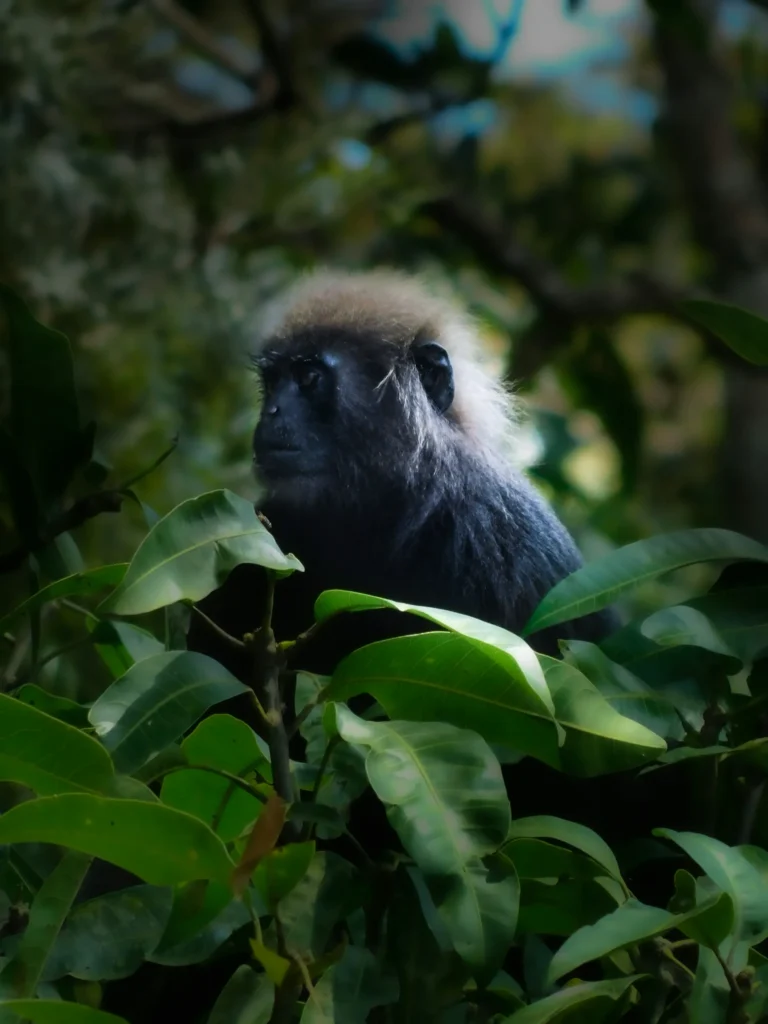
Image : Nilgiri Langur, an endemic primate species of Western Ghats in South India
The biological value of Silent Valley National Park lies in its isolation. Because the topography makes large sections of the park inaccessible, the habitat has remained undisturbed, allowing complex evolutionary processes to continue without human interference.
While many visitors arrive hoping to see large predators, the true ecological wealth of the park is found in its high levels of endemism—species that exist only in the Western Ghats. Scientific records often vary slightly depending on the taxonomic scope of the study, but the overall biodiversity metrics are consistently high.
Mammals of Silent Valley
Silent Valley is home to a robust mammal population, with studies recording between 26 large mammal species and 41 total mammal species, depending on the survey.
The undisputed flagship species of the park is the lion-tailed macaque, an endangered primate endemic to the Western Ghats. The survival of this macaque was a central argument during the Save Silent Valley movement, as the proposed dam would have submerged its primary rainforest habitat.
Other notable primates include the Nilgiri langur, frequently seen in the upper canopy.
The park supports significant populations of herbivores, including the Asian elephant and the gaur (Indian bison). In the higher elevations, the Nilgiri tahr grazes on the open grasslands.
While apex predators such as the tiger, leopard, and wild dog (dhole) inhabit the core zones, they are elusive and rarely seen by tourists restricted to the designated buffer routes. Smaller, lesser-known mammals like the Malabar giant squirrel and the endemic Jerdon’s palm civet also thrive in the dense canopy.
Birds and birdwatching
For birdwatchers, Silent Valley is a critical destination. Biodiversity surveys have recorded approximately 200 bird species within the park’s boundaries.
The park is especially important for protecting threatened and restricted-range species. Key targets for serious birders include:
- Nilgiri wood pigeon
- Nilgiri laughingthrush
- Nilgiri flycatcher
- Broad-tailed grassbird
Photography Tip: Bird photography in a dense tropical evergreen forest is challenging due to low light under the canopy and high contrast against the sky. Bring a fast lens (f/2.8 or f/4) and be prepared to push your ISO higher than you would in open savannah environments.
Reptiles, amphibians, and insects
Many travel guides overlook the smaller taxa, but Silent Valley’s ecological integrity is most evident in its herpetofauna and insect life.
Depending on the taxonomic update, studies cite between 19 and 43 amphibian species, alongside 20 to 42 reptile species (including various endemic lizards and snakes). The damp, shaded forest floor and the pristine Kunthipuzha River provide perfect microhabitats for rare frogs and forest reptiles.
Flora and forest types
The vegetation of Silent Valley is not uniform; it is a mosaic of different distinct ecosystems driven by the severe changes in elevation.
The lower and middle elevations are dominated by tropical evergreen forests, characterized by massive, buttressed trees and a dense, multi-layered canopy that blocks out most sunlight.
As the elevation increases above 1,500 meters, the landscape transitions into the shola-grassland ecosystem. Sholas are stunted, high-altitude evergreen forests restricted to the valleys and folds of the mountains, surrounded by expansive rolling grasslands. This structural variety is the primary reason the park supports such a wide spectrum of wildlife.
Wildlife sighting expectations vs. reality
Because Silent Valley is a dense rainforest ecosystem rather than an open dry deciduous forest (like Kanha or Ranthambore), wildlife viewing requires patience and realistic expectations. The park is not a zoo, and visitor movement is heavily restricted.
| What visitors expect | What is actually realistic |
| Tiger and leopard sightings | Extremely rare. The dense undergrowth hides predators, and tourists do not access the deep core zones. |
| Guaranteed macaque sightings | Possible, but not guaranteed. Lion-tailed macaques move across vast home ranges high in the canopy. |
| Close-up photography | Animals are often distant or obscured by thick vegetation. Binoculars are more useful than short camera lenses. |
| A “safari” experience | The experience is focused on guided nature treks, observing forest scenery, river views, and birdlife. |
Ultimately, a visit to Silent Valley should be approached as an opportunity to experience the atmosphere of an ancient, undisturbed rainforest rather than a checklist exercise for spotting big cats.
Plan your visit
Visiting Silent Valley requires more logistical preparation than most national parks in India. Because it is a strictly protected ecological zone, access is highly regulated, and the infrastructure is designed to limit human impact rather than maximize tourist numbers.
The gateway to the park is the village of Mukkali. Private vehicles are not permitted inside the core zone; all visitor movement into the forest begins here using designated Forest Department jeeps or buses.
Best time to visit
The ideal window for visiting Silent Valley is during the cooler, drier months from December to March. During this period, the weather is comfortable for trekking, the trails are free of leeches, and the visibility in the forest canopy is at its best.
While the park remains open throughout the year, the heavy monsoons (June to September) make travel difficult. Torrential rains often wash out trails, swell the Kunthipuzha River, and cause temporary park closures for safety.
Best Travel Seasons by Activity
| Season | Months | Experience Quality | Notes |
| Winter (Peak) | Dec – Mar | Excellent | Cool temperatures, clear skies, best for birdwatching and photography. |
| Summer | Apr – May | Good | Warmer weather. Animals may congregate near water sources, but heat can be tiring. |
| Monsoon | Jun – Sep | Poor / Challenging | Heavy rainfall, leeches, slippery trails. Only for serious monsoon-landscape enthusiasts. |
| Post-Monsoon | Oct – Nov | Very Good | Lush green landscapes and full rivers, though occasional late rains are possible. |
Timings and entry rules
Silent Valley operates on a strict entry schedule to limit the amount of time humans spend in the forest.
- Entry Timings: The park entry window at Mukkali is generally from 8:00 AM to 1:00 PM.
- Park Closure: All visitors must exit the forest by late afternoon (usually 3:00 PM to 5:00 PM, depending on the specific trek or safari duration).
- Vehicle Restrictions: You cannot drive your own car into the park. You must park at the Mukkali Forest Office and hire a Forest Department jeep.
How to reach Silent Valley
Silent Valley is located in the Palakkad district, but it is accessible from several major transport hubs in Kerala and neighboring Tamil Nadu. The final approach is always via the town of Mannarkkad, leading up to the Mukkali base station.
Travel Routes from Major Transport Hubs
| Transport Hub | Distance to Mukkali | Estimated Drive Time | Notes |
| Palakkad Junction (Train) | ~46 km | 1.5 hours | The nearest major railway station, well-connected to the rest of India. |
| Coimbatore (Airport/Train) | ~116 km | 3 hours | The most convenient major airport (in Tamil Nadu). |
| Kochi / Cochin (Airport) | ~145 km | 4 hours | A major international gateway with good road links. |
| Kozhikode / Calicut (Airport) | ~105 km | 3 hours | Alternative airport option in northern Kerala. |
Permits and tickets
Currently, access is managed directly by the Forest Department office at Mukkali.
- Booking Process: Most visitors must obtain their entry tickets and book their safari jeeps offline upon arrival at the Mukkali office. Because vehicle numbers are capped per day to prevent overcrowding, it is highly recommended to arrive early (by 7:30 AM to 8:00 AM) to secure a jeep.
- Costs: Fees are broken down into multiple components. Expect to pay a basic entry fee (around INR 50 per person), a vehicle fee (approximately INR 1,600 to INR 2,000 for a jeep seating up to 5 people), plus mandatory guide fees and camera charges.
(Note: Always verify current ticket prices and online booking availability via the official Kerala Forest Ecotourism portals immediately before your trip, as administrative rules frequently update.)
Travel tips
What to wear and carry
Because Silent Valley is a tropical rainforest, your packing should focus on protection from the environment rather than safari fashion.
- Footwear: Sturdy, closed-toe walking shoes or trekking boots with good grip. The paths can be damp and slippery even in the dry season.
- Clothing: Wear dull, earth-toned clothes (greens, browns, greys) to blend in. Choose lightweight, breathable fabrics. Long sleeves and long trousers are essential to protect against insects and thorny undergrowth.
- Gear: Bring a reusable water bottle, binoculars (crucial for canopy wildlife), a dry bag for electronics, and a basic first-aid kit.
- Leech Protection: If visiting during or just after the rains, carry leech socks and salt or insect repellent.
Do’s and don’ts
The Kerala Forest Department strictly enforces visitor rules to maintain the park’s ecological integrity. Violating these can result in heavy fines or expulsion from the park.
- DO strictly follow the instructions of your assigned forest guide.
- DO maintain complete silence to maximize your chances of hearing and seeing wildlife.
- DO carry all your plastic waste back out with you (water bottles, snack wrappers).
- DON’T feed, tease, or provoke any animals, including macaques.
- DON’T step off the designated trekking paths or safari tracks.
- DON’T smoke, consume alcohol, or light fires anywhere inside the park boundary.
- DON’T play music or use loudspeakers.
Photography and safety
- Safety: The Kunthipuzha River has strong, unpredictable undercurrents. Never attempt to swim or wade into the water unless explicitly permitted by your guide in a safe, designated spot. Keep a safe distance from all wildlife, particularly elephants.
- Photography: Flash photography is prohibited as it startles animals. Drones are strictly banned without high-level government clearance. Be prepared to pay a separate fee for still and video cameras at the ticket counter.
Nearby places and itineraries
While Silent Valley requires a dedicated morning to explore properly, its location in Palakkad district makes it easy to combine with other regional attractions.
One-day plan
A single-day trip must start early to secure a safari jeep at the Mukkali Forest Office.
- 07:30 AM: Arrive at Mukkali, purchase tickets, and hire your Forest Department jeep.
- 08:00 AM – 09:30 AM: Drive into the buffer zone toward Sairandhri.
- 09:30 AM – 12:30 PM: Climb the Sairandhri Watchtower for panoramic views of the forest canopy, then undertake a guided trek down to the Kunthipuzha River.
- 01:00 PM: Return to Mukkali, have a simple lunch at local eateries, and depart for Palakkad. You can spend the late afternoon visiting the historic Palakkad Gap or Malampuzha Dam.
Two-day Palakkad wildlife itinerary
For a deeper wildlife experience, combine Silent Valley with the drier, deciduous ecosystems nearby.
- Day 1 (Rainforest Ecosystem): Dedicate the day to Silent Valley as outlined above, focusing on the lion-tailed macaque, endemic birds, and the tropical evergreen environment. Stay overnight in Palakkad or Mannarkkad.
- Day 2 (Deciduous Forest Ecosystem): Travel to Parambikulam Tiger Reserve or Nelliyampathy hills. Parambikulam offers a completely different habitat structure, increasing your chances of seeing larger mammals like elephants, gaurs, and potentially big cats.
Common mistakes to avoid
- Expecting a conventional safari: Silent Valley is a protected rainforest, not an open dry-forest safari park. Large predators are rarely seen, and the focus is on the ecosystem as a whole.
- Arriving too late: Jeep numbers are capped daily. If you arrive after 9:00 AM during peak season, you risk being turned away.
- Bringing plastic into the park: The forest department is strictly against plastic waste. Remove wrappers and carry a reusable water bottle before reaching the entry gate.
- Underestimating the weather: Even in the dry season, the forest interior can be damp. Wearing shorts or sandals will leave you vulnerable to insects, leeches, and thorny plants.
FAQs
Where is Silent Valley National Park located? The park is situated in the Palakkad district of Kerala, India. It lies within the Nilgiri Hills of the Western Ghats.
What is the nearest town to Silent Valley National Park? The nearest major town is Mannarkkad. However, the immediate gateway and base station for all park entry is the village of Mukkali.
How far is Silent Valley from Palakkad? The park’s entry point at Mukkali is approximately 46 kilometers from Palakkad town. The drive usually takes about an hour and a half.
When was Silent Valley National Park established? The area was formally declared a National Park by the government in 1984. This followed the abandonment of a proposed hydroelectric dam in 1980.
Why is it called Silent Valley? The name originated from early British explorers who noted the perceived absence of noisy cicadas, giving the forest an unusually quiet atmosphere. It does not mean the forest is devoid of wildlife or animal sounds.
What is special about the park’s ecosystem? It is one of the last undisturbed tracts of tropical evergreen rainforests in the Western Ghats. It protects a highly endemic ecosystem centered around the pristine Kunthipuzha River valley.
What is the area of Silent Valley National Park? The total protected area commonly cited is 237.52 square kilometers. The highly restricted core zone covers 89.52 square kilometers.
What are the timings of Silent Valley National Park? Visitors are allowed to enter the park between 8:00 AM and 1:00 PM. All tourist vehicles must exit the forest by the late afternoon.
Is Silent Valley open every day? Yes, it generally remains open every day. However, access can be suspended during heavy monsoons if trails or river crossings become unsafe.
Do I need prior booking to visit?
Currently, most visitors must book their entry tickets and safari jeeps offline upon arriving at the Mukkali Forest Office. Because vehicle numbers are restricted, arriving early is essential.
What is the best season to visit Silent Valley?
The cooler, drier months from December to March offer the most comfortable weather for trekking and the clearest conditions for wildlife viewing and photography.
Can I see tigers in Silent Valley? While tigers inhabit the park’s core areas, sightings are extremely rare. The dense rainforest undergrowth and restricted tourist access make predator spotting very difficult.
Which famous primate lives in Silent Valley? The park is famous for the lion-tailed macaque, an endangered primate endemic to the Western Ghats. Protecting its habitat was a major reason the park was established.
How many bird species have been recorded here? Biodiversity surveys have recorded around 200 species of birds in the park. This includes several threatened and restricted-range species unique to the region.
Is Silent Valley part of the Nilgiri Biosphere Reserve? Yes, it forms a critical core component of the Nilgiri Biosphere Reserve. It connects with other protected areas to create a large wildlife corridor.
What is the Western Ghats connection? Silent Valley lies within the Western Ghats, a global biodiversity hotspot. The park acts as a benchmark ecosystem for studying the region’s ancient evolutionary history.
Are cameras allowed?
Yes, cameras are permitted inside the park, though flash photography is strictly prohibited. You will need to pay a separate camera fee at the entry gate.
Are there trekking routes inside the park? Yes, but visitors are not allowed to wander freely. All treks must be conducted on designated trails with a mandatory Forest Department guide.
What are the do’s and don’ts for visitors? Do maintain silence, follow your guide, and wear earth-toned clothing. Do not carry plastic, step off the trails, smoke, or attempt to feed any wildlife.
What nearby places can I combine with Silent Valley? Many visitors combine a trip to Silent Valley with visits to Malampuzha Dam, Parambikulam Tiger Reserve, or the Nelliyampathy hills in Palakkad district.
Conclusion
Silent Valley National Park stands apart from most wildlife destinations in India. It is a place defined not by the ease of photographing big cats, but by the sheer ecological integrity of its ancient rainforest. Thanks to the landmark Save Silent Valley movement, this segment of the Western Ghats continues to thrive as an undisturbed sanctuary for the lion-tailed macaque, rare avifauna, and countless endemic species.
When planning your visit, prioritize early arrival at Mukkali, respect the strict forest regulations, and adjust your expectations to appreciate the complex, layered beauty of a true tropical evergreen forest. By visiting responsibly, you support the ongoing conservation of one of the world’s most vital biodiversity habitats.
Author Note & Update Log: Written by the WildlifeSafaris.in Editorial Team. Last Updated: August 2026.
Safari Planning : Topics Cluster
- How to book a wildlife safari in India?
- Park by Park Online Safari Booking Guide
- Tiger Safari India Planning Workbook
- Park by Park Safari Permits Guide
- National Parks Permit Guide – Park by Park Guide
- Tatkal Safari Booking Guide – Last Minute Safari Permits Booking
- Tiger Safari in India Cost
- Indian Wildlife Safari Budget Planner
- Jeep vs Canter Safari
- Best time for Tiger Sightings in India
- How far advanced should you book safari permits?
- Can foreigners book Indian Wildlife Safari online?
- Special Permits Guide for Foreigners and Domestic Visitors
- How to book a Safari Permit online in India? 2026 step by step guide
- Senior Citizens Friendly Safari Planning
- Multi Generation Family Safari Planning
- 50 things to know before your first safari in India