
Plan your trip from Kolkata to the Sundarbans. Discover the best entry routes, transport options, boat safari rules, and realistic wildlife expectations.
Introduction & Route Fundamentals
The Reality of Traveling to the Sundarbans
Traveling from Kolkata to the Sundarbans is not a standard weekend road trip. Unlike typical mainland wildlife reserves where you drive directly to a jungle lodge or enter through a terrestrial park gate, the Sundarbans requires a fundamental shift in how you navigate geography. The transition from the urban sprawl of Kolkata to the quiet water systems of the delta is distinct, demanding coordinated coordination between land transport and river vessels.
The Indian Sundarbans is a massive, highly dynamic landscape. It forms part of the world’s largest delta system, carved out by the historical flows of the Ganges, Brahmaputra, and Meghna rivers. The inscribed UNESCO World Heritage site encompasses roughly 140,000 hectares of protected area, characterized by an intricate network of tidal waterways, expansive mudflats, and small, salt-tolerant mangrove islands.
Historically, this landscape has commanded rigorous conservation focus. The Sundarbans Tiger Reserve was initially established in 1973, designated as a Reserve Forest in 1978, and its core zone was formally declared a National Park in 1984. Understanding this timeline matters because the strict regulations governing travel today—such as fixed boat routes and mandatory permits—are rooted in decades of environmental protection. For the traveler, this means your journey is highly structured, deeply dependent on daily tides, and bound entirely to the water.
Route Fundamentals: From Concrete to Mangroves
The Transit Landscape
The journey from Kolkata begins on tarmac or rail but invariably ends on water. The delta itself is entirely devoid of vehicular bridges connecting the outer islands to the core tourist zones. Your primary objective when leaving Kolkata is to reach one of the recognized embarkation points along the river borders, where roads terminate and boat navigation begins.
Depending on your chosen route, the overland portion of the trip spans between 80 to 130 kilometers from central Kolkata. This drive typically requires three to four hours of travel time, varying with traffic conditions exiting the city and the shifting quality of regional roads. The most common launching points include:
- Godkhali Jetty: The most active and infrastructure-heavy entry point for mainstream tourism.
- Canning: The closest point accessible by the regional rail network.
- Sonakhali and Dhamakhali: Key alternative gateways providing access to different channels of the reserve.
- Namkhana and Raidighi: Southern embarkation options used for specific itineraries or targeted geographic access.
Why the Final Stretch is Water-Only
A common misconception among first-time visitors is that you can drive directly to a resort near the national park boundary. In reality, once you reach your designated jetty, all subsequent travel occurs via motorized wooden boats. These vessels serve as your transport to island accommodations, your platform for daily safaris, and your only means of moving between watchtowers.
[Kolkata]
│ (approx. 3–4 hours via Road or Rail)
▼
[Embarkation Jetties] (Godkhali, Canning, Sonakhali, etc.)
│ (Roads terminate completely)
▼
[Motorized River Boats]
│ (Waterway navigation only)
▼
[Sundarbans Core & Buffer Islands]
This water-only reality directly shapes how you must plan your departure from Kolkata. Because the West Bengal Forest Department strictly prohibits boat movements after daylight hours, missing your morning or early afternoon land connection can leave you stranded at the jetty with no legal way to cross to the inner islands. The tides also dictate the speed of travel; navigating against a strong low tide can add considerable time to your river journey.
Entry Points & Choosing Your Route
Evaluating the Kolkata Launch Points
Because the Sundarbans is a vast archipelago, there is no single “main gate” to the national park. Instead, several riverine towns along the delta’s edge serve as embarkation jetties. Choosing the right entry point depends entirely on your mode of transport from Kolkata, your budget, and where your chosen accommodation is located.
Most travelers arrive at one of the following hubs before transferring to a motorized boat.
The Godkhali Route: The Standard Choice
For most first-time visitors and structured tour packages, Godkhali Jetty is the primary entry point. It offers the most robust tourism infrastructure and serves as the most direct launch pad for boats heading toward the popular Sajnekhali, Sudhanyakhali, and Gosaba areas. If you are hiring a private car from Kolkata or joining an all-inclusive tour, you will likely drive straight to Godkhali.
The Canning Route: The Rail Option
If you prefer to avoid Kolkata’s road traffic or are traveling on a strict budget, Canning is the nearest railhead to the Sundarbans. Regular local trains operate between Sealdah Station in Kolkata and Canning. The train journey is highly cost-effective and avoids road congestion. However, Canning is not usually the final boat launch for core tourist zones. Upon arriving at Canning station, travelers typically hire auto-rickshaws or shared transport for the final overland leg to reach jetties like Godkhali or Sonakhali.
The Sonakhali and Dhamakhali Routes
Sonakhali and Dhamakhali serve as alternative road-accessible gateways. These points are often utilized by specific resorts, private boat operators, or travelers heading to slightly different sections of the reserve. Dhamakhali, for instance, provides excellent river access but requires coordinating with a boat operator who specifically docks there.
The Southern Hubs: Namkhana and Raidighi
Namkhana and Raidighi are located further south and cater to different geographical zones of the Sundarbans. These entry points are generally favored by travelers on specialized itineraries or those visiting specific southern islands. Accessing these points often involves longer road journeys from Kolkata or utilizing different railway lines.
Decision Guide: Which Route Suits Your Travel Style?
To simplify your planning, align your entry point with your travel priorities:
Embarkation Points at a Glance
| Entry Point | Primary Transport from Kolkata | Best Suited For |
| Godkhali | Private Car / Tour Bus | First-time visitors, families, and package tour groups seeking a straightforward transfer. |
| Canning | Local Train (from Sealdah) | Budget travelers and solo backpackers who want to bypass city road traffic. |
| Sonakhali / Dhamakhali | Private Car | Visitors whose specific resort or boat operator mandates these departure jetties. |
| Namkhana / Raidighi | Train / Private Car | Travelers booked on specialized southern itineraries or deep-water cruises. |
Expert Tip: Never assume you can show up at a jetty unannounced and easily hire a boat for a safari. The Sundarbans operates on a system of registered boats and guided access. Your boat, permits, and guide must be arranged in advance. Always confirm exactly which jetty your tour operator uses before leaving Kolkata.
Seasonality, Weather & Wildlife Realities
The Best Time to Visit the Sundarbans
Because the Sundarbans is a tidal, riverine environment exposed to the Bay of Bengal, the weather dictates not only your comfort but also whether the boats can safely operate.
October to March: The Core Travel Window
The winter months represent the optimum window for visiting the Sundarbans. During this period, the weather is stable, temperatures are pleasant for full days spent on the water, and humidity levels drop significantly. For wildlife viewing, this is the most productive season. Animals frequently emerge onto the exposed mudflats during low tide to bask in the winter sun, making reptiles and mammals considerably easier to spot against the mangrove roots.
April to June: The Summer Transition
The pre-monsoon summer is characterized by high heat and intense humidity. Spending six to eight hours on a boat during these months requires a high tolerance for tropical heat. However, summer does offer a specific advantage for dedicated wildlife watchers: as inland freshwater sources dry up, animals are often forced toward the main river channels and waterholes near the watchtowers.
The Monsoon Months: Structural Limits
Travel during the monsoon is generally discouraged and often structurally limited. The Sundarbans is a climate-sensitive landscape prone to severe cyclonic activity and heavy rainfall. Swelling rivers, rough waters, and unpredictable weather mean boat safaris are frequently canceled for safety reasons. Furthermore, the dense, wet foliage significantly reduces visibility, making wildlife spotting exceptionally difficult.
Seasonal Travel Matrix
| Season | Weather & Conditions | Wildlife Visibility | Operational Status |
| Oct – Mar | Pleasant temperatures, low humidity, calm waters. | Excellent. Animals bask on mudflats in the sun. | Fully operational. High tourist volume. |
| Apr – Jun | High heat and severe humidity. | Good. Animals approach waterholes due to heat. | Operational, but uncomfortable for casual tourists. |
| Jul – Sep | Heavy rains, high water levels, potential cyclones. | Poor. Dense foliage and flooded banks hide wildlife. | Partially restricted. High risk of weather cancellations. |
Understanding Mangrove Wildlife
The Sundarbans supports a highly specialized ecosystem encompassing 693 documented species of wildlife, including 49 mammals, 59 reptiles, 8 amphibians, and a vast array of aquatic life including 210 white fishes, 24 shrimps, 14 crabs, and 43 mollusks.
The Royal Bengal Tiger: Managing Expectations
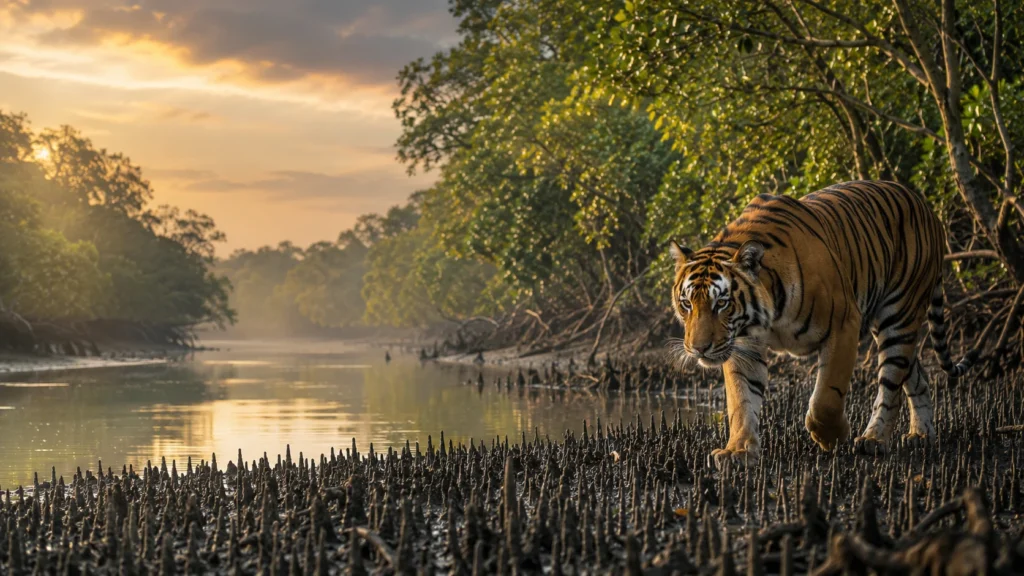
The Sundarbans is globally recognized as a critical habitat for the Royal Bengal Tiger. However, you must approach a Sundarbans safari with realistic expectations: sightings are notoriously difficult.
Unlike terrestrial parks where guides track alarm calls and pugmarks along dusty roads, a Sundarbans safari is conducted entirely from a boat navigating wide river channels. Tigers here are amphibious, highly elusive, and expertly camouflaged within the dense, salt-tolerant mangroves. If you visit solely to see a tiger, you risk leaving disappointed. Frame your trip around the broader ecosystem, and consider a tiger sighting a matter of extreme luck rather than a guaranteed checklist item.
Estuarine Giants and Aquatic Life
The muddy banks and waterways are heavily populated by the estuarine crocodile and the water monitor lizard. These reptiles are frequently seen sunning themselves on the mudflats during low tide. The waterways also support the Gangetic dolphin, river terrapins, olive ridley turtles, and Indian pythons. Spotting dolphins requires scanning the water surface where the main rivers converge, while crocodiles are best found along the sloping banks of smaller creeks.
The Avian Landscape
For birdwatchers, the reserve is exceptionally productive. The UNESCO property summary notes 260 bird species within the region. The mangrove canopy and mudflats are rich hunting grounds for multiple species of kingfishers, including the brown-winged and black-capped kingfisher. You can also expect to see apex avian predators like the white-bellied sea eagle patrolling the wider river channels.
Photography Tip: Because you are shooting from a moving boat across wide water channels, a long telephoto lens (400mm to 600mm) is essential for wildlife photography. Bring a dry bag to protect your gear from sudden splashes and the high ambient humidity.
Wildlife Spotting Dynamics
| Sighting Probability | Typical Species |
| Commonly Seen | Spotted deer, wild boar, estuarine crocodiles, water monitors, various kingfishers, egrets. |
| Occasionally Seen | Gangetic dolphins, white-bellied sea eagles, olive ridley turtles. |
| Rarely Seen | Royal Bengal Tiger, fishing cat, Indian python. |
Permits, Regulations, Sample Itineraries, FAQs & Conclusion
Permits, Timings, and Rules
Because the Sundarbans is a highly protected UNESCO World Heritage site and a designated Tiger Reserve, your movement within the park is heavily regulated. Understanding these rules before you leave Kolkata will prevent delays at the entry gates.
Official Entry Rules
Entry into the Sundarban Tiger Reserve requires an official forest permit. You cannot simply arrive at a jetty, hire a local fisherman’s boat, and enter the mangrove channels. Official tourism guidelines dictate that all visitors must travel on booked, registered tourist boats accompanied by an authorized forest guide. For international visitors, foreign passports are required for registration, and specific permit rules apply depending on the zones visited. In most cases, if you book through a reputable operator, they will handle the permit paperwork on your behalf.
Boat Hours and Daylight Restrictions
One of the most critical logistical constraints of a Sundarbans trip is that boat movement is strictly restricted to daylight hours. No tourist boats are permitted to navigate the forest channels or linger near watchtowers after the evening cutoff time. This rule exists to protect both the wildlife and the tourists. Consequently, your daily itinerary is rigidly bound by sunrise and sunset, meaning afternoon arrivals from Kolkata often result in a lost day of safari.
Essential Do’s and Don’ts
- Do carry valid government-issued photo ID (or passport and visa for international travelers) at all times.
- Do pack warm clothing for winter mornings on the water and sun protection for the midday heat.
- Don’t expect to step off the boat anywhere other than designated watchtowers and eco-tourism centers.
- Don’t carry single-use plastics into the reserve; strict anti-plastic regulations are enforced.
- Don’t play loud music or make excessive noise on the boat, as it carries far over the water and disturbs the wildlife.
Suggested Itineraries from Kolkata
Answering the question “How many days do I need?” is critical for route planning. While the transit from Kolkata is relatively short, the pace of river travel dictates your schedule.
1-Day Plan
A single-day trip from Kolkata involves an early morning departure (often around 5:00 AM) to reach Godkhali or Canning, a brief boat ride through the buffer zone channels to a nearby watchtower like Sajnekhali, and a prompt return to Kolkata by evening. This is highly compressed and generally not recommended unless you are on an extreme time crunch, as most of the day is spent in transit.
2-Day Plan (1 Night)
This is the standard weekend itinerary. Arrive at the jetty by late morning, transfer to your island accommodation, and take a short afternoon boat cruise. The second day allows for a full morning safari deeper into the reserve, such as visiting the Sudhanyakhali watchtower, before heading back to Kolkata in the late afternoon.
3-Day Plan (2 Nights)
This is the optimal duration for wildlife enthusiasts and photographers. Two nights allow you to navigate further into the delta, accessing watchtowers like Dobanki. It provides multiple tidal cycles for wildlife viewing, buffers against weather delays, and allows you to experience the mangrove ecosystem without feeling rushed.
Itinerary Duration Comparison
| Duration | Travel Pace | Wildlife Viewing Potential | Best Suited For |
| 1 Day | Rushed. | Very Low. Limits you to the outermost edges of the reserve. | Travelers with extreme time constraints. |
| 2 Days | Moderate. | Moderate. Allows for one dedicated morning safari. | Weekend planners and casual tourists. |
| 3 Days | Relaxed. | High. Allows access to deeper channels and multiple tides. | Photographers, families, and nature enthusiasts. |
Common Mistakes to Avoid
- Thinking you can drive into the reserve: You cannot drive into the Sundarbans reserve; final access to the park is strictly by boat.
- Assuming tiger sightings are guaranteed: Sighting a Royal Bengal Tiger is a matter of luck; they are elusive, and the environment is dense.
- Underestimating the ecosystem: The Sundarbans is not just about tigers. It is a complex habitat for birds, reptiles, and aquatic species that deserves equal attention.
- Hiring unauthorized transport: Any boat cannot enter the core areas. You must travel on booked, registered boats with official guides.
- Assuming a day trip is enough: While possible, a one-day trip provides only a superficial overview; most visitors require at least one to two nights for a proper experience.
Frequently Asked Questions
1. How far is the Sundarbans from Kolkata?
The road distance from Kolkata to the main embarkation points (like Godkhali) is approximately 80 to 100 kilometers, depending on your exact route.
2. How long does the trip take?
Expect about 3 to 4 hours of overland travel from Kolkata to the jetty, followed by a 1 to 2-hour initial boat transfer to your island accommodation.
3. Is Canning the nearest railhead? Yes, Canning is the closest railway station to the Sundarbans, connected directly to Sealdah Station in Kolkata.
4. Is Godkhali the main entry point? Yes, Godkhali is the most heavily utilized jetty and the primary entry point for standard Sundarbans tours.
5. What is the best time to visit?
October to March is the best time to visit due to pleasant weather and higher chances of seeing wildlife basking on the mudflats.
6. Do I need a permit to enter Sundarbans Tiger Reserve? Yes, all visitors require a forest permit to enter the national park, and boats must be registered with the forest department.
7. Can I enter the forest after sunset? No. Boat movement is restricted strictly to daylight hours for safety and conservation reasons.
8. Is the Sundarbans safe for families and senior travelers?
Yes, it is generally very safe. The motorized boats are large and stable. However, travelers with severe mobility issues should be aware that transferring between muddy jetties and wooden boats can sometimes be challenging during low tide.
9. What should I pack for a Sundarbans boat trip?
Pack light, breathable clothing, sun protection (hat, sunglasses, sunscreen), insect repellent, a windbreaker for morning river breezes, binoculars, and a camera with a telephoto lens.
10. Which is better: a package tour or a self-planned trip?
For first-time visitors, a package tour is highly recommended. Because the trip requires coordinating ground transport, boat hire, permits, and island lodging, utilizing an operator prevents logistical breakdowns.
Conclusion: Conservation and Responsible Travel
Traveling from Kolkata to the Sundarbans is an opportunity to witness one of the most unique delta ecosystems on the planet. The region’s status as a UNESCO World Heritage site is a direct reflection of its ecological importance and its vulnerability. This is a climate-sensitive landscape where issues like salinity intrusion, cyclonic activity, and human-wildlife conflict are ongoing realities.
When planning your journey, prioritize responsible tourism. Choose operators that respect the official safari timings, adhere to waste management rules, and employ local guides from the delta communities. By managing your wildlife expectations and appreciating the broader mangrove habitat—from the tidal mudflats to the apex predators—you will gain a much deeper understanding of what makes the Sundarbans a truly critical global reserve.
Author Note & Update Log: Written by the WildlifeSafaris.in Editorial Team. Last Updated: August 2026.