
Plan your safari to see the Vulnerable Nilgiri langur in the Western Ghats. Learn how to identify this rare primate, where it lives, and how to track it safely.
Introduction, Species Profile, and Identification
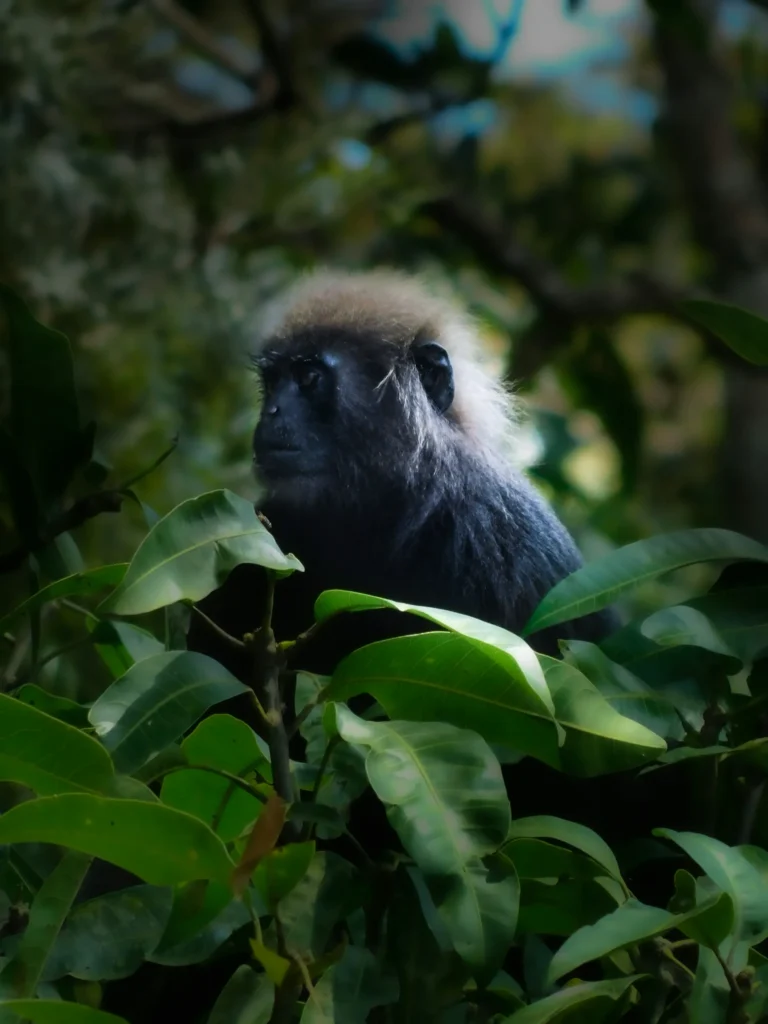
A rustle in the high canopy of a montane forest in Southern India often signals the presence of the Nilgiri langur (Semnopithecus johnii). Found exclusively in the Western Ghats, this specialized, leaf-eating primate plays a vital role in its native ecosystem.
The species is currently classified as Vulnerable by the International Union for Conservation of Nature (IUCN) due to historic hunting and ongoing habitat loss. Understanding its unique physical traits, taxonomic background, and how it differs from overlapping species is the first step toward planning an ethical safari to observe them.
What is the Nilgiri Langur?
Identifying a Nilgiri langur in the field is straightforward if you know what to look for, as its dark coat sets it apart from other regional primates. This species is primarily arboreal and diurnal, spending the vast majority of daylight hours foraging and resting high in the forest canopy.
Key Identification Features
- Adult Coloration: Mature individuals display a glossy black or deep chocolate-brown body coat. This dark fur covers the entire torso, limbs, and tail.
- The Hood: The most defining feature of an adult is the distinct golden-brown, yellowish, or ginger-colored mane that forms a hood around the head and face.
- Facial Features: The face itself is hairless, jet-black, and framed entirely by the lighter golden hood.
- Infant Coloration: Infants are born with a lighter reddish-brown coat. This natal coat gradually darkens to the adult coloration within the first few months of life.
- Vocalizations: Dominant males produce loud, resonant, guttural “whooping” calls that carry over long distances through the dense canopy, typically used to display dominance and define territorial boundaries.
Taxonomic Background and Classification
The scientific classification of the Nilgiri langur has been a subject of historical debate among primatologists. It has been placed alternately in the genera Semnopithecus and Trachypithecus. Modern taxonomic authorities frequently classify it as Semnopithecus johnii, grouping it alongside the classic gray langurs of South Asia, though it remains a distinct evolutionary line highly adapted to wet, high-altitude environments.
Local names for the animal often reflect its appearance or habitat. It is sometimes referred to as the Nilgiri leaf monkey, the hooded leaf monkey, or the black langur.
Comparing Western Ghats Primates
When traveling through southern Indian wildlife reserves, you are likely to encounter multiple primate species. The table below outlines the core visual and ecological differences to help you make accurate field identifications.
Table 1: Key Differences Between Western Ghats Primates
| Feature | Nilgiri Langur (Semnopithecus johnii) | Hanuman Langur (Semnopithecus spp.) | Lion-tailed Macaque (Macaca silenus) |
| Coat Color | Glossy black or deep chocolate brown with a golden-brown hood. | Grayish-white, buff, or light tan with a completely black face. | Glossy jet-black coat with a striking silver-white mane around the face. |
| Tail Characteristics | Long, slender, uniform black, used for balance during canopy leaps. | Exceptionally long, typically carried in a forward or backward loop over the body. | Medium length, ending in a distinct tuft of hair similar to a lion’s tail. |
| Primary Habitat | Shola forests, montane evergreen forests, wet canopy layers. | Deciduous forests, open woodlands, orchards, and urban edges. | Wet, undisturbed tropical evergreen rainforest canopies. |
| IUCN Status | Vulnerable (Population decreasing). | Least Concern (Varies by specific regional species). | Endangered (Highly fragmented populations). |
Field Note: Look carefully at the tail and behavior if you spot a dark primate at a distance. Lion-tailed macaques have shorter tails and move with a more deliberate, quadrupedal walk along branches. Nilgiri langurs are noticeably larger, possess very long tails, and move primarily by leaping clear across gaps in the upper canopy.
Range, Habitat, and Top National Parks for Sightings
To observe the Nilgiri langur in the wild, you must focus your travel planning entirely on the southern Western Ghats of India. Unlike the widespread Hanuman langur, which adapts easily to urban edges and dry deciduous zones, the Nilgiri langur has rigid ecological requirements that restrict its geographical range.
Range, Habitat, and Where to See Them
The species is strictly endemic to the southern reaches of the Western Ghats, with populations distributed across the states of Kerala, Tamil Nadu, and Karnataka. Because they rely heavily on dense canopy cover for both foraging and security, they are highly localized even within these states.
Preferred Forest Ecosystems and Elevations
Nilgiri langurs inhabit a distinct altitudinal band, typically found between 300 and 2,200 meters above sea level.
Within these elevations, they strongly prefer two specific types of ecosystems:
- Wet Evergreen Forests: The mid-elevation rainforests where a continuous, dense canopy allows for uninterrupted arboreal movement.
- Montane Shola-Grassland Mosaics: At higher elevations, they utilize the stunted, dense ‘shola’ forests that cluster in the valleys and folds of the rolling montane grasslands.
Expert Tip: When moving through a shola forest, keep your eyes on the upper middle to high canopy. Nilgiri langurs rarely descend to the ground, preferring the safety and food resources of the upper branches. If you hear a sudden, loud crashing of branches high above, it is often a troop leaping across canopy gaps.
Key Protected Areas and Best Viewing Sites
While the Nilgiri Hills give the primate its name, populations are fragmented across several distinct protected areas. When planning a safari, selecting a park with mature, undisturbed evergreen or shola habitat is crucial for a successful sighting.
The most reliable sightings occur in reserves where the forest canopy remains largely intact and contiguous. Notable locations include the Nilgiri Hills, Silent Valley National Park, Wayanad Wildlife Sanctuary, Periyar Tiger Reserve, Agasthyamalai, Mudumalai Tiger Reserve, Kalakkad-Mundanthurai Tiger Reserve, and Mukurthi National Park.
Table 2: Protected Areas Field Directory
The table below outlines the top protected areas for tracking Nilgiri langurs. Note that exact population numbers fluctuate, and a comprehensive recent nationwide census is currently lacking, though a 2018 Tamil Nadu regional survey recorded 535 individuals in specific ranges.
| Reserve Name | State | Dominant Langur Habitat | Viewing Logistics & Best Seasons |
| Silent Valley National Park | Kerala | Wet evergreen rainforests. | Offers excellent walking safaris with local guides. Best visited between November and March. |
| Mukurthi National Park | Tamil Nadu | High-elevation shola-grassland mosaics. | Access is strictly regulated for conservation; requires advance forest department permission. |
| Periyar Tiger Reserve | Kerala | Wet evergreen and moist deciduous forests. | Sightings are often possible from the lake during boat safaris or on guided nature walks. Post-monsoon (October–February) is ideal. |
| Mudumalai & Wayanad | Tamil Nadu / Kerala | Transition zones and moist deciduous pockets. | Vehicle safaris are standard here. Focus on the denser, wetter zones of these parks for langur sightings. |
| Kalakkad-Mundanthurai | Tamil Nadu | Wet evergreen and mixed forests. | Represents the southernmost portion of their range. Excellent for serious wildlife enthusiasts willing to trek. |
Photography Tip: Photographing dark-coated animals in heavy canopy shade is notoriously difficult. To avoid rendering the langur as a featureless black silhouette against a bright sky, use spot metering on the animal’s face, expose specifically for the golden hood, and utilize a lens with a wide aperture (f/2.8 or f/4) to gather as much light as possible.
Feeding Ecology, Social Structures, and Ecosystem Impact
Understanding how the Nilgiri langur behaves in its natural environment significantly improves your chances of observing them. Their daily routines are dictated by their specialized diet and the social dynamics of their small family groups.
Diet, Behaviour, and Social Life
Nilgiri langurs are entirely diurnal and arboreal, meaning they are active during the day and spend their lives navigating the complex strata of the forest canopy. They utilize different levels of the canopy for specific activities, often resting in the high canopy to avoid predators while descending to mid-levels to forage.
Feeding Ecology and Seasonal Diet Changes
These primates are primarily folivorous, heavily relying on a diet of leaves. They exhibit a strong preference for young, tender foliage, which is easier to digest and provides higher nutritional value.
However, they are not strictly leaf-eaters. Their diet is diverse and shifts significantly based on seasonal availability. Throughout the year, they supplement their leaf intake by foraging for seasonal fruits, flowers, seeds, and fresh buds. Field researchers have documented Nilgiri langurs feeding on more than 100 different plant species, demonstrating their deep integration into the local flora.
Social Troop Dynamics and Communication
Nilgiri langurs organize themselves into relatively small, cohesive troops. The typical social structure consists of a single dominant adult male, several adult females, and their dependent infants and juveniles.
Communication within and between troops is essential in the dense forest environment where visual contact is often obstructed. The dominant male is responsible for defending the troop’s territory, frequently letting out loud, resonant calls to announce his presence to neighboring groups.
In certain transition zones within the Western Ghats, researchers have documented fascinating mixed-species associations between Nilgiri langurs and the more widely distributed Hanuman langurs. Recent reports even indicate potential hybridization occurring in areas where their habitats overlap.
Seed Dispersal and Forest Regeneration
The Nilgiri langur is not merely a resident of the forest; it is an active architect of its ecosystem. Because their seasonal diet includes a substantial amount of fruits and seeds, they serve as crucial seed dispersers.
As the troops travel across large territories, they excrete viable seeds far from the parent trees. This daily activity drives the natural regeneration of the shola and wet evergreen forests, making the Nilgiri langur a flagship species whose survival is directly tied to the overall health of the Western Ghats.
Field Note: When attempting to locate a troop on foot, listen closely to the forest floor rather than straining to look into the dense upper canopy. The distinct sound of discarded leaves, snapped twigs, or half-eaten fruit dropping to the ground is often the most reliable indicator that a troop is foraging directly above you.
Conservation Challenges, Threats, and How to Help
While spotting a Nilgiri langur in the wild is a rewarding experience, it is critical to understand the precarious conservation reality these primates face. The species is currently classified as Vulnerable by the IUCN, with wild populations officially recognized as decreasing.
Population, Status, and Threats
There is no up-to-date, comprehensive nationwide census for the Nilgiri langur. Historical population estimates cited broad ranges between 5,000 and 20,000 individuals, but these figures are outdated. More recent, localized assessments highlight a fragmented reality; for example, a 2018 Tamil Nadu regional survey recorded just 535 individuals across specific ranges.
Forest departments and ecologists monitor these populations using line transects, camera traps, and direct troop counts, but significant knowledge gaps remain regarding precise population numbers, genetic health, and the extent of hybridization with Hanuman langurs.
Poaching, Plantations, and Habitat Fragmentation
The primary driver of the Nilgiri langur’s decline is habitat fragmentation. The historical conversion of continuous montane forests into commercial tea, coffee, and timber plantations has isolated langur troops into disconnected forest patches.
A common misconception is that because langurs are sometimes seen near agricultural estates, they thrive in plantations. In reality, plantations disrupt the contiguous canopy they require for safe movement and drastically reduce the variety of plant species they depend on for a balanced diet.
Additionally, the species faces targeted threats from poaching. They are historically hunted for their pelts and for their meat and organs, which are illicitly utilized in some traditional medicines.
Legal Protections
In India, the Nilgiri langur is granted the highest level of legal protection, listed under Schedule I of the Wildlife Protection Act (WPA). This categorization places them on par with tigers and elephants, meaning poaching or capturing them carries the strictest legal penalties. Internationally, their trade is restricted under CITES Appendix II.
Conservation Actions and How You Can Help
Protecting the Nilgiri langur requires a collaborative effort between government forestry departments, conservation organizations, local communities, and responsible travelers. Several NGOs, including the World Land Trust and regional wildlife trusts, actively fund habitat protection and community-based conservation initiatives in the Western Ghats.
Donate, Volunteer, and Report Citizen Sightings
Travelers can directly contribute to the survival of the species through conscious decision-making:
- Support Vetted NGOs: Direct financial donations to organizations funding shola forest restoration and anti-poaching patrols create immediate impact.
- Citizen Science: If you photograph a Nilgiri langur, you can upload your sighting data (including date, GPS location, and troop size) to platforms like GBIF (Global Biodiversity Information Facility) or regional wildlife monitoring apps. This data directly assists ecologists in tracking troop movements and population health.
- Ethical Ecotourism: Choose safari operators and lodges that actively employ local community members and enforce strict wildlife viewing guidelines.
Responsible Tourism Tip: Never ask your guide to drive off-road or approach a troop too closely to get a better photograph. Stress from human proximity forces langurs to expend critical energy fleeing rather than foraging. Maintain a quiet, respectful distance and use binoculars.
Table 3: Threat Mitigation Matrix
Understanding how local stakeholders address these challenges provides valuable context for your visit.
| Primary Threat | Ecological Impact | Mitigation Actions | Primary Stakeholders |
| Habitat Fragmentation | Isolates troops, reduces genetic diversity, and limits foraging resources. | Reconnecting forest corridors; converting abandoned plantations back to native shola forest. | State Forest Departments, conservation NGOs, and local community groups. |
| Poaching | Direct population reduction; loss of dominant breeding individuals. | Increased anti-poaching patrols; strict enforcement of WPA Schedule I penalties. | Forest guards, local informants, and wildlife crime control bureaus. |
| Human-Wildlife Conflict | Crop raiding in smallholder plantations adjacent to forests. | Implementing community forestry models and non-lethal deterrents. | Smallholder farmers and local forest officials. |
Common Travel Mistakes, Expert FAQs, and Conclusion
Planning a wildlife trip to the Western Ghats requires distinct preparation compared to standard central Indian tiger safaris. Because the Nilgiri langur occupies a highly specific ecological niche, visitors often make avoidable errors that reduce their chances of a successful and ethical sighting.
Common Field Mistakes to Avoid
- Scanning the Ground: Nilgiri langurs are almost entirely arboreal. A common mistake is looking into the undergrowth rather than the upper-middle and high canopy layers where these primates feed and rest.
- Misidentifying Species: Many visitors confuse the widespread Hanuman langur or the lion-tailed macaque with the Nilgiri langur. Look strictly for a glossy black coat with a distinct golden-brown hood and a long, non-tufted tail.
- Expecting Them in Plantations: While you might see them on the fringes of agricultural estates, true, healthy troops require dense, continuous forest canopies like shola or wet evergreen forests.
- Poor Camera Settings: Attempting to photograph a dark-coated animal against the bright sky of the canopy often results in silhouetted images. Failing to use spot metering and exposure compensation is the most common photography error.
Frequently Asked Questions
1. What is the scientific name of the Nilgiri langur? Taxonomic authorities primarily classify it as Semnopithecus johnii, though historically it has also been placed in the genus Trachypithecus.
2. What does the Nilgiri langur look like? It features a glossy black or dark chocolate-brown body with a prominent golden-brown or yellowish hood of hair framing a hairless black face.
3. Where is the Nilgiri langur found? It is endemic to the southern Western Ghats, spanning parts of Kerala, Tamil Nadu, and Karnataka.
4. What habitats does it prefer? It primarily inhabits mid-elevation wet evergreen forests and high-elevation montane shola-grassland mosaics.
5. Is the Nilgiri langur endemic to India? Yes, it is found nowhere else in the world.
6. What is its IUCN conservation status and legal protection? It is listed as Vulnerable by the IUCN and receives India’s highest level of wildlife protection under Schedule I of the Wildlife Protection Act.
7. How many Nilgiri langurs remain? There is no precise recent nationwide census, but populations are decreasing. Recent regional estimates indicate small, fragmented populations, such as 535 individuals recorded during a 2018 Tamil Nadu survey.
8. What does it eat and how does diet vary seasonally? They are heavily folivorous, preferring young, tender leaves, but supplement their diet seasonally with fruits, flowers, buds, and seeds from over 100 plant species.
9. What is its social structure and behavior? They are diurnal, arboreal primates that live in small troops led by a dominant male, accompanied by multiple females and their young.
10. When is the best time and place to see them in the wild? The post-monsoon and winter months (October to March) are ideal. Top locations include Silent Valley National Park, Periyar Tiger Reserve, and Mukurthi National Park.
11. Are Nilgiri langurs threatened by poaching? Yes, they have historically been hunted for their pelts and for meat/organs used in some traditional medicines.
12. How does habitat fragmentation affect them? The conversion of continuous forest into plantations isolates troops, cutting them off from adequate food resources and reducing genetic diversity.
13. What role do Nilgiri langurs play ecologically? By consuming seasonal fruits and traveling across the canopy, they act as vital seed dispersers, driving the natural regeneration of shola forests.
14. Are there hybridization interactions with other langurs? Yes, mixed-species associations and potential hybridization with Hanuman langurs have been documented in overlapping transition zones.
15. Which protected areas have stable populations? Reserves with large, intact tracts of wet evergreen and shola forests, such as Silent Valley, Kalakkad-Mundanthurai, and Periyar, support the most reliable populations.
16. How are they monitored? Forest departments and ecologists use line transects, camera traps, and direct troop counts, though rigorous, widespread data remains a gap.
17. Can I volunteer or donate to help conservation? Yes, you can support vetted organizations like the World Land Trust, volunteer for habitat restoration projects, or submit photographs as citizen-science data.
18. What are common threats from plantations and tourism? Plantations permanently break the forest canopy they need to survive, while unregulated tourism can cause severe stress and disrupt their foraging routines.
19. Are captive-breeding or translocation programs used? Current conservation efforts focus heavily on in-situ habitat protection, anti-poaching patrols, and corridor restoration rather than large-scale captive breeding.
20. How can local communities reduce conflict and support conservation? By adopting community forestry models, utilizing non-lethal deterrents to prevent crop raiding, and participating in shola restoration initiatives.
Further Reading and Sources
For researchers, conservation donors, and specialized wildlife travelers looking for deeper data, the following authoritative resources were referenced in this guide:
- Neotropical Primate Conservancy & Mammals of India: Comprehensive species accounts and identification parameters.
- Global Biodiversity Information Facility (GBIF): Occurrence records and citizen-science datasets for Semnopithecus johnii.
- World Land Trust: Information on active NGO funding and habitat protection initiatives.
- Regional Surveys: Ecology and conservation reports outlining localized population estimates and management strategies in the Western Ghats.
Conclusion
The Nilgiri langur is more than a rare sighting; it is a critical indicator of the health of the Western Ghats. Planning a safari to see these primates requires patience, the right choice of destination, and a commitment to ethical travel practices. By prioritizing protected reserves with intact canopies, traveling with responsible operators, and supporting local conservation efforts, your visit can directly contribute to the ongoing survival of this unique species.
Author Note & Update Log: Written by the WildlifeSafaris.in Editorial Team. Last Updated: August 2026.