Learn essential Sarus Crane facts, from identification and unique nesting habits to the best wetland landscapes for observing this species in the wild.
Introduction, Quick Species Profile & Identification
The Sarus Crane is a primary indicator of wetland health and holds the distinction of being the tallest flying bird on Earth. For wildlife travelers and birdwatchers, observing this species offers a unique look into how large waterbirds adapt to landscapes shaped by human activity.
This guide provides practical insights into the bird’s biology, field identification, and behaviors, using verified data from field researchers and conservation institutions.
What Is the Sarus Crane?
The Sarus Crane (Grus antigone, also classified as Antigone antigone) belongs to the family Gruidae and the order Gruiformes. It is a resident, non-migratory bird found across the Indian subcontinent, Southeast Asia, and northern Australia.
Unlike many large waterbirds that require isolated wilderness areas, the Sarus Crane frequently lives in close proximity to human settlements, utilizing agricultural fields and village ponds alongside natural wetlands.
| Parameter | Species Metric / Fact |
| Scientific Name | Grus antigone / Antigone antigone |
| Global Conservation Status | Vulnerable (IUCN Red List) |
| Estimated Population (India) | 15,000–20,000 individuals |
| Estimated Population (Global) | 25,000–37,000 individuals |
| Average Height | 152–156 cm |
| Average Wingspan | Approximately 240 cm |
| Primary Diet | Omnivorous (insects, aquatic plants, grains, small vertebrates) |
| Breeding Season | Aligned with seasonal monsoons; nests built in water |
Field Note
When traveling through rural landscapes in northern or western India, look for these birds in pairs or small family groups rather than large flocks. Because they do not undertake long-distance seasonal migrations, they can be monitored in the same regional territories throughout the year.
How to Identify a Sarus Crane
Distinguishing the Sarus Crane from other large wading birds is straightforward if you know what features to look for. Its extreme height is its most immediate identifying characteristic in the field.
Size and Plumage
Standing between 152 and 156 cm tall, the Sarus Crane easily towers over other wetland birds like storks, herons, and egrets. The body plumage is a uniform, clean grey color. When the bird takes flight, its extensive 240 cm wingspan is visible, showcasing broad wings that support a steady, rhythmic wingbeat.
Head, Neck, and Leg Features
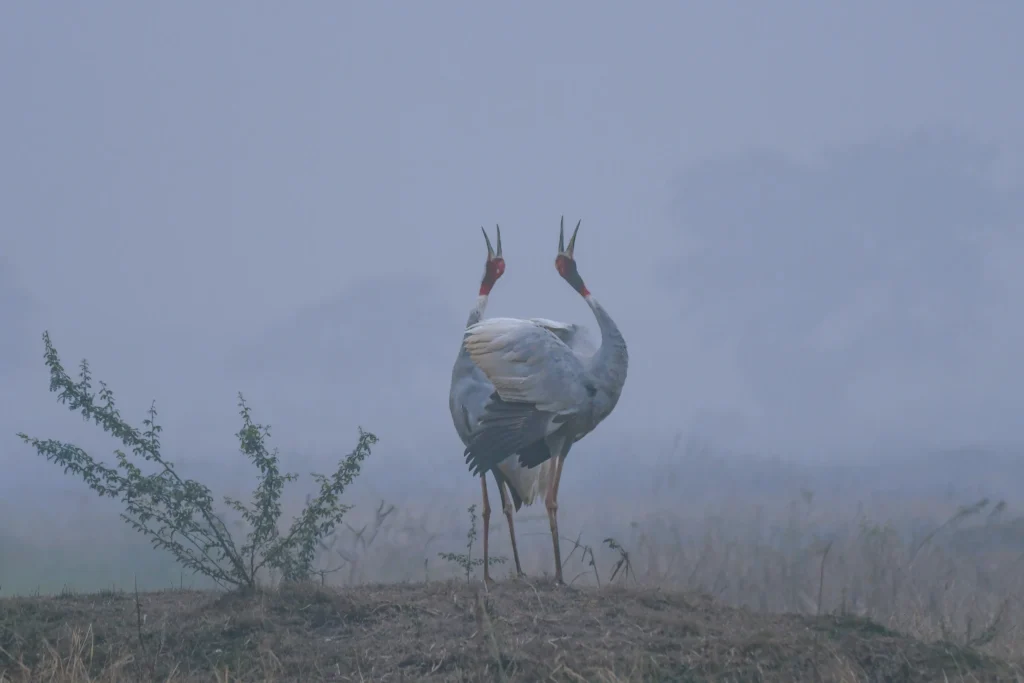
The most reliable field marking is the distinct, contrastingly colored head and upper neck.
- Upper Head and Neck: The bird features a stark patch of bare, bright red skin on the upper neck and head.
- Crown: The very top of the crown is covered in greenish-grey skin.
- Legs: The legs are long, slender, and distinctly pinkish or light-colored, designed for wading through shallow waters and mud.
Voice and Behavior
Sarus Cranes produce a loud, penetrating, trumpeting call that carries across long distances. This vocalization is often accompanied by synchronized physical displays, where pairs throw their heads back and point their beaks skyward.
If you observe a large grey bird walking slowly through a flooded field with a deliberate, measured stride, its size and bright red neck skin will confirm it is a Sarus Crane.
Where Sarus Cranes Live
Sarus Cranes require environments with shallow water, but they are highly adaptable within those parameters. They do not restrict themselves strictly to isolated wilderness areas; in fact, they frequently share landscapes with human communities.
Wetland Ecosystems and Paddy Fields
The primary habitats for this species include natural wetlands, marshes (often referred to locally as jheels), canals, and flooded agricultural areas. Flooded paddy fields and open cultivated plains provide excellent foraging and nesting grounds. This adaptability to agricultural landscapes is critical to their survival, but it also places them in direct contact with farming activities and human infrastructure.
Regional Distribution and Populations
The global population of the Sarus Crane is estimated between 25,000 and 37,000 individuals. The species is distributed across three distinct populations: the Indian subcontinent, Southeast Asia, and northern Australia.
India holds the largest share of the species, with an estimated population of 15,000 to 20,000 birds. Key populations are found in Uttar Pradesh, Bihar, Rajasthan, West Bengal, Gujarat, Madhya Pradesh, and Assam, as well as the Terai region of neighboring Nepal and parts of Pakistan.
Sarus Crane Behavior, Diet, and Mating
Observing Sarus Cranes in the field reveals complex social structures and highly specialized feeding techniques adapted for shallow waters.
Foraging and Diet
Sarus Cranes are omnivorous, utilizing their long bills to probe muddy banks and submerged soils. Their varied diet consists of aquatic plants, seeds, grains, insects, and small vertebrates. Their presence in agricultural fields often provides a natural form of pest control, which has historically fostered a tolerant relationship with local farmers.
Monogamy and Lifelong Pair Bonds
The species is famously monogamous. Sarus Cranes are known to form strong pair bonds, generally mating for life. These pairs remain together throughout the year, foraging, resting, and defending their territories cooperatively. This lifelong pairing is a significant reason the bird features heavily in regional cultural symbolism representing fidelity.
Nesting and Breeding Cycles
Breeding seasons are strongly tied to the availability of water, often aligning with the regional monsoons. Nests are constructed directly on the water in wetlands or flooded paddy fields using large mounds of vegetation.
A typical clutch consists of one to two eggs. Both parents participate in the incubation process, which lasts approximately 26 to 35 days. The young are precocial, meaning they are capable of walking and following their parents shortly after hatching to forage in the safety of shallow water.
Comparison Table: Sarus Crane vs. Common Crane
To help travelers differentiate species in the field, here is how the resident Sarus Crane compares to the migratory Common Crane, which is often seen in India during winter.
| Feature | Sarus Crane | Common Crane |
| Status in India | Resident (Non-migratory) | Winter Migrant |
| Size | 152–156 cm (Tallest flying bird) | Approx. 100–120 cm |
| Plumage Color | Overall clean grey | Slate grey with a darker back |
| Head/Neck Marking | Extensive bright red bare skin on upper neck and head | Black and white neck pattern with a small red crown patch |
| Typical Habitat | Flooded paddies, marshes, village jheels | Large open wetlands, dry agricultural fields in winter |
Photography Tip
When photographing nesting Sarus Cranes, maintain a respectful distance. The species nests in exposed, shallow water habitats. Approaching too closely can force the parents off the nest, exposing the eggs to predators or weather. Use a telephoto lens (400mm or longer) to capture intimate behavioral shots, such as their synchronized calling displays, without causing stress.
Sarus Crane Conservation Status and Threats
While the Sarus Crane has adapted to living alongside humans in agricultural landscapes, its population faces severe pressure from rapidly changing land-use practices. Understanding its conservation status requires looking at both global classifications and regional realities.
IUCN Listing and India Legal Protection
Globally, the Sarus Crane is classified as Vulnerable on the IUCN Red List. While its global status is Vulnerable, local pressures can be much worse in specific regions, making regional conservation critical.
In India, the species receives strict legal protection under the Wildlife (Protection) Act. However, because the majority of India’s estimated 15,000 to 20,000 Sarus Cranes live outside protected wildlife reserves, enforcing these legal protections requires cooperation from local farming communities.
Main Threats: Habitat Loss, Power Lines, and Pesticides
A common misconception is that all threats to cranes are natural; in reality, human-driven environmental changes are the primary drivers of population decline.
- Wetland Degradation: The draining of natural wetlands (jheels) and marshes for urban development or intensive agriculture removes the crane’s primary nesting and foraging grounds.
- Agricultural Intensification: While Sarus Cranes utilize flooded paddy fields, modern intensive farming practices disrupt their breeding cycles. Nests built in fields are often destroyed by heavy machinery.
- Pesticide Exposure: The increasing reliance on chemical pesticides in agriculture poisons the cranes’ food supply, leading to indirect fatalities and reduced reproductive success.
- Power Lines: Overhead power lines present a significant modern threat, particularly in rural areas. Because of their large size and limited maneuverability in flight, Sarus Cranes are highly susceptible to fatal collisions with these structures.
Comparison Table: Primary Threats vs. Conservation Responses
Conservation organizations are implementing targeted strategies to mitigate human-driven pressures on Sarus Crane populations.
| Primary Threat | Impact on Sarus Cranes | Conservation Management Response |
| Wetland Drainage | Loss of secure nesting sites and natural food sources | Active wetland restoration and connected wetland management |
| Pesticide Use | Chemical poisoning via contaminated insects and grains | Promoting sustainable agricultural practices in key crane habitats |
| Power Line Collisions | Direct mortality due to limited flight maneuverability | Installing flight diverters on utility wires in high-density areas |
| Agricultural Harvesting | Destruction of nests and eggs in paddy fields | Community-based monitoring and compensating farmers to protect nests |
Responsible Tourism Tip
If you visit rural areas in Uttar Pradesh or Gujarat to observe Sarus Cranes, avoid walking directly into agricultural fields. This prevents crop damage, respects the local farmers who tolerate the birds, and ensures you do not inadvertently disturb hidden nests during the breeding season.
Best Places to See Sarus Cranes in the Wild
Sarus Cranes are realistically observed across specific wetland landscapes and agricultural zones rather than deep forest reserves. Because they are resident, non-migratory birds, they can be found in these regions throughout the year, though observations are easiest when water levels concentrate them during the pre-monsoon drying phases or during the monsoon nesting season.
- Uttar Pradesh: This is the state most closely associated with the Sarus Crane. The extensive network of rural wetlands, agricultural plains, and local jheels (marshes) across western and central Uttar Pradesh holds the highest density of the bird in India.
- Gujarat & Rajasthan: The open plains, irrigated crop fields, and seasonal wetlands in these states provide ideal foraging grounds. Birds are typically seen in pairs walking through low-water marshes and rural farmland.
- The Terai Region (Nepal & India border): The low-lying wetland ecosystems and flooded plains of the Terai support a significant regional population.
- Other Key States: Smaller, stable populations are distributed across wetlands and cultivated landscapes in Bihar, Madhya Pradesh, West Bengal, and Assam.
Field Decision Guide: How to Spot a Sarus Crane
- Where to Look: Do not focus search efforts inside dense, forested national parks. Instead, scan open agricultural plains, flooded paddy fields, canals, and shallow village ponds near human settlements.
- Time of Day: Early morning is the most reliable time to observe foraging behavior and hear their loud, long-distance trumpeting calls.
- Social Structure: Look for pairs or small family groups of three (including a juvenile). If you see a lone crane, scan the immediate vicinity, as its mate is usually nearby.
Common Mistakes When Spotting Sarus Cranes
- Searching in the Wrong Terrain: Wildlife travelers often assume that rare or threatened birds only live in isolated wildlife sanctuaries. Looking for Sarus Cranes in deep woodlands or dry scrub forests is a mistake; they depend strictly on open, water-abundant agricultural plains and wetlands.
- Misidentifying Migratory Cranes: During winter, northern India hosts several migratory crane species, such as the Common Crane. Travelers often confuse them. Remember that the Sarus Crane is significantly taller (over 150 cm) and features an extensive, bare, bright red skin patch covering the upper neck and head, which migratory cranes lack.
- Approaching Nests in Paddies: Because these birds nest on large vegetation mounds in flooded agricultural fields, their nests are highly visible. Approaching too closely causes severe stress to the breeding pair and may lead them to temporarily abandon the nest, leaving eggs vulnerable to local predators or heat.
FAQs About Sarus Cranes
What is the scientific name of the Sarus Crane?
The scientific name is Grus antigone, also classified in recent taxonomic updates as Antigone antigone.
Is the Sarus Crane the tallest flying bird?
Yes, it holds the distinction of being the tallest flying bird on Earth.
How tall can a Sarus Crane grow?
Adult birds typically stand between 152 and 156 cm tall.
What does a Sarus Crane look like?
It has a uniform grey body plumage, long pinkish legs, a greenish-grey crown, and a distinctive patch of bare, bright red skin on its upper neck and head.
Where do Sarus Cranes live?
They live in natural wetlands, marshes, canals, open cultivated plains, and flooded paddy fields.
Are Sarus Cranes migratory?
No. Unlike many other crane species, the Sarus Crane is a resident, non-migratory bird.
What do Sarus Cranes eat?
They are omnivorous and eat aquatic plants, seeds, grains, insects, and small vertebrates.
Do Sarus Cranes live in pairs?
Yes. They are social birds that are almost always observed in pairs or small family groups.
Do Sarus Cranes mate for life?
Yes, the species is strictly monogamous and forms lifelong pair bonds.
How many eggs do they lay?
A typical clutch consists of one to two eggs.
What is the breeding season?
The breeding season is closely tied to the regional monsoons, which provide the high water levels needed for nesting.
Why are Sarus Cranes associated with wetlands?
Wetlands provide the shallow water required for their foraging techniques and the vegetation needed to build their large nesting mounds.
What is the conservation status of the Sarus Crane?
It is listed as Vulnerable on the IUCN Red List due to population declines driven by habitat changes.
What are the main threats to the species?
The primary threats are human-driven: wetland drainage, agricultural intensification, pesticide exposure, and collisions with overhead power lines.
Is the Sarus Crane protected in India?
Yes, it is a protected species under the Wildlife (Protection) Act.
What is the Sarus Crane’s population in India?
The Indian population is estimated to be between 15,000 and 20,000 individuals.
Which Indian state is most associated with Sarus Cranes?
Uttar Pradesh is most closely associated with the bird, where it serves as the official state bird.
Why is the Sarus Crane culturally important?
Because they pair for life, they are recognized in regional traditions as a symbol of marital fidelity, devotion, and coexistence.
How can wetlands help conserve Sarus Cranes?
Active wetland restoration and connected water management protect the essential nesting and foraging infrastructure the birds require to survive outside protected reserves.
Where can I see Sarus Cranes in the wild?
They are best observed in rural wetlands, marshes, and agricultural plains across Uttar Pradesh, Gujarat, Rajasthan, and the Terai region of Nepal.
Conclusion
The Sarus Crane serves as a vital indicator of wetland ecosystem health. Its ability to live within agricultural landscapes shows that wildlife can coexist with human communities when local practices remain sustainable. However, modern pressures like wetland drainage, agricultural chemical use, and power line infrastructure require active management to secure the future of this species. For the wildlife traveler, observing these birds in their natural rural habitats highlights the deep connection between traditional farming landscapes and bird conservation.
Author Note & Update Log: Written by the WildlifeSafaris.in Editorial Team. Last Updated: October 2026.