
Understand the Indian muntjac (barking deer). Learn about its taxonomy, core habitats across India, unique behaviors, and practical tips for wildlife tracking.
Introduction, Overview & Taxonomy
Introduction
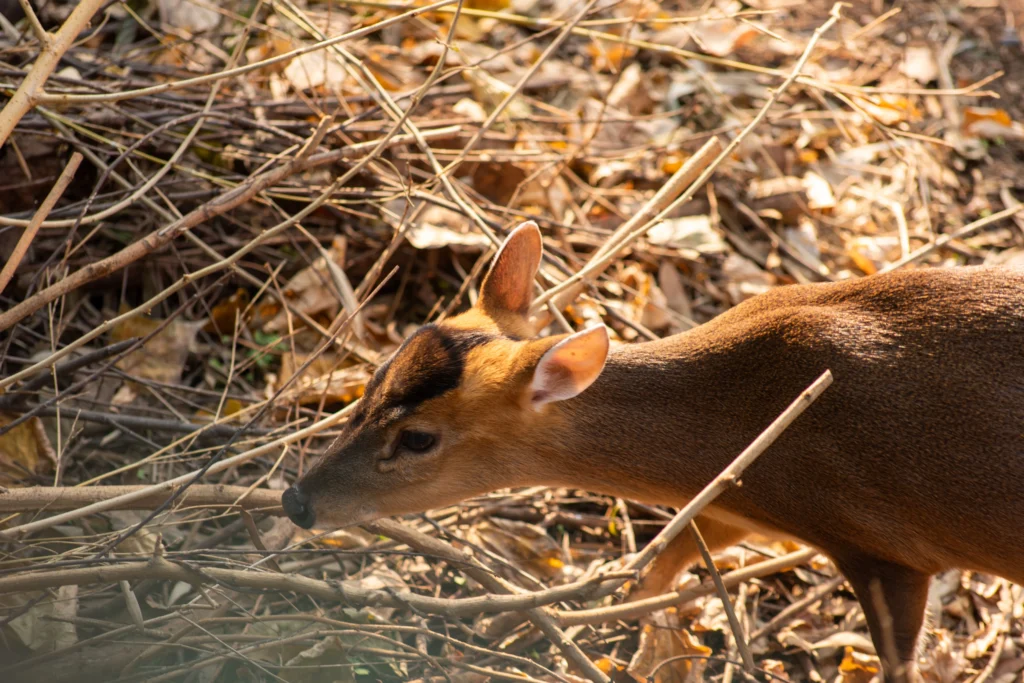
Spotting a barking deer requires patience and a keen eye for forest-edge environments. Unlike the highly visible spotted deer that frequent wide meadows, this small species prefers areas with dense cover. It plays a quiet but essential role in India’s forest food webs, serving as a primary prey base for large carnivores and aiding in seed dispersal.
To help you understand this animal, this guide bypasses generic descriptions and breaks down the latest field research, naming conventions, and specific habitat needs of the species in India.
What Is the Barking Deer?
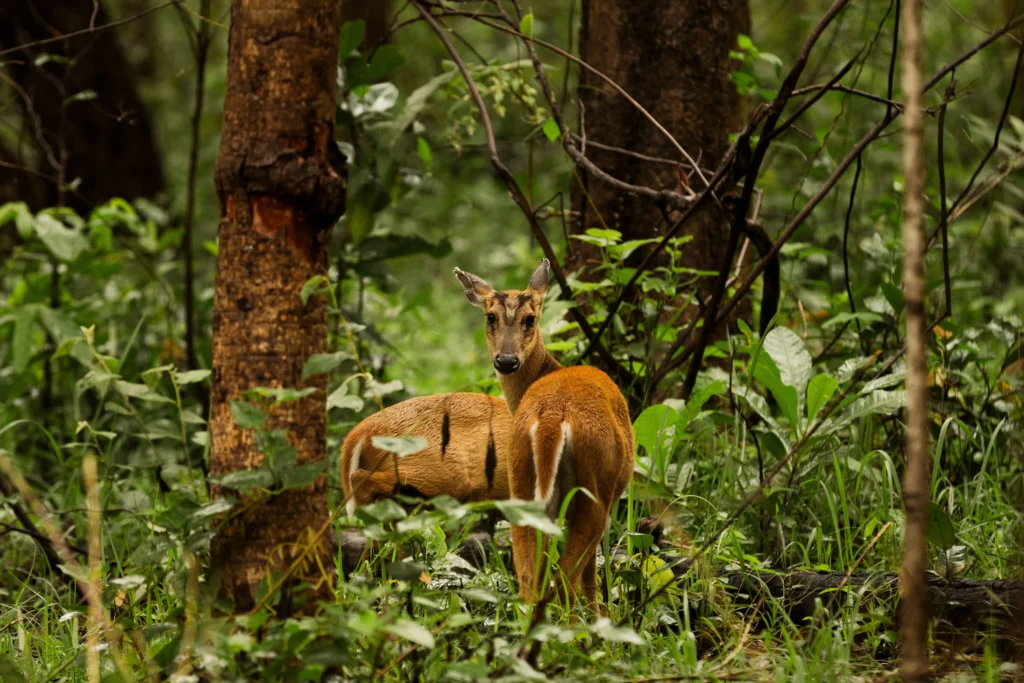
If you want to identify a barking deer in the wild, look for a small, solitary herbivore with a distinctly hunched posture and a glossy, reddish-brown coat. They are significantly smaller than spotted deer or sambar, standing roughly two feet tall at the shoulder.
Physical Appearance and Characteristics
Males possess short, unbranched antlers that grow from long, hair-covered bony stalks called pedicels. They also display elongated upper canine teeth that protrude like small tusks, which they use for defense and territorial disputes. Females lack antlers and instead have small bony knobs covered in tufts of hair.
Field Note
When startled, a barking deer will raise its tail, revealing a bright white underside. This visual flag serves as a silent warning to other nearby wildlife before the animal retreats into thick undergrowth.
The Naming Enigma: Barking Deer vs. Indian Muntjac
When reading safari trip reports or scientific papers, the multiple names used for this animal can cause confusion. The common name “barking deer” is a broad term used for several species within the genus Muntiacus due to their deep, dog-like alarm calls.
In India, the species you are most likely to encounter is scientifically classified as Muntiacus vaginalis. However, different authorities use overlapping common and scientific names based on regional variations and shifting taxonomic classifications.
Table 1: Scientific Nomenclature and Common Names
| Scientific Name | Primary Common Names | Taxonomic Scope / Notes |
| Muntiacus | Muntjac, Barking Deer | The overarching genus encompassing all muntjac species. |
| Muntiacus vaginalis | Indian Muntjac, Northern Red Muntjac, Barking Deer | The dominant species studied across the Indian subcontinent. |
| Muntiacus muntjak | Southern Red Muntjac, Indian Muntjac | A term historically used broadly, now often specific to southern populations. |
Taxonomic treatments vary depending on the wildlife authority or research institution you consult. For practical purposes on safari, “barking deer” and “Indian muntjac” are used interchangeably to describe the same animal.
Distribution & Habitat Suitability
Where Barking Deer Are Found in India
Barking deer are widely distributed across the Indian subcontinent. They do not restrict themselves to a single forest type, but instead inhabit multiple landscapes ranging from southern tropical forests to Himalayan foothill regions.
The Western Ghats Landscape
The Western Ghats hold significant populations of barking deer. Recent habitat modeling from 2026 confirms high-probability occurrences in the Nilgiris and Gudalur regions. The Mudumalai Tiger Reserve is also identified as a medium-to-high probability area for sightings and habitat suitability.
Eastern Ghats and Tamil Nadu Forest Divisions
In Tamil Nadu, the intersection of the Western and Eastern Ghats creates ideal conditions. Sathyamangalam Tiger Reserve and the Erode Forest Divisions are classified as high-probability habitats. The Cauvery North Wildlife Sanctuary also supports established populations.
Northeast India, Himalayan Foothills, and Unique Records
Barking deer populations extend well into the northeastern forests and the Himalayan foothills. While they are typically shy and forest-dwelling, rare sightings do occur on the urban fringe. For example, a free-ranging barking deer was recently documented in Delhi’s Yamuna Biodiversity Park, demonstrating that unusual city-edge records can occasionally happen.
Habitat Suitability: What Makes a Good Barking Deer Forest?
Simply being in a known geographic range does not guarantee a barking deer population. Their presence depends heavily on specific environmental variables.
A 2026 peer-reviewed habitat-suitability study conducted in Tamil Nadu utilized camera trapping, ecological sign surveys, and Random Forest modeling to determine exactly what drives barking deer distribution.
Environmental Drivers
The study identified that barking deer favor areas with specific topographic and climatic conditions, while actively avoiding regions with high human disturbance or unsuitable terrain.
Table 2: Environmental Drivers of Habitat Suitability
| Positive Habitat Factors | Negative Habitat Factors |
| High tree cover | Proximity to human settlements |
| Favorable elevation | Extreme or steep slopes |
| Consistent annual precipitation | Deforested or heavily disturbed zones |
Forest Edges and Cover Usage
Barking deer are primarily browsers that require access to undergrowth. A 2021 field study on habitat use found that the species frequently utilizes forest-edge environments and open habitats within their forested landscapes. These transitional zones provide access to low-hanging foliage while maintaining a quick escape route into thicker vegetation.
Expert Tip
Rather than scanning wide-open grasslands on a safari, focus your attention on the ecotones—the transition areas where dense woodlands border small clearings. Barking deer often linger just inside the tree line.
Ecology, Behavior & Conservation Status
Barking Deer Ecology and Behavior
To understand barking deer, you must look beyond their physical appearance and observe how they interact with their environment. They are highly attuned to their surroundings, relying on stealth and acute senses to survive in predator-heavy landscapes.
Diet and Browsing Habits
Barking deer are primarily browsing herbivores. Rather than grazing exclusively on ground-level grasses in open meadows, they feed selectively on leaves, shoots, and fruits. A 2021 field study focused on their feeding ecology demonstrated that they browse mostly on trees. This dietary preference dictates their movement, keeping them close to dense vegetation and forest edges where low-hanging foliage and fallen fruits are readily available.
Vocalizations and Alert Behavior
The common name “barking deer” comes from the animal’s distinct, sharp alarm call, which sounds remarkably like a dog barking. When a barking deer detects a potential threat—such as a tiger, leopard, or dhole (Indian wild dog)—it emits this deep, repetitive sound.
This call serves a dual purpose: it alerts other prey animals in the vicinity to the presence of danger, and it signals to the predator that it has been spotted, often ruining the element of surprise required for an ambush. On a safari, listening for this rhythmic barking is one of the most reliable ways guides locate big cats hidden in the undergrowth.
Field Note
A barking deer’s alarm call can last for several minutes after a predator has moved on. If you hear a single, isolated bark, the deer may have simply been startled. However, persistent, rhythmic barking usually indicates that a predator is actively moving through the area.
Conservation Status and Threats
While barking deer are a familiar sound in many Indian forests, their populations face localized pressures that require active monitoring.
Global Status vs. Regional Pressures
On a global scale, GBIF-linked taxonomic and conservation data classifies the species (Muntiacus vaginalis) as Least Concern. They are relatively adaptable and legally protected under Indian wildlife laws. The Wildlife Institute of India (WII), the nodal national agency for wildlife research, continues to monitor their presence through surveys and capacity-building programs, emphasizing their ongoing relevance to national conservation efforts.
Human Disturbance and Habitat Loss
Despite their stable global classification, barking deer are highly sensitive to habitat degradation. Recent research highlights that proximity to human settlements is a significant negative factor for their habitat suitability. They face local pressures from deforestation, habitat fragmentation, and hunting. As forests become fragmented by infrastructure or agricultural expansion, the dense cover they require for browsing and safety diminishes, pushing populations into isolated pockets.
Importance in Forest Food Webs
Protecting the barking deer is essential for the broader health of the forest. They play a critical dual role in the ecosystem. First, as a primary prey base, they support the survival of apex predators like tigers and leopards. Second, their foraging habits contribute to seed dispersal, helping to regenerate the very forests they inhabit.
Safari Guide, Common Mistakes & FAQs
Best Places to See Barking Deer in India
If you are planning a wildlife trip specifically hoping to see a barking deer, adjusting your expectations and locations is key. Sightings are often easier in quieter forested habitats rather than the wide, open grasslands favored by safari vehicles.
Protected Areas with Verified Populations
Recent 2026 habitat-suitability research has identified several specific reserves and forest divisions in Tamil Nadu that offer high-probability habitats for barking deer.
- Sathyamangalam Tiger Reserve: Classified as a high-probability habitat due to favorable elevation and tree cover.
- Nilgiris and Gudalur Forest Divisions: Both areas show strong evidence of established populations based on recent ecological sign surveys.
- Erode Forest Divisions: Another high-probability landscape identified by recent modeling.
- Mudumalai Tiger Reserve & Cauvery North Wildlife Sanctuary: Both provide medium-to-high probability habitats for the species.
Beyond the Western and Eastern Ghats, populations are also recorded in Northeast India and the Himalayan foothills, making them a widespread, if elusive, presence in the country’s forests.
What to Expect on Safari
Barking deer are shy and elusive. Do not expect them to stand in the middle of a safari track for extended periods. They are most frequently spotted momentarily at the forest edge before darting back into dense cover. Tracking them visually is difficult; guides rely heavily on listening for their distinct alarm calls to locate both the deer and nearby predators.
Field Identification: Barking Deer vs. Other Species
It is easy to misidentify a barking deer in the fleeting moments of a safari sighting. Using size and head morphology is the most reliable way to distinguish them from other Indian forest deer.
Table 3: Field Comparison Matrix
| Feature | Barking Deer (Indian Muntjac) | Sambar Deer | Mouse Deer (Indian Chevrotain) |
| Body Size | Small (approx. 2 feet at shoulder) | Large (approx. 4–5 feet at shoulder) | Tiny (approx. 1 foot at shoulder) |
| Antlers (Males) | Short, unbranched on long pedicels | Large, heavily branched | None |
| Typical Habitat | Dense forest edges and undergrowth | Deep forests and marshlands | Extremely dense leaf litter and thickets |
| Distinctive Traits | Humped posture, visible upper canines (tusks) | Shaggy coat, large ears | Very small, heavily spotted/striped coat |
| Call | Deep, dog-like bark | Loud, metallic honk | Generally silent |
Common Safari and Tracking Mistakes
Even experienced travelers make errors when tracking or interpreting barking deer behavior. Avoid these common misconceptions:
- Scanning Open Meadows: Barking deer avoid large clearings. Direct your binoculars toward the tree line and dense undergrowth where they browse.
- Assuming a Single Bark Means a Tiger: A single bark usually means the deer is startled. A rhythmic, repetitive barking sequence is a much stronger indicator of a moving predator like a leopard or tiger.
- Believing They Are Highly Endangered: Because they are hard to spot, visitors often assume they are rare. Globally, they are classified as Least Concern, though local populations do suffer from habitat fragmentation and proximity to human settlements.
- Expecting One Universal Name: Do not be confused if a naturalist refers to them as the Indian muntjac, red muntjac, or barking deer. These common names often describe the exact same animal depending on regional taxonomy.
Frequently Asked Questions
Is barking deer the same as Indian muntjac?
Yes, for all practical travel and field purposes in India, the barking deer and the Indian muntjac are the same animal. The common names are used interchangeably, though scientific nomenclature may vary depending on the research authority.
Why is it called a barking deer?
The species earns its name from its distinct, deep alarm call that closely resembles the bark of a dog. They use this sound to warn other animals of approaching predators.
What does a barking deer eat in Indian forests?
Barking deer are browsing herbivores. Instead of grazing on grass, they feed selectively on tree leaves, shoots, and fallen fruits found along forest edges and in dense cover.
Is the barking deer protected under Indian law?
Yes. While its global IUCN status is Least Concern, the barking deer is legally protected under Indian wildlife laws. Their habitats are actively monitored by institutions like the Wildlife Institute of India (WII).
Can barking deer be seen near urban settlements?
It is rare, as proximity to human settlements negatively impacts their habitat suitability. However, unusual city-edge records do occur; for instance, a wild barking deer was recently documented in Delhi’s Yamuna Biodiversity Park.
Conclusion
The barking deer may not draw the massive tourism crowds associated with tigers or elephants, but it is an essential component of India’s woodland ecosystems. Serving as both a critical prey base for carnivores and an important agent for seed dispersal, their presence is a strong indicator of forest health. For the wildlife traveler, understanding their habitat needs, recognizing their unique alarm calls, and learning to spot them along the forest edges adds a layer of depth and appreciation to any Indian safari experience.
Author Note & Update Log: Written by the WildlifeSafaris.in Editorial Team. Last Updated: August 2026.