
Discover the owls of India, including species, habitats, identification tips, conservation status, wildlife laws, myths, and the best places for ethical owl watching.
Owls of India: Species Guide, Habitats, Conservation, Laws & Best Places to See Them
Introduction
Owls are among India’s most widespread birds of prey, yet they are also some of the least understood. They inhabit an impressive range of environments—from dense forests and grasslands to farmland, wetlands, rocky hills, and even towns and villages. Many people rarely notice them because most species are active after dark and spend daylight hours resting quietly in trees, cliffs, or old buildings.
India supports one of the richest owl assemblages in Asia. Depending on the taxonomy and checklist used, sources generally recognise around 30–36 owl species in the country, with WWF India noting that 32 of the 35 owl species found across the Indian subcontinent occur in India. Differences in species counts mainly reflect ongoing taxonomic revisions rather than sudden changes in owl diversity.
Owls play an important ecological role by controlling rodents and other small animals, making them valuable predators in both natural ecosystems and agricultural landscapes. Despite these benefits, they continue to face pressures from habitat loss, illegal wildlife trade, and persistent superstitions that fuel persecution in parts of the country.
One species in particular—the Forest Owlet—has become a symbol of owl conservation in India. Once believed to be extinct for more than a century before its rediscovery, it remains one of the country’s most significant conservation priorities and continues to attract scientific attention as new records expand our understanding of its distribution.
Whether you are a wildlife traveller, birder, photographer, student, or simply curious about these remarkable birds, understanding India’s owls begins with appreciating both their diversity and their importance in the country’s ecosystems.
Why Owls Matter in India
More Than Just Nocturnal Birds
Most people associate owls with darkness, silence, and mystery. While many Indian species are indeed active at night, not all follow this pattern. Some, such as the Forest Owlet, are known to be active during daylight hours as well. This is one reason why broad statements such as “all owls are nocturnal” are inaccurate.
Owls belong to a specialised group of birds of prey adapted for hunting in low-light conditions. Their forward-facing eyes, acute hearing, and silent flight allow them to detect and capture prey with remarkable efficiency.
Why They Are Important for Ecosystems
Owls are natural predators that feed primarily on rodents, small mammals, reptiles, insects, and occasionally other birds, depending on the species. By keeping rodent populations under control, they provide an important ecological service in forests as well as agricultural landscapes.
For farmers, this natural pest control can reduce crop damage without relying solely on chemical methods. Healthy owl populations therefore contribute not only to biodiversity but also to more balanced ecosystems.
Why Owls Are Often Misunderstood
Unlike many daytime birds, owls are seldom seen, and this lack of familiarity has contributed to myths and misconceptions across cultures.
Some traditional beliefs associate owls with fortune, while others connect them with superstition, black magic, or ritual practices. Conservation organisations have highlighted that such beliefs are not merely folklore—they can contribute directly to illegal capture and trade, posing a genuine conservation challenge for several owl species in India.
Understanding the difference between cultural beliefs and scientific facts is therefore an important step toward protecting these birds.
Owl Diversity in India
How Many Owl Species Are Found in India?
The exact number depends on the scientific checklist being followed.
WWF India states that the Indian subcontinent supports 35 owl species, of which 32 occur in India. Other conservation references and bird checklists commonly cite figures ranging from 30 to 36 species, reflecting periodic revisions in bird taxonomy rather than disagreement about India’s importance for owl diversity.
Rather than focusing on a single number, it is more useful to recognise that India supports a diverse range of owls occupying habitats from the Himalayan mountains to tropical forests, deserts, wetlands, grasslands, and urban landscapes.
Why Different Sources Report Different Numbers
Bird taxonomy is continually refined as researchers study genetics, vocalisations, distribution, and behaviour. Sometimes a species is split into multiple species, while others are merged following new evidence.
As a result, field guides, scientific checklists, and conservation organisations may occasionally report slightly different totals. This is normal in ornithology and does not indicate uncertainty about the presence of owls in India.
The Two Major Owl Families Found in India
India’s owls belong to two principal families:
| Family | Characteristics |
| Tytonidae (Barn Owls) | Heart-shaped facial disc, long legs, lighter appearance, represented mainly by Barn Owls and related species. |
| Strigidae (Typical Owls) | Includes most Indian owl species such as the Spotted Owlet, Indian Eagle-Owl, Brown Fish-Owl, Forest Owlet, Scops-Owls, and Mottled Wood-Owl. |
Together, these families occupy nearly every major habitat type across the country, demonstrating the remarkable ecological adaptability of India’s owl fauna.
Common Owl Species of India
India’s owl diversity ranges from small species that live comfortably alongside people to large forest and cliff-dwelling hunters. While dozens of species occur across the country, a handful are encountered more frequently by birdwatchers and wildlife travellers. Learning to recognise these species provides a solid foundation for understanding India’s owl diversity.
Spotted Owlet (Athene brama)
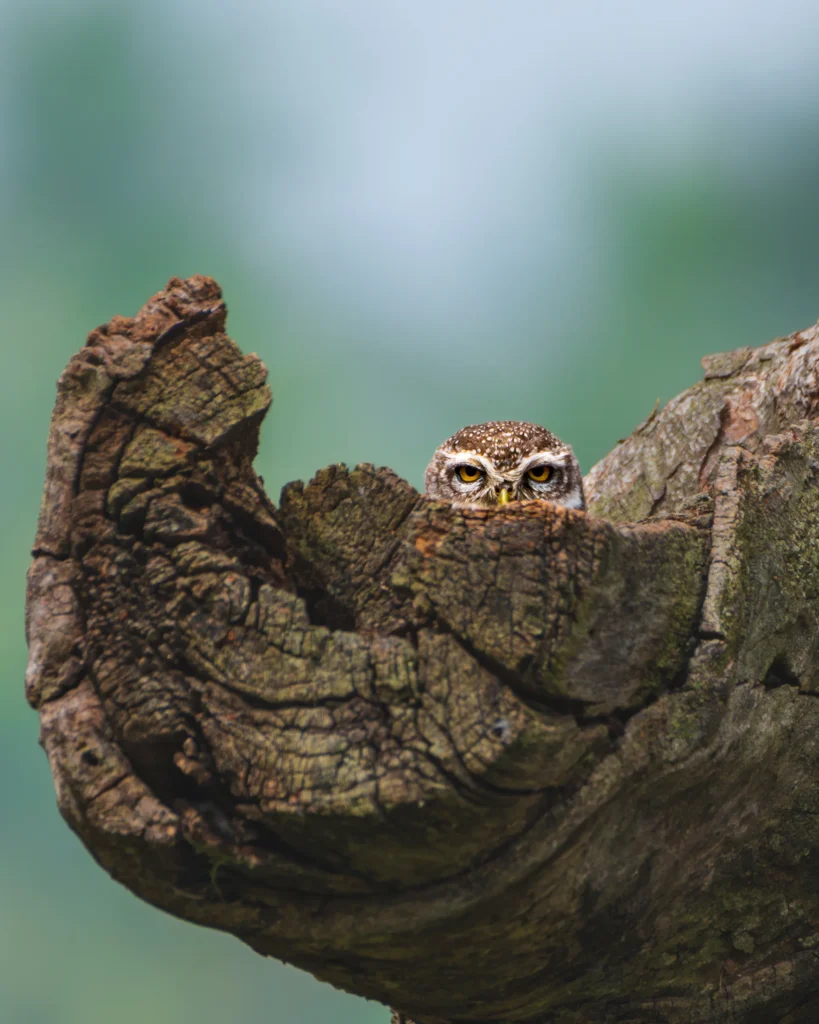
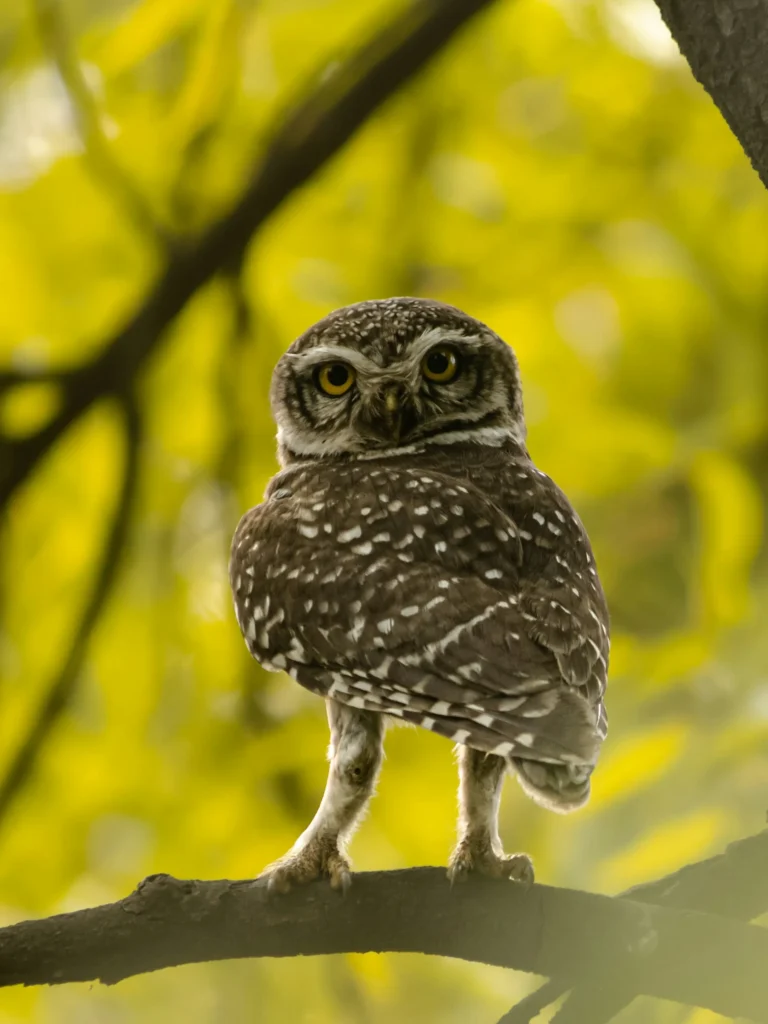
The Spotted Owlet is one of the most familiar owls in India and is often the first species that people notice. It is widespread across towns, villages, agricultural fields, parks, and open woodland, making it an excellent introduction to owl watching.
Unlike many larger owls that remain hidden throughout the day, Spotted Owlets are frequently seen perched on tree cavities, old buildings, electric poles, or boundary walls. They are especially active around dawn and dusk, although they may also be visible during daylight.
Identification
Key features include:
- Small, compact body
- Brown upperparts covered with white spots
- Pale underparts with streaking
- Bright yellow eyes
- Short tail
- Distinctive white facial markings
Their habit of living close to human settlements makes them one of India’s easiest owl species to observe responsibly.
Barn Owl (Tyto alba)
The Barn Owl is instantly recognisable because of its distinctive heart-shaped facial disc, unlike the rounded faces of most other Indian owls.
It occupies a wide variety of habitats including:
- Agricultural landscapes
- Grasslands
- Villages
- Old buildings
- Church towers
- Warehouses
- Abandoned structures
Barn Owls usually emerge after sunset to hunt rodents over open fields, making them highly beneficial to farmers.
Identification
Look for:
- Pale or white underparts
- Golden-buff upperparts
- Heart-shaped face
- Long legs
- Silent, buoyant flight
Although widespread, Barn Owls are more often heard than seen because of their nocturnal habits.
Field Note
If you notice a pale bird gliding silently over farmland after sunset, it is often a Barn Owl rather than a large white bird such as an egret. Their slow, floating flight is one of the easiest field clues.
Indian Eagle-Owl (Rock Eagle-Owl) (Bubo bengalensis)
The Indian Eagle-Owl is among India’s largest and most striking owls. Its impressive size, orange eyes, and prominent ear tufts make it one of the country’s easiest large owls to identify.
It typically inhabits:
- Rocky hills
- Cliffs
- Ravines
- Dry deciduous forests
- Scrublands
During the day it usually rests in shaded rocky outcrops or dense vegetation before becoming active after dusk.
Identification
Characteristic features include:
- Large body
- Prominent ear tufts
- Deep orange eyes
- Heavy build
- Brown, heavily streaked plumage
Its deep, resonant calls often carry long distances during the breeding season and are among the most memorable owl vocalisations in India.
Indian Scops-Owl (Otus bakkamoena)
The Indian Scops-Owl is much smaller than the Indian Eagle-Owl but is remarkably well camouflaged.
Its bark-like plumage allows it to blend almost perfectly into tree trunks, making visual detection surprisingly difficult even when perched in plain sight.
It is found in:
- Open woodland
- Orchards
- Parks
- Gardens
- Semi-urban habitats
Birdwatchers often locate this species by its calls before spotting it visually.
Identification
Features include:
- Small size
- Ear tufts
- Grey-brown plumage
- Excellent camouflage
- Yellow or orange eyes depending on light conditions
Its reliance on camouflage demonstrates why patience and careful observation are often more valuable than simply searching large areas.
Brown Fish-Owl (Ketupa zeylonensis)
As its name suggests, the Brown Fish-Owl is closely associated with water.
It is commonly found near:
- Rivers
- Lakes
- Reservoirs
- Wetlands
- Forest streams
Unlike many owls that primarily hunt rodents, this species also feeds on fish, amphibians, reptiles, and other aquatic prey.
Identification
Look for:
- Large size
- Prominent ear tufts
- Yellow eyes
- Loose, shaggy-looking plumage
- Preference for waterside perches
Because it remains close to freshwater habitats, searching suitable riverbanks after sunset often offers the best chance of encountering this impressive owl.
Comparing Some of India’s Most Familiar Owls
| Species | Typical Habitat | Size | Best Known For |
| Spotted Owlet | Villages, cities, farmland | Small | Common around people |
| Barn Owl | Farmland, grasslands, old buildings | Medium | Heart-shaped face and silent flight |
| Indian Eagle-Owl | Rocky hills and dry forests | Large | Ear tufts and orange eyes |
| Indian Scops-Owl | Woodland and gardens | Small | Outstanding camouflage |
| Brown Fish-Owl | Rivers and wetlands | Large | Hunting near water |
This comparison provides a useful starting point for identification, but many additional owl species occur across India’s forests, mountains, grasslands, and wetlands.
Rare and Endemic Owls of India
While common species are widespread and relatively easy to observe, several Indian owls are highly localised, rarely encountered, or of exceptional conservation importance. These species are often the focus of scientific research and conservation efforts.
Forest Owlet (Heteroglaux blewitti)
The Forest Owlet is India’s flagship owl conservation species.
Endemic to central India, it was famously believed to be extinct for more than a century before being rediscovered. Today it survives in fragmented dry deciduous forests, particularly within parts of the Satpura landscape.
Recent reports, including a noteworthy 2026 sighting from Kuno National Park, suggest that researchers are continuing to improve our understanding of its distribution. These findings reinforce the importance of ongoing field surveys and habitat protection.
Why the Forest Owlet Matters
The Forest Owlet illustrates several important conservation themes:
- Endemic to India
- Highly restricted distribution
- Sensitive to habitat fragmentation
- Protected under the highest legal category in India
- Subject of active conservation research
Unlike many owls, the Forest Owlet is known to be active during daylight, making it an important reminder that not all owl species are strictly nocturnal.
Expert Tip
Wildlife travellers should never expect guaranteed sightings of the Forest Owlet. Observations are rare and depend on suitable habitat, experienced guides, and a considerable amount of patience.
Mottled Wood-Owl
The Mottled Wood-Owl is a large forest-dwelling species that generally inhabits mature woodland and dense forests.
Its cryptic plumage and preference for remaining motionless during daylight make it difficult to locate despite its relatively large size.
Because it depends on well-preserved forest habitats, it also serves as an indicator of healthy woodland ecosystems.
Eastern Grass-Owl
The Eastern Grass-Owl is among India’s more specialised owl species.
Rather than forests, it favours:
- Tall grasslands
- Marshes
- Wet meadows
- Open grassy landscapes
Its dependence on grassland habitats highlights the importance of conserving ecosystems that often receive less attention than forests but support unique wildlife communities.
Other Lesser-Known Indian Owls
India’s owl fauna also includes several less frequently encountered species, including:
- Collared Scops-Owl
- Oriental Scops-Owl
- Dusky Eagle-Owl
- Himalayan Owl
- Brown Boobook
Many of these species have localised distributions or inhabit dense forests and mountainous regions, making them unfamiliar to most casual birdwatchers despite their ecological importance.
Common vs Rare Owl Species
| Category | Examples | General Distribution |
| Common and widespread | Spotted Owlet, Barn Owl | Villages, cities, farmland, open woodland |
| Habitat specialists | Brown Fish-Owl, Indian Eagle-Owl | Wetlands, rocky hills, forests |
| Rare or localised | Forest Owlet, Eastern Grass-Owl, Mottled Wood-Owl | Fragmented forests, grasslands, specialised habitats |
The next section explores where wildlife travellers and birdwatchers have the best opportunities to observe these owls responsibly across India, along with practical advice for planning successful owl-watching outings.
Where to See Owls in India
Unlike large mammals that may be concentrated within a few famous national parks, owls occur across almost every major habitat in India. The key to successful owl watching is not visiting a single destination but understanding which habitats support particular species.
Because owls are naturally elusive and many are active after sunset, sightings can never be guaranteed. Local knowledge, patience, and ethical birding practices are often far more important than visiting a specific location.
Dry Deciduous Forests
Dry deciduous forests support some of India’s most important owl populations, including the country’s flagship species—the Forest Owlet.
These forests are particularly significant in parts of:
- Central India
- Satpura landscape
- Melghat Tiger Reserve
- Kuno National Park
- Forests of Madhya Pradesh and Maharashtra
These landscapes also support several other woodland owls, making them rewarding destinations for experienced birdwatchers. Recent reports of Forest Owlet sightings beyond previously recognised areas demonstrate that scientific understanding of its distribution continues to evolve.
Grasslands and Scrublands
India’s grasslands are frequently overlooked compared with forests, yet they provide habitat for several specialised owl species.
These landscapes support birds adapted to:
- Tall grasses
- Open scrub
- Semi-arid plains
- Agricultural edges
The Eastern Grass-Owl is one such specialist, relying on dense grassland vegetation rather than forest habitats.
Protecting these ecosystems benefits numerous birds beyond owls, reinforcing the importance of conserving India’s remaining natural grasslands.
Rivers, Wetlands and Forest Streams
Owls associated with freshwater habitats require a different search strategy.
Species such as the Brown Fish-Owl are typically encountered near:
- Forest rivers
- Streams
- Reservoirs
- Lakes
- Wetlands
Rather than searching deep inside forests, birdwatchers often focus on large riverside trees, rocky banks, and quiet water bodies where these owls hunt during the evening and night.
Agricultural Landscapes
Many people are surprised to learn that productive farmland can support healthy owl populations.
Species such as the Barn Owl and Spotted Owlet regularly occur around:
- Crop fields
- Village boundaries
- Orchards
- Irrigation canals
- Farm buildings
Rodent populations associated with agriculture provide an abundant food source, making these landscapes valuable hunting grounds.
This close relationship also explains why owls are considered beneficial to farmers through their natural control of rodent pests.
Cities and Urban Fringes
Not every owl requires remote wilderness.
Several species have adapted remarkably well to human settlements.
Parks, campuses, old buildings, large avenue trees, and suburban green spaces may all support resident owl populations, especially the Spotted Owlet.
Urban birdwatchers who learn owl calls often discover that these birds have been living nearby unnoticed for years.
Regions Worth Exploring
The research brief highlights several regions that are particularly important for India’s owl diversity:
| Region | Why It Matters |
| Central India | Home to the Forest Owlet and diverse dry forest species |
| Western Ghats | Supports several forest specialists |
| Rajasthan | Rocky landscapes suitable for large eagle-owls |
| Northeast India | Diverse forest owl communities |
| Maharashtra | Important forests, sanctuaries and conservation areas |
| Madhya Pradesh | Major stronghold for several woodland species |
| Agricultural plains across India | Excellent habitat for Barn Owls and Spotted Owlets |
These regions should be viewed as broad landscapes rather than guaranteed sighting locations, as owl observations depend heavily on season, habitat quality, and field conditions.
Decision Guide: Choosing Where to Look
| Your Interest | Best Habitat |
| Common owls | Villages, parks and farmland |
| Large eagle-owls | Rocky hills and dry forests |
| Forest specialists | Protected forests and tiger reserves |
| Wetland owls | Rivers and lakes |
| Grassland species | Natural grasslands and scrub |
Family Travel Tip
Families introducing children to birdwatching often have the greatest success looking for Spotted Owlets in parks or village edges rather than attempting difficult night searches in forests.
How to Identify Indian Owls
Many beginners assume that identifying owls requires seeing them clearly. In reality, experienced birdwatchers combine several clues—including habitat, silhouette, behaviour, calls, and size—to narrow down the possibilities.
Learning these field marks greatly improves identification while reducing unnecessary disturbance to wildlife.
Start with Size and Shape
Overall body size is often the quickest clue.
For example:
- Spotted Owlets appear compact and small.
- Barn Owls have a slender build with relatively long legs.
- Indian Eagle-Owls and Brown Fish-Owls are noticeably larger and heavier.
Watching the bird’s silhouette before focusing on plumage often makes identification easier.
Facial Disc
Every owl possesses a facial disc that helps direct sound toward its ears.
The shape varies among species.
Barn Owls have the distinctive heart-shaped face that immediately separates them from India’s typical owls, which generally have rounded facial discs.
Ear Tufts
One of the most misunderstood features is the presence of ear tufts.
These feather tufts are not actually ears.
Species such as the Indian Eagle-Owl and Indian Scops-Owl possess obvious ear tufts, while Barn Owls and Spotted Owlets do not.
This single feature often eliminates several possible identifications.
Eye Colour
Although eye colour should never be used alone, it provides useful supporting evidence.
Depending on the species, Indian owls may have:
- Bright yellow eyes
- Deep orange eyes
- Darker eyes in certain lighting conditions
Combined with habitat and body shape, eye colour can strengthen an identification.
Habitat Provides Important Clues
Habitat often narrows the possibilities before the owl is even seen.
For example:
- A large owl beside a river is more likely to be a Brown Fish-Owl.
- A small owl on a city building is commonly a Spotted Owlet.
- A Barn Owl is frequently associated with farmland and old structures.
- Large rocky cliffs often indicate suitable habitat for Indian Eagle-Owls.
Rather than relying on plumage alone, experienced birders first ask whether the habitat matches the species.
Listening to Owl Calls
Many owl sightings begin with sound rather than sight.
Different species produce distinctive calls that help observers locate them in darkness or dense vegetation.
Learning common calls is often one of the most effective ways to improve owl identification while avoiding unnecessary movement through sensitive habitats.
Behaviour Can Be Equally Useful
Owls differ not only in appearance but also in behaviour.
Some remain motionless for long periods, relying on camouflage.
Others perch openly on exposed branches or buildings.
The Forest Owlet is unusual because it may also be active during daylight, unlike many of India’s more strictly nocturnal species.
Photography Tip
Avoid using flash photography on owls, particularly at night. Artificial light can temporarily disturb or disorient birds and may alter their natural behaviour. Using available light, higher ISO settings, and patient observation generally produces more ethical wildlife photographs.
Practical Checklist Before Heading Out
Before planning an owl-watching excursion, remember to:
- Research which owl species occur in the area.
- Learn a few common owl calls.
- Carry binoculars rather than relying on photography.
- Wear muted clothing.
- Move quietly after dusk.
- Maintain a respectful distance.
- Never disturb nesting or roosting birds.
- Avoid playback of owl calls unless permitted for scientific purposes.
- Follow the guidance of local naturalists and forest authorities.
Owls reward patience more than persistence. Remaining still and allowing birds to behave naturally usually results in better observations than actively searching every corner of a forest.
Conservation Challenges Facing Owls in India
Owls have survived across India’s forests, grasslands, wetlands, deserts, and agricultural landscapes for thousands of years. Today, however, many species face increasing pressure from human activities. While the challenges vary between species and regions, the research brief identifies four major concerns: habitat loss, habitat fragmentation, illegal wildlife trade, and superstition-driven persecution.
Habitat Loss
Like many birds of prey, owls depend on suitable nesting sites, mature trees, healthy forests, grasslands, and natural prey populations.
When forests are cleared or grasslands are converted for other land uses, owls lose:
- Nesting cavities
- Roosting sites
- Hunting grounds
- Stable prey populations
Species with specialised habitat requirements are generally more vulnerable than widespread generalists that can adapt to human-altered landscapes.
Habitat Fragmentation
Habitat fragmentation occurs when continuous natural habitat becomes divided into isolated patches.
Instead of one large forest, owls may be left with several disconnected fragments separated by roads, settlements, agriculture, or other developments.
This can make it more difficult for:
- Breeding populations to remain connected.
- Young birds to disperse safely.
- Suitable territories to be established.
- Small populations to remain genetically healthy.
The Forest Owlet is one of India’s best examples of a species affected by fragmented dry deciduous forests, which is why habitat protection remains central to its conservation.
Illegal Wildlife Trade
Illegal trade represents one of the most significant threats identified in the research brief.
According to WWF India, more than 1,000 owls belonging to at least 13 species were documented in illegal trade between 1992 and 2008. These figures illustrate that exploitation affects numerous species rather than only a few rare owls.
Reports highlighted in the research brief identify several frequently traded species, including:
- Indian Eagle-Owl (Rock Eagle-Owl)
- Brown Fish-Owl
- Dusky Eagle-Owl
- Indian Scops-Owl
- Mottled Wood-Owl
Importantly, illegal trade affects both large and small owl species.
Superstition and Cultural Beliefs
Owls occupy a unique place in Indian folklore and traditional beliefs.
While many cultural traditions respect owls, certain superstitions have also contributed to illegal capture and killing. Conservation organisations note that beliefs linking owls with black magic, ritual practices, or wealth can create demand for illegally traded birds.
These beliefs should not be viewed merely as folklore. They have real conservation consequences because they encourage wildlife crime and place additional pressure on already vulnerable populations.
Why Conservation Matters
Protecting owls benefits far more than the birds themselves.
Healthy owl populations contribute to:
- Natural rodent control
- Balanced food webs
- Healthier agricultural ecosystems
- Greater biodiversity
- Better functioning forest ecosystems
Their conservation therefore supports both wildlife and people.
Responsible Tourism Tip
Never purchase feathers, live birds, or wildlife products claiming to originate from owls. Even seemingly harmless purchases can support illegal wildlife trade.
Wildlife Protection Laws
Many visitors are surprised to learn that virtually all owls in India receive legal protection.
Understanding these laws helps wildlife travellers appreciate why ethical wildlife watching is essential.
Wildlife (Protection) Act, 1972
India’s principal wildlife legislation is the Wild Life (Protection) Act, 1972.
Under this Act, hunting is prohibited for protected species. Importantly, the legal definition of “hunting” extends beyond killing an animal and includes activities such as capturing, trapping, snaring, poisoning, or attempting to do so.
This broad definition reflects the law’s emphasis on preventing exploitation before it occurs.
Schedule I and Schedule IV Protection
The research brief notes an important distinction within the Wildlife (Protection) Act.
- Forest Owlet is listed under Schedule I, providing the highest level of legal protection.
- Other owl species are generally protected under Schedule IV.
Although protection categories differ, all scheduled owls receive legal safeguards against hunting and trade.
Legal Protection Summary
| Category | Applies To | Meaning |
| Schedule I | Forest Owlet | Highest level of legal protection |
| Schedule IV | Most other Indian owl species | Protected against hunting and trade under the Act |
International Protection
In addition to Indian law, international trade in many owl species is regulated through the Convention on International Trade in Endangered Species of Wild Fauna and Flora (CITES).
For wildlife travellers, the practical message is straightforward:
Owls are wild animals—not souvenirs, pets, or objects for commercial trade.
Can Owls Be Kept as Pets?
No.
The research brief makes it clear that owls are protected wildlife and should not be kept as pets. Their specialised diets, behavioural needs, and legal protection make captivity inappropriate except under authorised conservation, rehabilitation, or scientific circumstances.
Anyone encountering illegal sale or trafficking of owls should report the matter to the appropriate wildlife authorities rather than attempting to purchase or rescue the bird independently.
Myths vs Facts About Owls
Owls have inspired stories for centuries, but several widespread beliefs are inconsistent with scientific understanding. Separating fact from fiction helps both birdwatchers and conservation efforts.
| Myth | Reality |
| All owls are nocturnal. | Not all are. The Forest Owlet is known to show daytime activity. |
| Owls make good pets. | Owls are protected wild birds and should not be kept as pets. |
| Only large owls are targeted by wildlife traders. | Illegal trade has involved both large and small owl species. |
| Owls are harmful to agriculture. | They help control rodents and other prey, benefiting agricultural ecosystems. |
| Superstitions about owls are harmless traditions. | Certain beliefs can contribute to illegal capture, trade, and persecution, creating genuine conservation concerns. |
Why Science Matters
Many misconceptions arise simply because owls are rarely seen.
Their nocturnal habits, silent flight, and secretive behaviour have encouraged myths in many cultures. Scientific research, however, shows them to be highly specialised predators that play valuable ecological roles rather than symbols of fortune or misfortune.
For wildlife travellers, understanding this distinction encourages more respectful encounters and helps support conservation through responsible tourism.
Field Note
If you encounter an owl during a safari or birding trip, enjoy the observation quietly. A calm, undisturbed bird behaving naturally provides a far richer experience than one disturbed for a closer photograph.
Responsible Owl Watching in India
Watching owls in the wild can be one of the most rewarding wildlife experiences in India. Because these birds are often secretive and many species are active after dark, responsible behaviour is essential to avoid disturbing them.
Ethical birdwatching not only improves the experience for visitors but also helps ensure that owls continue to behave naturally and successfully breed in the wild.
Follow Local Regulations
Many of India’s best owl habitats lie within protected forests, wildlife sanctuaries, and tiger reserves.
Visitors should always:
- Follow forest department regulations.
- Remain on designated routes where required.
- Respect park timings.
- Listen to instructions from guides and naturalists.
- Avoid entering restricted areas.
Protected areas are managed primarily for wildlife conservation rather than photography or sightseeing.
Maintain a Respectful Distance
Owls often remain still even when they are uncomfortable.
This should never be interpreted as an invitation to approach closer.
Maintaining distance reduces stress and allows birds to continue their normal behaviour.
If an owl changes its posture, repeatedly looks toward observers, flies away, or abandons a perch, it is usually a sign that the viewing distance has become too close.
Avoid Flash Photography
Flash photography can temporarily disturb nocturnal birds and alter natural behaviour.
Whenever possible:
- Use natural or available light.
- Increase camera ISO instead of using flash.
- Use longer lenses rather than approaching the bird.
- Accept that some encounters are better enjoyed than photographed.
Ethical wildlife photography prioritises the welfare of the subject over obtaining a dramatic image.
Never Use Playback Recklessly
Playing recorded owl calls to attract birds is discouraged outside authorised scientific research or situations where local regulations specifically permit it.
Repeated playback may:
- Disrupt territorial behaviour.
- Increase stress.
- Interfere with breeding.
- Draw birds into unnecessary conflict.
Patient observation almost always provides a better wildlife experience.
Respect Nesting and Roosting Sites
Nesting owls are particularly sensitive to disturbance.
Avoid:
- Approaching nests.
- Revealing nest locations publicly.
- Trimming vegetation for photographs.
- Remaining near nesting birds for extended periods.
Protecting breeding birds contributes directly to long-term conservation.
Support Conservation Through Responsible Tourism
Wildlife tourism can positively contribute to conservation when visitors choose ethical operators and follow good field practices.
Responsible travellers can help by:
- Hiring knowledgeable local guides.
- Supporting protected-area tourism.
- Reporting suspected wildlife crime to authorities.
- Sharing accurate information rather than myths.
- Encouraging ethical bird photography.
Every responsible visitor becomes an ambassador for owl conservation.
Practical Checklist
Before heading out to look for owls, ask yourself:
✓ Have I identified which owl species occur in this region?
✓ Am I carrying binoculars?
✓ Do I understand the local regulations?
✓ Will I avoid flash photography?
✓ Will I avoid disturbing roosting or nesting birds?
✓ Am I prepared to observe quietly and patiently?
✓ Will I leave the habitat exactly as I found it?
Following these simple principles makes owl watching safer for both birds and observers.
Common Mistakes to Avoid
Many unsuccessful owl-watching trips result from unrealistic expectations rather than a lack of wildlife.
Some common mistakes include:
- Expecting guaranteed sightings of elusive species.
- Searching only after dark instead of understanding each species’ activity patterns.
- Ignoring habitat when trying to identify owls.
- Using flash photography unnecessarily.
- Walking too close to perched birds.
- Assuming all owls are nocturnal.
- Believing myths instead of scientific information.
- Supporting illegal wildlife trade by purchasing live birds or wildlife products.
- Treating owls as pets rather than protected wild animals.
- Relying solely on appearance instead of considering habitat, behaviour, and calls.
Avoiding these mistakes leads to more rewarding wildlife experiences while supporting conservation.
Frequently Asked Questions
How many owl species are found in India?
Depending on the scientific checklist used, India supports approximately 30–36 owl species. WWF India notes that 32 of the 35 owl species found across the Indian subcontinent occur in India.
Which owl is endemic to India?
The Forest Owlet is endemic to central India and is one of the country’s most important conservation species.
What is the Forest Owlet?
The Forest Owlet is a rare owl once believed to be extinct before its rediscovery. Today it survives in fragmented dry deciduous forests and remains the focus of ongoing conservation efforts.
Are all owls nocturnal?
No. While most Indian owls are active mainly at night, the Forest Owlet is known to show daytime activity as well.
Which owl species are commonly seen around villages and cities?
The Spotted Owlet and Barn Owl are among the species most frequently encountered around human settlements.
Which owl is the largest in India?
The Indian Eagle-Owl is one of India’s largest and most impressive owl species.
Where can I see owls in India?
Owls occur across forests, grasslands, wetlands, farmland, rocky hills, and even urban areas. The best habitat depends on the species you hope to observe.
Why are owls important?
Owls help regulate populations of rodents and other small animals, making them important predators in both natural ecosystems and agricultural landscapes.
Are owls protected by law in India?
Yes. Owls receive legal protection under the Wild Life (Protection) Act, 1972, with the Forest Owlet receiving the highest level of protection under Schedule I.
Can I keep an owl as a pet?
No. Owls are protected wild birds and should not be kept as pets.
Why are owls illegally traded?
Illegal demand is linked primarily to superstition and certain ritual practices rather than legitimate wildlife use. This trade represents a significant conservation concern.
What should I do if I encounter illegal owl trade?
Do not purchase the bird. Instead, report the matter to the appropriate wildlife authorities so that trained personnel can respond.
Do owls benefit farmers?
Yes. By feeding on rodents and other prey, owls contribute to natural pest control in agricultural landscapes.
What is the best time to watch owls?
Many species become active around dusk and after sunset, although activity varies between species and environmental conditions. Day-active species such as the Forest Owlet require different observation strategies.
Can photographers use recorded owl calls?
Responsible wildlife photography generally discourages the routine use of playback because it may disturb natural behaviour.
Conclusion
Owls are among India’s most fascinating birds of prey, occupying habitats that range from dense forests and rocky hills to wetlands, farmland, and urban neighbourhoods. Although they often remain hidden from view, they play a vital ecological role by controlling rodents and maintaining balanced ecosystems.
The country’s owl diversity also tells an important conservation story. From the widespread Spotted Owlet to the rare Forest Owlet, each species reflects the health of the habitats it depends upon. Protecting these birds requires more than wildlife laws—it also depends on preserving natural habitats, reducing illegal trade, challenging harmful myths, and encouraging responsible wildlife tourism.
For birdwatchers and wildlife travellers, the most rewarding encounters come through patience, careful observation, and respect for the birds’ natural behaviour. Rather than chasing guaranteed sightings, learning about owl habitats, identification, and conservation offers a deeper appreciation of these remarkable nocturnal hunters.
Whether your interest lies in birdwatching, photography, conservation, or simply understanding India’s wildlife better, owls provide an excellent reminder that some of nature’s most important species are often the ones we notice the least.
End of Article.