Plan your trip to Tal Chhapar Wildlife Sanctuary with our expert guide. Find the best times to visit, safari details, birding windows, and travel routes.
Introduction, Overview & Landscape Basics
Tal Chhapar Sanctuary is the top choice for travelers looking to observe wild blackbuck populations and migratory raptors in a natural grassland setting. Unlike the densely forested national parks of central India, this small reserve provides open visibility, making it highly rewarding for wildlife photographers and birdwatchers.
Every section of this guide is designed to answer your practical travel questions, outline exactly what you can expect on the ground, and help you arrange a seamless visit to this critical ecosystem.
Tal Chhapar Sanctuary at a Glance
Location and Landscape
Tal Chhapar Sanctuary is located in the Sujangarh tehsil of Churu district, positioned in the northwestern part of Rajasthan within the historic Shekhawati region. It sits on the fringe of the Thar Desert, meaning the landscape is primarily defined by desert scrub and open continental grasslands.
The word “tal” is a local term used to describe a flat saline depression. The sanctuary itself is exactly that—a vast, flat, low-lying clay area that fills with rainwater during monsoon periods and becomes arid during the drier months.
Covering an official area of approximately 7.1977 square kilometers (719 hectares), the sanctuary is remarkably compact. It sits at an average elevation of 305 meters above sea level. Because it is a flat grassland with scattered Khejri (Prosopis cineraria) trees, spotting animals here does not require navigating thick undergrowth.
Why it is Special
Despite its small physical footprint, Tal Chhapar is recognized internationally as a Key Biodiversity Area (KBA) due to its unique grassland-desert mosaic habitat. This specific ecosystem supports an extraordinarily high concentration of wildlife that cannot thrive in dense forests.
The sanctuary is home to a thriving population of over 4,500 blackbucks, alongside a diverse array of desert mammals and more than 250 recorded bird species. It acts as a crucial refueling stop and wintering ground for migratory raptors and harriers traveling down the Central Asian Flyway. The combination of open visibility, massive antelope herds, and seasonal influxes of birds of prey makes this one of the most ecologically significant destinations in northern India.
| Parameter | Details |
| Location | Chhapar Village, Sujangarh Tehsil, Churu District, Rajasthan |
| Region | Shekhawati / Fringe of the Thar Desert |
| Official Area | 7.1977 sq km / 719 hectares |
| Elevation | ~305 meters |
| Habitat Type | Grassland, Desert Scrub, and Saline Depression |
| Conservation Status | Wildlife Sanctuary; Globally recognized Key Biodiversity Area (KBA) |
| Key Flora | Khejri (Prosopis cineraria) trees and local perennial grasses |
Field Note
Do not arrive expecting a traditional jungle environment. Tal Chhapar is a true short-grass savanna. The absence of heavy canopy cover means wildlife is highly visible, but it also means there is minimal shade for visitors. Dress appropriately for open sun exposure even during the winter months.
Wildlife and Ecology
Wildlife of the Grasslands
Tal Chhapar is celebrated for its high visibility. Because the terrain is a flat, short-grass ecosystem with minimal tree cover, spotting wildlife here relies less on tracking through dense foliage and more on scanning wide-open spaces.
Blackbuck and Other Mammals
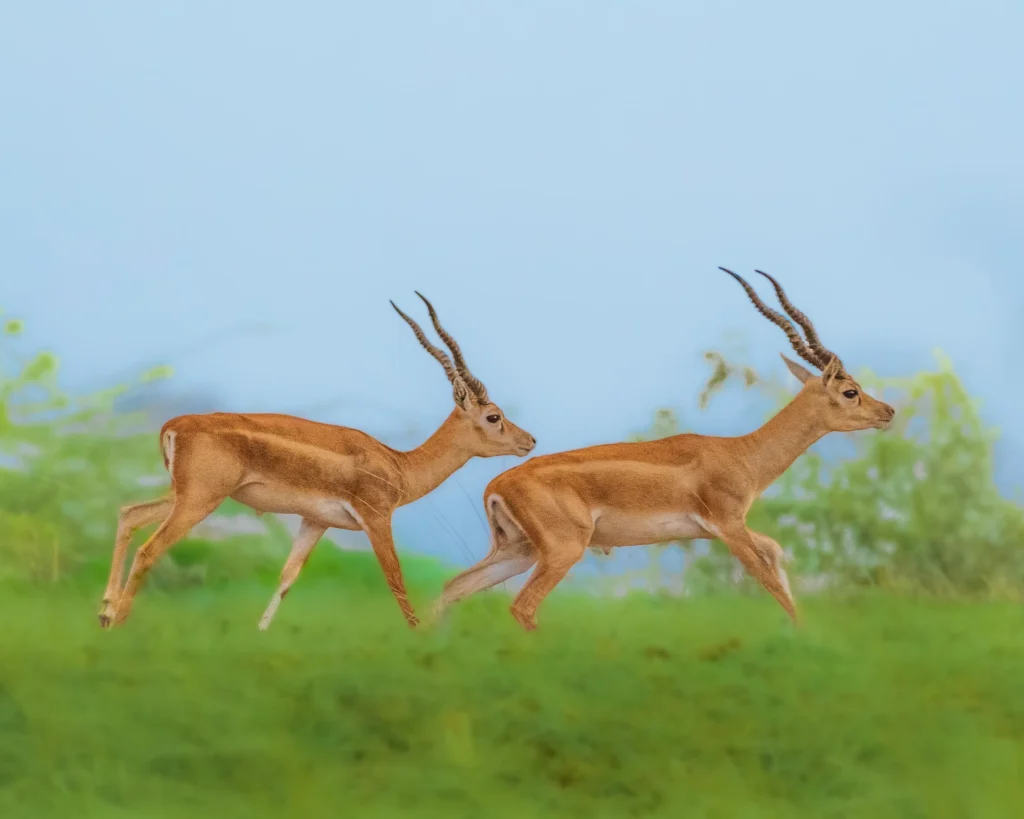
The primary mammalian draw of the sanctuary is the blackbuck, or Indian antelope. Current wildlife reporting indicates the sanctuary supports a thriving population of more than 4,500 blackbucks. Visitors can expect to see them moving in large herds, making it an excellent location to observe their complex social behaviors and the striking contrast between the dark-coated adult males and the lighter-colored females and fawns.
The sanctuary also sustains a smaller but stable population of chinkara (Indian gazelle). Due to the habitat structure, Tal Chhapar supports an array of desert-adapted carnivores and scavengers, including the golden jackal, Indian fox, red fox, and jungle cat. The desert hare is an important prey species for these mammals and raptors alike. During the warmer hours, reptiles such as the spiny-tailed lizard and the monitor lizard can often be observed.
Raptors and Migratory Birds
While the blackbuck draw the most general tourists, Tal Chhapar is highly regarded by the birdwatching community. More than 250 bird species have been recorded within the sanctuary and its immediate surroundings.
The area is famous as a wintering ground and refueling stop for migratory raptors traveling the Central Asian Flyway. It is one of the most reliable places in India to observe multiple harrier species, including Montagu’s, marsh, pallid, and hen harriers. Larger birds of prey, such as the eastern imperial eagle and the resident short-toed snake eagle, frequently use the scattered Khejri trees as hunting perches.
Beyond birds of prey, the sanctuary hosts large seasonal flocks of demoiselle cranes. Historical biodiversity records note that up to 2,000 demoiselle cranes can gather here during peak migration periods. You may also spot the bar-headed goose and black ibis. Year-round resident species include the Indian roller, bee-eaters, skylark, crested lark, and various doves.
Seasonal Sightings and Migration Windows
Understanding the seasonal rhythm of Tal Chhapar is essential for managing your expectations. Mammals are present year-round, but the birdlife shifts entirely based on the migration calendar.
Table: Seasonal Wildlife Presence
| Wildlife Category | Key Species | Best Viewing Window |
| Resident Mammals | Blackbuck, Chinkara, Golden Jackal, Desert Fox | Year-round (Active early morning and late afternoon) |
| Winter Migratory Birds | Demoiselle Crane, Bar-headed Goose | November to February |
| Raptors & Harriers | Montagu’s Harrier, Pallid Harrier, Eastern Imperial Eagle | October to March |
| Year-Round Birds | Indian Roller, Bee-eaters, Skylark, Crested Lark | Year-round |
Photography Tip
Photographing harriers in Tal Chhapar requires tracking them as they quarter low over the grasslands. Because the background is often a uniform dry yellow or brown, an autofocus system can easily lose tracking on a fast-moving bird. Use a single-point or small-zone autofocus setting to keep the sharpest focus firmly on the subject.
Practical Travel Planning
Best Time to Visit
Tal Chhapar is open throughout the year, but the experience changes dramatically with the seasons. The best time to go depends entirely on whether you are primarily interested in comfortable mammal viewing or specialized birdwatching.
Winter Birding Season
Winter is universally considered the best time to visit. From November to February, the harsh desert sun softens, making morning and afternoon safaris highly comfortable. More importantly, this is the peak window for migratory birds. The grasslands fill with thousands of demoiselle cranes, while raptors and harriers arrive to spend the winter months here. If you are a serious birder or wildlife photographer, this is the only season you should consider.
Monsoon and Summer Conditions
The monsoon season (July to September) transforms the typically dry, saline depression into a lush, green landscape. The short grasses flourish, and the blackbucks are highly active, often seen leaping through the greenery. However, the heavy rains can make some muddy tracks difficult for jeep safaris.
Summer (April to June) in the Shekhawati region is intensely hot, with temperatures frequently soaring above 40°C. While the heat makes midday visits punishing, summer does offer one distinct advantage: water scarcity forces mammals, including the chinkara and desert foxes, to congregate around the few remaining artificial waterholes, making them predictable to find.
Entry Fees, Timings, and Safari Booking
Safari and Ticket Logistics
To explore the sanctuary, visitors must pay a nominal gate entry fee and hire an official safari vehicle. Commonly cited visitor information places the basic entry fee around ₹20 per person, with exclusive jeep safaris costing approximately ₹3,500 per trip. However, because prices and permit rules are subject to change by the Rajasthan Forest Department, these figures must be revalidated via the official state wildlife portal just before your trip.
Standard safari timings are generally aligned with daylight hours, operating from early morning (around 6:00 AM) to sunset (around 6:00 PM), though exact gate times fluctuate slightly between summer and winter.
Practical Visitor Tips
Decision Guide: Jeep vs. Walking
While some fringe areas might allow limited foot access, booking a jeep safari is essential for navigating the sanctuary’s core. The distances within the 7.19 sq km area are vast enough that walking limits your scope, and a vehicle acts as a reliable mobile blind, allowing you to get closer to the skittish blackbuck herds without causing them to bolt.
- Book in Advance: During the peak winter season, demand for jeeps can outstrip supply.
- Bring Dust Protection: The dry terrain kicks up fine dust during safaris. Bring a cloth or cover to protect your camera gear and optics.
- Dress in Layers: Winter mornings in the Churu district are bitterly cold, but the temperature rises sharply by noon. Layered clothing is the most practical choice.
How to Reach Tal Chhapar
Tal Chhapar is well-connected to major cities in northern India, making it accessible for both dedicated wildlife tours and weekend trips.
By Road
Road travel is the most popular and practical way to reach the sanctuary. It is located just off the Nokha-Sujangarh highway. The roads throughout the Shekhawati region are generally in good condition, allowing for a comfortable drive from nearby hubs like Jaipur or Bikaner.
Table 3: Travel Distances and Estimated Drive Times
| Starting Point | Distance to Tal Chhapar | Estimated Drive Time |
| Churu | ~85 km | 1.5 to 2 hours |
| Bikaner | ~130 km | 2.5 to 3 hours |
| Jaipur | ~210 km | 4 to 4.5 hours |
| Delhi | ~350 km | 7 to 8 hours |
By Train
For those preferring rail travel, the sanctuary is highly accessible. The nearest railhead is the Chhapar Railway Station, which is situated on the Degana-Churu-Rewari line. The station is extremely close to the sanctuary gates, making it a convenient option. Alternatively, the larger Sujangarh station (roughly 15 km away) receives more frequent express trains from major cities.
By Air
The closest domestic and international transit hub is Jaipur International Airport, located approximately 215 km away. From Jaipur, visitors must hire a taxi or take a bus to complete the final four-hour road leg to the sanctuary.
Accommodation, Conservation Updates, Common Mistakes, and FAQs
Where to Stay and Nearby Destinations
Forest Rest House and Local Hotels
Accommodation near Tal Chhapar is relatively limited compared to larger national parks, but it covers the basic needs of travelers. The most sought-after option for dedicated wildlife enthusiasts is the official Forest Rest House (FRH) operated by the Rajasthan Forest Department, located adjacent to the sanctuary. For those seeking more modern amenities, nearby towns offer private hotels and heritage properties.
Table 4: Accommodation Options
| Accommodation Type | Pros | Cons |
| Forest Rest House | Immediate sanctuary access; excellent for early morning safaris. | Basic amenities; requires advance booking through official channels. |
| Local Hotels/Resorts | Better food options and more comfortable room facilities. | Requires a short commute to the sanctuary gates. |
Suggested Extension Itineraries
Tal Chhapar is well-suited for a one-to-two-night stopover. Because it is located in the historic Shekhawati region, you can easily pair a wildlife trip with cultural tourism. Many travelers combine Tal Chhapar with a visit to the painted havelis (mansions) of Churu or use it as a midway wildlife stop when driving between Jaipur and Bikaner.
Conservation, ESZ, and Environmental Updates
While Tal Chhapar is small, it faces complex ecological challenges. Understanding these issues provides vital context for your visit.
The Eco-Sensitive Zone (ESZ) Protection
Following heightened conservation attention, the Union Ministry of Environment, Forest and Climate Change issued draft and final notifications between 2023 and 2024 creating an Eco-Sensitive Zone (ESZ) around the sanctuary. This zone is designed as a protective buffer to regulate commercial development and minimize human-wildlife conflict near the park boundaries.
Habitat Threats and Carrying Capacity
The sanctuary is designated as a Key Biodiversity Area (KBA), but its fragile grassland-desert mosaic is under pressure. The primary threats include overgrazing, the spread of the invasive Prosopis juliflora tree, and the ecological impact of salt mining in the surrounding saline depression. Feral dogs also pose a predation threat to blackbuck fawns.
Because the current population of more than 4,500 blackbucks places heavy grazing pressure on the 7.19 sq km area, the sanctuary is operating near or beyond its carrying capacity. In 2025, Rajasthan High Court reporting indicated active legal efforts to speed up land transfer and expand the sanctuary’s protected footprint to ensure the long-term survival of its wildlife.
Table 5: Habitat Comparison
| Feature | Tal Chhapar Sanctuary | Traditional Central Indian Tiger Reserves |
| Primary Habitat | Open grassland, desert scrub, and saline depression | Dense deciduous forest and thick undergrowth |
| Visibility | High; easy to spot large herds over long distances | Low; relies on tracking and alarm calls |
| Key Attraction | Blackbucks, raptors, and harrier migrations | Tigers, leopards, and forest birds |
| Conservation Focus | Grassland preservation and carrying capacity management | Anti-poaching and corridor connectivity |
Common Mistakes to Avoid
Planning and Behavior Errors
- Expecting a Forest Experience: Do not arrive expecting thick jungle canopies. Tal Chhapar is a flat, semi-arid grassland.
- Ignoring the Migration Calendar: Visiting in the summer guarantees you will miss the spectacular harrier and demoiselle crane migrations that peak between November and February.
- Chasing the Herds: Blackbucks are highly skittish. Instruct your driver to maintain a respectful distance; attempting to drive too close will immediately scatter the herd.
- Relying on Outdated Fee Information: Entry fees and safari costs fluctuate. Always verify the latest rates via the Rajasthan Forest Department portal before your trip.
FAQs About Tal Chhapar
Planning Questions
- What is Tal Chhapar Sanctuary famous for? It is famous for its large wild population of blackbucks and for being a major wintering ground for migratory raptors and demoiselle cranes.
- Where is Tal Chhapar Sanctuary located? It is located in the Chhapar village of Sujangarh tehsil, within the Shekhawati region of northwestern Rajasthan.
- Which district is Tal Chhapar in? It is in the Churu district.
- How far is Tal Chhapar from Jaipur, Churu, and Bikaner? It is approximately 85 km from Churu, 130 km from Bikaner, and 210 km from Jaipur.
- What is the best time to visit Tal Chhapar Sanctuary? Winter (November to February) is the best time for comfortable weather and viewing migratory birds.
- Is Tal Chhapar open all year? Yes, the sanctuary remains open throughout the year, though wildlife visibility changes with the seasons.
- What is the entry fee for Tal Chhapar? Basic entry is typically cited around ₹20, with jeep safaris costing approximately ₹3,500, but these should be verified before travel as rates are subject to change.
- What are the safari timings in Tal Chhapar? Safaris generally run from early morning (around 6:00 AM) to sunset, adjusting slightly based on the season.
- Is a jeep safari available? Yes, hiring an official jeep safari is the standard and recommended way to explore the sanctuary core.
- How do you reach Tal Chhapar by train? The nearest station is Chhapar Railway Station, with the larger Sujangarh station roughly 15 km away.
- Which is the nearest airport to Tal Chhapar? Jaipur International Airport is the closest major air transit hub, located about 215 km away.
- Are there hotels or forest rest houses near Tal Chhapar? Yes, there is a Forest Rest House near the sanctuary, alongside private hotels in nearby towns.
- Is Tal Chhapar suitable for a day trip? Yes, it is small enough to be explored in a single day, though an overnight stay provides the best morning lighting for photography.
Wildlife Questions
- What wildlife can be seen in Tal Chhapar? You can see blackbuck, chinkara, desert foxes, golden jackals, and over 250 species of birds.
- Are blackbucks easy to spot there? Yes, with an estimated population of over 4,500 in an open 7.19 sq km area, sightings are highly reliable.
- Which birds migrate to Tal Chhapar? Key migrants include demoiselle cranes, bar-headed geese, and various harriers (Montagu’s, pallid, marsh).
- Is Tal Chhapar good for bird photography? It is considered one of the best locations in India for photographing raptors in flight due to the open landscape and unobstructed light.
- What is the size of the sanctuary? The official notified area is roughly 7.1977 square kilometers (719 hectares).
- What are the major conservation threats to Tal Chhapar? Primary threats include habitat degradation from invasive species, overgrazing, feral dogs, and adjacent salt mining.
- What recent eco-sensitive zone rules affect Tal Chhapar? A 2024 notification created an ESZ to regulate commercial activity and protect the sanctuary’s borders.
Conclusion
Tal Chhapar Wildlife Sanctuary offers a specialized wildlife experience that rewards patience and a keen eye. By trading the dense forests of central India for the sweeping, semi-arid plains of the Thar Desert fringe, visitors gain access to one of the most dynamic grassland ecosystems in the country. Whether you are planning a dedicated birdwatching expedition to photograph wintering harriers or simply looking to add a wildlife stopover to your Rajasthan road trip, careful planning around the seasons and an understanding of the sanctuary’s ecological limits will ensure a responsible and highly rewarding safari.
Author Note & Update Log: Written by the WildlifeSafaris.in Editorial Team. Last Updated: August 2026.
Safari Planning : Topics Cluster
- How to book a wildlife safari in India?
- Park by Park Online Safari Booking Guide
- Tiger Safari India Planning Workbook
- Park by Park Safari Permits Guide
- National Parks Permit Guide – Park by Park Guide
- Tatkal Safari Booking Guide – Last Minute Safari Permits Booking
- Tiger Safari in India Cost
- Indian Wildlife Safari Budget Planner
- Jeep vs Canter Safari
- Best time for Tiger Sightings in India
- How far advanced should you book safari permits?
- Can foreigners book Indian Wildlife Safari online?
- Special Permits Guide for Foreigners and Domestic Visitors
- How to book a Safari Permit online in India? 2026 step by step guide
- Senior Citizens Friendly Safari Planning
- Multi Generation Family Safari Planning
- 50 things to know before your first safari in India