
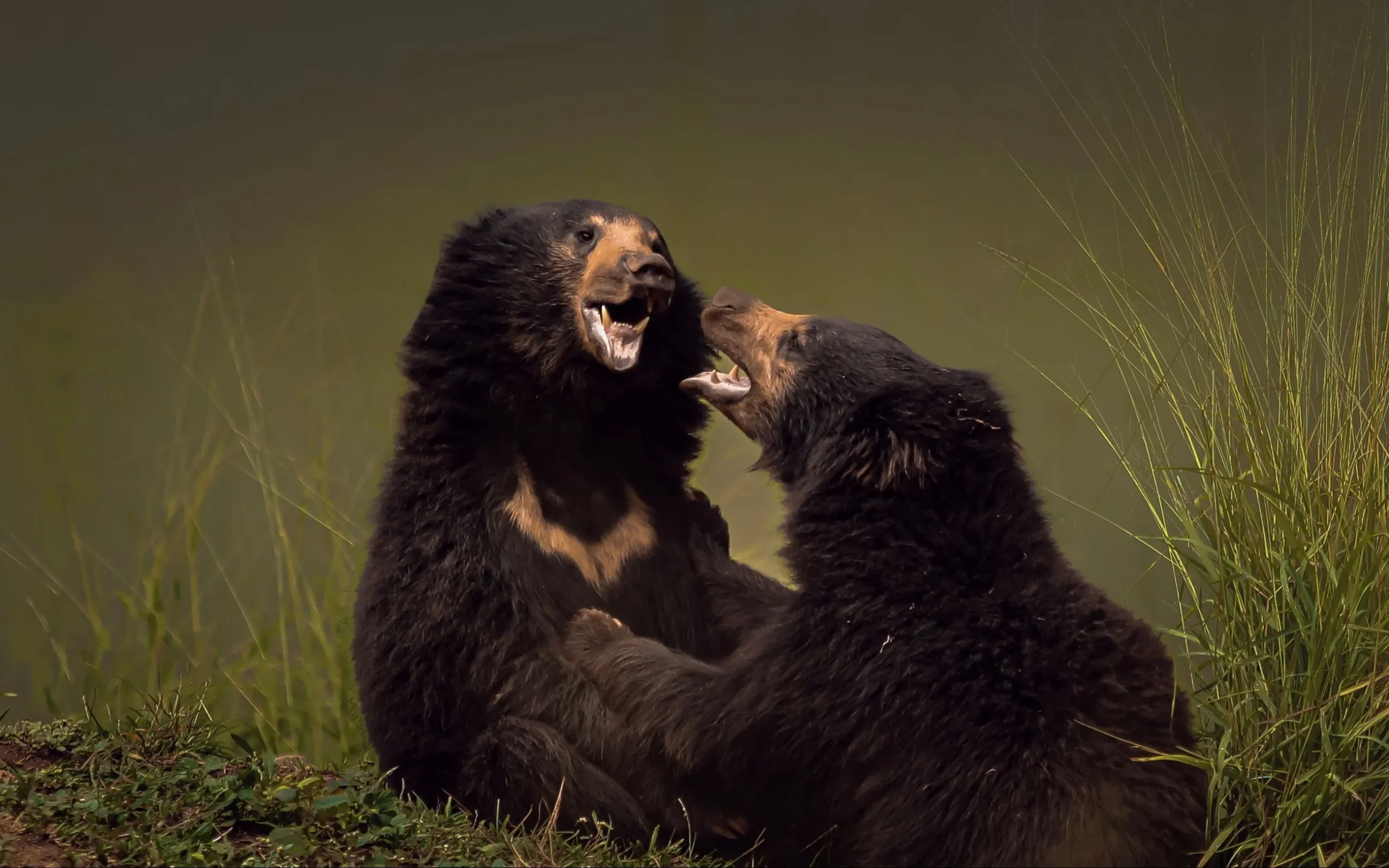
Learn how sloth bears defend themselves, why they attack when threatened, their survival adaptations, predator interactions, and how to stay safe in bear habitat.
Introduction
Among all the world’s bear species, the sloth bear (Melursus ursinus) has earned a reputation for responding aggressively when threatened. While this behaviour often surprises people, it is largely a survival strategy rather than a sign of unusual aggression.
Unlike predators that actively hunt large animals, sloth bears spend much of their time searching for termites, ants, fruits, and other seasonal foods. However, they share forests with powerful predators such as Bengal tigers and leopards while also living close to villages, farms, and forest trails across the Indian subcontinent. These overlapping pressures have shaped a defence strategy that relies on intimidation, speed, and overwhelming force when escape is not possible.
Understanding how sloth bears defend themselves helps explain why encounters with humans can become dangerous, why mothers fiercely protect their cubs, and why even large predators often treat adult sloth bears with caution.
Whether you are planning a wildlife safari, trekking through forested landscapes, or simply curious about bear behaviour, knowing the science behind these defensive adaptations provides valuable insight into one of Asia’s most distinctive mammals.
How Do Sloth Bears Defend Themselves? (Quick Answer)
Sloth bears defend themselves using a combination of physical strength, specialised anatomy, and bold behaviour.
Their primary defensive strategies include:
- Standing upright to appear larger.
- Charging loudly to intimidate threats.
- Delivering powerful swipes with long curved foreclaws.
- Using strong canine teeth during close encounters.
- Fiercely protecting cubs from predators.
- Responding rapidly to surprise encounters rather than fleeing immediately.
Most confrontations with people are defensive rather than predatory. Sloth bears typically attack when they are startled at close range, feel cornered, or are protecting young cubs. This distinction is important because it explains why reducing surprise encounters is one of the most effective ways to minimise conflict.
Why Sloth Bears Need Powerful Defences
Living Alongside Large Predators
Few bear species regularly share habitat with apex predators as formidable as the Bengal tiger. Across much of India, Nepal, and Sri Lanka, sloth bears occupy forests where tigers and leopards are also present. Although adult sloth bears are not common prey, vulnerable individuals and cubs can be targeted.
Rather than relying solely on escape, sloth bears have evolved to confront danger directly when necessary. Their long claws, muscular forelimbs, loud vocalisations, and willingness to charge help discourage predators that might otherwise view them as an easy target.
Why Defence Matters More Than Escape
Unlike more agile forest mammals, sloth bears cannot always avoid conflict. Their relatively poor eyesight means they may detect danger only at close range, particularly in dense vegetation. When surprised, they often react immediately with loud displays or aggressive charges intended to neutralise the perceived threat before it gets closer.
From an evolutionary perspective, this strategy has likely improved survival in landscapes where hesitation could prove fatal. The same behaviour, however, also explains why accidental encounters with humans can escalate quickly if people unknowingly approach a bear at close range.
Physical Adaptations That Make Sloth Bears Formidable
Sloth bears evolved primarily as insect-eating mammals, but many of the physical features that help them dig into termite mounds also make them effective at defending themselves. Their anatomy is built for power rather than speed, allowing them to react forcefully when threatened.
Long Curved Claws
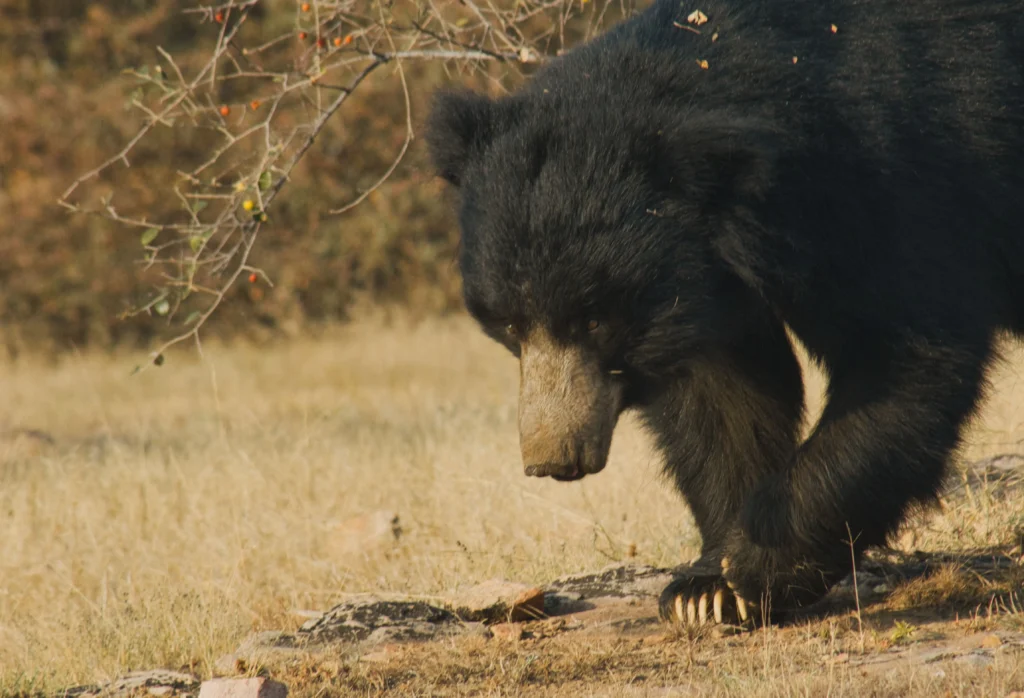
The most distinctive defensive feature of a sloth bear is its long, strongly curved foreclaws.
These claws originally evolved for tearing apart termite mounds, rotten logs, and hard soil in search of insects. However, they also serve as formidable defensive weapons.
During a confrontation, a sloth bear can deliver rapid, forceful swipes capable of causing severe injuries to predators or perceived threats. Unlike cats, which rely on retractable claws, sloth bear claws remain exposed, making them immediately ready for digging or defence.
The forelimbs supporting these claws are exceptionally muscular, allowing the bear to generate tremendous striking power.
Why the claws are so effective
- Long enough to hook and slash an attacker.
- Supported by powerful shoulder muscles.
- Useful in both forward strikes and defensive swipes.
- Effective against both animal predators and human threats.
Although these claws are not specialised hunting weapons, they are extremely effective in close-range defensive encounters.
Powerful Forelimbs and Muscular Build
Sloth bears possess heavily developed shoulders, chest muscles, and forelimbs. These adaptations allow them to excavate termite colonies that would be impossible for many other mammals to access.
The same strength becomes a significant advantage when confronting danger.
Rather than depending solely on speed, a threatened sloth bear often attempts to overpower an opponent through aggressive charges and repeated swiping attacks. Their muscular upper body also enables them to stand upright while maintaining balance, making intimidation displays more effective.
Adult sloth bears are surprisingly powerful despite their shaggy appearance.
Their body structure allows them to:
- Push through dense vegetation.
- Dig rapidly into hard ground.
- Wrestle with predators if necessary.
- Deliver repeated defensive blows without quickly tiring.
This combination of strength and endurance makes them one of the most physically capable mammals in their habitat.
Strong Canines and Defensive Bite
Although insects form much of their diet, sloth bears still possess large canine teeth that become important during self-defence.
Their front incisors are modified to help suck termites and ants from nests, but the prominent canines remain well suited for gripping and biting when under attack.
In close combat, these teeth provide another layer of defence after the foreclaws.
A defensive encounter may involve:
- Powerful bites.
- Claw strikes.
- Pushing and grappling.
- Loud roaring intended to intimidate the attacker.
This combination of weapons makes approaching an adult sloth bear extremely risky for both predators and humans.
Senses Used to Detect Danger
Sloth bears do not rely equally on all of their senses.
Excellent Sense of Smell
Their strongest sense is smell.
A sloth bear can detect food, predators, and other animals over considerable distances, allowing it to locate termite colonies, ripe fruits, or recognise unfamiliar scents in the forest.
This highly developed sense often alerts bears to potential danger before they see it.
Poor Eyesight
Compared with many other large mammals, sloth bears have relatively poor vision.
Dense vegetation and low-light conditions further reduce their ability to identify approaching animals or people.
As a result, humans walking quietly through forests sometimes surprise bears at very close range, increasing the likelihood of a defensive reaction.
Hearing
Their hearing is adequate but is generally considered less important than their sense of smell for detecting threats.
Forest sounds, wind, and dense vegetation can sometimes mask approaching footsteps, contributing to sudden encounters.
Behavioural Defence Strategies
Physical strength alone does not explain why sloth bears are so successful at protecting themselves. Their behaviour is equally important.
Rather than waiting to see whether a threat is genuine, sloth bears often react immediately when they perceive danger. This proactive defence may appear aggressive, but it can prevent predators from gaining an advantage.
Standing Upright
One of the most recognisable sloth bear behaviours is standing on the hind legs.
Contrary to popular belief, this posture is not necessarily an attack posture.
Instead, standing upright helps the bear:
- Assess the source of danger.
- Improve its view and sense of smell.
- Appear larger and more intimidating.
- Prepare to strike if necessary.
Many wildlife observers mistakenly assume that a standing bear is about to charge, whereas it may simply be trying to understand what is nearby.
Loud Vocalisations
Sloth bears produce a variety of loud sounds when threatened.
These include:
- Roars
- Snorts
- Huffs
- Growls
Such vocalisations serve several purposes.
They warn predators that the bear is prepared to defend itself, may discourage further approach, and can also alert nearby cubs to potential danger.
These sounds often accompany defensive displays such as standing upright or charging.
Bluff Charges and Real Charges
Not every charge results in physical contact.
Sometimes a sloth bear performs a bluff charge designed purely to intimidate the perceived threat into retreating.
However, distinguishing a bluff charge from a genuine attack is extremely difficult in real-world situations.
Because the bear’s behaviour can change within seconds, wildlife experts recommend treating every charge as potentially serious and maintaining as much distance as possible whenever an encounter occurs.
Aggressive Counter-Attacks
If intimidation fails, sloth bears may launch rapid counter-attacks.
Unlike predators attempting to kill prey, the objective is usually to eliminate the immediate threat and create an opportunity to escape safely.
Their defensive response may involve:
- Fast forward charges.
- Powerful forepaw strikes.
- Biting.
- Chasing an intruder for a short distance until the danger has passed.
Once they perceive the threat has ended, sloth bears generally stop pursuing and return to normal behaviour.
Escaping When Possible
Despite their reputation, sloth bears do not seek confrontation.
Whenever they detect danger early enough and have a clear escape route, they usually prefer to move away rather than fight.
Many conflicts arise only because the bear is surprised at close range, cornered, or unable to retreat without passing the perceived threat.
Understanding this behaviour is important for anyone travelling through sloth bear habitat. Giving bears space and avoiding sudden encounters greatly reduces the likelihood of defensive attacks.
How Mother Sloth Bears Protect Their Cubs
Among all sloth bear behaviours, maternal defence is perhaps the strongest. Female sloth bears invest heavily in raising their young, and this investment is reflected in the intensity with which they defend them from predators and perceived threats.
For wildlife travellers, understanding this behaviour is important because many serious human–sloth bear encounters involve mothers with cubs.
Carrying Cubs on Their Back
One of the most distinctive characteristics of sloth bears is that young cubs frequently ride on their mother’s back.
This behaviour is unusual among bears and serves several practical purposes.
Young cubs are unable to travel long distances through dense forests, rocky terrain, or termite-rich habitats. Riding on their mother’s back allows them to accompany her while remaining protected from many ground-based dangers.
This adaptation also enables the mother to move quickly if she senses danger without leaving her cubs behind.
Benefits of back-riding
- Protects vulnerable cubs while travelling.
- Allows rapid escape through dense forest.
- Keeps cubs away from many ground-level threats.
- Helps mothers continue foraging while caring for young.
Back-riding has become one of the defining features of sloth bear family life and is often observed by visitors on wildlife safaris.
Maternal Defence Behaviour
A mother sloth bear reacts immediately if she believes her cubs are threatened.
Instead of abandoning them, she typically positions herself between the danger and her offspring before using loud vocalisations, upright displays, charges, or physical attacks if necessary.
Her objective is not to hunt the intruder but to create enough time and space for the cubs to remain safe.
This protective behaviour explains why forest officials advise maintaining a generous distance whenever cubs are observed.
Why Mothers Are Especially Dangerous
Female sloth bears with cubs are widely regarded as the most defensive individuals.
Several factors contribute to this behaviour:
- Cubs are highly vulnerable to predators.
- Mothers have only limited opportunities to raise offspring successfully.
- Losing cubs represents a major reproductive cost.
Consequently, females are less likely to retreat when surprised and more likely to confront an approaching threat directly.
Family Travel Tip
If you see a sloth bear carrying cubs on its back during a safari, enjoy the sighting from a safe distance. Never encourage a guide to approach closer for photographs. Responsible viewing reduces stress on the animals and improves safety for everyone.
Defending Against Natural Predators
Although adult sloth bears are powerful animals, they still share forests with formidable predators. Their defensive behaviour has likely evolved under the constant risk posed by these carnivores.
Encounters with Bengal Tigers
The Bengal tiger is the principal natural predator capable of challenging an adult sloth bear.
However, encounters rarely follow a simple predator–prey pattern.
Adult sloth bears often respond aggressively rather than attempting immediate escape. They may stand upright, roar loudly, charge, and use their claws to discourage the tiger from pressing its attack.
Field observations have documented encounters in which both animals disengaged after brief confrontations, illustrating that tigers may avoid unnecessary injuries when faced with a determined adult sloth bear.
This does not mean sloth bears routinely defeat tigers. Rather, it highlights that the potential cost of attacking an adult bear can outweigh the benefits for even an apex predator.
Leopards and Other Threats
Leopards also overlap with sloth bears across much of their range.
Because leopards are generally smaller than tigers, they are more likely to target young cubs than healthy adults.
Adult sloth bears rely on the same defensive behaviours against leopards:
- Standing upright.
- Loud intimidation.
- Powerful swiping attacks.
- Immediate counter-charges when necessary.
Other carnivores, such as dholes, may occasionally threaten cubs but are generally less significant predators of adult bears.
Why Even Tigers Sometimes Avoid Adult Sloth Bears
Predators constantly balance risk against reward.
A tiger injured by powerful claws may lose its ability to hunt successfully for weeks or even longer. Because of this, attacking a healthy adult sloth bear is not always worth the risk.
Researchers suggest that long-term coexistence with large predators has helped shape the sloth bear’s unusually bold defensive behaviour. Rather than relying solely on flight, sloth bears often attempt to convince predators that an attack will be costly.
Field Note
Wildlife documentaries sometimes show dramatic confrontations between tigers and sloth bears. While these encounters are fascinating, they represent only a small fraction of interactions occurring in the wild. In many cases, both animals avoid prolonged conflict whenever possible.
Why Sloth Bears Sometimes Attack Humans
The reputation of sloth bears as one of the most dangerous bears for people largely stems from defensive encounters rather than predatory behaviour.
Understanding this distinction is essential for interpreting their behaviour correctly.
Defensive Rather Than Predatory
Unlike predators that deliberately hunt humans, sloth bears typically attack because they perceive an immediate threat.
Scientific studies indicate that most attacks occur after sudden encounters in which the bear has little time to assess the situation.
Once the perceived danger disappears, the bear generally withdraws instead of continuing the confrontation.
Common Triggers
Several situations consistently increase the likelihood of defensive behaviour:
- Accidentally surprising a bear at close range.
- Walking through dense vegetation where visibility is poor.
- Encountering a female with cubs.
- Coming between a mother and her offspring.
- Disturbing a bear while it is feeding or resting.
- Meeting a bear on narrow forest paths with limited escape routes.
These situations leave the bear with few options other than defending itself.
Why Surprise Encounters Are So Dangerous
Sloth bears depend heavily on their sense of smell, while their eyesight is comparatively poor.
If wind direction, dense vegetation, or background noise prevents them from detecting approaching people, both the bear and the human may suddenly find themselves only a few metres apart.
Such encounters can trigger an immediate defensive response before either has time to retreat.
This explains why many incidents occur in forested landscapes where visibility is limited rather than in open habitats.
India Focus: Human–Sloth Bear Encounters
India supports the largest remaining population of wild sloth bears, making it the country where most human–sloth bear interactions are reported.
Encounters are more likely in landscapes where forests, agricultural fields, villages, and seasonal collection of forest products overlap. Central and peninsular India—including states such as Madhya Pradesh, Chhattisgarh, Maharashtra, Karnataka, Odisha, and parts of Telangana—contain extensive sloth bear habitat where people and bears frequently use the same forest resources.
For visitors, however, the risk during a well-managed wildlife safari remains relatively low. Safari vehicles follow designated routes, trained guides monitor animal behaviour, and park regulations minimise close encounters on foot.
The risk is generally higher for people who regularly work or travel on foot inside forests, such as local communities collecting forest produce, livestock herders, or researchers conducting fieldwork.
Responsible Tourism Tip
Always remain inside your safari vehicle unless park rules specifically permit otherwise. Follow your guide’s instructions, avoid making unnecessary noise, and never attempt to approach a sloth bear for a closer photograph. Respecting wildlife space benefits both visitor safety and animal welfare.
What To Do If You Encounter a Sloth Bear
Although sloth bears are capable of defending themselves aggressively, encounters rarely become dangerous if the animal detects people early and has enough space to leave. Most safety recommendations focus on preventing surprise encounters rather than reacting after one has already occurred.
Before an Encounter
The best way to stay safe is to avoid startling a sloth bear.
When travelling through sloth bear habitat:
- Walk in groups whenever possible.
- Talk normally or make occasional noise so wildlife is aware of your presence.
- Stay on established trails.
- Avoid dense vegetation with poor visibility.
- Be especially cautious around dawn, dusk, and areas with abundant fruiting trees or termite mounds.
- Follow instructions from forest staff and local guides.
Giving wildlife advance warning allows bears to move away before people come too close.
During an Encounter
If you unexpectedly see a sloth bear:
- Remain as calm as possible.
- Do not run.
- Give the bear a clear escape route.
- Slowly increase the distance if the bear is not approaching.
- Avoid blocking its path.
- Stay together if you are in a group.
If the bear stands upright, remember that it may simply be trying to identify you rather than preparing to attack.
Should the bear charge, avoid sudden movements that could further alarm it. Every encounter is different, and the safest response depends on the situation, but remaining calm and creating distance is generally preferable to provoking the animal.
Actions to Avoid
Many dangerous encounters become worse because people react instinctively.
Avoid:
- Running away.
- Approaching for photographs.
- Trying to feed wildlife.
- Separating a mother from her cubs.
- Cornering the bear.
- Throwing objects unless absolutely necessary for immediate self-protection.
Respecting the animal’s space is the safest strategy.
Practical Checklist: Staying Safe in Sloth Bear Habitat
✔ Travel with experienced local guides.
✔ Remain inside safari vehicles where required.
✔ Stay alert in dense vegetation.
✔ Make moderate noise while walking in forests.
✔ Watch for fresh tracks, scat, or signs of digging.
✔ Never approach cubs.
✔ Allow the bear an unobstructed escape route.
✔ Report sightings responsibly to forest authorities if required.
Human–Bear Conflict and Conservation
Human expansion into forested landscapes has increased contact between people and sloth bears across much of their range.
Most conflict occurs outside protected areas where farming, grazing, firewood collection, and gathering of forest produce overlap with bear habitat.
Reducing conflict requires protecting both people and wildlife.
Habitat Loss
As forests become fragmented, bears increasingly encounter villages, agricultural fields, and roads.
These changing landscapes increase the chances of accidental close encounters rather than deliberate interactions.
Maintaining connected forest habitats helps bears move naturally while reducing contact with people.
Reducing Conflict
Conservation organisations and forest departments promote several measures to reduce conflict:
- Community awareness programmes.
- Early reporting of bear movements.
- Improved forest trail management.
- Education about avoiding surprise encounters.
- Scientific monitoring of conflict hotspots.
These approaches aim to prevent encounters before they occur instead of responding only after incidents happen.
Responsible Wildlife Tourism
Responsible tourism plays an important role in sloth bear conservation.
Visitors should:
- Follow park regulations.
- Maintain respectful viewing distances.
- Avoid disturbing feeding or resting animals.
- Never encourage unsafe wildlife approaches for photographs.
- Support parks and guides who prioritise ethical wildlife viewing.
Responsible behaviour helps ensure that wildlife remains wild while providing safe experiences for visitors.
Sloth Bear Defence Compared with Other Bear Species
| Feature | Sloth Bear | Brown Bear | American Black Bear | Polar Bear |
| Primary defence | Aggressive intimidation and counter-attack | Strength and size | Escape or climb when possible | Strength and predatory capability |
| Common trigger | Surprise encounters and cub protection | Threats to cubs or food | Feeling cornered | Territorial or hunting situations |
| Typical response | Charges, loud vocalisations, claw strikes | Bluff charge or physical attack | Often retreats if escape is possible | May investigate or attack depending on circumstances |
| Main defensive weapons | Long claws, canines, muscular forelimbs | Massive body and claws | Agility, climbing ability, claws | Powerful jaws, claws, body size |
Although every bear species defends itself when threatened, sloth bears are distinctive because they often respond rapidly and forcefully to unexpected close encounters.
Key Takeaways
- Sloth bears evolved powerful defensive adaptations rather than specialised hunting abilities.
- Long curved claws, muscular forelimbs, and strong canine teeth are their primary physical weapons.
- Standing upright, roaring, and charging are intended to intimidate threats.
- Most attacks on humans are defensive rather than predatory.
- Mothers with cubs are especially protective.
- Sharing habitat with large predators such as Bengal tigers has likely influenced the species’ bold defensive behaviour.
- Maintaining distance and avoiding surprise encounters are the most effective ways to stay safe.
- Responsible wildlife tourism benefits both visitors and sloth bear conservation.
Common Mistakes
Many misconceptions about sloth bears lead to unnecessary fear or unsafe behaviour.
Mistake 1: Assuming sloth bears hunt humans.
Current evidence indicates that the vast majority of attacks are defensive responses to perceived threats rather than attempts at predation.
Mistake 2: Believing sloth bears are slow because of their name.
Despite the name, sloth bears can move surprisingly quickly over short distances.
Mistake 3: Approaching for a better photograph.
Reducing the distance to any wild bear greatly increases the risk of provoking defensive behaviour.
Mistake 4: Ignoring warning signs.
Standing upright, vocalising, or displaying agitation should be treated as clear signals to give the animal more space.
Mistake 5: Running during an encounter.
Running may intensify the situation. Remaining calm and allowing the bear an escape route is generally the safer response.
Frequently Asked Questions
Why do sloth bears attack humans?
Most attacks occur when bears are surprised, cornered, or protecting cubs. They are generally defensive rather than predatory.
Are sloth bears more aggressive than other bears?
They are considered more likely to respond aggressively during sudden close encounters, largely because of their defensive adaptations and the environments in which they live.
Can a sloth bear defeat a tiger?
Adult sloth bears can successfully defend themselves in some encounters, but tigers remain apex predators. Outcomes vary depending on the circumstances, and neither species consistently dominates the other.
Why do sloth bears stand on two legs?
Standing upright helps them assess their surroundings, improve visibility and smell, and appear larger to potential threats.
How do mother sloth bears protect their cubs?
They often carry cubs on their backs and will aggressively defend them if they perceive danger.
Are sloth bears dangerous during wildlife safaris?
When safaris are conducted responsibly with trained guides and visitors follow park rules, serious encounters are uncommon.
What should I do if I see a sloth bear while trekking?
Stay calm, avoid sudden movements, give the bear space, and allow it a clear route to move away.
Where are sloth bears found in India?
They occur across many parts of central, western, southern, and eastern India, particularly in dry deciduous forests, scrub forests, and protected areas.
Do sloth bears climb trees?
Young bears and cubs are more capable climbers, while adults spend most of their time on the ground and rely primarily on their defensive abilities.
Why is conservation important for sloth bears?
Protecting habitats and reducing human–wildlife conflict helps ensure the long-term survival of this vulnerable bear while improving safety for local communities.
Conclusion
Sloth bears are among Asia’s most distinctive mammals, combining specialised adaptations for feeding on insects with powerful defensive traits shaped by millions of years of evolution. Their long claws, muscular forelimbs, intimidating displays, and willingness to confront danger enable them to survive alongside formidable predators while raising vulnerable cubs in challenging environments.
Their reputation for aggression is often misunderstood. Scientific evidence consistently shows that most attacks on people are defensive reactions triggered by surprise encounters, limited escape options, or maternal protection rather than deliberate predation.
For wildlife enthusiasts, photographers, and safari travellers, understanding these behaviours encourages safer and more respectful interactions. By maintaining distance, following expert guidance, and supporting responsible tourism and conservation initiatives, visitors can appreciate sloth bears in their natural habitat while helping ensure that these remarkable animals continue to thrive across the forests of the Indian subcontinent.