
Learn about the Himalayan Black Bear’s habitat, behaviour, distribution, conservation, best places to see it, safety tips, and responsible wildlife travel in India.
Himalayan Black Bear in India: Habitat, Behaviour, Conservation, Safari Guide & Safety Tips
The Himalayan Black Bear (Ursus thibetanus laniger) is one of India’s least-seen large mammals. Although it is widespread across the Himalayan region, it usually lives in dense temperate forests where human encounters are uncommon. Most people know it only through occasional news reports of conflicts in mountain villages, but the species plays an important ecological role by dispersing seeds, feeding on insects, and helping maintain healthy forest ecosystems.
For wildlife travellers, seeing a Himalayan Black Bear is far less predictable than spotting animals such as deer or langurs. Sightings are generally opportunistic and depend on season, food availability, and luck rather than regular safari routes. Understanding its behaviour and habitat helps visitors appreciate why the bear remains elusive despite occupying a large geographic range.
Unlike India’s Sloth Bear, which inhabits central and southern forests, the Himalayan Black Bear is adapted to cooler mountain landscapes. It spends much of the year moving between elevations as food sources change with the seasons, making it a fascinating example of adaptation to the Himalayan environment.
What is the Himalayan Black Bear?
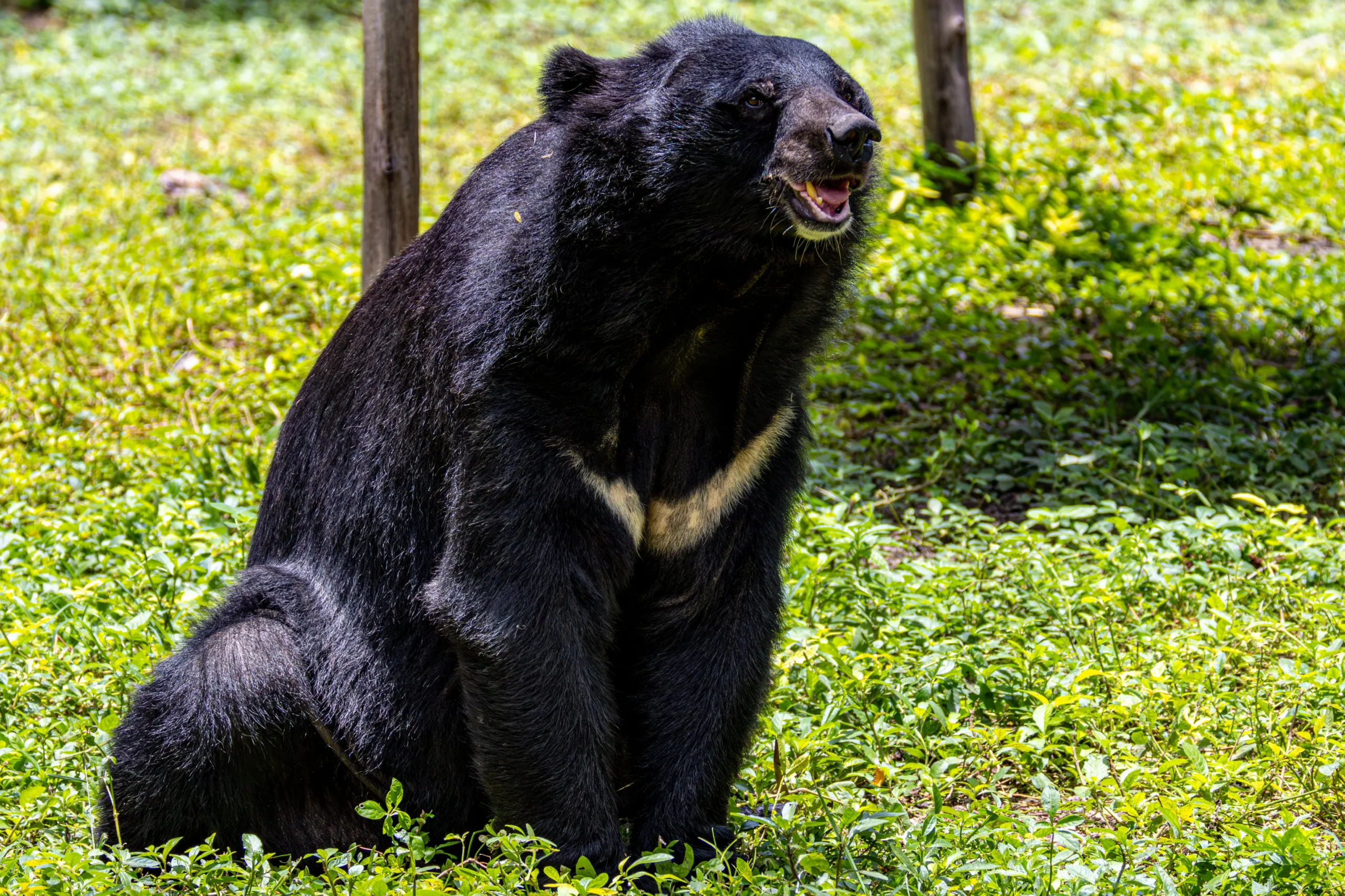
The Himalayan Black Bear is a subspecies of the Asiatic Black Bear (Ursus thibetanus). It is recognised by its thick black coat and the distinctive pale crescent-shaped marking on its chest, which has earned Asiatic black bears the nickname “moon bears.” The Himalayan subspecies is specially adapted to the colder climates of the Himalayas through its dense fur and seasonal movements between different elevations.
It occurs across the Himalayan mountain system, including northern India, Nepal, Bhutan, and parts of Pakistan. Within India, it inhabits forested regions of Jammu & Kashmir, Ladakh (where suitable habitat exists), Himachal Pradesh, Uttarakhand, Sikkim, Arunachal Pradesh, and adjoining Himalayan landscapes.
Although it is an omnivore, the Himalayan Black Bear’s diet is largely plant-based. Fruits, berries, nuts, grasses, roots, and other seasonal vegetation form much of its food, supplemented by insects, carrion, and occasional small vertebrates or livestock when opportunities arise. Seasonal food availability strongly influences its movements and behaviour.
Quick Facts
| Feature | Information |
| Scientific name | Ursus thibetanus laniger |
| Common name | Himalayan Black Bear |
| Family | Ursidae |
| Diet | Omnivore |
| Habitat | Temperate broadleaf, mixed and conifer forests |
| Elevation | Generally about 1,200–4,300 metres, varying seasonally |
| Distribution | India, Nepal, Bhutan and neighbouring Himalayan regions |
| Conservation status | Asiatic Black Bear is globally listed as Vulnerable; regional populations face continued pressure from habitat loss, poaching and conflict |
| Major threats | Habitat fragmentation, illegal wildlife trade, retaliatory killing and human–bear conflict |
Where Does the Himalayan Black Bear Live?
The Himalayan Black Bear is closely associated with forested mountain landscapes. It prefers broadleaf and mixed forests that provide dense vegetation, seasonal fruits, acorns, insects, and safe denning sites. As temperatures and food supplies change through the year, bears often move between lower and higher elevations rather than remaining in one area throughout the year.
In spring and summer, many bears move to higher elevations where fresh vegetation and seasonal foods become available. During autumn, they descend towards lower forests to feed heavily before winter. This seasonal movement also explains why encounters with people tend to increase near villages during certain times of the year when natural food is scarce.
Within India, the species occurs in several protected landscapes, including parts of the Great Himalayan National Park, Dachigam National Park, Nanda Devi Biosphere Reserve, Kedarnath Wildlife Sanctuary, Govind Wildlife Sanctuary, and other Himalayan protected areas where suitable forest habitat remains. Wildlife sightings, however, are generally infrequent because these bears are naturally wary of people and spend much of their time inside dense forest.
Field Note: Unlike tiger safaris, there are no parks where Himalayan Black Bear sightings can be considered reliable. Visitors should treat any encounter as a fortunate wildlife observation rather than an expectation.
Physical Appearance, Behaviour, Diet and Life Cycle
Physical Appearance and Identification
The Himalayan Black Bear is a medium-sized bear with a sturdy build, rounded ears, a short tail, and a thick black coat that provides insulation against cold mountain climates. Its most recognisable feature is the cream or white crescent-shaped patch on the chest, although the size and shape of this marking can vary between individuals.
Adults generally have a broad head with a relatively short muzzle compared with the Sloth Bear. Their long, curved claws make them excellent climbers, allowing them to reach fruiting branches, escape danger, and build feeding platforms in trees. Cubs learn these climbing skills at an early age and often remain high in trees if disturbed.
The bear’s thick fur becomes especially dense before winter, helping it survive freezing temperatures at higher elevations. In warmer months, the coat appears shorter as the animal sheds some of its winter fur. Seasonal coat changes are normal and should not be mistaken for poor health.
How to Identify a Himalayan Black Bear
Look for a combination of these characteristics:
- Glossy black fur
- Distinct white or cream chest crescent
- Rounded ears that appear relatively large
- Powerful shoulders and forelimbs
- Long climbing claws
- Short, bushy tail
- Confident climbing ability
Unlike many large mammals, Himalayan Black Bears often leave indirect evidence of their presence before they are actually seen. Broken branches, claw marks on tree trunks, overturned rocks, dug-up soil, and partially eaten fruits may indicate recent activity in an area.
Himalayan Black Bear vs Other Bears of India
| Feature | Himalayan Black Bear | Sloth Bear | Himalayan Brown Bear |
| Coat colour | Black | Black with shaggy hair | Brown to reddish-brown |
| Chest mark | White crescent | Pale Y- or V-shaped patch | Usually absent |
| Habitat | Himalayan forests | Dry forests and grasslands | High alpine regions |
| Climbing ability | Excellent | Moderate | Limited compared with black bears |
| Main diet | Fruits, nuts, vegetation, insects | Termites, ants, fruits | Omnivorous with greater dependence on alpine vegetation and animal matter |
| Distribution in India | Himalayan states | Central, western and southern India | High Himalayas of Ladakh and adjoining regions |
For wildlife travellers, habitat is often the easiest way to distinguish these three bears. If you are exploring temperate Himalayan forests, the bear is most likely to be a Himalayan Black Bear. Sloth Bears are found much farther south, while Himalayan Brown Bears are largely confined to high-altitude alpine landscapes.
Behaviour and Ecology
The Himalayan Black Bear is generally solitary. Adults spend most of their lives alone, coming together mainly during the breeding season or when females are raising cubs. Although they appear slow while feeding, they can move surprisingly quickly when threatened and are capable of climbing steep slopes and tall trees with ease.
Most activity takes place during the early morning, late evening, or at night, especially in areas where bears frequently encounter people. In remote forests with little human disturbance, they may also be active during daylight hours. Their daily routine is largely determined by food availability and seasonal weather conditions.
One interesting behaviour is the construction of feeding platforms. While eating fruits or nuts high in trees, bears often bend and break branches beneath them, creating temporary platforms from which they continue feeding. These structures can remain visible for weeks and are useful signs for researchers monitoring bear activity.
Seasonal Movements
Unlike animals that remain within a narrow elevation range throughout the year, Himalayan Black Bears regularly move up and down mountain slopes.
Typical seasonal pattern includes:
- Spring: Move towards emerging vegetation and fresh plant growth.
- Summer: Occupy higher elevations with abundant fruits and berries.
- Autumn: Feed intensively on nuts and fruits to build fat reserves.
- Winter: Descend to lower forests or use dens where snowfall is severe.
These movements help explain why sightings vary greatly between seasons and why bears occasionally enter agricultural areas during periods of food shortage.
Diet
Himalayan Black Bears are opportunistic omnivores, but vegetation forms the majority of their diet.
Common food items include:
- Wild fruits
- Berries
- Acorns
- Walnuts
- Chestnuts
- Grasses
- Bamboo shoots
- Roots
- Insects
- Honey
- Bird eggs
- Small mammals
- Carrion
When natural food becomes scarce, bears may raid orchards, maize fields, or livestock enclosures. These incidents are a major reason for conflict between bears and mountain communities. Such behaviour is generally linked to food availability rather than aggression towards people.
Expert Tip
Fruiting trees often attract Himalayan Black Bears. During autumn, guides frequently watch oak, walnut, and other fruit-bearing trees for signs such as broken branches, fresh droppings, or claw marks. Even if the bear is no longer present, these clues indicate recent activity.
Reproduction and Life Cycle
The Himalayan Black Bear has a relatively slow reproductive rate, making population recovery difficult when numbers decline.
General life cycle includes:
- Sexual maturity at around 3–5 years.
- Usually one or two cubs per litter.
- Cubs remain dependent on their mother for up to two years.
- Mothers are highly protective and avoid unnecessary contact with people during this period.
Young bears spend their first months learning essential survival skills, including climbing, locating seasonal foods, recognising danger, and navigating mountain forests. Because cubs rely heavily on their mothers, the loss of breeding females can have a significant impact on local populations.
Field Note
If you encounter a lone cub in the wild, never approach it. The mother is usually nearby, even if she is not immediately visible. Remaining at a safe distance and leaving the area quietly is the safest response for both people and bears.
Ecological Role, Conservation Status, Threats and Human–Bear Conflict
Why the Himalayan Black Bear Matters
Although it is often overshadowed by more well-known Himalayan wildlife such as the Snow Leopard or Red Panda, the Himalayan Black Bear plays an important role in maintaining healthy mountain forests. As an omnivore that consumes a wide variety of fruits, nuts and vegetation, it helps disperse seeds across large areas, contributing to forest regeneration. By feeding on insects, carrion and occasionally small animals, it also forms part of the natural ecological balance.
Because the species occupies extensive forest habitats and requires access to seasonal food resources, its presence is often considered an indicator of relatively intact mountain ecosystems. Declining bear populations can therefore signal broader environmental problems such as habitat fragmentation, excessive human disturbance and shrinking forest connectivity.
Conservation Status
The Himalayan Black Bear is a subspecies of the Asiatic Black Bear (Ursus thibetanus), which is classified as Vulnerable on the IUCN Red List. Across much of its range, populations are believed to be declining due to a combination of habitat loss, illegal hunting and increasing conflict with people. Regional population estimates remain uncertain because bears inhabit rugged mountain terrain where systematic surveys are challenging.
The species receives legal protection in India under the Wildlife (Protection) Act, and it is also protected through international agreements such as CITES, which regulate international trade in bear parts. Despite these legal safeguards, enforcement remains difficult in remote mountain regions.
Reliable population figures are available only for some parts of its range. National assessments from Nepal, for example, indicate a relatively small and declining population, highlighting the need for continued monitoring and conservation efforts. Similar challenges exist across other Himalayan countries, although comprehensive population estimates are lacking.
Why Population Estimates Are Difficult
Unlike species that inhabit open grasslands, Himalayan Black Bears are notoriously difficult to survey because they:
- Live in dense forests.
- Occupy steep and inaccessible terrain.
- Move seasonally across large elevation ranges.
- Are primarily solitary.
- Often avoid areas with regular human activity.
As a result, researchers increasingly rely on camera traps, genetic sampling, sign surveys and radio telemetry rather than direct observations.
Major Threats
No single factor threatens the Himalayan Black Bear. Instead, several pressures act together, making long-term conservation more complex.
1. Habitat Loss and Fragmentation
Expanding roads, settlements, hydropower projects, tourism infrastructure and agricultural development continue to reduce and fragment Himalayan forests. Even where forest cover remains, breaks in habitat can isolate bear populations and limit seasonal movement between feeding areas.
Habitat fragmentation also increases the likelihood of bears entering villages, orchards and crop fields as they move between forest patches.
2. Human–Bear Conflict
Conflict with people has become one of the most significant conservation challenges.
Most conflicts arise when bears:
- Raid maize fields or orchards.
- Damage crops close to forests.
- Attack livestock kept in poorly protected enclosures.
- Are surprised at close range by villagers, trekkers or forest workers.
- Search for food near settlements during periods of natural food scarcity.
Contrary to popular belief, bears do not normally seek out people. Many attacks occur because the animal feels threatened or is suddenly encountered at close distance, particularly if a female is accompanied by cubs.
3. Illegal Hunting and Wildlife Trade
Illegal hunting continues to affect bear populations across parts of Asia.
Historically, bears have been targeted for:
- Gall bladders and bile.
- Paws.
- Skins.
- Other body parts used in illegal wildlife trade or traditional medicine markets.
Although international trade is regulated, illegal demand remains a conservation concern.
4. Climate Change
Researchers also recognise climate change as an emerging challenge.
Changing temperatures and rainfall patterns may alter:
- Fruiting seasons.
- Availability of natural food.
- Snow cover.
- Seasonal migration patterns.
- Suitable mountain habitat.
While the long-term impacts continue to be studied, protecting connected forest landscapes is considered an important strategy for helping wildlife adapt to changing environmental conditions.
Human–Bear Conflict: Understanding the Problem
Reports of Himalayan Black Bear encounters often receive significant media attention, but they represent only one aspect of a much broader conservation issue.
As forests become increasingly fragmented, bears and people are sharing the same landscapes more frequently. Villages located near forest edges, particularly those surrounded by orchards or maize cultivation, are more likely to experience occasional bear visits.
These encounters create risks for both people and bears. Farmers may suffer crop losses or livestock damage, while bears may face retaliation or displacement.
Common Situations That Lead to Encounters
- Walking alone through dense forest.
- Collecting firewood early in the morning.
- Harvesting crops close to forest edges.
- Surprising a feeding bear.
- Encountering a female with cubs.
- Entering dense vegetation where visibility is poor.
Understanding these situations allows visitors and local communities to reduce unnecessary risks.
How Communities Reduce Conflict
Across the Himalayas, conservation organisations and forest departments are working with local communities to minimise conflict while protecting bears.
Common approaches include:
- Installing solar-powered or electric fencing around crops.
- Improving livestock enclosures.
- Conducting community awareness programmes.
- Encouraging early reporting of bear sightings.
- Managing waste to avoid attracting wildlife.
- Monitoring bear activity using camera traps.
- Supporting compensation or relief programmes where available.
No single solution works everywhere. Successful conservation usually combines habitat protection, community participation and scientific monitoring.
Practical Checklist: Reducing Conflict Near Forests
✔ Store food and livestock feed securely.
✔ Dispose of waste responsibly.
✔ Avoid walking alone through dense forest at dawn or dusk.
✔ Make your presence known while trekking in areas where bears occur.
✔ Never approach cubs or attempt to photograph them at close range.
✔ Report repeated bear activity to local forest authorities rather than attempting to chase the animal yourself.
How Scientists Study Himalayan Black Bears
Studying Himalayan Black Bears is challenging because they inhabit rugged terrain and are naturally elusive. Researchers therefore rely on several indirect methods to understand their distribution, behaviour and population trends.
Common research techniques include:
- Camera trapping.
- GPS or radio telemetry.
- DNA analysis from hair or scat samples.
- Footprint and claw-mark surveys.
- Interviews with local communities to document conflict patterns.
These methods help identify important habitats, movement corridors and areas where conservation efforts should be prioritised.
Expert Tip
If you notice claw marks, feeding platforms or fresh droppings while trekking, appreciate them as signs of a healthy ecosystem—but avoid searching for the animal. Giving bears space is the safest and most responsible way to observe wildlife.
Best Places to See Himalayan Black Bears, Wildlife Viewing, Photography & Safety
Where Can You See Himalayan Black Bears in India?
Unlike Bengal Tigers or Asiatic Lions, Himalayan Black Bears are not the primary attraction of any wildlife destination. Most sightings occur by chance while exploring forests that support healthy bear populations. Visitors should therefore choose destinations for their overall Himalayan wildlife experience rather than expecting guaranteed bear encounters.
Great Himalayan National Park, Himachal Pradesh
This UNESCO World Heritage Site protects extensive temperate and alpine forests that provide suitable habitat for Himalayan Black Bears. Sightings are uncommon because much of the park is explored on foot rather than by vehicle safaris, but trekkers occasionally encounter signs such as claw marks, feeding platforms and fresh droppings.
The park is also home to species including Himalayan Tahr, Musk Deer, Himalayan Monal and Snow Leopard, making it one of India’s most rewarding mountain ecosystems for wildlife enthusiasts.
Dachigam National Park, Jammu & Kashmir
Dachigam is best known for conserving the Hangul (Kashmir Stag), but it also supports Himalayan Black Bears. During seasons when fruit is abundant, bears may occasionally be observed feeding along forest edges or moving across mountain slopes.
Wildlife viewing here requires patience and experienced local guides who understand seasonal animal movements.
Nanda Devi Biosphere Reserve, Uttarakhand
Large tracts of protected forest within the biosphere reserve provide suitable habitat for Himalayan Black Bears. Access restrictions help preserve these fragile ecosystems, meaning wildlife observations usually occur during authorised trekking routes rather than conventional jeep safaris.
Kedarnath Wildlife Sanctuary
This sanctuary contains mixed forests, alpine meadows and seasonal food sources used by Himalayan Black Bears. Although sightings remain infrequent, the sanctuary protects important habitat connecting different elevations used by bears throughout the year.
Govind Wildlife Sanctuary
Located in Uttarakhand, Govind Wildlife Sanctuary supports several Himalayan mammals, including Himalayan Black Bears. Dense forests and rugged terrain make direct sightings uncommon, but the sanctuary remains an important part of the species’ range.
Comparison of Important Wildlife Destinations
| Protected Area | Why Visit | Bear Sighting Potential | Other Wildlife |
| Great Himalayan National Park | Extensive protected forests | Occasional | Himalayan Tahr, Musk Deer, Monal, Snow Leopard |
| Dachigam National Park | Hangul conservation | Occasional | Hangul, Leopard, Himalayan birds |
| Kedarnath Wildlife Sanctuary | Diverse mountain habitats | Low to occasional | Musk Deer, Serow, Monal |
| Govind Wildlife Sanctuary | Remote forests | Low | Himalayan Tahr, Serow, pheasants |
| Nanda Devi Biosphere Reserve | Protected Himalayan landscape | Occasional | Blue Sheep, Snow Leopard, Himalayan fauna |
Decision Guide
If your primary goal is to see a Himalayan Black Bear, it is important to set realistic expectations. Even experienced wildlife photographers may spend several visits without a direct sighting. Instead, enjoy these parks for their complete Himalayan wildlife experience.
When Is the Best Time to See Himalayan Black Bears?
Season has a significant influence on bear activity because food availability changes throughout the year.
Spring
Fresh vegetation emerges, encouraging bears to become more active after winter. They begin moving across forests in search of new food sources.
Summer
Higher elevations provide berries, herbs and other seasonal foods. Bears often remain in remote mountain forests where sightings become even less predictable.
Autumn
Many wildlife experts consider autumn one of the better seasons for observing Himalayan Black Bears because they feed intensively on fruits and nuts before winter. Increased foraging activity can occasionally improve viewing opportunities.
Winter
In areas with heavy snowfall, bears may spend extended periods in dens or reduce activity considerably. Lower-elevation populations may remain active depending on local climate and food availability.
Responsible Wildlife Viewing
Observing bears responsibly protects both visitors and wildlife.
Follow these guidelines whenever visiting bear habitat:
- Stay on designated trails.
- Follow instructions from guides and forest staff.
- Maintain a safe distance from any bear.
- Never attempt to attract wildlife with food.
- Keep noise to a minimum while observing animals.
- Avoid blocking an animal’s escape route.
- Leave immediately if a bear appears disturbed.
Responsible Tourism Tip
Remember that not seeing a bear is not a failed wildlife trip. Ethical wildlife tourism values healthy ecosystems over guaranteed sightings.
Photography Tips
Photographing Himalayan Black Bears is extremely challenging because encounters are usually brief.
Equipment Recommendations
- Telephoto lens (at least 400 mm if possible)
- Fast shutter speed for moving animals
- Binoculars for scanning distant slopes
- Rain protection for mountain weather
- Extra batteries, as cold temperatures reduce battery life
Field Photography Tips
- Photograph from a safe distance.
- Avoid approaching feeding bears.
- Never use bait.
- Keep sudden movements to a minimum.
- Capture habitat as well as the animal to tell a more complete conservation story.
- Respect all park regulations regarding photography.
Photography Tip
Images showing natural behaviour—such as climbing trees, feeding on fruits or moving through forests—are generally more valuable than close-up portraits obtained by disturbing wildlife.
Safety Guide for Trekkers and Wildlife Travellers
Most Himalayan Black Bears avoid people. Nevertheless, visitors should prepare for the possibility of an encounter when trekking through bear habitat.
Before Entering Bear Habitat
- Travel with experienced guides whenever possible.
- Learn about recent wildlife activity from local authorities.
- Carry sufficient food and water.
- Keep campsites clean.
- Store food securely.
If You Encounter a Bear
- Stay calm.
- Do not run.
- Give the bear space to move away.
- Speak softly so the bear recognises your presence.
- Slowly back away without making sudden movements.
- Never separate a mother from her cubs.
- Do not attempt to take close photographs.
Family Travel Tip
Children should always remain close to adults while walking through forested areas. Teach them never to approach wildlife, even if an animal appears calm or is seen at a distance.
Field Note
Many experienced naturalists consider finding claw marks on trees, fresh tracks or feeding platforms just as rewarding as seeing the bear itself. These signs reveal how wildlife uses the forest while allowing the animal to remain undisturbed.
Common Misconceptions, Frequently Asked Questions and Conclusion
Before concluding, it’s worth addressing a few common misunderstandings about the Himalayan Black Bear. Many of these misconceptions arise from occasional news reports or confusion with other bear species.
Common Misconceptions
Misconception 1: Himalayan Black Bears are always aggressive.
Reality: Most Himalayan Black Bears avoid people whenever possible. Defensive encounters usually occur when a bear is surprised at close range, when a female is protecting cubs, or when bears are feeding near villages due to limited natural food. Human–bear conflict should not be interpreted as normal bear behaviour.
Misconception 2: They are the same as American Black Bears.
Reality: Although both species have black fur, they are entirely different species. The Himalayan Black Bear belongs to the Asiatic Black Bear species (Ursus thibetanus), with its own evolutionary history, distribution, behaviour and conservation challenges.
Misconception 3: They spend the entire winter hibernating.
Reality: Winter behaviour varies across the Himalayas. In areas with deep snowfall, bears may den for extended periods, while populations in milder climates can remain active depending on weather conditions and food availability.
Misconception 4: Seeing one during a safari is common.
Reality: Himalayan Black Bears are among India’s most elusive large mammals. Even experienced wildlife photographers and researchers may spend years in suitable habitat without a clear sighting.
Misconception 5: Bears enter villages because they prefer human food.
Reality: Most village visits occur because natural food becomes scarce, habitats become fragmented, or attractive food sources such as orchards and maize fields are located close to forests. Improving habitat quality and reducing attractants can help minimise conflict.
Frequently Asked Questions
1. What is the scientific name of the Himalayan Black Bear?
The Himalayan Black Bear is Ursus thibetanus laniger, a subspecies of the Asiatic Black Bear.
2. Is the Himalayan Black Bear endangered?
The Asiatic Black Bear is globally classified as Vulnerable, and Himalayan populations face continued pressure from habitat loss, poaching and human–bear conflict.
3. Where is it found in India?
Its range includes parts of Jammu & Kashmir, Ladakh (where suitable habitat exists), Himachal Pradesh, Uttarakhand, Sikkim and Arunachal Pradesh, along with other Himalayan forest landscapes.
4. What does it eat?
Its diet mainly consists of fruits, nuts, berries, grasses, roots and insects, although it may also consume carrion, bird eggs and occasionally small vertebrates or livestock.
5. Does it hibernate?
Some populations den during severe winters, while others remain active depending on local climate and food availability.
6. Are Himalayan Black Bears dangerous?
Like most wild animals, they can be dangerous if surprised or threatened. Maintaining distance and respecting wildlife greatly reduces the likelihood of negative encounters.
7. Which national park offers the best chance of seeing one?
There is no park that guarantees sightings. Great Himalayan National Park, Dachigam National Park and several Himalayan protected areas support the species, but observations are generally rare.
8. Can they climb trees?
Yes. Himalayan Black Bears are excellent climbers and frequently feed, rest and even build temporary feeding platforms in trees.
9. Why do conflicts occur?
Most conflicts are linked to crop raiding, habitat fragmentation, seasonal food shortages and accidental close encounters rather than deliberate aggression.
10. How can visitors help conserve Himalayan Black Bears?
Choose responsible wildlife operators, follow park regulations, avoid disturbing wildlife, support conservation organisations and respect local communities living alongside bears.
11. What is the white patch on its chest?
The pale crescent-shaped marking is a characteristic feature of Asiatic Black Bears and helps distinguish them from many other bear species.
12. Are they solitary animals?
Yes. Adults are usually solitary except during the breeding season or when females are raising cubs.
13. How long do they live?
They generally live around 20–30 years, although lifespan varies depending on habitat, threats and whether the animal lives in the wild or captivity.
14. What are the biggest threats to the species?
Habitat loss, fragmentation, illegal wildlife trade, poaching and increasing human–bear conflict remain the principal threats.
15. Do they attack livestock?
Occasionally. Livestock attacks usually occur where domestic animals graze or are kept close to forest edges without secure enclosures.
16. How do researchers monitor them?
Scientists use camera traps, GPS telemetry, genetic sampling, footprint surveys and field observations to study their populations and movements.
17. Are they active during the day?
They can be active both during the day and at night. Activity patterns often depend on season, food availability and the level of human disturbance.
18. What should I do if I see one while trekking?
Remain calm, keep your distance, avoid running, slowly move away and allow the bear an escape route. Never approach cubs or attempt close photography.
19. Why are they important for Himalayan forests?
They help disperse seeds, recycle nutrients and contribute to the health and regeneration of mountain ecosystems.
20. Can wildlife tourists realistically expect to see one?
No. Sightings are unpredictable. The best approach is to enjoy the wider Himalayan ecosystem and consider any bear encounter a fortunate bonus rather than the main objective of the trip.
Conclusion
The Himalayan Black Bear is one of the Himalaya’s most fascinating yet least understood mammals. Although it receives far less public attention than species such as the Tiger, Snow Leopard or Red Panda, it plays a vital role in maintaining healthy mountain forests and reflects the ecological integrity of the landscapes it inhabits.
For wildlife travellers, the species offers a reminder that meaningful nature experiences are not always measured by the number of animals seen. Learning to recognise tracks, claw marks, feeding platforms and other field signs often provides a deeper appreciation of the bear’s secretive lifestyle and the complex ecosystems of the Himalayas.
Protecting the Himalayan Black Bear ultimately depends on conserving connected forests, reducing human–wildlife conflict and supporting communities that share their landscapes with this remarkable animal. By travelling responsibly, respecting wildlife and choosing ethical tourism practices, visitors can contribute to the long-term survival of one of India’s most elusive mountain mammals.
Himalayas : Topics Cluster
- Himalayan Wildlife Comprehensive Guide
- Wildlife in Ladakh
- Himalayan Pheasants
- Raptors of Himalayas
- Wildlife in Sikkim
- Wildlife in Arunachal Pradesh
- Wildlife in Uttarakhand
- Wildlife in Himachal Pradesh
- Wildlife in Jammu and Kashmir
- Himalayan Black Bear
- Snow Leopard
- Kibber Wildlife Sanctuary Guide
- Great Himalayan National Park
- Khangchendzonga National Park
- Eastern Himalayas