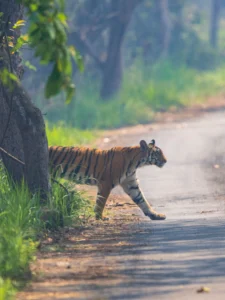
Discover how Bengal tigers and striped hyenas interact in India’s reserves. Learn about carcass competition, habitat sharing, and practical safari insights.
Tigers and striped hyenas frequently share the same landscapes in India, but their interactions are rarely the dramatic, violent clashes depicted in popular media. For wildlife travellers and researchers alike, understanding their relationship requires looking past sensationalized narratives. Instead, their day-to-day interactions are defined by a subtle game of resource access, timing, and spatial sharing that allows both species to survive within the same reserves.
If you are planning a safari to landscapes like Ranthambore, Sariska, or Panna, knowing how these predators interact changes how you view the ecosystem. It shifts your focus from merely tracking a single large cat to understanding the complex multi-carnivore network operating in the background.
Meet the Indian Striped Hyena: Beyond the Myths
To understand how these two species interact, we must first clarify what a striped hyena (Hyaena hyaena) actually is, as it is frequently confused with its African relative, the spotted hyena.
Striped hyenas are smaller, solitary, or paired animals covered in a coat of grey-to-straw-coloured fur with distinct vertical black stripes. Unlike spotted hyenas, they do not live in large, loud clans, nor do they vocalize with the famous “laugh”.
Physically, the striped hyena is built for an opportunistic lifestyle:
- Size: They typically weigh between 25 and 45 kilograms, making them significantly smaller than a Bengal tiger, which can exceed 200 kilograms.
- Dietary Role: They are facultative scavengers. While they rely heavily on finding the remains of animals killed by larger predators, they are also opportunistic hunters capable of catching small prey when the opportunity arises.
- Adaptations: Their exceptionally powerful jaws and specialized teeth allow them to crush large bones, extracting nutrients that other carnivores leave behind.
Field Note
When scanning the scrub forests of western or central India on safari, look for a sloped profile—the striped hyena’s forelegs are noticeably longer than its hind legs, giving it a distinct, lumbering walk. Because they are primarily nocturnal, early morning or late evening drives near rocky outcroppings offer the best chance of a sighting.
Coexistence Dynamics: Overlap and Space Sharing
How do a 200-kilogram apex predator and a 35-kilogram scavenger share the same forest without the smaller species being driven to extinction? The answer lies in conditional occupancy and spatial adaptation.
Tigers are obligate carnivores that require high densities of large wild ungulates, such as chital and sambar, to survive. Striped hyenas, being scavengers, are naturally drawn to areas where tigers are active because a higher density of tigers inevitably means more leftover carcasses.
Recent ecological research has fundamentally challenged the old assumption that tigers automatically drive down hyena numbers through direct aggression. Data collected by the Wildlife Institute of India in semi-arid landscapes shows that striped hyenas actually display high site utilization in areas where tigers are present.
Rather than fleeing a landscape entirely when tigers move in, hyenas adjust their fine-scale movements. They utilize specific micro-habitats, vary their activity times, and leverage rugged terrain to safely exploit the food resources that tigers inadvertently provide. Coexistence is maintained not because the two species get along, but because the striped hyena has evolved to be highly adept at staying just out of the tiger’s direct reach while benefiting from its kills.
The Science of Carcass Competition & the Scavenging Hierarchy
Most wildlife documentaries emphasize bloody battles over kills, but the reality in Indian forests is far more pragmatic. Competition at a carcass is rarely dramatic face-to-face combat. Instead, it is a calculated game of timing, access, and asserting dominance. Because striped hyenas are heavily reliant on carrion, understanding their interactions with other carnivores requires looking closely at what happens when an animal dies in the forest.
Tiger Dominance at the Kill Site
Tigers are unequivocally the dominant force at any large kill site. Ecological studies conducted in Rajasthan’s Sawai Mansingh Wildlife Sanctuary clearly identified tigers as the dominant species, capable of actively reducing carrion access for striped hyenas and other carnivores.
When a tiger is actively defending or feeding on a carcass, the data shows that striped hyena presence and total feeding time drop significantly. The hyena cannot physically challenge an adult tiger, so it must rely on patience.
However, hyenas are incredibly persistent scavengers. That same study in Rajasthan recorded striped hyenas visiting 12 different carcasses—more frequently than either tigers or leopards. This highlights their specialized role: while the tiger makes the kill and takes the prime meat, the striped hyena is the cleanup crew, moving in after the tiger abandons the site to process the remaining bones and tough hide.
Expert Tip
If your safari guide locates a tiger kill, pay attention to the surrounding brush rather than just the carcass itself. Scavengers like hyenas will often bed down in dense cover nearby, waiting hours or even days for the tiger to finally move off.
Hyena and Leopard Coexistence Dynamics
While tigers strictly dictate a hyena’s access to food, leopards share a completely different dynamic with striped hyenas. Research shows that leopards and striped hyenas exhibit relatively weak negative effects on each other when interacting at carcasses.
Because leopards are smaller and less dominant than tigers, they are less able to monopolize a kill site on the ground. This results in a higher degree of coexistence under certain conditions, where leopards and hyenas can exploit the same resources with far less direct conflict than either experiences with a tiger.
The Scavenging Hierarchy: Jackals and Competitors
The ecosystem at a carcass extends beyond big cats and hyenas. Golden jackals are the ultimate opportunists of the Indian forest, darting in to grab scraps while larger predators rest nearby. Understanding how these distinct species overlap requires viewing them within a structured hierarchy based on size, diet, and dominance.
Table 1: The Indian Predator and Scavenger Matrix
| Species | Primary Role | Body Size (Approx.) | Carcass Dominance | Behaviour at Kills |
| Bengal Tiger | Apex Predator | 130–250+ kg | Dominant. Controls access to the carcass until finished. | Feeds heavily, caches the kill, and defends the immediate area fiercely. |
| Leopard | Mesopredator | 30–70 kg | Subordinate to Tigers. Weakly competitive with hyenas. | Feeds quickly. Vulnerable to losing kills to both tigers and scavenging hyenas. |
| Striped Hyena | Facultative Scavenger | 25–45 kg | Subordinate to Tigers. Coexists near leopards. | Waits for tigers to leave; relies on bone-crushing jaws to extract marrow. |
| Golden Jackal | Opportunistic Scavenger | 8–15 kg | Lowest. Subordinate to all larger carnivores. | Darts in for quick scraps. Avoids direct confrontation with larger scavengers. |
By recognizing this hierarchy, wildlife travellers can better interpret the complex behaviours unfolding around a kill, understanding that every species is playing a specific evolutionary role rather than simply fighting for scraps.
Where These Interactions Happen: Reserve Insights
For wildlife travellers hoping to observe both tigers and striped hyenas on a single itinerary, choosing the right destination is critical. While tigers are found across dozens of Indian reserves, observing natural interactions between these two specific predators requires visiting semi-arid or dry deciduous forests where both populations are robust.
The most compelling scientific evidence detailing how these carnivores share space comes directly from focused research in Rajasthan and Central India.
Sariska Tiger Reserve: A Case Study in Adaptation
Sariska Tiger Reserve in Rajasthan offers one of the most important case studies in modern carnivore ecology. A 2025 Wildlife Institute of India (WII) dissertation conducted here explicitly analysed the interactions between striped hyenas, tigers, and leopards.
When tigers were reintroduced to Sariska, researchers needed to know how the resident hyena population would react. The findings were clear: striped hyenas demonstrated higher site utilization in the presence of tigers, exhibiting a conditional occupancy of 0.73 and a species interaction factor of 1.18.
Instead of avoiding the landscape entirely out of fear, the hyenas adapted, using co-occurrence strategies to remain in the area. In fact, the Sariska study reported one of India’s highest recorded striped hyena densities at 15.44 ± 2.48 individuals per 100 km².
Field Note
Interestingly, the Sariska study identified that open habitats, closed habitats, and high wild prey indexes were positive predictors of hyena occupancy, while extreme ruggedness actually reduced their occupancy in this specific landscape.
Sawai Mansingh Wildlife Sanctuary: Direct Carrion Data
Located near the famous Ranthambore landscape, Sawai Mansingh Wildlife Sanctuary provided the direct evidence for how these predators behave around food. A study published in Mammal Research monitored carcasses here to track carrion acquisition.
The sanctuary data proved that while tigers actively reduced hyena feeding times when present, the hyenas were highly persistent. Striped hyenas were recorded at 12 different carcasses during the study period—visiting kill sites more frequently than either tigers or leopards. This location highlights the day-to-day reality of their relationship: a persistent scavenger quietly operating in the shadow of an apex predator.
Panna Tiger Reserve: The Multi-Carnivore Network
Moving into Central India, Panna Tiger Reserve represents a different habitat type where a highly complex multi-carnivore network operates. A 2024 study on interspecific interactions among major carnivores in Panna highlights a landscape heavily shared by tigers, leopards, striped hyenas, wolves, golden jackals, and sloth bears.
In Panna, the interaction is not just a binary relationship between tiger and hyena. It is a cascading hierarchy where every kill must be defended against a diverse guild of both predators and scavengers. For safari travellers, Panna offers excellent opportunities to understand this broader carnivore community beyond just tracking the big cats.
Table 2: Key Research Landscapes Compared
| Reserve / Sanctuary | Key Research Focus | Major Scientific Finding | Takeaway for Wildlife Travellers |
| Sariska Tiger Reserve | Striped hyena ecology and tiger reintroduction impact (2025 WII Dissertation). | Hyenas show high density (15.44/100 km²) and co-occur alongside reintroduced tigers rather than fleeing. | Excellent destination to understand successful predator coexistence and high hyena numbers. |
| Sawai Mansingh WLS | Carrion acquisition and competition at kill sites (Mammal Research). | Hyenas visited carcasses most frequently (12 times), though tiger presence reduced their feeding time. | Highlights the persistence of scavengers in tiger-dominated territories. |
| Panna Tiger Reserve | Interspecific interactions among major carnivores (2024 study). | Documents extensive overlap among tigers, leopards, hyenas, wolves, and bears. | Best for observing a highly diverse, multi-carnivore network in Central India. |
Decision Guide: Choosing Your Destination
- Choose Sariska if you are interested in Aravalli semi-arid ecosystems and high hyena densities in a tiger-reintroduction landscape.
- Choose the Ranthambore/Sawai Mansingh landscape if you want to focus on high tiger densities with the chance of spotting opportunistic scavengers on the periphery.
- Choose Panna if your goal is to experience a broad, diverse carnivore guild including wolves and sloth bears alongside tigers and hyenas.
Why Striped Hyenas Survive Alongside Tigers
Given the significant size difference and the Bengal tiger’s dominance at kill sites, how do striped hyenas maintain healthy populations in shared reserves? The answer lies in how hyenas use the landscape and their highly adaptable behaviour.
Habitat Refugia and Landscape Preferences
Striped hyenas do not survive by fighting tigers; they survive by utilizing space intelligently. A 2025 Wildlife Institute of India (WII) dissertation from Sariska Tiger Reserve analyzed how these scavengers select their habitat.
The research identified that open habitats and closed habitats both serve as positive predictors of striped hyena occupancy. Interestingly, while hyenas are often associated with rocky hills, the Sariska study found that extreme terrain ruggedness actually reduced their occupancy. They need landscapes that offer a balance: enough cover for safety, but accessible terrain to forage for carrion efficiently.
The Role of Prey Abundance and Open Habitats
Prey abundance is the foundation of carnivore coexistence. The Sariska study highlighted that a high wild prey index is a strong positive predictor for the presence of striped hyenas.
This makes ecological sense. More wild ungulates mean more successful hunts by tigers and leopards, which directly results in more carcasses left behind for scavengers to exploit. When prey is abundant, the pressure of direct competition eases, allowing multiple predator species to share a territory successfully.
Human Disturbance and Denning Strategies
A critical factor in the striped hyena’s survival is its denning strategy and tolerance to human disturbance. Conservation data indicates that maintaining denning refugia is essential for their persistence. Because hyenas are largely nocturnal in these environments, secure den sites allow them to rest safely during the day when human activity and tiger movements are most frequent.
Responsible Tourism Tip
When on safari, if your guide spots a suspected hyena den site, maintain a respectful distance. Forcing vehicles close to active dens can cause severe stress and may lead adult hyenas to abandon the site, jeopardizing their young.
Conservation Realities Beyond the Tiger
For decades, Indian wildlife management has been heavily tiger-centric. While this has successfully boosted tiger numbers, focusing solely on one apex predator paints an incomplete picture of ecosystem health.
Striped hyenas play a vital role in nutrient cycling and disease control by clearing carcasses from the forest floor. Protecting them requires looking beyond the tiger to address broader conservation challenges, including:
- Corridor Functionality: Ensuring multi-use landscapes remain passable for scavengers moving between core tiger reserves.
- Habitat Quality: Preventing the fragmentation of the open and scrub habitats that hyenas rely on.
- Village Relocation Planning: Understanding how human settlement shifts affect not just tigers, but the mesopredators and scavengers that live on the periphery.
Common Mistakes Wildlife Travellers Make
Wildlife viewing improves drastically when you know what to look for—and what misconceptions to discard.
- Expecting African Spotted Hyenas: Many visitors expect to see large, laughing clans of hyenas hunting aggressively. The Indian striped hyena is a solitary or paired animal, much quieter, and relies primarily on scavenging.
- Assuming Tigers and Hyenas Constantly Fight: Popular media frames predator interactions as a constant war. In reality, interactions vary from avoidance to coexistence, largely driven by access to food rather than direct combat.
- Thinking Hyenas Only Scavenge: While the striped hyena is a facultative scavenger heavily reliant on tiger and leopard kills, it is also an opportunistic hunter capable of taking small prey when necessary.
- Ignoring the Scavenger Cleanup Crew: Safari-goers often leave a tiger kill site immediately after the tiger walks away. Waiting quietly often rewards patient observers with sightings of hyenas, jackals, and vultures moving in to feed.
Frequently Asked Questions
Do tigers and striped hyenas live together in India? Yes. In reserves with suitable habitats, striped hyenas co-occur alongside tigers rather than avoiding the landscape completely.
Are striped hyenas found in tiger reserves? Yes, they are documented in several prominent tiger reserves, particularly in semi-arid and dry deciduous landscapes like Sariska, Ranthambore (Sawai Mansingh WLS), and Panna.
Do tigers kill striped hyenas? While tigers are physically capable of killing hyenas and are dominant over them at carcasses, interactions are usually characterized by competition for food and spatial avoidance rather than routine predation.
Do striped hyenas steal tiger kills? No. Striped hyenas are subordinate to tigers. They must wait until the tiger abandons the carcass before moving in to feed on the remains, utilizing their powerful jaws to crush bones.
Which species is dominant at carcasses in India? The Bengal tiger is the dominant force at carcasses, capable of controlling access and significantly reducing the feeding time of scavengers like hyenas.
Are striped hyenas rare in India? Their numbers vary by region, but in suitable habitats, they can thrive. For example, Sariska Tiger Reserve supports a high density of 15.44 individuals per 100 km².
How do hyenas and leopards interact compared with tigers? Leopards and striped hyenas exhibit relatively weak negative effects on each other at carcasses, allowing for a higher degree of coexistence compared to the strict dominance imposed by tigers.
Conclusion
The relationship between the Bengal tiger and the striped hyena in India is a masterclass in ecological balance. It is not a story of endless conflict, but rather one of specialized roles, opportunistic survival, and complex coexistence. By understanding the scavenging hierarchy, the importance of habitat refugia, and the day-to-day realities of carrion competition, wildlife travellers can look beyond the tiger to appreciate the entire functioning ecosystem. The next time you sit by an abandoned kill in the dry forests of India, remember that for the striped hyena, the tiger’s departure is just the beginning.
Author Note & Update Log: Written by the WildlifeSafaris.in Editorial Team. Last Updated: August 2026.