
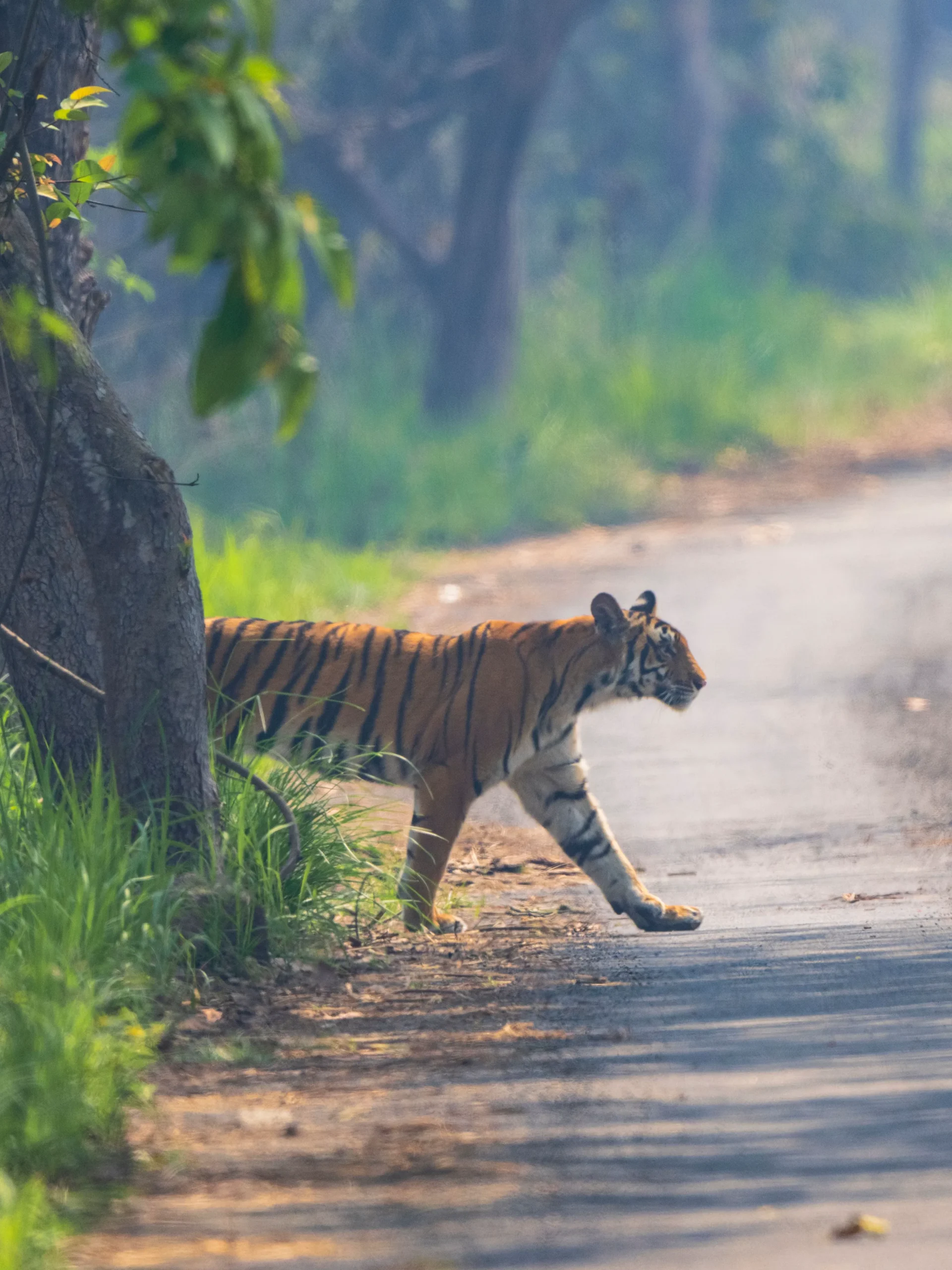
Discover how fast a tiger can run, its top speed in km/h and mph, how long it can sprint, and how it compares with lions, cheetahs, humans, and other big cats.
How Fast Can a Tiger Run?
A tiger can run at approximately 49–65 km/h (30–40 mph), but only over short distances. Rather than chasing prey for long periods, tigers rely on stealth, patience, and a rapid burst of speed during the final moments of a hunt.
Although these figures are widely reported by wildlife organisations and educational sources, they should be viewed as estimated top speeds rather than precisely measured universal values. A tiger’s speed can vary depending on factors such as terrain, the individual’s age and condition, and the circumstances of the chase.
For most readers, the key takeaway is simple:
- Top speed: about 49–65 km/h (30–40 mph)
- Used only for short bursts
- Designed for ambush hunting rather than endurance running
This distinction is important because many people assume that a tiger hunts in the same way as endurance predators. In reality, a tiger spends far more time stalking than running.
Why Isn’t a Tiger Faster?
Despite being the world’s largest wild cat, a tiger is not built to be the fastest predator. Instead, evolution has favoured a combination of:
- Powerful acceleration
- Explosive muscular strength
- Silent movement
- Precise timing
- The ability to overpower large prey at close range
A tiger’s hunting success depends much more on getting close without being detected than on maintaining high speed over long distances. Once it launches its attack, the sprint usually lasts only a brief period before the tiger either catches its prey or abandons the chase to conserve energy.
Field Note
If you watch a tiger during a safari, you are far more likely to see it walking quietly through vegetation, resting in shade, or carefully stalking prey than running at full speed. Full-speed sprints are relatively uncommon because they are energetically expensive and usually occur only during the final stage of a hunt.
What Makes Tigers So Fast?
A tiger’s impressive sprint speed is not the result of a single adaptation. Instead, it comes from a combination of physical traits that allow it to accelerate rapidly, generate tremendous power, and control its body while pursuing prey over short distances. These adaptations support its ambush hunting strategy rather than sustained running.
Powerful Muscles
Tigers have heavily developed shoulder, back, and hind-leg muscles that generate explosive force during a sprint. These muscles allow the animal to accelerate quickly from a standing or crouched position—an essential advantage when prey is only a few metres away.
Unlike endurance runners, tigers are built to produce maximum power for a short time rather than maintain speed over long distances.
Flexible Spine
A tiger’s spine bends and extends with each stride, increasing stride length and helping convert muscular force into forward movement. This flexibility improves acceleration and allows the tiger to cover more ground with every leap.
Although cheetahs possess even greater spinal flexibility for extreme speed, the tiger’s spine is well suited to its hunting style and body size.
Long Hind Legs
The hind limbs provide much of the propulsion during a sprint. Strong rear legs enable a tiger to:
- Accelerate rapidly
- Leap over obstacles
- Launch powerful attacks
- Cover the final distance to prey in just a few strides
These same legs also help the tiger navigate uneven forest terrain, fallen logs, rocky slopes, and dense vegetation.
Claws, Tail and Balance
A tiger’s speed is matched by excellent body control.
Its non-retractable grip during a sprint, combined with a long muscular tail, helps maintain balance while changing direction. Sharp claws provide traction on loose soil and forest floors, reducing the chance of slipping during a chase.
Expert Tip
Acceleration is often more important than top speed. In dense forests, prey is usually detected only at short range, so reaching maximum speed within a few strides is more valuable than sustaining high speed over hundreds of metres.
Tiger Speed Compared with Other Animals
Knowing a tiger’s top speed becomes more meaningful when viewed alongside other familiar animals. While tigers are among the fastest large predators, they are not the fastest members of the cat family.
| Animal | Approximate Top Speed | Key Characteristic |
| Tiger | 49–65 km/h (30–40 mph) | Powerful short-distance sprinter |
| Lion | About 50 km/h (31 mph) | Short-burst pursuit hunter |
| Leopard | About 58 km/h (36 mph) | Agile climber and sprinter |
| Jaguar | About 80 km/h (50 mph) | Powerful burst speed, dense habitat hunter |
| Cheetah | About 97–113 km/h (60–70 mph) | Fastest land animal |
Figures are approximate estimates reported by various wildlife sources and may vary depending on measurement methods.
Tiger vs Human
Even an elite human sprinter cannot match a tiger’s acceleration or top speed in the wild.
Most people can sprint for only a short distance at speeds well below a tiger’s estimated maximum. This illustrates why avoiding close encounters with wild tigers is essential. Wildlife authorities recommend following park regulations and maintaining safe distances rather than relying on speed or physical ability.
Responsible Tourism Tip
If you encounter a tiger during a guided safari, remain inside the vehicle and follow the instructions of your guide or forest staff. Responsible wildlife viewing depends on respecting the animal’s space and avoiding actions that may disturb or provoke it.
Tiger vs Lion
Tigers and lions have broadly similar sprinting abilities, with reported maximum speeds differing only slightly across sources.
The larger distinction lies in hunting behaviour:
- Tigers usually hunt alone using stealth and surprise.
- Lions often hunt cooperatively in prides, allowing them to surround or exhaust prey.
As a result, success in hunting depends far more on strategy than on small differences in top speed.
Tiger vs Leopard
Leopards are lighter and more agile than tigers. Their smaller size helps them manoeuvre quickly through trees, rocky terrain, and dense vegetation.
Tigers, however, compensate with greater power and strength, enabling them to subdue much larger prey.
Tiger vs Jaguar
Jaguars are renowned for their muscular build and powerful bite. While reported speed estimates suggest they can reach higher maximum speeds than tigers in short bursts, both species rely primarily on stealth rather than prolonged pursuit.
Dense forests and thick vegetation often limit opportunities for extended high-speed running.
Tiger vs Cheetah
The cheetah is unquestionably the fastest land mammal, capable of reaching speeds far beyond those of any tiger.
However, these two cats evolved for completely different hunting strategies:
- Tiger: stealth, ambush, explosive attack.
- Cheetah: open-ground pursuit at extremely high speed.
Comparing their top speeds alone overlooks the different ecological roles each species has evolved to fill.
Does Tiger Subspecies Affect Running Speed?
A common question is whether some tiger subspecies are naturally faster than others. Based on the available evidence, there is no authoritative scientific ranking of tiger subspecies by running speed. While different subspecies vary in size, habitat, and body proportions, reliable speed measurements are not available for meaningful comparisons.
This is why most reputable wildlife sources provide a general speed range for the species rather than assigning different maximum speeds to individual subspecies.
Bengal Tiger
The Bengal tiger (Panthera tigris tigris) is the most numerous wild tiger and is found across much of the Indian subcontinent.
It inhabits diverse environments including:
- Tropical forests
- Grasslands
- Mangrove forests
- Dry deciduous forests
Because Bengal tigers often hunt in dense vegetation, success depends more on stealth, positioning, and explosive acceleration than on maintaining maximum speed.
Amur (Siberian) Tiger
The Amur tiger lives primarily in the forests of the Russian Far East and parts of northeastern China.
Compared with Bengal tigers, Amur tigers are generally larger and heavier. Their snowy, rugged habitat presents different hunting challenges, but there is no reliable evidence showing that they are consistently slower or faster than other tiger subspecies.
Sumatran Tiger
The Sumatran tiger is the smallest surviving tiger subspecies and inhabits dense tropical rainforests on the Indonesian island of Sumatra.
Its smaller body size may improve agility in thick forest, but published scientific evidence does not establish a distinct maximum running speed for this subspecies.
Why Exact Comparisons Are Difficult
Several factors make precise speed comparisons between subspecies difficult:
- Wild tigers are rarely observed running at maximum speed.
- Habitat strongly influences movement.
- Hunting conditions differ between forests, grasslands, wetlands, and snowy landscapes.
- Published speed figures are generally estimates rather than controlled scientific measurements.
For these reasons, responsible wildlife writing should avoid claiming that one subspecies is definitively the fastest unless supported by robust scientific evidence.
Tiger Speed in the Wild
Although a tiger is capable of impressive sprint speeds, it spends only a tiny fraction of its life running at full pace.
Most of its daily activities involve:
- Patrolling territory
- Resting
- Stalking prey
- Drinking
- Swimming
- Marking scent boundaries
Full-speed chases are relatively uncommon because they require substantial energy and have a relatively low success rate if prey detects the tiger early.
Different Habitats, Different Hunting Strategies
The environment influences how a tiger uses its speed.
Dense Forests
In forests, visibility is often limited to only a few metres.
Instead of chasing prey over long distances, a tiger slowly approaches before launching a rapid attack from close range.
Grasslands
Open grasslands provide longer sightlines, but vegetation still offers enough cover for stalking.
A tiger may begin its sprint slightly farther from its prey than it would in dense woodland.
Wetlands and Mangroves
Mangrove forests, such as the Sundarbans, contain muddy ground, tidal creeks, and dense vegetation.
These conditions naturally limit prolonged running. Tigers rely even more heavily on stealth, patience, and careful positioning.
Snow-covered Forests
Amur tigers hunt in cold northern forests where snow, fallen timber, and uneven terrain affect movement.
Rather than attempting long pursuits, they continue to depend on ambush tactics similar to those used by other tiger populations.
Why Prey Selection Matters
Different prey species require different hunting approaches.
Large prey such as deer or wild boar often demand careful stalking before a rapid final attack. Because these prey animals are alert and capable of sudden escape, the tiger’s acceleration during the first few seconds of the chase is often more important than its absolute top speed.
Field Note
Safari visitors sometimes expect to witness dramatic high-speed chases. In reality, observing a tiger moving quietly through its territory is far more common. Patience and stealth are central to its hunting strategy, while full-speed sprints are brief and relatively rare.
Tiger Speed and Conservation
A tiger’s remarkable athletic ability has helped it survive as one of Asia’s apex predators, but speed alone cannot protect the species from modern threats.
Habitat loss, prey depletion, and illegal poaching remain far greater challenges than natural hunting success.
The tiger is classified as Endangered, and conservation organisations continue to work across its range to protect habitat, reduce human–wildlife conflict, and strengthen anti-poaching efforts.
Recent conservation assessments also highlight an important message: although tiger populations have shown encouraging recovery in some landscapes, the species remains heavily dependent on long-term habitat protection and effective conservation management.
Responsible Tourism Tip
Seeing a wild tiger is a privilege. Visitors can contribute to conservation by:
- Following park rules.
- Maintaining a respectful distance.
- Avoiding loud behaviour.
- Never attempting to attract or follow wildlife outside designated safari routes.
- Supporting responsible tourism operators that respect wildlife and local communities.
These simple actions help minimise disturbance while encouraging sustainable wildlife tourism.
Common Mistakes About Tiger Speed
Many online articles oversimplify tiger speed by focusing on a single headline number without explaining what it actually represents. Understanding these common misconceptions provides a more accurate picture of how tigers move and hunt.
Mistake 1: Believing Tigers Can Run at Top Speed for Long Distances
This is one of the most widespread myths.
A tiger’s reported top speed of approximately 49–65 km/h (30–40 mph) can only be sustained for a very short period. Tigers are built for explosive acceleration rather than endurance running.
Mistake 2: Assuming Tigers Are the Fastest Big Cats
While tigers are powerful sprinters, they are not the fastest members of the cat family.
The cheetah remains the fastest land mammal, capable of significantly higher speeds over short distances. Tigers instead rely on stealth, strength, and ambush hunting.
Mistake 3: Treating Every Published Speed Figure as Exact
Different wildlife organisations and educational sources report slightly different maximum speeds.
These figures should be understood as approximate estimates, since measuring the maximum speed of wild tigers under natural conditions is extremely difficult.
Mistake 4: Thinking Speed Alone Makes Tigers Successful Hunters
Speed is only one part of a tiger’s hunting strategy.
Successful hunts depend on:
- Remaining undetected.
- Approaching prey closely.
- Choosing the right moment to attack.
- Delivering an explosive final sprint.
Without stealth and timing, even a fast predator is unlikely to succeed.
Frequently Asked Questions
How fast can a tiger run?
A tiger can reach approximately 49–65 km/h (30–40 mph) during short bursts of speed.
How fast is a tiger in miles per hour?
Its estimated top speed is about 30–40 mph.
Can a tiger outrun a human?
Yes. A tiger can accelerate and sprint much faster than even the fastest human over short distances.
How long can a tiger maintain top speed?
Only briefly. Tigers are ambush predators and are not adapted for prolonged high-speed chases.
Are tigers faster than lions?
Reported top speeds are broadly similar. However, lions and tigers use different hunting strategies, making direct comparisons less meaningful.
Are tigers faster than leopards?
Leopards are generally considered more agile because of their smaller size, while tigers rely on greater strength and explosive power.
Are tigers faster than jaguars?
Published estimates suggest jaguars may achieve slightly higher burst speeds, but both species depend primarily on stealth rather than prolonged pursuit.
Are tigers faster than cheetahs?
No. Cheetahs are the fastest land animals and can reach much higher top speeds than tigers.
Does the tiger’s habitat affect how it runs?
Yes. Forests, mangroves, grasslands, and snowy landscapes all influence how a tiger stalks prey and when it chooses to sprint.
Which tiger subspecies is the fastest?
There is no authoritative scientific evidence ranking tiger subspecies by maximum running speed. Most reliable sources provide a general speed range for the species rather than separate figures for individual subspecies.
Why don’t tigers chase prey over long distances?
Long pursuits consume large amounts of energy and reduce the chances of a successful hunt. Instead, tigers depend on stealth and a rapid burst of acceleration once they are close to their target.
Do captive tigers run as fast as wild tigers?
Captive tigers have the physical ability to sprint, but opportunities to run at maximum speed are limited compared with wild individuals.
Conclusion
A tiger’s speed is impressive not because it rivals the fastest animals on Earth, but because it perfectly suits its hunting strategy. Capable of reaching around 49–65 km/h (30–40 mph) in short bursts, the tiger combines explosive acceleration with stealth, strength, and precise timing to ambush prey effectively.
Equally important is recognising the limits of these figures. Published top speeds are estimates rather than universally measured values, and they represent brief sprints rather than sustained running. Understanding this distinction helps explain why tigers are among nature’s most efficient ambush predators despite not being the fastest big cats.
Beyond speed, the tiger’s future depends less on its athletic ability and more on continued conservation efforts. Protecting forests, securing prey populations, and supporting responsible wildlife tourism remain essential for ensuring that future generations can continue to encounter this remarkable species in the wild.
Tiger Safari in India : Topics Cluster
- Tiger Safari Planning Workbook
- Tiger Safari Booking Guide
- Best time for tiger sightings in India
- How to increase chances of tiger sighting?
- Tiger Safari Naturalist Guide
- Tiger Safari India Cost
- How to book a Tiger Safari in India?
- Best Wildlife Tour Operators in India
- Best Destination Cities for Tiger Safaris in India
- Tiger Safari under ₹25000
- Top 10 Budget Tiger Safaris 2026
- Tiger Photography Tips
- Best Tiger Reserves
- Top 10 Tiger Reserves by sighting chances