
Learn how to accurately identify real signs of tiger presence in the wild. A practical guide to pugmarks, alarm calls, scat, and safari safety.
Reading the Forest: Why Tiger Signs Matter
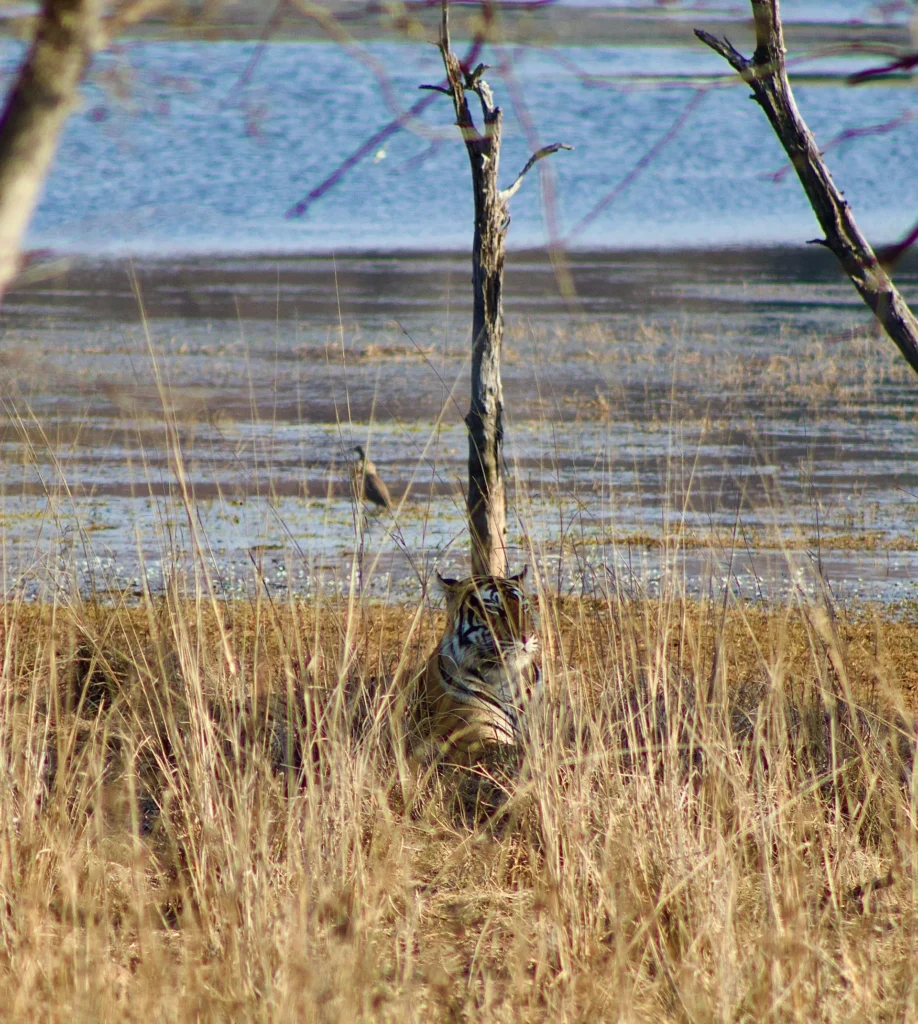
Image: Tiger hidden among grasses
Knowing how to spot tiger signs is the most reliable way to determine if a big cat is actively using a trail, helping you stay alert and understand the surrounding landscape during a safari.
Tigers are naturally elusive, solitary apex predators that avoid direct human contact whenever possible. Because direct visual encounters are rare, both safari travelers and field researchers rely heavily on indirect clues left behind in the environment to confirm their presence. The National Tiger Conservation Authority (NTCA) officially categorizes these field indicators into distinct groups: pugmarks, scat, scrapes, scent marks, rake marks, vocalizations, and direct sightings.
Understanding these indicators changes how you experience a tiger landscape. Instead of simply looking for a flash of orange through the trees, learning to read the forest floor, bark textures, and canopy sounds allows you to interpret the movement and behaviors of the animals living within it.
Core Field Signs of Tiger Presence
To accurately track a tiger, you must look for a combination of tracks, auditory warnings, and territorial markings rather than relying on a single isolated clue.
Pugmarks and Track Trails
Pugmarks are the most common physical evidence of a tiger’s movement across a landscape. A clear track on a soft dirt road, sandy dry riverbed, or muddy shoreline tells you exactly which direction the animal was traveling and provides immediate clues regarding how recently it passed through.
A tiger’s front paw track is generally larger, wider, and more circular, whereas the hind paw track is narrower and distinctly oval. Unlike dogs, tigers have retractable claws. This means you will rarely see claw impressions in a standard footprint unless the animal was running, leaping, or slipping on a steep, muddy incline. Tracking an extended trail of footprints provides far more reliable information than a single isolated print, revealing whether the tiger was patrolling its territory, hunting, or moving calmly between forest beats.
Scat and Territorial Scent Marks
Scat provides immediate information about a tiger’s recent diet, home range boundaries, and relative time of passage. Tigers frequently deposit scat in highly visible, conspicuous places—such as the center or intersections of safari tracks—to announce their presence to neighboring carnivores.
Fresh tiger scat is dark, moist, and possesses a strong, pungent odor. As it ages, it dries out, decomposes, and turns a distinct chalky white due to the high calcium content derived from digested prey bones. Naturalists examine the composition of the scat to identify hair, hooves, and bone fragments, which indicate the specific prey species the predator has been targeting. Alongside scat, tigers use scent marks by spraying a mixture of urine and anal gland secretions onto bushes and tree trunks at nose level, leaving a long-lasting chemical signature that defines their home range.
Scrapes, Rake Marks, and Tree Scratching
Scrapes and rake marks are visual boundary markers used to communicate with neighboring tigers and potential rivals. They are most frequently found along regular travel routes, territory borders, and prominent physical intersections in the forest.
A ground scrape is formed when a tiger uses its hind legs to push back soil, leaves, and forest debris, often leaving a small mound of earth next to a cleanly cleared patch of ground. These scrapes are frequently accompanied by a liquid scent mark to double the impact of the message. Rake marks, by contrast, are deep vertical scratches left on tree bark. Tigers stretch high up on their hind legs to claw at the bark of specific trees. This serves a dual practical purpose: it helps stretch their muscles and sharpen their claws, while simultaneously leaving a clear visual marker showing the physical height and size of the resident cat to any potential intruders.
Alarm Calls and Sudden Forest Silence
Alarm calls are your primary auditory cue that a tiger is actively moving through the undergrowth or preparing to hunt. Prey animals have evolved highly specific vocal warnings to alert their herds to the immediate danger of a stalking predator.
When a tiger is spotted by the surrounding wildlife, the forest canopy and floor erupt in sound. Langurs give sharp, coughing barks from the safety of the trees, chital (spotted deer) emit high-pitched whistles, and sambar deer give deep, resonant, bell-like honks. The direction, frequency, and intensity of these calls allow experienced guides to map the tiger’s exact path through dense cover. Conversely, a sudden, heavy silence across a previously noisy patch of forest can also indicate that a predator has entered the immediate area, causing smaller birds and mammals to freeze and cease all noise to avoid drawing attention to themselves.
Kill Sites and Drag Marks
Kill sites offer definitive proof of recent feeding activity and predatory success within a specific territory. Because tigers are ambush hunters targeting large prey like sambar, gaur, or wild boar, their kill sites leave highly visible, localized evidence.
When a tiger makes a successful kill, it rarely feeds out in the open. It typically secures a firm hold on the prey’s throat or neck and drags the heavy carcass into thick brush, tall grass, or a nearby dry riverbed (nullah) to hide it from competing predators and aerial scavengers. This movement leaves unmistakable drag marks: flattened vegetation, disturbed topsoil, and broken low branches leading away from the initial ambush point. A fresh kill site will show signs of immediate feeding, typically starting from the hindquarters, and the resident tiger will usually stay in the immediate vicinity for several days to guard and consume the meat.
Field Note: Always remember that forest signs are cumulative indicators. A single track or a solitary alarm call can easily be misread. True tracking relies on cross-referencing multiple signs—such as pairing a fresh footprint with a matching directional alarm call—before drawing a firm conclusion about a tiger’s location.
Distinguishing Tiger Signs from Other Species
Interpreting tracks accurately is essential, as the forest is shared by many predators. Misidentifying a leopard or dog track for a tiger’s is one of the most common errors made by inexperienced trackers.
Tiger vs. Leopard Tracks
Because both tigers and leopards are felines, neither typically shows claw marks in their standard footprints. The primary difference lies in overall size and structure. A leopard’s track is significantly smaller, narrower, and more compact. Tiger pugmarks, by contrast, are large and feature broad, rounder paw pads that take up more surface area on the ground.
Tiger vs. Domestic and Wild Dog Tracks
Feline and canine tracks have clear structural differences. Tracks from domestic dogs or wild dholes almost always show visible claw marks at the top of the toe pads because canines cannot retract their claws. Furthermore, a dog’s track is generally more oval and splayed. Context also matters: dog tracks are frequently found near villages, buffer zone roads, and human settlements, whereas tiger tracks are typically confined to deeper forest trails, sandbanks, and undisturbed mud.
Table 1: Track Identification Guide
| Comparison | Tiger | Leopard | Dog |
| Track Shape | Large, rounder paws | Smaller, more compact | Often oval, more splayed |
| Claw Marks | Usually absent | Usually absent | Often visible |
| Typical Context | Forest trails, mud, sand | Similar habitats | Near villages, roads, settlements |
Evaluating Sign Freshness: Recent vs. Old Evidence
A single pugmark only proves that a tiger passed through the area; it does not mean the animal is still nearby. To make practical use of field signs, you must evaluate their freshness.
Fresh pugmarks in mud will have sharp, crisp edges. As hours and days pass, wind, weather, and insect activity break down the ridges of the track, making it look softer and shallower. Fresh scat is moist, dark, and highly pungent, but turns dry and chalky white as the calcium from digested bones is exposed to the elements. Similarly, a fresh ground scrape will feature newly overturned, dark soil with no fallen leaves inside the depression.
Expert Tip: When assessing track freshness on a dirt road, look for vehicle tire tracks or the footprints of other animals superimposed over the pugmark. If a jeep track cuts through the tiger’s footprint, the tiger walked there before the last vehicle passed.
Safari Safety: Managing Encounters with Fresh Signs
Finding fresh signs while on foot—such as during a guided walking safari or when moving around a wilderness lodge—requires immediate situational awareness. While tigers generally avoid human contact, recognizing their proximity is critical for safety.
What to Do on a Safari Trail
If you discover highly fresh pugmarks, smell an intense musky odor, or hear sudden, localized alarm calls from deer or langurs, stop moving and listen closely. Immediately defer to the instructions of your park guide or forest guard. Maintain group formation, speak only in quiet whispers, and slowly back away along the clear path you came from. Never run, as sudden movement can trigger a predator’s chase instinct.
Critical Mistakes to Avoid
- Do not follow tracks into thick cover: A trail of pugmarks or drag marks heading off a clear path into tall grass or a dense nullah (dry riverbed) should never be followed. This vegetation is where tigers rest, sleep, or guard their kills.
- Do not assume all alarm calls mean a tiger: Sambar, chital, and langurs also sound alarms for leopards, dholes, and large snakes. An alarm call is a strong clue, but it is not absolute proof of a tiger.
- Do not mistake old marks for immediate danger: Rake marks on tree trunks can last for months or even years. Do not panic at the sight of tree scratches; other animals also rub against or scratch bark, and older signs simply indicate historical territory use, not immediate presence.
Responsible Tourism Tip: Never pressure your safari guide to break park rules or drive off-road to track a tiger based on an alarm call or pugmark. Staying on designated routes ensures your safety and minimizes habitat disturbance.
The Science of Tracking: How Researchers Monitor Tigers
While safari guides use field signs to track immediate movement, wildlife researchers use the same clues on a landscape scale to monitor conservation success. However, the way a tourist uses a sign is vastly different from how a scientist records it.
Table 2: Tourist Clues vs. Scientific Evidence
| Use Case | Field Application |
| Tourist Clues | Useful for situational awareness, tracking daily movement, and ensuring trail safety. |
| Scientific Evidence | Requires standardized sampling methods, spatial modeling, and cross-referencing with camera traps. |
Occupancy Surveys and Sign Encounter Rates
In India, the National Tiger Conservation Authority (NTCA) conducts a national tiger assessment every four years in collaboration with state forest departments, the Wildlife Institute of India (WII), and conservation partners. This is one of the world’s largest wildlife survey efforts.
Researchers conduct extensive foot surveys to measure the “sign encounter rate.” During the 2018 assessment, teams covered 522,996 kilometers of foot surveys specifically to record carnivore signs and measure prey abundance. These sign surveys, combined with data from 317,958 habitat plots, help scientists determine tiger occupancy—which areas tigers inhabit and how prey density impacts their territory.
Camera Traps and Genetic Sampling
Field signs confirm that a tiger occupies an area, but they cannot prove the exact number of tigers present. To determine actual population abundance, researchers rely on spatially explicit capture-recapture (SECR) models using camera traps. In the 2018 survey, 26,838 camera trap locations were deployed. Camera traps photograph the unique stripe patterns on a tiger’s flanks, allowing researchers to identify individual cats and generate accurate population estimates rather than relying on footprints alone.
The Limitations of Pugmark-Only Censuses
Historically, forest departments attempted to count individual tigers by tracing their pugmarks on glass or taking plaster casts. Scientific literature now notes that these pugmark census methods are not reliable for precise abundance estimation. The shape of a track changes depending on the substrate (mud, sand, or dry dirt), the animal’s speed, and the weather. A single tiger patrolling its territory can leave thousands of pugmarks across multiple forest beats, easily leading to overcounting if footprints are mistakenly assumed to belong to different individuals.
Table 3: Field Signs and Their Meanings Summary
| Sign Type | What It Indicates |
| Pugmarks | Direction of movement and recent travel. |
| Scat | Territory use, diet clues, and freshness. |
| Scrapes & Scent Marks | Territorial marking and communication with other cats. |
| Alarm Calls | Possible predator presence and immediate movement. |
| Kill Sites | Recent feeding activity and high probability the tiger is still nearby. |
Frequently Asked Questions
What are the main signs of tiger presence? The most common field signs are pugmarks (footprints), scat, ground scrapes, rake marks on trees, scent marks, and auditory clues like alarm calls from prey species.
How can I tell tiger pugmarks from leopard pugmarks? Tiger pugmarks are significantly larger, featuring broad, rounder paw pads. Leopard tracks are noticeably smaller and more compact.
Do tiger tracks show claw marks? Typically, no. As felines, tigers have retractable claws, so claw impressions usually do not appear in their tracks unless the animal was running, jumping, or slipping.
Does sudden silence in the forest indicate a tiger? Sudden silence can be suggestive of a predator entering the area, causing smaller birds and mammals to freeze. However, it is not diagnostic by itself and should be cross-referenced with other signs like tracks or alarm calls.
Why do wildlife experts use camera traps instead of only footprints? Footprints alone cannot reliably identify individual tigers or estimate exact population numbers due to variations in soil and weather. Camera traps photograph unique stripe patterns, allowing for accurate identification and population modeling.
Conclusion
Reading the forest is a practical skill that enhances any wildlife travel experience. By learning to identify pugmarks, interpret territorial markings, and listen to the alarm calls of prey, you shift from simply hoping to see a tiger to actively understanding its environment.
Remember that field signs are indirect clues. A footprint or a broken branch does not guarantee a sighting, nor does an alarm call offer absolute proof. True naturalists look for cumulative evidence, relying on context, freshness, and the combination of multiple signs to accurately interpret the landscape. Whether you are planning your first safari or returning to the wild, applying these observational skills will help you appreciate the intricate mechanics of tiger habitat safely and responsibly.
Author Note & Update Log: Written by the WildlifeSafaris.in Editorial Team. Last Updated: August 2026.