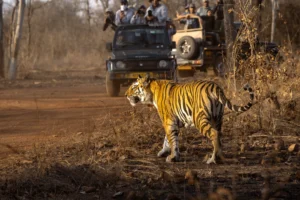
Planning a trip from Nagpur to Tadoba? Learn the best driving routes, travel times, gate choices, and official safari booking steps in this practical guide.
Introduction & Route Guide
Tadoba-Andhari Tiger Reserve is the most practical and rewarding wildlife getaway if you are starting your journey from Nagpur. With a robust tiger population, efficient road connectivity, and a well-regulated booking system, it serves as an excellent wilderness escape for weekend travelers, dedicated photographers, and families alike.
When planning this journey, your first decisions should center on your transport mode and gate destination. Choosing the wrong route or gate can easily add unnecessary hours to your travel time, cutting into your scheduled rest before your initial safari.
Nagpur to Tadoba: Route Overview
Driving is the most flexible and practical option for most travelers moving between Nagpur and Tadoba. It allows you to synchronize your arrival perfectly with afternoon safari check-in times and gives you direct access to your chosen safari gate without relying on local rural transfers.
Nagpur to Tadoba by Road
The drive from Nagpur to Tadoba covers a distance of approximately 104 km and typically takes between 2 to 3 hours, depending heavily on which specific gate you choose and the prevailing traffic conditions.
For travelers heading toward the northern gates like Kolara, the route via Chimur is generally the most direct choice. The roads on this stretch are well-maintained, minimizing travel friction and making it highly suitable for early morning departures. If you are aiming for the southern or western entry points like Moharli, you will navigate via Chandrapur-side approach roads.
Field Note: If you are planning an afternoon safari on your arrival day, aim to leave Nagpur no later than 9:00 AM. This ensures a comfortable buffer for hotel check-in, lunch, and mandatory permit verification at the park gates before the afternoon tracks open.
Nagpur to Tadoba by Train
Taking a train is an alternative if you prefer to avoid driving, though it requires a secondary road transfer to reach the park.
There is no railway station inside Tadoba National Park itself. The nearest major rail gateway is Chandrapur. You can board a regular train from Nagpur Junction to Chandrapur, which typically takes around 2.5 to 3 hours. Once you disembark at Chandrapur, you will need to arrange a local taxi or road transport for the remaining 30 to 45 km to reach the southern gates like Moharli. This multi-leg journey requires tight coordination to avoid missing your safari slots.
Nagpur to Tadoba by Flight and Transfer
For long-distance travelers using Nagpur as a transit hub, flying into Dr. Babasaheb Ambedkar International Airport in Nagpur is the standard approach.
Nagpur airport is the closest commercial airport to the reserve. Upon arrival, you can hire a prepaid airport taxi or arrange a pre-booked resort vehicle to drive you straight to the reserve. The transition from the airport terminal to the forest gates follows the same 2-to-3-hour road network used by self-drive travelers, making it a smooth option for interstate or international visitors.
Transport Comparison from Nagpur
The table below outlines the practical tradeoffs between the three transport options to help you choose the best fit for your travel style.
| Transport Mode | Average Travel Time | Direct Access to Gates? | Best Suited For |
| Road (Self-Drive / Private Cab) | 2 to 3 hours | Yes, right to your resort or gate | Families, photographers, and weekend travelers seeking maximum flexibility. |
| Train (via Chandrapur) | 3.5 to 4.5 hours (including road transfer) | No, requires a 30–45 km onward road journey | Budget-conscious travelers or those looking to avoid driving fatigue. |
| Flight (Nagpur Airport + Transfer) | 2 to 3 hours road transfer post-flight | Yes, via the airport taxi network | Interstate and international visitors using Nagpur as a base gateway. |
Safari Gates, Core vs Buffer Dynamics, and Official Booking Workflow
Selecting the right gate and zone is the single most critical decision you will make when planning a Tadoba trip. Unlike some parks where any entry point provides access to the entire forest, Tadoba operates on a strict gate-based entry system. The gate you choose dictates where you sleep, which forest tracks you explore, and how far you must drive from Nagpur.
Currently, Tadoba-Andhari Tiger Reserve features 6 core gates and 16 buffer gates.
Tadoba Safari Gates and Zones
Because the reserve spans a massive area, accommodation is clustered around specific entry points. If you book a safari at a northern gate but reserve a hotel at a southern gate, you may face a two-hour drive just to reach your morning safari on time.
Moharli vs Kolara for Nagpur Travelers
Most travelers originating from Nagpur focus on two primary entry hubs: Kolara and Moharli.
Kolara Gate is situated on the northern edge of the reserve. For travelers driving down from Nagpur, Kolara is generally the most convenient option because it is accessed directly via the Chimur route, minimizing overall travel time.
Moharli Gate is the historic southern hub of Tadoba. It boasts the highest concentration of accommodation options and tourist infrastructure. However, reaching Moharli from Nagpur requires driving further south via Chandrapur, making the journey slightly longer.
| Feature | Kolara Gate (North) | Moharli Gate (South) |
| Travel from Nagpur | Closer; accessed via Chimur | Further; accessed via Chandrapur |
| Logistics | Ideal for early morning departures from Nagpur | Better if connecting via train at Chandrapur |
| Crowd Levels | Generally quieter at the entry point | Busiest tourist hub in the reserve |
Core vs Buffer Safari
A common source of confusion for first-time visitors is the distinction between core and buffer zones. Both zones share the same contiguous landscape and support the exact same wildlife species, including tigers.
The Core Zone is the central, highly protected area of the national park where human activity is strictly limited to regulated tourism and forest management.
The Buffer Zone surrounds the core and acts as a transitional space. It encompasses forest areas alongside local villages and agricultural lands.
Decision Guide: Core vs Buffer If you are planning a weekend trip, try to book a mix of both. Buffer zones often have more water bodies adjacent to local villages, which can attract wildlife during drier months. Remember that official closure days dictate your schedule: the core zone is closed on Tuesdays, and the buffer zone is closed on Wednesdays.
| Zone Feature | Core Zone | Buffer Zone |
| Weekly Closure | Closed on Tuesdays | Closed on Wednesdays |
| Safari Types Offered | Morning, Evening, Full-Day | Morning, Noon, Evening, Full/Half-Day |
| Vehicle Density | Strictly capped per gate | Often higher availability than core slots |
Best Gate for Tiger Sightings
Many travelers ask which gate is “best” for seeing tigers. The reality is that wildlife sightings are never guaranteed, and making decisions based on outdated internet rumors can lead to disappointment.
Tigers are territorial animals that move freely across the entire Tadoba landscape—frequently crossing between core and buffer zones. Sightings depend entirely on seasonal conditions, water availability, and natural animal movement on any given day, rather than the name of the gate. Avoid choosing a gate solely based on an unsupported claim; instead, choose based on logistical convenience from Nagpur and the availability of permits.
Tadoba Booking Process
Recent tourism data indicates a significant surge in online safari bookings for Tadoba, reflecting high visitor demand. Because permits frequently sell out weeks in advance, relying on last-minute planning is a poor strategy.
All official reservations must be made through the government portal: mytadoba.mahaforest.gov.in.
Practical Checklist: The “What to Book First” Sequence
- Book your safari permits first. Do this as soon as the booking window opens on the official portal.
- Book your accommodation second. Only book your hotel after your safari permits are confirmed. Ensure the hotel is within a 15-minute drive of your booked gate.
- Book your transport last. Arrange your taxi or rental car from Nagpur only when your location and timings are locked in.
When booking, you will have the choice between a standard 6-seater open Gypsy or a larger, closed Cruiser vehicle. For dedicated photography and clear sightlines, the Gypsy remains the preferred standard. If you miss the advance booking window, the park does offer a restricted tatkal (last-minute) booking quota, but relying on this adds severe risk to your travel plans as these slots are highly limited and subject to immediate sell-outs.
Seasons, Wildlife Ecology, and Sighting Realities
Deciding when to travel from Nagpur to Tadoba depends entirely on what you prioritize: maximum comfort or maximum predator sightings. Tadoba experiences extreme seasonal shifts that drastically alter both the landscape and animal behavior.
Best Time to Visit Tadoba
Tadoba is fundamentally a dry deciduous forest. This means the jungle sheds its leaves during the dry months, opening up sightlines and forcing wildlife to concentrate around shrinking water sources.
For dedicated photographers and travelers strictly focused on seeing tigers, the intense heat of summer (March to June) yields the most consistent sightings. As smaller waterholes dry up, predators and herbivores alike are forced to visit the remaining permanent lakes, making their movements highly predictable. However, summer temperatures routinely cross 40°C, making afternoon safaris physically exhausting.
If you prefer a comfortable family trip or a more holistic forest experience, winter (November to February) is ideal. The weather is cool and pleasant, the forest retains some post-monsoon greenery, and morning safaris are much more forgiving. Sighting probabilities remain solid, though animals are more dispersed because water is still widely available throughout the reserve.
Monsoon Closure and Seasonal Access
A critical planning factor for any Tadoba trip is the annual monsoon closure.
From July 1 to September 30, the reserve’s core zone is completely closed to tourism. This mandatory shutdown allows the habitat to regenerate and gives wildlife undisturbed space during the breeding season.
During these three months, limited safaris may continue in the buffer zones, depending on road conditions and the severity of the rainfall. If you plan to travel from Nagpur during the monsoon, manage your expectations: you will only have access to buffer gates, and sudden weather changes can lead to impromptu safari cancellations.
| Season | Months | Weather & Forest Conditions | Wildlife Sighting Strategy |
| Summer | March – June | Extreme heat; dry, leafless forest. | Highest probability for tigers. Focus on waterholes during morning and late evening. |
| Winter | Nov – Feb | Cold mornings, mild afternoons; thicker vegetation. | Excellent for all-around wildlife and birding. Sighting requires more tracking. |
| Monsoon | July – Sept | Heavy rain; core zone is closed. | Limited to buffer zones only. Excellent for landscape photography and solitude. |
What Wildlife You Can See
A common misconception among first-time visitors is that Tadoba is exclusively a tiger destination. While the Bengal tiger is the apex predator and the primary draw, fixating solely on big cats often leads visitors to ignore the broader ecosystem.
Tadoba supports a robust predator matrix that includes leopards, sloth bears, and highly active packs of dholes (Indian wild dogs). Dholes are particularly fascinating to observe as they hunt in coordinated packs and are frequently seen on the move across the safari tracks.
The park’s diverse herbivore population provides the prey base that sustains these predators. During your drives, you will consistently encounter massive herds of gaur (Indian bison), sambar, chital (spotted deer), and the shy barking deer. Around Tadoba Lake and the marshy areas, keep an eye out for marsh crocodiles basking on the banks, as well as Indian pythons.
Birding Note: Tadoba is an exceptionally productive habitat for avian life. Maharashtra Tourism records over 195 bird species within the reserve. If you look beyond the mammalian tracks, you can easily spot raptors, diverse woodpecker species, and numerous waterbirds clustering around the core lakes. Bringing a good pair of binoculars will significantly enhance your downtime between predator tracking.
Custom Itineraries, Budgets, Common Mistakes, and FAQs
With your transport and safari permits secured, the final phase of planning your Nagpur to Tadoba trip involves structuring your daily schedule and managing your budget.
Nagpur to Tadoba Itinerary
Because the drive from Nagpur takes only 2 to 3 hours, you can easily maximize a short weekend without feeling exhausted. The structure of your itinerary will depend on how many nights you plan to stay and whether your focus is on a quick getaway or serious wildlife photography.
| Feature | 1-Night Quick Trip | 2-Night Wildlife Trip (Recommended) |
| Best For | Tight weekends and budget travelers. | Families, first-timers, and photography enthusiasts. |
| Arrival Timing | Leave Nagpur by 8:00 AM. Check in by noon for the afternoon safari. | Leave Nagpur by 9:00 AM. Check in leisurely before the afternoon drive. |
| Safari Strategy | 1 Afternoon Safari (Day 1) + 1 Morning Safari (Day 2). | 1 Afternoon Safari (Day 1) + Morning/Afternoon (Day 2) + Optional Buffer (Day 3). |
| Pacing | Fast-paced. Requires strict adherence to gate timings. | Relaxed. Provides backup opportunities if one safari yields poor sightings. |
Photography Tip: If you are visiting primarily for photography, prioritize morning safaris in the core zone for the best golden-hour lighting, and book a mix of core and buffer zones across a 3-night stay to diversify your backgrounds.
Tadoba Trip Budget and Stay Options
Tadoba offers accommodation ranging from basic homestays to luxury eco-lodges, with the majority clustered around the Moharli and Kolara gates.
When budgeting your trip from Nagpur, remember that safari fees and transport are fixed costs, while accommodation provides the most flexibility. A hired cab will significantly increase your transport budget compared to driving your own car, but it removes the fatigue of driving back to Nagpur after an early morning safari.
| Budget Category | Self-Drive from Nagpur | Hired Cab from Nagpur |
| Transport | Fuel and tolls only (approx. 300 km round trip). | ₹3,300 to ₹5,100+ for a one-way drop, depending on vehicle type. |
| Safari Permits | ₹8,000 to ₹9,000 per core gypsy (split among up to 6 people). | ₹8,000 to ₹9,000 per core gypsy (split among up to 6 people). |
| Accommodation & Meals | Variable based on resort choice. | Variable based on resort choice. |
| Primary Advantage | Absolute flexibility and lower overall cost. | Zero driving fatigue; door-to-door service. |
Safari Rules and Booking Tips
Tadoba is strictly regulated by the forest department. Breaking rules inside the park can result in immediate eviction and heavy fines. Always verify current regulations on the official portal before your trip.
What to Pack for Safari
- Original ID Proof: You must carry the exact original ID (Aadhar, Passport, Driving License) used during the online booking. Entry is denied without it.
- Muted Clothing: Wear greens, browns, and khakis. Avoid bright colors that distract wildlife.
- Dust Protection: Open gypsies kick up fine forest dust. Bring a buff or scarf to cover your nose and mouth.
- Binoculars: Essential for spotting the park’s 195+ bird species and observing distant predator movement.
- Layers (Winter): Morning safaris in winter (Nov-Feb) are incredibly cold. Pack a thick jacket, gloves, and a beanie, which you can shed as the sun rises.
Common First-Timer Mistakes
- Booking hotels before safaris: Always secure your safari permits on mytadoba.mahaforest.gov.in first. Accommodation is much easier to find than safari slots.
- Mismatching gates and hotels: Do not book a safari at a northern gate (like Kolara) and a hotel at a southern gate (like Moharli). You will spend hours driving between the two.
- Relying on Tatkal: Last-minute tatkal bookings are highly competitive and offer no guarantee of entry.
- Ignoring the buffer zone: Buffer zones host the same tigers as the core and often provide exceptional, less-crowded sightings.
FAQs About Nagpur to Tadoba
1. What is the distance from Nagpur to Tadoba? The distance is approximately 104 km to 145 km, depending on whether you travel to the northern or southern gates.
2. How much time does it take to reach Tadoba from Nagpur by road? The drive typically takes between 2 to 3 hours under normal traffic conditions.
3. What is the best route from Nagpur to Tadoba? For Kolara (North), the route via Chimur is best. For Moharli (South), the route via NH44 and Chandrapur is standard.
4. Is there a train from Nagpur to Tadoba? There is no direct train to the park. You must take a train to Chandrapur (approx. 3 hours) and hire a taxi for the final 30–45 km.
5. Is Nagpur airport the nearest airport for Tadoba? Yes, Dr. Babasaheb Ambedkar International Airport in Nagpur is the closest major commercial airport.
6. Which Tadoba gate should I use from Nagpur? Kolara is the most accessible for a direct drive from Nagpur, while Moharli offers the most accommodation options.
7. Which gate is best for tiger sightings? Tigers move freely across the entire reserve. No single gate guarantees sightings; choose based on logistical convenience.
8. How many days are enough for a Nagpur to Tadoba trip? A 2-night, 3-day trip is the sweet spot, allowing time for 3 to 4 safaris without exhausting yourself.
9. When is the best time to visit Tadoba? Summer (March-June) offers the highest probability for tigers, while winter (Nov-Feb) provides the most comfortable weather and excellent birding.
10. Is Tadoba good in summer? Yes, it is excellent for wildlife viewing as animals congregate around water, but temperatures frequently exceed 40°C.
11. Is Tadoba open in monsoon? The core zone is strictly closed from July 1 to September 30. Limited buffer safaris may operate depending on weather conditions.
12. How do I book a Tadoba safari online? All official bookings must be made through mytadoba.mahaforest.gov.in.
13. What are Tadoba safari timings?
Timings change seasonally but generally run from 6:00 AM to 10:00 AM, and 2:30 PM to 6:30 PM.
14. What are the safari rules at Tadoba?
You must carry original ID, stay inside the vehicle at all times, avoid bright clothing, and refrain from using mobile phones (which incurs a fine).
15. What is the difference between core and buffer? The core is the central protected area (closed Tuesdays). The buffer surrounds the core, includes village areas, and is closed Wednesdays. Both share the same wildlife.
16. What animals can I see in Tadoba? Beyond tigers, you can spot leopards, dholes (wild dogs), sloth bears, gaur, crocodiles, and over 195 bird species.
17. Can I do a day trip from Nagpur to Tadoba? Yes, but it requires leaving Nagpur by 4:00 AM for a morning safari or returning late at night after an evening safari. It is tiring but possible.
18. What should I pack for Tadoba? Original ID, binoculars, a dust buff, neutral-colored clothing, and heavy layers if traveling in winter.
19. What is the estimated budget for a Tadoba trip from Nagpur?
Expect to pay ₹8,000–₹9,000 per core safari gypsy, plus ₹3,300–₹5,100+ for a one-way taxi from Nagpur, alongside your chosen hotel costs.
20. Is Tadoba suitable for families and kids? Yes, it is highly suitable due to the short drive from Nagpur and excellent accommodation options. Winter is the most comfortable season for children.
Conclusion
Tadoba-Andhari Tiger Reserve remains one of India’s most rewarding wildlife destinations, largely because of its accessibility. By treating Nagpur as your base, you eliminate the long transit times associated with many other central Indian parks. The key to a successful trip lies entirely in advance planning: secure your safari permits first on the official portal, match your hotel to your booked gate, and decide early whether you prefer the comfort of a hired cab or the flexibility of driving yourself. With the logistics handled, you can focus entirely on enjoying the dry deciduous landscape and the remarkable wildlife it supports.
Author Note & Update Log: Written by the WildlifeSafaris.in Editorial Team. Last Updated: August 2026.
Tadoba National Park : Topics Cluster
- Complete Guide to Tadoba National Park
- Tadoba Quick Guide
- Tadoba Safari Cost Breakdown
- Best Zones in Tadoba National Park
- Best Resorts near Tadoba Tiger Reserve
- Best Tiger Safaris around Nagpur
- Nagpur to Tadoba Travel Guide
- Mumbai to Tadoba Travel Guide
- Pune to Tadoba Travel Guide
- Wildlife in Maharashtra
- Maharashtra Wildlife Tourism