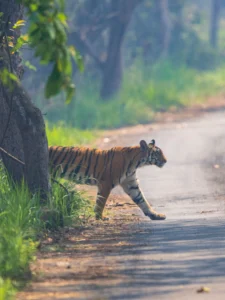
Can tigers swim? Learn why tigers are excellent swimmers, how they use water for hunting and survival, and what swimming reveals about tiger ecology.
Can Tigers Swim?
Yes. Tigers are excellent swimmers, and unlike many other cat species, they enter water willingly when it serves a purpose. Swimming is a natural part of tiger behaviour rather than an unusual exception. Across much of their range, rivers, lakes, marshes, mangroves, and forest streams are everyday features of the landscape, so water is simply another environment they know how to navigate.
Many people assume that all cats dislike water because domestic cats often avoid getting wet. Tigers are different. While they are not aquatic animals like otters or crocodiles, they are among the strongest swimmers in the cat family and regularly use water for survival.
Their ability to swim helps them:
- Cross rivers while travelling through large territories.
- Reach hunting areas separated by water.
- Cool down during hot weather.
- Move safely through wetlands and mangrove forests.
- Navigate habitats where water is a permanent feature.
Rather than asking whether tigers can swim, a more accurate question is why they swim so often in many parts of their range.
Why Are Tigers So Comfortable in Water?
Most wild tigers live in landscapes where water is unavoidable. Their habitats include tropical forests, river valleys, floodplains, marshes, and mangrove ecosystems. In these environments, avoiding water would make finding food, defending territory, and moving between habitat patches much more difficult.
Unlike domestic cats, tigers have evolved in environments where entering water often provides an advantage instead of a risk.
Water Is Part of Their Daily Environment
Many tiger reserves and protected forests contain:
- Rivers
- Seasonal streams
- Natural ponds
- Reservoirs
- Wetlands
- Mangrove channels
These water bodies are frequently used by both prey and predators. Deer, wild boar, gaur, and other animals visit water to drink, making these areas important locations for tiger activity.
Swimming Helps Tigers Stay Cool
Large predators generate considerable body heat, especially in tropical climates. During the hottest months, tigers often spend time standing, sitting, or lying in shallow water to regulate their body temperature.
This behaviour is commonly observed in several Indian tiger reserves during summer, when daytime temperatures can become extreme. Cooling off in water allows tigers to remain active without expending unnecessary energy.
Field Note: A tiger resting in a forest pool is not necessarily hunting. During hot afternoons, remaining in water is often an efficient way to avoid heat stress while conserving energy.
Why Do Tigers Swim?
Swimming is not recreational in the human sense. Every time a tiger enters water, there is usually a practical reason.
1. Crossing Rivers and Waterways
Tiger territories can cover extensive landscapes intersected by rivers and streams. Swimming allows individuals to move between different parts of their home range without being restricted by water barriers.
Maintaining access to food, mates, and suitable habitat depends on this ability, particularly in landscapes fragmented by natural river systems.
2. Hunting Opportunities
Water sometimes gives tigers access to prey that would otherwise be difficult to reach. Riverbanks, marshes, and wetlands attract herbivores seeking drinking water, creating natural hunting opportunities.
Although tigers do not rely exclusively on aquatic hunting, they are fully capable of moving confidently through water while stalking or pursuing prey when conditions favour such behaviour.
3. Cooling During Hot Weather
Summer temperatures across much of Asia frequently exceed comfortable limits for large mammals. Resting in water reduces heat stress and helps conserve energy.
Unlike many mammals that avoid prolonged contact with water, tigers often appear relaxed while partially submerged for extended periods during the hottest parts of the day.
4. Travelling Through Complex Habitats
In landscapes such as the Sundarbans, waterways are an integral part of the terrain. Swimming is essential for moving between islands, navigating tidal channels, and accessing different hunting areas.
Here, water is not an obstacle—it is simply part of the tiger’s everyday route.
Expert Tip
If you hope to photograph a tiger interacting with water, plan safaris during warmer months when animals are more likely to visit ponds, lakes, and shaded streams. However, sightings always depend on factors such as weather, habitat, and individual animal behaviour, so no encounter can be guaranteed.
What Makes Tigers Excellent Swimmers?
Tigers are not adapted for an aquatic lifestyle in the way otters or crocodiles are, but they possess several physical characteristics that make them capable, confident swimmers. Their strength, coordination, and endurance allow them to cross rivers, move through wetlands, and navigate water-rich habitats with relative ease.
Rather than relying on a single adaptation, it is the combination of their muscular body, powerful limbs, and natural familiarity with water that makes swimming an effective survival skill.
Powerful Muscles Generate Strong Propulsion
A tiger’s body is built for strength. The same muscles that help it stalk, leap, and overpower large prey also provide the power needed to move efficiently through water.
Its broad shoulders and strong chest create force with every stroke, while the hind legs generate much of the forward propulsion. This allows a tiger to swim steadily even when crossing wide rivers or negotiating strong currents.
Large Paws Act Like Powerful Paddles
Tigers have large, heavily muscled forelimbs with broad paws that push significant volumes of water during each stroke. Although internet articles sometimes exaggerate features such as “webbed paws,” the research brief recommends avoiding unsupported claims. What is well established is that their powerful limbs and coordinated movements make them effective swimmers.
Endurance Matters More Than Speed
Swimming is usually about reaching another part of the landscape rather than moving as quickly as possible. Tigers typically maintain a steady pace that conserves energy while allowing them to cross rivers or flooded terrain safely.
This endurance is especially useful in habitats where waterways form a regular part of their territory.
Confidence Around Water
Many domestic cats avoid water whenever possible, but wild tigers grow up in environments where rivers, ponds, and wetlands are common. Regular exposure from an early age makes water a familiar part of their surroundings rather than something to avoid.
Behaviour also varies between individuals and habitats. Tigers living in mangroves or floodplains are naturally more accustomed to water than those inhabiting drier forests.
Photography Tip: If you observe a tiger entering water, maintain a respectful distance and avoid sudden movements or loud conversations. Natural behaviour often continues when animals remain undisturbed.
How Far Can Tigers Swim?
One of the most common questions is how far a tiger can swim. The honest answer is that there is no universally verified maximum distance.
Many websites quote impressive figures, but these are often based on anecdotal observations rather than scientific studies. The research brief specifically recommends avoiding unsupported numerical claims because they cannot be consistently verified.
What researchers do know is that wild tigers regularly cross rivers and other substantial water bodies whenever necessary for survival.
What Is Well Supported?
Available evidence shows that tigers:
- Are capable of crossing wide rivers.
- Frequently swim between habitat patches.
- Navigate mangrove channels and wetlands.
- Enter both freshwater and, in some regions, saltwater environments.
- Show confidence in water compared with most other cats.
These observations are supported by conservation organisations studying tiger ecology across Asia.
Why Exact Distance Claims Differ
Unlike athletic records, wild animal behaviour is rarely measured under controlled conditions. A tiger may swim different distances depending on:
- River width
- Water current
- Weather conditions
- Habitat type
- Purpose of the crossing
- Individual behaviour
Because these situations vary enormously, quoting one “maximum swimming distance” can be misleading.
Expert Tip
When reading wildlife facts online, be cautious of articles that present precise swimming distances without citing recognised conservation organisations or scientific studies. Reliable wildlife writing distinguishes between documented observations and anecdotal reports.
Do Tiger Cubs Swim?
Tiger cubs are not born as expert swimmers, but they gradually become comfortable around water while growing up with their mother.
Like many survival skills—including hunting and territory awareness—swimming develops through experience.
Learning From Their Mother
Mother tigers play the central role in teaching cubs how to move safely through their environment. In landscapes containing rivers, streams, or wetlands, cubs naturally encounter water from an early age.
Repeated exposure helps them develop confidence rather than fear.
An Important Survival Skill
For cubs growing up in floodplains, mangrove forests, or riverine habitats, learning to swim can be essential.
As they mature, swimming enables young tigers to:
- Follow their mother across waterways.
- Explore expanding territories.
- Access food resources.
- Navigate fragmented landscapes.
The exact age at which cubs become proficient swimmers varies, and available research does not support assigning a universal timeline.
Responsible Tourism Tip
If you are fortunate enough to observe a tigress with cubs during a safari, remain quiet and follow your guide’s instructions. Young cubs are especially sensitive to disturbance, and responsible viewing helps minimise stress on wildlife.
Tigers, Water, and Their Habitat
Understanding where tigers live helps explain why swimming is such an important part of their behaviour. Across much of Asia, tiger habitats are closely linked to rivers, wetlands, floodplains, and mangrove forests. Water is not simply a place to drink—it shapes how tigers move, hunt, and survive.
Forest Rivers and Streams
Many tiger landscapes contain networks of rivers and seasonal streams. These waterways support healthy ecosystems by providing water for vegetation and attracting herbivores such as deer, wild boar, and gaur.
For a tiger, rivers can serve several purposes:
- Natural travel routes through dense forests.
- Boundaries within large territories.
- Places where prey frequently gathers.
- Reliable sources of water during dry periods.
Instead of avoiding rivers, tigers often cross them whenever necessary to patrol territory or search for food.
Wetlands and Floodplains
Wetlands are among the most productive wildlife habitats in Asia. They support abundant plant growth and provide ideal conditions for many prey species.
For tigers, wetlands offer:
- Reliable access to water.
- Dense vegetation for stalking prey.
- Cooler microclimates during hot weather.
- Safe movement through less disturbed areas.
These landscapes demonstrate that tiger ecology is closely connected to healthy freshwater ecosystems rather than forests alone.
The Sundarbans: Where Swimming Is Part of Daily Life
The Sundarbans, shared by India and Bangladesh, provide one of the world’s best examples of how tigers adapt to life in water-rich environments.
This vast mangrove ecosystem is crossed by countless tidal creeks and channels. Here, swimming is not occasional behaviour—it is a routine necessity.
Tigers in the Sundarbans regularly move between islands separated by tidal waterways, illustrating how water can be an integral part of a tiger’s habitat rather than an obstacle.
Field Note: The Sundarbans remind us that tiger conservation is not only about protecting forests. Conserving rivers, wetlands, mangroves, and natural water flows is equally important for maintaining suitable habitat.
Habitat Connectivity Matters
Modern conservation increasingly focuses on connecting fragmented habitats instead of protecting isolated forests alone.
Swimming enables tigers to move across rivers and natural barriers, helping them:
- Find new territories.
- Locate mates.
- Access prey.
- Maintain healthy genetic diversity between populations.
When rivers, wetlands, and wildlife corridors remain connected, tiger populations are more resilient. Conversely, fragmented landscapes can isolate populations and reduce long-term survival prospects.
Are All Tiger Subspecies Good Swimmers?
All living tiger subspecies are capable swimmers, but how frequently they enter water depends largely on their habitat rather than on the subspecies itself.
Bengal Tiger
Bengal Tigers inhabit a wide variety of landscapes, from tropical forests to grasslands and mangroves. Many populations regularly encounter rivers and waterholes, making swimming a familiar behaviour.
The Sundarbans population is especially associated with frequent river crossings because of its mangrove habitat.
Amur (Siberian) Tiger
Amur Tigers live in the temperate forests of the Russian Far East and parts of northeastern China.
Although these forests contain rivers and lakes, their cooler climate means swimming is generally associated with movement across waterways rather than escaping extreme heat. They remain capable swimmers whenever conditions require it.
Sumatran Tiger
Found only on the Indonesian island of Sumatra, Sumatran Tigers inhabit tropical rainforests where rivers and wetlands are common landscape features.
Like other tiger populations, they readily use water as part of their normal environment.
Habitat Influences Behaviour More Than Subspecies
Rather than assuming one subspecies swims better than another, it is more accurate to say that local habitat determines how often swimming is needed.
A tiger living in a mangrove forest is naturally likely to swim more often than one living in a drier inland forest because water is encountered more frequently.
Comparison: Tigers and Other Cats
| Feature | Tigers | Lions | Leopards | Domestic Cats |
| Comfortable entering water | Yes, commonly | Occasionally | Occasionally | Usually avoid water |
| Regular river crossings | Yes | Less common | Possible where required | Rare |
| Uses water for cooling | Frequently in hot climates | Sometimes | Occasionally | Rare |
| Water important to habitat | Often | Depends on habitat | Depends on habitat | Not normally |
General behavioural patterns vary between individuals and habitats.
Are Tigers Better Swimmers Than Lions?
Tigers are generally considered more comfortable in water than lions. This difference largely reflects habitat.
Many tiger landscapes contain rivers, wetlands, and mangroves, whereas lion habitats are often drier savannas where swimming is needed less frequently.
What About Leopards?
Leopards can swim when necessary, but they are more often associated with climbing and using trees for safety and hunting.
Tigers, by contrast, are much more strongly associated with water-rich habitats throughout much of their geographic range.
Tigers vs Domestic Cats
The comparison that surprises most people is between tigers and household cats.
Domestic cats often avoid getting wet because their ancestors evolved in comparatively dry environments. Tigers evolved under very different ecological conditions, making water a familiar and valuable part of daily life.
This difference demonstrates how habitat shapes animal behaviour over time.
India Focus: Where Can You See Tigers Around Water?
India offers some of the world’s best opportunities to observe natural tiger behaviour around water bodies, especially during the warmer months.
Parks where visitors occasionally witness tigers near ponds, lakes, reservoirs, or streams include:
- Ranthambore National Park (Rajasthan) – Known for lakes and waterholes where tigers may rest or drink.
- Bandhavgarh National Park (Madhya Pradesh) – Numerous forest pools and seasonal streams attract wildlife.
- Kanha National Park (Madhya Pradesh) – Meadows, rivers, and waterholes support diverse wildlife activity.
- Pench National Park (Madhya Pradesh & Maharashtra) – River systems and reservoirs form an important part of the landscape.
- Corbett Tiger Reserve (Uttarakhand) – The Ramganga River and associated habitats are central to the reserve’s ecology.
- Sundarbans National Park (West Bengal) – The best example of a tiger landscape where waterways are an everyday feature.
Photography Tip: Summer often improves opportunities to photograph tigers near water because many animals visit water sources more frequently during hot weather. However, wildlife sightings are never guaranteed and depend on numerous environmental factors.
Why Tiger Swimming Matters for Conservation
Tiger swimming is more than an interesting wildlife fact. It reflects the health of the landscapes where tigers live. Rivers, wetlands, floodplains, and mangrove forests are not just features of a tiger’s habitat—they are essential components of it.
Modern conservation recognises that protecting isolated forests is not enough. Tigers need connected landscapes where they can move safely between habitats, find mates, and maintain healthy populations. Rivers and wetlands often form part of these natural wildlife corridors.
Healthy freshwater ecosystems also benefit countless other species. By conserving habitats that support tigers, conservation programmes help protect forests, wetlands, watersheds, and the biodiversity that depends on them.
The research brief also notes that tiger conservation landscapes safeguard important watersheds supporting hundreds of millions of people across Asia, highlighting that protecting tiger habitat has ecological benefits beyond the species itself.
Can You See Tigers Swimming on Safari?
Many visitors hope to witness a tiger swimming or resting in water, but such sightings depend on habitat, weather, season, and the individual animal.
During India’s warmer months, tigers may spend more time near:
- Natural ponds
- Forest lakes
- Reservoirs
- Rivers
- Seasonal waterholes
Even then, there is never a guarantee. Every safari is unique, and responsible wildlife travel means appreciating natural behaviour rather than expecting specific sightings.
Responsible Tourism Tip
- Never ask guides to pressure wildlife for a better photograph.
- Stay inside the safari vehicle unless officially permitted.
- Keep noise to a minimum.
- Follow park rules and guide instructions.
- Remember that observing natural behaviour is far more valuable than disturbing wildlife for a closer view.
Ethical tourism helps ensure that future visitors can continue to experience wild tigers behaving naturally.
Common Misconceptions About Tiger Swimming
| Myth | Fact |
| Tigers dislike water like domestic cats. | Most wild tigers are comfortable entering water and regularly swim when needed. |
| Tigers swim only in zoos. | Swimming is well documented in wild populations across Asia. |
| Tigers swim purely for fun. | Swimming mainly supports survival, movement, cooling, and sometimes hunting. |
| Every published swimming-distance claim is scientifically verified. | Many precise distance claims are anecdotal and should be treated cautiously. |
| Only Bengal Tigers swim. | Swimming behaviour occurs across tiger subspecies, although frequency depends on habitat. |
Common Mistakes Readers Make
- Assuming all cats behave like domestic cats.
- Believing unsupported internet claims about maximum swimming distances.
- Expecting to see swimming tigers on every safari.
- Confusing habitat-related behaviour with subspecies differences.
- Ignoring the conservation importance of rivers, wetlands, and mangroves when discussing tiger ecology.
Frequently Asked Questions
Can tigers swim?
Yes. Tigers are naturally strong swimmers and regularly use water in the wild for movement, cooling, and other survival needs.
Do tigers enjoy water?
Many tigers willingly enter water, particularly in hot weather or when moving through water-rich habitats. While we cannot know whether they “enjoy” it in the human sense, they are clearly comfortable using it.
How far can a tiger swim?
There is no universally verified maximum distance. Reliable sources confirm that tigers are capable of crossing substantial waterways, but many exact figures found online are anecdotal.
Can Bengal Tigers swim?
Yes. Bengal Tigers are excellent swimmers and frequently encounter rivers, lakes, and wetlands throughout their range.
Can Amur Tigers swim?
Yes. Although they inhabit cooler forests, Amur Tigers readily swim when necessary to cross rivers or move through their territory.
Can tiger cubs swim?
Tiger cubs gradually learn to become comfortable around water while growing up with their mother.
Do tigers hunt in water?
Water can sometimes help tigers approach prey or move through wet habitats, but they do not rely exclusively on aquatic hunting.
Are tigers better swimmers than lions?
Generally, yes. Tigers are more closely associated with water-rich habitats and are usually more comfortable swimming than lions.
Can tigers swim in saltwater?
Yes. Tigers living in mangrove ecosystems such as the Sundarbans may swim through tidal and saline waters as part of their natural habitat.
Why is tiger swimming important for conservation?
Swimming reflects the importance of connected rivers, wetlands, and mangrove habitats. Protecting these ecosystems helps maintain healthy tiger populations and benefits many other species.
Conclusion
Yes, tigers can swim—and they do so remarkably well. Far from avoiding water, they use it as a practical tool for survival, whether crossing rivers, cooling off during hot weather, navigating mangrove forests, or moving between habitat patches.
Their swimming ability is closely tied to the landscapes they inhabit. Healthy rivers, wetlands, and connected forests enable tigers to travel, hunt, and maintain viable populations. Understanding this behaviour provides a deeper appreciation of tiger ecology and reinforces why conserving entire ecosystems—not just individual animals—is essential.
For wildlife enthusiasts and safari travellers, seeing a tiger near or in water offers a glimpse into one of the species’ most fascinating natural behaviours. More importantly, it reminds us that every river, wetland, and mangrove protected today contributes to the long-term future of one of the world’s most iconic big cats.