
Master the identification of Delhi’s 50 most common bird species. Learn when and where to find them across urban parks, the Ridge, and the Yamuna floodplains.
Introduction, Overview & Planning
Delhi presents a surprising geographic paradox for wildlife enthusiasts. Despite its dense urban sprawl, the National Capital Region supports an exceptionally rich bird list, largely due to its unique position at the intersection of major geographical features and wildlife highways.
The city sits directly along the Central Asian Flyway (CAF), a critical migratory route for birds travelling from the Arctic and Siberia down to the Indian subcontinent. This flyway intersects with two primary natural features within Delhi: the ancient, scrub-covered Aravalli Ridge and the aquatic corridor of the Yamuna River floodplains. This combination of woodland, wetland, and urban green spaces creates a mosaic of microhabitats that support both resident populations and seasonal visitors.
Whether you are a resident looking out from a balcony, an educator planning a nature walk, or a traveller spending a weekend in the city, learning to identify the 50 most common species is the most practical entry point into understanding Delhi’s urban ecology.
Quick Facts About Delhi’s Avian Diversity
Understanding the scale of Delhi’s birdlife helps contextualize what you can expect to observe during a day in the field.
- Total Recorded Species: Approximately 471 species have been documented across the wider Delhi area according to comprehensive historical and recent field data.
- Baseline Survey Findings: Recent multi-season field initiatives documented 221 species across the city within a single survey cycle, showing 200 species active in winter and 152 during the summer months.
- Core Resident Population: At least 126 species are classified as permanent residents, remaining in the capital year-round to feed, roost, and breed.
- Primary Geographical Drivers: The intersection of the Aravalli Ridge scrub forest, the Yamuna River corridor, and well-watered city parks provides the necessary cover and food resources for high species richness.
Methodology: How These 50 Species Were Selected
With nearly 500 species on the regional checklist, building a practical field guide requires strict selection criteria. The 50 birds detailed in this guide were chosen based on specific field metrics rather than aesthetic appeal:
- Reporting Frequency: The species selected maintain high reporting rates on community data platforms and historic avian monographs. They are the birds you are statistically most likely to encounter.
- Habitual Visibility: We prioritize species that actively utilize the lower, middle, and upper canopies of public urban parks, residential gardens, and accessible wetlands.
- Ecological Representation: The list is balanced to reflect Delhi’s true habitat breakdown, split among urban-adapted backyard species, scrubland specialists of the Ridge, and widespread waterbirds found near the floodplains.
Delhi’s Microhabitats: Where to Look
To locate specific birds, you must first understand the city’s distinct ecological zones. Birds are highly specialized; a species thriving in the rocky scrub of the southern ridge will rarely be seen wading through the mudflats of the Yamuna.
1. Urban Parks and Remnant Gardens
Locations like Lodhi Garden, Nehru Park, and Deer Park feature mature exotic and native trees, manicured lawns, and artificial water bodies. These areas offer safe nesting sites and constant water, making them ideal for adaptable canopy dwellers, barbets, hornbills, and frugivores.
2. The Aravalli Ridge and Scrub Forests
Areas such as Sanjay Van, the Central Ridge, and the Asola Bhatti Wildlife Sanctuary represent the original wilderness of the Delhi area. This dry, thorny deciduous habitat is dominated by acacia and native scrub, providing ideal cover for ground-dwelling birds, raptors, and shy insectivores.
3. Wetlands and River Floodplains
The Yamuna River corridor, the Yamuna Biodiversity Park, and the Okhla Bird Sanctuary are vital stopovers for waterbirds. The combination of open deep water, reed beds, and shallow mudflats draws massive numbers of wintering ducks, waders, gulls, and terns.
Habitat Comparison Matrix
The table below breaks down which bird groups dominate each primary habitat type across the capital.
| Habitat Type | Key Environmental Features | Target Bird Groups to Expect | Top Field Locations |
| Urban Gardens | Mature canopy trees, open lawns, steady human presence | Barbets, Hornbills, Sunbirds, Mynas, Parakeets | Lodhi Garden, Deer Park, Nehru Park |
| Scrub & Ridge | Dry deciduous acacia, rocky terrain, dense undergrowth | Peafowl, Babblers, Drongos, Doves, Birds of Prey | Sanjay Van, Asola Bhatti Sanctuary |
| Wetlands | Open river channels, mudflats, marshy reed beds | Ducks, Herons, Egrets, Kingfishers, Gulls, Terns | Okhla Sanctuary, Yamuna Floodplains |
Field Note
When birding in Delhi’s urban parks, the transition zones—where manicured lawns meet dense, unmapped thickets—hold the highest concentration of species. Shyer ground-foragers like thrushes and babblers will use the leaf litter under the bushes for feeding, while using the open lawns for quick movements.
The 50 Common Birds Directory: Resident Species (Birds 1–25)
The core of Delhi’s avian diversity relies on the 126 species classified as permanent residents. These birds remain within the National Capital Region year-round, successfully adapting to urban parks, the Aravalli Ridge scrub, and local residential gardens.
Before detailing the field identification for each species, use this quick-reference matrix to understand the seasonality and typical habitats of Delhi’s most common year-round residents.
Table 2: Quick-Reference Matrix (Resident Species 1–25)
| # | Common Name | Scientific Name | Seasonality | Primary Delhi Habitat | IUCN Status |
| 1 | House Sparrow | Passer domesticus | Resident | Urban gardens, markets | Least Concern |
| 2 | Rock Pigeon | Columba livia | Resident | Concrete infrastructure | Least Concern |
| 3 | Common Myna | Acridotheres tristis | Resident | Open lawns, streets | Least Concern |
| 4 | Rose-ringed Parakeet | Psittacula krameri | Resident | Mature park canopies | Least Concern |
| 5 | Indian Peafowl | Pavo cristatus | Resident | Scrub ridge, park undergrowth | Least Concern |
| 6 | House Crow | Corvus splendens | Resident | Ubiquitous urban zones | Least Concern |
| 7 | Black Kite | Milvus migrans | Resident | High urban canopy, landfills | Least Concern |
| 8 | Red-vented Bulbul | Pycnonotus cafer | Resident | Gardens, low bushes | Least Concern |
| 9 | Oriental Magpie-Robin | Copsychus saularis | Resident | Wooded parks, dense hedges | Least Concern |
| 10 | Indian Roller | Coracias benghalensis | Resident | Open scrub, utility wires | Least Concern |
| 11 | White-throated Kingfisher | Halcyon smyrnensis | Resident | Park ponds, open fields | Least Concern |
| 12 | Eurasian Hoopoe | Upupa epops | Resident | Short grass lawns, parks | Least Concern |
| 13 | Indian Grey Hornbill | Ocyceros birostris | Resident | Ficus trees, mature avenues | Least Concern |
| 14 | Asian Koel | Eudynamys scolopaceus | Resident | High canopy, fruit trees | Least Concern |
| 15 | Jungle Babbler | Turdoides striata | Resident | Leaf litter, underbrush | Least Concern |
| 16 | Cattle Egret | Bubulcus ibis | Resident | Floodplains, grazing fields | Least Concern |
| 17 | Indian Pond Heron | Ardeola grayii | Resident | Shallow park water bodies | Least Concern |
| 18 | Black Drongo | Dicrurus macrocercus | Resident | Open perches, scrub edge | Least Concern |
| 19 | Purple Sunbird | Cinnyris asiaticus | Resident | Flowering bushes, gardens | Least Concern |
| 20 | Red-wattled Lapwing | Vanellus indicus | Resident | Open ground, wetland edges | Least Concern |
| 21 | Barn Owl | Tyto alba | Resident | Old buildings, ruins | Least Concern |
| 22 | Eurasian Collared Dove | Streptopelia decaocto | Resident | Dry scrub, park edges | Least Concern |
| 23 | Laughing Dove | Spilopelia senegalensis | Resident | Gardens, dry underbrush | Least Concern |
| 24 | Brown-headed Barbet | Psilopogon zeylanicus | Resident | Large fruiting trees | Least Concern |
| 25 | Coppersmith Barbet | Psilopogon haemacephalus | Resident | Fig trees, urban canopy | Least Concern |
The 50 Common Birds of Delhi (Part A: Residents)
1. House Sparrow (Passer domesticus)
- ID: A small, chunky finch; the male features a grey crown, pale cheeks, and a distinct black bib, while the female is a plain buffy-brown.
- Size: ~14–16 cm.
- Season: Resident.
- Where to see: Residential areas, traditional markets, and park perimeters.
- Call: A continuous, high-pitched “chirrup” or “cheep”.
- Conservation: Least Concern. Though historically reported to be declining in dense urban cores, healthy populations remain active in Delhi’s green zones and scrub fringes.
- Source: Delhi Bird Atlas; Sudhir Vyas.
2. Rock Pigeon (Columba livia)
- ID: Typically blue-grey with two black bands on the wings and a dark tail band, though feral urban populations show highly varied plumage colours.
- Size: ~32–34 cm.
- Season: Resident.
- Where to see: Ubiquitous across concrete ledges, historical monuments, and urban feeding stations.
- Call: A deep, rolling “coo-roo-c’too-coo”.
- Conservation: Least Concern. An abundant synanthropic species that thrives on urban infrastructure.
- Source: Avibase; Launch India.
3. Common Myna (Acridotheres tristis)
- ID: A stout, brown bird with a black hood, bright yellow bill, and yellow bare skin behind the eye. In flight, prominent white wing patches are visible.
- Size: ~25 cm.
- Season: Resident.
- Where to see: Foraging aggressively on open lawns like Lodhi Garden, traffic intersections, and school grounds.
- Call: A noisy, varied repertoire of harsh chatters, clicks, and melodic notes.
- Conservation: Least Concern. Highly adaptable and abundant.
- Source: eBird; Sudhir Vyas.
4. Rose-ringed Parakeet (Psittacula krameri)
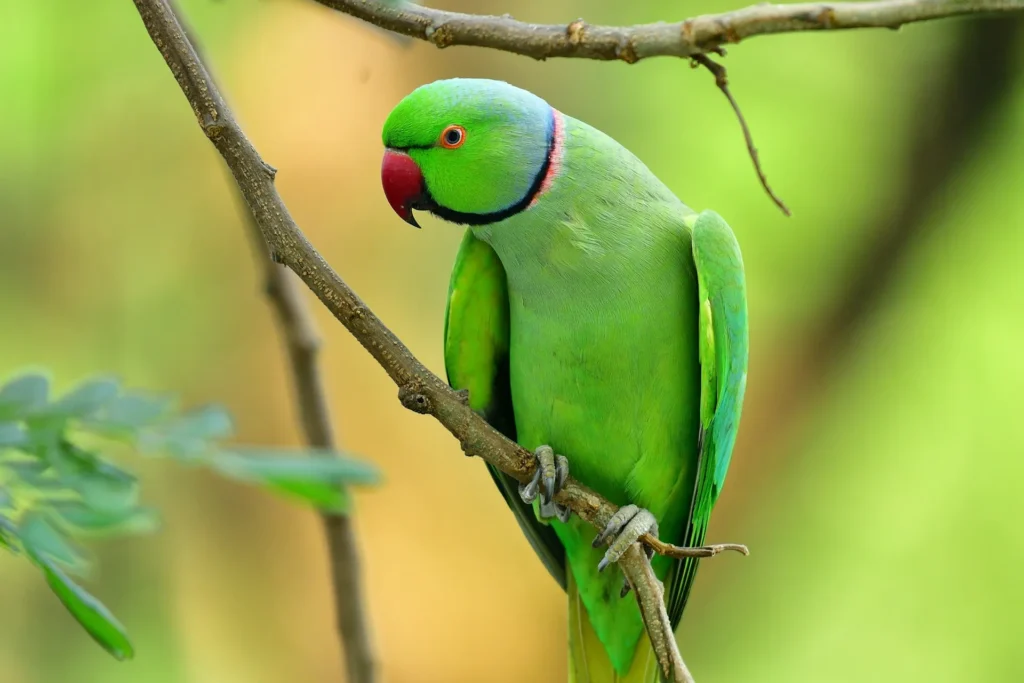
- ID: Bright green overall with a long, pointed tail. Adult males develop a distinct rose-and-black neck ring, clearly distinguishing them from other regional parakeet species.
- Size: ~40 cm (including tail).
- Season: Resident.
- Where to see: Widespread in mature park canopies, notably Deer Park and central Delhi avenues.
- Call: A loud, high-pitched, and screeching “kee-ak”.
- Conservation: Least Concern. Common throughout the capital.
- Source: Launch India; Delhi Bird Atlas.
5. Indian Peafowl (Pavo cristatus)
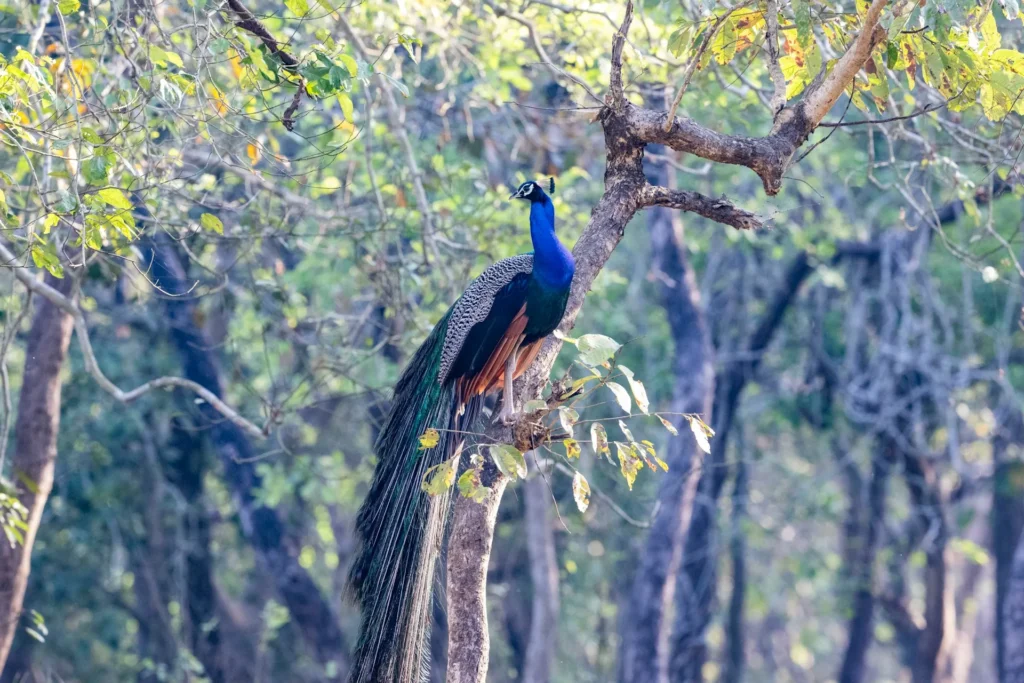
- ID: The unmistakable national bird; males possess an elongated, iridescent blue-green train with “eye” spots, while females are a mottled brown with a shorter tail and green neck.
- Size: Male ~200 cm (with train); Female ~86 cm.
- Season: Resident.
- Where to see: Often found in semi-urban and park areas, especially Sanjay Van and the Aravalli Biodiversity Park.
- Call: A loud, carrying “may-awe” or harsh trumpet.
- Conservation: Least Concern (Protected under Schedule I). Highly visible in secure ridge environments.
- Source: Sudhir Vyas; Launch India.
6. House Crow (Corvus splendens)
- ID: A slender crow with a distinctly glossy black forehead, crown, and throat, contrasting heavily with a greyish neck and breast. This two-toned look distinguishes it from the all-black Jungle Crow or Raven.
- Size: ~40 cm.
- Season: Resident.
- Where to see: Ubiquitous across all human settlements and refuse sites.
- Call: A flat, repetitive “caw-caw”.
- Conservation: Least Concern. Dominant urban scavenger.
- Source: Sudhir Vyas; eBird.
7. Black Kite (Milvus migrans)
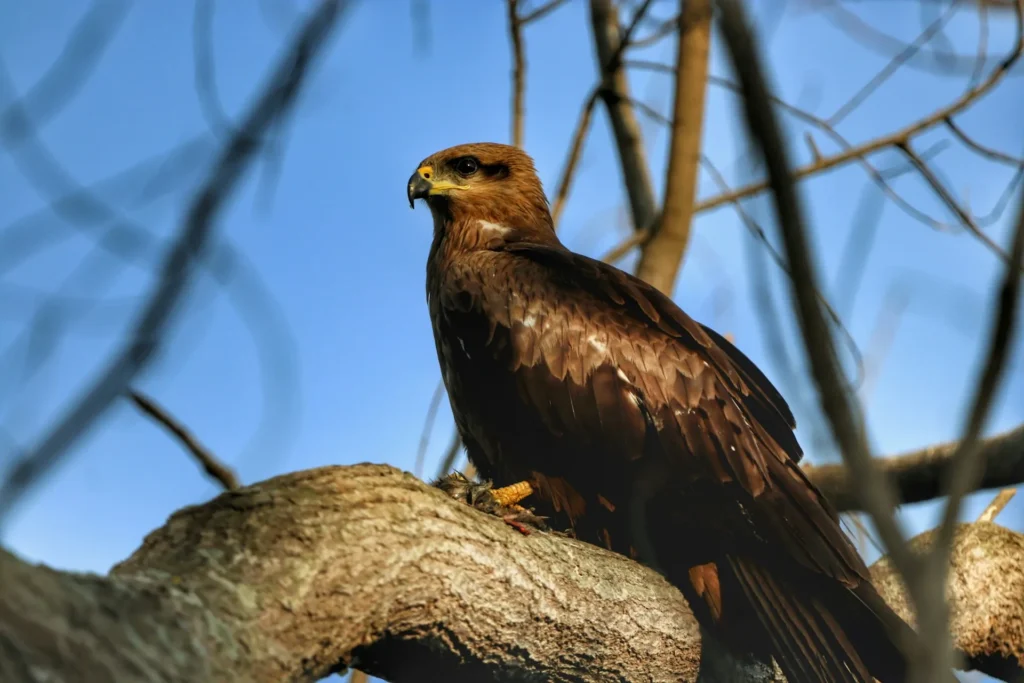
- ID: A large, dark brown raptor easily identified in flight by its shallowly forked tail—a feature separating it from all other common eagles and hawks in the city.
- Size: ~55–60 cm.
- Season: Resident.
- Where to see: Circling high on thermals over the city, especially near Ghazipur and the Yamuna floodplains.
- Call: A high-pitched, whinnying whistle.
- Conservation: Least Concern. Highly successful urban scavenger.
- Source: Delhi Bird Atlas; Avibase.
8. Red-vented Bulbul (Pycnonotus cafer)
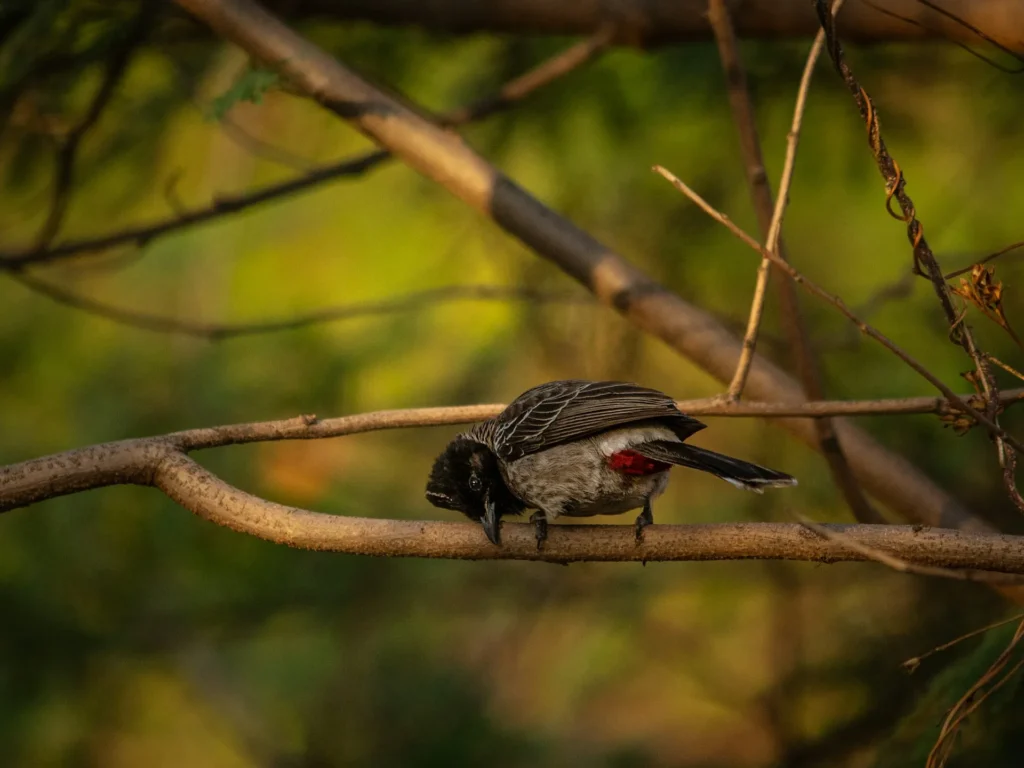
Image : Red Vented Bulbul
- ID: A smoky-brown, medium-sized bird with a slightly crested black head, scale-like pattern on the breast, and a distinct crimson patch under the tail base.
- Size: ~20 cm.
- Season: Resident.
- Where to see: Common in low bushes and gardens across residential Delhi and urban parks.
- Call: Cheerful, rapid, and melodic “be-care-ful” notes.
- Conservation: Least Concern. Flourishes in modified habitats.
- Source: eBird; Sudhir Vyas
9. Oriental Magpie-Robin (Copsychus saularis)
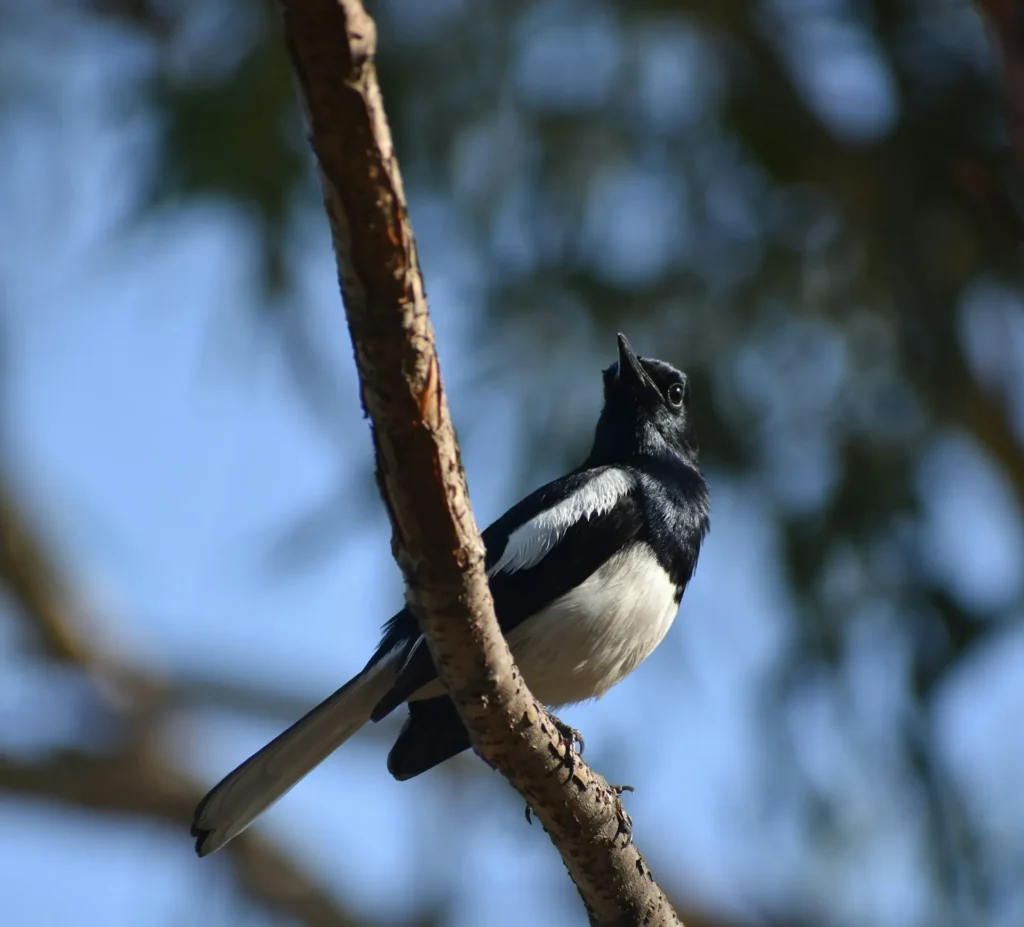
- ID: A striking black-and-white bird (females are grey and white) with a distinct upright posture, frequently cocking its long tail upwards.
- Size: ~19 cm.
- Season: Resident.
- Where to see: Wooded gardens, Lodhi Garden edges, and shady park undergrowth.
- Call: A beautiful, complex whistling song, usually delivered from a prominent perch at dawn.
- Conservation: Least Concern.
- Source: Avibase; Sudhir Vyas.
10. Indian Roller (Coracias benghalensis)
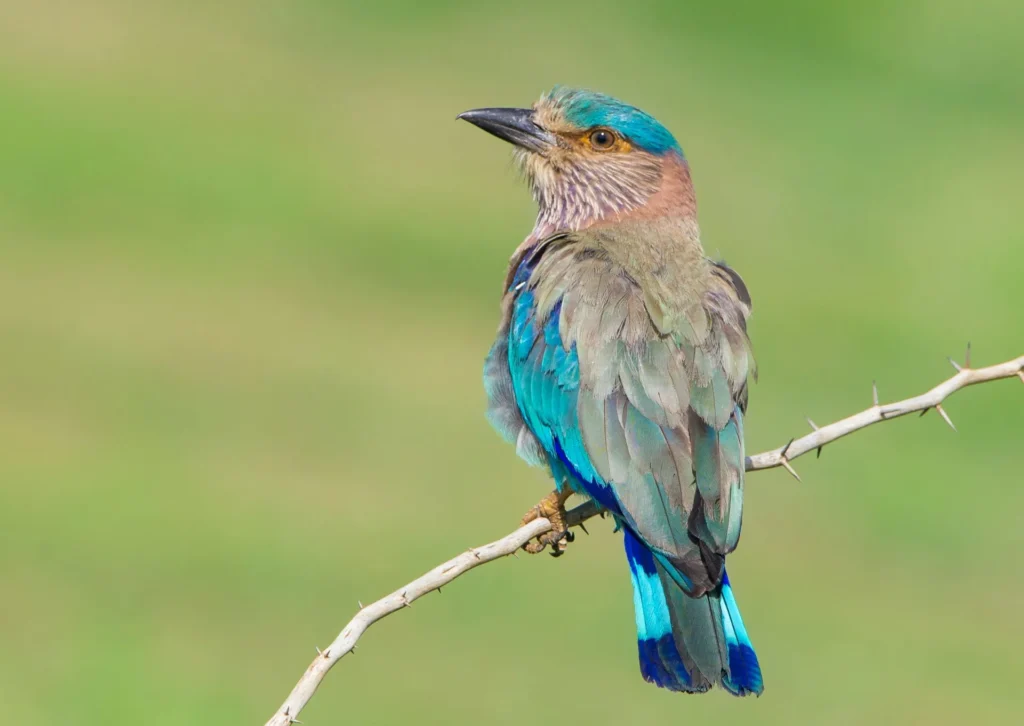
- ID: A stocky bird appearing dull brown and greenish-blue when perched, but revealing brilliant flashes of pale and dark blue across its wings in flight.
- Size: ~30–34 cm.
- Season: Resident.
- Where to see: Open scrub, agricultural fringes of the city, and perched on utility wires near the Aravalli ridge.
- Call: Harsh, crow-like “chack” sounds.
- Conservation: Least Concern.
- Source: Avibase; Delhi Biodiversity Foundation.
11. White-throated Kingfisher (Halcyon smyrnensis)
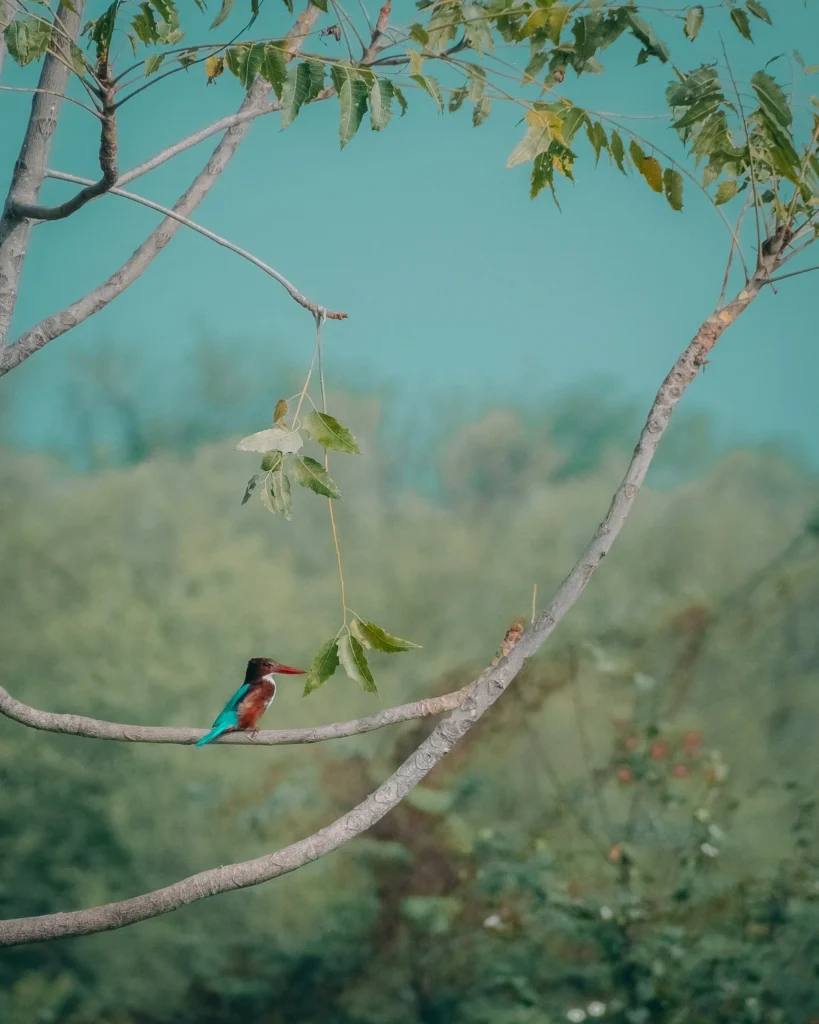
- ID: A large kingfisher with a massive red bill, striking turquoise back and wings, chocolate-brown head and belly, and a brilliant white throat and breast patch.
- Size: ~27–28 cm.
- Season: Resident.
- Where to see: Often sits on branches or cables away from water; common in major parks and open fields.
- Call: A loud, descending, trilling laugh.
- Conservation: Least Concern. Not strictly dependent on wetlands for feeding.
- Source: eBird; Sudhir Vyas.
12. Eurasian Hoopoe (Upupa epops)
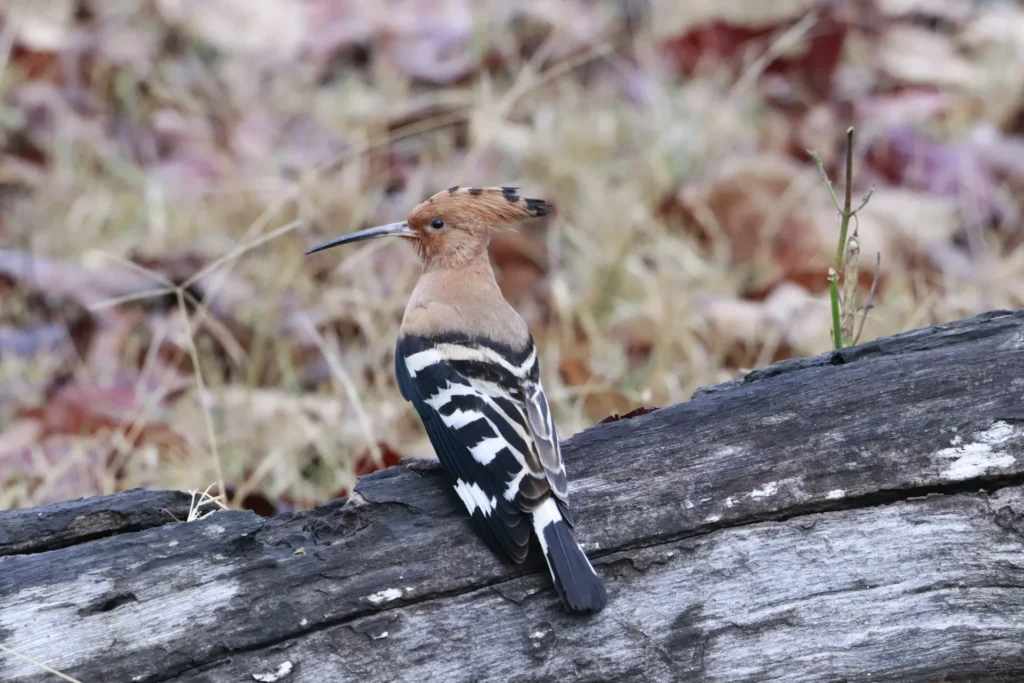
- ID: Instantly recognisable by its fawn-coloured body, dramatic black-and-white striped wings, and a prominent, fan-like crest that it raises upon landing.
- Size: ~25–29 cm.
- Season: Resident.
- Where to see: Probing the soil with its long curved beak on manicured lawns in Nehru Park and Lodhi Garden.
- Call: A soft, repetitive “oop-oop-oop”.
- Conservation: Least Concern.
- Source: Avibase; Sudhir Vyas.
13. Indian Grey Hornbill (Ocyceros birostris)
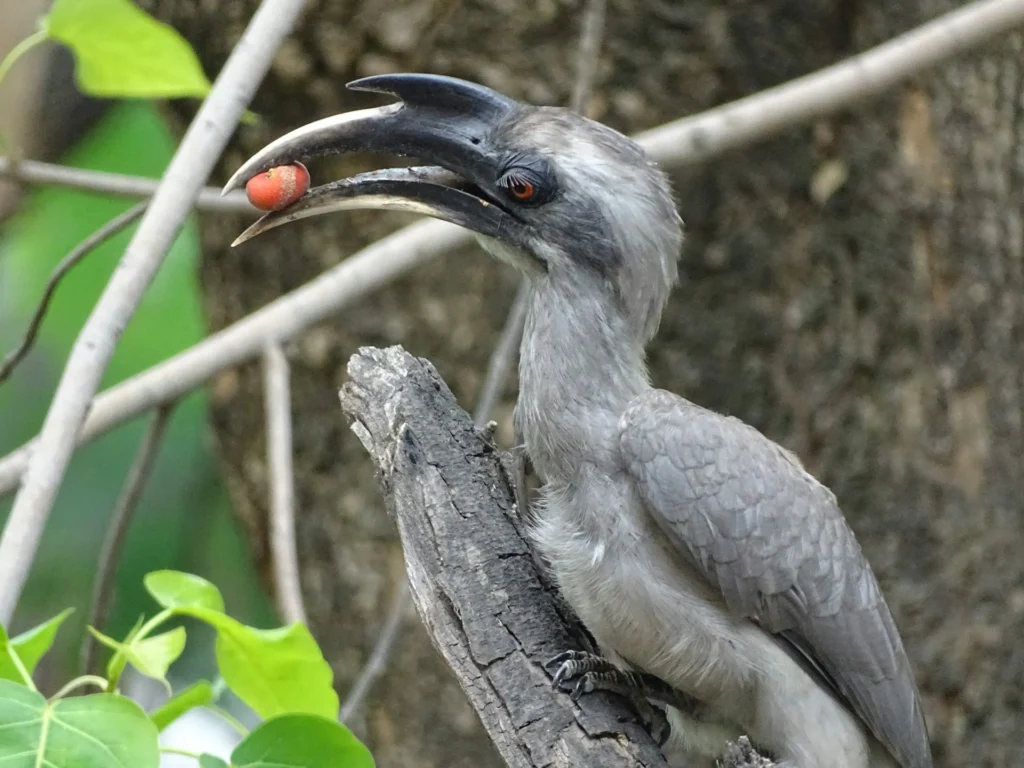
- ID: A large, cumbersome-looking grey bird with a heavy, curved bill featuring a small casque (horn-like structure) on top, and a long tail.
- Size: ~50 cm.
- Season: Resident.
- Where to see: Moving clumsily through the upper canopy of native woodland spaces like the Aravali Biodiversity Park and mature park avenues.
- Call: A loud, squeaky, kite-like “k-k-k-ka-e” squeal.
- Conservation: Least Concern. Adapts well to cities with large, old fig trees.
- Source: Delhi Bird Atlas; Sudhir Vyas.
14. Asian Koel (Eudynamys scolopaceus)
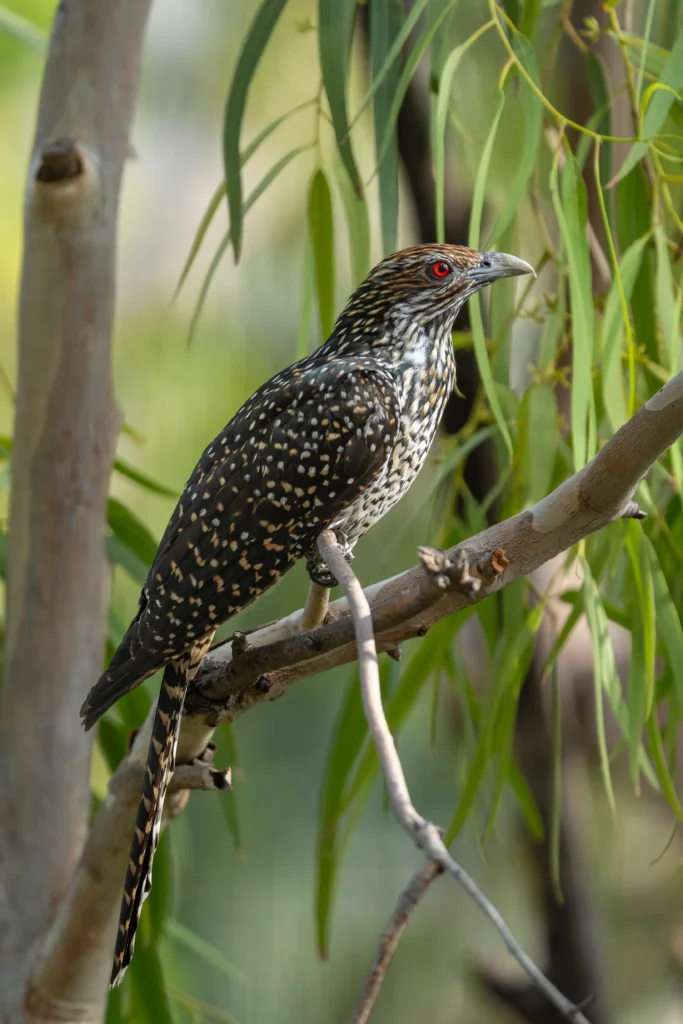
- ID: A large cuckoo. The male is glossy black with striking crimson eyes and a pale greenish bill; the female is dark brown, heavily spotted and barred with white.
- Size: ~39–46 cm.
- Season: Resident.
- Where to see: High up in dense canopy foliage across most urban parks; often heard before being seen.
- Call: A loud, escalating “ko-el, ko-el” that defines the sound of Delhi’s summer.
- Conservation: Least Concern. A brood parasite that primarily lays its eggs in crow nests.
- Source: eBird; Sudhir Vyas.
15. Jungle Babbler (Turdoides striata)
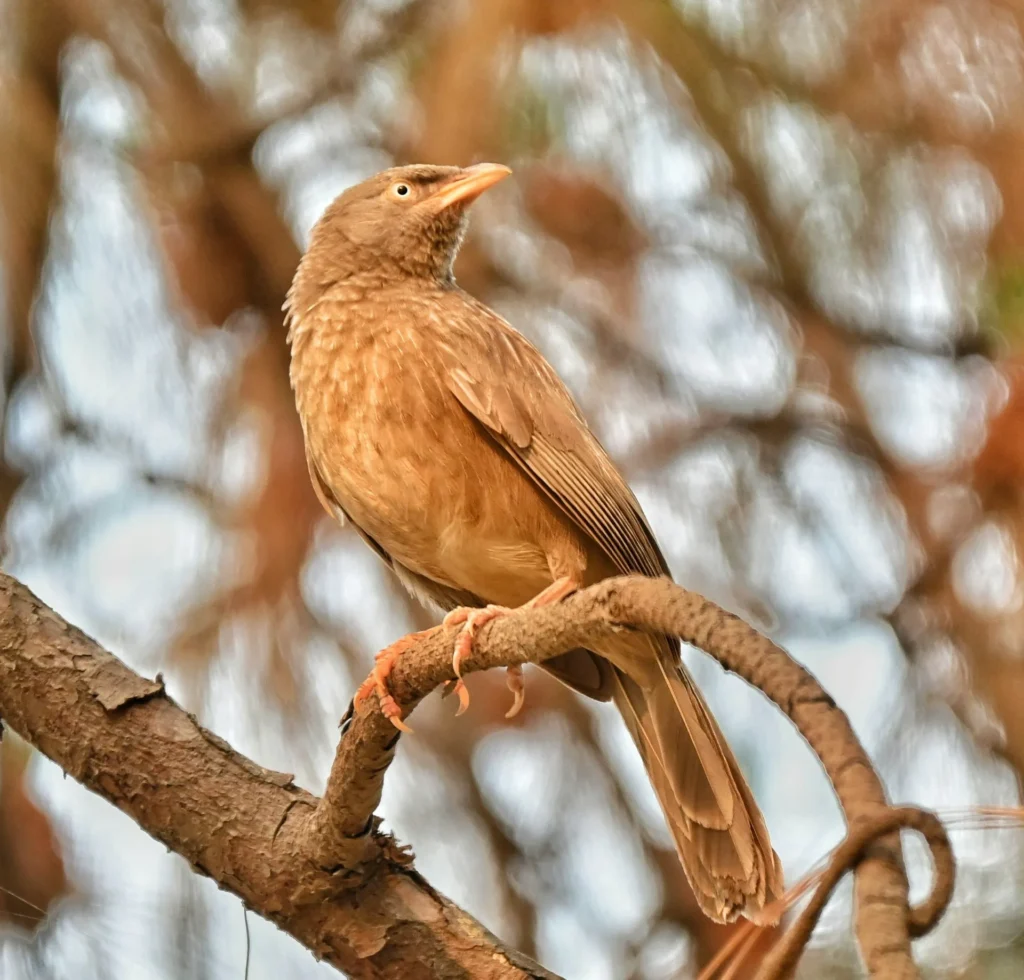
- ID: An untidy, earthy-brown bird with a yellowish bill and pale eyes, almost always seen moving rapidly in noisy groups of six to ten.
- Size: ~25 cm.
- Season: Resident.
- Where to see: Foraging aggressively through leaf litter in park underbrush and garden hedges.
- Call: A harsh, continuous, chattering squeak (hence the local name “Seven Sisters”).
- Conservation: Least Concern.
- Source: Avibase; Sudhir Vyas.
16. Cattle Egret (Bubulcus ibis)
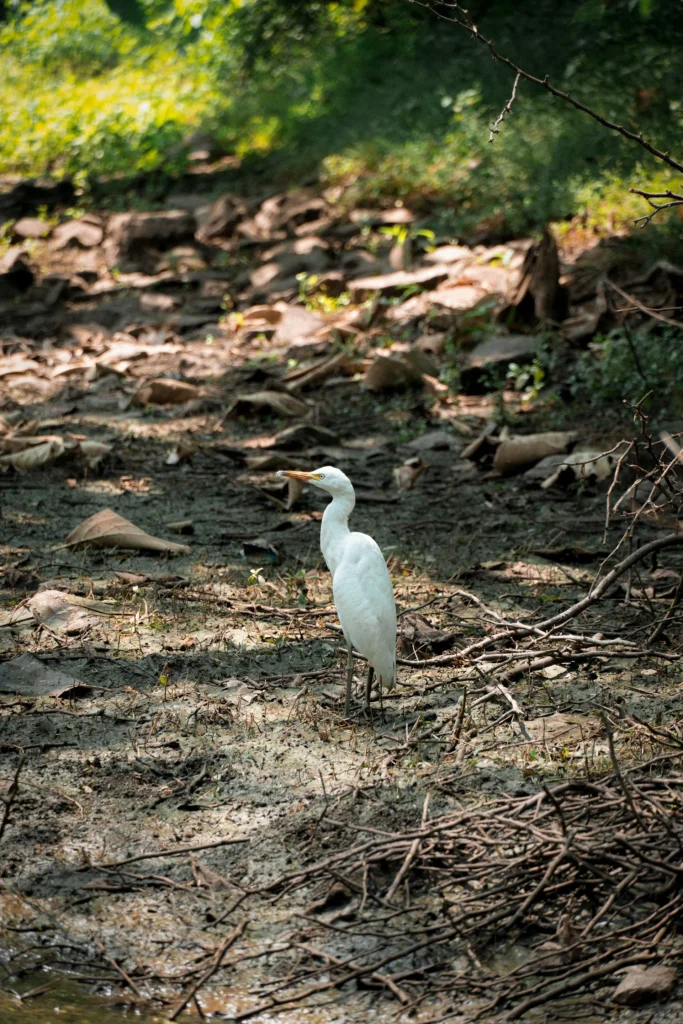
- ID: A compact, stocky white egret with a relatively short yellow bill and yellow legs. During the breeding season, it develops orange-buff plumes on the head, back, and breast.
- Size: ~46–56 cm.
- Season: Resident.
- Where to see: Open grassy fields, the Yamuna floodplains, and alongside cattle or tractors.
- Call: Generally silent, occasionally offering harsh croaks.
- Conservation: Least Concern.
- Source: Delhi Bird Atlas; Avibase.
17. Indian Pond Heron (Ardeola grayii)
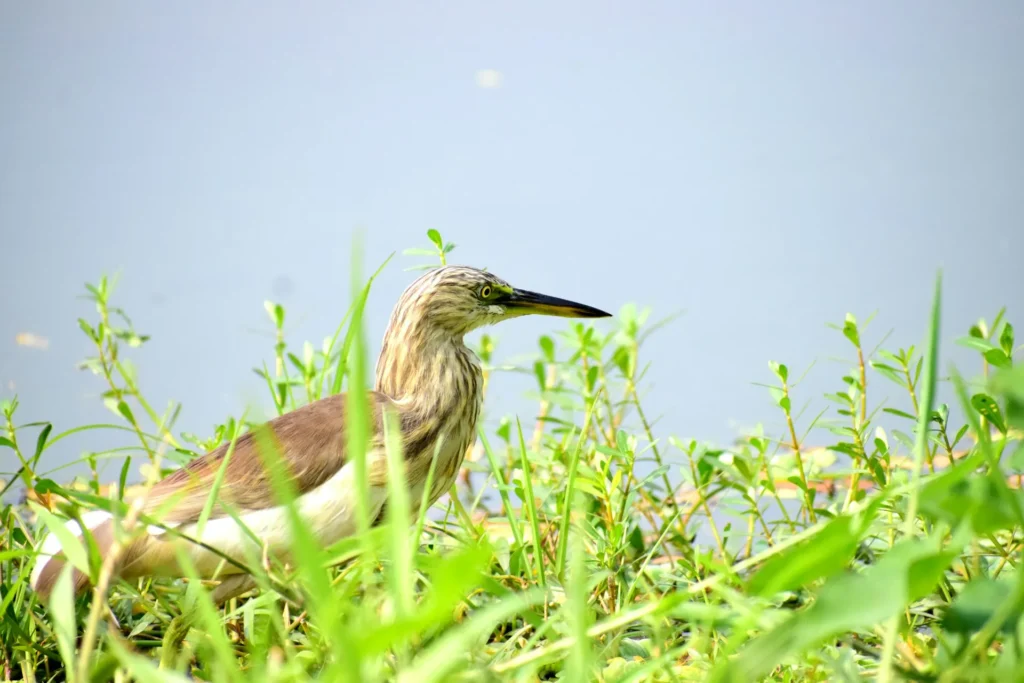
- ID: When hunched by the water, it appears as an unremarkable streaky brown bird. In flight, it transforms, revealing startlingly brilliant white wings.
- Size: ~42–46 cm.
- Season: Resident.
- Where to see: Standing motionless near the edges of ornamental ponds in Lodhi Garden and shallow wetlands.
- Call: A harsh, low croak when alarmed.
- Conservation: Least Concern.
- Source: Avibase; Sudhir Vyas.
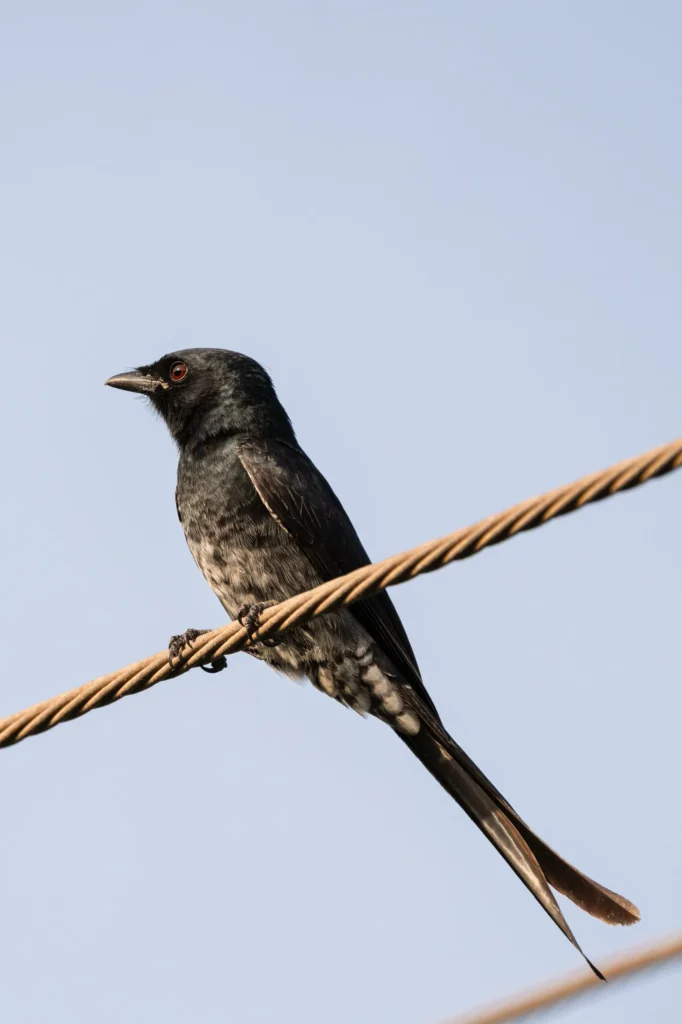
18. Black Drongo (Dicrurus macrocercus)
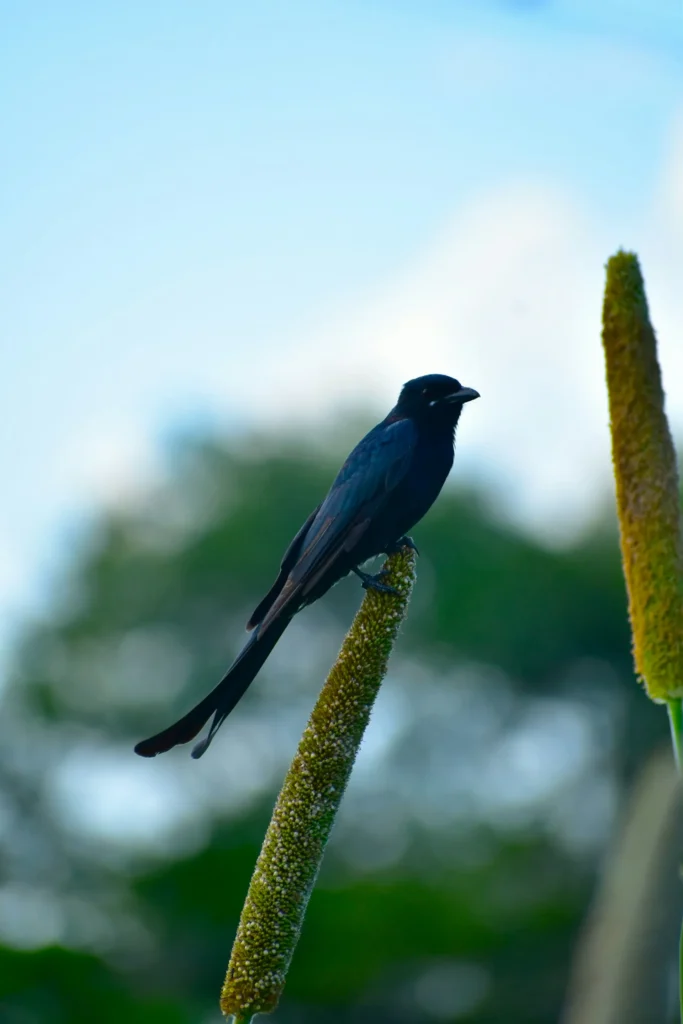
- ID: A sleek, glossy black bird with a distinctly long, deeply forked tail, often sitting completely upright on exposed perches.
- Size: ~28 cm.
- Season: Resident.
- Where to see: Fences, telegraph wires, and exposed branches at the edges of parks and agricultural land.
- Call: A series of sharp, varied, and occasionally harsh whistles.
- Conservation: Least Concern. An aggressive aerial hunter that frequently chases away larger birds.
- Source: eBird; Sudhir Vyas.
19. Purple Sunbird (Cinnyris asiaticus)
- ID: A tiny, active nectar-feeder with a thin, curved bill. Breeding males are glossy metallic purple-black; females are olive-brown above and pale yellow below.
- Size: ~10 cm.
- Season: Resident.
- Where to see: Hovering near tubular flowers in urban gardens, balconies, and scrubland.
- Call: A sharp, rapid “chwit-chwit”.
- Conservation: Least Concern.
- Source: Avibase; Sudhir Vyas.
20. Red-wattled Lapwing (Vanellus indicus)
- ID: A large plover with long yellow legs, a black head and breast, brown back, and a prominent fleshy red wattle just in front of each eye.
- Size: ~32–35 cm.
- Season: Resident.
- Where to see: Open ground, dry lake beds, and construction sites.
- Call: A frantic, loud, and repetitive “did-he-do-it” alarm call.
- Conservation: Least Concern.
- Source: Avibase; Sudhir Vyas.
21. Barn Owl (Tyto alba)
- ID: A medium-sized owl with a striking, heart-shaped white facial disk, pale underside, and golden-buff back with fine grey speckling.
- Size: ~33–39 cm.
- Season: Resident.
- Where to see: Nocturnal species recorded roosting in old ruins, large tree cavities, and historical monuments around Delhi.
- Call: An eerie, drawn-out, harsh shriek.
- Conservation: Least Concern. An important urban rodent controller.
- Source: Sudhir Vyas; eBird.
22. Eurasian Collared Dove (Streptopelia decaocto)
- ID: A pale, sandy-grey dove with a distinct narrow black half-collar on the back of its neck, and a long tail with white outer feathers.
- Size: ~31–33 cm.
- Season: Resident.
- Where to see: Dry scrub, open agricultural borders, and less congested suburban gardens.
- Call: A rhythmic, repetitive “coo-coo-coo”.
- Conservation: Least Concern. Often noted alongside other common columbids in the region.
- Source: Launch India; Avibase.
23. Laughing Dove (Spilopelia senegalensis)
- ID: A small, slim, reddish-brown dove with a lilac-tinged head and a distinctive scaled, black-and-copper patch on the lower throat.
- Size: ~25 cm.
- Season: Resident.
- Where to see: Ground foraging in dry gardens, parks, and the edges of the Aravalli scrub.
- Call: A gentle, bubbling, five-note “coo-coo-coo-coo-coo” that sounds like soft laughter.
- Conservation: Least Concern.
- Source: Avibase; Sudhir Vyas.
24. Brown-headed Barbet (Psilopogon zeylanicus)
- ID: A heavy-set, leaf-green bird with a streaked brown head, bare orange skin around the eye, and a large, pale bill.
- Size: ~27 cm.
- Season: Resident.
- Where to see: Concealed high in large fruiting trees within native woodland spaces like the Aravali Biodiversity Park and mature ridge areas.
- Call: A monotonous, ringing “kutroo-kutroo-kutroo” repeated continuously.
- Conservation: Least Concern.
- Source: Delhi Bird Atlas; Avibase.
25. Coppersmith Barbet (Psilopogon haemacephalus)
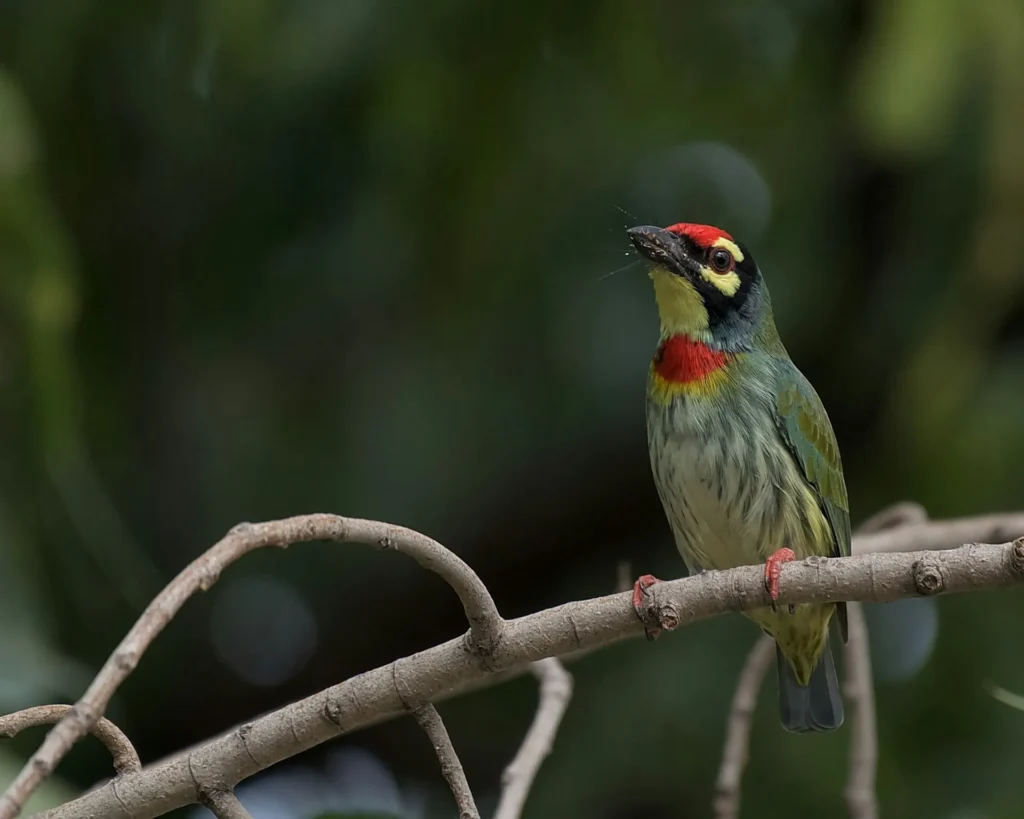
- ID: A small, stubby green bird with a yellow face, a bright crimson forehead, and a matching crimson patch on its breast.
- Size: ~17 cm.
- Season: Resident.
- Where to see: Clinging to the high branches of urban fig trees, often difficult to spot despite its bright colours.
- Call: A steady, metallic “tuk-tuk-tuk”, sounding like a coppersmith striking metal.
- Conservation: Least Concern.
- Source: Avibase; Sudhir Vyas.
.
The 50 Common Birds Directory: Migratory & Wetland Species (Birds 26–50)
Delhi’s position on the Central Asian Flyway transforms the city’s avian profile every winter. According to baseline survey data, species counts jump significantly in the colder months, with up to 200 species active during winter compared to 152 in the summer. This influx is most visible in wetland areas like the Okhla Bird Sanctuary and the Yamuna floodplains, which draw vast numbers of migratory ducks, waders, and gulls.
This section covers the second half of our guide, focusing on common waterbirds, significant local species of conservation interest, and the most reliable winter migrants.
Table 3: Quick-Reference Matrix (Migratory & Wetland Species 26–50)
| # | Common Name | Scientific Name | Seasonality | Primary Delhi Habitat | IUCN Status |
| 26 | Little Cormorant | Microcarbo niger | Resident | Lakes, park ponds | Least Concern |
| 27 | Great Cormorant | Phalacrocorax carbo | Winter/Resident | Deep open water | Least Concern |
| 28 | Little Egret | Egretta garzetta | Resident | River shallows, wetlands | Least Concern |
| 29 | Great Egret | Ardea alba | Resident | Floodplains, large lakes | Least Concern |
| 30 | Black-crowned Night Heron | Nycticorax nycticorax | Resident | Dense trees near water | Least Concern |
| 31 | White-breasted Waterhen | Amaurornis phoenicurus | Resident | Reeds, park pond edges | Least Concern |
| 32 | Common Moorhen | Gallinula chloropus | Resident | Marshy lakesides | Least Concern |
| 33 | Black-winged Stilt | Himantopus himantopus | Resident | Mudflats, shallow water | Least Concern |
| 34 | River Tern | Sterna aurantia | Resident/Local | Yamuna river channel | Vulnerable |
| 35 | Egyptian Vulture | Neophron percnopterus | Resident | Open scrub, ridge edges | Endangered |
| 36 | Shikra | Accipiter badius | Resident | Wooded parks, gardens | Least Concern |
| 37 | Yellow-footed Green Pigeon | Treron phoenicopterus | Resident | Mature fig trees | Least Concern |
| 38 | Green Bee-eater | Merops orientalis | Resident/Summer | Open ground, wires | Least Concern |
| 39 | Wire-tailed Swallow | Hirundo smithii | Resident | Flying over water | Least Concern |
| 40 | Ashy Prinia | Prinia socialis | Resident | Low bushes, gardens | Least Concern |
| 41 | Common Tailorbird | Orthotomus sutorius | Resident | Dense urban foliage | Least Concern |
| 42 | Indian Silverbill | Euodice malabarica | Resident | Dry grass, scrub | Least Concern |
| 43 | Northern Shoveler | Spatula clypeata | Winter Migrant | Open wetlands | Least Concern |
| 44 | Northern Pintail | Anas acuta | Winter Migrant | Flooded marshes | Least Concern |
| 45 | Eurasian Teal | Anas crecca | Winter Migrant | Shallow wetland margins | Least Concern |
| 46 | Gadwall | Mareca strepera | Winter Migrant | Lakes, Okhla Sanctuary | Least Concern |
| 47 | Brown-headed Gull | Chroicocephalus brunnicephalus | Winter Migrant | Yamuna river | Least Concern |
| 48 | Black-headed Gull | Chroicocephalus ridibundus | Winter Migrant | Yamuna river | Least Concern |
| 49 | Wood Sandpiper | Tringa glareola | Winter Migrant | Mudflats, river edges | Least Concern |
| 50 | White Wagtail | Motacilla alba | Winter Migrant | Lawns, water edges | Least Concern |
The 50 Common Birds of Delhi (Part B: Wetlands & Migrants)
26. Little Cormorant (Microcarbo niger)
- ID: A small, entirely black waterbird with a relatively short, thick bill and a long tail. Often seen holding its wings open to dry after diving.
- Size: ~50 cm.
- Season: Resident.
- Where to see: Artificial lakes in Deer Park, Lodhi Garden, and Yamuna backwaters.
- Call: Generally silent.
- Conservation: Least Concern.
- Source: eBird; Delhi Biodiversity Foundation.
27. Great Cormorant (Phalacrocorax carbo)
- ID: Much larger than the Little Cormorant, with a thicker neck, a prominent white patch on the throat, and yellow bare skin at the base of the bill.
- Size: ~80–100 cm.
- Season: Winter migrant with a small resident breeding population.
- Where to see: Deep, open water sections of the Yamuna River and Okhla Bird Sanctuary.
- Call: Guttural grunts at roosts.
- Conservation: Least Concern.
- Source: Delhi Bird Atlas; Avibase.
28. Little Egret (Egretta garzetta)
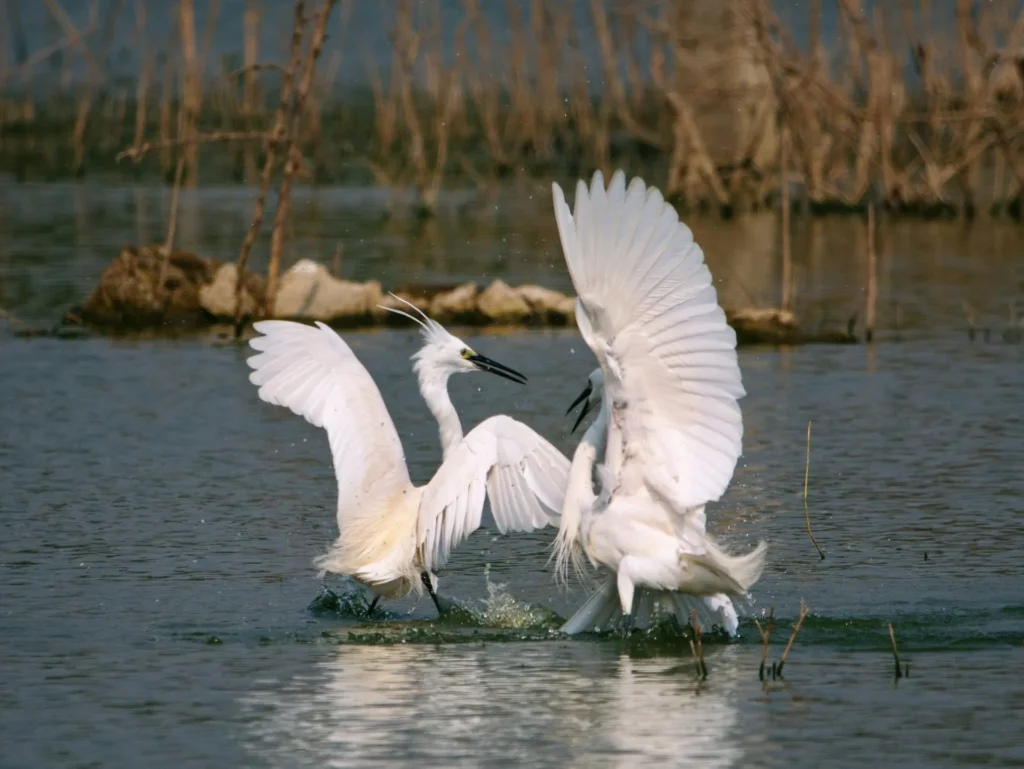
- ID: A slender, pure white heron distinguished by its black bill, black legs, and bright yellow feet (often visible as it wades in shallow water).
- Size: ~55–65 cm.
- Season: Resident.
- Where to see: Wading in the shallows of the Yamuna floodplains and park ponds.
- Call: Harsh croaks when flushed.
- Conservation: Least Concern.
- Source: Sudhir Vyas; eBird.
29. Great Egret (Ardea alba)
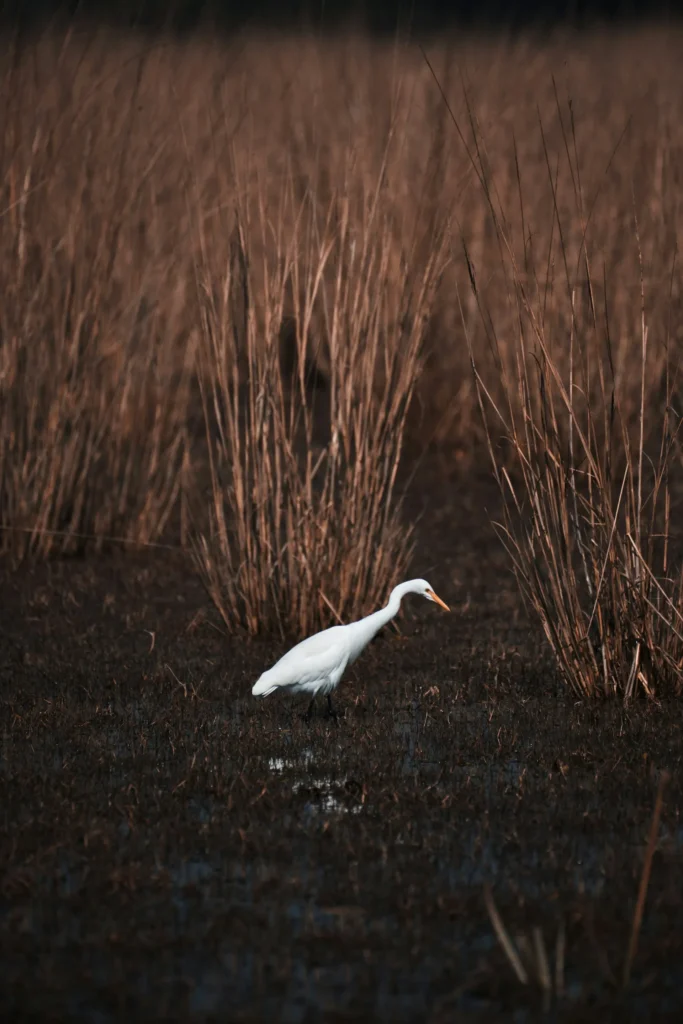
- ID: A massive, long-necked white heron with a heavy yellow bill and dark legs. It has a distinctive kink in its neck when resting or flying.
- Size: ~85–100 cm.
- Season: Resident.
- Where to see: Stalking fish in the Okhla wetlands and along the main Yamuna channel.
- Call: Deep, hoarse croaks.
- Conservation: Least Concern.
- Source: Avibase; Delhi Bird Atlas.
30. Black-crowned Night Heron (Nycticorax nycticorax)
- ID: A stocky, short-necked heron. Adults have a black crown and back, pale grey wings, white underparts, and striking red eyes.
- Size: ~58–65 cm.
- Season: Resident.
- Where to see: Roosting motionlessly during the day in dense trees overhanging water, such as those at the National Zoological Park.
- Call: A harsh “quark” given mostly in flight at dusk.
- Conservation: Least Concern.
- Source: Sudhir Vyas; Avibase.
31. White-breasted Waterhen (Amaurornis phoenicurus)
- ID: A dark slaty-grey bird with a brilliant white face and breast, and a rusty red patch under its stubby tail.
- Size: ~32 cm.
- Season: Resident.
- Where to see: Skulking in the reeds and dense vegetation around the edges of park ponds and marshy areas.
- Call: A loud, repetitive, and mechanical “ruwak-ruwak” call, especially during the monsoon.
- Conservation: Least Concern.
- Source: Delhi Biodiversity Foundation; eBird.
32. Common Moorhen (Gallinula chloropus)
- ID: A dark, charcoal-black waterbird with a prominent bright red frontal shield (forehead) tipped with yellow on the bill, and a white line along its flanks.
- Size: ~30–38 cm.
- Season: Resident.
- Where to see: Swimming in shallow, vegetation-choked water bodies across the NCR.
- Call: A sharp, explosive “kurruk”.
- Conservation: Least Concern.
- Source: Sudhir Vyas; Avibase.
33. Black-winged Stilt (Himantopus himantopus)
- ID: Unmistakable wader with strikingly long, needle-thin pink legs, a black back and wings, and bright white underparts.
- Size: ~35–40 cm.
- Season: Resident.
- Where to see: Probing the mudflats of the Yamuna floodplains and shallow seasonal pools.
- Call: A noisy, high-pitched “kik-kik-kik”.
- Conservation: Least Concern.
- Source: eBird; Delhi Bird Atlas.
34. River Tern (Sterna aurantia)
- ID: A medium-sized, elegant grey-and-white tern with a deep yellow bill, a black cap (in breeding plumage), and a deeply forked tail.
- Size: ~38–43 cm.
- Season: Resident/Local migrant.
- Where to see: Patrolling steadily back and forth over the main channels of the Yamuna River.
- Call: A sharp “kyuk-kyuk”.
- Conservation: Vulnerable. The Delhi Bird Atlas explicitly notes this species as an important record reflecting concern for local wetland habitats.
- Source: Delhi Bird Atlas.
35. Egyptian Vulture (Neophron percnopterus)
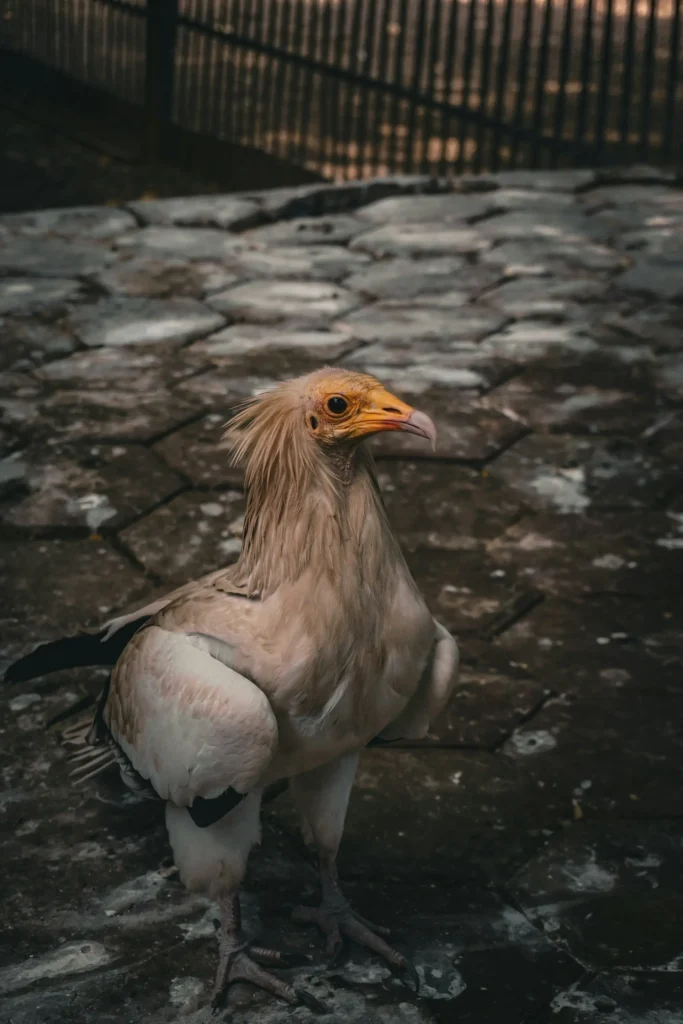
- ID: A small vulture. Adults are mostly white with contrasting black flight feathers and a bare, yellow face. Immatures are entirely dark brown.
- Size: ~58–70 cm.
- Season: Resident.
- Where to see: Soaring over the Aravalli ridge areas and scavenging near open scrub or refuse sites.
- Call: Generally silent.
- Conservation: Endangered. Despite its global decline, it remains an important, vulnerable species consistently recorded in the Delhi area.
- Source: Delhi Bird Atlas; Avibase.
36. Shikra (Accipiter badius)
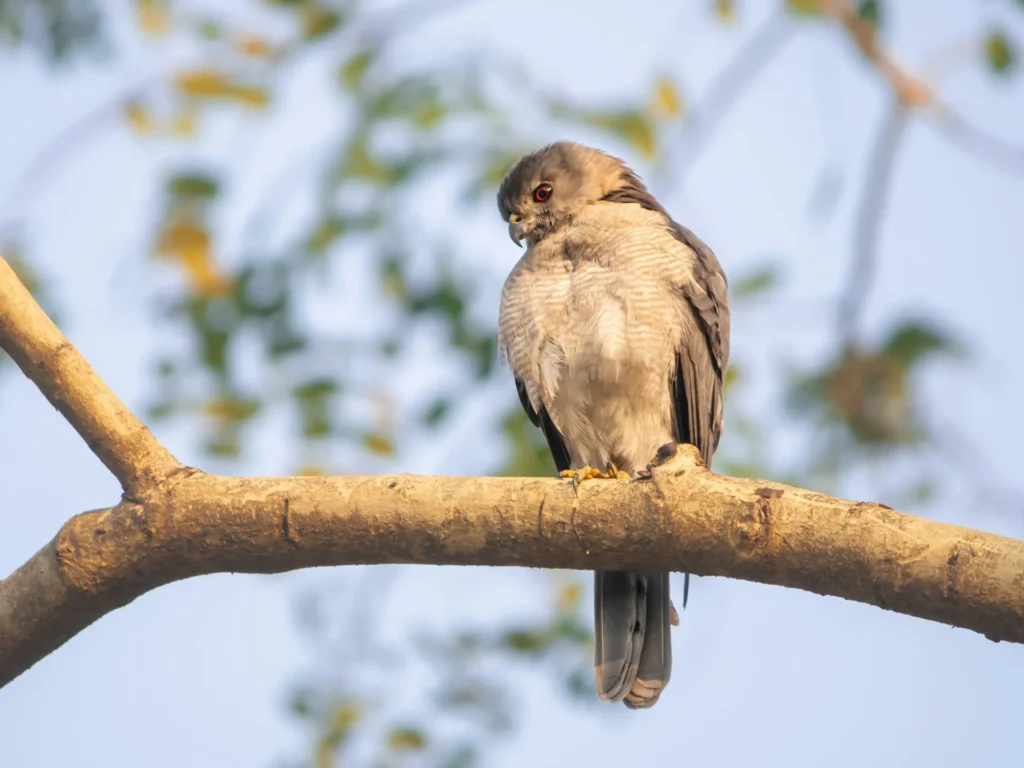
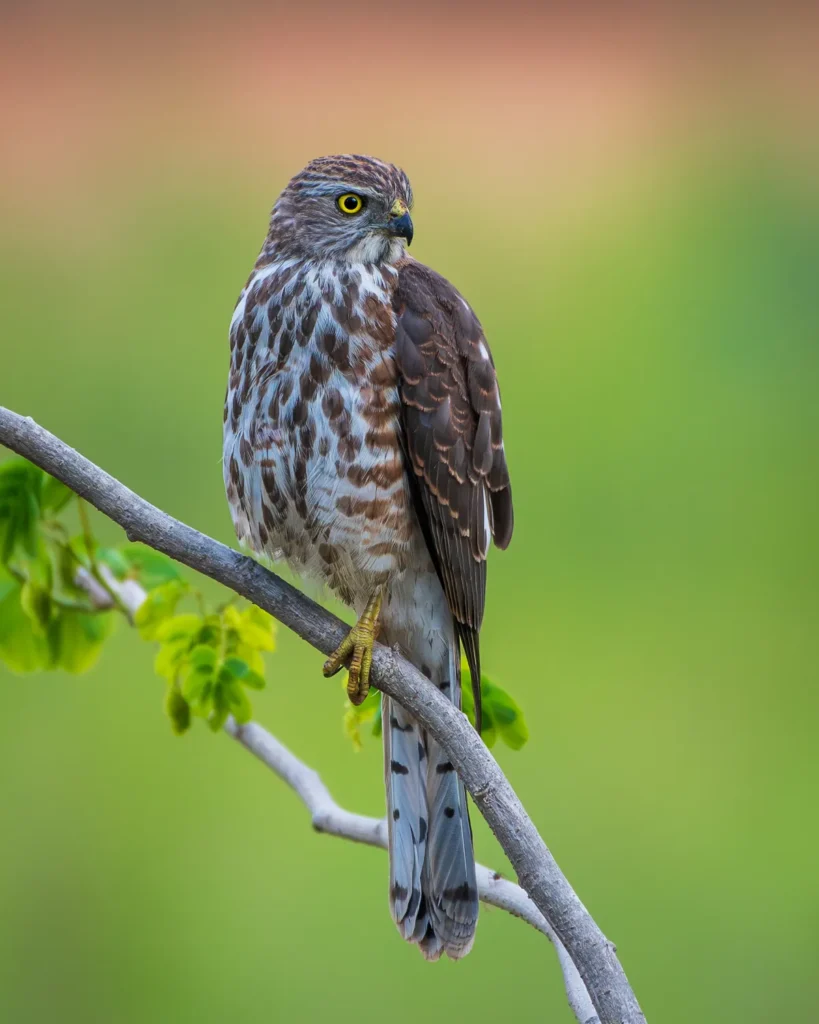
- ID: A small, fast-flying hawk. Adults have pale grey upperparts, fine orange-brown barring on the chest, and striking red eyes.
- Size: ~30–36 cm.
- Season: Resident.
- Where to see: Hunting from concealed perches in wooded parks like Sanjay Van and large residential gardens.
- Call: A sharp, rapid, two-note “ti-tu, ti-tu” whistle.
- Conservation: Least Concern.
- Source: Sudhir Vyas; eBird.
37. Yellow-footed Green Pigeon (Treron phoenicopterus)
- ID: A bulky, yellow-green pigeon with a lilac patch on the shoulder and distinct yellow legs. It blends perfectly into green foliage.
- Size: ~33 cm.
- Season: Resident.
- Where to see: Foraging in flocks high up in mature fruiting fig (peepal and banyan) trees across central Delhi.
- Call: A series of soft, melodious, human-like whistles.
- Conservation: Least Concern. This is the state bird of Delhi.
- Source: Launch India; Sudhir Vyas.
38. Green Bee-eater (Merops orientalis)
- ID: A tiny, brilliant emerald-green bird with a rusty crown, a black “mask” through the eye, a black throat band, and elongated central tail feathers.
- Size: ~16–18 cm (plus tail streamers).
- Season: Resident (with local summer movements).
- Where to see: Perched on low fences and electrical wires over open ground or agricultural borders.
- Call: A gentle, rolling “trill-trill”.
- Conservation: Least Concern.
- Source: eBird; Delhi Biodiversity Foundation.
39. Wire-tailed Swallow (Hirundo smithii)
- ID: A small, fast-flying bird with brilliant blue upperparts, bright white underparts, a chestnut cap, and two long, wire-like outer tail feathers.
- Size: ~14 cm (plus tail wires).
- Season: Resident.
- Where to see: Skimming low over the water at Okhla Bird Sanctuary and open lakes.
- Call: A sharp “chit-chit” during flight.
- Conservation: Least Concern.
- Source: Avibase; Sudhir Vyas.
40. Ashy Prinia (Prinia socialis)
- ID: A small, active warbler with ash-grey upperparts, pale buff underparts, and a long tail that it constantly wags or holds cocked upright.
- Size: ~13 cm.
- Season: Resident.
- Where to see: Foraging low in grass, scrub, and garden hedges.
- Call: A sharp, metallic “tchink-tchink-tchink”, sounding like tiny shears clipping.
- Conservation: Least Concern.
- Source: Sudhir Vyas; eBird.
41. Common Tailorbird (Orthotomus sutorius)
- ID: A tiny, restless bird with olive-green upperparts, pale underparts, and a distinct rust-coloured cap. It holds its short tail straight up.
- Size: ~13 cm.
- Season: Resident.
- Where to see: Hopping through dense ornamental bushes and undergrowth in urban gardens.
- Call: An incredibly loud, repetitive “towit-towit-towit”.
- Conservation: Least Concern.
- Source: eBird; Launch India.
42. Indian Silverbill (Euodice malabarica)
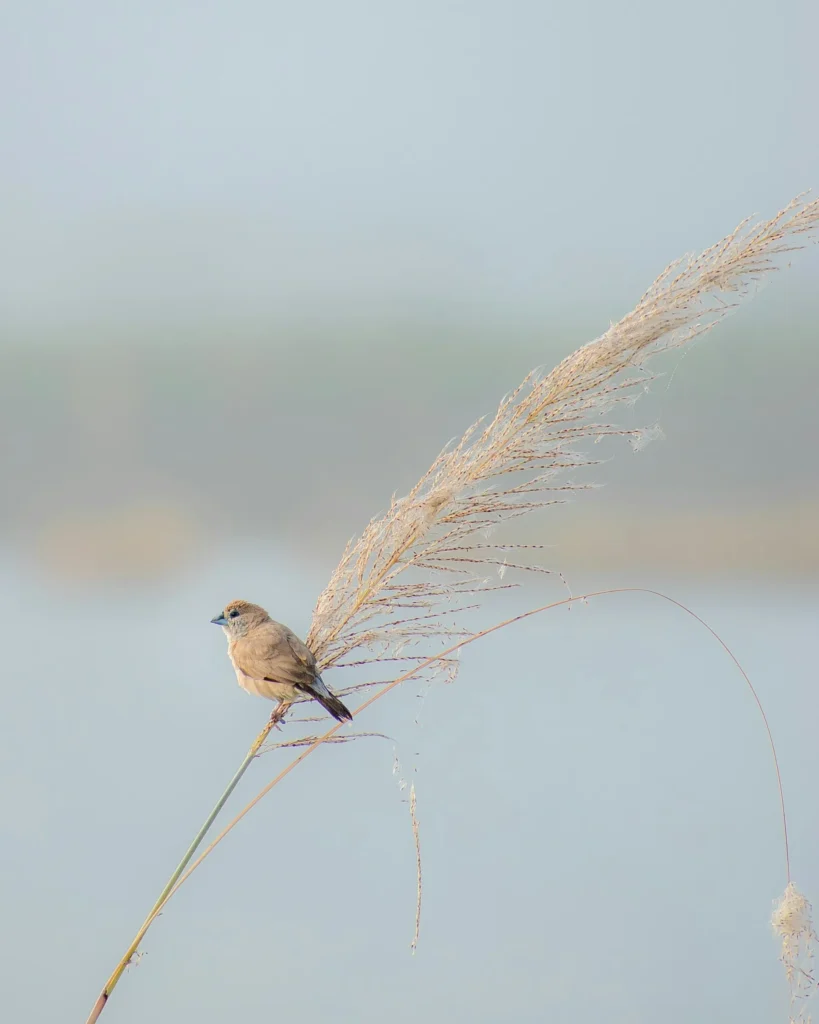
- ID: A small, plain, light-brown finch with a thick, conical silver-grey bill and a pointed black tail.
- Size: ~11 cm.
- Season: Resident.
- Where to see: Moving in small flocks through dry, tall grass in the Aravalli Biodiversity Park.
- Call: Soft, high-pitched chirps.
- Conservation: Least Concern.
- Source: Delhi Biodiversity Foundation; Avibase.
43. Northern Shoveler (Spatula clypeata)
- ID: A duck recognized instantly by its oversized, spatulate (spoon-shaped) bill. Males feature a green head, white chest, and chestnut flanks.
- Size: ~48–52 cm.
- Season: Winter Migrant.
- Where to see: Filtering feeding on the surface of open wetlands and the Okhla sanctuary.
- Call: Mostly silent; occasional low quacks.
- Conservation: Least Concern.
- Source: Delhi Bird Atlas; eBird.
44. Northern Pintail (Anas acuta)
- ID: A large, elegant dabbling duck. Males have a chocolate-brown head, a white neck stripe, and long, needle-like central tail feathers.
- Size: ~50–75 cm (male including tail).
- Season: Winter Migrant.
- Where to see: Shallow, flooded margins of the Yamuna floodplains.
- Call: A mellow, flute-like whistle.
- Conservation: Least Concern.
- Source: Delhi Bird Atlas; Avibase.
45. Eurasian Teal (Anas crecca)
- ID: A very small duck. The male has a finely grey-vermiculated body, a chestnut head, and a sweeping metallic green eye-patch bordered by cream lines.
- Size: ~34–38 cm.
- Season: Winter Migrant.
- Where to see: Dabbling at the muddy edges of Okhla Bird Sanctuary and local marshlands.
- Call: A high-pitched, ringing “krrik”.
- Conservation: Least Concern.
- Source: Delhi Bird Atlas; Sudhir Vyas.
46. Gadwall (Mareca strepera)
- ID: A medium-sized duck. From a distance, the male appears uniformly grey, but closer inspection reveals an intricate vermiculated pattern and a black rear end. Females resemble mallards but have a distinct white wing-patch.
- Size: ~46–56 cm.
- Season: Winter Migrant.
- Where to see: Flocking in large numbers on open lakes and wetlands during mid-winter.
- Call: Low, burping quacks.
- Conservation: Least Concern.
- Source: Delhi Bird Atlas; Avibase.
47. Brown-headed Gull (Chroicocephalus brunnicephalus)
- ID: A large, pale gull that develops a pale brown hood in summer. In winter (when seen in Delhi), the head is mostly white with dark smudges behind the eye. It has a heavy red bill.
- Size: ~40–45 cm.
- Season: Winter Migrant.
- Where to see: Wheeling in large numbers over the Yamuna River, especially near the main bridges.
- Call: Harsh, loud “karr-egh”.
- Conservation: Least Concern.
- Source: Delhi Bird Atlas; eBird.
48. Black-headed Gull (Chroicocephalus ridibundus)
- ID: Similar to the Brown-headed Gull but slightly smaller, with a thinner, dark red bill. It also loses its dark hood in winter, showing only a dark ear spot.
- Size: ~35–39 cm.
- Season: Winter Migrant.
- Where to see: Mixing with Brown-headed Gulls along the Yamuna floodplains.
- Call: A screaming, nasal “kree-ar”.
- Conservation: Least Concern.
- Source: Delhi Bird Atlas; Avibase.
49. Wood Sandpiper (Tringa glareola)
- ID: A medium-sized, elegant wader with long yellowish legs, a brownish back heavily speckled with white, and a prominent pale eyebrow.
- Size: ~19–21 cm.
- Season: Winter Migrant.
- Where to see: Picking carefully through the shallow mudflats of the Yamuna River edges.
- Call: A sharp, high-pitched “chiff-chiff-chiff” when taking flight.
- Conservation: Least Concern.
- Source: Delhi Bird Atlas; Sudhir Vyas.
50. White Wagtail (Motacilla alba)
- ID: A slim, energetic, black-and-white bird with a long tail that it pumps up and down constantly while walking.
- Size: ~16–19 cm.
- Season: Winter Migrant.
- Where to see: Running across open lawns, golf courses, and the edges of park water bodies.
- Call: A sharp “tsik-tsik” call given in flight.
- Conservation: Least Concern.
- Source: Delhi Bird Atlas; eBird.
Hotspot Deep-Dive, Seasonal Calendar & Urban Conservation
Knowing what to look for is only half the challenge; knowing exactly where and when to look is what guarantees a successful birding trip. Delhi’s sprawling layout means that choosing the wrong park for your target species will lead to disappointment.
To maximize your field time, select your location based on the habitat preferences of the birds you want to observe, rather than simply choosing the park closest to your hotel.
Hotspot Comparison: Delhi’s Top Birding Locations
Lodhi Garden & Central Parks: Best for Beginners and Photography
Central parks like Lodhi Garden, Deer Park, and Nehru Park offer the easiest birding conditions in the city. Because the resident birds are accustomed to heavy foot traffic, they are much more approachable here than in the wilder ridge areas.
- Target Species: Indian Grey Hornbill, Brown-headed Barbet, Coppersmith Barbet, Eurasian Hoopoe, and Oriental Magpie-Robin.
- Optimal Strategy: Walk the perimeter paths early in the morning before the crowds arrive. Focus on the mid-level canopy of large fig trees and the edges of ornamental ponds.
Okhla Bird Sanctuary: Best for Winter Migrants
Situated on the Yamuna barrage, this vital wetland sanctuary transforms entirely between November and March. It is the premier location for observing wintering waterfowl that have travelled down the Central Asian Flyway.
- Target Species: Northern Shoveler, Gadwall, Eurasian Teal, Great Cormorant, and large flocks of gulls.
- Optimal Strategy: Visit during the early morning in mid-winter. The wide expanse of water requires patience, and scanning the reed beds slowly will yield the highest species count.
Aravalli Biodiversity Park & Sanjay Van: Best for Native Scrub Species
These areas represent the ancient, rocky scrub forest of the Aravalli range. The dense, thorny vegetation makes spotting birds slightly more challenging, but it rewards you with species completely absent from the manicured central parks.
- Target Species: Indian Peafowl, Jungle Babbler, Shikra, and the Endangered Egyptian Vulture (often seen soaring above the ridge).
- Optimal Strategy: Walk slowly along the designated trails and listen for movement in the dry leaf litter. Mid-morning is excellent for raptors catching rising thermals.
The Yamuna Floodplains: Best for Waders and Flocks
The exposed mudflats, shallow channels, and sandy banks of the Yamuna River provide critical feeding grounds for birds that require open shorelines.
- Target Species: Black-winged Stilt, Red-wattled Lapwing, Wood Sandpiper, and the Vulnerable River Tern.
- Optimal Strategy: Approach the water edges quietly. Waterbirds have excellent vision and will flush easily if you move too quickly across the open ground.
Decision Guide: Which Park Should You Choose Today?
- Have only 2 hours and a smartphone camera? Go to Lodhi Garden.
- Want to see huge flocks of ducks in January? Go to Okhla Bird Sanctuary.
- Looking for a quiet forest walk to find raptors? Go to Aravalli Biodiversity Park.
- Want to observe wading birds on the mudflats? Head to the Yamuna Floodplains.
Seasonal Birding Calendar: Migrants vs. Residents
Delhi experiences drastic seasonal shifts in its bird populations. According to recent baseline survey data, the total number of active species across the city fluctuates significantly: up to 200 species are present in the winter, dropping to around 152 in the summer.
Winter (November to February): The Peak Season
Winter is the undisputed best time for birdwatching in Delhi. The arrival of migrants travelling the Central Asian Flyway swells the local population.
- What to expect: The wetlands fill with ducks, geese, and waders. Urban gardens see an influx of wintering leaf warblers and flycatchers.
- Key action: Focus your efforts on the Yamuna floodplains and Okhla to witness the massive migratory flocks before they depart.
Summer (March to June): The Breeding Season
As temperatures rise, the winter migrants depart, leaving the 126 permanent resident species. While the species count is lower, the behavioral observations peak.
- What to expect: Birds are highly vocal as they establish territories and court mates. The loud calls of the Asian Koel and Brainfever Bird dominate the canopy.
- Key action: Shift your focus from the wetlands to the urban parks and ridge forests where resident breeding activity is highest.
Monsoon (July to September): The Renewal
The heavy rains transform the dry scrub of the Aravalli ridge into dense, green undergrowth.
- What to expect: Insect populations boom, providing abundant food. You will frequently see resident birds aggressively foraging to feed their new fledglings.
- Key action: Watch the edges of temporary monsoon pools, which attract breeding frogs and the herons that hunt them.
Responsible Birding in an Urban Environment
Urban birds face immense pressure from habitat loss, pollution, and human disturbance. While species like the Rock Pigeon thrive, others require careful protection. The presence of threatened species, such as the Endangered Egyptian Vulture and the Vulnerable River Tern, highlights the ecological importance of Delhi’s remaining green spaces.
Follow these guidelines to minimize your impact:
- Prioritize the Bird’s Welfare: Never use playback (playing recorded bird calls on your phone) to lure shy birds out of the undergrowth. This causes severe stress and disrupts their natural feeding and breeding behaviors.
- Respect Nesting Sites: If you discover a nest, maintain a generous distance. Approaching too closely can force parents to abandon their chicks or lead predators directly to the site.
- Control Pets: When birding in scrub areas or parks, ensure dogs remain on leashes. Free-roaming dogs are a major threat to ground-nesting birds and fledglings.
- Contribute to Citizen Science: Your observations matter. Reporting your sightings to platforms like eBird helps researchers track population trends. The recent Delhi Bird Atlas relied heavily on citizen science initiatives to document the city’s 471 recorded species. By logging what you see, you actively contribute to the ongoing conservation mapping of the region.
Common Mistakes, Comprehensive FAQs & Editorial Conclusion
Even experienced wildlife watchers must adjust their approach when birding in a dense urban environment. Recognizing common misconceptions will help you build better identification skills and a deeper understanding of the local ecology.
Common Mistakes to Avoid
Assuming urban environments lack diversity It is a mistake to view the city as an ecological dead zone. Delhi supports an incredibly high avian diversity—with approximately 471 recorded species—specifically because it sits at the intersection of the Aravalli Ridge, the Yamuna River, and the Central Asian Flyway.
Dismissing common species as “secure” Do not assume that because a bird is frequently seen, its population is healthy. Certain commonly recorded birds in the Delhi area, such as the Egyptian Vulture (Endangered) and the River Tern (Vulnerable), face severe regional threats and require active conservation.
Lumping similar species together
Beginners often group all similar-looking urban birds under one label. For example, not all pigeons are the feral Rock Pigeon; paying close attention will reveal Eurasian Collared Doves and Laughing Doves. Similarly, while the Rose-ringed Parakeet is the most abundant parrot in the city, closer inspection of local flocks may reveal other distinct parakeet species.
Ignoring the seasonal shift Using a summer mindset in winter will cause you to misidentify species. Always account for seasonality; a field trip in January can yield up to 200 active species due to incoming migrants, while a similar trip in summer will yield around 152.
Frequently Asked Questions
1. How many bird species are recorded in Delhi? Approximately 471 species have been documented in the region, according to the comprehensive findings of the Delhi Bird Atlas.
2. Which birds are seen year-round in Delhi? The city supports at least 126 resident species that remain year-round, including the House Sparrow, Common Myna, Rose-ringed Parakeet, and Indian Peafowl.
3. Which birds migrate to Delhi in winter? A large influx of waterfowl and waders arrives in winter, including the Northern Shoveler, Gadwall, Eurasian Teal, and various gulls traveling along the Central Asian Flyway.
4. What are the top spots in Delhi for birdwatching? The most productive locations are Lodhi Garden, the Yamuna floodplains, Okhla Bird Sanctuary, and the Aravalli Biodiversity Park.
5. Is the Okhla Bird Sanctuary worth visiting? Yes. It is a critical wetland habitat near the city and the premier location for observing wintering waterbirds.
6. Are any common Delhi birds threatened or protected? Yes. The Egyptian Vulture is classified as Endangered, and the River Tern is considered Vulnerable; both are noted as important records in the local area.
7. What time of day is best for birding in Delhi?
Early morning is universally the most productive time, as birds are actively feeding and the city traffic and heat have not yet peaked.
8. Can I use eBird to log my Delhi sightings?
Absolutely. Delhi has an active community of citizen scientists, and platforms like eBird are vital for tracking local populations and assisting projects like the Delhi Bird Atlas.
9. How do I distinguish a House Crow from a Common Raven or Jungle Crow?
The House Crow is smaller and has a distinctly two-toned appearance, featuring a greyish neck and breast that contrasts sharply with its glossy black face and wings.
10. Which parks have native woodland species like barbets and hornbills?
Woodland specialists are best found in areas with mature canopy and native vegetation, such as the Aravali Biodiversity Park, Sanjay Van, and the Central Ridge.
11. Do wild peafowl actually occur within Delhi’s city limits?
Yes, the Indian Peafowl is a common resident, particularly thriving in semi-urban areas and secure park environments with dense underbrush.
12. Are there owls in Delhi?
Yes. The Barn Owl, among other nocturnal species, is a resident and frequently roosts in old buildings, ruins, and large tree cavities.
13. Which waterbirds are common near the Yamuna River? The river corridor supports high numbers of gulls (like the Brown-headed and Black-headed Gull), terns, herons, egrets, and various dabbling ducks.
14. How can I attract common birds to my balcony?
Provide a clean, shallow water source and plant native flowering shrubs. Avoid the use of chemical pesticides, which destroy the insect populations that birds rely on.
15. What references are recommended for Delhi bird identification? The recent Delhi Bird Atlas is the primary source for seasonal data, while Sudhir Vyas’s “The Birds of the Delhi Area” provides excellent annotated checklists.
16. How accurate is this “50 Common Birds” list for all seasons? This list represents a mix of the most visible permanent residents and highly reliable seasonal migrants; however, exact species presence will fluctuate between winter and summer.
17. How should I report rare bird sightings in Delhi?
Submit your records through eBird and notify local birding groups or Delhi Bird Atlas volunteers to ensure the sighting is properly documented.
18. Are any invasive or non-native birds common in Delhi?
The feral Rock Pigeon is the most abundant synanthropic (human-adapted) bird in the city, heavily dominating concrete infrastructure.
19. Is Delhi a good city for beginner birdwatchers? Yes. Because of its high diversity, intersection of distinct microhabitats, and highly visible urban-adapted species, it is an excellent training ground for beginners.
20. Where can I learn more or join local birding groups?
Connect with local NGOs, Delhi Biodiversity Foundation park events, and volunteer networks associated with the Delhi Bird Atlas.
Conclusion & Field Resources
Birdwatching in Delhi is a highly accessible way to connect with the natural world hiding in plain sight. By learning to identify these 50 common species, you transform a walk through a city park into an active observation of complex urban ecology.
Whether you are scanning the mid-winter waters of the Yamuna floodplains for incoming migrants or watching a Coppersmith Barbet carve out a nest in a roadside fig tree, the key is consistency. Observe patiently, respect the wildlife, and use the appropriate local data to guide your field trips.
Download Your Field Tools (upcoming)
To assist you in the field, we have compiled the information from this article into highly practical, mobile-friendly formats.
- Download the Printable Checklist: A 1-page PDF featuring all 50 species grouped by habitat, complete with checkboxes for your personal field notes.
Author Note & Update Log: Written by the WildlifeSafaris.in Editorial Team. Last Updated: August 2026
Wildlife in Delhi NCR : Topics Cluster