
Learn about the drongos of India with this complete field guide covering all species, identification, habitat, behaviour, distribution, and birdwatching tips.
Drongos of India: Complete Species Identification Guide, Habitat, Behaviour & Where to See Them
Introduction
Drongos are among the easiest birds to notice once you learn their distinctive shape. Most species have a glossy appearance, an upright posture, and a forked tail that makes them stand out even from a distance. Although many people simply describe them as “black birds with forked tails,” India’s drongos are far more diverse than they first appear. Some live in open farmland, others stay deep inside evergreen forests, while a few are found only in the Andaman Islands.
They are also among the most active insect hunters in the country. Whether perched on a telephone wire overlooking a field or moving through the forest canopy, drongos frequently launch short flights to catch insects in mid-air before returning to their favourite perch. Many species are also well known for boldly chasing away much larger birds, a behaviour called mobbing.
India is one of the best countries to observe drongos because it supports almost the entire range of habitats occupied by this bird family—from dry agricultural landscapes and plantations to Himalayan forests, tropical rainforests, and oceanic islands. This guide explains how many drongo species occur in India, how to identify them in the field, where to find them, and what makes each species unique.
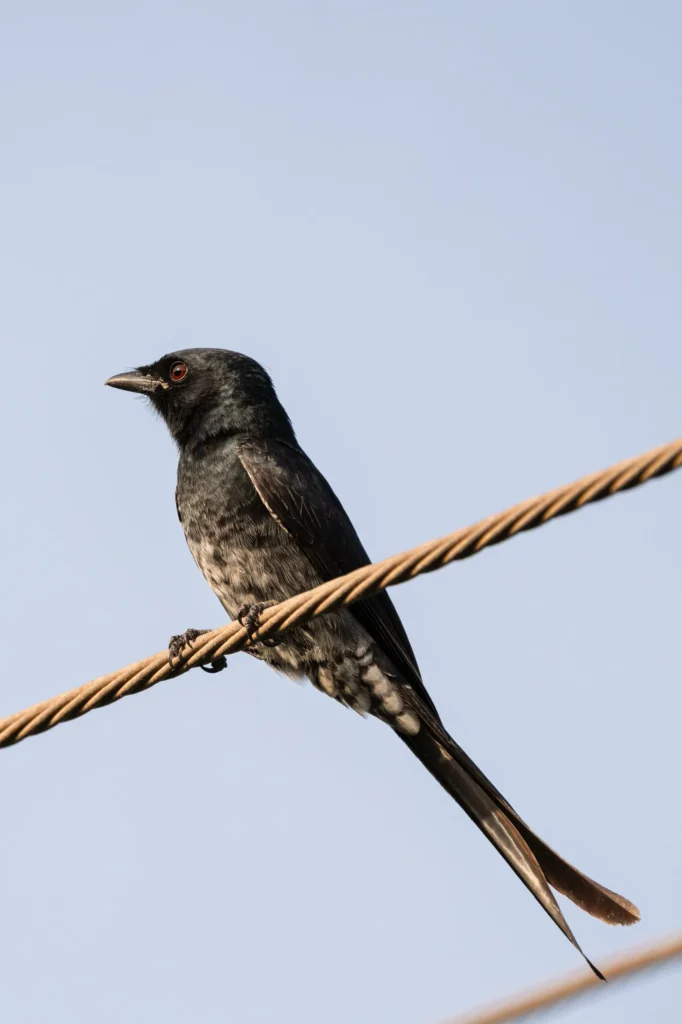
What Are Drongos?
Drongos belong to the bird family Dicruridae, a group of tree-dwelling insectivorous birds found across Asia, Africa, and Australasia. In India they are recognised by a combination of slender bodies, strong hooked bills, long tails, and confident behaviour. While many species appear predominantly black, others show grey plumage, bronzed sheen, or contrasting white underparts depending on the species.
Despite their modest size, drongos have earned a reputation for being unusually fearless. They routinely chase crows, raptors, and other much larger birds that venture too close to their nests or feeding territories. Birdwatchers often locate drongos by watching this aggressive behaviour before spotting the bird itself.
Several species are also accomplished vocal mimics. Rather than relying on a limited repertoire of calls, they can imitate sounds made by other birds, adding another layer of interest for anyone watching or listening in the field.
Key Characteristics of Drongos
- Mostly insect-eating birds.
- Strong, slightly hooked bill adapted for catching insects.
- Characteristic forked or deeply divided tail.
- Excellent aerial hunters that often return to the same perch after catching prey.
- Bold defenders of their nesting territory.
- Many species possess impressive vocal abilities, including mimicry.
Field Note: If you notice a black bird repeatedly leaving a perch to catch flying insects before returning to exactly the same branch or wire, there is a good chance you are watching a drongo.
How Many Drongo Species Are Found in India?
The exact number depends on the taxonomic authority being followed.
Many modern Indian bird references recognise nine species of drongos occurring in India, while some public-facing resources mention ten species. The difference arises from ongoing taxonomic treatment of certain species, particularly within the Hair-crested Drongo complex. Because scientific classifications continue to evolve, it is good practice to verify the latest accepted taxonomy before publishing definitive species counts.
Regardless of the precise count, birdwatchers in India can encounter an impressive variety of drongos ranging from widespread farmland specialists such as the Black Drongo to forest-dependent species like the White-bellied Drongo, spectacular Racket-tailed Drongos, and the island-endemic Andaman Drongo.
Indian Drongo Species Overview
| Common Name | Scientific Name | Primary Habitat | Distribution |
| Black Drongo | Dicrurus macrocercus | Open country, farmland | Widespread |
| White-bellied Drongo | Dicrurus caerulescens | Forests, plantations | Peninsular India |
| Ashy Drongo | Dicrurus leucophaeus | Hill and montane forests | Himalayas, Northeast, Western Ghats |
| Bronzed Drongo | Dicrurus aeneus | Evergreen forests | Western Ghats, Northeast |
| Greater Racket-tailed Drongo | Dicrurus paradiseus | Mature forests | Much of forested India |
| Lesser Racket-tailed Drongo | Dicrurus remifer | Dense forests | Northeast India |
| Hair-crested Drongo | Dicrurus hottentottus | Forests | Himalayas & Northeast |
| Crow-billed Drongo | Dicrurus annectens | Forest canopy | Northeast India |
| Spangled Drongo | Dicrurus bracteatus | Islands and coastal forests | Andaman region |
| Andaman Drongo | Dicrurus andamanensis | Island forests | Andaman Islands |
Although every species belongs to the same family, they occupy different habitats, have distinct field marks, and vary considerably in their distribution across India. Learning these differences is the key to confident identification, which is covered in the next part.
How to Identify Drongos in the Field
Many drongos look similar at first glance, especially when seen briefly against the light. Rather than relying on plumage colour alone, experienced birdwatchers identify them by combining several clues: tail shape, habitat, body size, behaviour, and voice. A bird perched on a telephone wire over farmland is likely to be a different species from one moving through the canopy of an evergreen forest, even if both appear dark in colour.
If you focus on a few consistent features instead of trying to remember every species at once, identifying drongos becomes much easier.
Start with the Tail
The tail is often the quickest way to narrow down a drongo’s identity.
- Deeply forked tail: Typical of the widespread Black Drongo.
- Racket-shaped outer feathers: Seen in the Greater and Lesser Racket-tailed Drongos, making them among the easiest species to recognise.
- Moderately forked tail: Found in several forest species, where other field marks become important.
- Less obvious fork: Can occur in juvenile birds, so additional features should always be considered.
Photography Tip: When photographing drongos, try to capture the bird from behind or in profile. Tail shape is often the single most useful identification feature in photographs.
Observe the Plumage
Although drongos are commonly described as black birds, not every Indian species fits that description.
- Glossy black plumage is characteristic of the Black Drongo.
- Grey plumage distinguishes the Ashy Drongo from darker relatives.
- White underparts immediately identify the White-bellied Drongo.
- Metallic bronzed sheen helps separate the Bronzed Drongo from plain black species.
- Glossy black with long ornamental tail streamers is typical of the racket-tailed drongos.
Lighting can dramatically alter how colours appear. Early morning sunlight may make a black bird appear bluish, while birds seen in dense forests often look almost completely silhouetted.
Notice the Habitat
Habitat is often just as important as appearance.
Some species strongly prefer open landscapes, while others rarely leave mature forests.
| Habitat | Species Most Likely to Encounter |
| Agricultural fields | Black Drongo |
| Villages and open countryside | Black Drongo |
| Forest edges | White-bellied Drongo, Bronzed Drongo |
| Evergreen forests | Bronzed Drongo, Greater Racket-tailed Drongo |
| Hill forests | Ashy Drongo |
| Dense forests of Northeast India | Lesser Racket-tailed, Crow-billed and Hair-crested Drongos |
| Andaman forests | Andaman Drongo |
Rather than searching for every drongo everywhere, first ask whether the habitat matches the species you expect to find.
Watch Their Behaviour
Behaviour can often confirm an identification.
Nearly all drongos catch insects in flight, but different species do so in slightly different ways.
Common behavioural clues include:
- Returning repeatedly to the same perch after catching insects.
- Chasing away crows, kites, raptors and other much larger birds.
- Remaining alert while perched on exposed branches.
- Flying with quick, direct movements rather than long soaring flights.
- Following grazing livestock or farm machinery in open fields to catch disturbed insects.
Forest species may spend more time moving through the canopy, whereas Black Drongos often choose exposed perches such as electric wires, fence posts and isolated trees overlooking cultivated land.
Field Note: One of the easiest places to observe Black Drongos is along rural roads, where they frequently perch on overhead wires before making short flights to capture insects.
Listen to Their Calls
Several drongos are easier to hear than to see.
Many species produce sharp whistles, metallic notes and varied calls that carry well through forests. Some are also known for their remarkable ability to imitate the calls of other birds, making them among the more interesting vocalists in Indian forests. Their mimicry can sometimes confuse birdwatchers into searching for species that are not actually present.
Learning a few common calls greatly improves your chances of finding forest-dwelling species that remain hidden among dense foliage.
Fast Identification Guide
| Feature | Black | White-bellied | Ashy | Bronzed | Greater Racket-tailed |
| Overall colour | Glossy black | Dark upperparts with white belly | Grey | Dark with bronzed gloss | Glossy black |
| Tail | Deep fork | Forked | Forked | Forked | Long racket-shaped streamers |
| Habitat | Open country | Forests | Hill forests | Evergreen forests | Mature forests |
| Visibility | Very common | Often inside forests | Seasonal in many regions | Forest canopy | Forest interior |
| Easy field mark | Telephone wires and farmland | White underparts | Ash-grey body | Metallic sheen | Long racket tail feathers |
Expert Decision Guide
If you see…
- A glossy black bird on a wire over farmland → Start by considering the Black Drongo.
- A drongo with unmistakable racket-shaped tail feathers → It is one of the Racket-tailed Drongos.
- A grey drongo in hill forests → The Ashy Drongo is the strongest possibility.
- A dark forest bird with contrasting white underparts → Look closely for the White-bellied Drongo.
- A metallic-looking drongo inside evergreen forest → The Bronzed Drongo becomes a likely candidate.
By combining habitat, tail shape and overall appearance, most Indian drongos can be identified confidently even without close views.
In the next part, we’ll look at each Indian drongo species in detail, beginning with the Black Drongo, White-bellied Drongo, Ashy Drongo, Bronzed Drongo and the spectacular Greater Racket-tailed Drongo.
Drongo Species Found in India
India’s drongos occupy a wide variety of habitats, from open agricultural landscapes to dense evergreen forests and remote islands. Some species are familiar sights even in villages, while others require careful searching in specialised habitats. Understanding where each species occurs and the field marks that distinguish it makes birdwatching far more rewarding.
Black Drongo (Dicrurus macrocercus)
The Black Drongo is the species that most people encounter first. It is widespread across much of India and is commonly seen in agricultural fields, grasslands, villages, roadsides, and other open landscapes. According to the research brief, it is a resident with local seasonal movements and has one of the broadest distributions among Indian drongos.
Identification
The bird appears glossy black with a slender body and a distinctly forked tail. Adults are usually easy to recognise because they spend much of their time perched in exposed locations.
Habitat
Unlike many of its forest-dwelling relatives, the Black Drongo thrives in human-modified landscapes.
Common locations include:
- Agricultural fields
- Village outskirts
- Grazing lands
- Roadside trees
- Electric wires and fence posts
- Open scrub
Behaviour
The Black Drongo is an active aerial hunter. It watches from a perch before making short flights to capture insects in mid-air, often returning to exactly the same perch.
It is equally famous for its fearless behaviour. Even large birds such as crows, kites and eagles may be chased aggressively if they enter its territory during the breeding season.
Birdwatching Tip
If you are new to birdwatching, the Black Drongo is one of the easiest drongos to study because it often allows prolonged views in open country.
White-bellied Drongo (Dicrurus caerulescens)
The White-bellied Drongo is a forest specialist found mainly in peninsular India. Unlike the Black Drongo, it prefers wooded habitats, plantations and forest edges rather than open farmland. The research brief also notes that this species shows a declining long-term trend in India despite its global Least Concern status.
Identification
Its most obvious feature is the contrasting white underparts, which immediately separate it from the uniformly dark Black Drongo.
Other features include:
- Dark upperparts
- White belly and lower breast
- Forked tail
- Medium-sized hooked bill
Habitat
Look for this species in:
- Moist deciduous forests
- Evergreen forests
- Coffee and spice plantations
- Forest edges
- Well-wooded landscapes
Behaviour
Like other drongos, it catches insects by making quick aerial sallies from exposed branches. However, it generally remains within forested habitats instead of venturing into open agricultural areas.
Conservation Note
Although globally listed as Least Concern, India-specific assessments indicate a long-term decline, highlighting the importance of conserving suitable forest habitats.
Ashy Drongo (Dicrurus leucophaeus)
The Ashy Drongo differs noticeably from most Indian drongos because of its soft grey plumage rather than glossy black colouring.
It is associated primarily with hill forests and montane regions, making it a regular sight in suitable habitats across the Himalayas, Northeast India and parts of the Western Ghats.
Identification
Key features include:
- Overall ash-grey plumage
- Forked tail
- Slender appearance
- Graceful flight
Because many birdwatchers expect drongos to be black, the Ashy Drongo is sometimes overlooked or mistaken for an entirely different family of birds.
Habitat
Typical habitats include:
- Montane forests
- Hill slopes
- Mixed woodland
- Forest edges
Behaviour
Ashy Drongos often hunt from elevated perches within the forest canopy before darting out to capture insects.
They are generally more associated with wooded landscapes than the Black Drongo.
Photography Tip: Overcast conditions often reveal the Ashy Drongo’s grey plumage more accurately than harsh midday sunlight.
Bronzed Drongo (Dicrurus aeneus)
The Bronzed Drongo is one of India’s smaller forest drongos. Although dark overall, its plumage shows a subtle metallic bronze sheen that gives the species its name.
Because it spends much of its time within dense forests, it is less frequently observed than the widespread Black Drongo.
Identification
Look for:
- Compact size
- Metallic bronzed gloss
- Forked tail
- Dark overall appearance
The bronzed sheen is often most visible when sunlight filters through the forest canopy.
Habitat
The species is typically associated with:
- Evergreen forests
- Moist deciduous forests
- Dense woodland
- Forest interiors
It occurs mainly in the Western Ghats and Northeast India.
Behaviour
Bronzed Drongos forage actively among trees, catching insects in flight and moving through different canopy levels while searching for prey.
Because they remain inside forests, patience is often required to obtain good views.
Greater Racket-tailed Drongo (Dicrurus paradiseus)
Among all Indian drongos, the Greater Racket-tailed Drongo is arguably the easiest to identify.
Its long tail streamers ending in distinctive racket-shaped tips make it unmistakable, even from considerable distance.
Identification
Key field marks include:
- Long ornamental tail streamers
- Racket-shaped outer feathers
- Glossy black plumage
- Prominent crest
- Strong hooked bill
Few other Indian birds possess such a distinctive tail.
Habitat
The species inhabits mature forests throughout much of forested India, including:
- Evergreen forests
- Moist deciduous forests
- Dense woodland
- Protected forests
- National parks
Behaviour
Greater Racket-tailed Drongos are highly vocal birds.
They are well known for:
- Mimicking the calls of numerous other bird species.
- Moving actively through the forest canopy.
- Catching insects in flight.
- Joining mixed-species feeding flocks.
Their vocal versatility often surprises birdwatchers, as a single individual may imitate several different birds within a short period.
Field Note: If you hear a confusing mixture of bird calls coming from one section of forest, it is worth searching carefully for a Greater Racket-tailed Drongo, as mimicry is one of its defining behaviours.
Expert Tip
When beginning to identify Indian drongos, don’t try to memorise all the species at once.
Instead, first separate them into three practical groups:
- Open-country species — Black Drongo.
- Forest specialists — White-bellied, Bronzed and Greater Racket-tailed Drongos.
- Hill and montane species — Ashy Drongo.
Once you are comfortable recognising these groups, identifying the remaining species becomes much easier.
Remaining Drongo Species Found in India
The remaining Indian drongos are generally more habitat-specific and less frequently encountered than the Black Drongo. Several are confined to dense forests, while one is found only on the Andaman Islands. For birdwatchers, these species often become highlights of trips to the Northeast, Western Ghats, Himalayas, or island forests.
Lesser Racket-tailed Drongo (Dicrurus remifer)
The Lesser Racket-tailed Drongo is one of India’s specialised forest birds. Although it shares the distinctive racket-shaped tail feathers of its larger relative, it is generally associated with dense forests of Northeast India and is encountered less frequently by visitors.
Identification
Key features include:
- Long tail with racket-shaped outer feathers
- Glossy dark plumage
- Slender build
- Smaller appearance than the Greater Racket-tailed Drongo
Distinguishing the two racket-tailed species can be challenging, especially in poor light. Careful observation of size, structure and locality is often more reliable than a brief view of the tail alone.
Habitat
Typical habitats include:
- Evergreen forests
- Dense hill forests
- Moist tropical woodland
- Forest interiors
Behaviour
Like other drongos, it feeds mainly on insects captured in flight. It often remains high in the canopy, making good views dependent on patience and favourable lighting.
Hair-crested Drongo (Dicrurus hottentottus)
The Hair-crested Drongo is one of the species responsible for differences in the reported number of Indian drongos. Changes in taxonomy over time mean that some references treat members of this group differently, so readers may encounter varying species counts in different publications.
Identification
Typical features include:
- Glossy dark plumage
- Distinctive crest
- Forked tail
- Strong hooked bill
The crest gives the bird a noticeably different silhouette from many other Indian drongos.
Habitat
The species is primarily associated with:
- Forested hills
- Himalayan forests
- Northeastern India
- Mature woodland
Behaviour
Hair-crested Drongos actively forage among trees, catching flying insects and moving through the forest canopy. They are most often encountered in well-wooded habitats rather than open landscapes.
Expert Tip: If you are compiling a life list, always check which taxonomic authority your field guide follows, as the treatment of Hair-crested Drongo has changed over time.
Crow-billed Drongo (Dicrurus annectens)
The Crow-billed Drongo is one of India’s lesser-known drongos and is largely confined to the forests of Northeast India.
Identification
Its most distinctive feature is its comparatively heavy, crow-like bill, from which it derives its common name.
Other features include:
- Dark glossy plumage
- Forked tail
- Robust head and bill
- Forest-dwelling habits
Habitat
Birdwatchers are most likely to encounter it in:
- Dense evergreen forests
- Broadleaf woodland
- Forest canopy
- Northeastern hill forests
Behaviour
Like other members of the family, it hunts insects by making short aerial sallies from exposed branches. However, because it spends much of its time within the canopy, prolonged observations can be difficult.
Spangled Drongo (Dicrurus bracteatus)
The Spangled Drongo has a much more restricted occurrence in the Indian region than widespread mainland species.
Identification
Key characteristics include:
- Glossy dark plumage with a spangled or metallic appearance
- Forked tail
- Strong bill
- Elegant profile
Depending on lighting conditions, the plumage may show subtle iridescent highlights.
Habitat
It is associated with:
- Coastal forests
- Island woodland
- Tropical forest habitats
Compared with species such as the Black Drongo, it has a far more limited distribution within India.
Birdwatching Note
Because its Indian occurrence is geographically restricted, most birdwatchers encounter the Spangled Drongo only during visits to suitable island habitats.
Andaman Drongo (Dicrurus andamanensis)
The Andaman Drongo is one of India’s endemic birds, occurring only in the Andaman Islands. For many birdwatchers, it is among the most sought-after island endemics.
Identification
The species resembles other dark drongos but is best identified through a combination of location, structure and detailed field characters.
Habitat
It occupies:
- Tropical evergreen forests
- Semi-evergreen forests
- Woodland across the Andaman Islands
Unlike mainland drongos, it cannot be found anywhere outside this island group.
Behaviour
Like its relatives, the Andaman Drongo feeds mainly on insects and spends much of its time moving through forest vegetation in search of prey.
Because of its restricted range, responsible birdwatching is especially important to minimise disturbance.
Responsible Tourism Tip: When searching for endemic island birds such as the Andaman Drongo, remain on designated trails and avoid using excessive playback of recorded bird calls, particularly during the breeding season.
Comparison: Black Drongo vs White-bellied Drongo
These two species are among the most commonly confused by beginners, but they occupy different habitats and can usually be separated with a few simple observations.
| Feature | Black Drongo | White-bellied Drongo |
| Scientific name | Dicrurus macrocercus | Dicrurus caerulescens |
| Overall appearance | Uniform glossy black | Dark upperparts with white underparts |
| Habitat | Open country, farmland, villages | Forests, plantations and wooded habitats |
| Distribution | Widespread across India | Mainly peninsular India |
| Typical perch | Electric wires, fence posts, isolated trees | Forest branches and woodland edges |
| Ease of observation | Very easy | More often seen inside forests |
For most birdwatchers, habitat is the quickest clue. A drongo hunting over cultivated fields is far more likely to be a Black Drongo, while one inside a forest with obvious white underparts is likely to be a White-bellied Drongo.
Practical Checklist for Birdwatchers
When you spot a drongo, note the following before consulting a field guide:
- Overall body colour
- Tail shape
- Presence or absence of racket-shaped feathers
- Habitat type
- Geographic location
- Behaviour while feeding
- Any distinctive calls or mimicry
- Whether the bird is perched in the open or within forest cover
Recording these details immediately will greatly improve the accuracy of later identification.
The next part explores where to see drongos across India, followed by their feeding behaviour, breeding ecology, vocal mimicry, and conservation status.
Where to See Drongos in India
Drongos occur across much of India, but no single destination offers every species. The best place to look depends on which drongo you hope to see. Some species are widespread and easily found in farmland, while others are restricted to evergreen forests, mountain ranges, or islands.
Planning your birdwatching around habitat rather than simply choosing a destination will significantly improve your chances of success.
Western Ghats
The Western Ghats are one of India’s richest regions for forest-dwelling drongos. Evergreen forests, moist deciduous forests, and plantations provide suitable habitats for several species.
Birdwatchers visiting this biodiversity hotspot may encounter:
- White-bellied Drongo
- Bronzed Drongo
- Ashy Drongo (in suitable hill habitats)
- Greater Racket-tailed Drongo
Well-protected forests generally offer the highest diversity because they support mature tree cover and abundant insect life.
Northeastern India
Northeast India supports the greatest diversity of drongos in the country. Extensive tropical forests and varied elevations create ideal conditions for species that are uncommon elsewhere.
Possible species include:
- Greater Racket-tailed Drongo
- Lesser Racket-tailed Drongo
- Hair-crested Drongo
- Crow-billed Drongo
- Bronzed Drongo
- Ashy Drongo
For birdwatchers interested in seeing multiple forest specialists during a single trip, the Northeast is one of India’s premier regions.
Himalayan Foothills and Hill Forests
Several drongo species are associated with wooded mountain landscapes rather than lowland plains.
Suitable habitats include:
- Broadleaf forests
- Mixed hill forests
- Montane woodland
The Ashy Drongo is among the better-known hill species, while Hair-crested Drongos also occur in suitable Himalayan forests.
Morning bird activity is usually highest shortly after sunrise, when drongos are actively feeding.
Central and Peninsular India
Many national parks and wildlife sanctuaries across central and southern India provide opportunities to observe both open-country and forest drongos.
Visitors may encounter:
- Black Drongo in open grasslands and buffer areas.
- Greater Racket-tailed Drongo inside mature forests.
- White-bellied Drongo in suitable wooded habitats.
- Bronzed Drongo in evergreen forest patches.
Safari visitors often focus on mammals, but paying attention to birds between wildlife sightings can be highly rewarding.
Agricultural Landscapes
Not every birdwatching trip requires a national park.
The Black Drongo has adapted exceptionally well to cultivated landscapes and is commonly seen around:
- Crop fields
- Village roads
- Grazing livestock
- Irrigation canals
- Open scrubland
These habitats make it one of India’s most familiar and easily observed drongos.
Family Travel Tip: Children often find the Black Drongo easy to spot because it frequently sits on exposed wires and fence posts, allowing prolonged observation without specialised equipment.
Andaman Islands
Birdwatchers visiting the Andaman Islands have the opportunity to observe the endemic Andaman Drongo, a species found nowhere else in the world.
Island forests also support other specialised birdlife, making the Andamans an important destination for those interested in India’s endemic birds.
Best Habitats for Different Drongos
| Habitat | Likely Species |
| Agricultural fields | Black Drongo |
| Village outskirts | Black Drongo |
| Forest edges | White-bellied Drongo |
| Evergreen forests | Bronzed Drongo, Greater Racket-tailed Drongo |
| Hill forests | Ashy Drongo |
| Northeastern forests | Lesser Racket-tailed, Hair-crested, Crow-billed Drongos |
| Andaman forests | Andaman Drongo |
Behaviour, Diet and Breeding
Although India’s drongo species occupy different habitats, they share many behavioural traits that make them fascinating birds to observe.
Feeding Behaviour
Drongos are primarily insectivorous birds.
Their preferred hunting technique involves watching from an exposed perch before making a rapid flight to capture insects in the air. After catching prey, they usually return to the same perch to scan for another opportunity.
This efficient hunting style allows them to exploit insects disturbed by grazing animals, agricultural activity, or movement through vegetation.
Common prey includes:
- Flying insects
- Beetles
- Grasshoppers
- Moths
- Flying termites
- Other small aerial invertebrates
Mobbing Behaviour
One of the defining characteristics of drongos is their willingness to confront much larger birds.
They regularly chase:
- Crows
- Kites
- Eagles
- Owls
- Other potential predators
This behaviour, known as mobbing, helps protect nests and may also drive competitors away from feeding areas.
Watching a relatively small drongo aggressively pursuing a large raptor is often one of the most memorable sights in the field.
Vocal Mimicry
Several drongo species are accomplished mimics.
Instead of producing only their own calls, they can imitate sounds made by numerous other birds. This behaviour contributes to their reputation as some of India’s most versatile woodland vocalists.
For birdwatchers, mimicry means that identifying birds by sound alone should be done cautiously when drongos are present.
Breeding
Drongos generally build nests in trees and actively defend the surrounding area.
During the breeding season they become particularly territorial, often chasing birds many times their own size.
Because nesting birds are easily disturbed, birdwatchers and photographers should observe from a respectful distance and avoid prolonged attention around nest sites.
Responsible Tourism Tip: Never use repeated playback calls to attract nesting drongos. Minimising disturbance helps ensure successful breeding and supports ethical birdwatching.
Conservation Status in India
According to the research brief, the Indian drongo species discussed are currently listed as Least Concern on the IUCN Red List. However, this global assessment does not necessarily reflect regional population trends.
For example, the White-bellied Drongo is noted as showing a long-term decline within India despite its global conservation status remaining unchanged.
This highlights an important point for readers: global conservation categories describe worldwide extinction risk, while national monitoring can reveal local population changes that deserve attention.
Protection in India
The research brief notes that species such as the Black Drongo and White-bellied Drongo are included under Schedule II of the Wildlife (Protection) Act, providing legal protection in India.
Conserving drongos depends on protecting:
- Native forests
- Woodland edges
- Agricultural landscapes with scattered trees
- Island forests
- Healthy insect populations
Maintaining a variety of habitats ensures suitable conditions for both open-country and forest-dependent species.
Conservation Status Overview
| Species | Global IUCN Status* | Key Conservation Note |
| Black Drongo | Least Concern | Widespread open-country species |
| White-bellied Drongo | Least Concern | Long-term decline reported in India |
| Ashy Drongo | Least Concern | Dependent on suitable forest habitats |
| Bronzed Drongo | Least Concern | Forest specialist |
| Greater Racket-tailed Drongo | Least Concern | Requires mature forests |
| Remaining Indian species | Least Concern | Continued habitat protection remains important |
*Based on information referenced in the research brief. Readers should consult the latest IUCN assessments for updates.
Common Misconceptions About Drongos
Several myths and assumptions about drongos persist because many species appear superficially similar. Understanding these misconceptions makes field identification much easier.
“All drongos are black.”
This is one of the most common misconceptions.
While the Black Drongo is widespread and familiar, India’s drongos also include grey species such as the Ashy Drongo, birds with contrasting white underparts such as the White-bellied Drongo, and species with metallic bronzed plumage.
“Every drongo is the same species.”
India supports multiple drongo species occupying different habitats.
Some specialise in farmland, others occur mainly in evergreen forests, while the Andaman Drongo is found only in the Andaman Islands. Habitat often provides the first clue to correct identification.
“Drongos only live in forests.”
This is only partly true.
The Black Drongo is strongly associated with open country, cultivated fields and villages, making it one of India’s most familiar birds. Forest species represent only part of the family’s diversity.
“Drongos are aggressive birds.”
They are certainly bold, but their aggression is usually defensive.
Most mobbing behaviour occurs to protect nests or feeding territories. Their willingness to chase much larger birds is an effective survival strategy rather than unnecessary aggression.
“Racket-tailed drongos and Hair-crested Drongos are the same.”
These are different species groups with distinct field characteristics and distributions, despite both occurring in forest habitats.
Practical Birdwatching Tips
Whether you’re a beginner or an experienced birder, a few simple techniques can greatly improve your chances of observing drongos.
Visit at the Right Time
Early morning and late afternoon are generally the most productive periods, when birds are actively feeding.
Look for Perches
Drongos often choose exposed branches, dead trees, fence posts or overhead wires that provide a clear view of flying insects.
Listen Carefully
Forest species are frequently detected by their calls before they are seen. Learning a few characteristic vocalisations can make locating them much easier.
Scan Different Habitats
Don’t restrict your search to national parks.
Depending on the species, excellent observations are possible in:
- Agricultural fields
- Village roads
- Plantations
- Forest edges
- Evergreen forests
- Hill stations
- Island forests
Be Patient
Forest drongos often move quietly through the canopy. Remaining still for several minutes frequently produces better sightings than constantly walking.
Photography Tips
Capturing good photographs of drongos can be challenging because many species remain active throughout the day.
For better results:
- Focus on the eyes whenever possible.
- Wait for the bird to return to its favourite perch.
- Photograph side profiles to show tail shape.
- Use continuous autofocus for birds making aerial feeding flights.
- Avoid disturbing nesting birds for close photographs.
Backlit birds may appear entirely black, so adjusting your position relative to the sun often reveals much more plumage detail.
Frequently Asked Questions
How many drongo species are found in India?
Most modern references recognise nine species, although some public-facing sources mention ten because of differing taxonomic treatments. Always check the taxonomy followed by your chosen field guide or checklist.
Which is the most common drongo in India?
The Black Drongo (Dicrurus macrocercus) is the most widespread and commonly observed species, especially in open countryside and agricultural landscapes.
Are all drongos insect-eating birds?
Yes. Indian drongos are primarily insectivorous and typically catch insects in flight by making short aerial sallies from exposed perches.
Why do drongos chase larger birds?
This behaviour is known as mobbing. Drongos use it to defend their nests, young and feeding territories from potential predators.
Which drongo has racket-shaped tail feathers?
The Greater Racket-tailed Drongo and Lesser Racket-tailed Drongo are recognised by their distinctive elongated tail feathers ending in racket-shaped tips.
Which drongo is easiest to identify?
The Black Drongo is usually the easiest because of its widespread distribution, open-country habitat and habit of perching prominently on wires and fence posts.
Which species is found only in the Andaman Islands?
The Andaman Drongo (Dicrurus andamanensis) is endemic to the Andaman Islands and is not naturally found elsewhere.
Are drongos migratory?
Some Indian drongos are resident, while others may be migratory or show seasonal local movements depending on the species.
Where are the best places to see drongos in India?
Excellent regions include:
- Western Ghats
- Northeastern India
- Himalayan foothills
- Central Indian forests
- Agricultural landscapes (for Black Drongo)
- Andaman Islands
Are drongos protected in India?
Yes. The research brief notes that species such as the Black Drongo and White-bellied Drongo are protected under Schedule II of the Wildlife (Protection) Act.
Conclusion
Drongos are among India’s most rewarding birds to observe because they combine distinctive appearance with fascinating behaviour. From the familiar Black Drongo perched above cultivated fields to the elegant Greater Racket-tailed Drongo gliding through mature forests and the endemic Andaman Drongo confined to island woodlands, each species reflects a different part of India’s remarkable avian diversity.
For beginners, the key to successful identification is to look beyond colour. Habitat, tail shape, behaviour and location are often more reliable than plumage alone. As your experience grows, recognising subtle differences between species becomes increasingly intuitive.
Whether you’re watching birds from a village road, exploring the forests of the Western Ghats, trekking through the Himalayas, or visiting the Andaman Islands, learning to recognise India’s drongos adds another dimension to birdwatching. Their aerial hunting skills, fearless defence of territory and remarkable vocal abilities ensure that these birds remain among the most engaging members of India’s avifauna.
Author Note & Update Log: Written by the WildlifeSafaris.in Editorial Team. Last Updated: August 2026.
- Silent Valley NP
- Periyar Tiger Reserve
- Anamalai Tiger Reserve
- Kaziranga NP
- Namdapha NP
- Eaglenest Wildlife Sanctuary
- Corbett NP
- Great Nicobar (where relevant)
- mimicry
- mobbing
- aerial sallies
- Typical perch height.
- Best light for photography.
- Behaviour during winter mornings.
- What usually gives away a hidden drongo.
- How mixed-species flocks help locate forest drongos.