
Discover India’s 11 native parakeet species. Learn field identification keys for look-alike birds, regional habitats, and Indian wildlife protection laws.
Parakeets of India: Field Guide, Identification, and Protected Status
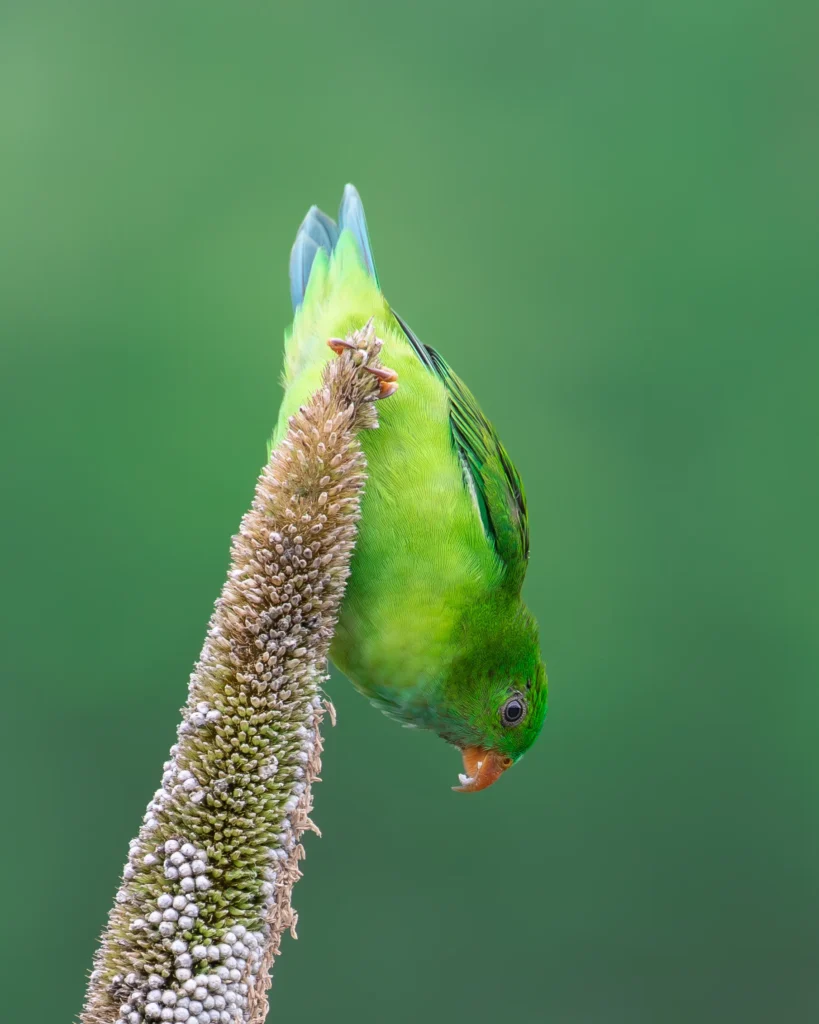
India serves as one of Asia’s primary strongholds for parakeets, hosting diverse populations that have adapted to diverse environments ranging from dense evergreen forests and island ecosystems to agricultural belts and urban parks. Identifying these birds requires moving past the generalized label of “green parrots” to understand the specific geographic ranges, distinct physical markings, and ecological pressures that define each unique species.
For travelers, birdwatchers, and naturalists, understanding these birds requires clear field data. This guide provides an authoritative overview of the native parakeet species found across the Indian subcontinent, their wild habitats, and the specific field markings used to distinguish them in their natural environments.
How Many Parakeet Species Live in India?
India is home to 11 native species belonging to the Psittaculidae family that are recognized in standard Indian ornithological and field-guide references. This count includes ten true parakeet species and one hanging parrot, which is traditionally grouped alongside parakeets in regional field checklists due to its overlapping distribution and taxonomic family ties.
When tracking these birds, it is critical to distinguish between native resident species and feral or invasive populations. All 11 species detailed below are native to the subcontinent or its associated island territories. They maintain stable or shifting wild ranges shaped by regional climate patterns, elevation limits, and habitat availability.
Native vs. Feral Populations
While species like the Rose-ringed Parakeet have established highly resilient, feral populations outside of India—sometimes causing ecological imbalances in Europe and the Americas—within India, they are a natural, historical component of the native ecosystem. Conversely, when observing parakeets in urban Indian environments, birders must note that high local concentrations are frequently augmented by escaped birds from the illegal domestic pet trade, making precise population tracking a dynamic challenge for field researchers.
Parakeet Species Found in India: Master Checklist
To plan birdwatching itineraries or cross-reference field sightings, utilize this foundational checklist tracking India’s native parakeet diversity.
| Common Name | Scientific Name | Primary Indian Range | Key Field Identifier | Global Conservation Status |
| Rose-ringed Parakeet | Psittacula krameri | Pan-India; highly urbanized and rural | Bright red bill; male has distinct black and rose neck ring | Least Concern |
| Alexandrine Parakeet | Psittacula eupatria | Widespread; localized forests, woodlands, urban fringes | Large size; massive red bill; prominent maroon shoulder patches | Near Threatened |
| Plum-headed Parakeet | Psittacula cyanocephala | Peninsular, central, and northern plains/foothills | Male has deep plum-red head; female has dull bluish-gray head | Least Concern |
| Blossom-headed Parakeet | Psittacula roseata | Northeastern India woodlands | Male has pale rose-pink head; white-tipped central tail feathers | Least Concern |
| Slaty-headed Parakeet | Psittacula himalayana | Himalayan foothills and sub-alpine belts | Dark slate-grey head; long blue-green tail with bright yellow tips | Least Concern |
| Gray-headed Parakeet | Psittacula finschii | Northeastern hills and valleys | Dull gray head; central tail feathers completely violet-blue | Least Concern |
| Red-breasted Parakeet | Psittacula alexandri | Northeast forests; recent records in northern plains | Salmon-pink upper breast; broad black mustache stripes | Near Threatened |
| Malabar Parakeet | Psittacula columboides | Western Ghats endemic zone | Bluish-gray body; double collar ring (black and turquoise) on males | Least Concern |
| Long-tailed Parakeet | Psittacula longicauda | Andaman and Nicobar Islands | Exceptionally long, slender tail; dark green crown with red cheeks | Vulnerable |
| Nicobar Parakeet | Psittacula caniceps | Nicobar Islands endemic zone | Massive size; prominent black forehead band and wide black mustache | Near Threatened |
| Vernal Hanging Parrot | Loriculus vernalis | Western Ghats, Eastern Ghats, Northeast forest zones | Diminutive size; bright red rump; hangs upside down to forage | Least Concern |
Species-by-Species Profiles
Rose-ringed Parakeet (Psittacula krameri)
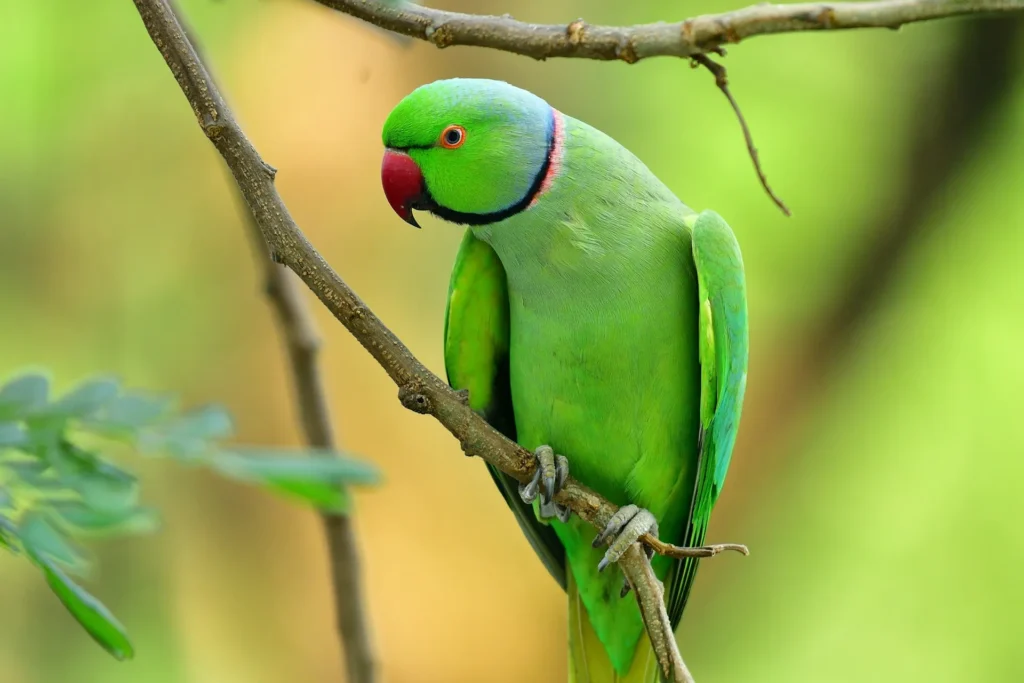
The Rose-ringed Parakeet is the most abundant and widespread parakeet species across India. It shows remarkable adaptability, thriving equally well in deep secondary forests, scrublands, open agricultural fields, and heavily congested metropolitan centers like Delhi, Mumbai, and Kolkata.
- Field Marks: Adult males show a clear black bib that connects to a rose-pink collar around the nape. Females lack the distinct neck ring but retain the overall bright, lime-green plumage and a sharp, decurved red bill.
- Habitat: Open woodlands, orchards, urban gardens, and agricultural land up to moderate elevations.
Alexandrine Parakeet (Psittacula eupatria)
The Alexandrine Parakeet is the largest native parakeet species in India. While it mirrors the general distribution of the Rose-ringed Parakeet in certain northern and central belts, it is significantly more dependent on mature, unfragmented forest tracts and old-growth trees for survival.
- Field Marks: Look for its robust, heavy-set body, disproportionately massive deep-red upper mandible, and a highly visible maroon-red patch on each shoulder wing patch. Males display a broad black band across the lower cheeks and a pink collar across the hindneck.
- Habitat: Moist deciduous forests, old plantations, and mature urban woodlands containing historic canopy trees.
Plum-headed Parakeet (Psittacula cyanocephala)
The Plum-headed Parakeet is a forest-edge and woodland specialist endemic to the Indian subcontinent, found widely across peninsular India and the lower Himalayan borders. They are highly gregarious birds, often observed in fast-flying, noisy flocks that move rhythmically through forest canopies.
- Field Marks: Sexual dimorphism is striking in this species. The male features a brilliant, deep plum-red head shaded with blue at the rear, bounded by a narrow black collar. The female displays a subtle, uniform bluish-gray head lacking the black neck ring altogether. Both sexes carry long, slender blue tails tipped with clean white.
- Habitat: Open deciduous forests, wooded foothills, hill slopes, and clearings near agricultural margins.
📋 Field Note
When trying to spot forest parakeets like the Plum-headed or Malabar Parakeet, avoid looking for them on the ground. Instead, train your binoculars on fruiting wild fig trees (Ficus species) or listen for their short, sharp, musical calls (tooi-tooi) which are distinctly more high-pitched and melodic than the harsh screech of the common Rose-ringed Parakeet.
How to Identify Indian Parakeets in the Wild
When you spot a parakeet, do not just look at the green body. Train your binoculars on three specific areas:
- The Shoulder: Is there a distinct maroon or red patch?
- The Head and Nape: What is the base color, and is there a solid ring, a double ring, or no ring at all?
- The Tail: Is it exceptionally long? What color are the central tail feathers?
Distinguishing Look-Alikes: The Rose-ringed vs. Alexandrine Matrix
The most common identification error in Indian birding is confusing the Rose-ringed Parakeet with the Alexandrine Parakeet. Both are primarily green, both feature red bills, and their ranges overlap heavily across the Indian subcontinent.
Table: Look-Alike Field Identification Matrix
| Feature | Rose-ringed Parakeet (P. krameri) | Alexandrine Parakeet (P. eupatria) |
| Overall Size | Medium (approx. 40 cm including tail) | Large and bulky (approx. 58 cm) |
| Shoulder Patch | None (solid green wings) | Prominent maroon-red patch on each shoulder |
| Bill Size | Small, neat red bill | Massive, heavy deep-red bill |
| Flight Profile | Swift, direct, and slender | Heavy, powerful, almost crow-like rowing wingbeats |
Head Color Variations: The “Headed” Parakeets
India hosts several species named for their distinct head colors. Geography is your first clue here, as these species occupy very specific regional niches.
- Plum-headed vs. Blossom-headed: If you are in peninsular or central India, you are looking at the Plum-headed Parakeet, where the male sports a deep plum-red head. If you are birding in the woodlands of Northeast India, expect the Blossom-headed Parakeet, which features a paler, rose-pink head and white-tipped central tail feathers.
- Slaty-headed vs. Gray-headed: In the Himalayan foothills, the Slaty-headed Parakeet is the dominant species, easily identified by its dark slate-grey head and bright yellow tail tips. Further east in the northeastern hills, it is replaced by the Gray-headed Parakeet, which has a duller gray head and completely violet-blue central tail feathers.
📷 Photography Tip
Capturing the diagnostic maroon shoulder patch of an Alexandrine Parakeet or the subtle head coloration of a Plum-headed Parakeet requires good lighting. Because parakeets often forage in the dense, dappled canopy of fruiting trees, try to photograph them in the early morning or late afternoon when sunlight hits them horizontally, revealing their true colors without the heavy shadowing of midday foliage.
Where to See Parakeets in India
India’s parakeets are not restricted to deep wilderness. Their distribution is a mix of highly specialized forest endemics and incredibly adaptable generalists.
Urban Adapters and Northern Plains
You do not need to book a safari to see parakeets in India. The Rose-ringed Parakeet is a highly successful urban adapter. Parks, gardens, and avenues in cities like Delhi, Mumbai, and Jaipur support massive, noisy roosts. They have a particular affinity for historic architecture, utilizing the crevices in ancient forts, monuments, and tombs as safe, elevated nesting cavities.
Forest Specialists of the Western Ghats and Northeast
To find India’s more specialized parakeets, you must travel to its primary biodiversity hotspots:
- The Western Ghats: This mountain range is home to the endemic Malabar Parakeet, recognized by its bluish-gray body and the male’s double collar of black and turquoise. You will also find the Vernal Hanging Parrot here—a tiny, bright green bird with a red rump that literally hangs upside down from branches to feed on nectar and fruit.
- The Himalayas and Northeast: The dense forests and varied elevations of Assam, Arunachal Pradesh, and the Himalayan belt support the Slaty-headed, Gray-headed, and Blossom-headed Parakeets. Recently, the Red-breasted Parakeet—traditionally associated with the northeast and characterized by its salmon-pink breast and black mustache—has been increasingly recorded in northern states like Haryana and Bihar, indicating shifting ranges or poorly understood historical distributions.
Table: Regional Distribution and Hotspots
| Region / Landscape | Expected Species | Reliable Birding Locations |
| Northern Cities & Plains | Rose-ringed, Alexandrine | Lodhi Gardens (Delhi), Keoladeo National Park (Bharatpur) |
| Central Indian Forests | Plum-headed, Rose-ringed, Alexandrine | Kanha, Pench, and Bandhavgarh Tiger Reserves |
| Western Ghats | Malabar Parakeet, Vernal Hanging Parrot | Thattekad Bird Sanctuary (Kerala), Dandeli (Karnataka) |
| Himalayas & Foothills | Slaty-headed, Plum-headed | Corbett National Park, Pangot (Uttarakhand) |
| Northeast India | Red-breasted, Blossom-headed, Gray-headed | Kaziranga National Park (Assam), Mishmi Hills (Arunachal) |
| Andaman & Nicobar | Long-tailed, Nicobar Parakeet | Mount Harriet National Park (Andamans), Great Nicobar Biosphere Reserve |
Diet, Calls, and Wild Breeding Behavior
Parakeets are highly social, flocking birds. Their behavior is driven by the search for seasonal food sources and secure nesting sites, leading to daily commutes between communal roosts and foraging grounds.
Natural Foraging Preferences and Crop-Raiding
Indian parakeets are primarily frugivorous and granivorous. Their wild diet consists predominantly of fruits, seeds, buds, and grains. By cracking hard seed coats and eating fleshy fruits, parakeets act as important ecological engines, aiding in seed dispersal and the pruning of canopy foliage across forest ecosystems.
However, because their natural diet heavily overlaps with agricultural produce, several species have developed complex relationships with human landscapes. Large flocks of adaptable species, particularly the Rose-ringed Parakeet, frequently engage in crop-raiding. They are regularly observed feeding on cultivated orchards, maize, and sunflower fields. This creates a complicated dynamic regarding urban coexistence, as conservationists must balance the biodiversity value of the birds with the economic realities of agricultural livelihoods.
Vocalizations in the Wild
A common misconception driven by the illegal pet trade is that parakeets are natural “talkers” or mimics of human speech. In the wild, their vocalizations serve entirely different purposes: maintaining flock cohesion, signaling alarm, and establishing territory.
The calls vary significantly among species. The ubiquitous Rose-ringed Parakeet relies on loud, harsh, and repetitive screeches that cut through urban noise. In contrast, forest-dwelling species rely on different acoustic profiles. The Plum-headed Parakeet, for example, communicates with a much softer, highly musical tooi-tooi whistle that carries efficiently through the dense foliage of the canopy.
Cavity Nesting Adaptations
Parakeets do not build traditional open-cup nests out of twigs and grass. They are obligate cavity nesters, meaning they require existing hollows to incubate their eggs and raise their young.
In wild forest environments, parakeets depend heavily on mature, old-growth trees with naturally occurring hollows or abandoned woodpecker holes. The availability of these old trees is a limiting factor for forest specialists like the Alexandrine and Malabar Parakeets.
Conversely, the survival success of urban adapters is largely due to their flexibility in choosing nesting sites. The Rose-ringed Parakeet frequently utilizes crevices in old forts, historical monuments, and the walls of buildings as safe, elevated nesting cavities. This structural adaptation explains why monumental cities like Delhi and Agra support such massive, thriving parakeet populations.
Breeding Seasons and Clutch Basics
While exact breeding seasons vary by region and elevation, most common parakeet species in India align their nesting periods with the arrival of warmer weather and the subsequent abundance of seasonal food supplies.
During the breeding season, females generally lay a clutch of plain white eggs directly onto the unlined floor of the nesting cavity. The female assumes primary responsibility for incubating the eggs, while the male takes on the task of foraging and returning to the cavity to feed her.
🌿 Responsible Tourism Tip
When birdwatching or photographing parakeets during their breeding season, never approach or disturb active nesting cavities. Parakeets can be highly sensitive to perceived threats near their nest sites. If you observe a male returning to a tree hollow or a fort crevice, maintain a respectful distance and use a telephoto lens or spotting scope to observe this natural behavior without causing nest abandonment.
Conservation Realities, Wildlife Law, and Ethical Birding
While observing parakeets in the wild or within urban centers is highly accessible in India, understanding the ecological pressures and legal protections surrounding these birds is essential for any responsible naturalist or traveler.
Conservation Status and Wild Trends
A common mistake is assuming that because parakeets are highly visible, their populations are universally secure. While species like the Rose-ringed Parakeet are incredibly widespread and listed globally as “Least Concern,” this broad categorization can obscure localized ecological stresses and declining sub-populations.
Other species face much steeper challenges. The Alexandrine Parakeet, which requires mature forest canopies and large nesting cavities, is globally categorized as “Near Threatened” due to rapid habitat fragmentation across its Asian range. However, tracking these populations requires localized data; a 2025 factsheet from the State of India’s Birds notes a rapidly increasing trend for the Alexandrine Parakeet specifically within India, highlighting the complex and changing nature of wild bird populations on the subcontinent.
Illegal Trade and Indian Wildlife Law
Despite their protected status, Indian parakeets are heavily exploited. According to a 2019 CITES analysis summary, an estimated 90% of all live birds traded globally belong to the Psittaciformes (parrots and parakeets) order.
Within India, the Rose-ringed, Alexandrine, and Plum-headed Parakeets suffer the highest rates of trapping. Poachers frequently raid natural nest cavities—whether in forest trees or urban monuments—to steal fledglings for the domestic pet trade or the illegal street “fortune-telling” industry. Recent enforcement reporting from 2025 confirms this is an ongoing crisis, with authorities conducting active seizures and rescues of trapped parakeets across multiple states.
Table: Legal Classifications Under Indian Law
| Legal Framework | Practical Implication for Citizens | Prescribed Penalties |
| Wildlife (Protection) Act, 1972 | It is strictly illegal to trap, purchase, sell, or hold any native Indian parakeet in captivity. | Violators are liable for a fine of up to ₹25,000, imprisonment for up to three years, or both. |
🛑 Responsible Tourism Tip
If you encounter a native parakeet being kept in a cage at a homestay, hotel, or private residence, do not encourage the practice by engaging with the bird. Native parakeets are not legal pets in India. Documenting such instances and quietly reporting them to the state forest department or local wildlife rescue organizations (such as Wildlife SOS) is the most ethical action a traveler can take.
Common Misconceptions
- “All green parrots are the same.” As outlined in the identification matrix, India hosts 11 distinct native species that vary significantly in size, head coloration, ecological niche, and vocalizations.
- “They are legal to keep if they are captive-bred.” This is a highly dangerous legal assumption. Indian wildlife law does not grant ownership exceptions for “captive-bred” native birds. Keeping them is unlawful regardless of their origin.
- “Urban parakeets are disconnected from wild conservation.” The parakeets nesting in Delhi’s urban tombs are part of the exact same ecological and legal framework as those in deep tiger reserves. Urban populations represent crucial biological adaptations, not a separate class of wildlife.
Frequently Asked Questions (FAQs)
1. How many parakeet species are native to India? India is home to 11 native parakeet species, which includes ten true parakeets and the closely related Vernal Hanging Parrot.
2. Which Indian parakeet is the largest?
The Alexandrine Parakeet (Psittacula eupatria) is the largest, identifiable by its heavy, bulky frame and massive deep-red bill.
3. What is the main physical difference between a Rose-ringed and an Alexandrine parakeet? The Alexandrine Parakeet is substantially larger and features a highly visible maroon-red patch on each shoulder. The Rose-ringed Parakeet is smaller and has solid green wings with no shoulder patch.
4. Are parakeets legal to keep as pets in India?
No. Under the Wildlife (Protection) Act, 1972, trapping, trading, or keeping any native Indian parakeet as a pet is completely illegal.
5. Which parakeet species is endemic to the Western Ghats?
The Malabar Parakeet (Psittacula columboides) is exclusively endemic to the moist deciduous and evergreen forests of the Western Ghats.
6. Which species are exclusive to the Andaman and Nicobar Islands?
The Nicobar Parakeet is strictly endemic to the Nicobar Islands, while the Long-tailed Parakeet can be found across both the Andaman and Nicobar archipelagos.
7. How can you tell a male plum-headed parakeet from a female?
The male features a brilliant, deep plum-red head with a narrow black neck collar. The female has a dull bluish-gray head and completely lacks the black neck ring.
8. Why do parakeets frequently nest in old historical buildings and forts? Parakeets are obligate cavity nesters. In urban areas where natural tree hollows are scarce, species like the Rose-ringed Parakeet adapt by nesting inside the deep architectural crevices of old stone monuments and forts.
Conclusion
The parakeets of India represent a remarkably resilient branch of the subcontinent’s biodiversity. From the tiny Vernal Hanging Parrot foraging in the dense canopy of the Western Ghats to massive flocks of Rose-ringed Parakeets roosting atop ancient Mughal architecture in the northern plains, these birds serve as crucial seed dispersers and indicators of habitat health. By understanding how to properly identify them in the field and recognizing their strict legal protections, wildlife travelers and naturalists can play an active role in advocating for their continued survival in the wild.
Author Note & Update Log: Written by the WildlifeSafaris.in Editorial Team. Last Updated: August 2026