Discover where to see gaurs in India. Compare top national parks in the Western Ghats and Central India, optimal safari seasons, and ethical viewing tips.
Understanding the Gaur: India’s Largest Bovine
The gaur (Bos gaurus) is the largest extant species of wild cattle in the world. Adult bulls often stand over 1.8 metres (6 feet) at the shoulder and weigh between 800 and 1,000 kilograms. Despite their massive physical presence, gaurs are forest-dependent ungulates that rely on dense cover, perennial water sources, and productive grazing grounds.
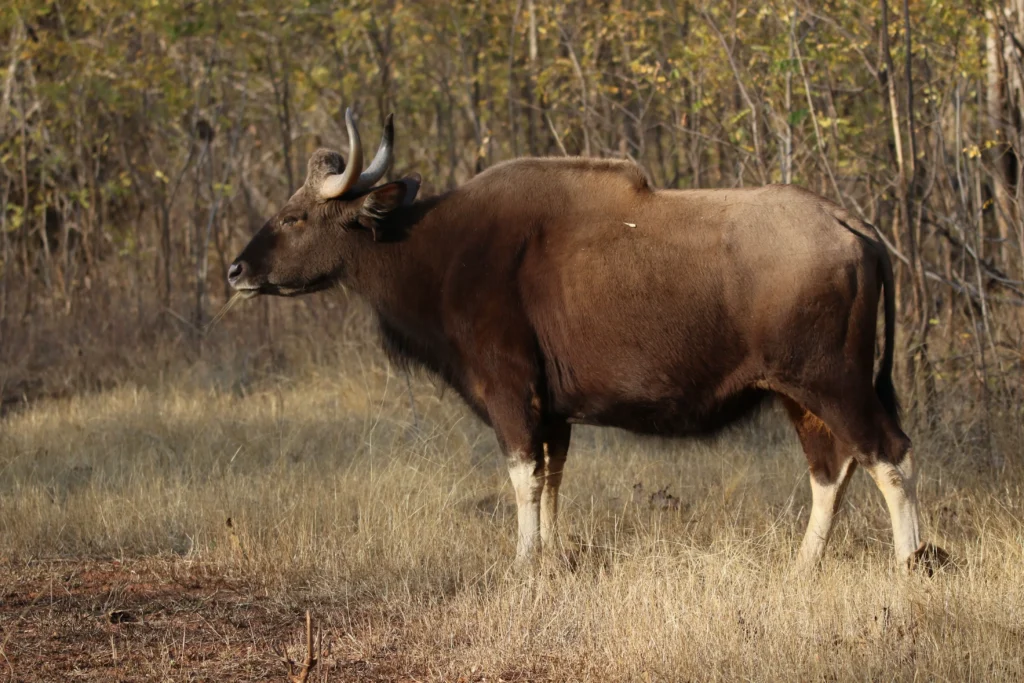
For wildlife travellers, watching a herd of gaur emerge from the timberline into an open meadow is one of the definitive safari scenes in India. Their deep chestnut to jet-black coats, muscular dorsal ridges, and contrasting white-to-cream “stockings” make them unmistakable.
TAXONOMIC SNAPSHOT
Common Name: Gaur, Indian Bison
Scientific Name: Bos gaurus
Family: Bovidae
IUCN Status: Vulnerable
Distribution: Fragmented across South, Central, and Northeast India
Gaur vs. Buffalo vs. Bison: Clearing the Confusion
Gaurs are routinely referred to as “Indian bison” in colloquial safari conversation, park literature, and field guides. However, this is a taxonomic misnomer:
- Gaur (Bos gaurus): A true wild bovine native to South and Southeast Asia. It has a prominent muscular dorsal ridge, high forehead crest, and distinctive pale leg markings.
- True Bison (Bison bison / Bison bonasus): Native strictly to North America and Europe, characterized by a massive woolly coat, lowered head carriage, and shorter horns.
- Wild Water Buffalo (Bubalus arnee): A different genus entirely, found in wet grasslands and riverine floodplains (such as Kaziranga and Manas), with flat, widely spreading crescent horns and an affinity for wallowing in open water.
Field Note: When reading historical travelogues or regional park boards, the term “bison” always refers to Bos gaurus. In field reporting and conservation biology, “gaur” is the standard term.
Core Gaur Habitats: Where Gaurs Live in India
Gaurs do not inhabit every wildlife reserve in India. They require contiguous tracts of moist deciduous, semi-evergreen, or evergreen forest intermixed with bamboo brakes and open grassy clearings. Unlike generalist herbivores such as chital (spotted deer), gaurs are sensitive to habitat fragmentation, forest degradation, and human disturbance.
GAUR HABITAT PROFILE
Primary Forest Types: Moist deciduous, dry deciduous with moist pockets, semi-evergreen, bamboo forest
Key Habitat Features: Undulating terrain, perennial streams, open glades, bamboo thickets
Primary Food Sources: Coarse grasses, bamboo shoots, young tree leaves, bark
India supports the largest remaining wild population of gaurs globally. These populations are concentrated across three distinct geographic blocs:
- The Western Ghats Complex: Spanning Karnataka, Tamil Nadu, and Kerala, this landscape represents the most contiguous, high-density gaur population in the world.
- The Central Indian Highlands: Extending across Madhya Pradesh and Maharashtra, these dry and moist deciduous teak forests host strong, localized populations.
- The Eastern and Northeastern Foothills: Encompassing the North Bengal Dooars, Assam foothills, and fragmented patches in Meghalaya and Odisha.
Best Gaur Destinations in the Western Ghats
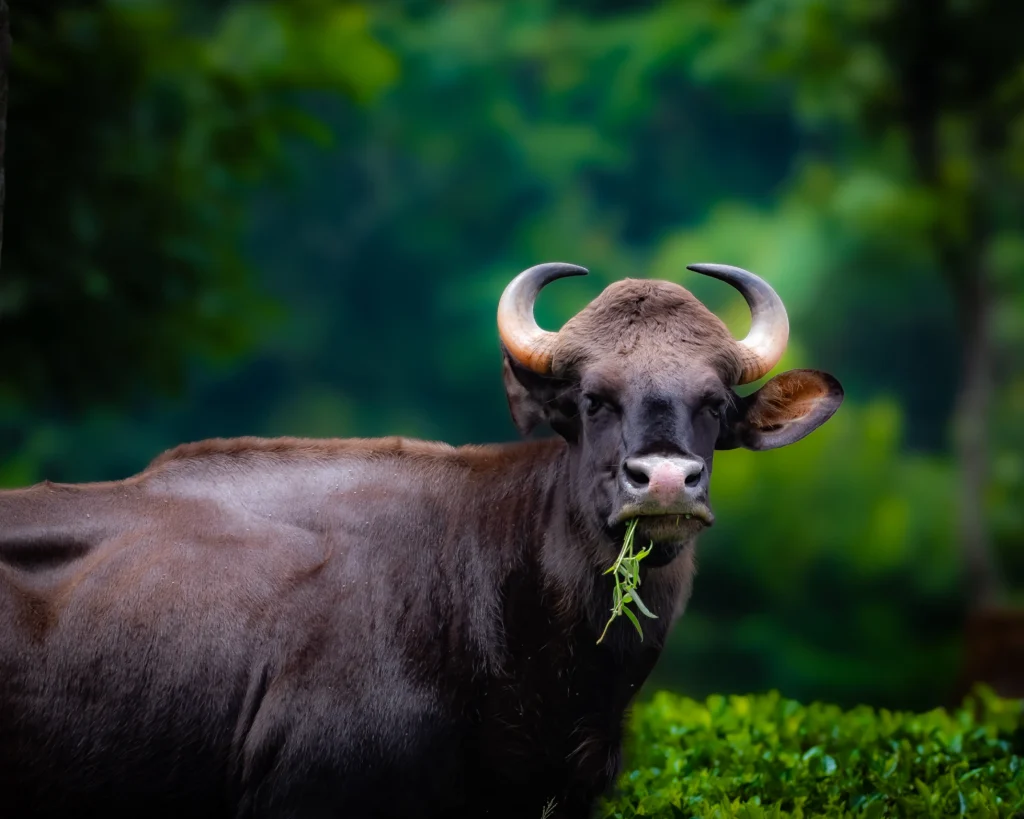
The Western Ghats landscape provides the most reliable gaur sightings in India. The combination of perennial rivers, high-canopy forests, and large protected forest complexes allows herds to move across wide home ranges without leaving forest cover.
WESTERN GHATS QUICK-LOOK
Best Baseline Parks: Nagarhole, Bandipur, Wayanad, Mudumalai
Optimal Habitats: Teak-bamboo transitions, riverine clearings, swampy meadows (hadlus)
Viewing Style: Jeep safari, vehicle road transects, boat safaris (Kabini/Periyar)
Nagarhole National Park and the Kabini Backwaters
Nagarhole (Nagarahole) is one of the most reliable reserves in India for observing large gaur herds. The park’s moist deciduous forests, interspersed with teak plantations and natural grassy swamps known locally as hadlus, provide year-round forage.
- Why it works for gaur: The Kabini River reservoir recedes during the dry season (February to May), exposing lush new grass along the waterline. Gaurs congregate here in large numbers alongside Asian elephants.
- Safari mode: Both regular jeep safaris through the core forest zones and boat safaris on the Kabini River produce regular sightings. Boat safaris offer unobstructed views of herds grazing along the water’s edge.
- Best zones: The Kabini safari zone (Dammankatte gate) is the primary access point for both terrestrial and boat viewing.
Expert Tip: For photographers, morning jeep safaris in Nagarhole often catch gaur herds moving through misty teak forest corridors, while late-afternoon boat safaris provide clear light on the open banks without foreground vegetation blocking the animals.
Bandipur National Park
Directly adjoining Nagarhole to the south, Bandipur features slightly drier mixed deciduous forest and scrubland transitioning toward the foothills of the Nilgiris.
- Why it works for gaur: Bandipur holds a high gaur density. Herds are frequently encountered along the central tourism routes and around road transects leading toward the Moyar Gorge.
- Viewing conditions: The more open understorey in Bandipur’s dry deciduous zones makes spotting animals through the forest easier than in dense evergreen tracts.
- Safari planning: Standard forest department jeep and canter safaris operate from the main Bandipur reception centre. Morning drives are particularly productive around water holes.
Mudumalai Tiger Reserve and Wayanad Wildlife Sanctuary
Mudumalai (Tamil Nadu) and Wayanad (Kerala) complete the Nilgiri Biosphere Reserve cluster alongside Bandipur and Nagarhole.
- Mudumalai Tiger Reserve: The Theppakadu and Kargudi zones feature extensive bamboo stands, which form a major seasonal food source for gaurs. Sightings along the main forest roads are common during early mornings and late afternoons.
- Wayanad Wildlife Sanctuary (Muthanga and Tholpetty): Wayanad acts as a critical wet-season refuge and migration corridor. Herds move freely between Bandipur, Nagarhole, and Wayanad based on grass palatability and water availability.
Periyar Tiger Reserve and Bhadra Wildlife Sanctuary
For travellers seeking gaur viewings outside the standard Nilgiri cluster, these two reserves offer distinct habitats:
- Periyar Tiger Reserve (Kerala): Periyar’s undulating evergreen and semi-evergreen terrain surrounds a large central reservoir. Gaur herds can be observed grazing on the slopes bordering the lake during boat cruises or guided walking safaris in designated eco-tourism zones.
- Bhadra Wildlife Sanctuary (Karnataka): Situated in the central Western Ghats, Bhadra’s moist deciduous and bamboo-covered hills support a healthy gaur population. The lower safari vehicle traffic here provides quiet, low-disturbance wildlife viewing compared to busier tourist hubs.
Best Gaur Destinations in Central India
The dry and moist deciduous forests of Central India support dense, healthy populations of gaurs. Unlike the continuous evergreen and semi-evergreen canopy of the Western Ghats, central Indian reserves feature open sal and teak forests intercut with broad grasslands (maidans) and river corridors. This open woodland structure often allows for clearer, longer-range viewing and photography.
CENTRAL INDIA QUICK-LOOK
Top Parks: Tadoba-Andhari, Pench, Kanha, Satpura
Optimal Habitats: Bamboo-dominated ridges, riverine valleys, open meadows (maidans)
Viewing Style: Open 4×4 Gypsy safaris, walking safaris (Satpura)
Tadoba-Andhari Tiger Reserve (Maharashtra)
Tadoba is widely regarded as one of the best locations in central India for close encounters with massive solitary gaur bulls as well as large maternal herds.
- Why it works for gaur: The reserve’s dense bamboo thickets (Dendrocalamus strictus) provide ample food, while permanent water sources like Tadoba Lake, Kolsa Lake, and the Erai water system keep herds active in core tourism zones year-round.
- Best zones: The Moharli, Tadoba, and Kolsa zones all produce regular sightings. The Kolsa range, with its secluded forest tracks and bamboo-clad hills, is particularly reliable for large breeding groups.
- Field note: The massive bulls in Tadoba often forage close to the main safari tracks, showing minimal reaction to vehicles that maintain an ethical idling distance.
Pench National Park (Madhya Pradesh & Maharashtra)
Pench’s undulating terrain, dominated by mixed teak forest and open grassy valleys, supports a robust gaur population.
- Why it works for gaur: The Pench River bisects the park, creating lush riverine meadows and gravel beds where herds gather during warm hours. Gaurs browse on young teak foliage, bamboo shoots, and ground herbs along seasonal drainage channels.
- Best zones: The Turia and Karmajhiri zones in Madhya Pradesh provide the most reliable vehicle tracks for spotting herds grazing near water bodies such as the Totladoh reservoir shoreline.
Kanha National Park (Madhya Pradesh)
Kanha’s vast network of open meadows (maidans) and dense sal forests makes it a prime habitat for large megafauna.
- Why it works for gaur: While gaurs spend the hottest parts of the day ruminating in the shade of dense sal and bamboo hills (dadars), they descend into broad clearings like the Kanha and Mukki meadows during early mornings and late afternoons.
- Viewing dynamic: Herds in Kanha can often be viewed alongside barasingha (swamp deer) and chital, providing opportunities to observe multi-species herbivore grazing patterns.
- Best zones: Mukki and Kanha zones offer consistent sightings around water points and bamboo transitions.
Satpura National Park (Madhya Pradesh)
Satpura’s sandstone peaks, narrow gorges, and dense mixed forest represent a pristine, rugged habitat for gaurs.
- Why it works for gaur: Gaurs naturally prefer hilly, undulating terrain. Satpura provides vast tracts of undisturbed forest where herds can feed on upland grasses and browse along deep, shaded ravines.
- Unique safari angle: In addition to standard 4×4 drives in the Madhai zone, Satpura offers permitted walking safaris with forest guides in designated buffer tracts, where naturalists can examine gaur tracks, rub marks on trees, and dung middens on foot.
Eastern and Northeastern Gaur Habitats
While the Western Ghats and Central India receive the majority of safari tourism, eastern and northeastern India contain vital foothill and floodplain strongholds.
EASTERN & NORTHEASTERN QUICK-LOOK
Key Regions: North Bengal (Dooars), Assam foothills, Meghalaya
Optimal Habitats: Terai-Dooars grasslands, moist sal forests, sub-Himalayan valleys
Viewing Style: Jeep safaris, watchtower viewing, vehicle road transects
North Bengal Terai and Dooars Forests
The sub-Himalayan plains of West Bengal—encompassing Gorumara National Park, Jaldapara National Park, and Buxa Tiger Reserve—host significant gaur numbers.
- Habitat characteristics: A mosaic of moist deciduous sal forests, riverine grasslands, and tea estate boundaries.
- Viewing dynamic: Gaurs in this landscape are frequently observed from forest department watchtowers (such as Jatraprasad and Rhino Point in Gorumara) as herds move out of the heavy timber into salt licks and forest clearings.
Meghalaya and Adjoining Northeastern Landscapes
In the northeastern hills, gaurs occupy moist semi-evergreen and bamboo-rich hill tracts across parts of Meghalaya, Assam, and bordering states.
- Field reality: Due to rugged terrain, dense undergrowth, and limited safari infrastructure outside major national parks, sightings require dedicated field tracking and are less frequent for casual safari tourists compared to central or southern parks.
The Changing Status in Palamau
Palamau Tiger Reserve in Jharkhand historically held a well-documented, thriving gaur population. However, over recent decades, habitat fragmentation, anthropogenic pressures, and disease transmission from domestic livestock led to a steep population collapse. Palamau stands as a stark case study illustrating why protected forest corridors and disease barriers are essential for long-term bovine survival.
Best Season and Timing for Gaur Sightings
Knowing when to plan a safari makes a major difference in sighting frequency, herd size, and photographic conditions.
SEASONAL VIEWING CALENDAR
Peak Visibility (Dry Season): March to May (concentrations around water)
Foliage & Dispersal (Winter): November to February (active during mid-morning)
Regeneration (Monsoon): July to September (most core zones closed; lush forage)
Summer vs. Winter Viewing Dynamics
- Summer (March to May/June):
- Sighting Reliability: Highest.
- Forest Conditions: High temperatures cause secondary water bodies to dry up and undergrowth to thin out significantly.
- Animal Movement: Gaurs congregate in large groups along perennial rivers (such as the Kabini or Pench rivers) and permanent park reservoirs.
- Photography: Open lines of sight with minimal foliage obstruction, though midday heat haze can affect long-range telephoto shots.
- Winter (November to February):
- Sighting Reliability: Moderate to high.
- Forest Conditions: Thick greenery and abundant surface water keep herds dispersed across upper ridges and interior forest tracts.
- Animal Movement: Gaurs do not need to travel far for water and may remain inside forest cover during hot hours. However, cooler temperatures encourage herds to graze in open meadows well into the mid-morning to absorb sunlight.
Time of Day and Safari Vehicle Behavior
Gaurs exhibit distinct crepuscular activity patterns to manage their metabolic needs and avoid direct heat:
- Dawn to 09:30 AM: Herds graze actively in open clearings, road shoulders, and meadow edges before the ambient temperature rises.
- 10:00 AM to 03:00 PM: Animals retreat into shaded bamboo brakes or dense tree cover to rest and ruminate.
- 03:30 PM to Dusk: Herds re-emerge into grassy glades and water margins for a secondary feeding session.
Naturalist Tip: During winter morning drives, do not rush through shaded tracks. Gaurs frequently pause on east-facing hill slopes or clearings where early sunlight pierces the canopy, offering natural spotlighting against dark forest backgrounds.
Gaur Behavior, Field Safety, and Safari Ethics
Encountering a one-tonne wild bovine in dense forest requires an understanding of their behavior. While gaurs are generally peaceful grazers, they are immensely powerful animals that demand respect and space from safari vehicles.
Herd Dynamics and Solitary Bull Behavior
Gaur social structures dictate how you will observe them in the wild. They primarily organize into two types of groups, alongside solitary individuals:
- Maternal Herds: Led by an older adult female, these herds consist of cows, juveniles, and calves. They range in size from a half-dozen individuals to aggregations of thirty or more during peak summer months when water is scarce. Herds are constantly on the move, grazing steadily as they walk.
- Bachelor Groups: Young males often form small, loose associations for feeding and protection.
- Solitary Bulls: As males mature and reach full size, they often leave the herds to become solitary. These older bulls carry the most impressive muscle mass and prominent dorsal ridges. They are frequently encountered feeding alone or resting in deep shade near forest tracks.
Field Note: You can often distinguish a mature solitary bull from a female by the sheer size of its dorsal ridge, the thickness of its horn bases (bosses), and a coat color that deepens to an almost pure, oily black. Females and younger males typically retain a slightly lighter, coffee-brown hue.
Safe Distance and Vehicle Etiquette
Because of their size and defensive capabilities, gaurs can be unpredictable if they feel stressed, cornered, or threatened.
- Maintain a generous buffer: Always observe gaurs from a stationary vehicle at a safe distance. Never pressure your driver to inch closer to a herd, particularly if calves are present.
- Do not block movement: Herds follow established game trails to water sources. Ensure your vehicle does not block their crossing path or their escape route into the undergrowth.
- Watch for warning signs: A stressed gaur will often face the vehicle directly, raise its head high to assess the threat, and let out a high-pitched snorting sound. If an animal exhibits this behavior, instruct your guide to slowly back the vehicle away.
PHOTOGRAPHY TIP: EXPOSING FOR DARK COATS
Photographing gaurs is notoriously tricky. Their dark coats absorb light, while the surrounding sunlit grass and foliage reflect it.
• Camera meters naturally want to brighten the dark animal, resulting in overexposed, blown-out backgrounds.
• To fix this, dial in negative exposure compensation (usually -0.3 to -1.0 EV, depending on the light).
• This preserves the natural highlights of the forest and ensures the gaur’s coat remains rich and detailed rather than washed out.
Conservation Status and Active Recovery Projects
Despite their formidable size, gaurs face significant survival pressures across their range. Understanding their conservation status provides important context for your safari experience.
Threats and Schedule I Legal Protections
The gaur is currently classified as Vulnerable on the IUCN Red List, reflecting a population decline over recent decades. While the species is highly protected in India under Schedule I of the Wildlife (Protection) Act, 1972, it remains threatened by several external factors.
The primary threats are habitat fragmentation and habitat loss. As agricultural expansion and infrastructure development cut through forest corridors, gaur herds become isolated. This fragmentation restricts their seasonal movement, limits genetic exchange, and forces them into closer contact with human settlements and domestic cattle, which increases the risk of disease transmission.
Reintroduction Projects: Sanjay and Srisailam
To combat localized extinctions and restore megafauna to historically occupied habitats, wildlife authorities have initiated active conservation translocation programs. These projects are critical for the long-term viability of the species in central and southern India.
- Sanjay Tiger Reserve (Madhya Pradesh): A formal gaur reintroduction plan has been developed for Sanjay Tiger Reserve, driven by the Forest Department in consultation with experts from the Wildlife Institute of India (WII). This project aims to rebuild the herbivore prey base and restore the ecological balance of the reserve.
- Nagarjunasagar Srisailam Tiger Reserve (Andhra Pradesh): The Andhra Pradesh Forest Department is pursuing a similar reintroduction initiative to bring the Indian gaur back into the sprawling Nagarjunasagar Srisailam Tiger Reserve.
These translocations are complex logistical operations that require careful habitat assessment, community cooperation, and long-term monitoring, highlighting the ongoing effort required to secure India’s wildlife landscapes.
Comparative Breakdown: Species, Destinations & Regions
To help you choose the right park and plan your wildlife itinerary, the tables below compare species identification, top safari reserves, and regional forest ecosystems.
Bovine Species Identification
It is common for travelers to confuse wild bovines in India. This table highlights the primary differences across species:
| Characteristic | Gaur (Bos gaurus) | Wild Water Buffalo (Bubalus arnee) | American Bison (Bison bison) |
| Native Region | South & Southeast Asia | South & Southeast Asia (river basins) | North America |
| Primary Habitat | Moist deciduous, bamboo, evergreen hill forests | Riverine floodplains, wet tall grasslands, swamps | Open prairies, plains, boreal woodlands |
| Key Physical Features | High dorsal ridge, high forehead crest, pale “stockings” | Broad crescent horns, flat forehead, slate-grey coat | Woolly humped forequarters, low head carriage, beard |
| Prominent Indian Parks | Nagarhole, Bandipur, Tadoba, Kanha, Pench, Periyar | Kaziranga, Manas, Dibru-Saikhowa | Not found in India |
Top Safari Destinations for Gaur Sightings in India
Each reserve offers different terrain, sighting probabilities, and seasonal viewing advantages:
| National Park / Reserve | State / Region | Primary Habitat | Sighting Reliability | Best Viewing Months | Recommended Safari Access |
| Nagarhole (Kabini) | Karnataka (Western Ghats) | Moist deciduous, teak, grassy swamps (hadlus) | Very High | February to May | Dammankatte (Jeep & Boat) |
| Bandipur | Karnataka (Western Ghats) | Mixed dry/moist deciduous, scrubland | Very High | January to May | Bandipur Main Gate |
| Tadoba-Andhari | Maharashtra (Central India) | Dense bamboo brakes, mixed teak woodland | High to Very High | March to May | Moharli, Kolsa, Tadoba |
| Pench | MP / Maharashtra (Central India) | Teak-dominated hills, riverine meadows | High | February to May | Turia, Karmajhiri |
| Kanha | Madhya Pradesh (Central India) | Sal forest, open grasslands (maidans) | High | November to May | Mukki, Kanha, Kisli |
| Periyar | Kerala (Western Ghats) | Tropical evergreen, semi-evergreen, reservoir margins | Moderate to High | October to April | Thekkady (Boat & Guided Walks) |
| Gorumara / Jaldapara | West Bengal (North Bengal) | Terai-Dooars floodplains, moist sal forest | Moderate | November to April | Lataguri / Madarihat (Watchtowers) |
Regional Gaur Landscapes Compared
Vegetation structure directly influences herd size and how easily you can see gaurs in the field:
| Region | Forest Architecture | Average Herd Size | Visibility & Photographic Conditions |
| Western Ghats | High canopy, dense evergreen, semi-evergreen, and moist deciduous | Large aggregations (15–35+) along water margins in summer | Contrast-heavy light; excellent open views along reservoir banks and swamps |
| Central Indian Highlands | Open teak and sal woodland, seasonal riverbeds, undulating clearings | Moderate groups (8–20); solitary massive bulls frequent | Excellent open sightlines in summer; great natural framing in open woodlands |
| Eastern Foothills & Dooars | Sub-Himalayan moist sal, tall riverine grass, semi-evergreen hill slopes | Small to medium groups (5–15) | Dense undergrowth; best viewed from elevated watchtowers and forest clearings |
Common Safari Mistakes When Looking for Gaur
- Ignoring Safe Buffer Distances: Assuming gaurs are docile like domestic cattle is a serious error. A full-grown bull can charge with incredible speed if it feels cornered. Always keep a safe, respectful distance and avoid blocking their movement path.
- Visiting During Peak Monsoon for Sightings: Dense seasonal foliage and heavy rainfall disperse herds across deep interior ridges, while several core tourism zones remain closed between July and September.
- Overlooking Solitary Bulls in Shaded Thickets: Travelers often scan only open meadows. Mature bulls spend hours resting in bamboo thickets and dense foliage close to safari tracks.
- Rushing Past Herbivore Clearings: Focusing solely on big cat pugmarks often causes visitors to miss natural herbivore behaviors, such as maternal interactions, nursing calves, and multi-species grazing dynamics.
- Mismetering Dark Coats in Harsh Light: Inexperienced photographers frequently overexpose the forest background, resulting in washed-out images of dark-coated gaurs. Manual exposure compensation is essential.
Frequently Asked Questions About Seeing Gaurs in India
Where is the single best place to see gaurs in India?
Nagarhole National Park (specifically the Kabini area) and Bandipur National Park in Karnataka offer the most reliable gaur sightings in India. The expansive backwaters and grassy swamps draw large herds throughout the dry season.
Is the gaur an Indian bison or a buffalo?
Taxonomically, the gaur (Bos gaurus) is a true wild bovine native to Asia. While “Indian bison” is a common colloquial name, it is not a true bison (Bison) nor is it a wild water buffalo (Bubalus arnee).
What makes the Kabini backwaters productive for gaur sightings?
As the Kabini reservoir recedes between February and May, it exposes fresh, nutrient-dense green grass along the banks. Gaurs, elephants, and deer gather along these open shorelines, making them easy to observe from safari boats and jeeps.
Are gaurs dangerous to safari vehicles or tourists?
Gaurs are generally non-aggressive if left undisturbed, but they are powerful wild animals. They can become defensive if a vehicle approaches too quickly, cuts off a calf from its mother, or blocks an escape route.
How does the season affect gaur visibility?
During the dry summer months (March to May), gaurs congregate around permanent rivers and water bodies due to scarce foliage and drying forest pools. In winter (November to February), herds are more dispersed across the forest, though they can be seen basking in sunlit clearings during morning drives.
Why are gaurs found in central India if the Western Ghats hold the largest numbers?
Central India’s dry and moist deciduous forests provide ideal forage, including bamboo stands and sal clearings. While the Western Ghats host the largest contiguous population, Central Indian parks like Tadoba, Kanha, and Pench support resilient, high-density populations.
Can you see gaurs on foot, or only by jeep safari?
In most Indian tiger reserves, all safari viewing is restricted to registered 4×4 vehicles. However, select reserves like Satpura National Park (Madhya Pradesh) and Periyar Tiger Reserve (Kerala) offer guided walking safaris with forest department naturalists in designated eco-zones.
What is the conservation status of gaurs in India?
The gaur is listed as Vulnerable on the IUCN Red List due to population declines caused by habitat fragmentation, land-use changes, and disease transmission from domestic cattle. It is strictly protected under Schedule I of India’s Wildlife (Protection) Act, 1972.
Why are gaur reintroduction programs taking place in Sanjay and Srisailam?
To reverse localized extinctions, re-establish viable breeding herds, and restore balanced herbivore prey bases, state forest departments and the Wildlife Institute of India have launched reintroduction initiatives in reserves like Sanjay Tiger Reserve and Nagarjunasagar Srisailam.
What camera settings work best for photographing dark-coated gaurs in deep forest shade?
Use spot metering or center-weighted metering paired with -0.3 to -1.0 EV exposure compensation. This prevents the camera from overexposing the surrounding sunlit greenery while retaining texture and detail in the dark coat.
Conclusion: Planning Your Gaur Safari
Observing the gaur in its natural habitat is one of the most rewarding wildlife experiences in India. Whether you choose the moist deciduous forests of the Western Ghats or the open teak woodlands of Central India, planning around the right season and habitat improves your chances of observing healthy herds and solitary bulls.
For high sighting frequency, combine Nagarhole and Bandipur during the late winter or dry summer months. For photography in open woodland settings, the core zones of Tadoba, Pench, and Kanha offer exceptional opportunities. Always prioritize ethical viewing, maintain a safe distance, and enjoy the presence of the world’s largest wild bovine.