Learn about the Indian bison or gaur—its habitat, behaviour, diet, conservation status, and the best national parks in India to see this remarkable wild cattle species.
Indian Bison (Gaur) Guide: Habitat, Behaviour, Size, Conservation & Best Places to See Gaur in India
Introduction
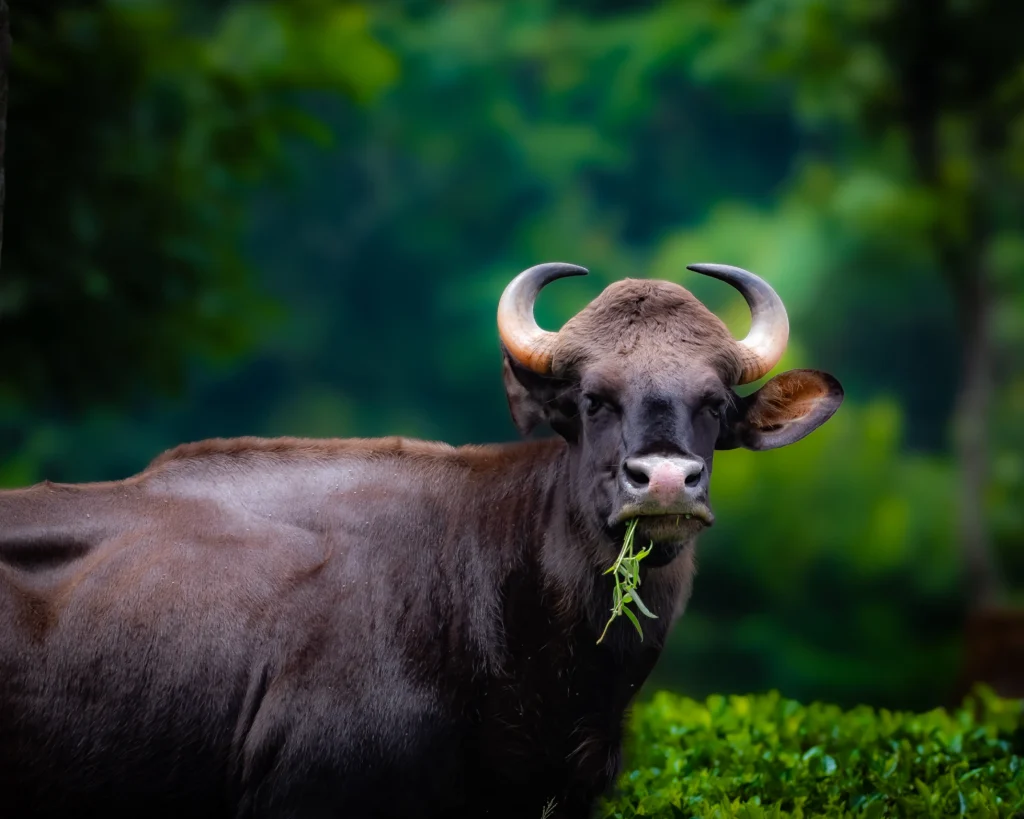
Few wild animals leave as strong an impression on a safari as a gaur. Standing taller than most domestic cattle, with a muscular build, curved horns, and distinctive white “stockings” on its lower legs, the gaur is the largest living wild cattle species in the world. Despite its size, it is often calm and spends much of its day feeding quietly in forests and grassy clearings.
Many people know this animal as the Indian bison, but that name is scientifically inaccurate. The correct common name is gaur, and its scientific name is Bos gaurus. Unlike the American bison or European bison, the gaur belongs to the genus Bos, making it more closely related to wild cattle than to true bison. Understanding this distinction helps avoid one of the most common misconceptions about the species.
Gaurs play a vital ecological role across India’s forests. As large herbivores, they influence vegetation through grazing and browsing, disperse seeds, and form an important part of forest food webs. Healthy gaur populations are often associated with well-connected forests that provide abundant forage, reliable water sources, and relatively low levels of disturbance.
For wildlife travellers, seeing a herd of gaurs is often one of the highlights of a safari, especially in the forests of the Western Ghats and parts of central India. Their impressive size, social behaviour, and close association with tiger habitats make them one of India’s most fascinating large mammals.
This guide explains what a gaur is, where it lives, how it behaves, the threats it faces, and the best places to observe it responsibly in the wild.
What Is the Indian Bison (Gaur)?
The gaur (Bos gaurus) is a wild bovine native to South and Southeast Asia and is widely recognised as the largest extant wild cattle species. India supports some of the species’ strongest remaining populations, making the country particularly important for its long-term conservation. Beyond India, gaurs also occur in countries including Nepal, Bhutan, Myanmar, Thailand, Cambodia, Laos, Vietnam, and Peninsular Malaysia, although their distribution varies across this range.
Unlike domestic cattle, gaurs have evolved to thrive in forest environments. They typically inhabit evergreen, semi-evergreen, and moist deciduous forests where grasses, shrubs, bamboo, and reliable water sources are available. Their preference for relatively undisturbed landscapes makes them useful indicators of healthy forest ecosystems.
For wildlife enthusiasts, gaurs represent much more than an impressive animal to photograph. Their presence reflects the condition of an entire landscape. Forests capable of supporting healthy gaur populations usually also support other large mammals such as Asian elephants, sambar, chital, wild boar, dholes, leopards, and tigers.
Scientific Name and Classification
The gaur belongs to:
| Classification | Details |
| Common name | Gaur |
| Alternative common name | Indian bison |
| Scientific name | Bos gaurus |
| Family | Bovidae |
| Genus | Bos |
| Diet | Herbivore |
| Conservation status | Vulnerable (IUCN) |
Although “Indian bison” remains widely used in guidebooks, tourism literature, and everyday conversation, conservation organisations and wildlife researchers generally prefer the name gaur, which more accurately reflects the animal’s taxonomy.
Why “Indian Bison” Is Not Technically Correct
One of the most persistent misconceptions is that the gaur is a true bison. It is not.
True bison belong to the genus Bison, which includes species such as the American bison and the European bison. The gaur belongs to the genus Bos, placing it alongside wild cattle rather than true bison. The term “Indian bison” became popular historically because of the animal’s massive body and superficial resemblance to bison, but it is not its correct zoological classification.
For this reason, most wildlife scientists, conservation organisations, and modern field guides use the name gaur. Visitors to Indian national parks will also often hear naturalists and safari guides use this preferred name.
Field Note: If a safari guide refers to both “gaur” and “Indian bison,” they are talking about the same animal. Using “gaur” simply reflects current scientific terminology.
Identifying a Gaur
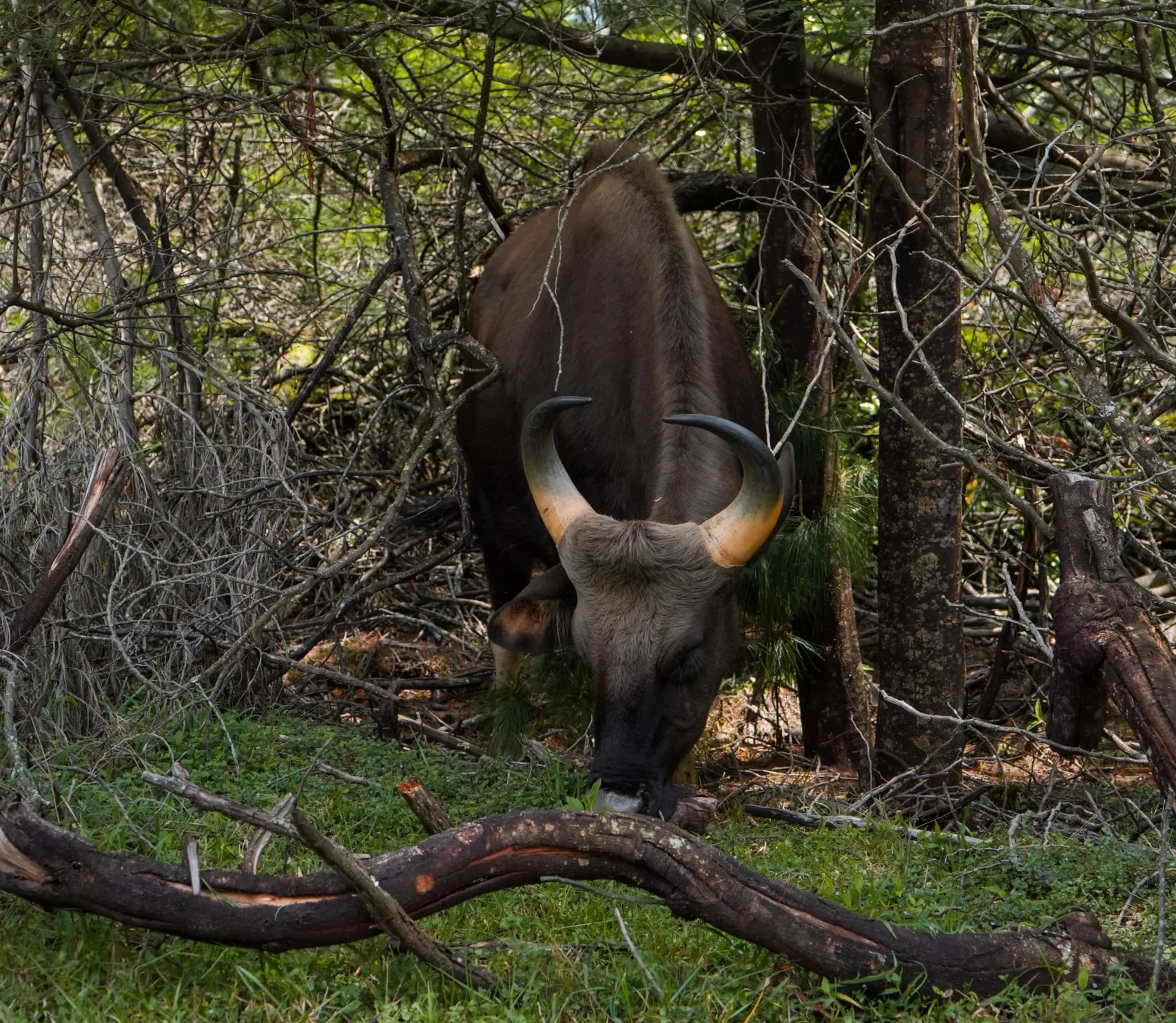
Although gaurs are often called “Indian bison,” they have a distinctive appearance that sets them apart from both true bison and domestic cattle. Their powerful build, glossy dark coat, muscular shoulders, and striking white lower legs make them one of the easiest large mammals to identify during a safari.
Unlike many deer species that rely on speed or camouflage, gaurs depend largely on their size, strength, and group vigilance. Even experienced safari-goers often underestimate just how large a fully grown bull can appear when seen at close range in the forest.
Size, Appearance and Key Features
The gaur is recognised as the largest living wild cattle species and among the heaviest wild bovids in the world. Adult bulls are noticeably larger and more muscular than females, particularly around the shoulders and neck.
Some of the easiest field marks include:
- A high, muscular shoulder ridge that gives the body a front-heavy appearance.
- A broad forehead between the horns.
- Smooth, upward-curving horns present in both males and females.
- A dark brown to almost black coat in mature bulls.
- Lighter brown colouring in females and younger animals.
- Distinctive white or pale cream lower legs, often described as “white stockings.”
- A large dewlap beneath the neck.
The combination of these features usually makes a gaur unmistakable, even from a distance.
Bulls, Cows and Calves
Adult bulls are considerably more imposing than cows. Besides being larger, they generally have darker coats and heavier muscles around the shoulders and neck.
Females are slightly smaller and usually appear more uniformly brown. They play the central role in herd life, leading family groups and caring for calves.
Young calves are born with a lighter golden or reddish-brown coat, which gradually darkens as they mature. Staying close to their mothers provides protection from predators during their early months.
Photography Tip: Early morning and late afternoon light highlights the gaur’s muscular profile and horn shape particularly well. Because their dark coats can lose detail in harsh midday sunlight, softer light usually produces better wildlife photographs.
Gaur vs American Bison vs Wild Buffalo
One reason for confusion is that gaurs share certain physical traits with both bison and buffalo. However, they are quite different animals.
| Feature | Gaur | American Bison | Wild Water Buffalo |
| Scientific genus | Bos | Bison | Bubalus |
| Common name | Indian bison (common usage) | American bison | Wild water buffalo |
| Largest wild cattle? | Yes | No | No |
| Shoulder hump | Muscular ridge | Large hump | Less pronounced |
| Habitat | Forests | Grasslands | Wetlands and grasslands |
| Typical range | South & Southeast Asia | North America | South & Southeast Asia |
Although all three belong to the bovine family, they occupy different habitats and evolved under different ecological conditions. The gaur’s adaptations are particularly suited to forested environments rather than open plains.
Gaur Behaviour and Ecology
Understanding gaur behaviour helps visitors appreciate what they are seeing on safari and also explains why these animals are so successful across many forest landscapes.
Gaurs are generally peaceful herbivores, but they remain wild animals capable of defending themselves if threatened. Most encounters involve animals feeding quietly, resting in shade, or moving steadily through forest clearings.
Herd Structure
Gaurs are social animals that usually live in herds. These family groups are commonly led by an experienced adult female rather than a dominant bull. This matriarch helps guide the herd between feeding areas, water sources, and safe resting sites.
A typical herd may include:
- Adult females
- Juveniles
- Young calves
- Sub-adult animals
This social organisation improves vigilance against predators and allows calves to remain protected within the group.
Male Behaviour
Adult bulls often follow a different lifestyle.
Rather than remaining permanently with family herds, mature males frequently live alone or in small bachelor groups. During the breeding season they may temporarily join female herds before returning to a more solitary existence.
This separation between female-led herds and solitary bulls is a normal part of gaur ecology and is commonly observed across their range.
Feeding Habits
Gaurs are herbivores that combine both grazing and browsing depending on food availability.
Their diet includes:
- Grasses
- Young shoots
- Leaves
- Bamboo
- Shrubs
- Stems
- Fruits when available
This flexible feeding strategy allows them to use a wide variety of forest habitats throughout the year.
Because of their large size, gaurs consume substantial quantities of vegetation every day. They therefore prefer forests where food remains available across seasons, particularly landscapes containing a mixture of woodland and grassy openings.
Field Note: Safari guides often locate gaurs by scanning grassy meadows bordering forests rather than searching deep inside dense woodland. Herds commonly emerge into open patches to feed before retreating into thicker cover.
Daily Activity Patterns
Gaurs are generally diurnal, meaning they are most active during daylight hours. Feeding is often concentrated during the cooler parts of the day, especially early morning and late afternoon.
However, their behaviour is not fixed.
In areas experiencing greater human activity or disturbance, gaurs may gradually shift towards increased nocturnal activity. This behavioural flexibility helps reduce encounters with people while allowing them to continue feeding efficiently.
This adaptation is one reason wildlife researchers caution against making broad statements about exactly when gaurs can be seen. Local conditions often influence activity patterns.
Behaviour at a Glance
| Behaviour | Typical Pattern |
| Social structure | Female-led herds |
| Mature bulls | Often solitary |
| Diet | Grazing and browsing herbivore |
| Peak activity | Mostly daytime |
| Response to disturbance | Can become more nocturnal |
| Preferred environment | Forests with water and abundant vegetation |
How Gaurs Respond to Disturbance
Despite their impressive size, gaurs generally avoid unnecessary confrontation.
When they detect people or vehicles at a respectful distance, they often continue feeding or slowly move into nearby forest cover. If they feel cornered or perceive a direct threat—particularly when calves are present—they may become defensive.
For safari visitors, the safest approach is straightforward:
- Stay inside authorised safari vehicles.
- Never attempt to approach a gaur on foot.
- Avoid loud noises or sudden movements.
- Give animals sufficient space to move naturally.
- Follow the instructions of your guide at all times.
Responsible Tourism Tip: A gaur that changes its behaviour because of approaching visitors has already been disturbed. Responsible wildlife viewing means observing natural behaviour without influencing it.
Habitat and Distribution
Knowing where gaurs live—and why they choose certain habitats—can greatly improve your understanding of both the species and the forests it inhabits. Unlike some large herbivores that thrive in open grasslands, gaurs are closely associated with forested landscapes that provide abundant food, reliable water, and relatively low levels of human disturbance.
Their distribution also reflects the health of these ecosystems. Areas that continue to support stable gaur populations often have well-connected forests capable of sustaining other large mammals such as elephants, tigers, leopards, and dholes.
Preferred Habitat
Gaurs favour landscapes where dense forest is interspersed with natural grasslands, bamboo patches, and open meadows. This combination allows them to feed efficiently while remaining close to cover.
Habitats commonly used by gaurs include:
- Evergreen forests
- Semi-evergreen forests
- Moist deciduous forests
- Forest clearings and grassy meadows
- Bamboo-dominated areas
- Valleys with perennial water sources
Unlike domestic livestock, gaurs generally avoid heavily disturbed landscapes whenever suitable forest habitat remains available.
Why Water Matters
Access to water is one of the most important factors influencing gaur distribution.
Most healthy populations occur in landscapes where streams, rivers, wetlands, or perennial waterholes remain available throughout much of the year. Water supports not only drinking needs but also the growth of grasses, shrubs, and other vegetation that form the gaur’s diet.
During hotter months, safari sightings often increase around water-rich valleys and forest clearings where animals congregate to feed and drink.
Expert Tip: If your primary goal is to see gaurs on safari, choose parks with extensive moist forests and permanent water rather than drier landscapes dominated by open woodland.
Distribution Across India
India contains some of the most significant remaining gaur populations anywhere in the species’ range.
Although many travellers associate gaurs mainly with South India, their distribution extends well beyond the Western Ghats. They are also found across parts of central and northeastern India wherever suitable forest habitat persists.
This broad distribution makes the gaur one of India’s most widespread large forest herbivores.
Western Ghats Strongholds
The Western Ghats support some of the country’s most reliable gaur populations.
Several protected landscapes are especially well known for regular sightings, including:
- Bandipur National Park
- Nagarhole National Park
- Mudumalai National Park
- Wayanad Wildlife Sanctuary
- Periyar Tiger Reserve
Together, these adjoining forests form one of Asia’s largest continuous protected landscapes, allowing gaurs to move across state boundaries while maintaining healthy populations.
Visitors to these parks frequently encounter gaurs grazing along roadsides, forest edges, and open meadows, particularly during morning and evening safari drives.
Central India
Strong populations also occur in parts of central India.
Among the best-known landscapes is Tadoba-Andhari Tiger Reserve, where gaurs share habitat with tigers, leopards, sloth bears, dholes, sambar, chital, and wild boar.
Their presence in central India demonstrates that gaurs are not confined to the wetter forests of the south but can also thrive in suitable deciduous forest systems.
Northeastern India
Northeastern India also supports gaur populations in appropriate forest habitats.
Although they are generally less associated with safari tourism than the Western Ghats, these forests contribute to the species’ wider distribution across the Indian subcontinent.
Wider Asian Range
Beyond India, gaurs occur across parts of South and Southeast Asia, including:
- Nepal
- Bhutan
- Myanmar
- Thailand
- Cambodia
- Laos
- Vietnam
- Peninsular Malaysia
The size and continuity of populations vary across these countries, but India remains one of the species’ principal strongholds.
Regional Comparison
| Region | Characteristics |
| Western Ghats | Extensive moist forests with some of India’s strongest gaur populations |
| Central India | Deciduous forests with established populations in protected reserves such as Tadoba |
| Northeastern India | Forested landscapes supporting regional populations |
| Wider Asian Range | Distribution extends into several South and Southeast Asian countries |
Conservation Status and Threats
Despite their immense size and strength, gaurs face several conservation challenges. Their physical power does not protect them from habitat loss, forest fragmentation, disease risks, or increasing pressure from expanding human activities.
For this reason, the species continues to receive legal protection across much of its range.
IUCN and Legal Protection
The gaur is currently classified as Vulnerable on the IUCN Red List.
Within India, it receives the highest level of legal protection under Schedule I of wildlife legislation. Internationally, it is also listed under CITES Appendix I, reflecting the importance of protecting remaining populations.
These protections recognise that, although gaurs remain widespread in some landscapes, long-term conservation depends on maintaining healthy forests and connected habitats.
Major Threats
Habitat Loss and Fragmentation
The greatest long-term challenge for gaurs is the reduction and fragmentation of suitable forest habitat.
As forests become divided into smaller patches, movement between populations becomes more difficult. This can reduce access to food, water, and breeding opportunities while increasing encounters with people.
Human Disturbance
Gaurs generally prefer relatively undisturbed forests.
Increasing tourism pressure outside regulated safari practices, expanding infrastructure, and other human activities may alter their natural behaviour. One documented response is a gradual shift towards greater nocturnal activity in disturbed landscapes.
Conflict Near Agricultural Areas
Where forests border cultivated land, gaurs may occasionally move into crop fields in search of food.
Such situations can lead to conflict between people and wildlife, highlighting the importance of landscape-level management that balances conservation with local livelihoods.
Poaching and Other Pressures
Although legal protection has strengthened conservation efforts, gaurs continue to face pressure from illegal hunting and other human-related threats in parts of their range. Combined with habitat degradation, these pressures contribute to their Vulnerable conservation status.
Recent Conservation Developments
Conservation efforts continue across several Indian landscapes.
One noteworthy recent development is the Palamu Tiger Reserve in Jharkhand, where the Forest Department initiated a study in 2025 aimed at understanding and supporting the revival of the reserve’s gaur population. This reflects growing recognition of the gaur as an important indicator of healthy forest ecosystems.
Wildlife managers also continue to emphasise:
- Protecting large, connected forest landscapes.
- Maintaining reliable water sources.
- Reducing human disturbance.
- Monitoring populations in protected areas.
- Supporting coexistence in forest-edge communities.
Threats and Conservation Responses
| Conservation Challenge | Typical Response |
| Habitat fragmentation | Protect and reconnect forest landscapes |
| Human disturbance | Manage tourism and reduce unnecessary disturbance |
| Crop-edge conflict | Promote coexistence and landscape management |
| Illegal hunting | Strengthen legal protection and enforcement |
| Population monitoring | Scientific surveys and long-term conservation programmes |
Responsible Tourism Tip: Every responsible safari contributes indirectly to gaur conservation by supporting protected areas and encouraging the long-term value of healthy forests. Visitors can help further by following park rules, keeping noise to a minimum, and never encouraging wildlife to change its natural behaviour.
Best Places to See Gaur in India
Although gaurs occur across several regions of India, some protected areas offer more consistent opportunities to observe them in their natural habitat. Parks with extensive forest cover, permanent water sources, and healthy grasslands generally support stable populations.
Unlike elusive predators, gaurs are often seen grazing in forest clearings or feeding along the edges of meadows. However, sightings always depend on season, habitat conditions, and the animals’ natural movements, so no park can guarantee an encounter.
Top National Parks for Gaur Sightings
| National Park / Reserve | Why It’s Known for Gaur |
| Bandipur National Park | One of the best-known gaur habitats within the Western Ghats landscape. |
| Nagarhole National Park | Extensive forests with healthy gaur populations and frequent safari sightings. |
| Mudumalai National Park | Connected to Bandipur and Nagarhole, allowing wildlife to move freely across the landscape. |
| Wayanad Wildlife Sanctuary | Part of the Nilgiri Biosphere landscape that supports gaurs alongside elephants and tigers. |
| Periyar Tiger Reserve | Moist forests and reliable water sources provide suitable habitat. |
| Tadoba-Andhari Tiger Reserve | One of central India’s important gaur landscapes. |
These protected areas are recognised not only for their gaur populations but also for conserving large, connected forest ecosystems that support a wide variety of wildlife.
What to Expect on Safari
Most gaur sightings occur while the animals are:
- Grazing in grassy meadows.
- Browsing near forest edges.
- Walking between feeding areas and water sources.
- Resting in shaded woodland during warmer hours.
A herd quietly feeding beside a safari track is usually one of the most memorable wildlife encounters in these forests.
Because gaurs are generally tolerant of vehicles that maintain a respectful distance, they often allow visitors to observe natural behaviour without obvious disturbance.
Photography Tip: A telephoto lens is ideal for photographing gaurs without approaching too closely. Wide-angle images can also work well when a herd is feeding in an open meadow, showing the animals within their forest habitat.
Why Gaur Matter to Forest Ecosystems
The gaur’s importance extends far beyond its impressive size.
As one of India’s largest herbivores, it influences forest vegetation through grazing and browsing. By consuming a wide range of grasses, shoots, leaves, and fruits, gaurs help shape plant communities and contribute to natural ecological processes.
An Indicator of Healthy Forests
Healthy gaur populations usually indicate that a landscape still provides:
- Extensive forest cover.
- Reliable water availability.
- Diverse vegetation.
- Space for wildlife movement.
- Relatively low levels of disturbance.
For conservationists, this makes the gaur an important indicator species. Protecting habitats suitable for gaurs also benefits many other forest-dependent animals.
Part of the Forest Food Web
Although adult gaurs have few natural predators because of their immense size, they remain an important component of predator-prey relationships in Indian forests.
They share habitat with:
- Tigers
- Leopards
- Dholes
- Asian elephants
- Sambar
- Chital
- Wild boar
Their presence contributes to the ecological complexity that makes India’s protected forests so valuable for biodiversity conservation.
Field Note: Many experienced naturalists consider seeing a relaxed herd of gaurs grazing naturally to be just as rewarding as spotting a tiger. Such behaviour often reflects a healthy, functioning forest ecosystem.
Common Myths About Gaur
| Myth | Reality |
| Indian bison and gaur are different animals. | “Indian bison” is simply a common name for the gaur. |
| Gaur are true bison. | They belong to the genus Bos, not Bison. |
| Gaur live only in South India. | They also occur in central and northeastern India, as well as other parts of South and Southeast Asia. |
| Gaur are always active during the day. | They are mainly diurnal but may become more active at night where disturbance is high. |
| Their large size means they face no conservation threats. | Habitat loss, fragmentation, disturbance, and poaching continue to affect populations. |
| Gaur are simply oversized domestic cattle. | They are a distinct wild species with specialised ecological roles and behaviour. |
Common Mistakes Visitors Make
When hoping to see or photograph gaurs, visitors sometimes make avoidable mistakes that reduce both safety and wildlife welfare.
The most common include:
- Assuming every large wild bovine is a gaur without checking identifying features.
- Expecting gaurs only in South Indian parks.
- Trying to approach solitary bulls for closer photographs.
- Making loud noises when a herd is nearby.
- Believing large animals are harmless because they appear calm.
- Leaving safari vehicles where park rules prohibit it.
- Judging the quality of a safari only by tiger sightings and overlooking one of India’s most impressive herbivores.
Following your guide’s instructions and respecting wildlife distances almost always results in a better safari experience.
Frequently Asked Questions
What is the Indian bison?
The Indian bison is the common name for the gaur (Bos gaurus), the world’s largest living wild cattle species.
Is gaur the same as Indian bison?
Yes. “Indian bison” is a widely used common name, while gaur is the scientifically preferred common name.
What is the scientific name of gaur?
Its scientific name is Bos gaurus.
Where are gaurs found in India?
Gaurs occur across the Western Ghats, central India, and parts of northeastern India in suitable forest habitats.
What do gaurs eat?
They are herbivores that feed on grasses, shoots, leaves, stems, bamboo, shrubs, and seasonal fruits.
Are gaurs herbivores?
Yes. They are entirely herbivorous.
Do gaurs live in herds?
Yes. Family groups are usually led by an experienced adult female, while mature bulls often spend much of their time alone.
Are male gaurs solitary?
Adult bulls are frequently solitary or occur in small bachelor groups outside the breeding season.
Are gaurs dangerous to humans?
Gaurs are generally calm and avoid confrontation. However, like any large wild animal, they can become defensive if threatened or if calves are present. Visitors should always maintain a safe distance and follow safari regulations.
What habitat do gaurs prefer?
They favour evergreen, semi-evergreen, and moist deciduous forests with abundant vegetation and dependable water sources.
Is gaur endangered?
The species is currently classified as Vulnerable on the IUCN Red List.
What is its legal protection in India?
The gaur receives the highest level of protection under Schedule I of Indian wildlife legislation and is also listed in CITES Appendix I.
Which national parks offer good opportunities to see gaurs?
Bandipur, Nagarhole, Mudumalai, Wayanad, Periyar, and Tadoba are among the best-known protected areas for gaur sightings.
Is the gaur bigger than an American bison?
The gaur is recognised as the largest living wild cattle species, although the two animals belong to different genera.
Why are gaurs important to forests?
They help shape vegetation, support ecological processes through grazing and browsing, and indicate the presence of healthy, well-connected forest ecosystems.
Conclusion
The gaur is much more than an impressively large wild animal. As the world’s largest living wild cattle species, it represents the health of many of India’s forests and the ecological processes that sustain them. Its preference for extensive, well-watered forests means that protecting gaur habitat also safeguards countless other plants and animals that share the same landscape.
For wildlife travellers, understanding the gaur adds a new dimension to every safari. Recognising the difference between a solitary bull and a family herd, understanding why gaurs favour particular habitats, or appreciating their role within forest ecosystems makes each sighting more meaningful than simply ticking another species off a checklist.
Whether you encounter gaurs in the forests of Bandipur, Nagarhole, Mudumalai, Periyar, Wayanad, Tadoba, or another protected landscape, observing them respectfully is a reminder that India’s forests are defined not only by their famous predators but also by the remarkable herbivores that help keep these ecosystems functioning.
Last updated: August 2026. Conservation status, regional distribution, and park-specific conditions can change over time. Always refer to the latest information from official park authorities before planning your visit.