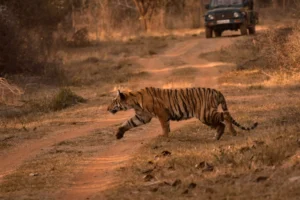
Discover how Pench National Park became linked with Rudyard Kipling’s The Jungle Book, the Seoni connection, Mowgli’s origins, myths, and safari experiences.
Introduction
For many travellers, Pench National Park is more than a tiger reserve. It is widely recognised as the landscape most closely associated with Rudyard Kipling’s The Jungle Book. Forests around Seoni, the Pench River, and stories of a wolf-raised child have helped shape the enduring connection between this region and the fictional world of Mowgli.
However, the relationship between Pench and The Jungle Book is often simplified. It is more accurate to say that Pench and the broader Seoni landscape are considered an important literary inspiration rather than the exact location of the story. Kipling created a fictional world by drawing on Central Indian geography, wildlife, and historical accounts instead of describing a single real forest.
Understanding this distinction makes the story even more interesting. Rather than searching for exact places from the book, visitors can appreciate how Pench’s forests, rivers, and wildlife resemble the landscape that has inspired generations of readers.
Did Pench Really Inspire The Jungle Book?
The Short Answer
Yes—Pench is widely regarded as one of the strongest real-world inspirations behind The Jungle Book, particularly through its association with the forests of Seoni and the Pench–Wainganga river landscape. This connection is recognised by tourism authorities, wildlife operators, and many travel writers. At the same time, historians generally avoid claiming that the novel was based exclusively on today’s Pench National Park.
The safest conclusion is that Pench represents an important source of inspiration rather than the book’s precise geographical setting.
Why the Connection Became So Strong
Several factors have reinforced Pench’s association with Mowgli over the years:
- The forests around Seoni closely match the landscape described in the stories.
- Historical accounts describe a wolf-child discovered near Seoni, often linked to the origin of Mowgli.
- The Pench River forms part of the wider Wainganga river system referenced in discussions about The Jungle Book.
- Forest departments, tourism boards, and safari operators increasingly present Pench as “Mowgli’s jungle,” helping popularise the connection.
Together, these historical, geographical, and cultural links have made Pench one of India’s best-known literary wildlife destinations.
Field Note: Enjoy Pench as the landscape that inspired a timeless story rather than expecting to find exact locations from the novel. The forests themselves are the real attraction.
Literary Inspiration Versus Historical Certainty
One of the biggest misconceptions is that Kipling directly copied Pench into his novel. Available evidence does not support such a straightforward claim. There is no clear proof that Kipling visited Pench before writing The Jungle Book, and the book predates the establishment of the modern national park.
Instead, researchers suggest that Kipling drew upon multiple influences, including:
- Central Indian geography
- Colonial-era reports
- Wildlife observations
- Historical stories from the Seoni region
- His own literary imagination
This balanced view respects both the historical evidence and the cultural significance of Pench.
Why Pench Is Closely Linked with Mowgli’s Story
The Seoni Landscape
The strongest geographical link is not simply Pench National Park itself but the broader forests of Seoni in present-day Madhya Pradesh. In The Jungle Book, Kipling refers to “Seonee” (the historical spelling of Seoni), leading many researchers to connect the fictional setting with this region.
Today’s Pench Tiger Reserve lies within this wider landscape, making it the most accessible place where visitors can experience forests resembling those described in the stories.
The Pench River and the Wainganga Connection
Pench takes its name from the Pench River, a tributary of the Wainganga River. References to the Wainganga have long strengthened the literary connection because similar river systems appear in discussions of Kipling’s setting. While the novel does not function as a geographical map, these natural features reinforce the impression that Central India’s river valleys helped shape its world.
The Wolf-Child Story
Perhaps the most influential historical link is the widely reported account of a boy allegedly found living among wolves near Seoni in the nineteenth century. Later colonial writings helped popularise this story, and many researchers believe it may have contributed to the creation of Mowgli’s character.
Although historians continue to debate how directly this account influenced Kipling, it remains one of the most frequently cited reasons for Pench’s enduring association with The Jungle Book.
Kipling’s Possible Sources of Inspiration
Rather than relying on one source, Kipling likely combined several influences:
- The forests of Central India.
- Reports from the Seoni region.
- Contemporary colonial accounts, including the wolf-child narrative.
- Real Indian wildlife such as tigers, wolves, sloth bears, and leopards.
- His own storytelling and imagination.
This explains why The Jungle Book feels authentic without corresponding exactly to any single location on a map.
Expert Tip: When visiting Pench, focus on understanding the broader Central Indian landscape that inspired the stories. Viewing the park as a literary landscape rather than a film set offers a richer and more rewarding experience.
Which The Jungle Book Characters Can Be Connected to Pench Wildlife?
One reason Pench feels so familiar to readers is that many of the animals in The Jungle Book are species that still live in Central Indian forests today. While Kipling’s characters are fictional and often display human personalities, they were inspired by real wildlife that visitors may encounter during a safari.
It is important, however, to distinguish between literary inspiration and biological reality. The characters represent species found in Central India, but they should not be interpreted as depictions of individual animals or exact wildlife behaviour.
Mowgli and the Wolves
Mowgli’s adoption by a wolf pack is central to the story and is one of the strongest links between The Jungle Book and the Seoni region.
Historical accounts describe a boy allegedly found living with wolves near Seoni during the nineteenth century. Although historians debate how much this account influenced Kipling, it remains one of the best-known historical connections associated with Mowgli’s origin.
Indian wolves still occur in parts of Central India, although sightings are uncommon because they generally inhabit more open grasslands and scrub habitats than the dense forests most safari visitors explore.
For travellers, seeing a wolf in Pench should be considered a rare bonus rather than an expectation.
Field Note: Even without spotting wolves, understanding their place in Central India’s ecology adds another layer of appreciation to the Mowgli story.
Shere Khan and Bengal Tigers
If one character defines The Jungle Book, it is Shere Khan.
Unlike many fictional animals in the story, Bengal tigers remain one of Pench’s greatest wildlife attractions. Pench is recognised as one of India’s important tiger reserves, and many visitors choose the park primarily for tiger safaris.
Although Shere Khan is portrayed as a villain, real tigers behave very differently.
Wild tigers generally:
- avoid humans whenever possible
- hunt natural prey
- defend territories rather than seek conflict
- play an essential ecological role as apex predators
Understanding this difference helps visitors appreciate real tiger behaviour instead of viewing them through the lens of fiction.
Photography Tip
If your goal is tiger photography:
- Keep your camera ready throughout the safari.
- Focus on behaviour rather than simply getting a close portrait.
- Respect your guide’s instructions and never pressure drivers to chase wildlife.
Ethical viewing almost always results in a better experience.
Baloo and Sloth Bears
Many readers assume Baloo represents a brown bear.
In reality, the closest Indian equivalent is the sloth bear, a species found in Pench and across much of Central India.
Sloth bears differ considerably from their friendly fictional counterpart.
They are:
- primarily insect eaters
- powerful diggers
- mostly solitary
- active during cooler hours
- known for their shaggy black coats and distinctive pale chest markings
Although they may appear slow, sloth bears can move surprisingly quickly and deserve plenty of space if encountered in the wild.
For many wildlife enthusiasts, a sloth bear sighting is almost as memorable as seeing a tiger.
Bagheera and the Black Panther Question
Bagheera is perhaps the most misunderstood character in relation to Pench.
Many tourism articles imply that Bagheera represents a black panther living in Pench. The reality is more nuanced.
A black panther is not a separate species. The term usually refers to a melanistic leopard—a leopard with unusually dark pigmentation.
While black leopards have been documented in parts of India, they should not be regarded as a defining feature of Pench or an expectation for visitors. Presenting Bagheera as proof that black panthers belong to Pench oversimplifies the evidence.
The more accurate interpretation is that Bagheera represents the grace, intelligence and stealth of Indian leopards rather than serving as evidence of a resident black panther population.
Expert Tip: If you read claims that Pench is “Bagheera’s home because black panthers live here,” treat them cautiously. The literary association is compelling, but it should not be confused with verified wildlife records.
Other Animals That Resemble Jungle Book Characters
Although the famous characters attract most attention, many other species found in Pench help recreate the atmosphere of The Jungle Book.
Visitors may encounter:
- Spotted deer (chital)
- Sambar deer
- Wild boar
- Langurs
- Indian gaur
- Leopards
- Numerous birds
- Reptiles
- Butterflies and insects
Together, these species create the dynamic forest environment that makes Pench feel remarkably similar to the landscapes imagined in the novel.
Comparison Table: Jungle Book Characters and Their Real-World Counterparts
| Jungle Book Character | Real Wildlife | Present in Pench? | Nature of the Connection |
| Mowgli | Wolf-child legend from Seoni | Historical association | Literary inspiration, not proven fact |
| Akela | Indian wolf | Rarely seen | Species occurs in Central India |
| Shere Khan | Bengal tiger | Yes | Strong ecological parallel |
| Baloo | Sloth bear | Yes | Closest Indian equivalent |
| Bagheera | Leopard (often imagined as a melanistic leopard) | Leopards present | Literary interpretation; black panther association is not definitive |
| Bandar-log | Langurs and monkeys | Yes | Behavioural inspiration rather than direct representation |
Historical Timeline
| Year | Event | Why It Matters |
| 1831 | Reported wolf-child discovered near Seoni | Often cited as an inspiration for Mowgli |
| 1894 | The Jungle Book published | Introduced Mowgli and the fictional Seonee jungle |
| Later 20th Century | Pench gains protected status | Conserves much of the landscape associated with the stories |
| Recent Years | Tourism increasingly promotes Pench as “Mowgli’s Jungle” | Strengthens the literary identity of the destination while encouraging visitors to understand the historical context |
Decision Guide: Is This Article About Fiction or Wildlife?
If you’re visiting Pench because of The Jungle Book, keep these expectations in mind:
| If you’re looking for… | Expect… |
| Exact locations from the novel | No—the story is fictional. |
| Landscapes resembling Mowgli’s forest | Yes—the Seoni-Pench region closely matches the literary setting. |
| Tigers, sloth bears and leopards | Yes, these are genuine wildlife highlights. |
| Guaranteed wolf sightings | No, wolves are elusive and rarely seen on standard safaris. |
| A deeper appreciation of how literature and wildlife intersect | Absolutely—this is where Pench offers something unique. |
By approaching Pench with realistic expectations, visitors can enjoy both its literary heritage and its remarkable wildlife without confusing storytelling with documented history.
Pench vs Kanha: Which Forest Really Inspired The Jungle Book?
Few topics generate as much discussion among wildlife travellers as whether Pench or Kanha is the “real” Jungle Book forest.
The simplest answer is that Pench generally has the stronger literary association, while Kanha remains an important part of the broader Central Indian landscape often linked to Kipling’s work. The debate exists because The Jungle Book is a work of fiction inspired by multiple influences rather than a description of one identifiable location.
Why Pench Is Usually Considered the Stronger Connection
Several factors explain why Pench is more frequently described as “Mowgli’s Jungle.”
1. The Seoni Connection
The stories repeatedly refer to “Seonee” (now Seoni), and Pench lies within this wider geographical region.
This direct geographical association is one of the strongest reasons tourism authorities and researchers connect Pench with The Jungle Book.
2. The Wolf-Child Narrative
Historical reports of a boy allegedly raised by wolves near Seoni became closely associated with Mowgli’s story.
Although historians cannot prove that this account directly inspired Kipling, it remains one of the most persuasive historical links connecting Pench and the novel.
3. Tourism and Official Interpretation
Over the years, forest authorities, safari operators and tourism organisations have consistently presented Pench as the landscape associated with Mowgli.
This does not prove literary certainty, but it explains why visitors commonly encounter Jungle Book references throughout the region.
Why Kanha Also Appears in the Debate
Kanha National Park is another celebrated tiger reserve in Central India and is often mentioned in discussions about The Jungle Book.
There are several reasons for this:
- Kanha protects forests similar to those found around Pench.
- It is internationally recognised as one of India’s finest wildlife destinations.
- Travel writers frequently discuss both parks together because they share Central Indian landscapes and wildlife.
However, available evidence does not clearly establish Kanha as the primary inspiration behind Mowgli’s forest. Much of its association comes from the broader Central Indian setting rather than the specific historical links that connect Pench with Seoni.
Inspiration Is Not the Same as an Exact Setting
This distinction is often overlooked.
Writers rarely copy real places exactly. Instead, they combine:
- landscapes
- historical events
- wildlife
- local stories
- imagination
Kipling appears to have done the same.
Rather than searching for the “one true Jungle Book forest,” it is more accurate to understand The Jungle Book as being inspired by Central India as a whole, with Pench providing one of its strongest identifiable geographical anchors.
Comparison Table: Pench vs Kanha
| Topic | Pench | Kanha |
| Strong link with Seoni | ✔ Yes | Limited |
| Historical wolf-child association | ✔ Frequently cited | No direct association |
| Tourism branding as Mowgli’s Jungle | Extensive | Limited |
| Tiger safari destination | ✔ Yes | ✔ Yes |
| Central Indian forest landscape | ✔ Yes | ✔ Yes |
| Widely considered literary inspiration | Strong | Broader regional association |
| Exact setting of the novel | Not proven | Not proven |
Decision Guide: If your trip is inspired primarily by The Jungle Book, Pench offers the more recognisable literary connection. If your priority is experiencing another outstanding Central Indian tiger reserve, Kanha remains an excellent choice in its own right.
How to Experience the Jungle Book Landscape in Pench Today
Although Mowgli is fictional, Pench allows visitors to experience many of the forests, rivers and wildlife that evoke the atmosphere of the stories.
Instead of searching for film-style attractions, approach the park as a living ecosystem where literature and nature intersect.
Look Beyond Tiger Sightings
Many first-time visitors focus almost entirely on seeing a tiger.
While Pench is an excellent tiger reserve, the Jungle Book connection becomes much richer when you notice the wider forest.
Watch for:
- Langurs giving alarm calls.
- Herds of chital moving cautiously.
- Sloth bears foraging.
- Leopards resting in trees.
- Dry teak forests changing with the seasons.
- Seasonal streams and river crossings.
Together, these elements create the setting that makes readers imagine Mowgli’s world.
Appreciate the Landscape
The appeal of Pench lies not only in its wildlife but also in its scenery.
Notice features such as:
- Teak forests
- Bamboo thickets
- Rocky hills
- Grassland openings
- River valleys
- Seasonal water bodies
These landscapes closely resemble descriptions commonly associated with Central India’s forests and help explain why Pench became linked with The Jungle Book.
Visit with a Storytelling Mindset
A safari becomes more rewarding when viewed through both natural history and literature.
Rather than asking,
“Where is Mowgli?”
Try asking,
- Which habitat would suit wolves?
- Why would a tiger choose this valley?
- How would a sloth bear use this termite mound?
- Which river corridor supports the most wildlife?
This perspective transforms the safari into a deeper exploration of the ecosystem that inspired generations of readers.
Family Travel Tip
Families travelling with children often find Pench especially engaging because many youngsters already recognise characters from The Jungle Book.
Parents can turn the safari into an educational activity by encouraging children to identify:
- Tiger → Shere Khan
- Sloth bear → Baloo
- Leopard → Bagheera
- Wolves → Akela’s pack
- Langurs → Bandar-log
Remind children that the real animals behave differently from their fictional counterparts, making the safari both entertaining and educational.
Photography Tip
Instead of trying to recreate scenes from films, photograph the natural landscape that inspired the stories.
Some rewarding subjects include:
- Misty forest roads at sunrise.
- Light filtering through teak forests.
- Wildlife using riverbanks.
- Deer framed by bamboo.
- Forest reflections after the monsoon.
- Birds perched in open woodland.
These images often capture the spirit of Pench more effectively than close-up portraits alone.
Responsible Tourism Tip
The popularity of The Jungle Book should encourage appreciation for wildlife—not unrealistic expectations.
While exploring Pench:
- Stay inside your vehicle unless permitted.
- Keep noise to a minimum.
- Never feed wildlife.
- Follow your guide’s instructions.
- Avoid asking drivers to disturb animals for photographs.
- Respect safari regulations.
Responsible behaviour ensures that future visitors can enjoy the same forests that inspired one of the world’s most enduring wildlife stories.
Practical Checklist for Jungle Book Fans
Before your safari, ask yourself:
☐ Do I understand that The Jungle Book is fiction inspired by real landscapes?
☐ Am I visiting to appreciate wildlife rather than recreate a movie?
☐ Have I learned about the Seoni connection?
☐ Do I know which animals actually occur in Pench?
☐ Am I prepared to enjoy the entire forest, even if I don’t see a tiger?
Visitors who answer “yes” to these questions usually leave with a much deeper appreciation of both Pench and Kipling’s enduring legacy.
Fact vs Myth: Understanding Pench’s Jungle Book Connection
The relationship between Pench and The Jungle Book is fascinating because it blends documented history, literary inspiration and modern tourism. Separating these helps visitors appreciate the story without accepting popular myths as established fact.
| Statement | Fact or Myth? | Explanation |
| Pench inspired The Jungle Book. | Largely supported | Pench and the wider Seoni landscape are widely recognised as important literary inspirations. |
| Pench is the exact forest described in the novel. | Myth | The book is fictional and combines multiple influences rather than depicting one real location. |
| Rudyard Kipling visited Pench before writing the book. | Not supported by available evidence | No reliable historical evidence confirms this. |
| The Seoni region influenced Mowgli’s story. | Well supported | References to Seonee and historical accounts strengthen this connection. |
| Mowgli was a real documented individual. | Partly based on historical accounts | The nineteenth-century wolf-child story may have contributed to the character but does not prove Mowgli existed as portrayed in the novel. |
| Bagheera proves black panthers live in Pench. | Myth | Bagheera is a fictional character. The black panther association should not be treated as evidence of a resident population. |
| Pench is worth visiting even without the Jungle Book connection. | Absolutely | Its wildlife, forests and conservation value stand on their own. |
Expert Tip: The most rewarding way to explore Pench is to appreciate both its literary heritage and its ecological importance. Neither diminishes the other.
Common Mistakes Visitors Make
Planning a safari around The Jungle Book can make a trip more enjoyable, but unrealistic expectations sometimes lead to disappointment.
Expecting to Find the Exact Locations from the Book
The novel was never intended to function as a geographical guide.
Instead of searching for “Mowgli’s cave” or “Shere Khan’s valley,” enjoy the broader landscape that inspired the stories.
Believing Every Tourism Claim Literally
Many travel websites simplify the Pench connection into catchy slogans.
The evidence supports Pench as an important inspiration, but not as the exact setting of every event in the novel. Keeping this distinction in mind leads to a better understanding of both literature and history.
Focusing Only on Tigers
Tiger sightings are exciting, but Pench offers much more.
Watching alarm calls, birdlife, deer behaviour, forest habitats and changing light often creates equally memorable safari experiences.
Ignoring the Story Behind the Landscape
Many visitors know the Disney adaptation but are unfamiliar with the historical and literary background.
Learning about Seoni, the wolf-child story and Central India’s forests before your visit adds valuable context to every safari.
Forgetting Responsible Wildlife Viewing
Wild animals are not actors performing scenes from a novel.
Good safari etiquette includes:
- Respecting wildlife.
- Remaining quiet.
- Following guide instructions.
- Avoiding pressure on drivers for close encounters.
- Valuing natural behaviour over dramatic photographs.
Responsible tourism supports conservation while improving the experience for everyone.
Frequently Asked Questions
Did Pench really inspire The Jungle Book?
Pench is widely regarded as one of the principal real-world inspirations for The Jungle Book, particularly because of its connection with the Seoni landscape and the historical wolf-child story. However, the novel is fictional and should not be viewed as a direct description of today’s national park.
Is Pench officially called “Mowgli’s Jungle”?
Many tourism organisations and safari operators promote Pench using the Mowgli theme, but this is a cultural and literary association rather than an official historical designation.
Did Rudyard Kipling ever visit Pench?
There is no clear historical evidence confirming that Kipling visited Pench before writing The Jungle Book. Most researchers believe he drew upon published accounts, Central Indian geography and historical narratives.
Why is Seoni important?
The book refers to “Seonee,” and historical accounts associated with Seoni—including the famous wolf-child narrative—have become central to understanding the origins of Mowgli’s story.
Was Mowgli based on a real child?
Many historians believe reports of a wolf-raised child from the Seoni region may have influenced the character, but Mowgli himself remains fictional.
Is Pench more closely linked to The Jungle Book than Kanha?
Most travel and tourism sources consider Pench the stronger literary association because of its links with Seoni and the wolf-child story. Kanha, however, remains part of the broader Central Indian landscape often discussed in relation to the novel.
Can visitors see wolves in Pench?
Wolves occur in parts of Central India, but sightings during a Pench safari are uncommon. Visitors should treat any wolf sighting as an exceptional bonus rather than an expectation.
Is Bagheera a black panther found in Pench?
Bagheera is fictional. Although black leopards exist in some parts of India, visitors should not assume that Pench is known for black panther sightings.
Which Jungle Book animals are commonly seen?
Visitors have realistic chances of seeing:
- Bengal tigers
- Sloth bears
- Leopards
- Langurs
- Chital
- Sambar
- Wild boar
- Numerous bird species
Actual sightings always depend on season, luck and safari conditions.
Is Pench worth visiting if I’m not a Jungle Book fan?
Absolutely. Pench is one of Central India’s premier tiger reserves and offers rewarding wildlife viewing, diverse habitats and excellent safari experiences regardless of its literary connection.
Conclusion
Pench National Park occupies a unique place in India’s wildlife and literary heritage. While historians rightly distinguish between documented evidence and popular storytelling, the forests around Seoni, the Pench River landscape and the enduring wolf-child narrative have together made Pench the destination most closely associated with The Jungle Book.
Rather than searching for exact scenes from the novel, visitors should approach Pench as a living forest that captures the spirit of Kipling’s imagination. Watching a tiger emerge from teak woodland, hearing langurs sound alarm calls or observing a sloth bear forage at dusk offers a deeper appreciation of the natural world that inspired one of literature’s most enduring wildlife stories.
Whether you arrive as a wildlife enthusiast, a literary traveller or a family introducing children to Mowgli’s adventures, Pench rewards curiosity with experiences rooted in real forests, real wildlife and a story that continues to connect people with nature more than a century after it was first published.
Pench National Park : Topics Cluster
- Pench Detailed Guide MP and Maharashtra Gates
- Pench National Park Quick Guide
- Pench Jungle Book Connection
- Pench Safari Booking Step by Step Guide
- How to reach Pench National Park?
- Pench Safari Zones
- Best Tiger Safaris around Nagpur
- Tiger Safari India Planning Workbook
- Wildlife in Madhya Pradesh
- Wildlife in Maharashtra
- Tadoba vs Pench
- Satpura vs Pench