
Discover all 9 hornbill species of India, their habitats, distribution, conservation status, ecology, and the best places to see these remarkable forest birds.
Hornbills of India: Complete Guide to All 9 Species, Distribution, Habitats & Best Places to See Them
Hornbills are among India’s most recognisable forest birds. Their oversized bills, distinctive casque, and noisy wingbeats make them easy to notice, but their ecological importance goes far beyond their appearance. Many hornbill species feed on fruits and transport seeds across large distances, helping regenerate tropical forests. For this reason, they are often referred to as the “farmers of the forest.”
India is home to nine hornbill species, ranging from the adaptable Indian Grey Hornbill, which can even be found in urban parks, to the Narcondam Hornbill, a species found only on a single volcanic island in the Andaman and Nicobar archipelago. Together, these birds occupy a remarkable variety of habitats, including the rainforests of the Western Ghats, the evergreen forests of Northeast India, riverine forests, and even some human-modified landscapes.
For wildlife travellers, hornbills are often among the most rewarding birds to observe because their behaviour is both conspicuous and fascinating. Watching a Great Hornbill glide between towering forest trees or witnessing a nesting pair caring for their young provides insights into some of India’s oldest forest ecosystems. At the same time, many hornbill populations face pressures from habitat loss, fragmentation, and the disappearance of large nesting trees, making responsible wildlife tourism and conservation increasingly important.
Whether you are planning a birdwatching trip, hoping to photograph India’s forest birds, or simply want to learn more about these remarkable species, this guide brings together species identification, regional distribution, conservation, and practical travel advice in one place.
Hornbills of India at a Glance
Hornbills belong to the family Bucerotidae, a group of birds distributed across Africa and Asia. In India, they are closely associated with tropical and subtropical forests, where mature fruiting trees and natural nesting cavities provide the resources they need to survive. Most species rely heavily on large trees for nesting, making old-growth forests particularly valuable for their long-term conservation.
Several features distinguish hornbills from other birds:
- Large, curved bills often topped by a casque.
- Strong dependence on fruit, although many species also consume insects and small animals.
- Long-distance seed dispersal that helps forests regenerate.
- Nesting in natural tree cavities, where the female seals herself inside during incubation, leaving only a narrow opening through which the male delivers food.
- Close association with healthy tropical forests containing mature trees.
Field Note
If you hear loud, rhythmic wingbeats overhead before spotting the bird, look up. Large hornbills, particularly the Great Hornbill, often announce their arrival with wingbeats that can be heard from considerable distances in quiet forests.
How Many Hornbill Species Are Found in India?
India supports nine species of hornbills, each with its own distribution, habitat preferences, and conservation challenges. Some are widespread across peninsular India, while others are confined to the rainforests of the Western Ghats, the Eastern Himalayas, or isolated islands.
Broadly, these species can be grouped into three categories:
Widespread Species
These occur across relatively large parts of India and are more likely to be encountered by general wildlife travellers.
- Indian Grey Hornbill
- Great Hornbill
- Oriental Pied Hornbill (within suitable northeastern habitats)
Western Ghats Specialists
The Western Ghats support four hornbill species and remain one of India’s most important hornbill landscapes.
- Great Hornbill
- Malabar Grey Hornbill
- Malabar Pied Hornbill
- Indian Grey Hornbill (locally)
Research has shown that moist and wet forests of the Western Ghats support substantially higher hornbill encounter rates than drier forest types, highlighting the importance of conserving these evergreen landscapes.
Northeast India and Island Specialists
Several species have highly restricted Indian distributions.
- Rufous-necked Hornbill
- Wreathed Hornbill
- White-throated Brown Hornbill
- Oriental Pied Hornbill
- Narcondam Hornbill (restricted entirely to Narcondam Island)
These forests represent India’s greatest hornbill diversity and offer some of the country’s finest birdwatching opportunities.
Complete Guide to Every Hornbill Species in India
The nine hornbill species found in India occupy different habitats and regions, from city parks and dry deciduous forests to remote tropical rainforests and isolated islands. Understanding where each species occurs and what makes it distinctive can help birdwatchers and wildlife travellers plan more rewarding trips while appreciating the conservation challenges each bird faces.
Great Hornbill (Buceros bicornis)
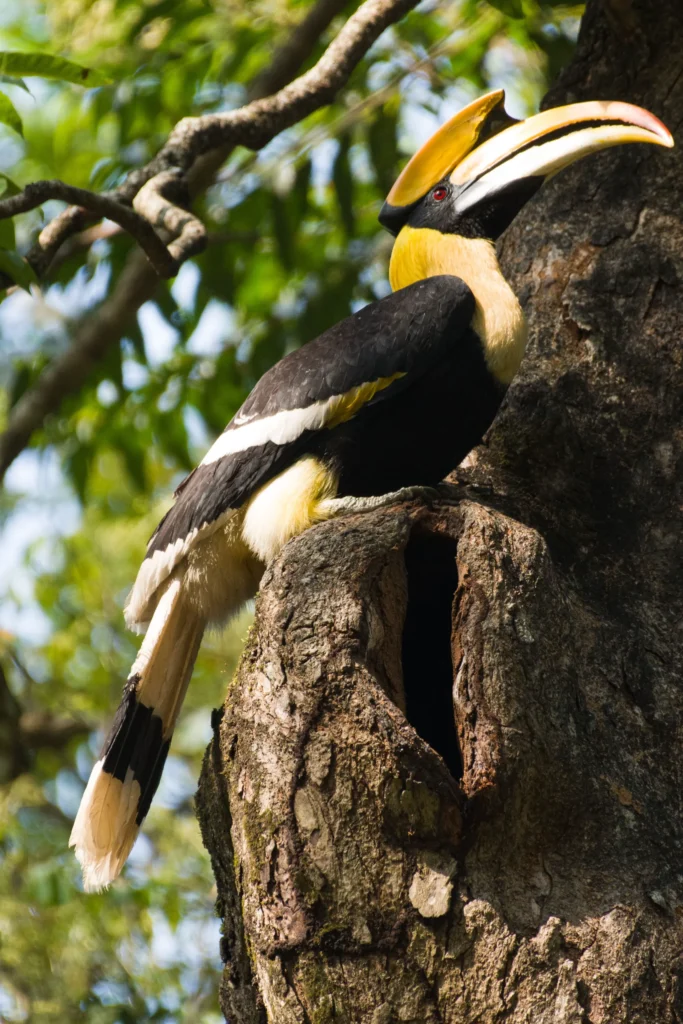
The Great Hornbill is India’s largest hornbill and one of the country’s most recognisable forest birds. Its bright yellow bill and casque, striking black-and-white plumage, and broad wings make it unmistakable in flight.
Within India, it is found mainly in the Western Ghats and Northeast India, where it depends on extensive evergreen and semi-evergreen forests containing mature fruiting trees and large nesting cavities. Because these forests take decades to develop, the species is closely tied to old-growth habitats.
Large fig trees are particularly valuable food sources, although the birds also consume other fruits, insects, and small vertebrates when available.
Where to see it
- Periyar Tiger Reserve
- Anamalai Tiger Reserve
- Parambikulam Tiger Reserve
- Dandeli Wildlife Sanctuary
- Pakke Tiger Reserve
- Namdapha National Park
For many visitors to the Western Ghats, the Great Hornbill is the flagship bird of tropical evergreen forests.
Rufous-necked Hornbill (Aceros nipalensis)
The Rufous-necked Hornbill is one of India’s most localised hornbills. Adults are recognised by their rich rufous neck and contrasting dark body, making them one of the most attractive hornbill species in Asia.
In India, the species occurs only in parts of the Eastern Himalayas, especially Arunachal Pradesh, where it inhabits undisturbed montane evergreen forests.
Its restricted range and dependence on intact forests make it particularly vulnerable to habitat degradation.
Where to see it
- Eaglenest Wildlife Sanctuary
- Pakke Tiger Reserve
- Other suitable forests of Arunachal Pradesh
Sightings usually require dedicated birdwatching trips rather than general wildlife safaris.
Wreathed Hornbill (Rhyticeros undulatus)
The Wreathed Hornbill is a large canopy-dwelling species distinguished by the ridged folds around the base of its bill that give the bird its common name.
It ranges across the forests of Northeast India and is often observed flying long distances between feeding and roosting areas.
Unlike some hornbill species that remain within relatively small territories, Wreathed Hornbills can travel considerable distances in search of seasonal fruiting trees.
Best places to look
- Pakke Tiger Reserve
- Namdapha National Park
- Forests of Arunachal Pradesh
- Parts of Assam and adjoining northeastern states
Birdwatchers often detect them by their loud wingbeats before the birds become visible above the canopy.
Narcondam Hornbill (Rhyticeros narcondami)
Among India’s birds, few species have a distribution as restricted as the Narcondam Hornbill.
It is found only on Narcondam Island, a small volcanic island in the Andaman and Nicobar archipelago. Nowhere else in the world does this species occur naturally.
Because of this extremely limited range, conservation of the island’s forests is vital for the species’ long-term survival.
For most travellers, observing the Narcondam Hornbill is not practical because access to the island is highly restricted and generally limited to scientific or official visits.
Field Note
Although birdwatchers often dream of seeing the Narcondam Hornbill, it is better appreciated as an example of why isolated island ecosystems require careful protection rather than as a realistic wildlife tourism target.
Malabar Pied Hornbill (Anthracoceros coronatus)
The Malabar Pied Hornbill is recognised by its contrasting black-and-white plumage and large pale bill topped with a prominent casque.
In India it occurs mainly across parts of the Western Ghats and selected riverine and coastal forest landscapes.
Compared with the Great Hornbill, it is often associated with lower-elevation forests and river systems where large fruiting trees remain.
Good locations include
- Dandeli Wildlife Sanctuary
- Anamalai landscape
- Parts of Kerala’s protected forests
Local movements often follow seasonal fruit availability.
Oriental Pied Hornbill (Anthracoceros albirostris)
The Oriental Pied Hornbill is widespread across Southeast Asia, but within India its distribution is concentrated in the Northeast.
It inhabits evergreen forests, wetlands, and riverine woodland and is often more tolerant of modified habitats than some larger hornbill species.
Its relatively broad ecological tolerance allows it to persist in landscapes where suitable trees remain, although extensive habitat loss still affects local populations.
Where to watch
- Kaziranga landscape
- Assam wetlands
- Arunachal Pradesh forests
- Other suitable northeastern protected areas
White-throated Brown Hornbill (Anorrhinus austeni)
The White-throated Brown Hornbill is one of India’s lesser-known hornbill species.
Unlike the colourful Great Hornbill, this species has more subdued plumage, although the contrasting white throat provides a useful identification feature.
It occurs in the forests of Northeast India, particularly where mature evergreen forests remain intact.
Because it spends much of its time high in the canopy and often moves quietly, sightings are less frequent than for some larger hornbills.
Malabar Grey Hornbill (Ocyceros griseus)
The Malabar Grey Hornbill is endemic to the Western Ghats, making it one of the region’s signature birds.
Smaller than the Great Hornbill and lacking the large casque, it is nevertheless highly vocal and frequently encountered in evergreen and moist deciduous forests.
Its range closely follows the Western Ghats mountain chain, making it an important indicator of this biodiversity hotspot.
Popular locations include:
- Periyar Tiger Reserve
- Silent Valley National Park
- Wayanad Wildlife Sanctuary
- Anamalai Tiger Reserve
- Parambikulam Tiger Reserve
Wildlife travellers exploring southern India’s forests often encounter this species more frequently than the larger Great Hornbill.
Indian Grey Hornbill (Ocyceros birostris)
The Indian Grey Hornbill is the most adaptable of India’s hornbills.
Unlike many forest specialists, it is commonly found in woodlands, agricultural landscapes, urban parks, avenues, and city gardens, provided mature trees remain. Citizen science observations have highlighted this adaptability, making it the hornbill most people are likely to encounter outside protected areas.
Its grey plumage, gently curved bill, and noisy calls make it familiar across much of northern, central, and western India.
For many people, this species provides their first introduction to hornbills without requiring travel to remote forests.
Comparison Table: India’s Nine Hornbill Species
| Species | Primary Indian Range | Distinguishing Feature | Best Chance of Seeing |
| Great Hornbill | Western Ghats, Northeast | Largest Indian hornbill with prominent yellow casque | Periyar, Anamalai, Pakke |
| Rufous-necked Hornbill | Eastern Himalayas | Rich rufous neck | Arunachal Pradesh |
| Wreathed Hornbill | Northeast India | Ridged casque and long-distance flights | Pakke, Namdapha |
| Narcondam Hornbill | Narcondam Island | Island endemic | Restricted island habitat |
| Malabar Pied Hornbill | Western Ghats | Black-and-white plumage | Dandeli, Kerala forests |
| Oriental Pied Hornbill | Northeast India | Pale bill and adaptable habitat use | Assam and Arunachal |
| White-throated Brown Hornbill | Northeast India | White throat with brown body | Evergreen forests of Northeast |
| Malabar Grey Hornbill | Western Ghats | Western Ghats endemic | Kerala, Karnataka, Tamil Nadu |
| Indian Grey Hornbill | Much of peninsular and northern India | Frequently found outside forests | Parks, avenues and woodland |
Photography Tip
Hornbills often spend long periods feeding in fruiting fig trees. Rather than walking continuously through the forest, identify an active fruiting tree and wait patiently. This approach often provides longer viewing opportunities and more natural behavioural photographs than trying to follow birds through dense vegetation.
Where to See Hornbills in India & Travel Planning
Knowing where a hornbill occurs is only part of planning a successful birdwatching trip. Habitat quality, forest type, and the availability of mature fruiting and nesting trees have a major influence on the likelihood of encountering these birds. While hornbills occur across much of tropical India, a handful of landscapes consistently support the greatest diversity and are the best destinations for wildlife travellers.
Where to See Hornbills in India
Western Ghats: India’s Premier Hornbill Landscape
The Western Ghats are the best destination for visitors interested in seeing multiple hornbill species during a single trip. This mountain chain supports four species:
- Great Hornbill
- Malabar Grey Hornbill
- Malabar Pied Hornbill
- Indian Grey Hornbill (in suitable areas)
Research covering dozens of localities across five states identified several landscapes as particularly important for hornbill conservation, including:
- Anamalai–Parambikulam–Vazhachal
- Nilgiris–Wayanad
- Amboli–Goa–Dandeli
- Someshwara–Sharavati–Mookambika
- Neyyar–Peppara–Kalakkad–Mundanthurai
- Periyar landscape
These landscapes contain extensive evergreen and semi-evergreen forests with abundant fruiting trees and mature nesting sites, making them especially valuable for hornbill populations.
Recommended Protected Areas
For most wildlife travellers, these reserves offer the best opportunities:
- Periyar Tiger Reserve
- Anamalai Tiger Reserve
- Parambikulam Tiger Reserve
- Silent Valley National Park
- Wayanad Wildlife Sanctuary
- Dandeli Wildlife Sanctuary
- Kali Tiger Reserve
Many of these destinations also support elephants, gaur, Nilgiri langurs, lion-tailed macaques, and numerous endemic birds, making them rewarding even beyond hornbill watching.
Northeast India: Highest Hornbill Diversity
If your goal is to see India’s greatest variety of hornbill species, Northeast India is unmatched.
The forests of Arunachal Pradesh, Assam and neighbouring states support several species that do not occur anywhere else in mainland India, including:
- Rufous-necked Hornbill
- Wreathed Hornbill
- White-throated Brown Hornbill
- Oriental Pied Hornbill
- Great Hornbill
The combination of tropical evergreen forests, high rainfall and extensive forest cover creates ideal habitat for these birds.
Among the most respected birding destinations are:
- Pakke Tiger Reserve
- Namdapha National Park
- Eaglenest Wildlife Sanctuary
- Forests of Arunachal Pradesh
- Selected protected areas in Assam
These destinations attract dedicated birdwatchers from around the world because they support many other rare Himalayan and Indo-Malayan bird species alongside hornbills.
Narcondam Island
Narcondam Island deserves special mention because it is the only place on Earth where the Narcondam Hornbill naturally occurs.
Although this makes it one of India’s most significant bird conservation sites, it is not a conventional wildlife tourism destination. Access is highly restricted, and most travellers should not plan their itinerary around visiting the island.
Instead, the Narcondam Hornbill serves as an important reminder of how isolated island ecosystems can produce species found nowhere else.
Best Destinations by Travel Goal
| Your Goal | Recommended Destination |
| See several hornbill species | Western Ghats |
| Photograph Great Hornbill | Periyar, Anamalai, Dandeli |
| Observe endemic Western Ghats species | Silent Valley, Wayanad, Periyar |
| Watch northeastern hornbills | Pakke, Namdapha, Eaglenest |
| Look for urban hornbills | Parks and wooded neighbourhoods across much of northern and peninsular India |
Why Hornbills Matter to Forests
Hornbills are much more than charismatic birds. They play a central ecological role by transporting seeds across forests, helping maintain tree diversity and supporting natural forest regeneration. Their importance is one of the reasons conservationists often refer to them as the “farmers of the forest.”
Many tropical trees produce large fruits that smaller birds cannot swallow. Hornbills consume these fruits and later disperse the seeds, often many kilometres away from the parent tree.
This process benefits forests by:
- Reducing competition between young seedlings and parent trees.
- Allowing forests to regenerate naturally after disturbance.
- Maintaining plant diversity across large landscapes.
- Connecting fragmented forest patches through long-distance seed dispersal.
Without healthy hornbill populations, regeneration of many large-seeded tree species becomes more difficult.
Field Note
If you spend time beneath a fruiting fig tree in the Western Ghats or Northeast India, you may observe an entire community of wildlife using the same food source. Hornbills often feed alongside barbets, imperial pigeons, macaques and giant squirrels, illustrating how a single fruiting tree can support numerous forest animals.
Diet, Nesting and Behaviour
What Do Hornbills Eat?
Although hornbills are best known for eating fruit, their diet is more varied than many people realise.
Depending on the species and season, they may consume:
- Figs and other forest fruits
- Berries
- Small reptiles
- Insects
- Small mammals
- Nestling birds when opportunities arise
Fruit remains the dominant component of the diet for most Indian hornbills and underpins their role as seed dispersers.
One of the Most Unusual Nesting Strategies Among Birds
Hornbill breeding behaviour is unlike that of almost any other Indian bird.
The female selects a natural cavity in a large tree and then seals herself inside using mud, fruit pulp and droppings, leaving only a narrow slit.
During incubation and while raising young chicks:
- The male delivers food through the narrow opening.
- The female remains protected inside the nest.
- Both parents invest heavily in raising a small number of chicks.
This remarkable strategy helps reduce the risk of predation but also means hornbills depend heavily on large, cavity-bearing trees. Forests lacking mature trees may therefore provide food but still fail to support successful breeding.
Why Large Trees Are Essential
Hornbills need mature forests for two reasons:
- Large fruiting trees provide reliable food.
- Old trees contain the natural cavities required for nesting.
Removing old trees, even if younger forest remains, can therefore reduce breeding opportunities.
This dependence explains why habitat quality is just as important as habitat quantity.
Photography Tip
Early morning is generally the most productive time to photograph hornbills. Birds often become active soon after sunrise as they travel between roosting and feeding sites. Position yourself near fruiting trees rather than attempting to follow birds through dense forest, as this usually results in longer and less disturbed observations.
Responsible Wildlife Watching Checklist
Before heading into the field:
- Carry binoculars before relying on a telephoto lens.
- Maintain a respectful distance from nesting birds.
- Never use playback calls near breeding sites.
- Stay on designated trails whenever possible.
- Avoid loud conversations beneath fruiting trees.
- Follow the instructions of local guides and forest staff.
- Remember that watching natural behaviour is more valuable than forcing close encounters.
Threats, Conservation, Common Mistakes, FAQs & Conclusion
India’s hornbills have survived for millions of years, but many populations now face pressures created by human activities. Some species remain relatively widespread, while others occupy small, fragmented ranges where even modest habitat changes can have significant consequences. Conservation therefore focuses not only on protecting individual birds but also on safeguarding the forests they depend upon.
Threats Facing Hornbills in India
Habitat Loss
The greatest challenge for most hornbill species is the loss of suitable forest habitat.
Conversion of forests for agriculture, infrastructure and other land uses reduces the availability of:
- Fruiting trees that provide food.
- Mature cavity-bearing trees required for nesting.
- Continuous forest corridors used for daily movements.
Because many hornbills depend on extensive forest landscapes, isolated forest patches may not provide enough resources to support healthy populations.
Habitat Fragmentation
Even where forests remain, fragmentation can affect hornbills by separating feeding areas from nesting sites.
Research from the Western Ghats highlights the importance of conserving connected forest landscapes rather than protecting isolated reserves alone. Maintaining links between protected and non-protected forests allows hornbills to move across the landscape and continue dispersing seeds.
Loss of Large Nesting Trees
Hornbills are unusually dependent on old trees with natural cavities.
Removing these mature trees can reduce breeding success even if younger forest remains.
For this reason, conserving old-growth trees is one of the most effective ways to support hornbill populations.
Hunting and Illegal Trade
In some regions, hunting and illegal capture continue to affect hornbill populations. Although legal protection has improved in many areas, these pressures remain a concern alongside habitat loss.
Conservation Efforts
Conservation organisations, researchers, forest departments and local communities are working together to improve the long-term future of India’s hornbills.
Major priorities include:
- Protecting large forest landscapes.
- Conserving mature nesting trees.
- Monitoring hornbill populations.
- Reducing habitat fragmentation.
- Supporting community-based conservation.
Recent studies continue to emphasise that hornbill conservation must extend beyond protected areas because many populations also occur in surrounding forested landscapes.
Citizen Science: Hornbill Watch
Citizen science has become an important tool for understanding hornbill distribution across India.
Projects such as Hornbill Watch encourage birdwatchers and nature enthusiasts to submit observations, helping researchers:
- Map species distributions.
- Detect changes over time.
- Improve understanding of habitat use.
- Identify conservation priorities.
These observations are especially valuable in areas that receive relatively little formal scientific surveying.
How Wildlife Travellers Can Help
Visitors can contribute to hornbill conservation by making responsible choices during their trips.
Responsible Tourism Tip
- Choose responsible local guides.
- Respect park regulations.
- Never disturb nesting birds.
- Avoid playback calls to attract hornbills.
- Support destinations that conserve native forests.
- Report wildlife sightings through recognised citizen science programmes where appropriate.
Responsible tourism may seem like a small contribution, but collectively it helps reinforce the value of conserving natural habitats.
Common Mistakes Visitors Make
Expecting to see every species on one trip
India’s nine hornbill species occupy different regions. No single destination supports all of them.
Looking only inside national parks
Several hornbill species also occur in reserved forests, community forests and other forested landscapes outside protected areas. Landscape-scale conservation is therefore important.
Ignoring fruiting trees
Many visitors focus only on trails or roads. Spending time near fruiting fig trees often provides better opportunities for prolonged observations.
Visiting without binoculars
Hornbills usually remain high in the forest canopy. A good pair of binoculars often improves the experience more than attempting to approach closely.
Assuming all hornbills are equally threatened
Their conservation status varies considerably. Some species have broad distributions, while others have highly restricted ranges, such as the Narcondam Hornbill.
Frequently Asked Questions
How many hornbill species are found in India?
India has nine recognised hornbill species.
Which is the largest hornbill in India?
The Great Hornbill is the largest hornbill found in India.
Which hornbill is found only on Narcondam Island?
The Narcondam Hornbill is endemic to Narcondam Island in the Andaman and Nicobar Islands.
Which hornbill species occur in the Western Ghats?
The Western Ghats support:
- Great Hornbill
- Malabar Grey Hornbill
- Malabar Pied Hornbill
- Indian Grey Hornbill
Which hornbill species occur in Northeast India?
The region supports:
- Great Hornbill
- Rufous-necked Hornbill
- Wreathed Hornbill
- Oriental Pied Hornbill
- White-throated Brown Hornbill
Why are hornbills called the “farmers of the forest”?
Because they disperse seeds over large distances, helping forests regenerate naturally.
What do hornbills eat?
Most species feed primarily on fruits, especially figs, but many also consume insects and small vertebrates when available.
Can hornbills be seen in cities?
Yes. The Indian Grey Hornbill is known to occur in parks, gardens and wooded urban areas where mature trees remain.
Which Indian states are best for hornbill watching?
Excellent opportunities exist in:
- Kerala
- Karnataka
- Tamil Nadu
- Goa
- Arunachal Pradesh
- Assam
- Parts of Meghalaya and Nagaland
How can ordinary citizens contribute to hornbill conservation?
Supporting responsible tourism, protecting mature trees, and contributing observations through citizen science initiatives all help improve hornbill conservation.
Conclusion
Hornbills are among India’s most important forest birds—not only because of their striking appearance but because of the ecological role they play in maintaining healthy tropical forests. From the adaptable Indian Grey Hornbill found in city parks to the island-endemic Narcondam Hornbill and the impressive Great Hornbill of the Western Ghats and Northeast India, each species tells a different story about India’s diverse landscapes.
For wildlife travellers, hornbills offer far more than a memorable sighting. Watching them move between fruiting trees, listening to the powerful wingbeats of a Great Hornbill overhead, or observing a pair returning to a nest cavity provides a deeper understanding of how tropical forests function.
At the same time, these birds remind us that healthy forests depend on more than protected areas alone. Conserving mature trees, maintaining connected landscapes, and supporting responsible wildlife tourism all contribute to the future of India’s hornbills.
Whether your interest lies in birdwatching, wildlife photography, or simply learning more about India’s natural heritage, hornbills are among the most rewarding birds to discover—and among the most important to protect.
Author Note & Update Log: Written by the WildlifeSafaris.in Editorial Team. Last Updated: August 2026.
Hornbills by Region
Western Ghats
- Great
- Malabar Grey
- Malabar Pied
- Indian Grey
Northeast
- Great
- Rufous-necked
- Wreathed
- Oriental Pied
- White-throated Brown
Andaman & Nicobar
- Narcondam
Central & North India
- Indian Grey
| Ecological Role | Importance |
| Seed dispersal | Regenerates forests |
| Long-distance movement | Links forest patches |
| Fruit consumption | Maintains tree diversity |
| Nest cavity dependence | Indicates mature forests |
- Why do female hornbills seal themselves inside tree cavities?
- Which hornbill is easiest to photograph?
- Can hornbills survive outside protected areas?
- Why are fig trees important for hornbills?