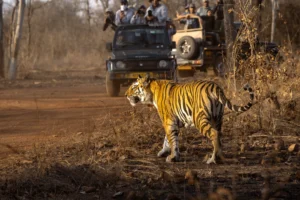
Discover where to see crocodiles in India in the wild. Compare top sanctuaries for gharials, saltwater crocodiles, and muggers with safari planning advice.
Best Places to See Crocodiles in India: Species Guide, Top Sanctuaries & Safari Tips
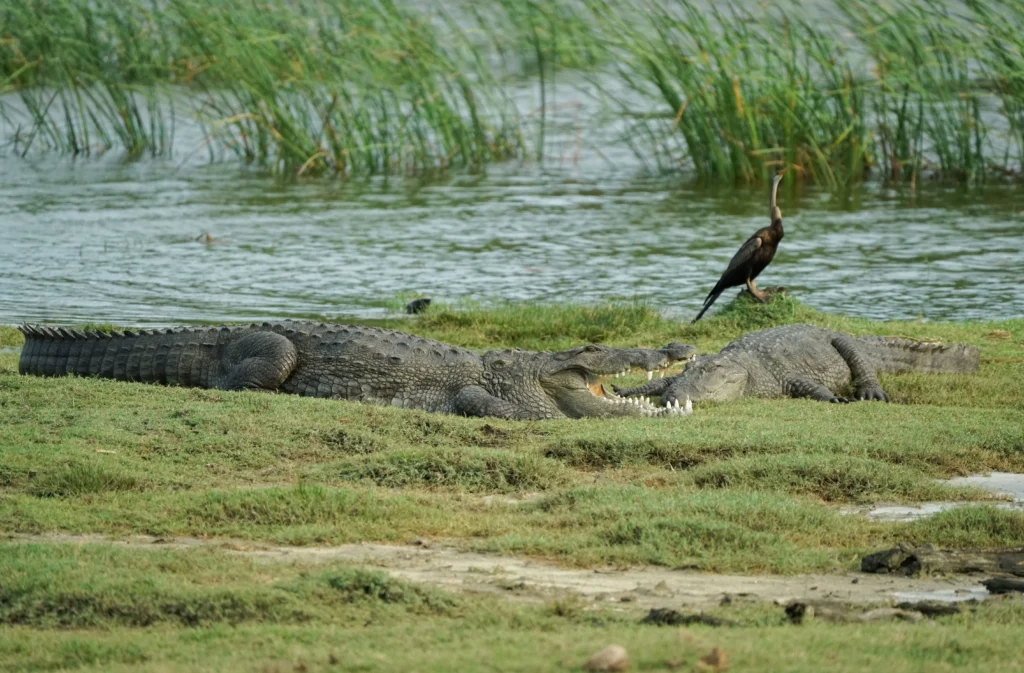
Image: Mugger Crocodiles basking by a water body. The characteristic olive green skin color is evident.
India is one of the few countries in Asia where you can observe three distinct crocodilian species in their natural habitats: the saltwater crocodile (Crocodylus porosus), the mugger or marsh crocodile (Crocodylus palustris), and the specialized fish-eating gharial (Gavialis gangeticus).
Unlike terrestrial carnivores that require extensive tracking across forest terrain, crocodilians depend on thermal regulation. Because they rely on the sun to regulate their body temperature, they consistently haul out onto exposed sandbars and mudbanks during cooler months. This basking behavior allows travelers to observe them from regulated boat safaris without disturbing their daily routines.
Choosing where to go depends primarily on the species you want to see, the type of waterway you want to explore, and the season of your trip.
Quick Reference: Top 5 Sighting Spots at a Glance
If you are planning a focused wildlife trip, these five locations offer the most reliable sighting opportunities in India:
- Bhitarkanika National Park (Odisha): The prime destination in India for observing large saltwater crocodiles along tidal mudflats and mangrove creeks.
- National Chambal Sanctuary (Madhya Pradesh / Uttar Pradesh / Rajasthan): The global stronghold for the critically endangered gharial, offering clear-water river safaris.
- Sundarbans National Park (West Bengal): Extensive tidal mangrove networks with sightings of estuarine crocodiles, best suited for travelers wanting a broader delta experience.
- Katarniaghat Wildlife Sanctuary (Uttar Pradesh): A pristine river system along the Girwa River where both gharials and mugger crocodiles share clean freshwater channels.
- Satkosia Gorge Sanctuary (Odisha): A deep river canyon along the Mahanadi River that supports both gharial and mugger populations in a rugged, less-crowded setting.
India’s Three Crocodilian Species: Identification and Ecology
Before booking a safari, it helps to understand the physical and ecological differences between India’s three crocodilian species. Each occupies a distinct ecological niche, uses specific river or coastal systems, and holds a different conservation status.
Plaintext
+—————————————————————————————————-+
| INDIA’S THREE CROCODILIANS |
+—————————–+————————————+———————————+
| Saltwater Crocodile | Gharial | Mugger Crocodile |
| (Crocodylus porosus) | (Gavialis gangeticus) | (Crocodylus palustris) |
+—————————–+————————————+———————————+
| • Massive, broad snout | • Extremely long, slender snout | • Broad, blunt snout |
| • Estuaries & mangroves | • Deep, fast-flowing rivers | • Lakes, marshes & slow rivers |
| • Estuarine apex predator | • Specialized fish-eater | • Generalist freshwater predator|
| • Status: Least Concern | • Status: Critically Endangered | • Status: Vulnerable |
+—————————–+————————————+———————————+
Saltwater Crocodile (Crocodylus porosus)
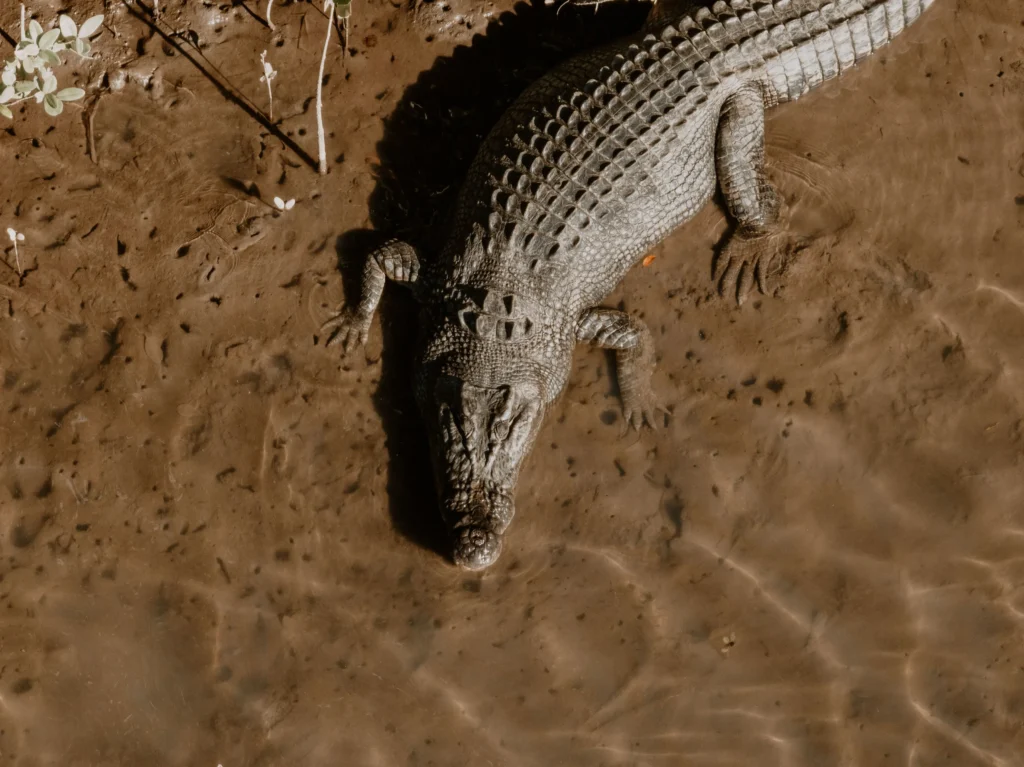
The saltwater crocodile, often called the estuarine crocodile, is the largest living reptile on Earth.
- Physical Characteristics: Mature males frequently exceed 5 to 6 meters in length. They possess a heavy, broad snout, a robust body structure, and strong dermal armor along their backs.
- Habitat and Ecology: They thrive in saline and brackish environments, including coastal mangrove swamps, tidal creeks, and river deltas. They have specialized salt-excreting glands that allow them to live in high-salinity marine environments, though they also venture into freshwater tidal stretches.
- Conservation Status: Globally assessed as Least Concern by the IUCN, though their Indian distribution is restricted primarily to eastern coastal mangrove belts and island groups. Recent survey figures in Bhitarkanika indicate a healthy local population of approximately 1,811 individuals.
Naturalist Field Note: Saltwater crocodiles are tidal baskers. In mangrove ecosystems, the best sightings happen at low tide. As the water recedes, muddy banks are exposed to direct sunlight, prompting large individuals to haul out onto the mud to warm their core body temperatures.
Gharial (Gavialis gangeticus)
The gharial is a river specialist recognized by its distinct, elongated snout.
- Physical Characteristics: Gharials have long, slender jaws lined with over 100 interlocking, razor-sharp teeth designed specifically for catching fish. Adult males develop a bulbous cartilaginous growth at the tip of their snout, called a ghara (the Hindi word for earthen pot), which functions as a visual resonator during courtship and territory defense.
- Habitat and Ecology: Gharials cannot move easily on land due to their reduced leg musculature. They depend entirely on clean, deep, fast-flowing freshwater rivers with high, undisturbed sandbanks for nesting and sunbathing.
- Conservation Status: Listed as Critically Endangered by the IUCN. WWF-India estimates that roughly 800 individuals remain in surviving wild populations across fragmented river systems. The National Chambal Sanctuary protects the largest viable breeding subpopulation in existence.
Mugger Crocodile (Crocodylus palustris)
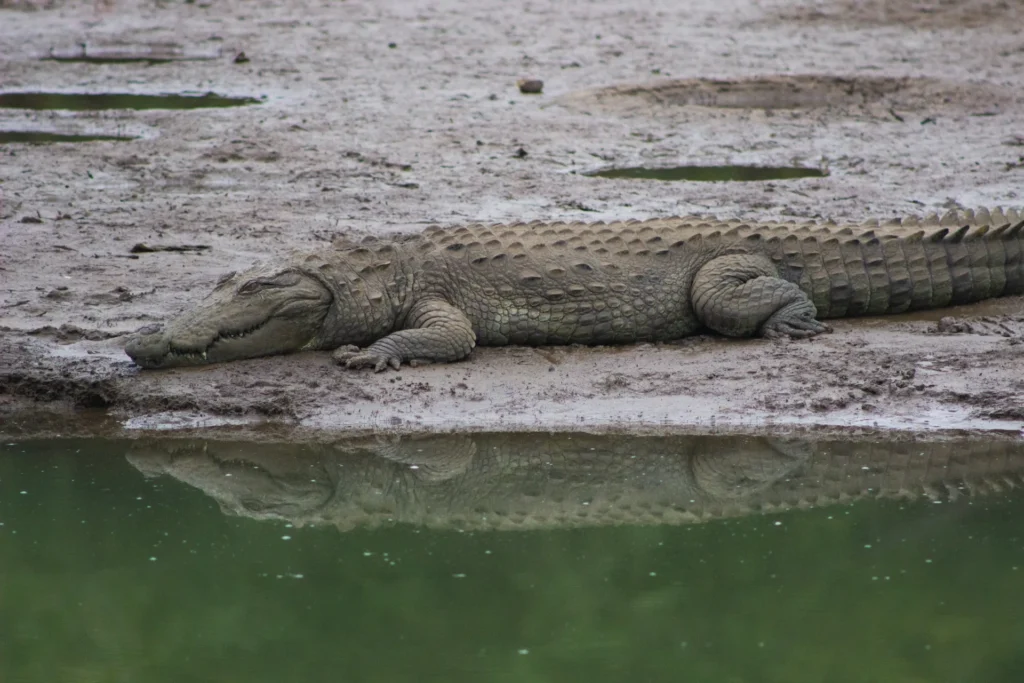
The mugger, or marsh crocodile, is the most widespread crocodilian species in the Indian subcontinent.
- Physical Characteristics: Muggers feature a broad, flat snout and heavily armored scutes. Adults usually measure between 3 and 4 meters in length. Their broad jaw provides the bite force necessary to capture a wide variety of prey, from fish and waterbirds to small mammals.
- Habitat and Ecology: The mugger is an adaptable freshwater generalist. It inhabits calm rivers, lakes, man-made irrigation reservoirs, marshes, and even select urban river channels. During dry spells, muggers can travel over land to locate surviving water bodies or dig deep burrows to escape severe heat.
- Conservation Status: Listed as Vulnerable on the IUCN Red List. Authoritative Red List assessments estimate the national wild population in India between 3,021 and 4,287 individuals, with an increasing overall trend in protected reservoirs and managed sanctuaries.
Species Comparison Matrix
| Feature | Saltwater Crocodile (Crocodylus porosus) | Gharial (Gavialis gangeticus) | Mugger Crocodile (Crocodylus palustris) |
| Typical Adult Size | 4.5 – 6.0+ m | 3.5 – 5.0 m | 3.0 – 4.0 m |
| Snout Structure | Broad, heavy, triangular | Extremely narrow and elongated | Broad, blunt, and rounded |
| Primary Diet | Fish, crustaceans, mammals | Exclusively fish | Fish, birds, reptiles, mammals |
| Primary Habitat | Mangroves, tidal creeks, estuaries | Deep, clean freshwater rivers | Lakes, marshes, slow-moving rivers |
| IUCN Status | Least Concern | Critically Endangered | Vulnerable |
| Key Strongholds in India | Bhitarkanika, Sundarbans | Chambal, Girwa, Gandak, Son | Satkosia, Chambal, reservoirs |
The Best Sanctuaries for Crocodile Spotting in India
Choosing the right destination dictates which species you will encounter and the type of safari experience you will have. India offers regulated boat safaris across tidal mangroves, deep river gorges, and calm freshwater reserves.
Bhitarkanika National Park, Odisha
Bhitarkanika is the best choice if your primary goal is to see large saltwater crocodiles in a concentrated area. The sanctuary is widely recognized by conservationists and wildlife travelers as one of India’s most important habitats for the species.
Recent reports cite a population of 1,811 saltwater crocodiles within the park’s network of tidal creeks and mangrove forests. Because the waterways are relatively narrow compared to open deltas, visitors often secure close, clear sightings of large adults hauled out on the muddy banks.
- Target Species: Saltwater crocodile.
- Safari Format: Motorized boat safaris.
Photography Tip: Time your boat safari with the low tide. Saltwater crocodiles in mangrove ecosystems are tidal baskers; when the tide recedes and exposes the mudflats, crocodiles emerge to warm themselves in the sun.
National Chambal Sanctuary, Madhya Pradesh / Uttar Pradesh / Rajasthan
The Chambal River is the definitive destination for seeing the critically endangered gharial in its natural breeding habitat. Spanning the borders of three states, this sanctuary protects a deep, fast-flowing, and exceptionally clean river system.
With the global wild gharial population estimated at around 800 individuals by WWF-India, Chambal serves as the most critical stronghold for their survival. The river’s high, undisturbed sandbanks provide the exact nesting and basking conditions the specialized fish-eaters require.
- Target Species: Gharial, with secondary sightings of mugger crocodiles.
- Safari Format: Motorized and non-motorized river boat safaris.
Sundarbans National Park, West Bengal
Choose the Sundarbans if you want a multi-day delta boat safari that includes saltwater crocodiles alongside a broader mix of mangrove wildlife.
While Bhitarkanika offers a higher frequency of crocodile sightings due to its concentrated creeks, the Sundarbans provides a vast, estuarine wilderness experience. Saltwater crocodiles here share the tidal networks with diverse birdlife, water monitors, and the Bengal tiger. Sightings require patience, as the sheer scale of the river channels gives the wildlife ample space to disperse.
- Target Species: Saltwater crocodile.
- Safari Format: Multi-day motorized boat cruises.
Katarniaghat Wildlife Sanctuary, Uttar Pradesh
Katarniaghat offers a quieter alternative to Chambal for spotting both gharials and mugger crocodiles on the same river stretch. Located along the Girwa River near the Nepal border, this sanctuary features pristine freshwater channels.
It is an excellent addition for travelers already exploring the northern Indian wildlife circuit, providing highly reliable sightings of gharials basking on mid-river sandbars without heavy tourist boat traffic.
- Target Species: Gharial and mugger crocodile.
- Safari Format: Motorized boat safaris.
Satkosia Gorge Sanctuary, Odisha
Satkosia is ideal for travelers looking for a rugged, less crowded wilderness experience featuring both gharials and muggers. The sanctuary is defined by a deep, dramatic canyon carved by the Mahanadi River. The deep waters and sandy banks support both crocodilian species, though populations here are less concentrated than in Chambal or Bhitarkanika.
- Target Species: Gharial and mugger crocodile.
- Safari Format: Boat safaris.
Vishwamitri River and Western Mugger Habitats, Gujarat
The Vishwamitri River in Gujarat demonstrates how adaptable mugger crocodiles are to semi-urban and urban river systems. While not a traditional safari park, the river sustains a highly concentrated population of muggers. Travelers and photographers interested in herpetology often visit this region to observe how a vulnerable apex predator navigates a human-dominated landscape.
- Target Species: Mugger crocodile.
- Safari Format: Shoreline observation (safely guided).
Dandeli and the Kali River Basin, Karnataka
For travelers in South India, the Kali River in Dandeli provides reliable mugger crocodile sightings in a forested river environment. The rocky outcrops and slower-moving stretches of the river create ideal basking spots for muggers, easily viewed during coracle (traditional round boat) rides or guided walks along the banks.
- Target Species: Mugger crocodile.
- Safari Format: Coracle rides and shoreline walks.
Madras Crocodile Bank Trust, Tamil Nadu
Visit the Crocodile Bank near Chennai for education and conservation viewing rather than wild safari spotting. As a premier center for herpetology, this ex-situ facility plays a vital role in the conservation breeding of gharials and muggers. It is an essential stop for families or researchers wanting to study all three Indian crocodilian species up close in a safe, controlled environment.
- Target Species: All three Indian species (captive).
- Safari Format: Walking tour of the conservation facility.
Sanctuary Sighting Matrix
Use this reference to quickly align your primary wildlife goal with the correct destination.
| Destination | Primary Target Species | Safari Format | Sighting Likelihood |
| Bhitarkanika (Odisha) | Saltwater Crocodile | Mangrove Boat Safari | Very High |
| National Chambal (MP/UP/RJ) | Gharial | River Boat Safari | Very High |
| Sundarbans (West Bengal) | Saltwater Crocodile | Delta Boat Cruise | Moderate |
| Katarniaghat (UP) | Gharial / Mugger | River Boat Safari | High |
| Satkosia Gorge (Odisha) | Gharial / Mugger | River Boat Safari | Moderate |
| Dandeli (Karnataka) | Mugger Crocodile | Coracle / Rafting | High |
| Vishwamitri River (Gujarat) | Mugger Crocodile | Shoreline Viewing | High |
How to Choose: Best Destinations by Traveler Type and Region
Selecting the right crocodile destination depends entirely on your travel style, your geographic location in India, and what else you hope to see during your trip.
For First-Time Safari Visitors
If your priority is simply to see crocodiles clearly and reliably, prioritize Bhitarkanika National Park or the National Chambal Sanctuary. Both locations offer high-frequency sightings because the animals are concentrated along relatively narrow waterways. In Bhitarkanika, you are nearly guaranteed to see saltwater crocodiles hauled out on the mud during low tide, while Chambal offers excellent visibility of gharials resting on mid-river sandbars.
For Wildlife Photographers
Photographers require good lighting, clean backgrounds, and close access without disturbing the subjects. Bhitarkanika is exceptional for close-up portraits of massive saltwater crocodiles against dense mangrove roots. For the critically endangered gharial, Katarniaghat Wildlife Sanctuary often provides better photographic opportunities than Chambal because it sees less boat traffic, allowing for longer, undisturbed observation of basking animals.
For Family and Educational Travel
Taking children on a river safari requires careful consideration of safety and duration. The Madras Crocodile Bank near Chennai is the best educational starting point, offering guaranteed, safe viewing of all three Indian species alongside expert herpetologists. For a wild safari, Chambal is highly family-friendly; the boats are stable, the water is calm, and the safaris are typically shorter (1 to 3 hours), making them manageable for younger travelers.
Options Near Delhi and North India
Travelers based in or visiting Delhi do not need to fly to the eastern coast to see crocodilians. The National Chambal Sanctuary is easily accessible via road from Agra, making it an ideal day trip or one-night extension to a Golden Triangle itinerary. Katarniaghat is further east in Uttar Pradesh but remains accessible for North Indian road-trippers exploring the Terai arc landscapes.
Traveler Decision Guide
| Traveler Profile | Recommended Destination | Primary Advantage | Target Species |
| First-Timers | Bhitarkanika / Chambal | Highest sighting probability on short trips | Saltwater / Gharial |
| Photographers | Katarniaghat | Uncrowded sandbars, clean river backgrounds | Gharial / Mugger |
| Families | Madras Crocodile Bank | Safe, educational, guaranteed viewings | All three (captive) |
| North India Road-Trippers | National Chambal | Easy driving distance from Agra / Delhi | Gharial |
| Bird & Big Cat Enthusiasts | Sundarbans | Combines mangrove ecology with tiger habitat | Saltwater |
Best Time to Visit and Seasonal Sighting Dynamics
Unlike mammals, which are active year-round, crocodilians are ectothermic (cold-blooded). Their visibility to tourists is entirely dictated by their need to regulate their body temperature.
Winter Basking Window (November to February)
Winter is universally the best time to see crocodiles in India. When the air and water temperatures drop, crocodiles must haul themselves completely out of the water to absorb the sun’s heat. During these months, you will see large individuals resting motionless on mudbanks, sandbars, and rocky outcrops for hours at a time. Visibility is exceptionally high.
Summer River Levels (March to May)
As temperatures rise sharply in the Indian summer, crocodiles spend far less time exposed on the banks. They retreat into deeper water or seek shade under overhanging vegetation to avoid overheating. While river levels drop—which can concentrate populations into smaller pools—the harsh light and reduced basking times make photography and viewing more challenging.
Monsoon Closures and Water Levels (June to October)
Wildlife viewing is generally poor during the monsoon. Heavy rains swell the rivers and tidal creeks, submerging the sandbars and mudflats where crocodiles normally rest. Without exposed banks, sightings drop significantly. Additionally, many protected areas, including parts of Bhitarkanika and Chambal, restrict or suspend boat safaris during these months due to dangerous water currents and safety protocols.
Expert Tip: If visiting mangrove habitats like Bhitarkanika or the Sundarbans, seasonality is only half the equation. You must also check the daily tide charts. Sighting probability peaks during low tide when the mudbanks are fully exposed.
Safari Safety, Boat Ethics, and Photography Guidelines
Viewing apex predators in their aquatic habitats requires strict adherence to safety and ethical guidelines. Never assume that staying on land is inherently safer than a boat safari; regulated, guided boat viewing is often the most secure way to observe these reptiles.
Safe Viewing Distances and Boat Protocols
Always follow your boat pilot and naturalist guide’s instructions. Boats should maintain a respectful distance from basking animals to avoid triggering a flight response. If a crocodile slides into the water upon a boat’s approach, you have moved too close. Visitors must remain seated, keep arms inside the vessel, and avoid sudden, loud noises that carry easily over water.
Shoreline Etiquette and Habitat Respect
Never walk along the shorelines of known crocodile habitats unguided. Do not crowd the banks, and absolutely never attempt to feed or bait crocodiles. Disturbing basking animals forces them to expend vital energy, and interfering with nesting sites (often located on sandy riverbanks) is both dangerous and illegal under wildlife protection laws.
Field Advice for River and Estuary Photography
- Focal Length: Use a telephoto lens (400mm to 600mm) to secure detailed portraits without needing to bridge the physical distance.
- Flash Photography: Disable your flash. Flash photography is prohibited in many sanctuaries and can startle the wildlife.
- Stability: Shooting from a moving boat is difficult. Bring a beanbag to rest your camera on the boat’s gunwale, or rely on lenses with strong optical stabilization.
Conservation Realities: Protecting River and Mangrove Apex Predators
The survival of India’s three crocodilian species depends heavily on intact freshwater rivers, healthy mangrove belts, and undisturbed riverine sandbars.
- The Gharial’s Fragile Strongholds: The gharial (Gavialis gangeticus) remains one of the world’s most threatened crocodilians, listed as Critically Endangered with an estimated wild population of around 800 individuals. Unlike the more adaptable mugger crocodile, gharials cannot travel easily across land and depend strictly on fast-flowing, clean river channels with high sandbanks for basking and nesting. Illegal riverbed sand mining, dam construction that alters natural river flow, and accidental entanglement in nylon fishing nets pose constant threats to their surviving populations in river basins like the Chambal and Girwa.
- Mangrove and Estuarine Protection: Saltwater crocodiles (Crocodylus porosus) thrive in protected eastern habitats such as Bhitarkanika (which supports a reported population of 1,811 individuals) and the Sundarbans. Maintaining the ecological integrity of these mangrove estuaries is essential, as these zones act as natural tidal barriers and nutrient filters.
- The Role of Responsible Wildlife Tourism: Regulated boat safaris provide an alternative economic incentive for riverine communities. Local boatmen and forest-trained naturalists serve on the front lines of conservation, monitoring wildlife numbers and deterring illegal fishing and poaching in core zones.
Common Planning Mistakes to Avoid
- Visiting During the Monsoon: Heavy rains submerge mid-river sandbars and tidal mudflats, dispersing wildlife and forcing sanctuary authorities to close or limit boat operations. Plan trips between November and February for peak basking visibility.
- Ignoring Tidal Cycles in Mangroves: In tidal estuaries like Bhitarkanika and the Sundarbans, booking a boat ride at high tide drastically reduces your chance of sightings. Always schedule your boat safaris around the daily low tide, when the exposed mudflats draw crocodiles out to warm themselves.
- Assuming All Crocodilians Share the Same Habitat: Gharials, muggers, and saltwater crocodiles have fundamentally different ecological requirements. If your goal is to see gharials, head to northern freshwater river sanctuaries like Chambal or Katarniaghat, not eastern coastal mangroves.
- Expecting High Crocodile Densities in Open Deltas: While the Sundarbans supports saltwater crocodiles, the sheer scale of the delta means sightings require sustained multi-day cruising. If you only have a single day or weekend for high-frequency crocodile spotting, choose Bhitarkanika instead.
- Approaching Unregulated Riverbanks: Never explore crocodile habitats on foot without official guides. Muggers and saltwater crocodiles are ambush predators capable of moving rapidly along shorelines. Stick exclusively to authorized boat safaris and designated watchtowers.
Frequently Asked Questions
1. What are the best places to see crocodiles in India in the wild?
The top wild destinations are Bhitarkanika National Park (Odisha) for saltwater crocodiles, National Chambal Sanctuary (Madhya Pradesh/UP/Rajasthan) for gharials, and Katarniaghat Wildlife Sanctuary (Uttar Pradesh) for both gharials and muggers.
2. Which Indian sanctuary offers the best saltwater crocodile sightings?
Bhitarkanika National Park in Odisha offers the highest sighting frequency for saltwater crocodiles due to its narrow mangrove creeks and large resident population.
3. Where can you reliably see gharials in India?
The National Chambal Sanctuary is the most reliable destination globally for seeing gharials in their natural river habitat. Katarniaghat Wildlife Sanctuary along the Girwa River is another reliable Northern stronghold.
4. Which park is best for seeing mugger crocodiles?
Mugger crocodiles can be reliably spotted in Satkosia Gorge (Odisha), the Kali River in Dandeli (Karnataka), and alongside gharials in Chambal and Katarniaghat.
5. Is Bhitarkanika better than the Sundarbans for viewing crocodiles?
Yes, for crocodile-specific safaris. Bhitarkanika’s narrower creeks concentrate basking reptiles close to the boat channels, whereas the vast open waters of the Sundarbans make sightings more spread out.
6. What is the physical difference between a gharial, a mugger, and a saltwater crocodile?
Gharials have an extremely long, slender snout designed exclusively for catching fish. Muggers feature a broad, blunt snout adapted for generalist freshwater hunting. Saltwater crocodiles are much larger, with a heavy, triangular head and robust body armor suited for estuarine and marine environments.
7. What is the best season to spot crocodiles sunbathing in India?
Winter (November to February) is the best period. Cool air and water temperatures drive crocodilians onto exposed sandbars and mudflats to regulate their body temperature in the morning and midday sun.
8. Are crocodile boat safaris in India safe for tourists and families?
Yes. Official safaris operate regulated, stable motorized boats or coracles with trained pilots who maintain safe, non-intrusive distances from the animals.
9. Can I see wild crocodiles near Delhi or in North India?
Yes. The National Chambal Sanctuary is located near Agra and can easily be visited as a day trip or overnight extension from Delhi.
10. Is the Madras Crocodile Bank a wild reserve or a captive facility?
The Madras Crocodile Bank Trust near Chennai is a world-renowned ex-situ herpetology and conservation breeding facility, not a wild national park. It provides safe, close-up educational viewing of all three Indian species.
11. Which crocodile species in India is the largest?
The saltwater crocodile (Crocodylus porosus) is the largest, with mature males frequently exceeding 5 to 6 meters in length.
12. Why is the gharial listed as Critically Endangered?
The gharial is classified as Critically Endangered due to extensive habitat degradation, sand mining on nesting banks, altered river hydrology from dams, and mortality from commercial fishing nets, leaving roughly 800 individuals in the wild.
13. Can all three crocodilian species be found together in one wild location?
No single sanctuary supports viable wild populations of all three species together, as their ecological niches diverge between coastal saltwater mangroves and inland freshwater rivers. However, you can see all three species at the Madras Crocodile Bank.
14. Where can I spot crocodiles in South India?
The Kali River basin in Dandeli (Karnataka) is one of South India’s most accessible wild spots for viewing mugger crocodiles.
15. What permits and booking procedures apply to crocodile river safaris?
Sanctuary permits, entry tickets, and boat hire can typically be arranged at official forest department entry gates (such as Dangamal for Bhitarkanika or Pinahat/Bah for Chambal) or pre-booked through state ecotourism portals.
16. What camera focal lengths work best for crocodile photography from boats?
A telephoto zoom lens in the 100–400mm or 200–600mm range allows you to capture detailed head portraits and behavioral shots while keeping a safe, non-disruptive distance.
17. Are crocodile sightings guaranteed on river and mangrove boat safaris?
While wildlife sightings are never 100% guaranteed, visiting during the winter months at low tide in Bhitarkanika or on clear days in Chambal yields near-certain sighting opportunities.
18. Why do mugger crocodiles thrive in urban rivers like the Vishwamitri?
Muggers are highly adaptable generalists capable of tolerating disturbed water conditions, feeding on diverse prey, and using artificial banks or slow currents in semi-urban channels.
19. How do tides affect crocodile viewing in mangrove habitats?
Tidal movements dictate bank availability. At high tide, water covers the muddy banks, forcing crocodiles into the mangroves. At low tide, the mudflats are exposed to direct sunlight, providing ideal basking conditions.
20. How does wildlife tourism contribute to crocodilian conservation in India?
Regulated ecotourism generates direct revenue for local forest communities, incentivizes the preservation of river corridors, and maintains regular monitoring presence on vulnerable waterways.
Naturalist Summary and Recommendations
India offers exceptional opportunities for crocodilian viewing, provided you match your destination to the specific species you wish to observe:
- For the Ultimate Saltwater Crocodile Experience: Choose Bhitarkanika National Park. Its high population density and accessible mangrove creeks provide close, dependable sightings.
- For the Critically Endangered Gharial: Head to the National Chambal Sanctuary. The broad sandbars and clear water offer unmatched views of this unique river specialist.
- For Combined Wildlife and Birding: Consider Katarniaghat Wildlife Sanctuary or Satkosia Gorge, where you can observe gharials and muggers alongside diverse riverine birdlife in quieter surroundings.
- For Educational Family Outings: Visit the Madras Crocodile Bank Trust to study all three Indian crocodilians up close in a dedicated conservation setting before exploring the wild sanctuaries.
Plan your journey between November and February, synchronize estuarine boat trips with the daily low tide, and always respect safe viewing distances on the water.