
Learn how to identify eagle species in India using field marks, silhouettes, and habitat cues. Separate confusing lookalikes with our practical guide.
Introduction
Identifying large raptors in India is notoriously difficult because many species share similar brown plumages, vary significantly by age, and change appearance based on feather wear. A large bird soaring overhead can easily confuse even experienced birdwatchers if they rely solely on color.
This guide provides a practical field method for identifying Indian eagles. By focusing on structural silhouettes, habitat types, and seasonal presence, you can confidently separate India’s true eagles from other birds of prey.
What Are Indian Eagles?
Understanding the Eagle Family in India
The label “eagle” is often applied loosely to any large, predatory bird, but correct identification requires looking at specific taxonomic traits. In India, true eagles belong to the Accipitridae family and are grouped into specialized genera such as Aquila, Clanga, and Hieraaetus.
True eagles are distinguished from other large raptors—such as hawk-eagles, serpent eagles, fish eagles, sea eagles, buzzards, kites, and vultures—by their anatomy and lineage. For example, true eagles generally feature fully feathered legs (tarsi) extending all the way down to the toes. Conversely, species like serpent eagles or fish eagles display bare, scaled legs adapted for seizing reptiles or slippery fish.
Understanding these structural differences is the first step in avoiding misidentification in the field.
How to Identify Eagles in India
To identify an eagle accurately, observe its primary physical features and behavior systematically before looking at detailed plumage variations.
Size, Silhouette, and Flight Style
When an eagle is soaring overhead, its silhouette provides immediate clues. Look closely at the trailing edge of the wings, the length and shape of the tail, and the appearance of the “fingered” primaries—the deeply slotted feathers at the wingtips.
Pay attention to how the bird holds its wings while gliding:
- Flat profile: Some eagles hold their wings perfectly level.
- Dihedral (V-shape): Certain species tilt their wings upward.
- Bowed profile: Others glide with their wingtips pointing downward.
Field Note
Juvenile eagles often present different wing and tail proportions than adults of the same species, making structural silhouettes and flight profiles more reliable than plumage patterns alone.
Habitat-Based Identification
Matching an eagle to the landscape where you see it narrows down the possibilities immediately. While some raptors are generalists, most Indian eagles specialize in distinct environments.
For example, open grasslands, scrub deserts, and dry plains attract specific ground-dwelling or soaring hunters. Wetlands, rivers, and marshes host species adapted for aquatic hunting, while dense forests and hill ranges support agile flyers that navigate tree canopies.
Table 1: Eagle Groups by Primary Indian Habitat
| Habitat Type | Key Eagle Groups & Species Examples | Landscape Characteristics |
| Grasslands & Scrub | Steppe Eagle, Tawny Eagle | Open semi-arid plains, dry fields, savannahs |
| Wetlands & Rivers | Pallas’s Fish Eagle, Greater Spotted Eagle | Lakes, marshes, large reservoirs, river deltas |
| Forests & Woodlands | Black Eagle, Indian Spotted Eagle | Forest canopies, dense woodlots, forest edges |
| Mountains & Foothills | Golden Eagle, Bonelli’s Eagle | Rocky ridges, Himalayan terrain, upland cliffs |
| Coastal Areas | White-bellied Sea Eagle | Marine coastlines, estuaries, tidal creeks |
Resident vs Migratory Species
Seasonality acts as an effective filter for identification. Several of India’s largest eagles are winter migrants or passage birds that travel from northern Asia and Europe.
If you observe an eagle in India during the peak summer breeding months, you can safely eliminate strict winter migrants from your list. Knowing whether a species is a permanent resident, a winter visitor, or an internal migrant within India simplifies field identification.
Eagle Species Found in India
Organizing India’s eagles by their preferred habitat is the most reliable way to begin identification in the field. While some species migrate across vast areas, most settle into specific environments during their time in the subcontinent.
Below is a breakdown of the key eagle species, grouped by the landscapes where you are most likely to encounter them.
Grassland and Scrub Specialists
Steppe Eagle (Aquila nipalensis) The Steppe Eagle is an Endangered species and a widespread winter migrant to India. It is most frequently encountered in grasslands, dry plains, and semi-arid scrub landscapes. Because it is a dark Aquila eagle, it is at the center of many identification debates.
- Status & Range: Winter migrant.
- Field Marks:
- Part of the challenging dark Aquila group.
- Displays a heavy soaring silhouette with deeply fingered primaries.
- Juvenile plumage can be highly misleading for beginners.
- Requires careful separation from the Tawny Eagle and Eastern Imperial Eagle.
Tawny Eagle (Aquila rapax) Sharing the same open, semi-arid landscapes as the Steppe Eagle, the Tawny Eagle is a resident raptor. Because it does not leave India to breed, summer sightings in these habitats strongly point toward this species.
- Status & Range: Resident.
- Field Marks:
- Closely resembles the Steppe Eagle, creating a major identification challenge.
- Feather wear significantly alters adult plumage over time.
- Resident status is a key differentiator during summer months.
Eastern Imperial Eagle (Aquila heliaca) Completing the trio of large, open-country Aquila eagles, the Eastern Imperial Eagle is another winter migrant that hunts over dry plains.
- Status & Range: Winter migrant.
- Field Marks:
- Belongs to the dark Aquila complex.
- Shows distinct plumage phase variation between juveniles and adults.
- Frequently confused with the Steppe Eagle in the field.

Wetland and Open Country Eagles
Greater Spotted Eagle (Clanga clanga) The Greater Spotted Eagle is strongly tied to aquatic environments. Birders typically spot this winter migrant around marshes, large reservoirs, rivers, and deltas.
- Status & Range: Winter migrant.
- Field Marks:
- A dark Clanga eagle heavily associated with wetlands.
- Shares a heavy, soaring silhouette with other large eagles.
- Juvenile plumage is easily confused with the Indian Spotted Eagle.
Pallas’s Fish Eagle (Haliaeetus leucoryphus) & Grey-headed Fish Eagle (Haliaeetus ichthyaetus) While not “true eagles” from the Aquila or Clanga genera, these aquatic raptors are categorized as fish eagles and are vital for field birders to recognize. They are apex predators of India’s lakes and river systems.
- Status & Range: Found in wetland habitats across India.
- Field Marks:
- Adapted specifically for hunting in aquatic environments.
- Flight silhouettes and hunting behaviors differ significantly from true eagles.
- Lack the fully feathered legs of true eagles.
Forest and Foothill Species
Indian Spotted Eagle (Clanga hastata) The Indian Spotted Eagle is a globally Vulnerable species, facing a long-term estimated decline of -24.26%. It receives strict Schedule I protection under India’s Wildlife Protection Act. It favors open habitats, agricultural plains, and forest edges across a distribution range of 3,09,810 sq km, with strongholds in states like Karnataka, Tamil Nadu, and Uttar Pradesh.
- Status & Range: Resident and within-India migrant.
- Field Marks:
- Belongs to the dark Clanga group.
- Juveniles have spots, but worn adults lose these markings, making identification difficult.
- Often misidentified as the Greater Spotted Eagle.
Booted Eagle (Hieraaetus pennatus) Despite being a globally Least Concern species, the Booted Eagle carries Schedule I protection in India. It is a winter migrant with a very large distribution range, often seen soaring over woodlands and forest edges.
- Status & Range: Winter migrant.
- Field Marks:
- Exhibits distinct plumage phase variations (light and dark morphs).
- Recognized by a specific soaring silhouette.
- Requires careful separation from Bonelli’s Eagle in flight.
Black Eagle (Ictinaetus malayensis) A true forest specialist, the Black Eagle is a resident raptor that patrols the dense canopies of India’s forests, ghats, and foothills.
- Status & Range: Resident.
- Field Marks:
- Favors forest edges and dense wooded valleys.
- Shows prominent fingered primaries during characteristic slow flights.
- Rarely seen far from forested hills.
Mountain and Coastal Eagles
Golden Eagle (Aquila chrysaetos) & Bonelli’s Eagle (Aquila fasciata) These eagles are adapted to rugged terrain, favoring rocky ridges, upland cliffs, and Himalayan environments.
- Status & Range: Resident (Golden Eagle restricted primarily to the Himalayas).
- Field Marks:
- Golden Eagle is generally restricted to high-altitude mountain habitats.
- Bonelli’s Eagle requires careful identification to separate it from the Booted Eagle.
- Both display strong, heavy soaring silhouettes.
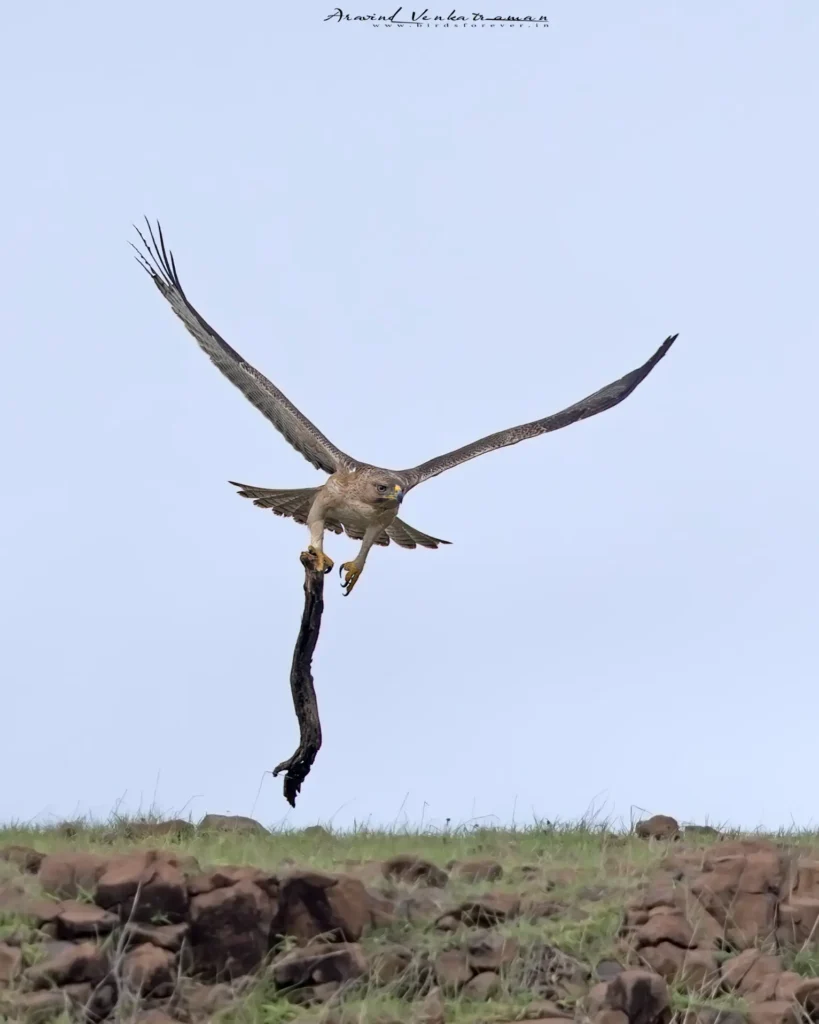
White-bellied Sea Eagle (Haliaeetus leucogaster) This resident raptor is restricted to marine coastlines, estuaries, and tidal creeks. Like the fish eagles, it is not a true eagle but a sea eagle, easily identified by its specialized coastal habitat and striking plumage.
- Status & Range: Resident in coastal zones.
- Field Marks:
- Strictly found in coastal and marine habitats.
- Part of the sea eagle classification rather than a true eagle.
- Presents a large soaring silhouette over coastal waters.
Expert Tip
Many birders assume that a spotted eagle will always have spots. This is a common misconception. Spots are prominent on juveniles, but as the bird ages and its feathers wear, the spots fade. Never rely on spots alone; always evaluate the bird’s size, silhouette, and habitat first.
Confusing Eagle Lookalikes
The most significant challenge for birdwatchers in India is the “lookalike” problem. Many large raptors share uniform dark brown plumage, making them incredibly difficult to separate at a distance.
The confusion primarily centers around two groups: the dark Aquila eagles and the Clanga (spotted) eagles. Furthermore, plumage changes dramatically between juvenile and adult phases, and severe feather wear can alter a bird’s appearance completely.
Before attempting to separate true eagle lookalikes, it is crucial to ensure the bird is actually a true eagle.
True Eagles vs Hawk-Eagles and Serpent Eagles
A common misconception among wildlife tourists is that all large raptors are eagles. In reality, India’s skies are shared with hawk-eagles (such as the Changeable Hawk-Eagle) and serpent eagles (like the Crested Serpent Eagle).
Hawk-eagles and serpent eagles often have different structural proportions, such as shorter wings and longer tails adapted for maneuvering through forest canopies, compared to the heavy, broad-winged soaring silhouettes of true eagles. Serpent eagles also lack the fully feathered legs characteristic of true eagles, possessing bare scales designed for grappling with reptiles.
Table 2: Key Differences for Confusing Lookalike Pairs
| Confusing Pair | Primary Visual Clues | Habitat & Seasonality Cues |
| Indian Spotted vs Greater Spotted | Focus on silhouette; spots fade on worn adults. | Indian is a resident/local migrant; Greater is a winter migrant strictly tied to wetlands. |
| Steppe vs Tawny Eagle | Look at structural heaviness and juvenile plumage markers. | Tawny is a resident; Steppe is a winter migrant. Summer sightings point to Tawny. |
| Eastern Imperial vs Steppe | Note distinct plumage phase variations in juveniles. | Both are winter migrants hunting over dry plains and scrub. |
| Booted vs Bonelli’s Eagle | Booted Eagle shows distinct light and dark morph phases. | Both soar over woodlands and rocky terrain; Booted is a winter migrant. |
Indian Spotted Eagle vs Greater Spotted Eagle
These two Clanga species are notoriously difficult to separate. The most common mistake is assuming that spotted eagles can be easily identified by their spots. While juveniles display prominent spotting, worn adults lose these markings entirely, making plumage an unreliable metric.
Instead, rely on habitat and seasonality. The Greater Spotted Eagle is a winter migrant that stays close to marshes, rivers, and large reservoirs. The Indian Spotted Eagle is a resident (or within-India migrant) that prefers open agricultural plains, dry habitats, and forest edges.
Photography Tip
When photographing spotted eagles for later identification, always expose for the underwing. The contrast between the flight feathers and the underwing coverts often provides better diagnostic clues than the top-down view of faded spots.
Steppe Eagle vs Tawny Eagle
Historically, these birds were often considered the same species, which remains a lingering misconception. They are distinct species and require careful comparison.
The Tawny Eagle is a resident bird of India’s dry plains, meaning any dark Aquila eagle seen in these habitats during the peak summer breeding months is highly likely to be a Tawny. The Steppe Eagle is a winter migrant. Be highly cautious of plumage, as adult Tawny Eagles suffer from extensive feather wear that drastically changes their color profile.
Eastern Imperial Eagle vs Steppe Eagle
Both of these massive Aquila eagles are winter migrants that hunt over similar semi-arid landscapes and dry plains. Separating them requires studying their juvenile plumage, which differs significantly between the two species. Structurally, both present a very heavy soaring silhouette with deeply fingered primaries, requiring a solid view of the plumage phases to confirm identification.
Booted Eagle vs Bonelli’s Eagle
While soaring, the Booted Eagle and Bonelli’s Eagle present similar outlines against the sky. The key to separating them lies in the Booted Eagle’s distinct plumage phase variations. The Booted Eagle appears in both light and dark morphs, with the light morph displaying high-contrast underwings that instantly separate it from Bonelli’s Eagle. Additionally, the Booted Eagle is a winter migrant, whereas Bonelli’s Eagle is a resident of rocky ridges and uplands.
Best Places to See Eagles in India
To maximize your chances of spotting and correctly identifying eagles, visit regions where their preferred habitats remain intact. Seasonality is critical; planning your trip between November and March allows you to observe both resident species and winter migrants simultaneously.
- Semi-Arid Grasslands and Deserts (e.g., Rajasthan and Gujarat): These open terrains are excellent for observing large Aquila species. During winter, hundreds of Endangered Steppe Eagles gather around open plains and dump sites, alongside resident Tawny Eagles and visiting Eastern Imperial Eagles.
- Wetland Complexes and River Basins (e.g., Uttar Pradesh and Assam): Large reservoirs, marshes, and river systems provide ideal hunting grounds for the Greater Spotted Eagle, Pallas’s Fish Eagle, and Grey-headed Fish Eagle.
- Deciduous Woodlands and Agricultural Landscapes (e.g., Karnataka and Tamil Nadu): These states serve as major strongholds for the Vulnerable Indian Spotted Eagle, which hunts over open country and nests in forest edges.
- The Himalayan Region and Foothills: High-altitude ridges and montane valleys are the primary places to look for the Golden Eagle, while the lower foothills and forested valleys provide tracking ground for the Black Eagle.
Conservation Status of Indian Eagles
Many of India’s eagles face severe population pressures due to habitat modification, pesticide use, and the loss of nesting trees. Monitoring their populations relies heavily on data from the State of India’s Birds initiative, which tracks long-term trends and distribution ranges.
Understanding their legal and conservation status is essential for reporting sightings and supporting regional conservation efforts.
Table 3: Indian Eagle Status, Migration, and Legal Protection
| Species | IUCN Global Status | India WPA Protection | Migration Status in India | Distribution / Trend Data |
| Indian Spotted Eagle | Vulnerable | Schedule I | Resident & within-India migrant | 309,810 sq km range; long-term decline estimated at -24.26%. |
| Steppe Eagle | Endangered | High Protection | Winter migrant | Widespread winter visitor to open plains and grasslands. |
| Booted Eagle | Least Concern | Schedule I | Winter migrant | Very large winter distribution range across multiple habitats. |
| Greater Spotted Eagle | Vulnerable | High Protection | Winter migrant | Strictly tied to declining wetland ecosystems. |
| Eastern Imperial Eagle | Vulnerable | High Protection | Winter migrant | Winter visitor to dry plains and semi-arid scrub. |
Common Eagle Identification Mistakes
- Relying purely on “spots” for spotted eagles: Juveniles are heavily spotted, but worn adults lose these markings, leading birders to misidentify adult Indian Spotted Eagles as other species.
- Ignoring seasonality: Identifying a large brown raptor as a Steppe Eagle in the middle of summer is a frequent error; winter migrants return north to breed, leaving only resident species like the Tawny Eagle behind.
- Misidentifying lookalikes as true eagles: Due to their large size, the Changeable Hawk-Eagle and Crested Serpent Eagle are regularly misidentified as true eagles. Always check for fully feathered legs to confirm a true eagle.
- Overlooking feather wear: Severe feather wear can make a dark bird look pale or streaked, completely changing its perceived plumage phase and leading to incorrect species logging.
FAQs on Indian Eagle Identification
1. How many eagle species occur in India? India is home to over a dozen distinct eagle species, spanning true eagles (Aquila, Clanga, Hieraaetus), sea eagles, and fish eagles.
2. What is the most common eagle in India?
In open, dry country, the resident Tawny Eagle is frequently seen. During the winter months, the migratory Steppe Eagle becomes the most abundant large eagle across India’s grasslands and plains.
3. Which is the largest eagle in India?
The Golden Eagle (Aquila chrysaetos), found primarily in the high-altitude regions of the Himalayas, is the largest true eagle species in the country.
4. How do I distinguish a Steppe Eagle from a Tawny Eagle? Look at the season and structural details. The Tawny Eagle is a year-round resident, while the Steppe Eagle is strictly a winter migrant. Adult Tawny Eagles often show extreme feather wear, whereas Steppe Eagles display a heavier silhouette and a deeper gape line.
5. What are the key field marks of the Indian Spotted Eagle? The Indian Spotted Eagle features a relatively small body compared to the Greater Spotted Eagle, an open-country habitat preference, and a resident or internal migratory status. Juveniles show distinct spots, but adults lose them as their plumage wears down.
6. Which eagles are winter migrants to India? Key winter migrants include the Steppe Eagle, Greater Spotted Eagle, Eastern Imperial Eagle, and Booted Eagle. They arrive in autumn and depart by early spring.
7. What is the difference between a true eagle and a hawk-eagle?
True eagles possess fully feathered legs (tarsi) all the way down to their toes. Hawk-eagles, like the Changeable Hawk-Eagle, have different structural proportions (shorter, rounded wings and longer tails) adapted for forest navigation.
8. Which Indian eagles are threatened or endangered? The Steppe Eagle is globally Endangered. The Indian Spotted Eagle, Greater Spotted Eagle, and Eastern Imperial Eagle are classified as Vulnerable, making precise field identification vital for tracking their remaining populations.
Conclusion & Field Checklist
Mastering Indian eagle identification requires moving past general color descriptions and focusing on structure, habitat, and seasonality. Because plumages change with age and feather wear, relying on a systematic framework is the only way to ensure accuracy in the field.
Actionable Field Checklist
- [ ] Check the legs: Are they feathered to the toes (true eagle) or bare and scaled (serpent/fish eagle)?
- [ ] Analyze the silhouette: Look at the wing trailing edge, tail length, and the deeply slotted, fingered primaries.
- [ ] Note the habitat: Is the bird over a dry scrub plain, a wetland marsh, a dense forest canopy, or a mountain ridge?
- [ ] Factor in the calendar: Is it summer (eliminating winter migrants) or winter (when migratory species arrive)?
- [ ] Look for feather wear: Assess if the bird is a neatly plumaged juvenile or a worn adult whose markings have faded.
Author Note & Update Log: Written by the WildlifeSafaris.in Editorial Team. Last Updated: August 2026.