Plan your safari to Sanjay Dubri Tiger Reserve. Learn about online permit bookings, core and buffer entry gates, seasonal timings, and wildlife tracking.
Introduction
Sanjay Dubri Tiger Reserve offers a distinct alternative to the heavily crowded wildlife parks of central India. Situated in the Sidhi district of Madhya Pradesh, this reserve combines deep sal forests, critical river systems, and a low volume of tourist vehicles. For travelers willing to look past simple sighting statistics, it provides an authentic look at the wilderness of the central Indian highlands.
This guide details the practical logistics, booking steps, safari zones, and ecological contexts required to plan an independent itinerary.
Quick Facts at a Glance
The following table summarizes the administrative, geographical, and logistical baselines for the reserve:
| Parameter | Details |
| Total Area | 1,674.11 sq km to 1,674.51 sq km |
| Core Area | 812.581 sq km |
| Buffer Area | 861.93 sq km |
| Establishment | Notified as National Park & Sanctuary in 1975; Tiger Reserve status in 2008 |
| Altitude Range | 212 meters to 538 meters |
| Average Annual Rainfall | Approximately 1,100 mm |
| Primary River Systems | Gopad, Banas, Mawai, Mohan, Kodmar, Umrari |
| Nearest Rail Hub | Beohari |
| Nearest Air Hubs | Jabalpur, Varanasi |
Why Visit Sanjay Dubri Tiger Reserve?
Sanjay Dubri is a practical choice for travelers seeking low vehicle density and unhurried wildlife viewing. In contrast to high-profile reserves where multiple jeeps routinely crowd wildlife sightings, visitors here often track game without encountering other tourist vehicles.
The reserve serves three specific travel intents:
- Uncrowded Trackings: Low tourism footfall ensures that safaris proceed at a natural pace, allowing photographers time to set up shots without pressure from trailing vehicles.
- Diverse Ecosystem Profiles: The landscape changes rapidly between dense, multi-layered sal canopies, vast bamboo thickets, and open riparian floodplains.
- Strategic Regional Integration: The reserve provides a logical stopover when combining a broader itinerary with Bandhavgarh National Park or the Son-Gharial Sanctuary.
While tiger densities are lower than in neighboring Kanha or Bandhavgarh, population trends have risen steadily due to focused habitat management and prey-base restoration projects.
Field Note: Do not visit Sanjay Dubri expecting guaranteed tiger sightings on your first drive. Visit to experience a wild, large-scale forest corridor where tracking requires patience, clear listening for alarm calls, and an appreciation for birdlife and nocturnal mammals.
Landscape, Habitat, and River Systems
Sanjay Dubri Tiger Reserve features a varied terrain with altitudes ranging between 212 and 538 meters above sea level. The physical landscape is defined by its extensive river systems and distinct forest types, which dictate where wildlife aggregates during different seasons.
The reserve’s hydrology serves as a vital lifeline for the entire region. Six major perennial rivers and streams flow through the forest:
- Gopad River
- Banas River
- Mawai River
- Mohan River
- Kodmar River
- Umrari River
These watercourses drain northward into the Son River, directly connecting the reserve’s hydrology to the adjacent Son-Gharial Sanctuary. This connection supports a continuous riparian ecosystem that acts as a vital breeding ground for endangered gharials downstream.
[ Sanjay Dubri Tiger Reserve ]
│
┌───────────┬───────────┼───────────┬───────────┐
Gopad Banas Mawai Mohan Other Streams
│ │ │ │ │
└───────────┴───────────┬───────────┴───────────┘
▼
[ Son River ]
│
▼
[ Son-Gharial Sanctuary ]
The vegetation profile inside the 812.581 square kilometer core zone is dominated by moist peninsular Sal (Shorea robusta) forests. These give way to extensive bamboo thickets on the slopes and mixed deciduous forests along the drier ridges. The riverbanks feature unique riparian zones characterized by thick grass cover and alluvial soils, which provide critical forage for the park’s herbivores during the dry summer months.
History and Conservation: The White Tiger Legacy
The landscape encompassing Sanjay Dubri holds a significant place in international wildlife history. In May 1951, a wild white tiger cub was captured in these forests by Maharaja Martand Singh of Rewa. Named “Mohan,” this specific animal became the progenitor of nearly all captive white tigers in existence today.
Conservation Note: A common misconception among travelers is that white tigers still roam wild within Sanjay Dubri. Free-ranging white tigers no longer exist in the wild anywhere in India; the genetic mutation is preserved exclusively within captive populations worldwide.
Beyond historical narratives, the modern reserve is globally recognized for its strategic position within the larger central Indian wildlife network. It forms a cornerstone of the Bandhavgarh–Sanjay–Guru Ghasidas–Palamau tiger landscape.
[ Bandhavgarh ] <───► [ Sanjay Dubri ] <───► [ Guru Ghasidas ] <───► [ Palamau ]
Wildlife biologists classify this region as a critical meta-population landscape. Because individual tiger populations within isolated reserves face long-term genetic risks, Sanjay Dubri acts as a physical bridge. Its 861.93 square kilometer buffer zone secures migratory corridors, allowing large mammals to move between Bandhavgarh in Madhya Pradesh and Guru Ghasidas National Park in Chhattisgarh. Protecting these fragile forest corridors ensures genetic exchange and minimizes local extinction risks.
Wildlife Tracking Guide: Mammals, Birds, and Reptiles
Sanjay Dubri supports a diverse faunal index driven by its mix of deep forests and perennial rivers. Official wildlife summaries document 32 mammal species, approximately 152 bird species, 11 reptile species, 3 amphibians, and 34 freshwater fishes.
Big Cats: Tiger and Leopard Populations
Bengal tigers are the apex predators in this landscape. Tracking tigers here requires understanding recent population dynamics. Historically, official All India Tiger Estimation (AITE) reports between 2014 and 2018 recorded a smaller population of 5 to 6 individuals. However, recent local monitoring and media reports from 2023 indicate a significant rise, with some compilations citing populations of 41 to 43 tigers. Because population counts vary depending on methodology (AITE versus local camera-trap counts), visitors should consult the latest state forest updates for the most current figures.
Leopards are also resident in the reserve. They are typically elusive, often utilizing the dense sal undergrowth to avoid direct competition with tigers.
Sloth Bears, Dholes, and Herbivores
Beyond big cats, the park hosts Indian elephants, sloth bears, and highly active packs of dhole (wild dogs). The herbivore prey base is varied, featuring chital, nilgai, chinkara, the four-horned antelope, and limited numbers of sambar deer. The scrub and peripheral areas also support Indian wolves and striped hyenas.
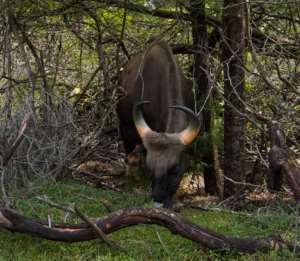
To strengthen the park’s ecology, the forest department has focused on prey-base restoration. In 2023, reports confirmed that 43 gaur were successfully relocated from Kanha and Satpura reserves to Sanjay Dubri.
Avian Life and Birdwatching Highlights
The reserve’s multi-layered canopy and riparian zones provide excellent opportunities for birding. The official bird lists highlight sightings of the Indian roller, Asian koel, red junglefowl, peafowl, and several species of owls.
Wildlife Sighting Field Checklist
The following table outlines key species, their behavior, and the best conditions for observation:
| Species | Sighting Probability & Seasonality | Preferred Habitat & Field Notes |
| Bengal Tiger | Higher probability during dry summer months | Concentrates around remaining waterholes and riverbeds. |
| Sloth Bear | Seasonal and highly variable | Often spotted foraging in mixed deciduous patches. |
| Dhole (Wild Dog) | Moderate | Look for pack behavior and listen for distinct whistling calls. |
| Gaur | Developing | Recently reintroduced (2023); herds are establishing territories. |
| Indian Python | Low (Seasonal) | Typically found near water sources and deep ground cover. |
Photography Tip: Because the sal forests create dappled lighting and deep shadows, keep your camera’s ISO settings flexible. A lens in the 200–600mm range is ideal for capturing tigers across riverbeds or birds high in the canopy.
Safari Zones, Gates, and Booking Process
Safari operations at Sanjay Dubri are managed by the Madhya Pradesh Forest Department. Because the reserve experiences lower visitor volumes than other parks, securing a permit is generally easier, but advance booking is still required to guarantee access to your preferred zones.
Core and Buffer Safari Gates
The reserve is divided into core and buffer zones, each with distinct entry points. Core zones encompass the deepest forest habitats and are entirely free from human settlement, while buffer zones allow for co-existence between wildlife and local communities.
The primary entry gates are categorized as follows:
- Core Zone Gates: Bastua, Salaiya, Kothar Badkadol.
- Buffer Zone Gates: Amjhar, Aamgaon, Kusmi, Songarh.
The following matrix outlines the gate structure and access logistics:
| Zone Type | Entry Gates | Administrative Access Hub | Recommended For |
| Core | Bastua, Salaiya, Kothar Badkadol | Sidhi / Beohari | First-time visitors and primary tiger tracking. |
| Buffer | Amjhar, Aamgaon, Kusmi, Songarh | Local access routes | Photographers seeking longer drives and varied terrain. |
Decision Guide: If you have limited time, prioritize booking core gates such as Bastua or Salaiya. If you are staying for multiple days, mix core and buffer drives to experience both the dense sal canopy and the peripheral habitats.
Step-by-Step Permit Bookings and Fees
Permits for jeep safaris must be secured through the official MP Forest Department booking portal (forest.mponline.gov.in).
- Online Reservation: Navigate to the state forest portal and select Sanjay Tiger Reserve.
- Date and Zone Selection: Choose your preferred date, morning or afternoon timing, and specific gate. Note that some gates may close during the monsoon season; always check the official site for current closures.
- Passenger Details: You must input the exact names and government ID numbers (Passport for international visitors, Aadhaar or PAN for Indian nationals) for all passengers. The ID used for booking must be presented physically at the gate.
- Payment: The online payment covers the forest entry permit. You will pay separate fees at the gate for the mandatory official guide and the registered safari vehicle (jeep).
While elephant safaris have historically been an option in Indian parks, their availability depends heavily on current management policies and animal welfare regulations. Always confirm current elephant safari availability directly with the booking authorities prior to your trip.
Practical Checklist for the Gate:
- Printed copy of the online booking voucher.
- Original government ID used during the booking.
- Cash for vehicle and guide fees (ATMs are not reliably available near the gates).
- Dust mask or scarf for dry season tracks.
Practical Logistics: How to Reach and Where to Stay
Reaching Sanjay Dubri requires some planning, as it is less commercialized than other prominent parks in Madhya Pradesh.
Transit Hubs and Driving Times
The reserve can be accessed through a combination of rail, air, and road routes:
- By Rail: The nearest railway station is Beohari, which connects directly to the local road network leading to the park gates.
- By Air: The closest operational domestic airports are located in Jabalpur and Varanasi. Travelers arriving at these airports must arrange for private vehicle transfers to complete the journey to the reserve.
- By Road: Road entry routes flow primarily through the towns of Sidhi, Rewa, and Beohari. Driving conditions vary depending on the season, with the dry months offering the most predictable travel times.
Accommodation Options: Onsite and Nearby
Because tourism here is lower than in adjacent parks, lodging choices focus on practical and administrative properties rather than sprawling luxury resorts:
- Forest Rest Houses: The Madhya Pradesh Forest Department maintains a limited number of forest rest houses inside or directly adjacent to the reserve boundaries. These require booking in advance through official department channels.
- Nearby Hotels: Traditional hotel accommodations and basic guest houses are available in the regional hubs of Beohari, Sidhi, and Rewa. These provide reliable bases for travelers planning day trips into the park.
- Camping Options: Limited camping arrangements are permitted under strict forest department guidelines and require official coordination at the time of permit booking.
Suggested Itineraries and Regional Combinations
To get the most out of a trip to this landscape, consider combining your safari drives with neighboring wildlife destinations.
Sample 3-Day Combined Itinerary
- Day 1: Arrival & Core Safari — Arrive via Beohari or Sidhi. Take an afternoon safari drive through a core gate like Bastua to familiarize yourself with the sal forest and river corridors.
- Day 2: Multi-Zone Tracking & Buffer Explorations — Complete a morning safari in the core zone focusing on apex predators. Dedicate the afternoon to the buffer zones (such as Kusmi or Amjhar) to observe local community conservation efforts and track nocturnal mammals.
- Day 3: Son-Gharial Sanctuary & Departure — Travel to the connected Son-Gharial Sanctuary morning pool zones to observe breeding gharials and river birds before starting your return transit to Jabalpur or Varanasi.
Common Travel Mistakes to Avoid
- Searching for Wild White Tigers: Many travelers visit expecting to see wild white tigers due to the region’s history. Remember that the white tiger mutation is preserved today only within captive lineages; you will not see them free-roaming in the forest.
- Relying on Outdated Sighting Data: Relying exclusively on old tiger census statistics can lead to low expectations. While older reports showed low single-digit populations, modern monitoring reveals a recovering population that justifies a focused tracking effort.
- Arriving Without Cash: Digital networks and local ATMs are highly unreliable near the entry gates. Always carry sufficient cash to cover local guide and vehicle fees directly at the gate counter.
- Ignoring Speed and Wildlife Rules: The reserve enforces a strict 20 km/h speed limit for safari vehicles to protect crossing wildlife. Violating park rules can result in the immediate cancellation of your permit and financial penalties.
Frequently Asked Questions
Where is Sanjay Dubri Tiger Reserve located?
The reserve is located in the Sidhi district of northeastern Madhya Pradesh, India.
What is the total area of the reserve?
The reserve covers a total area of approximately 1,674.11 to 1,674.51 square kilometers, split between an 812.581 square kilometer core zone and an 861.93 square kilometer buffer zone.
When was the park declared a tiger reserve?
Sanjay National Park and the Dubri Sanctuary were originally established in 1975, and the combined landscape was notified as an official tiger reserve in 2008.
How do I reach the reserve by air and rail?
The closest rail hub is Beohari, while the nearest major domestic airports are located in Jabalpur and Varanasi.
What are the primary entry gates for the core zone?
The primary core zone entry gates are Bastua, Salaiya, and Kothar Badkadol.
How do I book a safari permit online?
Permits must be reserved via the official Madhya Pradesh forest booking portal: forest.mponline.gov.in.
Is an official forest guide mandatory for safaris?
Yes, an authorized forest department guide must accompany every vehicle entering both the core and buffer zones.
What are the best months for tiger sightings?
The dry summer months (typically March through May) offer the highest probability of sightings, as wildlife concentrates around remaining waterholes and major riverbeds.
Which large mammals are found here?
The reserve supports Bengal tigers, leopards, Indian elephants, sloth bears, dholes (wild dogs), gaur, chital, nilgai, chinkara, and four-horned antelopes.
Are wild white tigers still found in this reserve?
No. The historical white tiger Mohan was captured here in 1951, but free-roaming white tigers are extinct in the wild.
Official Contacts and Direct Links
For official updates, direct queries, and verified booking requests, use the following verified administrative resources:
- Official Booking Portal: forest.mponline.gov.in
- Administrative Oversight: Office of the Field Director, Sanjay Tiger Reserve.
- Official Information Documentation: Sanjay Tiger Reserve Information Booklet & MP Forest Department Profile Portal.
Conclusion
Sanjay Dubri Tiger Reserve provides a wild and authentic look at the central Indian highlands. By prioritizing habitat connectivity, corridor protection, and successful reintroductions like the gaur project, the reserve plays a vital role in regional conservation. For the independent traveler, it offers an unhurried, practical safari experience far away from commercial tourist crowds.
Author Note & Update Log: Written by the WildlifeSafaris.in Editorial Team. Last Updated: August 2026.