
Discover the best places to see sloth bears in India. Compare top parks like Daroji and Satpura, understand bear habitats, seasonality, and safari tips.
Introduction, Habitat Ecology & Dedicated Sanctuaries
Why India Is the Premier Destination for Sloth Bear Sightings
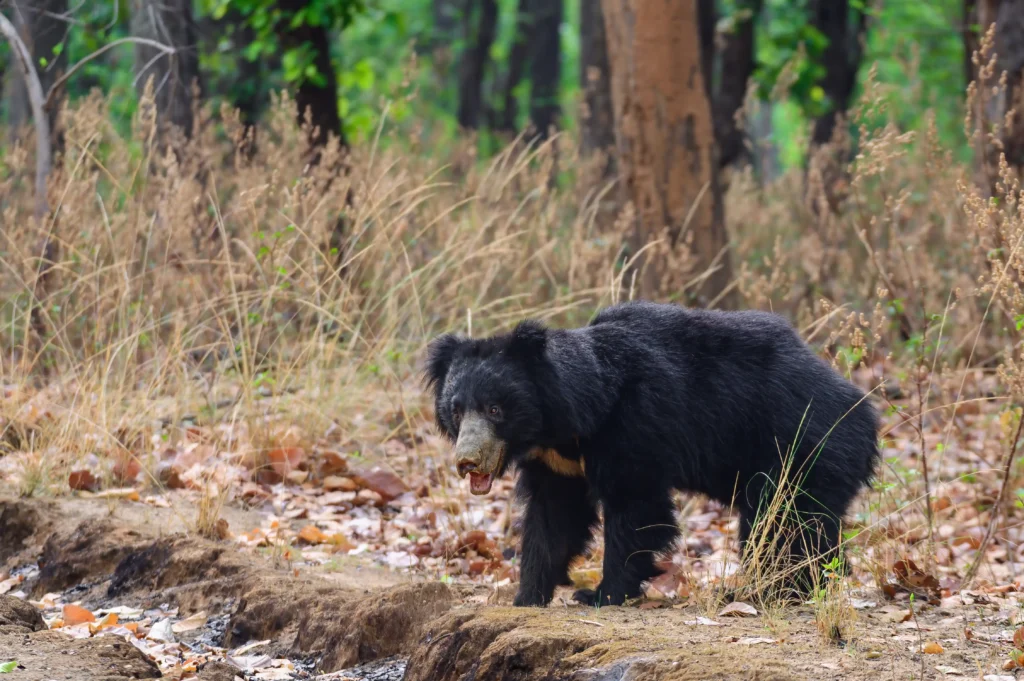
India is home to the core global population of the sloth bear (Melursus ursinus). While the species also occurs in Nepal, Bhutan, and Sri Lanka, India offers the highest concentration of accessible protected areas where travellers can regularly observe these specialised insectivorous bears in their natural habitats.
Unlike generalist brown bears or arboreal black bears, the sloth bear evolved specifically across the Indian subcontinent. A comprehensive study by the Wildlife Conservation Society (WCS) India Program revealed that sloth bears occupy roughly 67% of their potential habitat in India, demonstrating high occupancy throughout the central Indian highlands and the southern peninsula.
+———————————————————————–+
| FIELD NOTE |
| Sloth bears do not hibernate. Their activity continues year-round, |
| driven primarily by seasonal food availability—insects, fruits, |
| and flowers—rather than climatic dormancy. |
+———————————————————————–+
Observing a sloth bear in the wild requires an understanding of their specific habitat requirements. They are secretive, primarily active during crepuscular and nocturnal hours, and often navigate dense undergrowth. However, in regions with the right mix of food sources, rocky shelter, and well-managed safari infrastructure, sighting probabilities are dependable.
The Sloth Bear Habitat Formula: Why Terrain Dictates Sighting Odds
Sloth bears are not evenly distributed across all forest types. While dense tropical moist forests hold populations, dry deciduous woodlands, rocky scrublands, and open savannah mosaics consistently deliver clearer sightings.
THE SLOTH BEAR HABITAT MATRIX
+——————————————————-+
| Rocky Outcrops & Scrublands |
| • Cavities for daytime resting |
| • Thermal refuge in peak summer |
| • High security for maternal dens |
+—————————+—————————+
|
v
+——————————————————-+
| Dry Deciduous & Grassland Mosaics |
| • High termite mound density |
| • Seasonal fruiting (Mahua, Ber, Tendu) |
| • Clear sightlines along vehicle tracks |
+——————————————————-+
Dry Deciduous Woodland and Scrub
Dry deciduous forests shed their canopy during the late winter and dry pre-monsoon months. This reduction in foliage significantly improves sightlines for travellers on safari tracks. The open floor of dry deciduous forests supports substantial populations of ground-dwelling invertebrates, which form the dietary backbone for the species.
Rocky Outcrops, Boulders, and Caves
Sloth bears rely heavily on rugged, broken topography. Granite boulder fields, sandstone ravines, and natural karst caves provide essential daytime resting sites. These geological features protect bears from intense midday heat and provide safe maternal dens away from large carnivores like tigers and leopards. Research in the Western Ghats indicates that sloth bears occupy nearly 61% of forested zones with a clear statistical preference for rugged, drier terrain.
Termite Mounds and Foraging Grounds
Sloth bears are myrmecophagous, meaning their diet consists primarily of ants and termites. They use their long, curved claws to dig into rock-hard termite mounds and their specially adapted gap in their upper incisors to vacuum insects out of underground galleries. Regions with high densities of intact Odontotermes termite mounds regularly see repeatable foraging activity along vehicle trails and watchtower clearings.
The Role of Multi-Use Forests and Corridors
Sloth bears are not confined strictly to protected core zones. Conservation studies demonstrate that sloth bears frequently use territorial buffer areas, revenue lands, and mixed-use forest corridors that link major reserves. Understanding this distribution helps travellers appreciate why buffer zones in Central India often yield sightings as productive as core safari areas.
Flagship Dedicated Sloth Bear Sanctuaries
For travellers whose primary focus is seeing bears rather than general tiger-centric safaris, dedicated sanctuaries provide focused viewing formats and high encounter consistency.
+———————————————————————–+
| EXPERT TIP |
| Dedicated bear sanctuaries offer distinct viewing styles. Daroji |
| provides fixed watchtower observation overlooking feeding zones, |
| while reserves like Satpura or Jessore rely on mobile safari routes. |
+———————————————————————–+
Daroji Sloth Bear Sanctuary, Karnataka
Located adjacent to the UNESCO World Heritage site of Hampi, Daroji Sloth Bear Sanctuary was established in 1994 as Asia’s first protected reserve dedicated specifically to Melursus ursinus.
- Terrain & Ecosystem: 82 square kilometres of rugged thorn scrub, granite boulder formations, and dry deciduous brush.
- How Viewing Works: Unlike mobile jeep-track reserves, Daroji’s primary viewing occurs from a high watchtower overlooking boulder-strewn hillsides. Forest staff apply a mixture of jaggery, honey, and grain to designated rock faces in the late afternoon, encouraging bears to emerge from cave shelters in the rocks.
- Best Window for Sightings: Late afternoon (15:30 to 18:00) provides the most consistent viewing conditions.
- Traveller Logistics: Daroji is easily accessible from Hospet and Hampi, making it an ideal destination for travellers combining cultural heritage touring with wildlife observation.
+———————————————————————–+
| PHOTOGRAPHY TIP |
| Bring a telephoto lens (400mm–600mm) for Daroji’s watchtower. The |
| viewing distance to the baited rock shelves across the clearing is |
| fixed, and natural late-afternoon light drops rapidly behind the |
| granite ridges. |
+———————————————————————–+
Jessore Sloth Bear Sanctuary & Mount Abu, Gujarat / Rajasthan Border
Situated in the Banaskantha district of Gujarat within the Aravalli hills, Jessore Sloth Bear Sanctuary preserves an important arid-zone bio-corridor.
- Terrain & Ecosystem: Desert scrub transitioning into dry deciduous forest across steep metamorphic ridges.
- Viewing Experience: Jessore offers a quieter, low-vehicle wildlife experience compared to popular tiger circuits. Bear activity is centred around seasonal water channels, ravines, and scrub corridors.
- Adjacent Range — Mount Abu Wildlife Sanctuary: Just across the state border in Rajasthan, the Mount Abu reserve features similar rocky woodland terrain with documented sloth bear presence along foothill trails.
- Best Season: November through March provides comfortable temperatures for tracking activity in these dry tracts.
Top National Parks for Sloth Bears (Central & Southern India)
While dedicated sanctuaries offer focused observation, India’s larger national parks and tiger reserves provide the opportunity to see sloth bears as part of a wider big-game safari. Central India, in particular, forms a critical habitat block. Research indicates the highest probabilities of sloth bear occurrence are found in the landscapes linking the central Indian highlands with the southern peninsula.
When visiting these parks, sightings often depend heavily on the safari zone selected, the season, and the specific terrain you traverse.
Satpura Tiger Reserve, Madhya Pradesh
Satpura is the top choice for serious wildlife travellers looking for high-quality sloth bear sightings away from heavy tourist crowds.
Unlike flatter parks, Satpura is defined by its deep sandstone ravines, quiet ranges, and rugged terrain, which together create an ideal environment for sloth bear activity. Because the park limits vehicle numbers strictly and lacks the intense tiger-focused traffic found elsewhere, bears here are often less skittish and can be observed foraging naturally for extended periods.
- Best Season: March to June offers the highest visibility as water sources shrink, though post-monsoon months also yield good activity.
- Safari Style: Satpura is uniquely known for its walking safaris and non-motorised options. Tracking a sloth bear on foot with an expert naturalist is a completely different experience from viewing one from a vehicle.
+———————————————————————–+
| EXPERT TIP |
| If you are prioritising sloth bears in Satpura, request your lodge |
| to book the Madhai and Parsapani zones, which are consistently |
| productive for evening bear movement. |
+———————————————————————–+
Tadoba-Andhari Tiger Reserve, Maharashtra
Tadoba is highly recommended for travellers wanting an action-packed itinerary combining strong tiger sightings with excellent sloth bear odds.
The park’s dry deciduous forest and extensive bamboo cover provide precisely the habitat sloth bears favour. Tadoba is known for having an exceptionally high density of termite mounds, which serves as a reliable food source that keeps bears active near the vehicle tracks.
- Best Season: March to June is optimal. During peak summer, it is common to see bears crossing the dusty tracks at dawn or dusk in search of water.
- Park Dynamics: Because Tadoba is a high-profile big-cat destination, you will need to actively instruct your guide that you want to stop and wait for bears, rather than rushing past tracks to join a tiger queue.
Bandhavgarh National Park, Madhya Pradesh
Bandhavgarh suits travellers on a classic mixed-big-cat trip who want good potential for bears.
While famous for its tigers, the park’s topography features rocky outcrops and mixed woodland that support a healthy sloth bear population. The rocky hillsides in the peripheral and buffer zones provide excellent denning sites.
- Best Season: February to June.
- Observation Strategy: Early morning drives are often the most productive here, as bears forage among the boulders before the midday heat forces them into cave shelters.
Kanha National Park, Madhya Pradesh
Kanha is the best option for families and first-time safari-goers seeking broader appeal, with sloth bears as a strong secondary target.
The park offers beautiful forest mosaics and dense bamboo thickets. Sloth bears here are often seen vacuuming up termites on the edges of the park’s famous meadows or crossing the sandy tracks in the late afternoon.
- Best Season: March to June.
- Why it Works: Kanha’s excellent tourism infrastructure and highly trained naturalists make it an easy and comfortable park for extended stays, increasing your overall odds of a sighting.
+———————————————————————–+
| FIELD NOTE |
| Sloth bears are frequently sighted in the multi-use buffer forests |
| surrounding parks like Kanha and Bandhavgarh. Do not dismiss buffer |
| zone safaris; they often yield excellent bear sightings in habitats |
| that fall outside the highly regulated core areas. |
+———————————————————————–+
Panna Tiger Reserve, Madhya Pradesh
Panna is ideal for low-crowd safari travellers who appreciate a balanced wildlife destination.
The reserve is characterised by mixed woodland, deep gorges, and steep escarpments along the Ken River. These rocky plateaus are prime sloth bear real estate. Because Panna generally experiences lower visitor volumes than Kanha or Bandhavgarh, the quiet ranges allow for patient, undisturbed observation of solitary bears.
- Best Season: November to May.
Ranthambore National Park, Rajasthan
Ranthambore is the right choice for those wanting to combine dramatic landscapes and cultural ruins with wildlife viewing.
The park’s arid, rocky habitat and scrub vegetation mirror the dry conditions that sloth bears thrive in. They are heavily associated with the steep, rocky peripheries of the park rather than the flat lakeside meadows.
- Best Season: March to June. The intense summer heat severely limits water sources, making sightings near remaining waterholes more predictable.
- Zone Selection: Bear activity in Ranthambore is often highly zone-dependent. Discuss your priorities with your operator before booking permits.
Kabini (Nagarhole) and Bandipur, Karnataka
For those travelling in southern India, the Kabini and Nagarhole landscape offers the most reliable big-game safari experience.
The moist and dry deciduous forests transitioning into scrub provide excellent habitat. Sloth bears here are frequently seen foraging along the forest edges and the riverine belts. This region sits within the vital conservation corridor linking the southern peninsula’s populations.
- Traveller Profile: Excellent for those who want a premium lodge-based stay while exploring a high-yield wildlife corridor.
- Safari Dynamics: Kabini offers both land and water safaris, though sloth bears are almost exclusively spotted during early morning or late afternoon jeep drives deep in the woodland sectors.
Travel Matching, Seasonality & Safari Logistics
Which Sloth Bear Destination Suits Your Travel Style?
Choosing the right destination depends on whether your priority is a guaranteed sighting window, a diversified big-game safari, or specialised wildlife photography.
+———————————————————————–+
| DECISION GUIDE |
| • Focused Bear Sighting + Heritage: Daroji (Hampi) |
| • Wilderness Tracking & Walking: Satpura |
| • High-Intensity Big Cats + Bears: Tadoba or Bandhavgarh |
| • Relaxed Family Safari: Kanha |
| • Low-Crowd Exploration: Panna |
+———————————————————————–+
Best for First-Time Wildlife Travellers
- Top Picks: Daroji Sloth Bear Sanctuary and Kanha National Park.
- Why: Daroji offers fixed-location watchtower viewing that eliminates the uncertainty of long vehicle searches, making it rewarding for beginners. Kanha combines world-class park management, wide forest tracks, and comfortable lodge infrastructure, providing an easy entry point to Indian wildlife viewing with steady bear encounter rates.
Best for Wildlife Photographers
- Top Picks: Daroji Sloth Bear Sanctuary and Satpura Tiger Reserve.
- Why: Daroji guarantees predictable angles of bears moving across open granite boulders in late afternoon light. Satpura allows for extended observation time without vehicle congestion, giving photographers clear sightlines along sandstone ravines and open riverbanks.
+———————————————————————–+
| PHOTOGRAPHY TIP |
| Sloth bears have shaggy, light-absorbing black coats that can trick |
| camera light meters into overexposing the surrounding bright terrain. |
| Use spot metering on the bear’s body or dial in -0.3 to -0.7 EV of |
| exposure compensation to retain fur texture and facial details. |
+———————————————————————–+
Best for Mixed-Species / Big-Cat Itineraries
- Top Picks: Tadoba-Andhari Tiger Reserve, Bandhavgarh National Park, and Ranthambore National Park.
- Why: These parks offer high densities of Bengal tigers and leopards alongside thriving sloth bear populations. The dry, open terrain in late spring allows visitors to track predators and insectivorous mammals during the same drive.
Best for Walking and Active Safaris
- Top Pick: Satpura Tiger Reserve.
- Why: Satpura is one of the few reserves in Central India permitted to operate guided walking safaris inside select forest ranges. Tracking sloth bears on foot—interpreting fresh claw marks on termite mounds and reading pugmarks along sandy dry nullahs—provides a deeper natural history perspective.
Master Safari Destination Comparison
The table below compares India’s top sloth bear destinations by terrain, sighting approach, and optimal travel windows:
| Destination | State | Primary Habitat | Best Season | Primary Viewing Method | Sighting Consistency | Best For |
| Daroji Sanctuary | Karnataka | Granite scrub & dry boulders | Nov–May | Fixed watchtower | High (dedicated feeding areas) | Dedicated bear viewing & short trips |
| Satpura Reserve | Madhya Pradesh | Sandstone gorges & mixed forest | Mar–Jun (also post-monsoon) | 4×4 Jeep, walking safaris | Moderate to High | Serious naturalists & walking safaris |
| Tadoba-Andhari | Maharashtra | Dry deciduous & bamboo brakes | Mar–Jun | 4×4 Jeep safaris | Moderate to High | Combined tiger and bear itineraries |
| Bandhavgarh | Madhya Pradesh | Sal forest, bamboo & rocky hills | Feb–Jun | 4×4 Jeep safaris | Moderate | Mixed predator safaris |
| Kanha | Madhya Pradesh | Sal woodland & open meadows | Mar–Jun | 4×4 Jeep safaris | Moderate | Families & balanced wildlife travel |
| Panna | Madhya Pradesh | Teak woodland & river gorges | Nov–May | 4×4 Jeep safaris | Moderate | Low-crowd, tranquil safari experiences |
| Ranthambore | Rajasthan | Arid scrub & rocky escarpments | Mar–Jun | 4×4 Jeep / Canter | Moderate | Wildlife & heritage photography |
Seasonality Guide: When to Plan Your Safari
Sloth bear activity varies predictably with seasonal weather patterns, temperature shifts, and natural food availability.
ANNUAL SIGHTING DYNAMICS
Nov – Feb (Winter) Mar – Jun (Dry Summer)
+————————–+ +————————–+
| • Dense green foliage | | • Thinned deciduous tree |
| • Morning sun basking on | | canopy |
| rock shelves | | • Concentration near |
| • Shorter daily foraging | | shrinking water holes |
| windows | | • Peak visibility across |
| • High travel comfort | | forest floors |
+————————–+ +————————–+
Dry Summer (March to June)
The dry summer months provide the highest statistical encounter rates across Central and Western India. As heat increases:
- Deciduous trees shed their leaves, significantly opening up sightlines into the brush.
- Natural water pools dry up, compelling bears to visit remaining perennial waterholes and riverbanks during daylight margins.
- Termite mounds dry out and become brittle, making excavation noisier and easier to detect from safari tracks.
Winter (November to February)
Winter is the most comfortable time for travel, but viewing requires a different approach:
- Forest cover is thicker following the monsoon rains.
- Sloth bears often emerge from rocky dens later in the morning to bask in the sun on open stone ridges before retreating to shade.
- Sightings are shorter in duration but can offer clear photographic light during midday hours.
Monsoon (July to September / October)
Most core national park zones in Central India close to tourist vehicles during the monsoon breeding and regeneration season. Dedicated sanctuaries like Daroji remain open, though heavy vegetation reduces visibility.
Viewing Methods: Watchtowers vs. Jeep Safaris vs. Walking Trails
Understanding how you will encounter a sloth bear helps set realistic expectations for your itinerary.
+———————————————————————–+
| RESPONSIBLE TOURISM |
| Regardless of whether you view bears from a vehicle, a hide, or on |
| foot, maintain strict silence. Sloth bears have poor eyesight but |
| exceptionally keen hearing; sudden noises cause them to bolt into |
| thick cover. |
+———————————————————————–+
1. Watchtower and Hide Observation
- Where It Works: Daroji Sloth Bear Sanctuary.
- Experience: Visitors sit quietly in an elevated stone facility overlooking rocky hillsides. This format causes zero disruption to the animals and allows you to watch natural foraging and family interactions for an hour or more at a time.
2. Open 4×4 Jeep Safaris
- Where It Works: Satpura, Tadoba, Kanha, Bandhavgarh, Panna, Ranthambore, and Kabini.
- Experience: The standard Indian safari format. Jeeps cover established trail networks at low speeds. Encounters are dynamic—bears may cross the track, forage along road shoulders, or dig into termite mounds alongside the vehicle.
3. Guided Walking Safaris
- Where It Works: Select buffer and core zones of Satpura Tiger Reserve.
- Experience: Led by an official forest department tracker and a lodge naturalist. Walking safaris emphasize reading field signs—fresh dung, excavations, and territorial scratch marks—while keeping a safe, respectful distance from active wildlife.
Biology, Field Safety, Common Mistakes & FAQs
Sloth Bear Field Biology and Identification
To appreciate a sloth bear sighting, it helps to understand their distinct evolutionary adaptations. Native to the Indian subcontinent—spanning India, Nepal, Bhutan, Sri Lanka, and Bangladesh—the sloth bear (Melursus ursinus) is the most widely distributed bear species in India.
Despite their widespread presence, they are frequently misunderstood by travellers and sometimes misidentified in the field.
Diet and Foraging Dynamics
Sloth bears are highly specialised insectivores. Their primary diet consists of termites and ants, which heavily dictates their movement and habitat selection. They possess large, curved, ivory-coloured claws designed to tear into rock-hard termite mounds. Furthermore, they lack upper central incisors, allowing them to use their mobile lips to create a vacuum and suck insects directly from underground galleries—a process so loud it can often be heard by safari vehicles before the bear is seen.
Distinguishing India’s Bears
India hosts three distinct bear species. Knowing the difference prevents confusion, especially in northern and northeastern regions where territories occasionally overlap.
| Feature | Sloth Bear (Melursus ursinus) | Asiatic Black Bear (Ursus thibetanus) | Himalayan Brown Bear (Ursus arctos isabellinus) |
| Primary Habitat | Dry deciduous forests, scrub, rocky lowlands. | Steep, forested mountainous terrain. | High-altitude alpine meadows above the tree line. |
| Physical Markers | Shaggy unkempt black coat, distinct pale muzzle, large U- or Y-shaped white chest mark. | Sleeker black coat, prominent white V-shaped chest mark, distinct “Mickey Mouse” ears. | Light brown to reddish-brown coat, heavily built, pronounced shoulder hump. |
| Dietary Focus | Chiefly termites, ants, and seasonal fruits (like Mahua). | Omnivorous (nuts, fruits, roots, small mammals). | Omnivorous (roots, grasses, marmots, insects). |
Safari Safety and Ethical Viewing Standards
A common misconception among travellers is that sloth bears are slow, clumsy, and harmless. In reality, they are remarkably agile, can run faster than humans, and possess a highly defensive temperament. Because they share their habitat with apex predators like tigers and leopards, and because they have poor eyesight, a surprised sloth bear will often react with immediate aggression rather than fleeing.
+———————————————————————–+
| RESPONSIBLE TOURISM TIP |
| Never encourage your driver to block a bear’s path for a better |
| photograph. Sloth bears often use vehicle tracks to travel between |
| foraging sites. If a bear is walking along the road, your vehicle |
| should pull over, turn off the engine, and let the animal pass. |
+———————————————————————–+
When observing sloth bears:
- Maintain strict silence: Their keen sense of hearing compensates for their poor vision. Sudden human voices can cause them to panic and bolt into the undergrowth.
- Respect defensive behaviour: A mother with cubs riding on her back is particularly vulnerable and requires maximum viewing distance.
- Follow guide instructions: On walking safaris in places like Satpura, always stay strictly behind your armed forest guard and naturalist, and never attempt to approach a termite mound if a bear is excavating it.
Common Mistakes Travellers Make When Planning a Bear Safari
- Assuming sightings are guaranteed: No wildlife sighting is ever guaranteed. Even in dedicated sanctuaries like Daroji, weather shifts and food availability can alter daily movement patterns.
- Ignoring buffer zones: Travellers often insist on booking only “core” zone safari permits. However, conservation research shows sloth bears thrive in multi-use forests and territorial buffer zones. These peripheral areas often yield spectacular, uninterrupted sightings.
- Hiding priorities from the guide: If you only tell your guide you want to see a tiger, they will drive past productive scrub habitat and ignore termite mounds to join queues at waterholes. Tell your naturalist your target species before the drive begins.
- Assuming bears are strictly nocturnal: While they are highly active at night, sloth bears regularly forage during the early morning and late afternoon, and occasionally during the day depending on human disturbance levels and seasonal water needs.
Frequently Asked Questions
Which destination in India offers the highest probability of seeing a sloth bear? For dedicated, reliable viewing, Daroji Sloth Bear Sanctuary in Karnataka provides the most consistent sightings due to its fixed watchtower viewing and baited rock habitats. For a traditional open-jeep safari, Satpura Tiger Reserve and Tadoba-Andhari Tiger Reserve offer excellent encounter rates.
Are sloth bears dangerous to tourists? They can be highly defensive if startled on foot. However, when viewed from a designated watchtower or a safari vehicle driven by a qualified guide, they pose very little risk to tourists provided you maintain a respectful distance and do not crowd them.
Can you combine a sloth bear safari with tiger tracking? Yes. Central Indian parks like Tadoba, Bandhavgarh, Kanha, and Panna support strong populations of both Bengal tigers and sloth bears. The dry deciduous terrain in these parks supports multi-species itineraries perfectly.
Do sloth bears hibernate?
No. Because they rely heavily on insects and live in warmer tropical and subtropical climates, sloth bears do not need to hibernate. They remain active year-round.
How many days should I allocate to a park to maximise sloth bear sighting chances?
Plan for at least three to four days (roughly six to eight safari drives). This allows you to explore different topographical zones within the park—such as moving from flat meadows to rocky escarpments where bears prefer to rest during the day.
Final Naturalist Summary & Decision Framework
India remains the ultimate destination for observing the sloth bear in its natural environment. Successful planning requires moving beyond standard tiger-centric itineraries and paying close attention to terrain.
To finalise your travel decision:
- Choose Daroji if your primary goal is a focused, high-probability bear encounter, perhaps combined with the cultural ruins of Hampi.
- Choose Satpura if you are a serious wildlife enthusiast or photographer wanting premium, low-crowd wilderness tracking and the rare opportunity to explore bear habitat on foot.
- Choose Tadoba, Kanha, or Bandhavgarh if you want a diverse big-game safari where tigers and leopards are the primary focus, but sloth bears serve as an exceptional secondary target.
By aligning your travel dates with the dry season, selecting parks with abundant rocky scrub and termite mounds, and communicating your priorities to your guides, you will put yourself in the best possible position to observe one of India’s most fascinating mammals.