
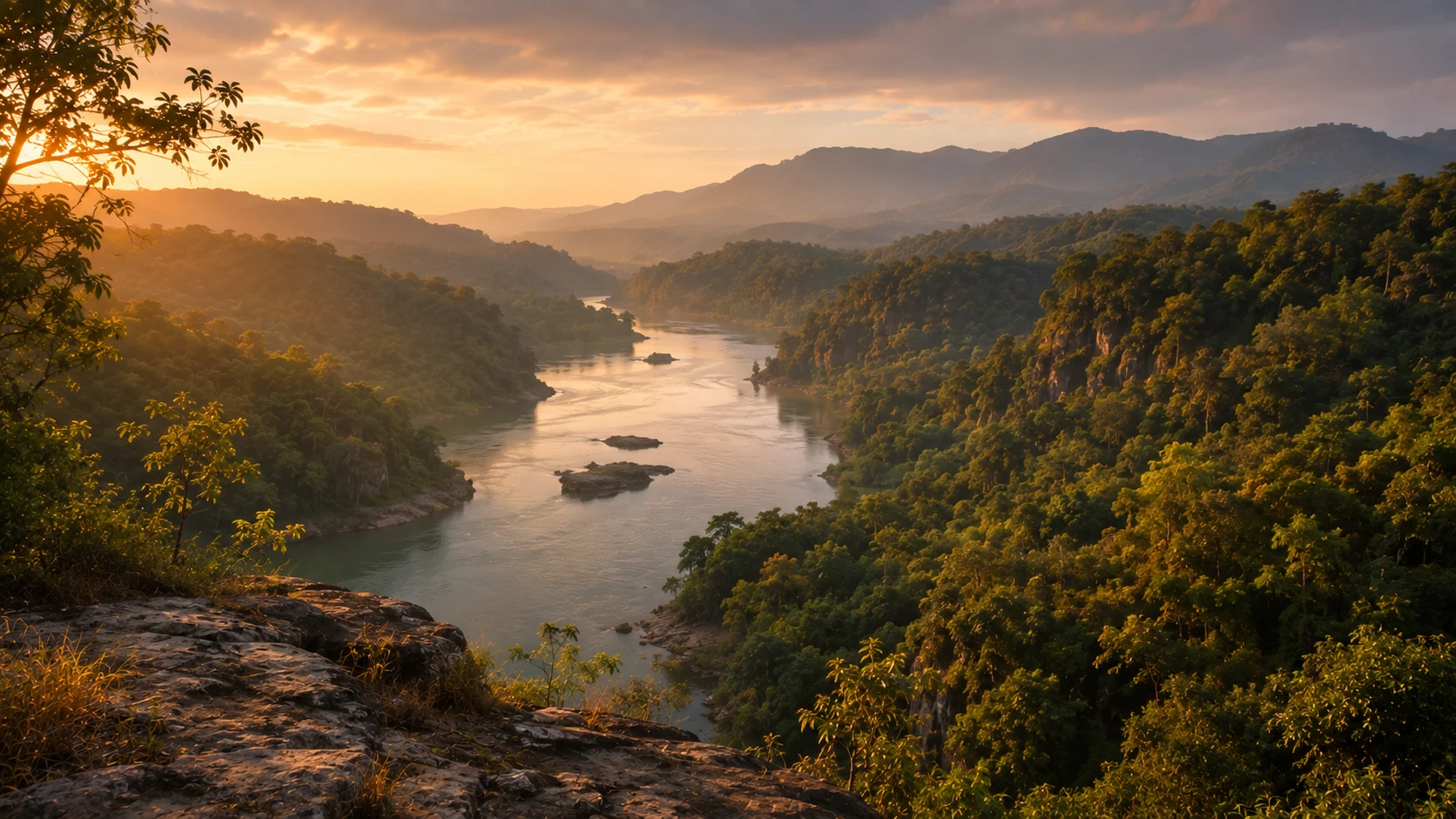
Explore Nagarjuna-Srisailam Tiger Reserve with this complete travel guide covering wildlife, best time to visit, tourism, conservation, history, and latest visitor updates.
Introduction
Nagarjuna-Srisailam Tiger Reserve (NSTR) is the largest tiger reserve in India by total notified area. Spread across the rugged Nallamala Hills of the Eastern Ghats, it protects one of the country’s most significant landscapes for tiger conservation. Beyond its size, the reserve is valued for its continuous forests, deep valleys, the Krishna River, and the ecological connectivity it provides to neighbouring protected areas.
Unlike many tiger reserves that are primarily known for safari tourism, NSTR serves multiple roles. It is an important refuge for tigers, leopards, sloth bears, wild dogs, and hundreds of bird species, while also supporting local communities and accommodating one of southern India’s major pilgrimage destinations at Srisailam. This combination of wildlife conservation, cultural significance, and landscape-scale management makes the reserve distinct among India’s protected areas.
For travellers, NSTR offers a different experience from the more tourism-focused tiger reserves. The emphasis here is less on frequent tiger sightings and more on exploring a vast forest ecosystem where conservation remains the primary objective. Understanding this helps visitors set realistic expectations and appreciate the reserve for its ecological importance rather than treating it solely as a safari destination.
Field Note: Visitor access can change seasonally. The reserve’s core area is closed to tourists from 1 July to 30 September 2026 to reduce disturbance during the tiger breeding season. Always check the latest official updates before planning a trip.
What Makes Nagarjuna-Srisailam Tiger Reserve Special?
India’s Largest Tiger Reserve
NSTR is recognised as India’s largest tiger reserve by total notified area, covering approximately 5,937 square kilometres. Official NTCA figures describe a landscape comprising a large critical tiger habitat (core area) and an extensive buffer that together protect one of the biggest continuous forest blocks in peninsular India. Because different official sources may refer to the entire reserve, the Andhra Pradesh administrative area, or updated mapped boundaries, readers may encounter varying area figures. Understanding which figure a source is using helps avoid confusion.
Why This Landscape Matters
The reserve’s importance extends beyond the number of tigers it supports. Its forests function as a landscape-scale conservation area where wildlife can move across large tracts of habitat. Such connectivity is essential for maintaining healthy tiger populations, supporting genetic diversity, and allowing animals to disperse between protected forests in the Eastern Ghats. The Krishna River, steep valleys, plateaus, and dry deciduous forests together create habitats for a wide range of mammals, birds, reptiles, and amphibians.
Who Should Visit?
NSTR is best suited for:
- Wildlife enthusiasts interested in large forest ecosystems rather than guaranteed tiger sightings.
- Birdwatchers looking to explore one of the Eastern Ghats’ important avian habitats.
- Nature photographers seeking varied landscapes, reservoirs, and forest scenery.
- Travellers combining wildlife with a visit to the Srisailam Temple.
- Students and conservation enthusiasts interested in India’s tiger conservation efforts.
Location and Geography
Where Is Nagarjuna-Srisailam Tiger Reserve?
Nagarjuna-Srisailam Tiger Reserve lies within the Nallamala Hills of the Eastern Ghats in Andhra Pradesh and forms part of a broader forest landscape that connects with Telangana’s Amrabad Tiger Reserve. Rather than functioning as an isolated protected area, it is part of a larger ecological network that supports the movement of wide-ranging species such as tigers and leopards.
Landscape at a Glance
| Feature | Details |
| Tiger Reserve Status | 1983 |
| Original Sanctuary Notification | 1978 |
| Landscape | Nallamala Hills |
| Mountain System | Eastern Ghats |
| Major River | Krishna River |
| Forest Type | Tropical dry deciduous forest |
| Significance | India’s largest notified tiger reserve |
Nallamala Hills and the Eastern Ghats
The Nallamala Hills define much of the reserve’s character. Instead of open grasslands, visitors encounter rugged plateaus, rocky ridges, narrow valleys, seasonal streams, and extensive dry deciduous forests interspersed with bamboo. These varied habitats support different wildlife communities and provide shelter for predators as well as prey species.
Krishna River and Reservoirs
The Krishna River is a defining feature of the reserve, flowing through dramatic gorges before widening into major reservoirs, including those associated with Nagarjunasagar and Srisailam. These water bodies not only shape the landscape but also support aquatic wildlife such as mugger crocodiles, otters, turtles, and numerous waterbirds. During dry periods, permanent water sources become especially important for sustaining wildlife across the reserve.
History of Nagarjuna-Srisailam Tiger Reserve
Understanding the reserve’s history helps explain why it occupies such an important place in India’s conservation network. While many visitors know it as a tiger reserve, the area first gained legal protection as a wildlife sanctuary before becoming part of Project Tiger. This gradual evolution reflects India’s broader approach to protecting large forest landscapes rather than focusing solely on individual species.
From Wildlife Sanctuary to Tiger Reserve
The forests of the Nallamala Hills were notified as a wildlife sanctuary in 1978. Recognising their importance for tiger conservation, the area was brought under Project Tiger in 1983, giving it the status of a tiger reserve. This change strengthened habitat protection and introduced long-term management focused on safeguarding both predators and their prey.
Since then, conservation has expanded beyond protecting tigers alone. Management today also focuses on maintaining healthy forests, conserving water sources, reducing human pressures, and preserving wildlife corridors that allow animals to move across the broader Eastern Ghats landscape.
Understanding Core and Buffer Areas
Like other tiger reserves in India, NSTR is divided into core and buffer zones, each serving a different purpose.
| Zone | Primary Purpose |
| Core Area | Strict protection of wildlife and critical tiger habitat with minimal human disturbance |
| Buffer Area | Supports conservation while allowing regulated community activities and carefully managed tourism |
This zoning system balances wildlife conservation with the needs of local communities living around the reserve. It also helps reduce conflicts between people and wildlife while protecting sensitive breeding habitats.
Responsible Tourism Tip: Remaining on designated roads and following forest department instructions helps minimise disturbance in the reserve’s most sensitive habitats.
Geography and Habitat
One of NSTR’s greatest strengths is the variety of habitats it protects. Instead of a uniform forest, the reserve contains a mosaic of landscapes that support different wildlife species throughout the year.
A Landscape of Hills, Valleys and Rivers
The reserve occupies a large section of the rugged Nallamala Hills, an important offshoot of the Eastern Ghats. The terrain includes:
- Rocky plateaus
- Deep valleys
- Narrow gorges
- Seasonal streams
- Permanent rivers
- Dense forested slopes
This varied topography creates numerous microhabitats, allowing wildlife to find food, water, and shelter under changing seasonal conditions.
Tropical Dry Deciduous Forests
Most of the reserve is covered by tropical dry deciduous forest, one of India’s characteristic forest types. These forests shed many of their leaves during the dry season to conserve moisture before becoming green again with the arrival of the monsoon.
Common habitat features include:
- Dry deciduous woodland
- Bamboo patches
- Grass undergrowth
- Rocky escarpments
- Riverine vegetation along the Krishna River
Together, these habitats support a wide range of herbivores, which in turn sustain large carnivores such as tigers, leopards and dholes.
Why Habitat Diversity Matters
Large predators require more than forest cover. They also need abundant prey, reliable water, and safe movement routes between different parts of the landscape.
NSTR provides this combination by protecting extensive tracts of relatively continuous forest. The reserve also forms part of a larger conservation landscape connected with neighbouring protected forests, making it an important wildlife corridor in the Eastern Ghats. Such connectivity allows animals to disperse naturally and helps maintain healthy populations over the long term.
Field Note: Unlike reserves dominated by open meadows, much of NSTR consists of dense dry deciduous forest. Wildlife sightings often depend on patience, quiet observation, and spending time near natural water sources.
Wildlife of Nagarjuna-Srisailam Tiger Reserve
Although tigers attract most attention, the reserve protects an impressive variety of mammals, birds, reptiles and amphibians. Official records document more than 80 mammal species, 303 bird species, 54 reptile species, and 20 amphibian species, making it one of the most biologically important protected landscapes in the Eastern Ghats.
Big Cats and Other Mammals
Bengal Tiger
The Bengal tiger is the reserve’s flagship species and the primary focus of conservation management. The vast forested landscape provides suitable habitat for breeding tigers, while seasonal tourism closures help minimise disturbance during sensitive periods.
Indian Leopard
Leopards are widespread throughout the reserve and are particularly adaptable, using rocky hills, forest edges and dense woodland. Recent reporting highlighted NSTR for having one of India’s highest estimated leopard populations among tiger reserves, although such figures should always be interpreted in the context of the survey year and methodology.
Other Carnivores
Visitors may also encounter signs of several other predators, including:
- Dhole (Indian wild dog)
- Indian wolf
- Golden jackal
These carnivores play an important role in maintaining ecological balance by regulating herbivore populations.
Herbivores
Healthy prey populations are essential for sustaining large predators. The reserve supports a variety of ungulates and smaller mammals, including:
- Sambar deer
- Chital (spotted deer)
- Chowsingha
- Chinkara
- Mouse deer
- Wild boar
- Indian porcupine
Their abundance reflects the diversity of habitats found across the reserve.
Birds, Reptiles and River Wildlife
Birdwatchers have the opportunity to observe a wide variety of forest and riverine birds across different seasons. Official records list approximately 303 bird species, making the reserve an important destination for avian diversity in the Eastern Ghats.
Reptiles and aquatic wildlife include:
- Mugger crocodile
- Freshwater turtles
- Otters
- Numerous snake and lizard species associated with dry forests and river habitats
The Krishna River and its reservoirs add another ecological dimension by supporting species rarely seen in purely terrestrial protected areas.
Wildlife at a Glance
| Group | Highlights |
| Mammals | Tigers, leopards, sloth bears, dholes, wolves, deer, wild boar |
| Birds | Around 303 recorded species |
| Reptiles | Mugger crocodiles, turtles, snakes and lizards |
| Amphibians | About 20 recorded species |
| River Fauna | Otters, crocodiles and freshwater wildlife |
Photography Tip: Dense forests often limit visibility compared with open grassland reserves. Carry a telephoto lens, use higher ISO settings when necessary, and be prepared for brief wildlife encounters rather than prolonged sightings.
Tiger and Leopard Population
Wildlife population figures are among the most searched aspects of Nagarjuna-Srisailam Tiger Reserve. While these numbers provide a useful snapshot of conservation progress, they should always be interpreted carefully. Population estimates vary depending on the survey year, monitoring methods, and reporting source. Rather than viewing them as fixed figures, it is better to see them as indicators of long-term conservation trends.
Tiger Population
Recent reports indicate that Nagarjuna-Srisailam Tiger Reserve supports around 76 tigers. This reflects the reserve’s importance as one of India’s major tiger landscapes rather than simply another protected area with a tourism focus. Its vast forests, relatively low levels of habitat fragmentation, and extensive prey base provide suitable conditions for breeding and dispersing tigers.
Because NSTR protects such a large area, tigers are naturally spread across extensive territories. As a result, visitors should not expect the same frequency of sightings seen in smaller reserves with concentrated safari routes.
Leopard Population
Although tigers receive most public attention, leopards are another major conservation success story within the reserve. Recent coverage based on EnviStats India-2024 estimated approximately 360 leopards, placing NSTR among India’s leading tiger reserves for leopard abundance.
Leopards occupy a wide variety of habitats across the reserve, from rocky escarpments and valleys to dense dry deciduous forests. Their adaptability allows them to coexist with tigers while exploiting different prey and habitat niches.
Why Population Numbers Change
Wildlife numbers should never be viewed as permanent.
Several factors influence official estimates, including:
- Improvements in camera-trap coverage.
- Updated survey techniques.
- Natural births and mortality.
- Seasonal movement of animals.
- Refinement of scientific methodologies.
For this reason, official surveys released by agencies such as the National Tiger Conservation Authority (NTCA) remain the most reliable reference for long-term trends.
Expert Tip: When comparing tiger reserves, avoid judging them solely by tiger numbers. Habitat quality, landscape connectivity, prey availability, and successful breeding are equally important indicators of conservation success.
Best Time to Visit Nagarjuna-Srisailam Tiger Reserve
The best time to visit depends on what you hope to experience. Wildlife viewing, weather conditions, road accessibility, and visitor regulations all change throughout the year.
Winter (October to February)
Winter is generally the most comfortable season for visiting the reserve.
Visitors can expect:
- Pleasant daytime temperatures.
- Comfortable conditions for sightseeing.
- Good opportunities for birdwatching.
- Green landscapes following the monsoon.
Although wildlife can be more difficult to spot in denser post-monsoon vegetation, the overall travel experience is usually more enjoyable because of the cooler climate.
Summer (March to June)
Summer offers the highest chances of observing mammals near permanent water sources.
As natural water becomes scarce, animals often concentrate around rivers, reservoirs, and waterholes. While temperatures can become extremely high during the afternoon, early morning and late evening excursions may reward patient observers with sightings of deer, wild boar, sloth bears, and occasionally large carnivores.
Monsoon (July to September)
The monsoon transforms the reserve into a lush green landscape.
However, this period also brings practical limitations:
- Heavy rainfall.
- Slippery roads.
- Reduced accessibility.
- Dense vegetation that limits wildlife visibility.
The core tourism zone remains closed from 1 July to 30 September 2026 to minimise disturbance during the tiger breeding season. Visitors planning wildlife trips should verify the latest official notifications before travelling.
Seasonal Guide
| Season | Conditions | Suitable For |
| October-February | Cool and comfortable | General tourism, birdwatching, sightseeing |
| March-June | Hot and dry | Wildlife observation near water sources |
| July-September | Rainy with seasonal restrictions | Landscape photography; tourism may be restricted |
Photography Tip: Early morning light during winter often provides the best balance between soft illumination and active wildlife movement.
Tourism and Visitor Experience
Unlike heavily commercialised safari destinations, Nagarjuna-Srisailam Tiger Reserve places greater emphasis on conservation than tourism. Visitors should approach the reserve with realistic expectations and an appreciation for its ecological significance.
Understanding Tourism Access
Tourism within the reserve is carefully regulated to reduce disturbance to wildlife. Access varies depending on management decisions, seasonal conditions, and conservation priorities.
Some areas remain open for visitors, while highly sensitive habitats receive stricter protection. This approach helps maintain breeding areas and minimises pressure on wildlife.
Core and Buffer Areas
Visitors often encounter the terms core and buffer, but these areas serve different purposes.
| Feature | Core Zone | Buffer Zone |
| Primary Objective | Wildlife protection | Conservation with regulated human use |
| Tourism | Highly controlled | More flexible where permitted |
| Human Activity | Minimal | Carefully managed |
| Ecological Importance | Critical breeding habitat | Supports connectivity and community participation |
Understanding this distinction helps explain why access restrictions sometimes apply even when surrounding areas remain open.
Seasonal Closures
Temporary tourism closures are an important conservation tool rather than an inconvenience.
The reserve’s core area was closed between 1 July and 30 September 2026 to reduce disturbance during the tiger breeding season. Such closures allow wildlife to breed and rear young with minimal human interference.
Visiting Srisailam
One feature that distinguishes NSTR from many other tiger reserves is the presence of Srisailam, one of India’s most significant pilgrimage centres.
This creates an interesting balance between conservation and religious tourism. Forest managers work to accommodate pilgrims while ensuring that wildlife habitats remain protected, particularly during periods of increased visitor numbers.
How to Reach Nagarjuna-Srisailam Tiger Reserve
Travellers should plan their journey well in advance, particularly if combining wildlife tourism with a pilgrimage to Srisailam.
By Road
Road travel is the most practical way to reach different parts of the reserve. Several access routes connect nearby towns with forest entry points and Srisailam.
By Rail
Visitors arriving from other parts of India typically use nearby railway stations before completing the journey by road.
By Air
The nearest airports provide convenient access for domestic travellers, followed by onward road travel.
Because transport infrastructure and visitor regulations may change over time, travellers should confirm the latest route information before departure.
Practical Checklist Before You Travel
- ✔ Check whether tourism zones are open.
- ✔ Confirm seasonal closure dates.
- ✔ Carry sufficient drinking water, especially in summer.
- ✔ Wear neutral-coloured clothing.
- ✔ Carry binoculars and a telephoto lens if interested in wildlife photography.
- ✔ Respect speed limits and forest department regulations.
- ✔ Never feed or approach wildlife.
- ✔ Keep noise to a minimum throughout your visit.
Conservation Challenges and Management
Nagarjuna-Srisailam Tiger Reserve is important not only because of its size but because it protects one of the largest remaining forest landscapes in the Eastern Ghats. Managing such an extensive reserve involves balancing wildlife conservation, local livelihoods, pilgrimage traffic, and tourism while maintaining healthy habitats for wide-ranging species like tigers and leopards.
A Landscape Connected Beyond Reserve Boundaries
Unlike smaller protected areas, NSTR functions as part of a much larger conservation landscape. Wildlife does not recognise administrative boundaries, and large mammals regularly move through connected forests in search of food, mates, and new territories.
This connectivity:
- Maintains genetic diversity.
- Allows young tigers to establish new territories.
- Reduces the risk of isolated wildlife populations.
- Strengthens long-term conservation across the Eastern Ghats.
Protecting these movement corridors is therefore as important as protecting the reserve itself.
Habitat Management
Conservation extends far beyond protecting individual animals. Forest managers work to maintain healthy ecosystems by focusing on habitat quality.
Key management priorities include:
- Preventing forest fires.
- Protecting natural water sources.
- Controlling illegal activities.
- Monitoring wildlife movement.
- Maintaining prey populations.
- Reducing habitat degradation.
These measures help sustain the ecological processes that support the reserve’s diverse wildlife.
Community Participation
Communities living around protected forests are important partners in conservation.
The Chenchu communities have long-standing cultural connections with the forests of the Nallamala Hills. Modern conservation increasingly recognises that involving local communities in protection, monitoring, and sustainable resource management contributes to better long-term outcomes for both people and wildlife.
Managing Tourism Responsibly
Tourism provides opportunities for education and local livelihoods, but it also requires careful regulation.
Measures such as:
- Seasonal closures,
- Controlled visitor access,
- Regulated vehicle movement,
- Visitor awareness programmes,
help minimise disturbance to wildlife, especially during sensitive breeding periods. Rather than viewing these restrictions as inconveniences, visitors should recognise them as part of responsible protected-area management.
Responsible Tourism Tip: Your behaviour matters. Staying on designated routes, avoiding loud noises, and following guide instructions all contribute to protecting wildlife.
Nagarjuna-Srisailam Tiger Reserve vs Amrabad Tiger Reserve
Because these neighbouring reserves share the Nallamala landscape, travellers often wonder how they differ.
| Feature | Nagarjuna-Srisailam Tiger Reserve | Amrabad Tiger Reserve |
| Primary State | Andhra Pradesh | Telangana |
| Landscape | Nallamala Hills | Nallamala Hills |
| Ecological Role | Largest notified tiger reserve and key landscape for tiger conservation | Connected tiger habitat within the same landscape |
| Main Highlights | Vast forests, Krishna River, Srisailam, high leopard abundance | Dense forests, wilderness experience, tiger conservation |
| Visitor Experience | Wildlife, conservation, pilgrimage and landscape exploration | Primarily wildlife-focused |
Rather than competing with each other, the two reserves complement one another by protecting adjoining sections of the same forest ecosystem. Together, they form one of India’s most important tiger landscapes.
Practical Visitor Tips
Expert Tip
Plan your visit around the overall experience rather than hoping for a tiger sighting. NSTR is best appreciated as a large, functioning ecosystem where every observation—from birds and butterflies to deer and reptiles—contributes to the experience.
Photography Tip
Carry binoculars and a telephoto lens. Dense forest often means wildlife appears only briefly, so patience is more valuable than constantly searching for dramatic sightings.
Family Travel Tip
Families combining wildlife with a pilgrimage to Srisailam should allow extra travel time and check seasonal visitor advisories before departure.
Responsible Tourism Tip
Avoid littering, never feed wildlife, and keep conversations quiet while inside forest areas. Respect temporary closures and restricted zones.
Practical Checklist
Before visiting:
- □ Confirm whether tourism zones are open.
- □ Check seasonal weather.
- □ Carry government-issued identification if required.
- □ Wear earth-toned clothing.
- □ Pack binoculars.
- □ Carry drinking water.
- □ Follow instructions from forest staff.
- □ Respect wildlife viewing distances.
- □ Leave no litter behind.
Common Mistakes Visitors Make
Avoid these common planning errors:
Expecting Guaranteed Tiger Sightings
NSTR protects an enormous landscape where tigers occupy extensive territories. Wildlife sightings are never guaranteed.
Ignoring Seasonal Closures
Visitors sometimes assume the reserve remains open throughout the year. Always verify current access conditions before travelling.
Treating the Reserve Like a Zoo
Wild animals behave naturally and may remain hidden for long periods. Appreciating tracks, birds, landscapes, and smaller wildlife is part of the experience.
Underestimating Travel Distances
The reserve covers a vast area. Journey times between destinations can be longer than expected.
Focusing Only on Tigers
NSTR also supports leopards, sloth bears, dholes, crocodiles, hundreds of bird species, reptiles, and diverse forest ecosystems.
Frequently Asked Questions
Is Nagarjuna-Srisailam Tiger Reserve the largest tiger reserve in India?
Yes. It is recognised as India’s largest notified tiger reserve by total area.
Where is Nagarjuna-Srisailam Tiger Reserve located?
The reserve lies in the Nallamala Hills of Andhra Pradesh and forms part of a larger forest landscape connected with Telangana’s Amrabad Tiger Reserve.
What is the best time to visit?
October to February offers pleasant weather, while summer can improve wildlife viewing near water sources.
How many tigers live in the reserve?
Recent reports indicate around 76 tigers, although official numbers vary with each survey.
Why is the reserve important?
It protects one of India’s largest continuous forest landscapes and plays a major role in tiger conservation, wildlife connectivity, and biodiversity conservation.
Is the reserve good for birdwatching?
Yes. Official records mention approximately 303 bird species, making it an attractive destination for bird enthusiasts.
Can I visit throughout the year?
Not always. Tourism access can be seasonally restricted, particularly in the core area during sensitive breeding periods. Always check current official updates before planning your visit.
What other wildlife can I see?
Besides tigers, the reserve supports leopards, sloth bears, dholes, wolves, deer, wild boar, crocodiles, otters, reptiles, amphibians, and hundreds of bird species.
Is this reserve suitable for first-time wildlife travellers?
Yes, provided expectations are realistic. It is better suited to travellers interested in experiencing a large natural landscape than those seeking frequent tiger sightings.
Why are seasonal closures necessary?
Temporary closures reduce human disturbance during critical wildlife breeding periods and support long-term conservation objectives.
Conclusion
Nagarjuna-Srisailam Tiger Reserve stands apart not simply because it is India’s largest tiger reserve, but because it protects an entire landscape where forests, rivers, wildlife, and local communities remain closely connected. Its ecological significance extends beyond tiger conservation, supporting hundreds of bird species, diverse mammals, reptiles, amphibians, and one of the most extensive dry deciduous forest ecosystems in the Eastern Ghats.
Visitors who approach NSTR with realistic expectations are likely to find far more than a wildlife checklist. Exploring its rugged terrain, observing its varied habitats, and understanding its conservation challenges provide a deeper appreciation of how large protected landscapes function. Whether you are a wildlife enthusiast, photographer, birder, student, or pilgrim visiting nearby Srisailam, the reserve offers valuable insights into India’s ongoing efforts to conserve biodiversity on a landscape scale.
Before travelling, always check the latest official information on visitor access, seasonal closures, and conservation advisories. Responsible travel not only improves your experience but also helps ensure that this remarkable landscape continues to support wildlife for generations to come.