Discover the four-horned antelope (chousingha), India’s unique four-horned mammal. Learn about its habitat, behaviour, conservation status, and the best protected areas to see it.
Four-horned Antelope (Chousingha): India’s Only Four-horned Mammal
Among the many mammals found in the Indian subcontinent, the four-horned antelope stands apart for one reason that is immediately obvious from its name. Mature males typically develop two pairs of horns, making it the world’s only wild antelope with this distinctive feature. Yet this unusual appearance tells only part of its story.
Known locally as chousingha or chausingha, the species is a shy, solitary antelope that inhabits dry deciduous forests, wooded hills, and forest-grassland mosaics across parts of India and lowland Nepal. Unlike blackbuck that gather in open grasslands or nilgai that are often seen near agricultural landscapes, the four-horned antelope usually remains concealed in lightly wooded habitats where careful observation—and a measure of luck—are needed to spot it.
Although its overall range stretches across much of peninsular India, populations are naturally sparse and increasingly fragmented. Habitat loss, forest degradation, and landscape fragmentation have contributed to a continuing decline, leading the International Union for Conservation of Nature (IUCN) to classify the species as Vulnerable. Current estimates suggest that around 7,000–10,000 mature individuals remain in the wild, although local population densities vary considerably between protected and unprotected landscapes.
For wildlife travellers, the four-horned antelope is rarely the primary target of a safari, but encountering one is often considered a rewarding sighting. Its cautious behaviour, preference for broken terrain, and naturally low densities make every observation memorable without being predictable.
This guide explains how to identify the species, where it lives, how it behaves, the conservation challenges it faces, and the protected areas where visitors have the best chance of seeing it responsibly.
What Is the Four-horned Antelope?
The four-horned antelope (Tetracerus quadricornis) is a small member of the family Bovidae, which also includes antelopes, cattle, buffalo, sheep, and goats. Despite its modest size, it occupies a unique place in mammalian evolution because no other living wild bovid regularly develops four horns.
The scientific name reflects this defining characteristic:
- Tetracerus means “four-horned.”
- Quadricornis also refers to the presence of four horns.
This unusual naming underscores just how distinctive the species is among the world’s hoofed mammals. While horn abnormalities occasionally occur in other species, the four-horned antelope is the only one in which four horns are a normal characteristic of adult males.
Quick Facts
| Feature | Details |
| Scientific name | Tetracerus quadricornis |
| Common names | Four-horned antelope, Chousingha, Chausingha |
| Family | Bovidae |
| Distribution | India and Nepal |
| IUCN Status | Vulnerable |
| Estimated mature population | 7,000–10,000 |
| Typical habitat | Dry deciduous forests, wooded hills, forest-grassland mosaics |
| Social behaviour | Mostly solitary |
| Diet | Mixed browser and grazer |
| Distinguishing feature | Adult males usually possess four horns |
How to Identify a Four-horned Antelope
Even without seeing the horns, experienced wildlife watchers often recognise the species by its compact build and preference for wooded slopes rather than open plains.
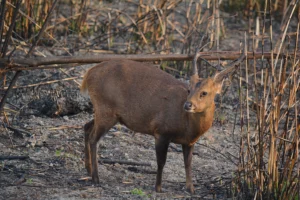
Adults are among the smallest wild antelopes in Asia, standing roughly 55–65 cm at the shoulder and weighing around 18–21 kg. Their coat is generally yellowish-brown to reddish-brown, becoming paler on the underside. The face is relatively slender, with large ears and dark eyes adapted for detecting movement in dense vegetation.
The Unique Four Horns
The feature that gives the species its name is found primarily in adult males.
Unlike most antelopes, which carry a single pair of horns, mature males typically possess:
- A smaller front pair positioned between the eyes.
- A larger rear pair located farther back on the skull.
The front horns are often much shorter and may be difficult to see unless the animal is viewed from close range or from the side. This explains why distant sightings sometimes appear to show only two horns.
Not every male displays equally developed horns, and researchers caution against assuming identical horn growth in every individual. Females generally lack horns, making sex identification straightforward in good viewing conditions.
Field Identification Tips
When trying to distinguish a four-horned antelope from other Indian ungulates, look for a combination of characteristics rather than relying solely on the horns:
- Small, lightly built body.
- Solitary or paired behaviour rather than large herds.
- Preference for dry forests and rocky hills instead of open grasslands.
- Short, pointed face with relatively large ears.
- A cautious tendency to pause briefly before disappearing into cover.
Because sightings are often brief, paying attention to habitat and behaviour can be just as useful as observing physical features.
Field Note: Even experienced safari guides may only encounter a handful of four-horned antelopes each year. Their rarity on game drives is influenced as much by their secretive habits and low population density as by their actual distribution.
Distribution and Habitat
The four-horned antelope has one of the widest historical distributions among India’s smaller wild bovids, but its presence is far from continuous. Instead of occupying every suitable forest across its range, it survives in scattered, often isolated populations separated by unsuitable habitat, agriculture, settlements, and infrastructure. Understanding this fragmented distribution is essential for appreciating why the species remains vulnerable despite occurring across a broad geographic area.
Distribution Across India
India supports the vast majority of the world’s remaining four-horned antelope population. The species occurs across much of the country’s central, western, and southern regions, although its abundance varies considerably from one landscape to another.
Its range broadly extends through:
- Central Indian forests.
- Parts of western India.
- The Deccan Plateau.
- Sections of the Eastern and Western Ghats.
- Isolated forested landscapes where suitable dry deciduous habitat persists.
Rather than occupying dense tropical rainforests or expansive open grasslands, the species is closely associated with wooded landscapes that combine forest cover, natural clearings, rocky slopes, and reliable escape terrain.
Researchers note that even within protected landscapes, populations often occur at naturally low densities. This means large areas of apparently suitable habitat may hold only a small number of individuals, making sightings relatively uncommon.
Distribution in Nepal
Nepal represents the northern edge of the species’ global range.
Today, the four-horned antelope survives primarily in the country’s lowland Terai landscapes, where it has been recorded from protected areas including:
- Chitwan National Park
- Bardia National Park
- Banke National Park
- Parsa National Park
These populations are considerably smaller and more isolated than those in India. Scientific studies suggest that the broad Indo-Gangetic Plain forms an ecological barrier that limits connectivity between Nepal’s populations and the larger Indian range. As a result, conservation efforts within Nepal are especially important because recolonisation from neighbouring regions may be limited.
Expert Tip: A species can have a large geographic range yet still face conservation challenges if that range is fragmented into isolated pockets. The four-horned antelope is a good example of this principle.
Preferred Habitat
Unlike antelopes adapted to open plains, the four-horned antelope depends on landscapes that provide a balance between visibility and cover.
Typical habitats include:
- Dry deciduous forests.
- Open woodland.
- Forest-grassland ecotones.
- Rocky hillsides with scattered vegetation.
- Undulating terrain with natural drainage lines.
These habitats provide three essential requirements:
- Food in the form of grasses, leaves, shoots, shrubs, and seasonal vegetation.
- Protective cover that allows individuals to remain concealed from predators.
- Broken terrain that offers multiple escape routes when disturbed.
The species generally avoids dense evergreen forests, heavily cultivated landscapes, and extensive treeless grasslands.
One reason these habitats are so important is behavioural. Four-horned antelopes rely heavily on remaining undetected rather than outrunning predators across open country. Woodland edges and lightly forested slopes allow them to feed while staying close to cover.
Elevation and Landscape
Although most records come from lowland and gently hilly forests, the species occupies a variety of elevations where suitable dry forest conditions exist.
Common landscape features include:
- Rocky outcrops.
- Seasonal stream valleys.
- Low hill ranges.
- Open forest patches interspersed with grass.
- Areas with moderate rather than dense tree cover.
The animals frequently use elevated ground to scan their surroundings before moving to feeding areas, a behaviour that helps reduce the risk of predation.
Why Fragmented Habitat Matters
One of the most important findings from recent research is that the four-horned antelope’s challenge is not simply the amount of habitat available, but how that habitat is connected.
Many remaining forests have become fragmented into isolated patches by:
- Agricultural expansion.
- Roads and highways.
- Human settlements.
- Mining activities.
- Infrastructure development.
As forest patches become separated, movement between populations becomes increasingly difficult. Smaller, isolated groups are generally more vulnerable to local extinction because opportunities for dispersal and genetic exchange decline over time.
Range-wide habitat modelling has shown that suitable habitat extends across a broader area than previously recognised, particularly towards southern India. However, much of this habitat exists as disconnected patches rather than a continuous landscape. Consequently, a broad distribution map should not be interpreted as evidence of a secure or abundant population.
Habitat Characteristics
| Habitat Feature | Importance for the Species |
| Dry deciduous forest | Primary habitat across most of its range |
| Open woodland | Provides feeding areas with nearby cover |
| Forest-grassland margins | Supports browsing and grazing opportunities |
| Rocky hills and undulating terrain | Offers refuge and escape routes |
| Dense evergreen forest | Generally less preferred |
| Open treeless grassland | Usually avoided due to limited cover |
Field Note: Many visitors expect to find four-horned antelopes deep inside dense forests. In reality, they are more often associated with open dry forests, wooded slopes, and ecotones where vegetation is neither too sparse nor too dense.
Behaviour and Ecology
The four-horned antelope is one of the least conspicuous large mammals in the Indian subcontinent. Its behaviour reflects a strategy centred on avoiding detection rather than relying on speed or group vigilance.
Unlike blackbuck or chital, which often form herds, the four-horned antelope usually lives alone or in pairs. This solitary lifestyle contributes to its elusive reputation and partly explains why even experienced safari guides encounter it infrequently.
Daily Activity
The species is primarily active during daylight hours, although activity patterns vary with season, temperature, and local disturbance.
Periods of greatest activity typically occur:
- During the cooler hours after sunrise.
- In the late afternoon before sunset.
The hottest part of the day is often spent resting in shaded woodland or among rocky cover. By limiting activity during peak temperatures, the antelope reduces both heat stress and unnecessary energy expenditure.
Feeding Behaviour
The four-horned antelope has a flexible feeding strategy, allowing it to exploit a variety of food resources throughout the year.
Its diet includes:
- Grasses.
- Tender leaves.
- Shrubs.
- Young shoots.
- Seasonal vegetation.
This combination of grazing and browsing enables it to adjust to changing food availability between wet and dry seasons.
Rather than feeding continuously in exposed areas, individuals often emerge briefly into small clearings before retreating to nearby cover, maintaining a cautious balance between foraging and safety.
Social Structure
The species is best described as predominantly solitary.
Most observations involve:
- A single adult.
- A male and female pair.
- A female with a young animal.
Large aggregations are extremely uncommon and are not considered typical social behaviour.
This contrasts sharply with many other Indian ungulates, where group living provides additional vigilance against predators. Instead, the four-horned antelope depends on camouflage, stillness, and intimate knowledge of its surroundings to avoid danger.
Territorial Behaviour
Although the four-horned antelope has not been studied as extensively as many larger Indian ungulates, field observations indicate that adults maintain relatively small home ranges and show a degree of territoriality, particularly males.
Rather than travelling long distances in search of forage, individuals tend to remain within familiar patches of woodland where they know the locations of feeding areas, water sources, resting sites, and escape cover. This familiarity is especially valuable in broken terrain, where a quick retreat behind rocks, shrubs, or tree cover can mean the difference between escaping a predator and being caught.
Because neighbouring individuals occur at naturally low densities, direct encounters between adults are thought to be infrequent compared with herd-forming antelopes.
Breeding and Reproduction
Information on the species’ breeding biology remains relatively limited, particularly from free-ranging populations. Much of what is known comes from field observations combined with records from zoological institutions.
Females generally give birth to a single calf, a reproductive strategy common among many small antelopes. The young rely on concealment during their earliest weeks, remaining hidden in vegetation while the mother returns periodically to nurse them. This behaviour reduces the risk of attracting predators.
Compared with prolific grazers that produce larger numbers of offspring over time, the four-horned antelope’s slower reproductive rate means population recovery can take many years following declines caused by habitat loss or hunting.
Predators and Survival Strategies
The four-horned antelope shares its habitat with several large carnivores, including:
- Tiger
- Leopard
- Dhole (Asian wild dog)
- Occasionally wolves in suitable landscapes
Young animals may also be vulnerable to medium-sized predators.
Instead of relying on herd vigilance or sustained speed, the species employs several complementary survival strategies:
- Remaining motionless when danger is first detected.
- Feeding close to protective cover.
- Using rocky slopes and uneven terrain for escape.
- Moving quietly through woodland rather than crossing open ground.
- Relying on excellent hearing and alertness to detect threats early.
This cautious lifestyle explains why the species is often overlooked even in reserves where it is known to occur.
Photography Tip: If you hope to photograph a four-horned antelope, scan rocky hillsides and lightly wooded slopes during the first few hours after sunrise. The animals often pause briefly before disappearing into cover, so keeping your camera ready can make the difference between a record shot and a missed opportunity.
Conservation Status
The four-horned antelope’s greatest conservation challenge is not that it has disappeared from most of its historical range, but that many surviving populations are small, isolated, and increasingly disconnected from one another.
This gradual fragmentation has reduced the resilience of the species, making local populations more vulnerable to habitat change and human disturbance.
IUCN Red List Status
The four-horned antelope is classified as Vulnerable on the IUCN Red List under criterion C2a(i).
Current assessments estimate approximately 7,000–10,000 mature individuals remain in the wild, with an overall decreasing population trend. The assessment reflects not only population size but also continuing habitat degradation and fragmentation across much of the species’ range.
While the species is still distributed across large parts of India and persists in several protected areas in Nepal, conservationists emphasise that its occurrence is naturally sparse. Large areas of suitable habitat may contain only a few animals.
Major Threats
Habitat Loss
The most significant long-term threat is the continued loss of dry deciduous forests.
As forests are converted for agriculture, settlements, mining, or infrastructure, suitable habitat becomes both smaller and increasingly fragmented.
Even where some woodland remains, reduced habitat quality can limit food availability, shelter, and breeding opportunities.
Habitat Fragmentation
Fragmentation is often more damaging than habitat loss alone.
Roads, villages, and cultivated land divide forests into isolated patches that may support only small populations. Over time, these isolated groups become increasingly vulnerable because movement between populations is restricted.
Scientific modelling has highlighted that while suitable habitat still exists across much of peninsular India, many of these areas no longer form connected landscapes. Maintaining ecological connectivity is therefore an important conservation priority.
Hunting and Local Pressures
Although habitat change is considered the principal threat, hunting continues to affect some local populations.
Because the species naturally occurs at low densities, even limited hunting pressure can have a disproportionate impact on local numbers.
Additional pressures include:
- Livestock grazing inside forests.
- Human disturbance.
- Small-scale habitat degradation.
- Competition for natural resources.
The relative importance of these pressures varies from one landscape to another.
Population Density
Unlike species that occur in large herds, four-horned antelopes are naturally uncommon.
Studies have reported densities ranging from approximately 0.2 to just over 2 individuals per square kilometre, depending on habitat quality, protection level, and local ecological conditions.
This low density means that even healthy populations may produce relatively few sightings during wildlife safaris. Visitors should therefore avoid judging the conservation status of the species solely by how often they encounter it.
Expert Tip: Rare sightings do not necessarily indicate that a reserve lacks four-horned antelopes. The species combines naturally low population density with highly secretive behaviour, making it one of India’s most challenging ungulates to observe consistently.
Legal Protection
The four-horned antelope benefits from multiple layers of conservation protection.
| Protection Framework | Status |
| IUCN Red List | Vulnerable |
| CITES | International trade regulated |
| India | Protected under national wildlife legislation |
| Nepal | Protected under national wildlife conservation laws |
These legal measures help regulate hunting and international trade, but legislation alone cannot secure the species’ future. Long-term conservation depends on maintaining connected landscapes that allow populations to persist across their natural range.
Research Gaps
Despite being one of Asia’s most distinctive mammals, the four-horned antelope remains comparatively understudied.
Researchers continue to identify important knowledge gaps, including:
- Accurate population estimates in many landscapes.
- Long-term population trends.
- Fine-scale habitat preferences.
- Movement between isolated forest patches.
- Responses to changing land use and climate.
Addressing these gaps will improve conservation planning and help identify priority areas for habitat protection and restoration.
Where Can You See a Four-horned Antelope?
Seeing a four-horned antelope in the wild requires realistic expectations. Unlike tigers or large deer that frequently use roads and open meadows, this species spends much of its time in lightly wooded hillsides, rocky terrain, and forest edges where it can remain concealed.
Most sightings are brief, often lasting only a few seconds before the animal slips back into cover.
Protected Areas in India
The species has been recorded from numerous protected landscapes across its range, particularly in central and peninsular India.
Rather than visiting a reserve solely for the four-horned antelope, travellers are more likely to encounter it while exploring parks known for diverse dry deciduous forest ecosystems.
Protected Areas in Nepal
In Nepal, the species survives in several important lowland protected areas, including:
| Protected Area | Importance |
| Chitwan National Park | One of Nepal’s best-known remaining populations |
| Bardia National Park | Supports suitable dry forest habitat |
| Banke National Park | Part of the western Terai conservation landscape |
| Parsa National Park | Important eastern lowland habitat |
These parks play a significant role in safeguarding Nepal’s isolated populations and maintaining the species within the country’s protected-area network.
Responsible Tourism Tip: If you are fortunate enough to encounter a four-horned antelope, observe quietly from a distance. Avoid asking drivers to leave designated tracks or pursue the animal for a better photograph. Minimising disturbance is especially important for elusive species that depend on remaining concealed.
Why the Four-horned Antelope Matters
The four-horned antelope occupies a unique ecological niche within the dry deciduous forests of the Indian subcontinent. Although it is neither the largest herbivore nor the most conspicuous, it contributes to the functioning of these ecosystems through its feeding habits and its role in the forest food web.
As a mixed browser and grazer, it feeds on grasses, leaves, shoots, and shrubs, helping shape vegetation structure at ground level. In turn, it serves as prey for large carnivores such as tigers and leopards, forming part of the complex ecological relationships that sustain healthy forest ecosystems.
Its continued presence also acts as an indicator of relatively intact woodland habitats. Because the species is sensitive to extensive habitat fragmentation and human disturbance, landscapes that continue to support viable populations often retain many of the characteristics required by a wide range of other forest-dependent wildlife.
Perhaps most importantly, the four-horned antelope reminds us that conservation is not only about protecting charismatic megafauna. Many lesser-known mammals depend on the same forests, and safeguarding these habitats benefits entire ecological communities rather than a single species.
Common Misconceptions
“The four-horned antelope is a deer.”
It is not. The species belongs to the family Bovidae, making it a true antelope rather than a deer. Unlike deer, bovids retain permanent horns that are not shed annually.
“Every four-horned antelope has four horns.”
Only mature males typically develop the characteristic two pairs of horns. Females generally lack horns, and the smaller front pair in males may be difficult to see during distant observations.
“It is common throughout India.”
Although the species occurs across a broad geographic range, it is naturally uncommon and survives in scattered populations. Many apparently suitable forests no longer support the species because of habitat fragmentation.
“It is easy to see on safari.”
Most visitors do not encounter a four-horned antelope, even during several days in suitable habitat. Its solitary behaviour, preference for wooded terrain, and naturally low population density make sightings unpredictable.
“Its biggest threat is hunting.”
Hunting affects some local populations, but current research identifies habitat loss and fragmentation as the principal long-term threats across much of its range.
Practical Checklist for Wildlife Travellers
If seeing a four-horned antelope is on your wildlife wish list, keep these points in mind:
- Visit protected areas with extensive dry deciduous forest.
- Spend multiple game drives in suitable habitat rather than expecting a single outing to produce a sighting.
- Scan rocky hillsides, forest edges, and lightly wooded slopes.
- Carry binoculars, as animals are often observed at a distance.
- Keep noise to a minimum and avoid sudden movements.
- Be patient—brief sightings are more common than prolonged observations.
- Treat any encounter as a bonus rather than the primary objective of your safari.
Frequently Asked Questions
Why is it called the four-horned antelope?
The name refers to the two pairs of horns usually found on adult males. It is the only living wild antelope in which four horns are a normal characteristic.
What is its scientific name?
Its scientific name is Tetracerus quadricornis.
Is the four-horned antelope found only in India?
No. While India supports most of the global population, the species also occurs in lowland Nepal, particularly within several protected areas.
Is it a deer or an antelope?
It is an antelope belonging to the family Bovidae.
Do females have four horns?
Generally, no. Adult females usually do not possess horns.
What does the four-horned antelope eat?
It feeds on a mixture of grasses, leaves, shrubs, shoots, and other seasonal vegetation, making it both a browser and a grazer.
Is it active during the day?
Yes. It is primarily diurnal, with peak activity during the cooler hours of the morning and late afternoon.
Does it live alone?
Most individuals are solitary. Occasionally, a pair or a female with a young animal may be seen.
Why is it difficult to spot?
Its secretive behaviour, preference for wooded habitats, and naturally low population density make sightings uncommon.
What is its conservation status?
The species is classified as Vulnerable on the IUCN Red List, with an estimated 7,000–10,000 mature individuals remaining in the wild.
Which national parks in Nepal protect the species?
Confirmed protected-area populations occur in Chitwan, Bardia, Banke, and Parsa National Parks.
Can tourists reliably see one during a safari?
No. Even in suitable reserves, sightings are never guaranteed. Observing a four-horned antelope is generally considered a rewarding bonus rather than an expected part of a safari.
Why are four horns useful?
The exact evolutionary advantage remains uncertain. Researchers recognise the characteristic as a defining feature of the species, but its precise adaptive significance has not been conclusively established.
Is habitat fragmentation a serious concern?
Yes. Fragmentation isolates populations, restricts movement between forest patches, and increases the vulnerability of small local populations.
How can visitors help conserve the species?
Visitors can support conservation by following park regulations, maintaining respectful viewing distances, avoiding disturbance, and supporting protected areas and responsible tourism initiatives.
Unlike tigers, elephants, or gaur, the four-horned antelope is seldom the primary reason visitors choose a national park. Most sightings are incidental—rewarding moments that occur while exploring healthy dry deciduous forests rather than predictable wildlife encounters.
Its naturally low population density, preference for broken terrain, and habit of remaining close to cover mean that even parks with established populations may produce only occasional sightings. Travellers should therefore focus on visiting landscapes with suitable habitat and view any encounter as a fortunate bonus.
Best National Parks and Tiger Reserves in India
The species has been recorded from several protected landscapes across central, western, and southern India. While regular monitoring varies between reserves, the following parks are among the best-known strongholds.
| Protected Area | State | Why It Is Suitable | Sighting Expectations |
| Satpura Tiger Reserve | Madhya Pradesh | Extensive dry deciduous forests, rugged hills, sandstone escarpments, and relatively low tourist pressure provide ideal habitat. | One of the better places for patient wildlife watchers, though sightings remain uncommon. |
| Pench Tiger Reserve | Madhya Pradesh & Maharashtra | Mosaic of teak forests, open woodland, grassy clearings, and rocky terrain closely matches the species’ preferred habitat. | Occasionally seen during jeep safaris, particularly away from busy tourism routes. |
| Tadoba-Andhari Tiger Reserve | Maharashtra | Large tracts of dry deciduous forest interspersed with bamboo and open patches support suitable habitat. | Rare but regularly reported by experienced guides over multiple safari seasons. |
| Nagarhole National Park | Karnataka | Dry deciduous sections and woodland edges provide habitat, particularly outside the wetter evergreen areas. | Possible but infrequent; visitors usually focus on larger mammals. |
| Bandipur National Park | Karnataka | Part of the Nilgiri landscape with suitable dry forest habitats in several sectors. | Uncommon but documented within appropriate habitat. |
| Similipal Tiger Reserve | Odisha | Diverse forest types, undulating terrain, and historical records indicate the species’ presence. | Difficult to observe because of dense vegetation and naturally low densities. |
| Panna Tiger Reserve | Madhya Pradesh | Dry forests, rocky plateaus, and river valleys create favourable habitat in parts of the reserve. | Occasionally encountered during extended visits. |
| Ranthambore Tiger Reserve | Rajasthan | Dry forest and scrub habitat support isolated populations in suitable areas. | Rare; tiger sightings dominate most safari itineraries. |
The species has also been reported from several other protected landscapes across central and peninsular India, reflecting its broad but fragmented distribution. However, confirmed presence does not necessarily translate into regular tourist sightings.
Field Note: Safari guides often identify four-horned antelopes by movement rather than horns. A brief glimpse of a small antelope slipping quietly across a wooded hillside is frequently the first indication that one is nearby.
Protected Areas in Nepal
Nepal supports the northernmost populations of the species, all confined to the country’s lowland Terai. These populations are smaller and more isolated than those in India, making their conservation particularly important.
| Protected Area | Why It Matters |
| Chitwan National Park | Nepal’s best-known stronghold, with suitable dry forest and riverine habitats supporting one of the country’s most important populations. |
| Bardia National Park | Large protected forests in western Nepal provide valuable habitat for this elusive antelope. |
| Banke National Park | Forms part of the western Terai conservation landscape and contributes to habitat connectivity. |
| Parsa National Park | Protects dry lowland forests that continue to support the species within eastern Nepal’s Terai. |
Research suggests that Nepal’s populations are largely isolated from the larger Indian range, increasing the importance of protecting these remaining habitats.
When Are You Most Likely to See One?
There is no dedicated “four-horned antelope season,” but certain conditions improve the chances of an encounter.
- Early morning and late afternoon are typically the most active periods.
- The dry season often offers better visibility as vegetation becomes less dense.
- Animals are more likely to be seen along woodland edges, rocky slopes, and natural clearings than in dense forest interiors.
- Multiple safaris over several days greatly increase the likelihood of a sighting compared with a single game drive.
Patience is essential. The four-horned antelope seldom remains in the open for long and usually disappears into cover within seconds of detecting disturbance.
Photography Tips
Photographing a four-horned antelope can be challenging because encounters are often brief and at some distance.
- Carry a telephoto lens of at least 400 mm if possible.
- Watch rocky hillsides and lightly wooded slopes rather than open grasslands.
- Focus on capturing natural behaviour instead of trying to obtain a close portrait.
- Avoid asking your guide to approach too closely or leave designated tracks.
- Be prepared to react quickly—many sightings last only a few moments.
Responsible Wildlife Watching
Because the species depends on remaining undisturbed, responsible viewing practices are especially important.
- Stay inside authorised safari vehicles.
- Maintain a respectful distance.
- Keep conversations quiet when wildlife is nearby.
- Never encourage guides to pursue or corner the animal for photographs.
- Follow all park regulations and support protected-area conservation initiatives.
A respectful observation not only reduces stress on the animal but also increases the likelihood that future visitors will be able to enjoy similar encounters in the wild.
Conclusion
The four-horned antelope is one of the Indian subcontinent’s most distinctive mammals, yet it often receives far less attention than larger and more familiar wildlife. Its unique four-horned appearance, solitary nature, and association with dry deciduous forests make it an intriguing species for naturalists and wildlife travellers alike.
Its future, however, depends less on its unusual anatomy than on the continued protection of the fragmented forests it inhabits. Conserving connected woodland landscapes across India and Nepal will benefit not only the four-horned antelope but also countless other plants and animals that share the same ecosystems.
For safari enthusiasts, a glimpse of a chousingha is rarely planned and never guaranteed. More often, it is a quiet reward for patience, careful observation, and time spent exploring the subtler corners of India’s forests—an encounter that highlights the value of looking beyond the headline species and appreciating the full diversity of the wild.